
How to integrate Fiber Optics into AI-driven Automation? The process starts by building a reliable communication layer that connects sensors, machines, IoT devices, edge systems, AI platforms, and automation software.
Fiber optics moves data between connected systems, AI analyzes that data, edge computing handles time-sensitive processing closer to the source, and automation software turns approved decisions into actions. Human teams remain responsible for oversight, exceptions, and important operational decisions.
In this blog, you will learn how fiber optics and AI-driven automation work together, how to integrate fiber networks with AI, IoT, edge computing, and automation systems, which industries benefit from this approach, and what technical challenges to consider before implementation.
What Is the Role of Fiber Optics in AI-Driven Automation?
Fiber optics provides the connectivity layer that allows AI-driven automation systems to transfer large volumes of data quickly and reliably.
AI automation depends on continuous information from sensors, cameras, machines, IoT devices, and business systems. That information must reach AI or edge-processing systems before automated workflows can respond.
Fiber optic technology supports these requirements through:
- High bandwidth for large data volumes
- Low latency for time-sensitive applications
- Reliable long-distance communication
- Strong resistance to electromagnetic interference
- Scalable infrastructure for growing IoT and AI workloads
Fiber does not perform AI processing. Its role is to provide the communication infrastructure that connects the systems responsible for collecting, processing, and acting on data.
How Do Fiber Optics and AI Automation Work Together?
Fiber optics and AI automation work together by creating a high-speed data pipeline between physical devices, processing systems, and automation workflows.
A typical architecture contains four main layers.
1. Data Collection Layer
Sensors, cameras, machines, robots, and IoT devices collect information from the physical environment.
For example, a manufacturing machine may generate temperature, vibration, pressure, and production data. A smart building may collect occupancy, energy, and environmental data.
2. Fiber Optic Network Layer
The fiber network transports data between connected equipment, edge systems, servers, and other network locations.
Fiber is particularly useful when an automation environment generates large amounts of continuous data, such as high-resolution video from industrial inspection cameras or data from thousands of connected devices.
3. AI Processing Layer
AI systems analyze collected data to identify patterns, detect anomalies, predict outcomes, or recommend actions.
Common applications include:
- Predictive maintenance
- Automated quality inspection
- Energy optimization
- Equipment monitoring
- Demand forecasting
- Operational planning
4. Automation Workflow Layer
Automation software uses approved AI outputs to trigger actions within connected systems.
A typical workflow looks like this:
Sensor detects an issue → fiber network transfers the data → edge or AI system analyzes it → automation platform triggers a response → human team monitors or approves the action where required.
For example, if a machine develops unusual vibration, an AI model can identify a possible equipment problem, and an automation workflow can create a maintenance alert or work order.
Why Does AI-Driven Automation Need Fiber Optics?
AI-driven automation does not always require fiber, but fiber becomes valuable when systems need high bandwidth, reliable communication, low latency, or long-distance connectivity.
-
Faster Data Transfer
AI automation can generate significant amounts of data from cameras, sensors, machines, and IoT devices.
Fiber provides the capacity needed to move this information efficiently, particularly in data-intensive environments such as smart factories, data centers, and large enterprise facilities.
-
Lower Network Latency
Low latency reduces the time required for data to travel between devices and processing systems.
This matters when automation depends on timely information, including:
- Robotic systems
- Machine-vision inspection
- Industrial monitoring
- Smart security
- Real-time building controls
- Connected warehouse equipment
The actual response time of an automation system also depends on processing, software, device controllers, and network architecture. Fiber is one part of the overall performance chain.
-
More Reliable Connectivity
Fiber is resistant to electromagnetic interference and can provide stable communication over long distances. This makes fiber useful in environments containing industrial machinery, large facilities, distributed equipment, and other sources of electrical interference.
-
Better Support for IoT and AI Systems
IoT devices continuously generate information that AI systems can analyze. Fiber provides a high-capacity communication path for moving this information between devices, edge infrastructure, enterprise systems, and AI platforms.
How Can AI Work With IoT?

AI works with IoT by analyzing data collected from connected devices and using those insights to support decisions or automate processes.
A simple IoT and AI workflow is:
- IoT sensors collect data.
- The network transfers the data.
- Edge or cloud systems process the information.
- AI identifies patterns or anomalies.
- An automation platform triggers an appropriate action.
- Humans monitor the process and handle exceptions.
For example, sensors in a warehouse can monitor equipment activity and environmental conditions. AI can identify unusual patterns, while automation software can generate an alert or adjust an operational workflow.
Fiber becomes particularly useful when the number of connected devices and the volume of data increase.
Does AI Need Fiber-Optic Cable?
AI does not inherently require fiber-optic cable, but large AI and automation deployments can benefit significantly from fiber-based connectivity.
Smaller AI applications may operate effectively over wireless or copper networks. Fiber becomes more important when an organization needs:
- High data capacity
- Low and consistent latency
- Long-distance connections
- Reliable communication
- Large-scale IoT connectivity
- High-resolution video transmission
- Data center connectivity
The decision should be based on application requirements rather than the assumption that every AI system needs fiber.
How to Build AI-Powered Fiber Networks for Automation
An AI-powered fiber network combines fiber infrastructure with network monitoring, edge computing, AI processing, and automation software.
A practical architecture should define what each technology is responsible for:
- Fiber infrastructure moves data between systems.
- IoT devices: Collect operational data.
- Edge computing: Processes time-sensitive information near the source.
- AI systems: Analyze data and generate predictions or recommendations.
- Automation software executes defined workflows.
- Human operators: Monitor systems, approve sensitive actions, and manage exceptions.
This separation makes the infrastructure easier to design, troubleshoot, secure, and scale.
How Does AI Improve Fiber Network Performance?
AI can improve fiber network operations by analyzing network data, identifying abnormal behavior, predicting potential faults, and helping teams optimize network resources.
-
Predictive Network Maintenance
AI can analyze network performance patterns to identify conditions that may indicate an emerging problem.
Relevant signals can include:
- Changes in signal performance
- Increasing latency
- Abnormal traffic patterns
- Equipment behavior
- Repeated connectivity events
This allows network teams to investigate potential issues before they become major service interruptions.
-
AI Network Optimization
AI can analyze traffic patterns and help network teams allocate capacity according to operational requirements. For example, an industrial network may need to prioritize communication associated with robotic control or safety-related monitoring over less time-sensitive data.
AI can support these decisions, but network policies and operational requirements should determine which traffic receives priority.
-
Intelligent Network Monitoring
AI-powered monitoring can help teams identify unusual changes across large networks. Instead of manually reviewing every device and connection, teams can use automated monitoring to surface events that require investigation. This can improve visibility across complex fiber, IoT, edge, and enterprise environments.
How to Integrate Fiber Optics Into AI-Driven Automation Systems
The integration process should begin with the business workflow rather than the technology. Businesses should first determine what they want to automate, what data the process generates, and how quickly the system needs to respond.
Step 1: Identify Automation Goals and Data Requirements
Define the process that requires improvement and determine what information the automation system requires.
Evaluate:
- Number of connected devices
- Data volume
- Required response time
- Network distance
- Security requirements
- Existing infrastructure
- Future expansion plans
For example, a robotic manufacturing line may have stricter latency and reliability requirements than a building energy-monitoring application.
Step 2: Design the Fiber Network Architecture
The network should be designed around device locations, bandwidth requirements, redundancy, security, and future capacity.
A typical architecture may connect:
Sensors and machines → fiber network → edge infrastructure → AI platform → automation system
The exact design depends on whether processing occurs locally or on cloud infrastructure in an enterprise data center.
Step 3: Select the Appropriate Fiber Infrastructure
Fiber selection depends on distance, required bandwidth, network architecture, and deployment environment. Single-mode fiber is commonly used for longer-distance communication, while multimode fiber is suitable for shorter-distance connections within facilities.
Network equipment, transceivers, connectors, switches, and installation standards must also be matched to the required performance.
Step 4: Connect Edge Computing and AI Systems
Time-sensitive applications may benefit from processing data close to where it is generated. Edge infrastructure can receive information from connected equipment, run selected AI models locally, and send only relevant information to centralized systems.
This can reduce unnecessary data movement and improve response times for applications that require local decisions.
Step 5: Integrate Automation Workflows
AI output should connect to clearly defined business or operational workflows.
For example:
Machine data → anomaly detection → maintenance recommendation → workflow approval → maintenance ticket
The workflow should specify which actions are automatic and which require human approval.
Step 6: Test, Monitor, and Scale
Before expanding the system, test:
- Network performance
- AI model accuracy
- Automation response times
- Device compatibility
- Security controls
- Failure recovery
- Human approval processes
Monitoring should continue after deployment so teams can identify network, AI, and workflow problems as the environment changes.
What Role Does Edge Computing Play in Fiber-Based AI Automation?
Edge computing processes selected data closer to where it is generated, reducing communication delays and limiting unnecessary data transfer.
A fiber-connected edge architecture may work as follows:
Sensors → fiber network → local edge system → AI processing → automation response
Edge computing is particularly useful for:
- Industrial robotics
- Real-time quality inspection
- Smart security
- Autonomous equipment
- Healthcare monitoring
- Building management systems
Not every workload needs edge processing. Centralized cloud or data center processing may be more appropriate when immediate local response is not required.
How Do You Use AI to Drive Automation?
AI drives automation by analyzing data, identifying patterns, predicting outcomes, and providing information that automation software can use to trigger predefined actions.
AI can support automation in several ways.
-
Manufacturing
AI can analyze machine data to identify potential equipment problems and support predictive maintenance. For example, vibration and temperature data can be analyzed to identify patterns associated with equipment degradation. The automation system can then generate a maintenance alert for the appropriate team.
-
Logistics
AI can analyze inventory, warehouse, and transportation data to improve scheduling and resource allocation. In an automated warehouse, AI can help identify inventory patterns while connected systems coordinate robots, sorting equipment, and other workflows.
-
Smart Buildings
AI can analyze occupancy, temperature, energy consumption, and equipment information to support building management. Automation systems can then adjust lighting, HVAC settings, or other building functions according to defined rules and operating conditions.
-
Healthcare
AI can support medical image analysis, patient monitoring, and administrative workflows. For sensitive healthcare applications, AI outputs should support qualified professionals rather than replace clinical judgment.
-
Enterprise Environments
AI can support workflow automation, network monitoring, document processing, resource planning, and operational analytics. The goal is to reduce repetitive work and improve decision support while keeping people responsible for processes that require judgment or approval.
Fiber Optics vs. Traditional Networking for AI Automation
Fiber is often better suited to large-scale AI automation because it provides high bandwidth, strong resistance to electromagnetic interference, and reliable communication over longer distances.
| Factor | Fiber Optic Networking | Traditional Copper Networking |
| Data capacity | High | Generally lower |
| Electromagnetic interference | Highly resistant | More susceptible |
| Long-distance connectivity | Strong | More limited |
| Large IoT deployments | Well suited | Depends on network design |
| AI video workloads | Well suited | May require additional capacity |
| Scalability | Strong | Can require additional upgrades |
| Industrial environments | Often advantageous | Suitable for some applications |
Copper remains useful for many local connections, especially where distances and bandwidth requirements are modest. The best architecture may use both fiber and copper rather than replacing one technology entirely.
Common Challenges When Integrating Fiber With AI Automation
Successful integration requires more than installing fiber cables. Businesses also need compatible equipment, appropriate network architecture, secure data flows, and well-defined automation workflows.
-
Infrastructure Cost
Fiber deployment can require investment in cabling, network equipment, installation, edge infrastructure, AI platforms, and integration services. The business case should consider expected operational benefits and future capacity requirements rather than evaluating the cable installation alone.
-
System Integration
Existing equipment may use different communication protocols, interfaces, or control systems. Integration teams may need to connect legacy systems with newer IoT, edge, AI, and automation platforms. A phased deployment can reduce disruption and allow compatibility issues to be addressed before wider rollout.
-
Security and Data Management
AI automation networks may carry operational, business, or sensitive data.
Important controls include:
- Network segmentation
- Access management
- Secure device configuration
- Monitoring and logging
- Regular software and firmware updates
- Appropriate data protection policies
Security should be designed into the network rather than added after deployment.
-
Skills and Maintenance
AI automation combines networking, industrial systems, software, data, and operational workflows. Organizations may need expertise across several disciplines to design, deploy, monitor, and maintain the environment.
Which Industries Benefit From AI-Powered Fiber Networks?
AI-powered fiber networks are most valuable in environments where connected devices generate large amounts of data and operations depend on reliable communication.
Smart Manufacturing
Manufacturing facilities can use fiber to connect machines, robots, cameras, sensors, and edge systems.
Applications include:
- Predictive maintenance
- Machine-vision inspection
- Robotic automation
- Production monitoring
- Equipment analytics
Smart Buildings
Fiber can connect building management systems, security infrastructure, IoT devices, and centralized or edge computing systems.
AI can then support:
- Energy optimization
- Occupancy analysis
- Equipment monitoring
- Security workflows
- Facility management
Telecom
AI in telecom can use network data to identify faults, analyze traffic, forecast capacity requirements, and support network operations. Fiber provides the high-capacity infrastructure required by many of these telecom applications.
Logistics
Warehouses and logistics facilities can connect automated sorting systems, robots, tracking devices, cameras, and enterprise platforms. AI can analyze operational data to support inventory management, equipment utilization, and workflow optimization.
Healthcare
Healthcare organizations can use fiber networks to connect medical imaging systems, monitoring devices, clinical systems, and other infrastructure. AI can support medical image analysis, monitoring, and administrative workflows while qualified professionals retain control over clinical decisions.
Enterprise Environments
Large organizations can use fiber to connect offices, data centers, servers, edge systems, security infrastructure, and business applications. AI can then support network monitoring, workflow automation, resource planning, and operational analytics.
What Are the Future Trends in AI-Powered Fiber Networks?
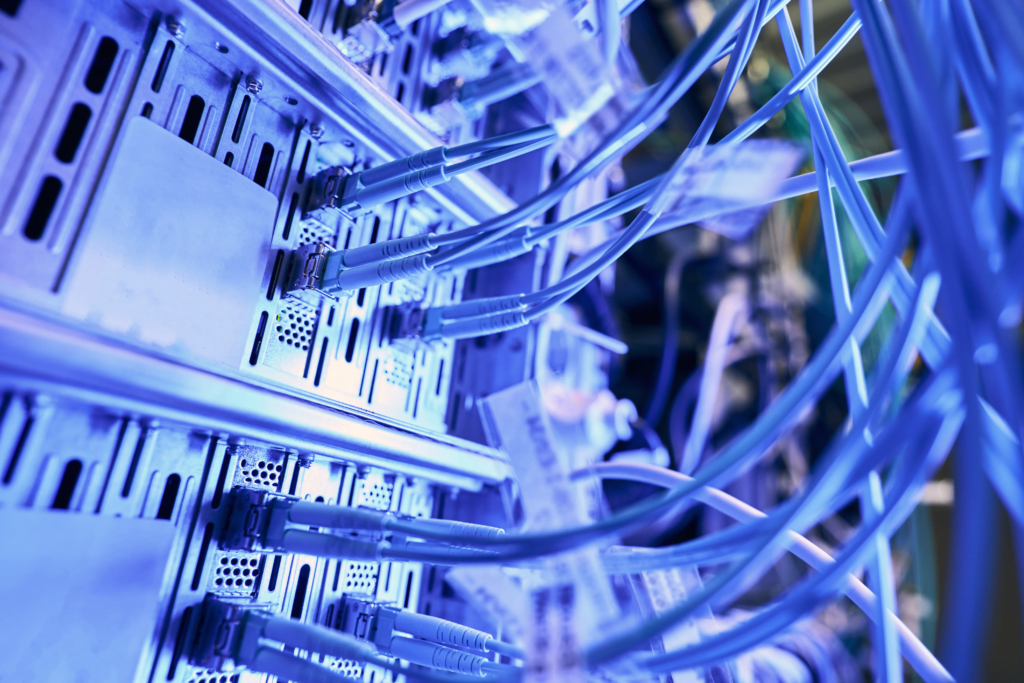
AI infrastructure is moving toward higher data volumes, edge AI, intelligent network management, and deeper integration between connected devices and automation workflows.
AI-Based Network Management
AI can assist network teams with fault detection, traffic analysis, capacity planning, and infrastructure monitoring. The objective is not to remove network engineers but to help them identify important events faster and respond more efficiently.
Growth of Edge AI
Edge AI is becoming more useful for applications that require rapid local processing. Factories, buildings, warehouses, healthcare facilities, and other distributed environments can process selected workloads closer to the devices generating the data.
Expansion of AI and IoT Connectivity
As organizations connect more sensors, machines, cameras, and devices, network infrastructure must support higher data volumes and more complex communication patterns. Fiber can provide the high-capacity backbone required by many of these environments.
More Integrated Automation Platforms
Automation systems are increasingly connecting network monitoring, IoT data, edge computing, AI models, and business workflows. This integration can give organizations better operational visibility while keeping human oversight where it matters.
Ultimately,
- Fiber optics is the connectivity layer for many high-performance AI automation environments.
- AI is the analysis and intelligence layer that identifies patterns, predicts outcomes, and supports decisions.
- Edge computing is the local processing layer that can reduce delays for time-sensitive workloads.
- Automation software is the execution layer that turns approved decisions into operational actions.
Human teams remain responsible for oversight, exceptions, governance, and strategic decisions. The most effective implementation starts with the business workflow and then determines the network, AI, edge, and automation architecture required to support it.
Closing Insights on How to integrate fiber optics into AI-driven automation?
Fiber optics provides the communication infrastructure that connects the physical and digital components of AI-driven automation.
When designed correctly, a fiber-based architecture can connect sensors, machines, IoT devices, edge systems, AI platforms, and automation workflows while supporting the bandwidth and reliability required by modern operations.
The strongest implementations do not treat fiber, AI, edge computing, and automation as one technology. Each has a different role:
- Fiber optics moves data.
- IoT devices collect data.
- Edge computing processes selected information locally.
- AI analyzes data and supports decisions.
- Automation workflows execute defined actions.
- People supervise systems and make important decisions.
For businesses planning an AI automation initiative, the first step is to identify where better connectivity and intelligent workflows can create measurable operational improvement.
Flexlab can help you identify practical automation opportunities, evaluate your existing workflow, and determine where AI, fiber connectivity, IoT, and edge computing can create a scalable solution.
FAQs: How to integrate fiber optics into AI-driven automation?
1. Does AI Need Fiber-Optic Cable?
AI does not always need fiber, but large AI automation systems can benefit from fiber’s bandwidth, reliability, low latency, and long-distance connectivity.
2. How Can AI Work With IoT?
AI analyzes data collected by IoT devices to identify patterns, predict problems, and support automated actions. Fiber can provide the high-capacity connection needed when IoT deployments generate large volumes of data.
3. Can AI Improve Fiber Optic Network Performance?
Yes. AI can analyze network data to detect anomalies, predict potential faults, monitor traffic, and support capacity planning. Network teams still define policies and handle important operational decisions.