
How Custom AI Solutions Can Enhance Your Business Revenue?
Agentic AI vs Generative AI | AI in FinTech | Enterprise AI Solutions
Do you want to retain customers and prioritize data privacy? Don’t worry! Here comes custom AI solutions that provide operational efficiency, seamless integration, and generate revenue, all while keeping your sensitive information under your control.
Custom AI is built around your data, your workflows, and your growth goals, so it does not just automate tasks; it turns insights into smarter decisions, more personalized experiences, and new revenue streams. Whether you want to reduce churn, boost conversions, or strengthen trust through better security and compliance, a tailored AI solution helps you do it all in one unified system.
In this guide, you will discover how custom AI can transform your business from the inside out, making it faster and more profitable without compromising on privacy or control.
What are Custom AI Solutions?
Custom AI solutions are artificial intelligence applications that were created to solve specific business challenges as per your needs.
Instead of using pre-ready AI models, companies often partner with an AI development company or an AI automation agency to build models that evaluate their unique datasets and customize their workflow automation.
Here are some key examples below:
- An AI predictive maintenance platform used in manufacturing plants.
- An AI-powered chatbot trained enough to represent a customer brand tone.
- A demand forecasting tool for a retail chain.
Hence, each solution is built for purposes that optimize operations and increase return.
Difference Between Custom AI and Off-the-Shelf Solutions
Business owners often confuse investing in which: off-the-shelf solutions or custom AI. Both approaches have benefits; however, it is largely based on specific needs and goals.
Off-the-Shelf AI Solutions
These solutions are ready-to-use and pre-built tools designed to solve common business issues. These AI business solutions are ready to deploy with minimal time and effort. It is attractive for those companies that want to integrate AI quickly without wasting time. These AI systems provide standardized features and functionalities. Therefore, it is suited for those AI development companies that require quick implementation to solve problems right away.
Custom AI Solutions
In contrast, custom AI-powered solutions are niche-specific and developed from the ground up on a powerful base model, using your company’s unique, proprietary data. These solutions are created through AI strategy consulting and AI-powered product development that are basically tailored to fit the specific needs of your business. AI learns the nuances of your customer behavior, your supply chain bottlenecks, and your specialized industry terminology in an AI custom build.
In short, custom AI is especially useful for industries that need high accuracy, deep personalization, enterprise scalability, integration with the Internet of Things, and advanced automation and predictive insights.
Summarized Comparison Table
| Factor | Custom AI Solutions | Off-the-Shelf Solutions |
| Cost | High upfront ($100K+), lower long-term; owns IP | Low initial/subscription ($2K-5K/mo), rises at scale |
| Deployment | Months for build/integration | Days/weeks, quick start |
| Customization | Fully tailored to data/workflows | Limited configs for average cases |
| Scalability | High, cloud-native growth | Vendor-limited, tier jumps |
| Maintenance | In-house control | Vendor-handled, potential disruptions |
How Can Custom AI Solutions Drive Measurable Revenue Growth?
Custom AI solutions are no longer a tech experiment; they’re a core revenue engine for modern businesses. When built around your data, workflows, and growth goals, custom AI turns insights into higher conversions, smarter pricing, and new revenue streams that off‑the‑shelf tools simply can’t match.
1. Hyper‑Personalized Experiences That Close More Deals
Generic recommendations can’t work in the evolving digital landscape. Then what to do? Here comes the custom AI software that analyzes a vast amount of your customers’ purchase history, browsing behavior, clicks, and engagement patterns to deliver:
- Product recommendation
- Personalized marketing messages
- Targeted promotions
For instance, e-commerce companies leverage recommendation engines to showcase products that customers are likely to purchase. Hence, this increases average order value, lifts conversion rates, and builds customer loyalty. To sum up, AI-powered personalization turns generic interaction into revenue-driven moments.
2. Predictive Analytics That Turn Uncertainty Into Upside
Raw data doesn’t increase revenue; insight does. Custom predictive analytics help businesses to forecast demand, churn, seasonal trends, and campaign performance. Instead of reactive decision-making, companies can predict which products sell best, when customers are likely to churn, and how marketing campaigns perform, so they can generate the most revenue.
It turns insights into revenue-driving action, integrating your predictive models with an Order Management System (OMS). An intuitive OMS leverages real-time demand signals to route orders to the best-available store or warehouse, display endless‑aisle alternatives when items are out of stock, and enable seamless buy online, pick up in store (BOPIS) or ship‑from‑store fulfillment. This reduces stockouts and delivery costs while boosting conversion, average order value, and customer satisfaction across every channel.
3. Automation That Frees Teams to Focus on Revenue‑Generating Work
AI-powered automation is maintaining workflows across departments. It cuts operational costs and improves speed and accuracy. Moreover, the real revenue is generated when employees spend less time on repetitive tasks and are more focused on sales, upselling, innovation, and high-value customer relationships. Custom workflows such as AI-driven lead routing, smart order handling, and intelligent support triage that are designed to feed your deal pipeline.
Furthermore, many companies deploy intelligent agents that can independently handle tasks such as lead qualification, scheduling, and customer interactions without constant human supervision.
4. Smarter Lead Scoring and Sales Forecasting
Sales teams got a lead, but not all leads convert equally. Don’t worry. We have a custom AI lead-scorning model that helps businesses to prioritize the leads more likely to convert based on engagement history, demographic patterns, and past buying behavior. This allows the sales team to focus on the highest-quality opportunities with the best conversion rates and shorten the sales cycle.
Additionally, AI sales forecasting provides more accurate revenue projections, making it easier to plan campaigns, hiring, and expansion that directly fuel growth.
5. AI‑Driven Marketing That Optimizes for Revenue, Not Just Clicks
Most marketing tools optimize for clicks and impressions; custom AI can optimize for revenue per visitor, per campaign, and per channel. From selecting the highest‑ROI audiences and creatives to adjusting bidding and timing in real time, AI‑driven marketing turns spend into measurable pipeline and sales, not vanity metrics.
6. Risk Management and Fraud Detection That Protect Revenue
AI in fraud detection and risk‑monitoring systems defends revenue streams by spotting anomalies, blocking fraudulent transactions, and minimizing chargebacks. Instead of seeing AI as a compliance tool, leading companies treat it as a revenue‑protecting layer that keeps margins healthy and customer trust intact.
7. AI‑Powered Products and Services That Create New Revenue Streams
AI is not a tool for optimization; it’s a product differentiator. Custom AI-enhanced offerings such as personalized workout plans, smart devices, recommendation-driven subscriptions, and AI-assisted services. For example, e-commerce brands use AI to create personalized product bundles based on a shopper’s browsing history, past purchases, and preferences.
This opens new monetization paths, higher ARPU, and recurring revenue models. When AI is built into the product itself, it gives the business a strong advantage that customers are willing to pay for.
8. Competitive Advantage That Translates Into Market‑Share Growth
Companies that deploy custom AI early move faster, serve customers better, and adapt to changing markets with precision. This translates into higher retention, stronger referrals, and expanded market share, all of which compound revenue over time. Custom AI isn’t just a feature; it’s a long‑term growth engine baked into your business model.
5 Top AI Technologies Powering Businesses Today
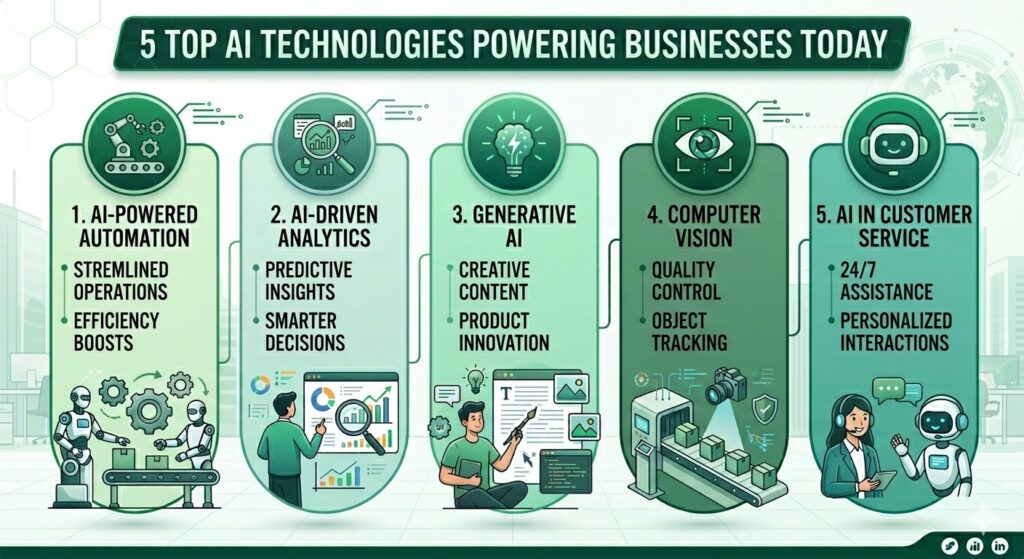
More and more businesses are using AI to work faster and smarter. Some AI tools are ready to use right away, while others can be built just for your business. These are five of the most useful AI technologies right now.
1. AI-Powered Automation
AI automation helps businesses handle repeated tasks quickly and accurately. It saves time, cuts down on mistakes, and helps teams focus on more important work.
In industries like finance and healthcare, it can speed up many routine processes. That means businesses can run more smoothly and use their resources better.
2. AI-Driven Analytics
AI-driven analytics helps companies make sense of large amounts of data fast. It can spot customer trends, find problems, and help manage risk.
With these insights, businesses can make better decisions and improve results.
3. Generative AI
Generative AI is changing how businesses create content, design products, and build software. It can help write marketing copy, draft documents, and even support coding work.
This makes everyday tasks faster and easier for many teams.
4. Computer Vision
Computer vision helps AI understand images and video. Businesses use it for things like product quality checks, self-driving cars, and visual search.
It can also help monitor production lines and give customers better search experiences with images. Additionally, this technology is widely used in AI in manufacturing and smart factory environments connected through the Internet of Things.
5. AI in Customer Service
AI is also making customer service better. Chatbots and virtual assistants can answer questions quickly and help customers at any time of day.
This leads to faster support, happier customers, and lower support costs for businesses.
Tips for Implementing Custom AI Solutions
Implementing custom AI solutions can be challenging, but with the right approach, businesses can leverage them to double their investment and scale their growth. Here are our tips.
-
Start with One Clear Goal
Pick one problem you want AI to solve first. This could be saving time, improving customer service, increasing sales, or reducing mistakes.
-
Pick a Problem that Matters
Choose a use case that has a real impact on your business. The best artificial intelligence projects solve something important, not just something interesting.
-
Make Sure your Data is Ready
AI works best when your data is clean, organized, and easy to access. If the data is messy, the results may not be accurate.
-
Test the AI on a Small Project First
Start with a small pilot project or MVP development approach before rolling it out everywhere. This helps you see what works and what needs to be improved without taking big risks.
-
Choose the Right AI Development Partner
Choose the right AI development company to reduce technical complexity and accelerate AI implementation. It also helps with infrastructure planning, workflow automation, and long-term optimization.
-
Connect it to your Current Tools and Workflows
The AI should fit naturally into the systems your team already uses. If it saves extra steps instead of adding them, people are more likely to use it.
-
Train your Team
Your team needs to understand how the AI works and how to use it. Simple training can make the difference between a tool people ignore and one they use every day.
-
Track Results
Measure whether the AI is actually helping your business. Consider factors such as sales growth, time saved, improved customer satisfaction, or reduced errors.
-
Improve it Over Time
AI should not stay the same forever. Review the results, collect feedback, and continually improve the system to ensure it remains useful and effective.
Is Investing in a Custom AI Solution Worth It?
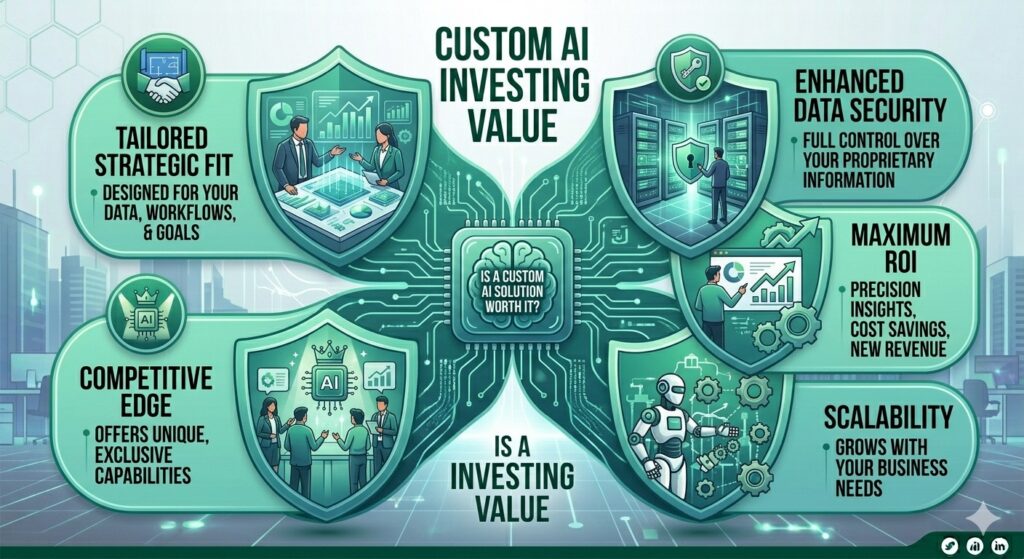
Yes, custom AI is worth the investment when your business needs a solution that fits your exact goals, data, and workflows. Unlike off-the-shelf tools, custom AI can help you solve specific problems, improve efficiency, and create new ways to grow revenue.
It is especially valuable if your business handles unique customer data, complex operations, or industry-specific challenges that generic tools cannot solve well. In these cases, custom AI can improve personalization, forecasting, automation, and decision-making in ways that directly support growth.
That said, custom AI makes the most sense when you have a clear goal, clean data, and a real business case. A well-planned AI project should be measured by results such as higher sales, lower costs, faster workflows, or better customer satisfaction.
For many businesses, the smartest approach is to start with one high-impact use case, test it with a small pilot, and then scale once the value is proven. This reduces risk and makes it easier to see whether custom AI is truly paying off.
Real- World Example That Leverages Custom AI
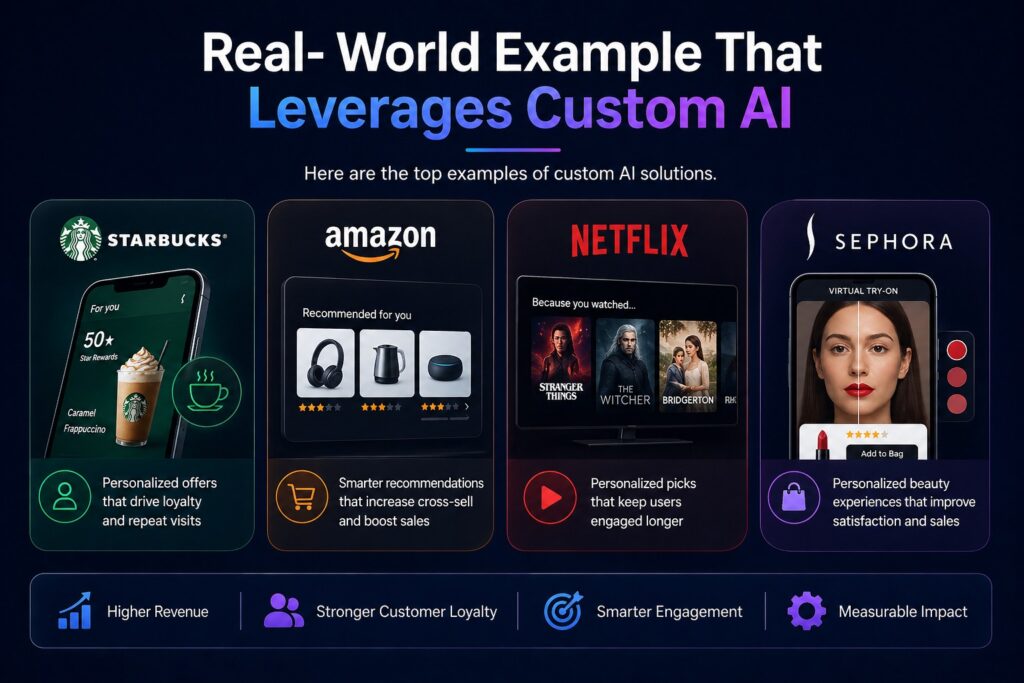
Here are the top examples of custom AI solutions.
1. Starbucks
Starbucks uses AI to personalize offers and recommendations for its rewards members. By analyzing purchase history, time of day, and customer preferences, it can suggest drinks and food items that feel more relevant to each person. This helps increase repeat visits, improve customer loyalty, and drive more sales.
2. Amazon
Amazon uses AI to recommend products based on what customers browse and buy. These personalized suggestions help shoppers discover items they may want, which increases cross-selling and upselling. It is one of the clearest examples of how AI can directly support revenue growth.
3. Netflix
Netflix uses AI to recommend shows and movies based on viewing habits. This keeps users engaged for longer and makes the platform more valuable to subscribers. When people stay longer and watch more, it strengthens retention and reduces churn.
4. Sephora
Sephora uses AI to give shoppers personalized product recommendations and virtual try-on experiences. This helps customers choose the right beauty products more easily and makes shopping feel more personal. As a result, the brand improves customer experience and encourages more purchases.
The Best AI Development Tools for Custom AI Solutions
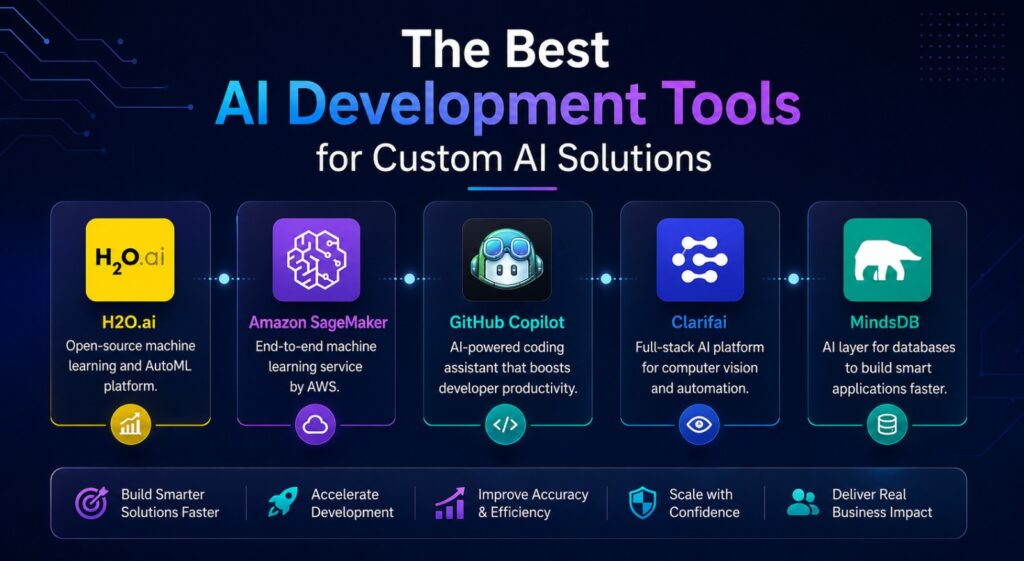
To build and deploy custom AI at scale, you need the best AI tools for business. These platforms help you create, train, and integrate AI models while maintaining security, compliance, and smooth connectivity with your existing business systems. Let’s read the top AI development tools below.
H2O.ai: Open‑Source Machine Learning
H2O.ai provides enterprise‑ready AI frameworks that make machine learning accessible. Companies use it to build and train predictive models for tasks like customer churn prediction, credit risk assessment, and fraud detection.
Amazon SageMaker: Scalable Cloud‑Based AI
Amazon SageMaker offers an end‑to‑end machine learning environment. It simplifies developing, testing, and deploying custom ML models in the cloud so teams can scale quickly and efficiently.
GitHub Copilot: AI‑Powered Code Assistance
GitHub Copilot acts as an AI assistant for developers. Built on OpenAI’s Codex, it suggests code lines, automates repetitive tasks, and speeds up the development process.
Clarifai: AI for Computer Vision & NLP
Clarifai specializes in analyzing images, videos, and text. Businesses use it to enhance security, personalize e‑commerce experiences, and improve visual search functionality.
MindsDB: Machine Learning Inside Your Database
MindsDB brings machine learning directly into existing database systems. This lets businesses run predictive analytics without moving or copying data, keeping workflows simple and secure.
Turn AI Investment into Measurable Results with Flexlab
Partner with Flexlab to move beyond generic AI tools and build custom solutions that directly impact your revenue, efficiency, and customer experience. We provide AI development services and ML development services, where we help you define clear goals, design AI‑driven workflows, and track real‑world results, so every dollar you invest in AI delivers measurable growth for your business.
We offer you:
- And Much More! Explore our Services and Case Studies
Conclusion: Custom Ai Solutions
Custom AI solutions are no longer a luxury for tech giants; they are a practical way for modern businesses to increase revenue, improve efficiency, and stand out in a crowded market. From personalized customer experiences and smarter pricing to predictive analytics, automation, and AI‑powered products, the right AI implementation strategy can turn data into a real growth engine.
The key is to start with a clear business goal, choose a high‑impact use case, and build a solution that fits your workflows and data, not the other way around. When you do that, AI stops being a cost center and becomes a measurable revenue driver that compounds results over time.
Contact us now for your custom roadmap and check our LinkedIn for real results. You’ll also love our blockchain and AI blog with insights on Multimodal AI, Digital Transformation Strategy with AI and Blockchain, AI-Powered Chatbots in Healthcare Services, and Trusted Execution Environment for AI & Blockchain.
Ready to Turn Custom AI Into Real Revenue?
📞 Book a FREE Consultation Call: +1 (416) 477-9616
📧 Email Us: info@flexlab.io
How much does a custom AI solution cost in 2026?
A simple custom AI tool like a basic chatbot usually costs a few thousand to around 25,000 dollars. A mid level tool with more features, such as lead gen or automation, often costs 25,000 to 100,000 dollars. A full custom AI system for a bigger company can cost 100,000 dollars or more. The price depends on how complex it is, how much data you use, and how many custom features you need.
Which custom AI tool is best in 2026 for small businesses?
For small businesses, an AI powered CRM like HubSpot is usually a good fit because it is cheap, easy to use, and helps with sales and marketing. If you want a chatbot trained on your own data, simple no code AI platforms work well without a big technical team. he best tool is the one that matches your main workflow and fits your budget.
What are the biggest challenges in building custom AI solutions?
Building custom AI solutions faces major challenges, mostly around data quality and access, a lack of skilled technical talent, and high running costs. Common issues include getting enough high quality proprietary data, reducing algorithmic bias, protecting security and privacy, connecting with older legacy systems, and making the solution scalable as the business grows.