

What is Web3? Why Web3 is the Future of the Digital Economy?

What is Web3? Why Web3 is the Future of the Digital Economy?

Blockchain, Web3 and The Future of the Digital Economy

Blockchain App Development | AI vs Automation | What Are AI Agents

Are you searching for what is Web3 technology and why it matters? Congratulations, you are in the right place. Let’s discover together this emerging idea that could upgrade the way we interact and are involved in online activities.

Web3 is a blockchain-based technology incorporated with decentralization and smart contracts, and it is a significant transition that provides a secure, user-friendly platform that allows individuals to have ownership and identity of their digital assets to enhance users’ economic growth and security in the online world.

Get ready to explore in this blog post how Web3 helps users to get back their power of ownership and identity in a secure environment. You can also learn the reasons why Web3 matters in developing modern economic models and boosting the internet. Imagine how promising future plans are to modify our digital interactions.

Understanding the Power of Web3 Technology

Web3 technology is the transformation from a centralized to a decentralized internet, empowering users with significant control over their data, digital identity, and digital assets through a blockchain-based network that, in addition, provides secure and transparent data management.

The Web3 ecosystem consists of integrated applications and technologies; in particular, it comprises decentralized applications (dApps), decentralized finance (DeFi), and NFTs (non-fungible tokens). Moreover, it enables the ownership and creation of exclusive digital assets.

Foundational Principles of Web 3 Technology

Let’s discover the key pillars driving Web3 technology. A decentralized, secure, and user-empowered digital future awaits you! 
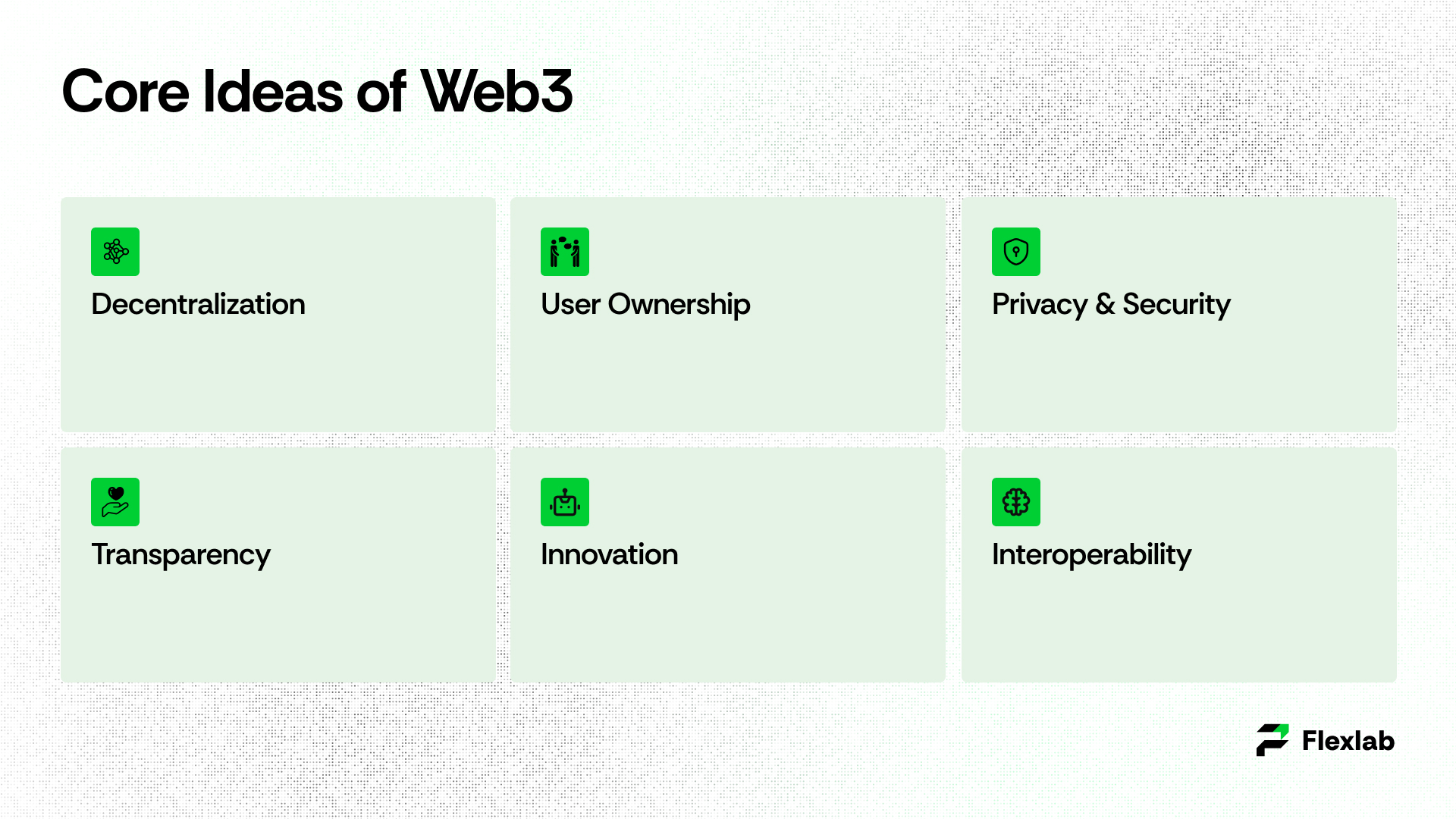
Core Principles of Decentralized Internet

  • Decentralization: Distributed power across the blockchain network.
  • User ownership: Users own their data, identity, and digital assets.
  • Privacy and security: Users control the shared information, protected by cryptographic technology.
  • Transparency: Blockchain verifies all the transactions and processes to build trust and accountability.
  • Innovation: Users are rewarded for contributing to the Web3 ecosystem; therefore, it promotes participation and drives development.
  • Interoperability: It enables different decentralized apps, blockchain networks, and other services to work together, providing a smooth and innovative user experience.

Key Features of Web 3

The distinct features of Web3 make it unique and compelling, working together to develop a strong and user-centric Web3 ecosystem.
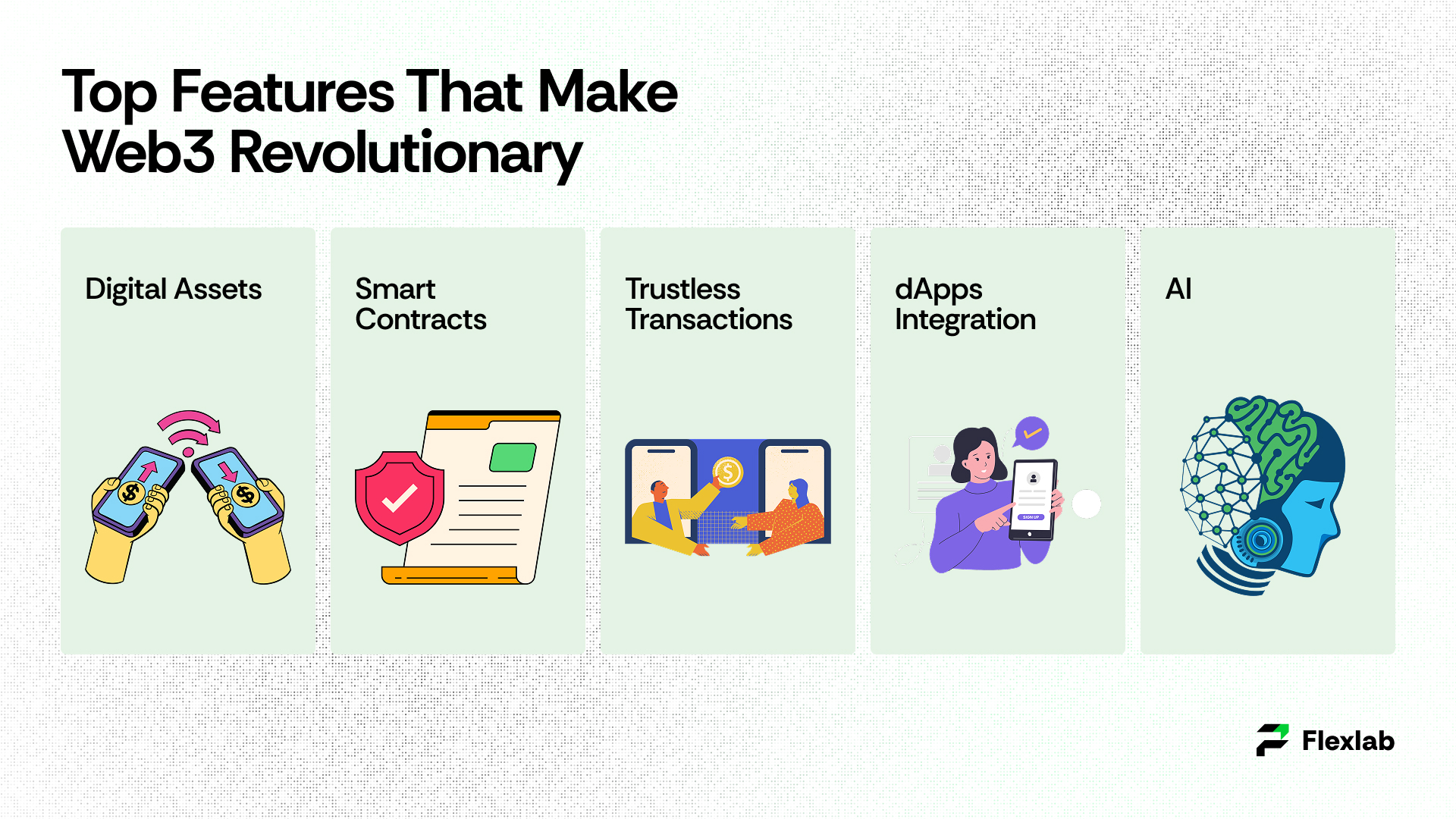
Key Features of Next-Generation Internet Systems

1. Digital Assets

Digital assets comprise currencies, digital art, and digital content, such as NFTs (non-fungible tokens) or cryptocurrencies, which are, in fact, in the direct ownership of the user and are recorded on a secure blockchain. Furthermore, this system facilitates and empowers startups since users can, therefore, monetize their digital content by themselves.

2. Smart Contracts

Smart contracts are self-enforcing agreements stored on the blockchain. In addition, when predetermined conditions are completed, they become automatically active. As a result, they remove the need for middlemen and ensure openness, security, and trust. Consequently, these contracts enable rapid, cost-effective transactions as well as decentralized applications (dApps).

3. Trustlessness 

Web3 users can enjoy transparency and consistency; moreover, they benefit from the absence of intermediary interruption for transaction verification. In addition, it enables different decentralized integration apps (dApps), blockchain networks, and other services to work together, thereby providing a smooth and innovative user experience.

4.DApps Integration

Decentralized applications (dApps) run on blockchain networks and offer services without relying on centralized control. Their integration allows users to interact directly with smart contracts to ensure security. DApps can cover various fields such as finance, games, social media, and supply chain. Seamless dapp integration increases the user experience and promotes a more open, innovative Web3 ecosystem.

5. New Artificial Intelligence Technology

Machines can interpret data intelligently with the advent of the “semantic web,” a network where machines can, therefore, understand, analyze, and process data more effectively. Moreover, the integration of new artificial intelligence technology, advanced AI, and machine learning helps develop an efficient online experience with more personalized and useful content. In addition, AI helps in fraud detection; it can also enhance smart contracts and, consequently, manage decentralized autonomous organizations (DAOs).

4. Why Does Web 3 Matter?

Web 3 matters due to its revolutionary offers, such as:

  • Decentralized autonomy: Users participate in the system without centralized control.
  • Real Digital Ownership: Property and identity are directly related to individuals.
  • Data privacy and security: Blockchain reduces fraud and risk of abuse.
  • Freedom from central authority: No single institution determines rules or access.
  • Innovative income streams: Cryptographic tokens and NFTs are opening up fresh opportunities for businesses to generate revenue.
  • Transparency and trust: Open protocols make transactions confirmed and reliable.

What Technologies Support Web3?

Web3 is a revolutionary technology that enables users to own and interact with the internet. Let’s explore the key building blocks that support the Web3 ecosystem:

1. Blockchain

It is a decentralized distributed ledger that records transactions across multiple computers, known as nodes, ensuring transparency and security. Such that:

  • Ethereum: The most authoritative platform to build Web3 apps.
  • Polygon: An Ethereum scaling solution for faster and lower-cost transactions.
  • Solana: With an output of 65000 transactions per second at low fees, it is ideal for multiplayer and real-time games. 

In short, Web3 is a blockchain-based technology that supports decentralization.

2. Smart Contracts- Zero Intermediary Interaction

Self-regulating autonomous programmes stored on the blockchain run when suitable conditions are met. Curtail intermediaries like brokers, lawyers, and banks.

Real-world cases of smart contracts are;

  • Uniswap is a decentralized finance (DeFi) protocol used for decentralized trading.
  • NFTs (Non-fungible tokens) enable autonomous royalty transactions.
  • The DAO (Decentralized Autonomous Organization) voting system utilizes tokens to make decisions together.

Simply, a smart contract is a program that autonomously executes transactions and agreements on the blockchain.
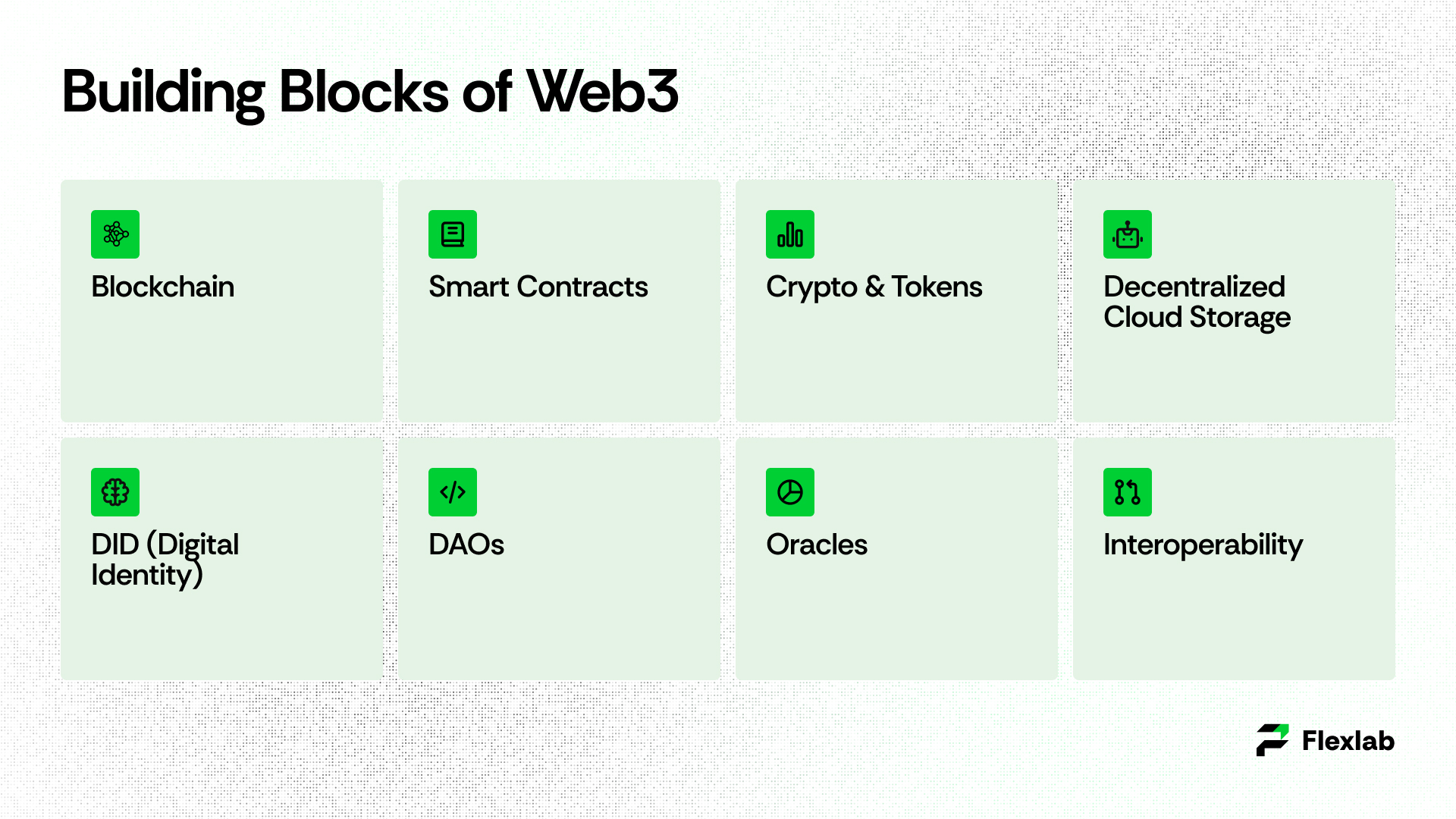
Building Blocks of a Decentralized Ecosystem

3. Cryptocurrencies and Tokens – The Web3 Currency

Digital currencies such as Bitcoin, ETH, etc., besides digital assets such as utility tokens, facilitate digital transactions and fuel decentralized ecosystems. It gives powers to the Web3 economic model by providing payment for services, rewarding users for participation, and enabling governance. In short, digital tokens are the oxygen of the Web3 economy.

4. Cloud Storage – A Decentralized Approach

Decentralized cloud storage gives power to users over companies and provides a secure self-sovereign identity system based on blockchain technology. Users then have control over their personal information and data.

There are some examples of cloud storage:

  • ENS (Ethereum Name Service): It is a decentralized domain name service (DNS) that allows users to register and manage their unique domain names like “username.eth” on the Ethereum blockchain.
  • Civic: It is a decentralized identity verification platform based on blockchain technology; therefore, it allows users to keep a check on and securely manage their personal information with respect to identity and data.
  • Decentralized cloud storage serves the purpose of giving power to users while making data in Web3 accessible, secure, and transparent.

5. Decentralized Identity (DID) – Users’ Digital Passport

(DID) is a decentralized identity that gives users control over their personal information and interactions online. In addition, this blockchain-based technology allows users to manage and verify their identity safely; as a result, they do not need to involve or rely on other authorities.

Examples of DID are:

  • MakerDAO: It is a decentralized autonomous organization (DAO) that operates on the Ethereum Blockchain and is known for the stablecoin DAI.
  • AAVE DAO: A decentralized autonomous organization (DAO) controls the Aave Protocol, a lending platform on the Ethereum Blockchain. In turn, this enables users to borrow and lend cryptocurrency.

Get ready to unlock a secure digital future for transactions and interactions online by the owner of your own digital identity without relying on technical giants.

6. Autonomous Organizations (DAOs) – Empowered Blockchain Ecosystem

It is a blockchain-based outfit run by the members and operated autonomously; at the same time, it ensures transparent control by the users.

Examples include:

  • MakerDAO: A decentralized loan platform managing StableCoin DAI.
  • AAVE DAO: A decentralized loan platform that allows users to borrow and lend Cryptocurrency.DAOs return decision-making into users’ hands.

7. Web3 Browsers – Gateways to the Future

It allows users to connect to decentralized applications (dApps) and blockchain-based services; as a result, it ensures openness and security while supporting lightweight wallet administration, as well as interacting with and detecting dApps.

Example:

  • Brave browser: This is a privacy-centred browser with an underlying crypto wallet.
  • Opera Web 3 browsers: Spontaneous interaction with decentralized applications and support for different cryptocurrencies.

Web3 browsers are the entrance to a world where freedom meets innovation.

8. Oracles Bridge the Gap – Unlocking Blockchain Potential

These are services that provide data from the real world to smart contracts; likewise, blockchain relies on them to access external information.

Example:

  • Chainlink: Smart contracts provide a safe and reliable data feed.
  • Band Protocol: Provides sharp and secure data integration on several blockchain ecosystems.

Oracles connect dots between blockchain and the real world.

9. Layer-2 – Speeding Up Web3 with Lower Cost

It is a protocol based on blockchain that increases speed and controls transaction costs; moreover, it enhances users’ work experience and encourages the adoption of Web3 applications.

Examples are:

  • Polygon: A layer 2 scaling system that provides fast and low-cost transactions. Additionally, it enhances the overall user experience by reducing network congestion.
  • Optimism: An optimism rollup solution for Ethereum that enables fast and cheaper transactions. Furthermore, it helps scale Ethereum without compromising security.
  • Mediator: A scaling system that uses optimized rollups to increase scalability and reduce costs. As a result, it supports broader adoption of Web3 applications.

10. Interoperability Protocols – The Key to Web3 Ecosystem

These are technologies that enable various blockchain platforms, networks, and decentralized applications to share, communicate, and interact initially. In addition, interoperability protocols play a crucial role in building a user-friendly, efficient, and integrated Web3 ecosystem.

Examples are:

  • Polkadot: Develops interoperability between multiple blockchain networks to share assets and data.
  • Cosmos: These are independent, scalable blockchain interoperability networks.
  • Interoperability protocols enable spontaneous interaction and unlock new opportunities for an associated universe.

Web2 vs. Web3: A Detailed Comparison

What makes Web3 innovative? Let’s take a deeper dive.
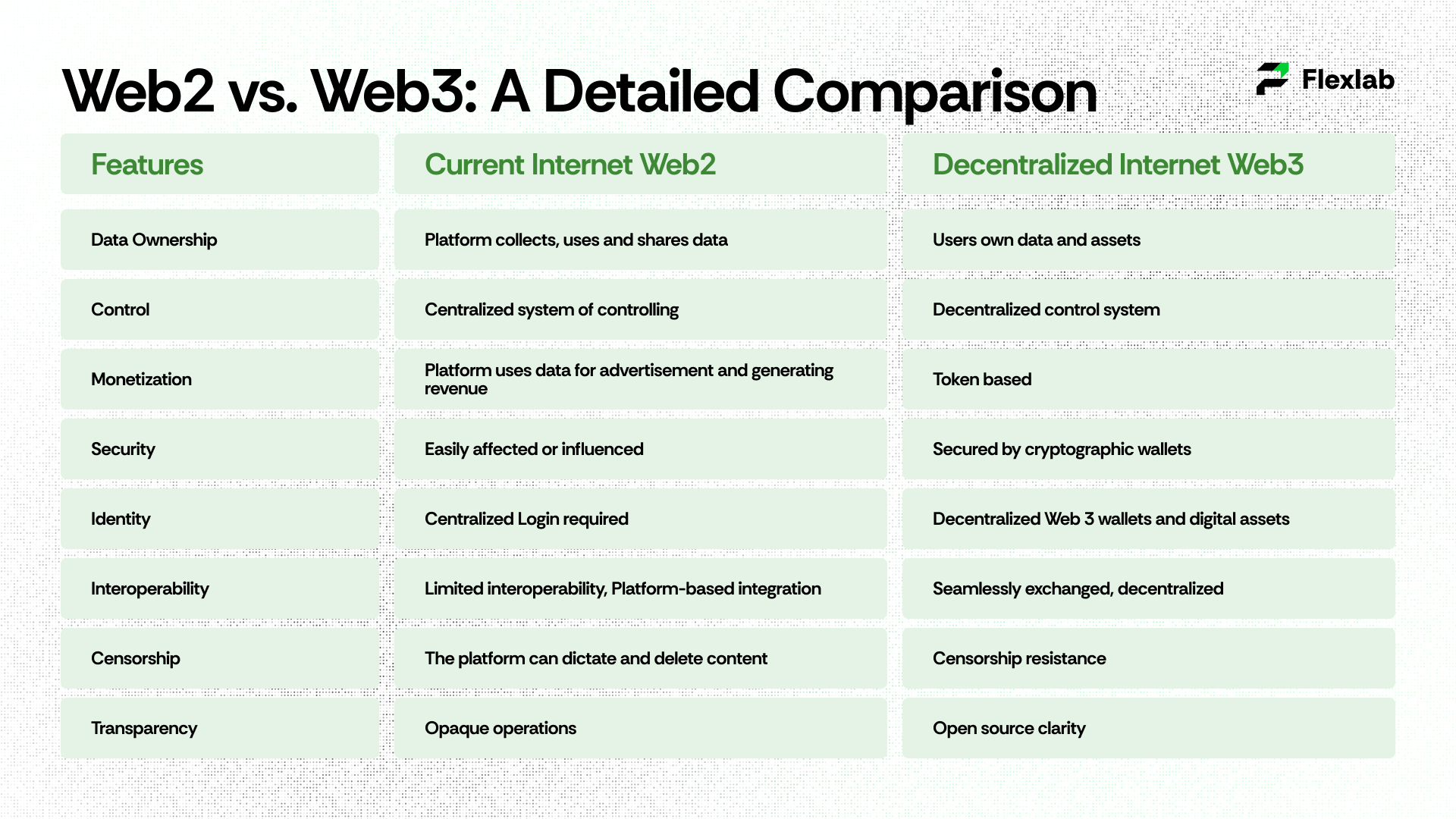
Detailed comparison of Web2 vs Web3

Web3 empowers users by shifting control from corporations to individuals; in fact, it signals a fundamental transformation in the digital world.

Web3 Reality Check: Challenges and Limitations

It is a revolutionary idea for the upcoming generation of the Internet, which promises to provide a secure Internet and reopen the digital world. From its inception, Web3 faces several challenges and limitations that must be addressed and resolved carefully to enjoy the exciting journey of Web3 that is not so far.

Let’s take a closer look at all the challenges and limitations that Web3 is expected to face.
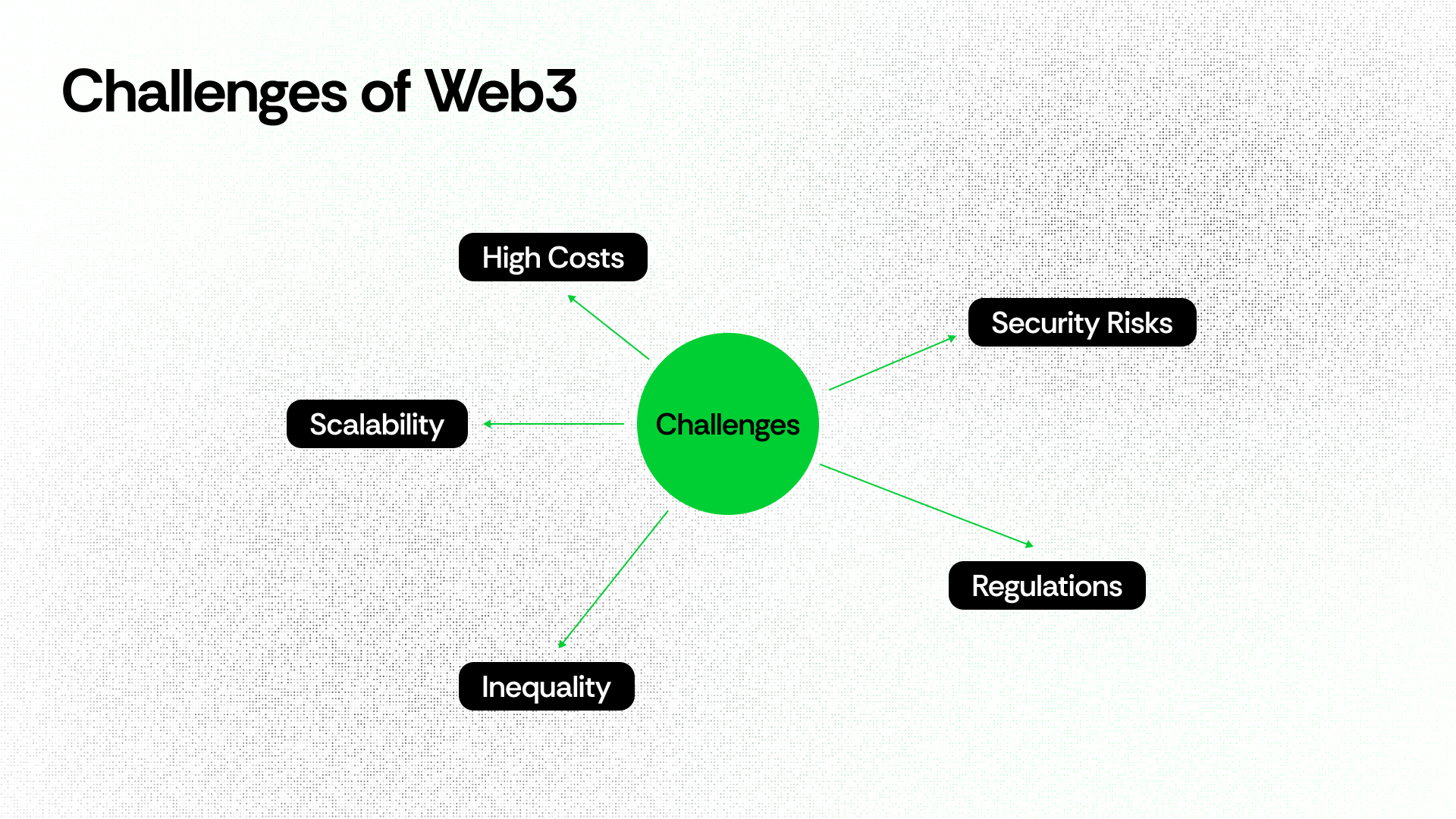
Major Challenges in Decentralized Technologies

  • Scalability Issues

As we are aware, Web3 is a blockchain-based network that gives priority to security and decentralization over speed. However, with the increase in demand, its performance is affected; consequently, it slows down, and the cost increases notably.

  • High Transaction Costs

Blockchain transactions can be super expensive. Sometimes, the fee is higher than what we’re sending! When multiple people use the network at the same time, it gets overloaded and fees shoot. This creates an issue for people with limited budgets.

  • Security Risks

Although blockchain technology is generally secure, other tools built around it, including smart contracts, crypto wallets, and decentralized exchanges, can nevertheless face vulnerabilities like hacking and unethical use because of these issues. Many people lose millions of dollars. There isn’t any user support system that recovers these losses. Therefore, effective security measures and user awareness are crucial to eliminate or reduce the risks.

  • Regulatory Uncertainty

All over the world, governing bodies are trying to regulate decentralized currencies such as Crypto, DeFi, and Web3. Some countries adopt innovation while others ban or impose restrictions on it. Rules and regulations are inconsistent, which creates uncertainty among investors and businesses and ultimately affects growth. The imposition of too many rules kills innovation; in contrast, fewer rules could increase the chances of scams and assaults.

  • Digital Inequality

Web3 wants to build a fairer internet; however, the lack of knowledge and unequal access to technology are not supportive. Consequently, Web3 could benefit only those who have a good understanding of technology and can use it effectively.

Web3 Adoption Strategies for Businesses

Educate and Upskill Teams: The first step is building internal knowledge. As a result, companies need to train employees about the rise of Web3 and how it differs from Web2, along with the opportunities it creates. Furthermore, partnering with a dependable Web3 developer will help teams gain hands-on experience.

Start with a Small Pilot Project. Rather than jumping straight into everything, companies should start with a few pilot Web3 applications, such as trial runs for Web3 wallet integration for digital payments or loyalty programs, with minimal pre-investment.

Integrate and Bring Blockchain into Present Operations

Companies can streamline the procedures by bringing blockchain into their systems. It can range from supply-chain to financial reporting, cutting through inefficiencies in preparation for widespread adoption, where central-bank digital currency transactions will come later.

  • Exploitation: Tokenization lets companies create digital assets representing value in the real world. In addition, from loyalty to part-time ownership of assets, this approach could transform customer engagement.
  • Collaborate with web3 partners: A Web3 expert develops strategic collaboration implementation with ecosystem partners or other developers. The partnership provides access to networks in areas such as the Metaverse or IP network (Internet Protocol network), where adoption increases.
  • Priority to security and compliance: When new models emerge, Web3 challenges, such as security risks and vague rules, require attention. Consequently, companies should collaborate with legal and cybersecurity experts to ensure compliance and safeguard their users.

Opportunities Web3 Offers to Businesses
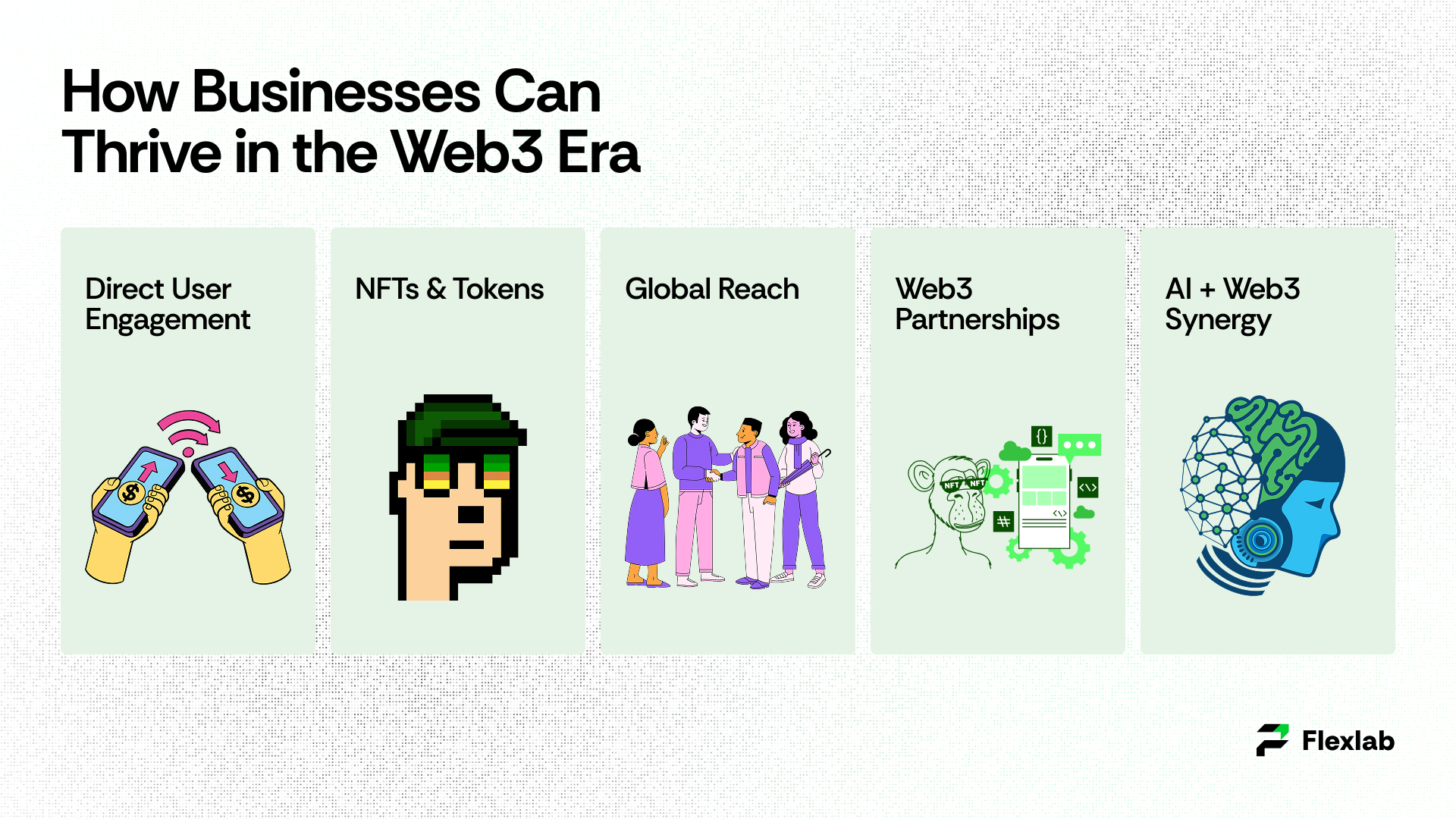
How Businesses Can Thrive in the New Digital Era

  • Direct User Engagement: Token rewards and personalized experiences strengthen customer relations, fostering loyalty and direct engagement.
  • NFTs & Tokens: New monetization instruments such as NFTs, tokens, and metaverse services unlock a new mode of income.
  • Global Reach: Services inherently become available to any user worldwide who holds a Web3 wallet; as a result, decentralized platforms extend their reach to everyone.
  • Web3 Partnership: Customers gain greater control over their digital identity and better transparency.
  • AI + Web3 Synergy: Businesses that embrace the growth of Web3 before competition will be the ones to carve out the market.
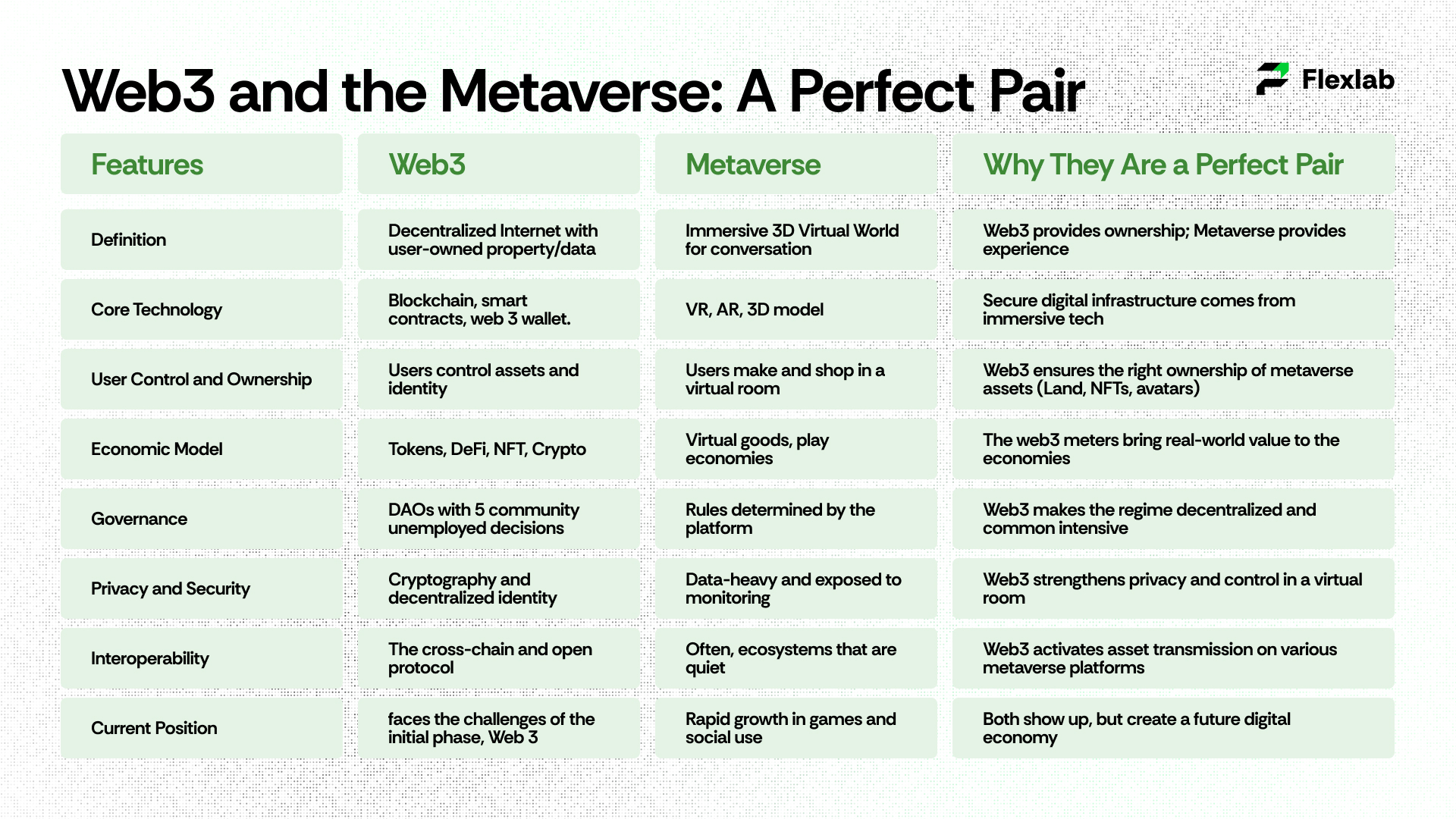
The Metaverse and Its Connection to Web3

Use Cases and Real-world Applications of Web3

1. Decentralized Finance (DeFi)

DeFi ends the requirement for conventional middlemen, such as banks and brokers. Instead, it executes transactions for loans, strikes, and trades on decentralized protocols operated by smart contracts. Only with a Web3 wallet can a user avail financial services across the globe at any time without any spatial or credit history burdens. Thus, DeFi opens new opportunities for companies to transact payments and financing and also to border transition alternatives that stand in the way of the existing central bank digital currency systems.

2. Non-Fungible Tokens (NFTs)

NFTs do much more than just digital art. From the brands’ perspective, things like limited products, membership seats, and interactive fan engagement are some of the new use cases. Moreover, an NFT can act as a certificate of authenticity or a digital collectible connected to real-world experiences. As a result, this use case becomes central to marketing strategies. It propels companies to evolve through a very user-driven campaign, whereas Web 2 platforms enable creating brand loyalty in ways that Web 2 cannot.

3. Decentralized Autonomous Organizations (DAOs)

Instead of corporate hierarchies, the DAO runs as a society governed by token holders. Members cast their votes on proposals, allocate resources, and earn parts in the outcomes. In this manner, a DAO presents alternate models of funding and management to start-ups. Traditional firms could also institute transparency systems and processes of employee participation inspired by DAOs, yet this is where we see the evolution of the Web3 regime versus traditional frameworks.

4. The Supply Chain Transparency

Each supply chain step is recorded and verified in an irreversible manner using the blockchain technique. This helps in establishing the authenticity of products, avoiding fraud, and increasing accountability. Making the supply chain transparent, from agriculture to luxury goods, becomes the greatest Web3 application, instilling equal trust within customers and regulators while addressing sustainability concerns.

5. Gaming and Play-to-Earn model

The gaming industry accelerates Web3 development. Those who play the Play-to-Earn model allow tokens or businesses to serve as digital assets that carry fair value. In conjunction with the metaverse, players can use NFTs for avatars, leather, and in-game activities, thus generating a rich virtual economy in the process. Brand experiences created by companies also come into this site, from locations outside of games within this virtual environment.

6. Digital Recognition and Privacy of Data

Traditional systems depend on centralized databases that are often considered unsafe for fractures. In contrast, Web3 introduces self-confidential identity, where users control their credentials through the Web3 wallet. As a result, this changes the ownership relationship of data from companies to individuals and, furthermore, reduces security risk by increasing confidence. For companies, this, in turn, implies using decentralized identification frameworks, ensuring strong compliance, and enabling secure customer interaction.

7. Material Creation and Social Media

On the Web2 platforms, creators often suffer because the revenue is based so heavily on ads and algorithms. In contrast, in the Web3 model, applications reward creators directly through tokens, NFTs, or decentralized revenue-sharing methods. This paves the way for a more beneficial ecosystem where most value is in the hands of users and not the platforms. For companies, this brings opportunities; in particular, it allows them to create direct collaborations with creators on a transparent basis.

8. Tokenized Real-World Assets

Tokenization offers everything for the digitization of physical assets, be they real estate and objects, or securities. The token parties, then, become much easier to trade, which was otherwise discouraged, therefore also opening up access to investors. Improvement in liquidity and transparency is what Tokening brings to the financial markets as one of the most promising Web3 applications, minimizing the gap between traditional systems and decentralized innovations on an Internet Protocol network.

Final Thoughts on Web3 Technology

Web3 applications are the next step in the development of the Internet; in fact, they transfer the power from centralized platforms to users. Moreover, with Web3 applications, Web3 wallets, and blockchain-based ecosystems, individuals and businesses receive real ownership of data, assets, and identity. Furthermore, from DeFi and NFTs to the metaverse and symbols, the possibilities are truly great. While the challenges with Web3, for instance, regulation and scalability, working with a reliable Web3 development company can help navigate these challenges. In the long term, Web3 means something because it creates a more transparent, safe, and user-driven digital economy.

Ready to Grow Your Business?

📞 Book a FREE Consultation Call: +1 (416) 477-9616

📧 Email us: info@flexlab.io

How can Flexlab Support Web3 Application Requirements? 

Are you ready to take your digital presence to new heights? If so, start building your Web3 app today with Flexlab and turn your dream into a reality to explore the limitless possibilities of Web3 applications and unlock your full potential.

Flexlab, a trusted partner in your revolutionary journey of Web3 development, offers powerful tools, expert guidance, and seamless integration with smart contracts, blockchain, and decentralized technologies. Whether you decide to launch a decentralized app, NFT marketplace, or any other next-generation Web3 project, Flexlab provides the expertise and support to accelerate your vision forward. 

Reach out to our experienced team. Contact us to discuss your Web3 projects and explore Flexlab as your partner in Web3 innovation. Let’s collaborate to develop outstanding solutions that take your business to the next level. 

Discover More:

                       Blockchain App Development: The Complete Guide for Businesses

                       AI vs Automation: Decoding the Differences for Business Success

                       What Are AI Agents? A Beginner’s Guide (2025)

How does Web 3 work?

Web3 uses a decentralized protocol operated by blockchain and peer-to-peer networks. Unlike traditional systems, it removes the brokers and gives users direct control over the data and digital assets. With a web3 wallet, individuals can safely act without relying on centralized officers and transfer themselves. It enables secure and transparent transactions to promote a trustless domain. Individuals can directly interact with Web applications, encouraging innovations and community-driven growth.

Is Web 3 the future?

Yes. Web3 represents a change to decentralization, openness, and usage in the digital economy. Many technical companies and even governments are searching for Web3 applications, from blockchain solutions to a central bank digital currency model, which indicates it is the main part of the Internet of the future. This transition is expected to enhance innovation, improve security, and generate new economic opportunities.

What is Web3 technology for dummies?

Think of Web3 as the next version of the Internet, where you own your data and digital identity. Instead of large companies controlling everything, you keep keys through blockchain and Web3 wallets. This allows you to send and receive digital currencies directly without banks or middlemen.Web3 technologies also enable transparent and secure interactions in the presence of smart contracts, developing trust and automating processes. With the help of Web3, users have more autonomous power to manage digital transactions according to their convenience.

8 Responses

  1. I have been browsing on-line greater than three hours today, but I never discovered any attention-grabbing article like yours. It is lovely worth sufficient for me. In my view, if all web owners and bloggers made just right content material as you probably did, the web might be much more helpful than ever before.

Leave a Reply

Your email address will not be published. Required fields are marked *

How to gain visibility in Claude starts with making your brand easy to find, understand, verify, and cite, but no method can guarantee inclusion.

Claude may answer from model knowledge, live web results, uploaded files, past conversations, or connected business tools. This guide is for marketers, founders, SEO teams, and agencies whose brands are missing from Claude answers.

What Visibility in Claude Really Means

Claude visibility is not a result or a score. It includes being recognized as an entity, found during retrieval, mentioned in an answer, cited as a source, and described accurately.

A company can receive one outcome without the others. Claude may mention a familiar brand from model knowledge without citing its website. It may retrieve a useful page but cite a stronger third-party source. It may also answer from a private document or connector that public users cannot access.

Use these distinctions when setting goals:

  • Model knowledge: Information learned before the model’s knowledge cutoff.
  • Live web retrieval:  Current information found through a web search or a provided public URL.
  • Citation visibility: A webpage or document is shown as evidence for a claim.
  • Brand mentions: The company, product, or expert is named in the response.
  • Entity recognition: Claude connects the brand with its category, services, people, locations, and attributes.
  • User-supplied documents: Files, pasted text, project knowledge, or previous chats available to that user.
  • Direct integrations: Information retrieved from approved apps and services through connectors.

How Claude Finds and Uses Information

Claude can use different information paths depending on the prompt, product settings, model, account permissions, available tools, and conversation context. There is no single public index that guarantees the same sources for every response.


  • Model Knowledge

Model knowledge supports general answers and facts. It can also contain incomplete, old, or unclear brand information. A business cannot submit a page and require Claude to add it immediately to model knowledge.


  • Live Web Search

When web search is available and Claude uses it, the system can find current webpages, compare sources, and provide citations. This is the main opportunity addressed by Claude AI search optimization.

A page must first be accessible. It must then match the user’s question, explain the answer clearly, and provide evidence strong enough to support a response.


  • Citations and Sources

A citation is evidence attached to a claim. It is not the same as a brand mention or recommendation. Claude may find several pages, use only part of their information, and cite the sources that best support the final answer.


  • Retrieval From Uploaded Content

Claude can work with files, project knowledge, and other user-provided material. Larger project libraries must employ retrieval methods to efficiently locate relevant sections, rather than loading every document into a single prompt.


  • Connectors and External Data

Connectors allow Claude to access approved services under the user’s permissions. Depending on the integration, Claude may retrieve emails, documents, records, calendars, code, or other business data.

How to Gain Visibility in Claude Through Eight Practical Actions

improve product visibility in Claude

How to gain visibility in Claude requires a combined approach. Technical access creates eligibility. Clear entities improve understanding. Useful content supports retrieval. Independent coverage adds verification. Measurement shows which gaps still block results.

1. Check Claude-SearchBot and User-Directed Access

Confirm that important public pages are accessible by Anthropic’s relevant web agents. Claude-SearchBot supports search quality, while user-directed retrieval may access a page when someone asks Claude to use it.

Priority pages should:

  • Return a normal 200 status.
  • Present key information in rendered HTML.
  • Use one clear canonical URL.
  • Include descriptive titles, headings, text, and internal links.

2. Create a Clear Entity Home

Give Claude and other systems one strong page that explains your organization. State the official name, product names, category, audience, locations, leadership, services, and main differentiators.

Entity clarity improves when relationships are explicit:

  • The company owns or provides a named product.
  • The product serves a defined audience and use case.
  • Research is linked to an author, date, method, and source.

Use structured data when it accurately reflects visible page content. Organization, Product, Person, Article, FAQ, and Breadcrumb markup can clarify names, ownership, authorship, offers, and page relationships.

Keep identifiers, URLs, and descriptions consistent. Markup should confirm the page, not introduce facts that visitors cannot verify. It supports understanding, but it cannot force recognition, ranking, or citation.

3. Publish Direct Answers to Buyer Questions

How to gain visibility in Claude through content starts with answering the questions buyers actually ask. Broad thought-leadership articles often fail because they avoid pricing, limitations, comparisons, requirements, and practical decisions.

Create pages for questions such as:

  • Which solution fits a specific workflow?
  • What does the service include and exclude?
  • How much does it cost?
  • How does the product compare with alternatives?
  • Who should not use the product?

Open each section with the answer. Then provide detail, evidence, examples, and limitations. This structure helps readers scan the page and gives answer systems a complete passage that can stand alone.

4. Replace Marketing Claims With Citable Evidence

Claims such as “best,” “leading,” and “most trusted” are difficult to verify. Replace them with specific proof.

Useful evidence includes original research, transparent surveys, benchmarks, case studies, product documentation, public specifications, pricing, policies, calculators, and expert analysis.

A strong claim states:

  • What was measured.
  • Who or what was included.
  • The sample size or test conditions.
  • The period and location.
  • The result and comparison baseline.
  • The method and known limits.

Make evidence easy to reuse. Put the main finding near the top, label charts and tables clearly, and explain the method in plain language. Link every important number to its original source or research page. Add a publication date and update the page when the data changes. A strong evidence page should remain useful even when one paragraph is extracted from it.


5. Earn Independent Brand Confirmation

Owned pages explain what your company says about itself. Independent sources help confirm whether those claims deserve attention.

Digital PR for GEO should prioritize relevant authority, not large volumes of low-quality links. Seek coverage in trusted trade publications, association resources, customer case studies, conference pages, expert interviews, research collaborations, specialist directories, and well-edited podcasts with transcripts.

Third-party coverage does not guarantee that Claude will mention your brand. It creates additional, independent paths through which the entity and its claims can be discovered and checked.


6. Improve Product and Service Pages

Improve product visibility in Claude by making commercial pages useful during research, not only after a buyer has decided.

Each important page should clearly state:

  • The problem the offer solves.
  • The audience it is built for.
  • Main features and outcomes.
  • Requirements and limitations.
  • Pricing or the pricing process.
  • The next action a qualified buyer should take.

7. Build a Strong Source Architecture

Claude SEO becomes weaker when useful facts are scattered across duplicate, outdated, or disconnected pages. Create clear paths between definitions, research, product details, documentation, case studies, comparisons, and conversion pages.

Consolidate pages that compete for the same question. Redirect obsolete versions where appropriate. Repair orphan pages and broken links. Use stable URLs and descriptive anchor text.

Good source architecture helps retrieval systems identify the best page for a question. It also helps human visitors verify information and continue toward a commercial decision.

8. Keep Important Facts Current

Outdated pricing, capabilities, integrations, leadership details, certifications, and comparison claims can make a page unsuitable for a current answer.

Set review schedules based on how quickly each fact changes. Product features and pricing may need frequent checks. Evergreen definitions may need less attention.

Why Is My Brand Not Appearing in Claude?

Most visibility problems come from a specific gap, not from a lack of publishing volume.

Common causes include:

  • Claude did not use live web search.
  • The page was blocked or difficult to retrieve.
  • The content did not match the exact question.
  • A competing source answered more clearly.
  • Brand and product details were inconsistent.
  • Claims lacked evidence or independent support.
  • Key information was hidden behind a form or login.
  • Important pages were duplicated or isolated.
  • The answer relied on uploaded files or connectors.
  • Claude retrieved the page but did not cite it.
  • The response changed across repeated tests.

Teams asking how to gain visibility in Claude should identify the retrieval path before recommending a fix.

Track Brand Visibility in Claude With a Repeatable Method

How to gain visibility in Claude must be measured across a set of realistic prompts. A single test is unreliable because wording, context, tools, sources, and response generation can vary.

Build a prompt library from:

  • Sales calls and buyer objections.
  • Search queries and site-search data.
  • Product categories and use cases.
  • Comparison and alternative questions.
  • Industry, location, and audience variations.
  • Support tickets and onboarding questions.

Prioritize prompts by business value, not by search volume alone. Start with questions that appear during evaluation, comparison, procurement, and final selection. Group prompts by topic, audience, location, and buying stage.

This reveals whether the brand is absent everywhere or only for specific decisions. It also helps teams connect visibility work to qualified traffic, assisted leads, and sales conversations, rather than reporting mentions without commercial context.

For each prompt, record whether web search was used, which brands appeared, which pages were cited, what competitors were mentioned, and whether the description was accurate. Measure source quality alongside frequency because weak mentions can give teams misleading signals about progress.

Separate brand mentions from owned citations. A positive mention supported by an independent publication is different from a citation to your product page. A useful Claude visibility tool should support repeated tests, prompt groups, competitor comparison, source tracking, and historical changes.

Run a Focused Claude Visibility Audit

how to improve brand visibility in Claude

A Claude visibility audit should turn observations into a prioritized plan. Treat the audit as a decision document. Rank each gap by expected value, effort, confidence, and dependency. A crawler problem should come before a new article.

Missing product facts should come before broad digital PR. Weak independent support may require outreach after owned pages are corrected. This sequence reduces waste and gives content, SEO, product, and communications teams one shared plan.

Start with four questions:

  1. Which buyer prompts matter commercially?
  2. Which brands and sources appear now?
  3. Why are those sources easier to retrieve or cite?
  4. Which gap can be fixed with the least risk and highest value?

Review technical access, entity consistency, content coverage, source quality, evidence, independent mentions, internal linking, and conversion paths. Match every recommendation to a measured gap.

A Practical 90-Day Plan

Use the first 30 days to establish the baseline. Build the prompt set, repeat key tests, map current mentions and citations, review crawler access, identify entity conflicts, and inventory the sources competitors receive.

During days 31 to 60, fix high-value gaps. Improve the entity home, rewrite weak product pages, consolidate duplication, publish answer-first resources, and add missing proof.

How to gain visibility in Claude becomes more manageable when each action is tied to access, relevance, evidence, authority, entity clarity, citation selection, or conversion.

Closing Insights: Build Durable Claude Visibility

How to gain visibility in Claude is a long-term process of becoming easier to retrieve, understand, verify, and cite. Technical access creates eligibility. Entity clarity reduces confusion.

Direct answers improve relevance. Original evidence strengthens citation value. Independent coverage supports authority. Repeated tracking shows where progress is real.

Important limits remain. Claude may answer from model knowledge, skip web search, use user-supplied documents, rely on connected services, select competing sources, or produce different responses to similar prompts. No agency, schema type, crawler setting, or content format can promise mentions, citations, rankings, or recommendations.

Your main gap may not be a shortage of articles. It may be a break between buyer questions, public evidence, entity consistency, third-party confirmation, and a clear conversion path.

Flexlab addresses that gap with a scoped Claude visibility audit. One concrete deliverable is a prompt-to-source gap map showing where your brand is absent, which competitors and sources appear instead, and which technical, content, entity, or digital PR action deserves priority.

This strategy lowers risk by setting a clear baseline before investing in a larger campaign. It does not depend on promised rankings or guaranteed citations.

FAQs

1. How Long Does It Take to Improve Visibility in Claude?

There is no fixed timeline. Technical fixes may improve accessibility quickly, while stronger entity recognition, independent coverage, and citation-worthy authority usually take longer. Progress should be measured through repeated prompt testing, source tracking, and referral data rather than waiting for decisive ranking changes.

2. Does Publishing More Content Help a Brand Appear in Claude?

Publishing more pages is not enough. Content helps when it answers a specific question, provides original value, supports claims with evidence, and connects clearly to the company’s products or expertise. A smaller group of strong, updated pages can be more useful than a large library of repetitive articles.

3. What Type of Content Is Most Likely to Be Cited by Claude?

Content is a stronger citation candidate when it provides verifiable evidence. Original research, detailed documentation, transparent comparisons, expert analysis, current statistics, and case studies with clear methods are more useful than broad promotional copy. Citation selection still depends on the prompt, retrieval path, and competing sources.

How to cancel Claude AI subscription depends on where you purchased your plan. If you subscribed through the Claude website or desktop app, open Settings > Billing and select Cancel.

If you paid through Apple or Google Play, you must cancel through the same app store account used for the purchase.

Complete the cancellation at least 24 hours before your next billing date. Your paid access will normally continue until the end of the billing period you have already paid for.

This guide is for Claude Pro, Max, Team, and Enterprise users who want to stop future charges without deleting their accounts. It explains the correct cancellation route, how to confirm that auto-renewal is disabled, what happens after cancellation, and how to handle refunds or unexpected charges.

Where Do You Cancel Claude?

The billing provider that collected your payment controls the cancellation.

Where You Purchased Claude Where to Cancel Who Can Cancel? What Happens Next?
Claude website Settings > Billing Account holder Paid access continues until the billing period ends
Claude desktop app Settings > Billing Account holder The subscription stops renewing
iPhone or iPad Apple Subscriptions Apple Account holder Apple disables the next renewal
Android device Google Play Subscriptions Google account holder Google Play disables the next renewal
Claude Team plan Organization Settings > Billing Owner or Primary Owner Team access continues until the cycle ends
Self-serve Enterprise plan Organization Settings > Billing Owner or Primary Owner Access continues until the annual term ends
Sales-assisted Enterprise plan Anthropic account representative Authorized business contact Cancellation follows the signed agreement

Cancelling stops the next recurring subscription payment. It does not automatically:

  • Delete your Claude account
  • Remove saved chats
  • Issue a refund
  • Cancel Claude API billing
  • Disable usage-credit purchases
  • Close a Team or Enterprise organization

Before You Cancel Your Claude Subscription

Confirm your account, payment provider, and renewal date before starting. Most cancellation problems happen because users sign in with the wrong email address or look in the wrong billing platform.


  • Check the Paid Account

Make sure you are signed in to the Claude account connected to the subscription. You may have separate accounts for:

  • Personal use
  • Work
  • Apple
  • Google
  • A Team organization
  • Claude Console or API access

Search your email for the original Claude receipt when you are unsure which account was used.


  • Identify the Payment Provider

Check the merchant name shown on your receipt or bank statement.

  • A Claude or Anthropic receipt usually means the subscription is managed directly through Claude.
  • An Apple receipt means Apple controls the subscription.
  • A Google Play receipt means the subscription must be managed through Google.

Cancelling from the wrong platform will not stop the active plan.


  • Check the Next Billing Date

Open the subscription settings and note the next renewal date. Cancel at least 24 hours before that date.  Waiting until the final few hours may allow the renewal process to begin before your cancellation is recorded.

You should also save any invoices needed for tax, reimbursement, or business records.

How to Cancel Claude AI Subscription on the Website

Use this method when you purchased Claude Pro or Max directly through the Claude website.

  1. Sign in to the paid Claude account.
  2. Select your name or initials in the lower-left corner.
  3. Open Settings.
  4. Select Billing.
  5. Find the subscription management section.
  6. Click Cancel.
  7. Complete all confirmation prompts.
  8. Return to Billing and check the subscription status.

Look for a message showing that the plan has been cancelled or will end on a specific date. This is also the correct process for users searching for how to cancel a Claude AI Pro subscription when Anthropic processed the payment.

Do not rely on removing your payment card, closing the browser, or stopping use of Claude. Complete the official cancellation steps.

How to Cancel Claude on the Desktop App

Claude desktop subscriptions purchased directly from Anthropic use the same billing route as website subscriptions.

  1. Open the Claude desktop app.
  2. Select your name or initials.
  3. Choose Settings.
  4. Open Billing.
  5. Select Cancel.
  6. Complete the confirmation process.

The app may open a billing page in your web browser. Continue until you see a cancellation status or access end date.

Uninstalling the Claude desktop app does not cancel the subscription.

How to Cancel Claude on iPhone or iPad

Apple controls the subscription when you purchase Claude through the iOS app. To cancel through your iPhone or iPad:

  1. Open the Settings app.
  2. Tap your name at the top.
  3. Select Subscriptions.
  4. Find and open Claude.
  5. Tap Cancel Subscription.
  6. Confirm the cancellation.

You may also start from the Claude app:

  1. Open Claude.
  2. Tap your initials.
  3. Select Billing.
  4. Tap Manage Subscription.
  5. Continue through Apple’s subscription settings.

After cancelling, reopen the subscription page and check the expiry date. Deleting Claude from your iPhone or iPad does not cancel Apple billing.

If Claude does not appear under Subscriptions, check whether you are signed in to the Apple Account used for the original purchase.

How to Cancel Claude on Android

Google Play controls the subscription when you purchased Claude through the Android app.

To cancel through Google Play:

  1. Open the Google Play Store.
  2. Tap your profile picture.
  3. Select Payments and subscriptions.
  4. Tap Subscriptions.
  5. Choose Claude.
  6. Tap Cancel subscription.
  7. Complete the confirmation steps.

You may also begin inside the Claude app:

  1. Open Claude on Android.
  2. Tap your initials.
  3. Select Billing.
  4. Tap Manage Subscription.
  5. Continue through Google Play.

Check the subscription status and ending date after cancellation. Removing the app, clearing its data, or changing your phone will not stop Google Play billing.

If Claude is missing from the subscription list, switch to another Google account and check again.

How to Cancel a Claude Free Trial

Claude’s standard free plan does not require cancellation because it does not renew as a paid subscription. Promotional trials or app-store offers may convert to a paid plan once the trial period ends.

Cancel the trial through the platform that created it:

  • Claude Billing for a direct offer
  • Apple Subscriptions for an iPhone or iPad offer
  • Google Play Subscriptions for an Android offer

Check the conversion date and cancel before the paid period begins. Signing out, deleting the app, or removing a shortcut does not guarantee that a promotional trial will stop renewing.

How to Cancel a Claude Team Subscription

An Owner or Primary Owner must cancel a Claude Team subscription. To cancel the organization’s plan:

  1. Sign in to the correct Claude organization.
  2. Open Organization Settings.
  3. Select Billing.
  4. Choose the cancellation option.
  5. Complete the confirmation prompts.
  6. Check the billing-cycle end date.

A regular Team member normally cannot cancel the organization’s subscription. Removing users or reducing seats does not automatically cancel the entire plan.

The subscription remains active until an authorized owner completes the cancellation. Before cancelling, the organization should:

  • Download invoices
  • Review active seats
  • Inform team members about the access end date
  • Export important business information
  • Review integrations and shared workflows
  • Check usage credits
  • Check Claude API billing separately

How to Cancel a Claude Enterprise Subscription

The cancellation route depends on how the Enterprise plan was purchased.


  • Self-Serve Enterprise Plan

An Owner or Primary Owner can normally manage a self-serve Enterprise subscription through:


  • Organization Settings > Billing

The subscription may remain active until the current annual billing term ends.


  • Sales-Assisted Enterprise Plan

A sales-assisted Enterprise subscription may have contract-specific renewal and cancellation terms. Contact the Anthropic representative or account manager listed in the agreement. Review the signed order form for:

  • Renewal deadlines
  • Required notice periods
  • Minimum commitments
  • Payment obligations
  • Data-export procedures
  • Account-offboarding requirements

Removing employees or seats does not necessarily cancel a contracted Enterprise plan.

How to Confirm That Claude Auto-Renewal Is Disabled

Check the subscription status after cancelling. Do not assume that clicking the first cancellation button completed the process.

  1. For a direct Claude subscription, return to Settings > Billing and look for:
  • A cancelled status
  • An access end date
  • A scheduled downgrade
  • A message confirming that the plan will not renew

2. For Apple, reopen Claude under Apple Subscriptions and check the expiry information.

3. For Google Play, reopen Claude under Subscriptions and confirm the status and end date.

Save the following information:

  • Cancellation confirmation email
  • Screenshot of the final status
  • Cancellation date
  • Paid account email
  • Subscription end date
  • Original payment receipt

This proof can help if another charge appears later.

What Happens After You Cancel Claude?

Cancelling normally stops the next renewal. It does not usually remove paid access immediately. You can generally continue using Claude Pro, Max, Team, or Enterprise features until the current paid period ends.

After that date, an individual account may return to the free Claude plan available in the user’s location. Paid limits and plan-specific features may no longer be available.

Cancellation alone does not permanently close the account.

Will Cancelling Claude Delete Your Chats?

Cancelling a subscription does not automatically delete your Claude account or saved conversations. Account deletion is a separate action.

You should still export important work before:

  • Deleting the account
  • Leaving a Team organization
  • Losing access to a work email
  • Ending an Enterprise workspace
  • Moving business workflows to another platform

Do not keep your only copy of important company information inside a chat account.

Claude Cancellation Versus Account Deletion

How to manage Claude subscription

Cancellation stops future subscription renewals. Account deletion permanently closes the account.

  • Choose cancellation to stop paying, but you can continue using the free plan or subscribe again later.
  • Opt for deletion when you want to ensure that access to the account is permanently revoked and no longer available.

For a direct paid account, use this order:

  1. Cancel the subscription.
  2. Confirm the paid access end date.
  3. Export any information you want to keep.
  4. Open Settings.
  5. Select Account.
  6. Choose the account-deletion option.
  7. Complete the permanent deletion process.

Do not delete your Claude account as a shortcut for cancelling an Apple or Google subscription. Cancel through the app store first.

Can You Get a Refund After Cancelling Claude?

Cancelling does not automatically return a payment that has already been processed. Cancellation stops a future renewal. A refund request asks the payment provider to return an existing charge.


  • Refund for a Direct Claude Payment

For a payment made directly to Claude:

  1. Sign in to the paid account.
  2. Select your name or initials.
  3. Choose Get Help.
  4. Open the support messenger.
  5. Start a new support message.
  6. Choose the refund-related option.
  7. Provide the requested payment details.

Include the account email, payment date, amount, receipt, and reason for the request. Approval is not guaranteed.


  • Refund for an Apple Payment

Apple processed the transaction when the subscription was purchased through an iPhone or iPad. Cancel through Apple Subscriptions and submit the refund request to Apple.


  • Refund for a Google Play Payment

For an Android purchase, the correct refund route may depend on the payment status and transaction age. Start by reviewing the order in Google Play. You may then need to contact Claude support or Google Support.

Why Is the Claude Cancel Button Missing?

A missing cancellation option usually means you are using the wrong account, payment provider, or organization role.

Check whether:

  • You are signed in with the correct email
  • Apple processed the payment
  • Google Play processed the payment
  • The plan has already been cancelled
  • You are viewing a free account
  • You are inside the correct Team organization
  • You are an Owner or Primary Owner
  • The Enterprise agreement requires an account representative

Search your email for the original payment receipt when the provider is unclear. For a direct paid plan that cannot be accessed, contact Claude support with the account email, charge date, and receipt. Never send your password, one-time login code, or complete card number.

Why Did Claude Charge You After Cancellation?

Start by checking the cancellation date and the subscription renewal date.

A charge may still appear when:

  • The cancellation was completed after the renewal deadline
  • The final confirmation step was not completed
  • Another Claude account has an active subscription
  • Apple or Google manages a separate subscription
  • A Team or Enterprise plan is still active
  • Usage credits are enabled
  • Claude API billing is active
  • The charge is a temporary card authorization

Compare the charge with:

  • Claude invoices
  • Apple purchase history
  • Google Play order history
  • Team billing records
  • Claude Console activity
  • Usage-credit settings

Gather the receipt and proof of cancellation before contacting the payment provider.

Claude Subscription and API Billing Are Separate

Claude API billing

Cancelling Claude Pro, Max, Team, or Enterprise does not automatically stop Claude API charges.

A Claude subscription covers access through supported Claude applications. Claude Console is the developer platform used for API keys, integrations, and application development.

Review Claude Console separately when you have used Claude through:

  • A website integration
  • A business application
  • An automation tool
  • A custom chatbot
  • Developer API keys
  • Third-party software

Check API usage, credit balances, spending limits, and automatic reload settings.

Review Usage Credits Before Cancelling

Usage credits may create charges separate from the base Claude subscription. Before leaving the billing page, open Settings > Usage and review:

  • Whether usage credits are enabled
  • Current credit balance
  • Recent usage
  • Monthly spending limits
  • Auto-reload settings
  • Saved payment methods

Disable automatic credit reloads when you do not want further usage-based charges. Team and Enterprise owners should also review organization-level spending controls.

Claude Subscription Cancellation Checklist

Use this checklist to confirm that the process is complete:

  • Confirm the paid account email.
  • Identify Claude, Apple, or Google as the payment provider.
  • Check the next renewal date.
  • Cancel at least 24 hours before renewal.
  • Complete every confirmation prompt.
  • Check the paid access end date.
  • Save the confirmation email.
  • Take a screenshot of the final status.
  • Download required invoices.
  • Review usage credits.
  • Disable auto-reload when necessary.
  • Check Claude API billing separately.
  • Export important work before account deletion.
  • Submit any refund request through the correct provider.
  • Recheck the account after the former renewal date.

Final Thoughts on How to Cancel Claude AI Subscription

The correct cancellation method depends on where the subscription was purchased.

  • Use Claude Billing for website and desktop subscriptions.
  • Use Apple Subscriptions for iPhone and iPad purchases.
  • Use Google Play for Android purchases. An authorized organization owner must manage the team and self-serve Enterprise plans.

After cancelling, confirm the subscription end date and save proof. Also review usage credits, automatic reloads, Team billing, and Claude API spending because these charges may continue separately.

For an individual user, cancelling one subscription may solve the problem. For a business, this may indicate a larger problem: unused software, duplicate AI platforms, and licenses that renew without delivering measurable value.

Flexlab helps businesses assess which AI tools are actually being used, identify unnecessary subscription costs, and build workflows around platforms that deliver clear results. Review your AI stack with Flexlab before the next budget or renewal cycle.

FAQs

1. How Do I Cancel My Claude AI Subscription?

Open Settings > Billing > Cancel when you purchased the plan through the Claude website or desktop app. Use Apple Subscriptions for purchases made on iPhone or iPad, and Google Play Subscriptions for Android purchases.

2. Can You Cancel Claude AI Subscription Anytime?

Yes. You can normally cancel Claude Pro or Max at any time. The cancellation stops the next renewal, while paid access usually continues until the end of the current billing period. Complete the process at least 24 hours before the next billing date.

3. Can I Cancel Claude AI Subscription and Get a Refund?

You can cancel the next renewal and submit a separate refund request. A refund is not automatic and approval depends on the payment provider, transaction details, applicable terms, and local consumer law.

How much can I use Claude for free depends on the work Claude must process, not a guaranteed number of messages. Anthropic gives free accounts a session-based allowance that resets every five hours, but it does not publish a fixed message cap. Short questions may allow more messages, while long chats, files, tools, and deeper reasoning consume the Claude usage limit faster.

The Claude free plan is built for occasional writing, research, study, coding help, planning, file analysis, and testing. It is not unlimited capacity for continuous professional production. You can continue using the free tier without purchasing a Claude subscription, as long as the plan is available in your region and your account adheres to Anthropic’s guidelines. 

This guide answers “how much can I use Claude for free,” what affects the limit, and when paying is practical.

Quick Answer: How Much Can I Use Claude for Free?

How much can I use Claude for free? There is no accurate universal daily chat number. Anthropic describes usage as a conversation budget. Each request consumes budget based on its context, model, effort, and tools.

A short question in a fresh chat typically uses less capacity than the same question in a long conversation that includes earlier replies and uploaded documents. Claude may need to process much of that existing context again before responding. Therefore, two people can send the same number of prompts and reach their limits at different times.

Does Claude Free have a limit? Yes. Free accounts have a five-hour session-based limit. Message availability may also change with system demand, fair-access controls, and current product rules. Do not plan important work around unofficial message estimates from Reddit, blogs, or videos.

What the Free Plan Includes

The free plan now includes more than basic text chat. Verified features include:

  • Access through the web, iOS, Android, and desktop apps
  • Writing, editing, content creation, coding, and data visualization
  • Web search for current information
  • Memory across conversations
  • File creation and code execution
  • Desktop extensions
  • Slack and Google Workspace connections
  • Remote connectors through MCP
  • Extended thinking for complex work
  • File and image uploads
  • Up to five Projects for saved instructions, chats, and knowledge

Every feature draws from the same usage. Web search, connectors, file creation, and extended thinking do not provide separate allowances. Availability may also depend on platform, region, account settings, and staged product releases.

How Free Usage Limits Work

Claude does not meter Free through a simple message counter. Consumption changes because of:

  • Prompt length: Large instructions require more input processing.
  • Response length: A long answer generally uses more capacity.
  • Conversation length: Earlier messages can remain in the working context.
  • File size: Documents add text, tables, pages, and images to process.
  • Selected model: Different models can consume allowances differently.
  • Effort and thinking: Higher effort can require more computation.
  • Tools: Search, connectors, and code execution add processing steps.
  • Product surface: Activity across Claude products may share usage.
  • Demand and capacity: Availability can tighten during busy periods.
  • Current rules: Anthropic may revise allowances and controls.

Anthropic confirms that conversation length, attached files, feature use, model choice, effort level, and tool activity can affect usage. Activity across Claude product surfaces may also count toward one allowance.

This is why “How many chats can I do in Claude for free?” has no dependable fixed answer. One focused chat can produce useful work, while one overloaded request may consume a large share of a session.

Why Limits Differ Between Users

Different results do not prove that one account has a hidden penalty. Users submit different prompt lengths, upload different files, choose different settings, and keep conversations of different sizes. Demand can also change across locations and time periods.

A person asking ten simple questions in separate chats may use less capacity than someone running two research-heavy prompts in a long project. A short follow-up can still be costly when Claude must reread a large chat and several documents.

What is 90% of the session limit in Claude? It means the interface estimates that most of the current session allowance has been consumed. It does not show an exact remaining message count. One demanding prompt could use the rest.

Claude officially warns users when they are approaching the five-hour limit and displays a reset time after the limit is reached. The percentage is a capacity indicator, not a guaranteed message counter.

When Free Usage Resets

The Claude free limit reset occurs on a session-based five-hour cycle, not through a simple midnight refresh. When you reach the limit, Claude usually shows when you can use the service again. Waiting for that specified time is the legitimate free option.

What is the 5-hour limit on Claude? It is a usage window for measuring included capacity. It is not a guarantee that Claude will work for five continuous hours, nor is it a timer that stops one conversation after five hours. Heavy tasks may consume the allowance much sooner.

Is there a daily limit for Claude? Anthropic does not publish one guaranteed daily message total for Free. It may apply additional limits to maintain fair access. Free users should watch the warnings and reset time shown in Claude. Paid users can open Settings, then Usage, to view session and weekly progress.

Models Available to Free Users

Claude Sonnet 5 is the current default model for Free and Pro accounts. Anthropic says Sonnet 5 is available across all plans. Paid plans provide access to more models, while Free model choice may be narrower and can change when Anthropic launches, retires, or reallocates models.

How many tokens does Claude Free have? Claude’s pricing page lists a 200K context window for Free. That is not a balance of 200,000 tokens you can spend during a five-hour session. The context window is the amount of information Claude can work with in one conversation. Usage limits separately control how much interaction you receive over time.

Verify the model name next to the message box before creating a workflow based on a specific model. Model availability is a current product setting, not a permanent promise.

File and Image Uploads

How much does Claude cost

Claude supports PDF, DOCX, CSV, TXT, HTML, ODT, RTF, EPUB, JSON, and XLSX files, although XLSX uploads require code execution and file creation to be enabled. Supported image formats include JPEG, PNG, GIF, and WebP.

Current chat upload limits allow files up to 500MB each, up to 20 files in one chat, images up to 8,000 by 8,000 pixels, and PDFs up to 1,000 pages. Claude analyzes text and visuals in PDFs up to 100 pages. From 101 to 1,000 pages, it processes text only. Project files can be up to 30MB each, with the total content still limited by the context window.

These technical ceilings do not promise that Free can analyze every maximum-size file. Extracted text, image detail, page count, chat history, and requested analysis all affect capacity. Upload only the pages, rows, images, or code sections needed for the task.

How to Make Free Usage Last Longer

How much can I use Claude for free becomes easier to manage when each prompt has one clear purpose. Use these legitimate methods:

  1. Start a new chat when the subject changes.
  2. State the audience, goal, format, and length in the first prompt.
  3. Remove repeated details and conflicting instructions.
  4. Upload only relevant pages, rows, images, or code.
  5. Request a concise answer before expansion.
  6. Use standard effort for routine work.
  7. Disable tools the task does not require.
  8. Save a compact handoff summary from long chats.
  9. Store stable reference material in Projects.
  10. Group related edits into one structured request.

These steps improve useful output per session without abusing accounts. They also reduce mistakes caused by cluttered context. Anthropic similarly recommends planning conversations, writing specific prompts, batching related requests, starting fresh chats when appropriate, and reusing Project knowledge.

Activities That Use More Capacity

Large context combined with demanding work can quickly exhaust a message cap. High-capacity activities include reviewing long PDFs, analyzing large spreadsheets, searching many sources, generating substantial code, creating files, using connected services, and requesting extended thinking.

Image-heavy PDFs can use more capacity because Claude must interpret visual information as well as text. Repeatedly requesting complete rewrites can also cost more than asking for specific changes. Research and agent-style tasks may perform several tool actions behind one visible request.

A practical method is to separate discovery, decision, and production. First request a short plan. Next, provide only the selected material. Finally, ask for the finished output. This approach keeps context focused and makes session use easier to control.

Claude Free vs Paid Plans

Claude Pro usage limits vs free

Claude Pro usage limits vs free mainly differ in capacity, priority, model choice, projects, and professional tools. Pro offers at least five times the usage per session compared with Free during peak hours. It still has five-hour session limits and a weekly usage limit, so it is not unlimited.

Plan

Current web price Included usage

Best fit

Free $0 Limited five-hour sessions Occasional questions and testing
Pro $20 monthly or $200 yearly At least 5x Free per session, plus a weekly limit Regular individual work
Max 5x $100 monthly 5x Pro capacity per session, with plan limits Frequent advanced work
Max 20x $200 monthly 20x Pro capacity per session, with plan limits Daily power users

The current prices for individual plans and their respective usage tiers are available on Anthropic’s website. The current prices for individual plans and their respective usage tiers are available on Anthropic’s website. Max also remains subject to weekly and other capacity controls.

The cheapest Claude subscription is Pro. Annual billing is $200, or about $16.67 monthly before tax. In Pakistan, the official price may appear in a supported local currency or at the regional checkout. At PKR 276.768 per US dollar on August 3, 2026, $20 equals about PKR 5,535 before tax, bank spreads, foreign fees, or app-store differences. Check the final checkout amount before subscribing.

Paid users can enable usage credits to continue after included limits at standard API rates. A user may remove a spending ceiling, but that creates metered paid usage. It does not make Pro or Max unlimited at the subscription price.

Who Can Rely on the Free Plan?

Students can depend on Free for occasional explanations, outlines, revision questions, and focused document assistance. They should test capacity before a deadline and keep another method available for urgent work.

Occasional users who ask short questions may find Free sufficient for a long time. Freelancers and professionals can use it to test Claude, draft small items, or complete non-urgent tasks. They should not depend on it for continuous client delivery, large research assignments, or repeated file processing where a reset would create a business problem.

Teams should not build shared operations around several personal free accounts. Team and Enterprise plans provide organizational billing, administration, security, collaboration, and access controls that individual accounts do not replace.

When Paying Makes Sense

Upgrade when the cost of interruption exceeds the subscription cost. Use this practical decision-making framework:

  • Stay free when tasks are short, optional, occasional, and easy to postpone.
  • Choose Pro when Claude supports regular work and Free repeatedly interrupts useful sessions.
  • Choose Max 5x when Pro limits often stop valuable professional work.
  • Choose Max 20x when Claude supports demanding work throughout most days.
  • Consider paid usage credits when workloads vary and metered continuation is useful.
  • Consider Team or Enterprise when several people need shared administration and controls.

Track one week of real usage before paying. Record the task, files, tools, interruptions, time saved, and business value. A subscription makes sense when added capacity reliably saves more time or revenue than it costs.

Can I use Claude for free forever? The Free plan has no published expiry date, but its features, limits, eligibility, and regional access can change. You cannot use Claude Unlimited with the included allowances.

Free Plan Bottom Line: How Much Can I Use Claude for Free?

How much can I use Claude for free is best answered as limited but renewable access rather than a fixed number of chats. Free users receive Sonnet 5, a 200K context window, web search, uploads, memory, Projects, file creation, and other useful tools. However, prompt length, file size, conversation length, model demand, effort, tools, system capacity, and current product rules determine how quickly the allowance runs out.

Use Claude Free when your tasks are occasional and waiting for the next usage reset will not disrupt important work. Consider a paid plan only when repeated limits delay client projects, study deadlines, development tasks, or other valuable work.

Not sure whether Claude Free, Pro, or Max fits your workload? Flexlab can help you compare AI tools, estimate real usage costs, and plan a workflow that avoids unnecessary subscriptions. To discuss your requirements and choose an AI setup that supports your budget, team, and goals.

How Much Can I Use Claude for Free? FAQs

1. How much can I use Claude for free, according to Reddit?

Reddit reports can describe personal experiences, but they cannot establish your allowance because prompts, files, demand, settings, and conversation history differ. Use Claude’s own warning and reset information instead of treating community message counts as guaranteed policy.

2. How can I use Claude for free without a subscription?

Create a free account from a supported location, complete the required verification, and use Claude within the displayed session limits. Pakistan is currently supported, but account requirements and regional rules still apply.

3. Can you bypass Claude’s free limit or increase it?

You cannot legitimately bypass the limit; creating extra accounts, using proxies, or misrepresenting your identity may result in restrictions. Increase useful capacity by shortening context, starting focused chats, waiting for the usage reset, or upgrading when the value justifies it.

Is Claude private? Claude is reasonably private for many everyday tasks, but it is not anonymous, end-to-end encrypted, or automatically appropriate for every confidential workflow.

Anthropic applies security controls, encrypts data in transit and at rest, and gives consumer users a choice over whether eligible chats help improve its models.

However, privacy still depends on the plan you use, your settings, retention rules, workplace administration, connected services, and the information you submit.

Claude can handle ordinary writing, research, coding, planning, and study with sensible precautions. For regulated records, trade secrets, client files, credentials, health information, or other restricted data, use an approved business environment with documented access, retention, contractual, and compliance controls.

Is Claude Private on Free, Pro, and Max?

Claude Free, Pro, and Max are consumer plans. Paying for Pro or Max increases access, capacity, and features, but it does not turn a personal account into a confidential corporate workspace.

Consumer users can control whether eligible new or resumed chats and coding sessions are used to improve Claude.

When model improvement is disabled, Anthropic says those conversations will not be used in future training runs. Data already included in training that has started, or in models already trained, cannot be pulled back.

There are exceptions. A conversation may still be processed for safety, fraud prevention, legal compliance, service operation, or feedback you intentionally submit. Anthropic may also review material when automated systems flag possible policy violations.

Consumer accounts are suitable for low-risk activities such as rewriting public text, brainstorming, summarizing non-sensitive notes, explaining public information, or debugging sanitized code.

A paid personal subscription is not a substitute for an employer-approved system, a data processing agreement, or a regulated-data workflow.

Does Claude Keep Your Conversations?

Yes. Standard Claude chats may remain in your account history until you delete them or an applicable organizational retention policy removes them.

For consumer accounts, deleting a conversation immediately removes it from visible history. Anthropic indicates that the deleted chat will also be removed from backend storage within 30 days, except in cases where legal requirements, security investigations, disputes, or enforcement of usage rules apply.

If you allow model improvement, eligible data may be retained in a de-identified form in training pipelines for up to five years. Data related to feedback, such as ratings or bug reports, may also be retained for 5 years.

Material flagged by automated trust and safety systems may be subject to longer timelines. Anthropic states that flagged inputs and outputs may be retained for up to two years and related safety classification scores for up to seven years.

Are Claude Uploads Private?

Files uploaded to Claude should be treated with the same care as typed prompts. Claude must process the file contents to analyze, summarize, extract, compare, or rewrite them.

Before uploading a document, spreadsheet, image, screenshot, code archive, or log file:

  • Remove pages that are not needed
  • Redact names, addresses, account numbers, and identifiers
  • Delete passwords, API keys, tokens, and private URLs
  • Check comments, tracked changes, hidden sheets, and metadata
  • Replace real customer or employee records with synthetic examples
  • Crop screenshots so unrelated apps and notifications are not visible
  • Confirm that you have permission to share third-party information

Is Claude Incognito Really Private?

Claude’s incognito mode improves privacy within the product, but it is not anonymous browsing and does not mean zero retention.

An incognito chat is not saved in normal chat history, is not used to build Claude memory, and is not used for model improvement. It is useful when you want a temporary conversation that will not affect future personalization or appear in your regular history.

However, incognito content is retained for at least 30 days for safety purposes. On Team and Enterprise accounts, incognito chats may be included in organizational data exports and remain subject to the organization’s retention policy.

Incognito is best for temporary context and tasks you do not want mixed with persistent memory. It is not appropriate for passwords, private keys, legal evidence, unreleased financial information, medical records, or anything unacceptable in a retained system.

Can Your Employer See Your Claude Chats?

How to keep Claude chats private

If you use Claude through a Team or Enterprise workspace, assume that the organization controls the account and its data.

Anthropic describes the customer organization as the data controller and Anthropic as the processor for Claude for Work. The organization decides who can join, which features are enabled, how the service is governed, and how submitted data may be managed.

A Primary Owner can request exports that may include conversations, files, account data, and usage information. Coworkers generally cannot browse every private chat, but a work account is not a personal space. Avoid using it for private job searches, health questions, personal disputes, or other matters outside company policy.

How Private Is Claude Team?

Claude Team offers a managed workspace and commercial data protections. Anthropic says inputs and outputs from commercial products are not used to train its models by default unless the customer explicitly opts into an eligible program or submits qualifying feedback.

Team owners can manage membership, integrations, sharing options, and organizational settings. Users can keep chats private from colleagues unless they intentionally share them, but the Primary Owner can request data exports.

Team is more appropriate than a consumer plan for routine business use, yet the organization still needs internal rules. It should define which data classes are allowed, who may connect external services, how long information is kept, and which tasks require legal or security approval.

How Private Is Claude Enterprise?

Claude Enterprise adds governance features intended for larger or more regulated organizations. Available controls may include single sign-on, automated user provisioning, role-based administration, audit capabilities, domain controls, data exports, retention settings, and other enterprise security options.

Enterprise owners can configure a custom retention period, with Anthropic documenting a minimum of 30 days. If no custom period is configured, data may be retained according to the product’s default behavior.

Enterprise controls improve manageability, but they do not make every use automatically compliant. The organization must evaluate the legal basis, confidentiality obligations, data location, access controls, incident response plans, record-keeping requirements, integrations, and the specific features being utilized.

Is Claude API Data Private?

The Claude API is often better suited for controlled applications, as it does not use commercial inputs and outputs for model training by default. However, standard API retention and feature-specific storage still apply.

Anthropic states that API inputs and outputs are generally deleted from backend systems within 30 days, except when a feature uses longer customer-controlled storage, another agreement applies, data must be retained for policy enforcement, or the law requires retention.

Different API features may store files, jobs, sessions, or other resources. Therefore, it is essential to review each endpoint rather than assuming a single rule applies across the platform.

Qualified organizations can request zero data retention, or ZDR. For eligible use, prompts and responses are not stored at rest after the response returns. ZDR is not automatic and does not cover every feature, model, or consumer plan.

Application logs, analytics, databases, backups, and employee access can still retain prompts. Privacy must cover the full data path.

Do Third-Party Claude Providers Follow the Same Rules?

Not necessarily. Accessing Claude through another platform can change who processes the data and which terms apply.

Third-party products may have different retention periods, processing regions, logs, administrator controls, and contracts. Before sensitive use, verify who receives prompts, where processing occurs, how long data is stored, whether content supports model improvement, who can access logs, and which deletion or export controls exist. The model may remain the same, but the boundaries of privacy can vary.

Do Claude Connectors Affect Privacy?

Yes. Connectors can expand Claude’s access to email, documents, calendars, messages, cloud storage, and internal tools. Privacy then depends on Anthropic, the connected provider, the permissions granted, the user’s account privileges, and the connector’s design.

Grant only the permissions needed, disconnect unused services, separate personal and work accounts, and review custom integrations. Broad permissions, prompt injection, insecure tools, or excessive retrieval can expose more data than intended.

For computer-control features, close unrelated apps, hide notifications, remove sensitive files from view, and begin with low-risk tasks.

Is Claude End-to-End Encrypted?

Anthropic states that Claude data is encrypted in transit and at rest. That protects information while it travels over networks and while it is stored on systems.

This is not the same as end-to-end encryption. In an end-to-end encrypted service, the provider generally cannot read the protected content.

Treat Claude as a secured cloud service, not as an offline notebook or encrypted messaging vault.

Does Anthropic Sell Your Data?

Anthropic states that it does not sell user data and that Claude remains ad-free. This does not mean data is never shared or processed.

Data may still be processed by service providers, infrastructure partners, advisers, or authorities to operate the service, protect users, comply with law, or support authorized features. Privacy is fundamentally shaped by how we collect, retain, access, integrate, export, and even accidentally share information. Ensuring that these processes are managed effectively is essential for protecting individual rights.

Can Shared Claude Chats Become Public?

Yes. Claude conversations and artifacts are private by default, but users can create shareable links. Anyone with a working link may be able to view the shared snapshot.

A shared chat may include prompts, answers, uploaded content, generated artifacts, names, or details copied from another source. Links can be forwarded, posted in public channels, stored in browser histories, or captured in screenshots.

Review shared content before publishing it. Remove public access when it is no longer needed, and never create public links for client records, proprietary code, employee information, legal matters, credentials, or personal documents.

Is Claude Safe for Confidential Work?

Can Claude be used privately

Claude can support confidential work when the account, contract, settings, and workflow are appropriate. Confidentiality is not guaranteed merely because the service has security controls.

A suitable setup may require a commercial account, a data processing agreement, approved retention rules, identity controls, sharing restrictions, vendor review, employee guidance, incident procedures, redaction, and sector-specific terms. Consumer Pro or Max should not be assumed to meet these requirements.

What Should You Never Put Into Claude?

Avoid entering information that could cause serious harm if exposed, retained, exported, or misused. Examples include:

  • Passwords and one-time passcodes
  • API keys, private keys, and access tokens
  • Live session cookies
  • Full payment-card or bank details
  • Government identification documents
  • Unredacted medical or therapy records
  • Customer databases
  • Private employee files
  • Confidential legal evidence
  • Unreleased financial results
  • Merger, acquisition, or investment details
  • Export-controlled or classified information
  • Production logs containing personal data
  • Another person’s private information without permission

For sensitive tasks, create a simplified or synthetic version. Replace names with labels, remove unnecessary fields, shorten logs, modify sample values, and provide only the context needed.

How to Keep Claude Chats Private

Use these steps to reduce exposure:

  1. Choose the right account for the data.
  2. Turn off consumer model improvement when appropriate.
  3. Use incognito for temporary history control, not secrecy.
  4. Delete chats and files that are no longer needed.
  5. Disable memory or past-chat search when unnecessary.
  6. Redact personal, confidential, and regulated information.
  7. Never paste credentials or live authentication data.
  8. Review shared links and remove old ones.
  9. Limit connector permissions.
  10. Keep work and personal accounts separate.
  11. Follow employer, school, client, and professional rules.
  12. Use approved commercial controls for sensitive business work.

Final Verdict: Is Claude Private?

Claude is private enough for many low-risk tasks when users choose appropriate settings, limit sharing, and avoid entering sensitive information.

It employs cloud security controls, offers options for consumer model training, and, by default, does not utilize commercial inputs and outputs for model training.

However, Claude is not anonymous, end-to-end encrypted, or universally suitable for confidential work. Conversations may be retained, reviewed in limited circumstances, exported by workplace administrators, exposed through public links, or processed by connected services.

Treat Claude as a secure cloud service rather than a private notebook. Use consumer accounts for low-risk tasks, managed commercial accounts for approved business data, and data minimization for every prompt, file, connector, and workflow.

Privacy-conscious businesses should also collect only the customer information they genuinely need. Flexlab helps teams create clear, low-friction digital experiences that turn qualified interest into sales without adding unnecessary steps or data requests.

FAQs

1. Is Claude private for personal use?

Yes, for everyday tasks such as writing, studying, and planning. Avoid sharing passwords, financial details, medical records, or other highly sensitive information.

2. Are Claude chats used for training?

Consumer users can control whether eligible chats help improve Claude. Commercial Claude and API data are not used for training by default.

3. Can my employer see my Claude chats?

Possibly. In a Team or Enterprise workspace, authorized administrators may access exported conversations and files, so treat work accounts as company-controlled.

To launch Claude Code in terminal, install the Claude Code command-line tool, open the folder that contains your project, type claude, complete the sign-in process, and review every permission request before allowing file changes or shell actions. Start with a read-only question to confirm that Claude Code is operating in the correct repository.

This guide covers setup for Windows, macOS, Linux, and WSL, including installation, authentication, project selection, troubleshooting, and beginner safeguards.

What Is Claude Code?

Claude Code is Anthropic’s coding assistant for the command line. It can examine a project, explain unfamiliar files, suggest changes, edit approved files, run permitted terminal commands, support Git workflows, and help with testing or debugging.

Unlike browser chat, Claude Code can work with local files and available development tools. Users must therefore monitor folder scope, credentials, approvals, and generated changes.

The simplest explanation of how to launch Claude Code in terminal is this: install the CLI, move into the intended project folder, type claude, sign in, and start with a limited request.

How Do You Launch Claude Code?

Follow these five steps:

  1. Install Claude Code using the official installer or a supported package manager.
  2. Close and reopen the terminal after installation.
  3. Navigate to the root folder of the project you want Claude Code to inspect.
  4. Confirm the folder path, then type claude and press Enter.
  5. Sign in and ask Claude Code to explain the project without changing files.

The launch command to use is “Claude.” To ensure a smooth operation, be aware that most issues arise from PATH errors, shell mismatches, incomplete installations, or selecting the wrong working folder. Address these potential pitfalls for the best experience!

What Do You Need Before Starting?

You need a supported computer, a terminal, internet access, an eligible Claude or organizational account, and permission to work inside the chosen project directory.

Claude Code supports macOS, Windows, common Linux distributions, and Windows Subsystem for Linux. A supported 64-bit system and adequate memory are required; large repositories need more resources.

Use a shell you understand: Zsh on macOS, PowerShell or Command Prompt on Windows, or Bash or Zsh on Linux. WSL users should install Claude Code inside WSL when the project lives there.

Access may come through a Claude plan, team workspace, enterprise organization, Console account, or approved cloud platform. Company users should follow internal identity and security policies.

Choose a safe project. Avoid home, drive-root, download, or parent folders containing unrelated work. Start with a small Git-controlled repository.

How to Install Claude Code

Anthropic recommends its native installer, while Homebrew and WinGet remain supported alternatives.

On macOS, Linux, or WSL, use the native command on the official quickstart page. On Windows, choose the command written for PowerShell or Command Prompt.

Do not copy a PowerShell command into Command Prompt or a Command Prompt command into PowerShell. The syntax differs, and shell mismatch is a common reason installation fails.

After installation, reopen the terminal so updated environment settings and PATH entries load.

Type claude –version. A version response confirms installation. A command-not-found error usually points to PATH, an unfinished install, or a terminal that was not restarted.

Update Homebrew or WinGet installations through the same package manager. Native installations can update automatically.

How to Launch Claude Code in Terminal

Open your preferred terminal and move into the project directory. Use the normal change-directory command for your shell, followed by the full or relative path to the project.

Before launching, display the location and list files. Use pwd and ls on macOS, Linux, or WSL; use cd and dir in Command Prompt. PowerShell supports Get-Location and the pwd alias.

In a Git repository, run git status to check the branch and uncommitted work. Save important changes before permitting edits.

Once the path is correct, type claude and press Enter. The first launch usually begins authentication. Later launches normally open an interactive Claude Code session in the current directory.

Make the first prompt narrow and read-only. Ask for the folder structure, main entry point, or project organization without changes.

Use the response to confirm repository scope. If it describes unrelated files, exit, correct the folder, and relaunch.

Why the Project Folder Matters

Claude Code uses the current directory as its starting context. The repository root usually provides source files, configuration, tests, documentation, and Git history.

Starting too high in the folder hierarchy can expose unrelated projects or personal files. Starting too deep may hide important configuration stored closer to the repository root.

A project root often contains Git data, a package manifest, build settings, a README, source files, or tests. Inspect it before launching.

Although a session can move between directories, beginners should avoid expanding scope. Relaunching from the correct folder creates a clearer boundary.

How Authentication Works

How do I run a file in terminal

When you run Claude Code for the first time, it typically opens a browser window to sign in. Complete the login using the account associated with your Claude plan, Console access, team workspace, enterprise organization, or approved provider.

If the browser does not open, copy the displayed login address and open it manually. WSL, SSH, and containers may require pasting a login code into the terminal.

When an Anthropic API key is already set, Claude Code may request approval for that credential. Never expose keys in repositories, screenshots, shared history, or support posts.

Use /logout to remove the active account and repeat setup. Ask an administrator when organizational login methods are restricted.

What Happens After Claude Code Opens?

After logging in, Claude Code presents a prompt linked to the current directory. It can read files, answer questions, suggest edits, and request permission to run tools or actions. The experience depends on your account, configuration, installed version, settings, and policies.

Do not treat a launch as permission to approve everything. Confirm the project path, ask for a summary, and compare the answer with files you recognize. Inspect permission rules before requesting changes.

For an initial task, choose something to review, such as improving a README paragraph, locating a configuration value, explaining a test failure, or identifying files related to a feature. Avoid deployments, database migrations, dependency overhauls, mass renaming, and production access until you understand the workflow.

What Makes a Good First Prompt?

A first prompt states the goal, limits the scope, and defines what Claude Code must not do. For example, ask it to explain the project structure, name files involved in a feature, and avoid edits or commands.

When making a change request, clearly specify the target file, expected outcome, validation method, and boundaries. If several files might be impacted, demand a plan before execution. Clear constraints are essential; they enhance reviewability and minimize unnecessary details.

Essential Claude Code Commands

Beginners only need a small command set.

  • claude starts an interactive session in the current directory.
  • claude followed by a quoted task starts a session with an initial instruction.
  • claude -p followed by a query sends a one-time request, prints the response, and exits.
  • claude -c continues the most recent conversation associated with the current directory.
  • claude -r resumes a previous session selected by its identifier or name.

Inside an interactive session, /help displays available commands. /permissions lets you inspect approval rules. /clear starts a fresh conversation. /compact reduces the working conversation when context becomes large. /doctor checks the installation and configuration. /exit closes the session.

Type a forward slash inside the session to view commands available in your installed version.

Resume carefully because earlier assumptions may persist. Start fresh when changing projects, goals, branches, or security boundaries.

A Safe Beginner Workflow

Use the following process for your first real task:

  1. Select a small project that is already under Git version control.
  2. Save or commit the current state before opening Claude Code.
  3. Open the terminal and navigate to the repository root.
  4. Verify the path and inspect the visible files.
  5. Run git status and note the active branch.
  6. Check the installation with claude –version.
  7. Start Claude Code by typing claude.
  8. Complete authentication if prompted.
  9. Ask for a read-only explanation of the project.
  10. Confirm that the response matches the expected repository.
  11. Open /permissions and review saved approval rules.
  12. Request one small, reversible change.
  13. Read each proposed command before approving it.
  14. Inspect the resulting diff and changed files.
  15. Run the project’s normal tests or validation process.
  16. Exit the session and commit only the changes you understand.

This sequence separates orientation, permissions, editing, testing, and version control, making mistakes easier to detect and reverse.

How to Relaunch or Resume Claude Code

To relaunch Claude Code, return to the correct project folder and type claude again. This starts a new interactive session with the current directory as its project context.

To continue the latest conversation for that folder, use claude -c. To reopen a different saved session, use the resume option and choose the relevant conversation.

Start fresh when the task changes substantially. Resume only when earlier context remains useful and trustworthy.

Before continuing, please verify the branch, path, and working tree, as the earlier context may no longer be relevant.

Common Launch Problems and Fixes

  • Claude Command Not Found

Restart the terminal and retry claude –version. If it fails, confirm installation and PATH. Check official troubleshooting guidance before editing PATH manually.

  • Wrong Installer for the Shell

PowerShell and Command Prompt use different syntax. Open the intended shell and use its matching command. WSL users should install inside WSL.

  • Browser Does Not Open

Use the displayed option to copy or reveal the login address, open it manually, and complete authentication. In remote environments, paste the supplied login code back into the terminal.

  • Authentication Fails

Reopen Claude Code and sign in again. Confirm account access, active invitations, and permitted network connections. Use /logout for the wrong stored account.

  • Permission Denied

Confirm your normal account can read and write the installation and project folders. Avoid administrator or root execution, which widens risk and can create ownership problems.

  • Claude Opens the Wrong Project

Exit before approving actions. Navigate to the correct repository root, display the current path, list the files, check the Git status, and restart Claude Code.

  • Claude Code Runs Slowly

Large repositories, generated folders, long conversations, plugins, and integrations can increase resource use. Try /compact, restart between tasks, and run diagnostics.

  • Project Commands Fail

Claude Code and your application have separate requirements. Install required runtimes and dependencies through the project’s documented process, reviewing every proposed action.

Security Best Practices

How do I open the code in terminal

Treat Claude Code as a powerful local collaborator, not an automatic authority.

Read every requested command. Pay special attention to deletion, dependency installation, network access, database operations, cloud tools, Git history changes, deployment commands, and scripts downloaded from the internet.

Keep permission rules narrow. Permanently approve only understood, repeatable actions, and remove broad allowances when they are unnecessary.

Protect secrets. Avoid exposing environment files, tokens, private keys, production credentials, customer records, or confidential documents. Redact sensitive values before asking for help.

Use Git defensively: work on a separate branch, begin clean, inspect the full diff, review new files and lockfiles, then test before committing.

Limit the scope of folders and avoid accessing parent directories. Use a disposable branch, worktree, container, or a non-production copy for making risky changes.

Before high-impact work, request a plan covering files, commands, tests, rollback steps, and assumptions.

Final Takeaway

How to launch Claude Code in the terminal comes down to a controlled sequence: install the official CLI, verify the installation, enter the correct repository, run claude, authenticate, and begin with a read-only request. The command is simple; safe setup depends on project scope, account access, permission review, version control, and careful approval.

A reliable terminal workflow should support a clear business process. Flexlab helps teams connect technical execution with lead management and sales operations, reducing handoff friction between tools, people, and decisions. Visit flexlab.io to discover how cleaner automation can lead to the quickest measurable improvements.

FAQs

1. How do I install Claude Code before launching it?

Install Claude Code using Anthropic’s official installer or a supported package manager for your operating system. Reopen the terminal after installation, then run claude –version to confirm that the command is available.

2. Why is the Claude command not working in my terminal?

A command-not-found error usually means the installation did not complete, the terminal has not loaded the updated PATH, or the wrong shell installer was used. Restart the terminal, verify the installation, and confirm that the Claude Code installation directory is included in PATH.

3. How do I stop Claude Code from making unwanted changes?

Begin with a read-only prompt, review permission settings, and approve only commands or file edits you understand. Utilize Git to review changes, restrict access to the designated project folder, and refrain from giving permanent permissions for broad or destructive actions.

Is Claude Opus better than Sonnet? Claude Opus 5 is better for the hardest reasoning, coding, research, and long-running agent tasks. Claude Sonnet 5 is the better default for most daily work because it is faster, cheaper, and capable enough for high-volume professional use.

This guide is for individuals, developers, and businesses deciding whether Opus provides enough value to justify its higher cost. It helps readers choose by workload, risk, speed, and budget rather than product tier.

The best choice is not universal. Opus makes sense when a weak plan, a missed dependency, or an incorrect decision could lead to expensive rework. Sonnet makes sense when the task is clear, repeatable, easy to review, and performed at scale.

Is Claude Opus Better Than Sonnet? Direct Answer

Opus is the stronger of these two models for difficult and ambiguous work. It is better suited to complex software architecture, root cause analysis, multi-document synthesis, high-stakes planning, and agent workflows that must make progress through many connected steps.

Sonnet is the more practical choice for everyday coding, content production, customer support, document processing, research assistance, and structured automation. It combines strong performance with lower token pricing and faster comparative response times.

For most teams, the best policy is simple:

  • Start routine and well-defined tasks with Sonnet.
  • Move difficult, failed, or high-risk tasks to Opus.
  • Require human review before consequential decisions or actions.

This approach keeps common work efficient while making stronger reasoning available when it can change the outcome. It also prevents businesses from paying the Opus premium for tasks where Sonnet produces an equally usable result.

Claude Opus vs Sonnet: Key Differences

Both models support large inputs, advanced reasoning, text and image input, tool use, and long outputs. The main differences are the depth of reasoning, processing speed, cost, and the intended workload.

Factor Claude Opus 5

Claude Sonnet 5

Best position Complex agentic and enterprise work Scaled professional work
Reasoning Better for difficult, unclear, connected problems Strong for clear and moderately complex problems
Coding Better for architecture, deep debugging, and large changes Better for daily development and defined tickets
Writing Better for nuanced synthesis and difficult revision Better for most drafting and production
Speed Moderate Faster
Standard input price $5 per million tokens $3 per million tokens
Standard output price $25 per million tokens $15 per million tokens
Context window One million tokens One million tokens
Maximum synchronous output 128,000 tokens 128,000 tokens
Best buying reason Higher capability on costly problems Better speed-to-cost balance

Sonnet has introductory pricing of $2 per million input tokens and $10 per million output tokens through August 31, 2026. Its standard pricing begins on September 1, 2026.

Token prices do not show the full workflow cost. A cheaper model may need more retries or review, while a more expensive model may reach an acceptable answer sooner. Measure cost per approved result, not token price alone.

Reasoning and Complex Problem-Solving

Opus is better when the problem is unclear and the solution must be discovered. These tasks require the model to create a plan, test assumptions, notice contradictions, use tools, recover from failed steps, and revise its approach when new evidence appears.

Examples include investigating intermittent production failures, comparing acquisition targets, planning connected migrations, or forming recommendations from conflicting documents.

Sonnet performs well when the objective, inputs, format, and validation rules are already defined. It can follow established processes, transform information, apply known patterns, and complete moderately complex tasks without the higher cost of Opus.

A useful decision rule is to ask what happens when the first plan is wrong. When an incorrect plan creates major downstream damage, Opus is usually worth testing. When the output is easy to inspect and inexpensive to correct, Sonnet is normally sufficient.

Claude Opus vs Sonnet for Coding

Who is better, Claude Sonnet or Opus

Opus is the better choice for complex coding where judgment matters more than output speed. It is useful for software architecture, difficult debugging, large repository changes, security-sensitive reviews, technical migrations, and tasks that require sustained reasoning across many files.

Sonnet is the better default for normal development work. It can generate components, explain code, create tests, update documentation, refactor straightforward functions, fix well-scoped defects, and complete tickets with clear acceptance criteria.

A team might use Sonnet to build and test a dashboard feature, then escalate to Opus when it causes an intermittent failure across databases, caching, permissions, and background jobs.

The model should not be the final quality gate. Teams still need automated tests, static analysis, dependency checks, isolated execution, peer review, and controlled deployment. Opus may reduce errors on harder work, but it does not make verification optional.

Choose Opus after Sonnet repeatedly misreads the architecture, produces fixes that break other components, loops through unsuccessful approaches, or cannot reconcile conflicting requirements. Routing based on failure signals is more efficient than assigning every coding task to Opus.

Writing, Research, and Content Production

Sonnet is better for most writing because production work usually values speed, consistency, and cost control. It suits briefs, outlines, landing pages, product descriptions, email sequences, summaries, editing, repurposing, and structured content created from approved information. Opus becomes more useful when writing depends on difficult judgment.

Examples include

  • A board report built from conflicting departmental data,
  • A technical proposal with several stakeholder constraints,
  • A policy draft that must balance competing risks, or
  • A research synthesis that needs careful distinction between evidence and inference.

For SEO teams, Sonnet can handle briefs, drafts, updates, FAQs, and repurposing. Opus is more valuable for diagnosing intent conflicts, consolidating overlapping pages, or developing strategy from incomplete evidence.

Neither model is a source of truth. Research content still requires original-source checks, current dates, clear citations where appropriate, and human review by someone who understands the subject. Fluent wording can hide weak assumptions or false details.

Use Sonnet when the structure and evidence are already known. Use Opus when the model must decide which evidence matters, resolve contradictions, or build a defensible conclusion from complex material.

Real-World Business Use Cases

Sonnet is best for frequent, structured tasks, while Opus is best for unusual cases where mistakes are expensive. The following examples show how the models can work together in practical operations.

  • Customer Support

A support team can utilize Sonnet to classify tickets, summarize conversations, retrieve approved help content, and draft replies to frequently asked questions. Its lower cost and quicker response times make it ideal for handling large volumes of requests.

Opus can review escalated complaints involving several account events, conflicting policies, or unusual customer circumstances. A human should approve refunds, account closures, legal responses, and other consequential actions.

  • Document Processing

Sonnet can extract fields, classify files, summarize reports, identify standard clauses, and convert unstructured documents into consistent records. These tasks have clear outputs and can often be validated automatically.

Opus is more suitable when a team must compare many contracts, find contradictions, assess unusual wording, or build a conclusion from evidence spread across several documents.

  • Sales and Marketing

Sonnet can prepare account summaries, personalize approved outreach, draft campaign assets, and turn research into reusable formats. It is useful when teams need many reviewed outputs quickly.

Opus can support complex account planning, market positioning, campaign strategy, or proposal development when the information is incomplete and several business constraints must be balanced.

  • AI Agents and Automation

Sonnet can serve as the main execution layer for standard tool calls, record updates, searches, reports, and repeatable operational steps. Opus can handle planning, recovery, difficult exceptions, and final review.

This tiered design gives businesses access to stronger reasoning without using the more expensive model for every action.

Speed, Pricing, and Cost Efficiency

Which is faster, Sonnet or Opus

Sonnet is generally the better choice when response speed directly affects the user experience. Minor delays are significant in interactive chat, customer support, autocomplete, repeated tool calls, and applications handling numerous users simultaneously.

Opus may take longer, but the extra time can be reasonable when success matters more than rapid interaction. In a long debugging, research, or planning task, avoiding a failed direction may matter more than receiving each response a little sooner.

At standard rates, Opus costs about 1.67 times as much as Sonnet for both input and output. During Sonnet’s introductory pricing period, Opus costs 2.5 times as much.

Businesses should also account for prompt caching, tool use, output length, retries, failed runs, human corrections, monitoring, and infrastructure. A model with a lower token rate is not automatically cheaper if its outputs require substantially more review.

Track task completion, reviewer edits, response time, token usage, tool failures, and total cost per accepted result. These measurements show whether the Opus premium creates real value on a specific workflow.

Context Window and Long Documents

Both models support a one-million-token context window, so context capacity alone should not decide the comparison. A context window is the amount of information the model can reference during a request, not a promise that every detail will receive equal attention.

Using large inputs is beneficial for codebases and document collections; however, consolidating everything into one prompt may increase costs and diminish relevance.

Use retrieval, document segmentation, metadata filters, summaries, and prompt caching to control what the model receives. This improves focus and makes results easier to evaluate.

Sonnet is well suited to search, extraction, classification, summarization, and transformation across large volumes. Opus is better when the same material requires difficult comparison, cross-document reasoning, or a high-value recommendation.

Benefits and Future Challenges

Opus offers stronger reasoning on complex work, while Sonnet offers better speed and cost efficiency. Using both models can provide a practical balance between capability and scale.

The main benefits include fewer failed approaches on difficult tasks, faster processing of routine work, flexible model routing, and better control over AI spending. Teams can reserve Opus for work where deeper reasoning changes the result and use Sonnet everywhere else.

Several challenges still require attention:

  • Unpredictable usage: Reasoning depth, tool calls, and output length can make costs harder to forecast.
  • Model updates: Performance, pricing, features, and behavior may change as models are revised.
  • Evaluation gaps: Public tests cannot predict performance on private data, policies, code, or customers.
  • Hallucinations: Both models can produce incorrect facts, calculations, explanations, or code.
  • Long-context limits: Important evidence may be missed even when it fits inside the context window.
  • Governance: Businesses need rules for access, security, retention, approvals, and accountability.
  • Routing complexity: Weak escalation rules can waste money or leave difficult work with the wrong model.

The answer is continuous evaluation. Maintain representative test cases, record errors, measure accepted outcomes, review costs, and update routing rules as workloads and models change.

Which Claude Model Should You Choose?

Most individuals and teams should start with Sonnet. It provides strong performance for daily writing, analysis, coding, document work, and planning, without the higher cost and the moderate latency of Opus.

Choose Opus when the task is difficult to define, expensive to get wrong, or likely to require many connected reasoning steps. It is also worth testing when Sonnet repeatedly fails despite clear instructions and proper tools.

Use this decision matrix as a starting point:

Use case Recommended model

Why

Daily software development Sonnet Strong results with better speed and cost
Complex debugging Opus Better fit for deep root-cause analysis
Software architecture Opus Stronger judgment across connected decisions
High-volume content Sonnet Faster and more economical
Customer support Sonnet Suitable for frequent structured requests
Complex research Opus Better for ambiguous and conflicting evidence
Document extraction Sonnet Efficient for clear processing tasks
Agent planning and recovery Opus Better for long-horizon decisions
Routine automation Sonnet Better throughput for repeated work
Final review of high-risk work Opus Higher capability can justify escalation

The matrix is a policy starting point, not a permanent rule. Test both models on real examples from your own workflow before standardizing in each real production environment today.

Final Verdict

Is Claude Opus better than Sonnet? Opus is better for the hardest reasoning, coding, research, and agentic work. Sonnet stands out as the best option for most users because it delivers exceptional capabilities, faster response times, and more cost-effective operations.

Start with Sonnet for clear, repeatable work. Escalate to Opus when ambiguity, task duration, failure costs, or recurring errors require stronger judgment. Measure completed and approved outcomes rather than selecting a model solely based on prestige or published capability.

Flexlab helps businesses evaluate Claude models, test real workflows, and build a practical routing plan that balances quality, speed, risk, and spend. Request a review of the Claude workflow to determine where Sonnet, Opus, or a combined routing system fits into your business.

FAQs

1. Is Claude Opus worth the extra cost?

Opus is worth the premium when stronger reasoning reduces expensive mistakes, failed implementations, or heavy review. Sonnet offers better value when tasks are clear, repeatable, and easy to verify, so the answer depends on cost per accepted result.

2. Which Claude model is best for coding?

Sonnet is the better default for everyday development, tests, documentation, and well-scoped fixes. Opus is better for architecture, difficult debugging, major migrations, and repository-wide work that requires deeper judgment across connected systems.

3. Can businesses use Claude Opus and Sonnet together?

Yes. Businesses can use Sonnet for frequent execution and route difficult, failed, or high-risk cases to Opus. This model-routing approach balances response speed, output quality, risk, and operating cost more effectively than using a model everywhere.

CALL NOW