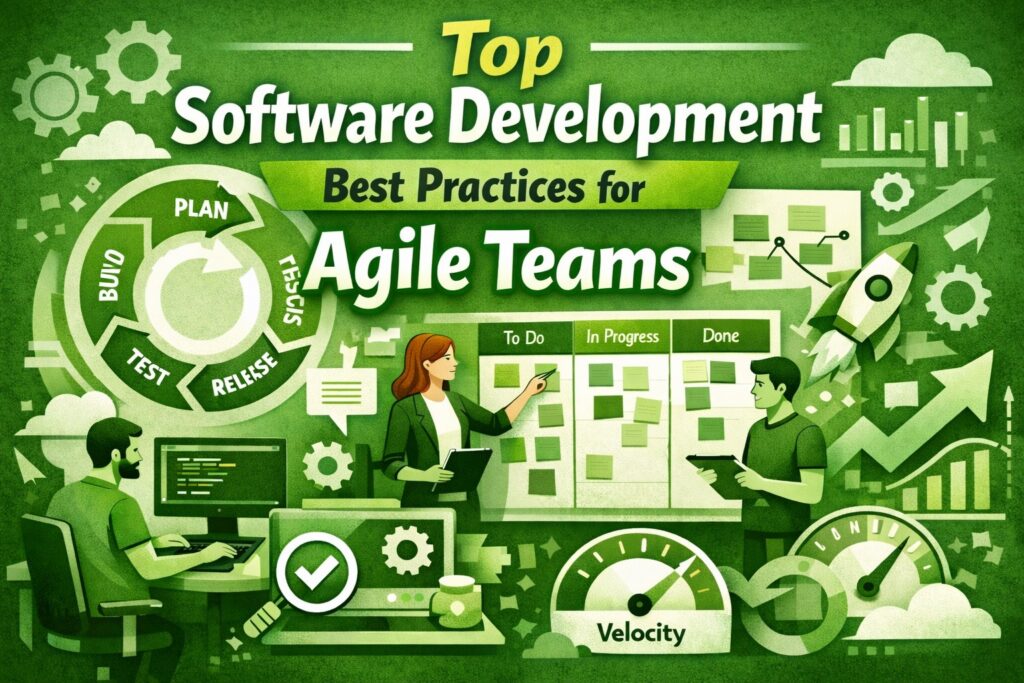
Effective Software Development Best Practices for Agile Workflows
Smart Contract Security Best Practices | Blockchain Development Services | Smart Contract Development
Software development best practices separate struggling Agile teams from market leaders. In fact, code quality, security gaps, and unscalable architecture kill 70% of software projects before they reach profitability. Ultimately, the difference comes down to proven standards executed with precision.
This guide delivers 12 battle-tested software development best practices that top Agile teams use to build enterprise-grade AI in software development, blockchain, and Web3 applications. Moreover, from software requirements specification to production monitoring, you’ll get step-by-step implementation, tools, and real-world examples that are tailored for modern development challenges.
Why are Software Development Practices so Important?
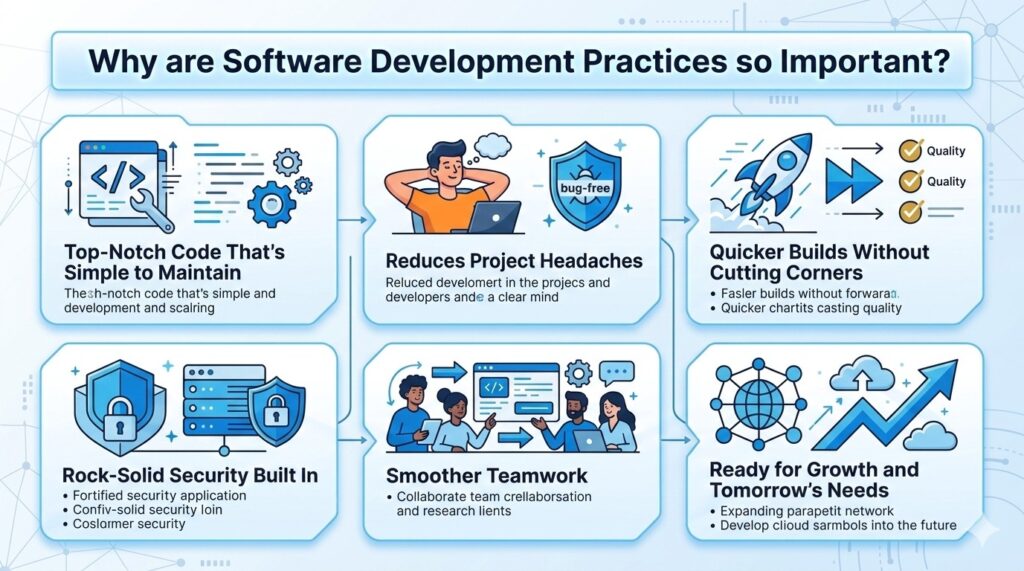
A great software product succeeds because of how it’s made. Industry best practices and software design principles lay a strong foundation not only for solid tech but also for real business wins, such as faster growth and loyal users.
Here’s why your cross-functional teams need them:
-
Top-Notch Code That’s Simple to Maintain
The quality code is clean, consistent, and easy to work with. Following standards, including regular code review, modular designs, and uniform coding conventions. This approach will make code readable and maintainable; hence, lead to fewer glitches and hassle-free updates. For instance, tools like ESLint keep everything tidy.
-
Reduces Project Headaches
Every software project faces some risks, delays, security holes, or extra costs. Structured approaches, including smart planning, regular check-ins with stakeholders, and non-stop testing, catch problems early via test-driven development (TDD) principles. No more small issues turning into disasters.
-
Quicker Builds Without Cutting Corners
Speed counts, but quality first. Agile software development, CI/CD pipeline (like GitHub Actions), automated tests, and DevOps services cut busywork and speed things up. For example, test every change automatically for rapid releases.
-
Rock-Solid Security Built In
Make security part of the process from the start, rather than treating it as an afterthought. For example, use secure coding standards such as OWASP guidelines, perform routine vulnerability scans with tools like Snyk, and implement quick fixes whenever issues appear. As a result, your application stays protected while also strengthening user trust, which is especially important for blockchain or AI projects.
-
Smoother Teamwork
Software thrives on collaboration. Therefore, Agile methodologies, clear chats (Slack), and version control systems like Git keep teams synced. As a result, teams achieve smarter designs, less confusion, and on-time launches.
-
Ready for Growth and Tomorrow’s Needs
Following principles such as modular design, clean APIs (REST/ GraphQL), and cloud-native development ensures your software can handle future growth without any expensive costs. For instance, Netflix manages huge traffic without expensive overhauls. It is perfect for evolving tech like Web3.
Benefits of Implementing Best Practices in Software Development
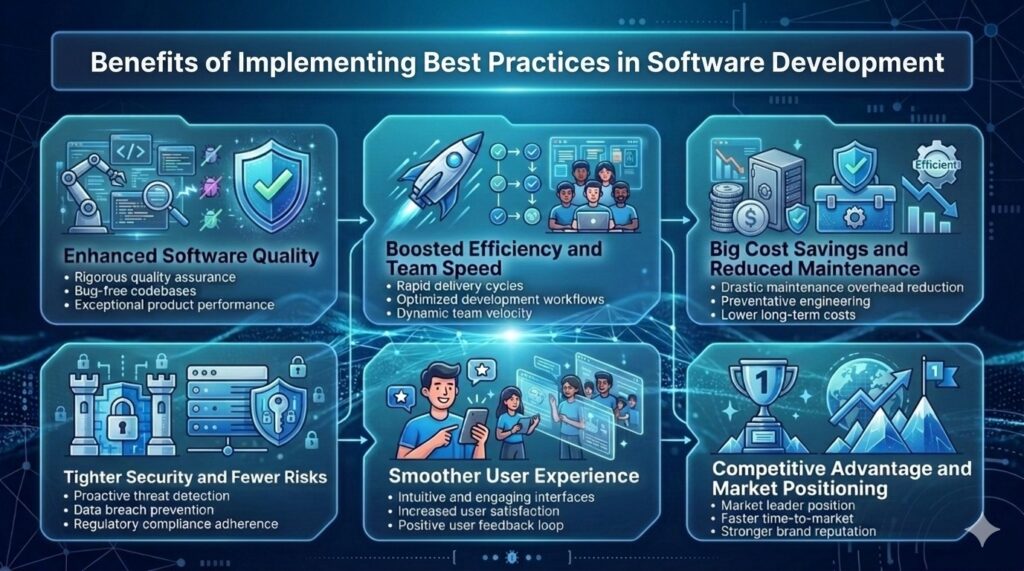
Here are the best practices that go beyond better processes. Furthermore, these benefits shape the software development lifecycle, fortify the end product’s market viability, and strengthen business results.
- Enhanced Software Quality
- Boosted Efficiency and Team Speed
- Big Cost Saving and Reduced Maintenance
- Tighter Security and Fewer Risks
- Smoother User Experience
- Competitive Advantage and Market Positioning
First, implementing software development best practices delivers big cost savings by catching issues early through proactive planning and automated testing, thus eliminating expensive post-launch fixes. Additionally, modular designs enable simple updates without system rewrites, while predictable processes cut overtime and contractor costs over time.
Moreover, teams create smoother user experiences with intuitive applications built on user-centered design, WCAG accessibility standards, and performance optimization that work flawlessly across devices. As a result, satisfied users generate positive reviews, reduce support tickets, and fuel organic growth through word-of-mouth.
Finally, these practices provide a competitive advantage through scalable cloud-native architecture, cutting-edge security, and rapid delivery cycles. In fact, this positions your team as innovation leaders with future-proof software that handles enterprise growth effortlessly, while competitors struggle with legacy systems, ultimately delivering clear market differentiation and accelerated revenue growth.
Top 12 Software Development Best Practices in 2026
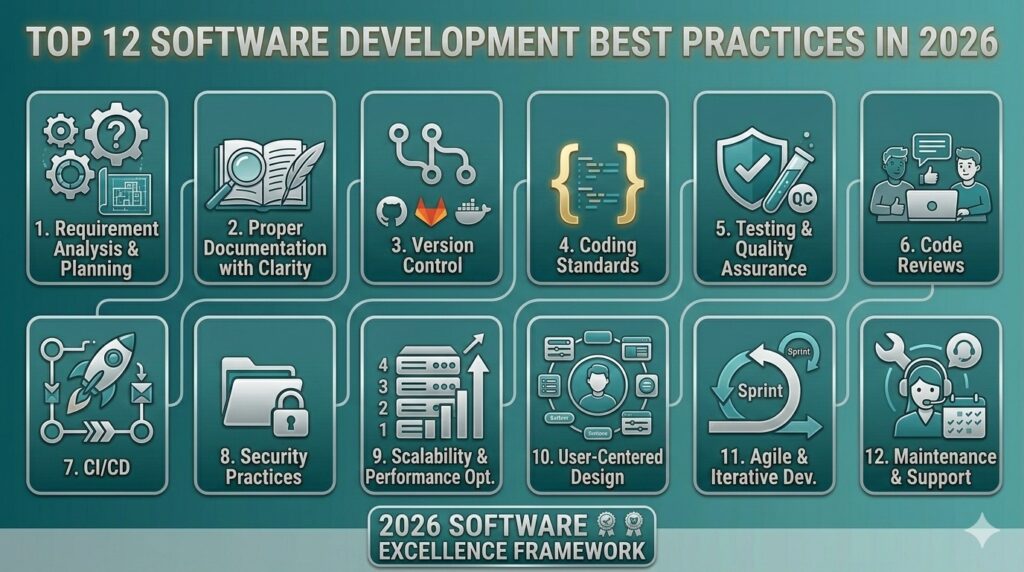
These 12 practices form the backbone of professional software development. Moreover, each includes step-by-step implementation, examples, and tools tailored for modern teams working on AI, blockchain, or enterprise applications.
1. Requirement Analysis and Planning
When you start a project without a clear requirement, it leads to confusion and wastes your efforts. Therefore, you need to thoroughly analyze the requirements so that the project’s goal is well aligned with the client’s expectations and user needs. Create an effective plan with a clear roadmap, mitigate risks, and deliver the project on time. This approach is significant in spotting potential challenges early on.
How To Do:
- Conduct stakeholder interviews and user surveys
- Create user stories and acceptance criteria
- Build a project roadmap with milestones
- Identify risks and create contingency plans
Tools You May Use: Jira, Confluence, Miro, Notion
Example: For a blockchain wallet, define “users must recover wallet with 12-word seed” before development starts
2. Proper Documentation with Clarity
Documentation is the most crucial aspect of software development best practices. Moreover, it provides clear knowledge for current and future teams, making onboarding and knowledge transfer easier. In addition, clear and concise documentation serves as a guide for software maintenance and preserves core functionalities and specifications.
How to do it:
- JSDoc comments for every function/class
- API documentation with Swagger/OpenAPI
- Architecture decision records (ADRs)
- README with setup, deployment, and troubleshooting
Tools you Can Use: Swagger, MkDocs, Docusaurus, GitHub Wikis
Example: Auto-generate ABI docs from Solidity contracts, so that auditors can understand interfaces instantly.
3. Version Control
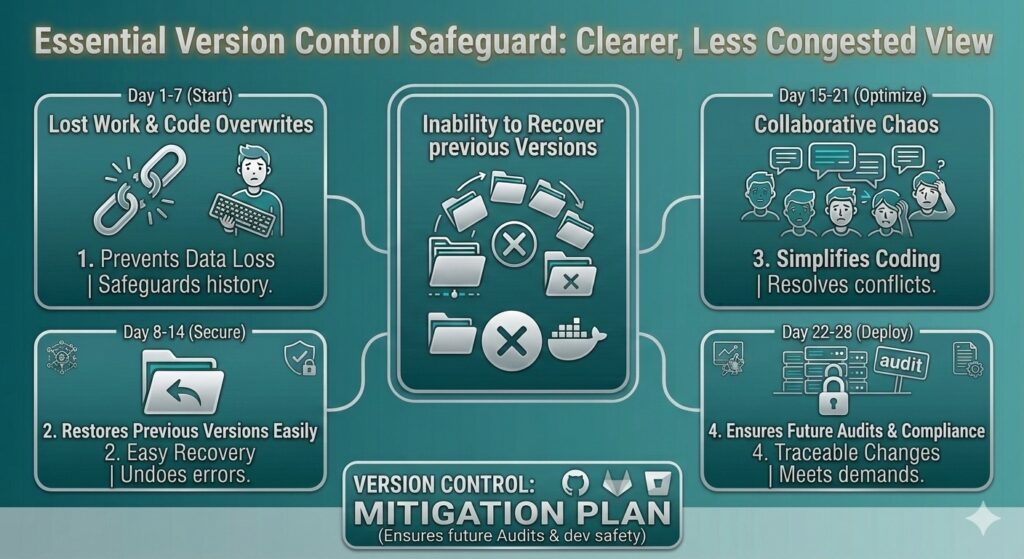
Version control is a tool within software development principles that safeguards the codebase system. It allows multiple developers work simultaneously with a safety net while recovering previous code versions. In short, this is the only way to develop collaboratively, track progress, roll back changes on code, and is crucial for future audits.
How to do it:
- Git with feature branches (feature/add-login)
- Pull requests with 1+ approvals required
- Semantic versioning (v1.2.3)
- Protect main/develop branches from direct commits
Tools: GitHub, GitLab, Bitbucket
Example: AI teams keep model versions as separate branches (v1-gpt4 vs v2-llama3)
4. Coding Standards
Coding standards maintain consistency and readability within the software development process. Furthermore, they guide developers to write uniform code, facilitating easier maintenance and updates. In addition, adherence to these standards reduces complexity, making software stable and secure against vulnerabilities.
How to do it:
- Enforce ESLint/Prettier in the CI pipeline
- 80-character line limit, consistent naming
- Functions < 20 lines, classes < 200 lines
- Follow language-specific style guides (PEP8, Google Java Style)
Tools: ESLint, Prettier, SonarQube
Example: Blockchain contracts use consistent naming, for example, onlyOwner and safeTransfer.
5. Testing and Quality Assurance
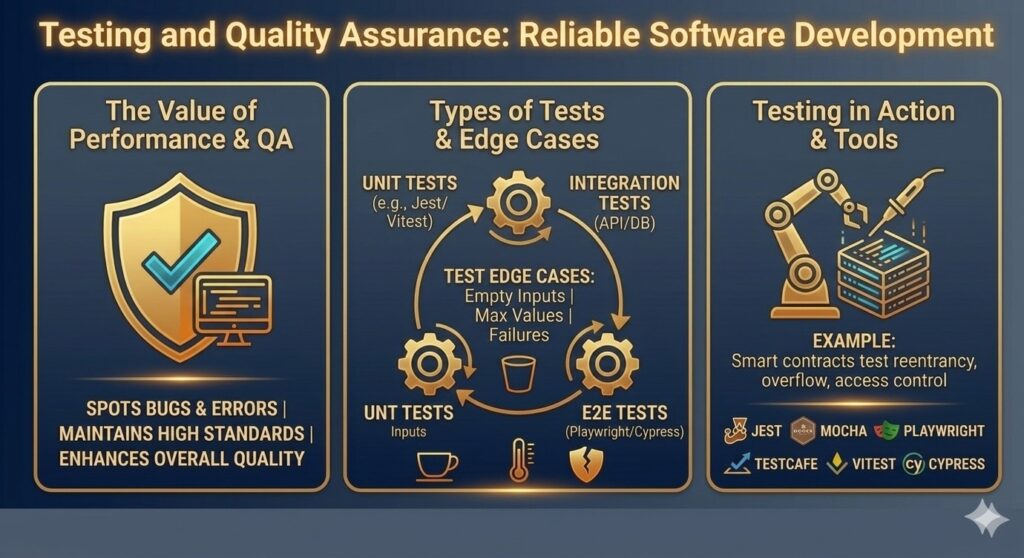
Software performance testing is a non-negotiable software development practice that spots bugs and errors before they affect any user. Moreover, quality assurance (QA) sets high standards throughout the development process and maintains the reliability of the final product to meet requirements. As a result, regular QA promptly addresses issues and enhances the software’s overall quality.
How to do it:
- Unit tests (Jest/Vitest) for individual functions
- Integration tests for API/database interactions
- End-to-end tests (Playwright/Cypress) for user flows
- Test edge cases: empty inputs, max values, failures
Tools: Jest, Mocha, Playwright, TestCafe
Example: Smart contracts test reentrancy, overflow, and access control
6. Code Reviews
Code review is essential for an error-free software development process. Team members review each other’s work, spot bugs, suggest new ways, and teach better tricks. Hence, it fosters the culture of sharing knowledge and continuous learning. Moreover, reviews not only spot mistakes early but also ensure the code aligns well with established standards and best practices.
How to do it:
- 1+ reviewer required per PR
- 200-line limit per review session
- Check security, performance, SOLID principles
- Leave actionable feedback, not style nitpicks
Tools: GitHub PRs, GitLab Merge Requests
Example: Senior dev reviews junior’s blockchain access control logic
7. Continuous Integration and Continuous Deployment (CI/CD)
Continuous integration and continuous deployment (CI/CD) serve as the automated backbone of modern software engineering while transforming the delivery lifecycle into a streamlined, high-speed pipeline. CI/CD ensures that every update is tested and deployed with consistent reliability, thereby effectively eliminating the risks associated with manual intervention. As a result, teams can release more robust applications and remain highly responsive to evolving market demands.
How to do it:
Commit → Lint → Test → Security Scan → Deploy Staging → Manual Approval → Production
- Blue-green deployments for zero downtime
- Rollback strategies for failed deploys
Tools: GitHub Actions, Jenkins, GitLab CI, CircleCI
Example: Deploy smart contracts to testnets automatically after Slither passes
8. Security Practices
It is essential to integrate robust security practices from the outset to mitigate cyber threats. Therefore, developers must prioritize secure coding, encryption, and regular security audits. As a result, this proactive approach maintains integrity throughout the software development lifecycle.
How to do it:
- Snyk/Dependabot for dependency vulnerabilities
- OWASP ZAP for runtime security testing
- Secret scanning (no hardcoded API keys)
- Rate limiting, input validation, HTTPS everywhere
Tools: Snyk, OWASP ZAP, GitHub CodeQL
Blockchain: Slither, Mythril, Hardhat security plugins
Example: Never trust user input; therefore, sanitize everything.
9. Scalability and Performance Optimization
Designing for scalability means building apps that handle growth smoothly without slowing down. Furthermore, strategic planning and regular performance checks keep applications fast and responsive as user numbers increase. As a result, scalable apps deliver better experiences while staying cost-effective to maintain during expansion.
How to do it:
- Database indexing and query optimization
- Caching (Redis), CDN (Cloudflare)
- Horizontal scaling with load balancers
- Async processing for long-running tasks
Tools: New Relic, DataDog, Lighthouse
Example: Paginate blockchain transaction history
10. User-Centered Design
Another best practice is to adopt a user-centered design approach so that it aligns well with the final product and meet expectation with the users’ needs. This approach includes an interactive design process, in which user feedback is consistently compiled, evaluated, and integrated into ongoing improvements. Furthermore, by prioritizing the user experience, organizations can enhance satisfaction, foster loyalty, and improve retention. In short, it’s a key factor in the long-term success of any application.
How to do it:
- WCAG 2.2 accessibility compliance
- 5-user usability tests per iteration
- A/B testing for key flows
- Mobile-first responsive design
Tools: Figma, UserTesting, Hotjar
Example: Crypto wallet shows gas fees clearly before transactions
11. Agile and Iterative Development
Agile development and iterative methodologies prioritize flexibility and the ability to respond quickly to change, which are critical in today’s fast-evolving market landscape. Furthermore, by organizing work into short, focused sprints and fostering strong collaboration among cross-functional teams, these approaches support continuous feedback, rapid adaptation, and ongoing enhancement. As a result, frequent iterative releases ensure that users receive timely updates, helping the software remain current, competitive, and aligned with evolving needs.
How to do it:
- 2-week sprints with planning, review, and retrospective
- Daily 15-min standups
- Product owner prioritizes backlog
- Definition of Done (DoD) for every story
Tools: Jira, Trello, Azure DevOps
Example: AI model improvements deployed iteratively
12. Maintenance and Support
To keep ongoing maintenance and support of software development, maintain reliability and durability. They include troubleshooting and fixing issues as well as updating the software to meet current standards and the latest technologies. Moreover, proactive maintenance prevents issues early before they occur. This approach will address issues promptly.
How to do it:
- Automated monitoring (Sentry, DataDog)
- Monthly security patches
- Feature flags for safe rollouts
- 24/7 on-call rotation
Tools: Sentry, PagerDuty, feature flags (LaunchDarkly)
Example: As a result, Hotfix critical blockchain vulnerabilities within 24 hours
Join Flexlab for Battle-Tested Software Development
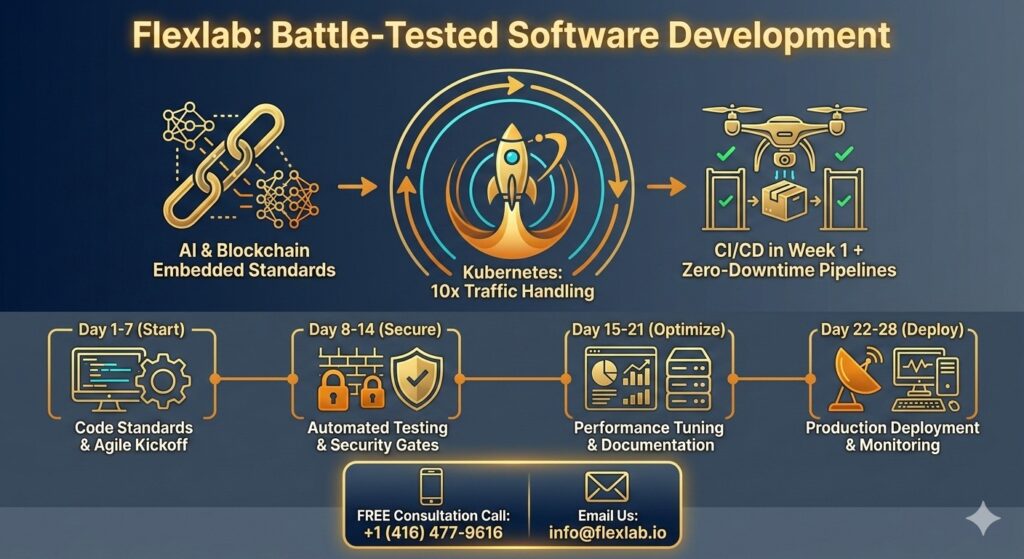
We don’t chase trends; instead, we ship software that scales to millions. Moreover, forget generic “best practices.” Flexlab is a leading custom software development company whose AI and blockchain specialists embed 12 proven standards directly into your codebase.
What Sets Flexlab Apart:
We focus on real projects instead of just slides; for example, we’ve already audited over 50 smart contracts. Moreover, our approach combines speed and security, with CI/CD pipelines up and running by Week 1. In addition, DevSecOps is built right in, running OWASP ZAP scans from the very first commit. Finally, everything is growth-ready, using Kubernetes clusters that handle 10x more traffic without a hitch.
Your Custom Flexlab Blueprint:
- Days 1-7: Code standards + GitFlow + Agile kickoff
- Days 8-14: Automated testing + CI/CD + security gates
- Days 15-21: Performance tuning + documentation system
- Days 22-28: Production deployment + monitoring dashboard
Clients Get:
- Live smart contracts passing Slither audits
- Zero-downtime GitHub Actions pipelines
- WCAG-compliant React/Vue frontends
- Full handover – your team runs it independently
Ready to Transform Your Software Development?
📞 Book a FREE Consultation Call: +1 (416) 477-9616
📧 Email Us: info@flexlab.io
Visit our AI and blockchain blog page, and also discover insightful details on the Benefits of AI in Supply Chain, Public Key Vs Private Key, AI in Marketing, Enterprise AI Solutions, and learn how Flexlab helps Toronto Businesses Scale Faster With AI Automation.
Conclusion
The 12 software development best practices above represent the exact standards that distinguish profitable tech companies from struggling ones. But here’s the reality: most teams never move beyond theory because they lack the systems, automation, and expertise to execute at scale.
Implementing these shifts isn’t just about writing better code; rather, it’s about building a culture of excellence that future-proofs your business against rapid changes in AI, Blockchain, and Web3. Additionally, contact us now and visit our LinkedIn page to transform your development process with our software development services.
FAQs
1. What are the 5 pillars of software development?
The five pillars of software development are requirements and planning, design and architecture, development, testing, and deployment with maintenance. Moreover, these stages ensure that software is properly planned, built, verified, and maintained. In addition, each pillar supports quality, functionality, and long-term sustainability. Together, they create a structured framework for successful software delivery.
2. What are some best practices for successful software engineering?
Successful software engineering involves writing clean, maintainable code and following coding standards. It requires strong teamwork, proper documentation, and thorough testing. Security, scalability, and performance must be considered from the beginning. Continuous learning and improvement also contribute to long-term success.
3. What are SDLC best practices?
SDLC best practices include clear requirement gathering, iterative development, and continuous testing. Furthermore, they emphasize version control, code reviews, and risk management throughout the lifecycle. In addition, automation through CI/CD improves efficiency and reduces errors. Finally, continuous feedback ensures ongoing improvement and adaptability.