
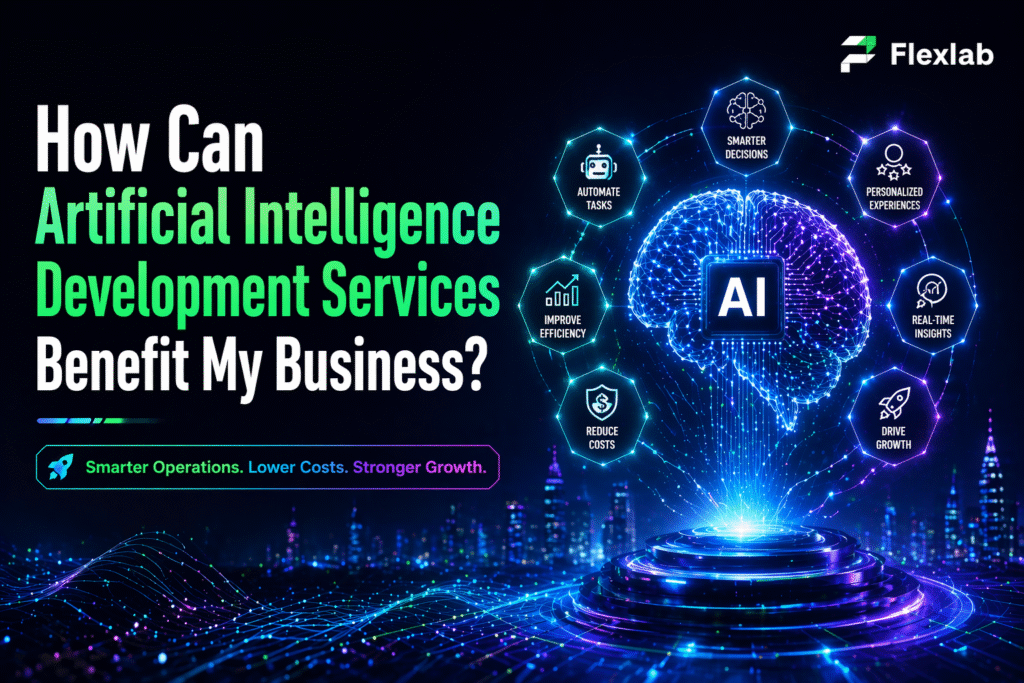
Key Advantages of Using Artificial Intelligence Development Services in Your Company
Enterprise AI Solutions | AI Automation Services in 2026 | 11 Best AI Tools
Artificial intelligence development services benefit businesses in several ways. For example, they reduce operational costs, automate repetitive tasks, and improve decision-making. In addition, they deliver personalized customer experiences at scale. As a result, if you’re evaluating whether AI is worth the investment, the data is already clear. According to McKinsey, 88% of companies use AI in at least one business function, making it a baseline capability rather than a future trend.
The gap now isn’t awareness; it’s execution. In fact, Businesses that have already implemented AI are operating faster, leaner, and more efficiently, in fact gaining a strong competitive advantage.
While others are still deciding where to begin, whether you’re running a startup or scaling a mid-sized company, AI development services are now accessible, practical, and capable of delivering measurable ROI. The real question isn’t if AI can benefit your business; it’s where to start and how to implement it correctly.
By the end of this guide, you’ll know exactly how artificial intelligence development services work, where they’ll move the needle most for your business, and how to get started without burning your budget on the wrong things.
Defining AI Development Services in 2026
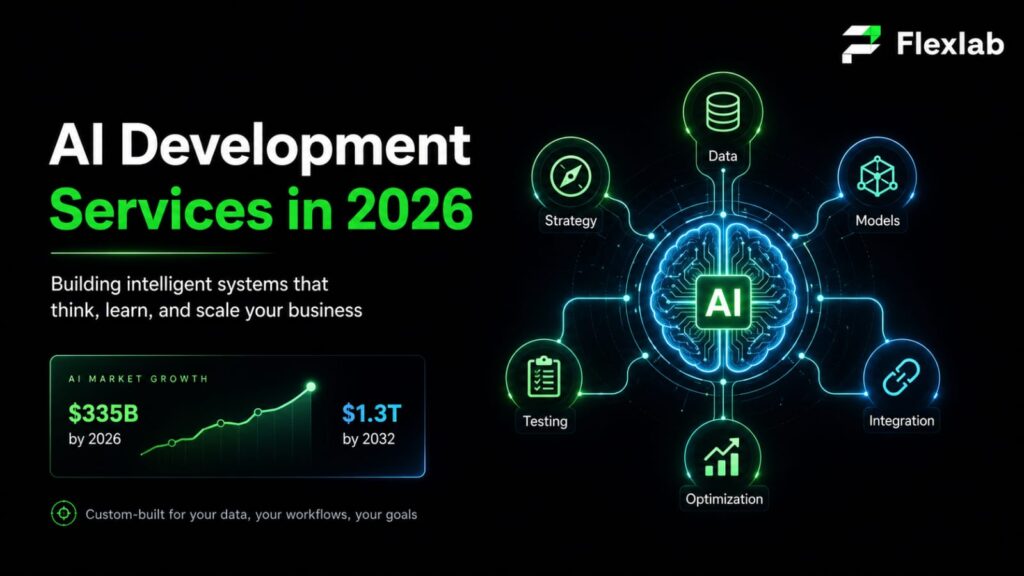
Artificial intelligence development services refer to the end-to-end process of designing, building, and deploying intelligent systems that can think, learn, and make decisions, like a human would, but faster, at scale, and without the coffee breaks. These systems analyze data, recognize patterns, and take actions that would otherwise require a trained person sitting behind a screen.
As reported by Statista, the global AI market is on track to reach US$335.29 billion in 2026 and grow at 25.38% annually, reaching US$1.30 trillion by 2032. The US alone accounts for US$75.14 billion of that in 2026. This is not hype money; this is real investment from real businesses that are already seeing returns. So what does this actually look like in practice? Let’s break it down by its type.
-
Core Components of a Professional AI Build
AI software development services cover everything from initial strategy and data preparation, all the way to building, training, testing, and maintaining intelligent systems inside your business. Think of it less like buying a software tool off the shelf and more like hiring a team that builds a brain specifically for your operation, one that learns your data, your customers, and your goals.
Additionally, these artificial intelligence development services are not one-size-fits-all. A healthcare company needs AI that handles patient data carefully. A retail brand needs AI that predicts buying behavior. That’s exactly why custom builds exist and why the right partner matters.
5 Essential AI Service Types for Scalable ROI
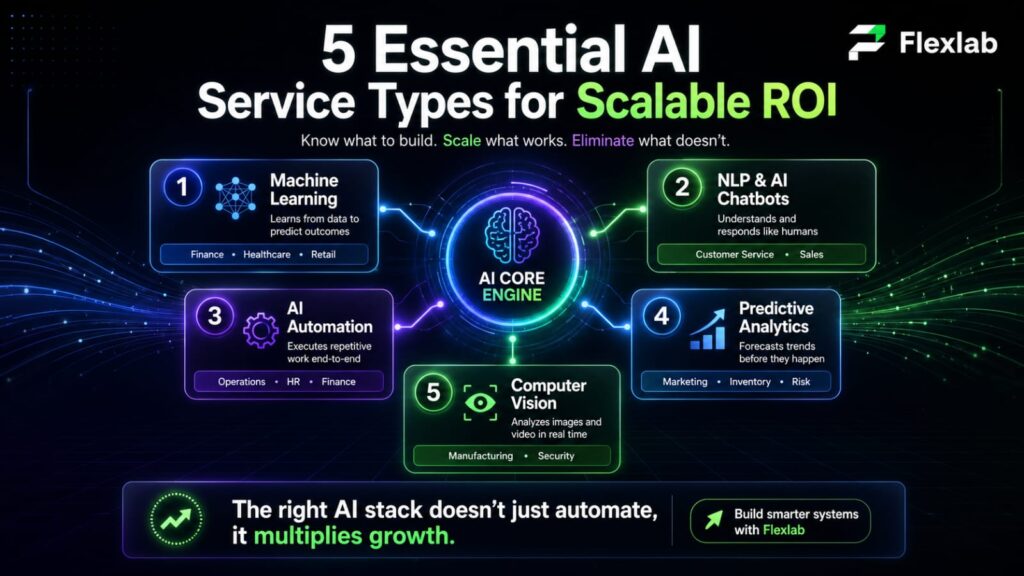
Here’s a quick breakdown of the most common types, so you know exactly what to ask for when you’re ready to move forward with artificial intelligence development services.
| Type | What It Does | Best For |
| Machine Learning | Learns from data to predict outcomes | Finance, healthcare, retail |
| NLP and AI Chatbots | Understands and generates human language | Customer service, sales |
| AI Automation | Handles repetitive tasks end-to-end | Operations, HR, finance |
| Predictive Analytics | Forecasts trends from historical data | Marketing, inventory, risk |
| Computer Vision | Interprets visual data in real time | Manufacturing, security |
1. Machine Learning Development Services: Teaching Your Systems to Think
Machine learning development services are probably the most widely used AI type, and for good reason. Instead of following fixed rules, machine learning models study your historical data and find patterns on their own. The result is a system that gets smarter the longer it runs. Whether you’re predicting customer churn, catching fraudulent transactions, or optimizing your supply chain, machine learning is usually the engine running quietly underneath it all.
2. AI Chatbots: The Customer Service Rep That Never Sleeps
AI chatbots aren’t those clunky pop-up boxes that frustrate customers with scripted responses anymore. Modern AI-powered chatbots understand context, remember previous parts of a conversation, and resolve complex queries without looping in a human agent. Furthermore, they work around the clock, across every time zone, without ever having a bad day. For high-volume businesses, that’s not just convenient; it’s a measurable competitive advantage.
3. Intelligent Automation: Stop Paying People to Do What Machines Do Better
Intelligent automation goes several layers deeper than the basic workflow tools most businesses already use. It handles invoice processing, employee onboarding, compliance checks, and data entry across multiple platforms simultaneously. As a result, your team stops spending Monday mornings on repetitive manual work and starts focusing on decisions that actually move your business forward.
4. AI Predictive Analytics: Know What’s Coming Before It Hits
Imagine knowing which products will spike in demand next quarter, or which customers are three weeks away from canceling. That’s exactly what AI predictive analytics makes possible. By analyzing patterns in historical data, predictive models surface insights that traditional reporting simply can’t catch. Consequently, businesses using predictive analytics don’t just react to what’s happening; they’re already prepared for what’s next.
5. Computer Vision: Give Your Business Eyes That Never Miss a Thing
Artificial intelligence technologies such as computer vision are quietly transforming industries that rely on visual data. In manufacturing, it catches product defects before they reach customers.In retail, it monitors shelf stock in real time, while in security, it flags unusual activity the moment it happens. If your business deals with images, video, or visual processes, computer vision is worth serious attention.
The 7-Step AI Development Lifecycle
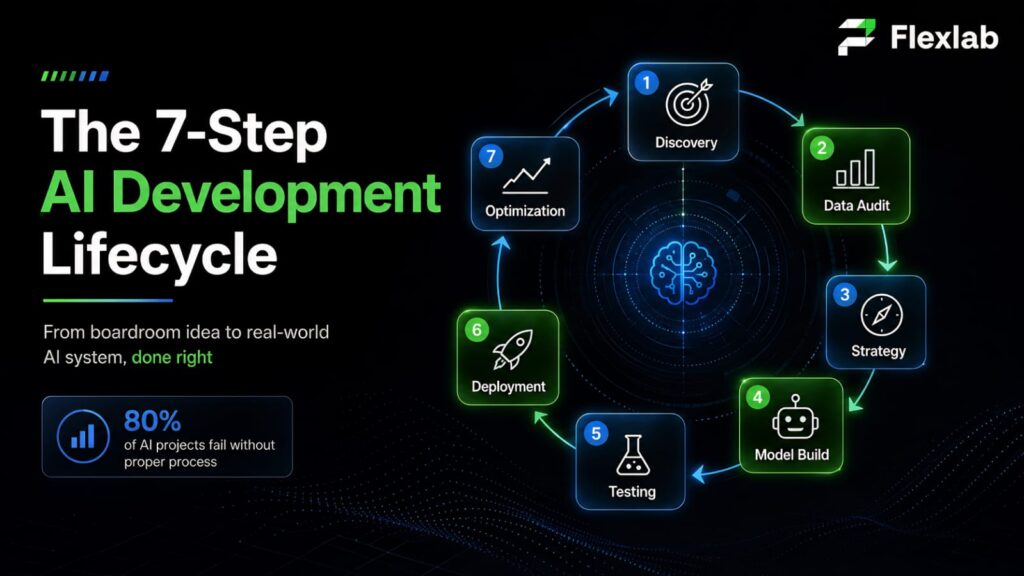
The AI development lifecycle is the structured roadmap that takes an AI idea from a boardroom conversation to a working system inside your business. Understanding this process matters because skipping steps is exactly why most AI projects fall apart. According to RAND via Pertama Partners, 80.3% of AI projects fail to deliver their intended business value, with 33.8% abandoned before ever reaching production. Done right, however, the process is straightforward.
From Strategy to Launch: The Implementation Roadmap
AI strategy consulting is where every successful AI project begins. Skipping this step is one of the most expensive mistakes a business can make. Here is the full lifecycle broken down simply:
- Discovery and Goal Setting: Define the business problem AI needs to solve
- Data Assessment: Audit what data you have, what’s missing, and what needs cleaning
- Strategy and Roadmap: Build a phased plan with clear milestones and measurable outcomes
- Model Development: Build and train the AI model on your specific data
- Testing and Validation: Run the model against real scenarios before going live
- Deployment: Integrate the system into existing workflows with minimal disruption
- Monitoring and Optimization: Track performance and retrain the model as your data evolves
Each step builds on the one before it. Therefore, rushing discovery or skipping data assessment almost always produces a system that works in theory but fails in practice.
How to Build an AI Strategy That Aligns With Your Business Goals
An AI strategy for business works when it starts with a specific problem, not a technology trend. The businesses getting the best results aren’t chasing the latest model releases. They identify exactly where their operations are leaking time or money and build AI around fixing that first.
Additionally, a solid strategy defines success before a single line of code is written. That means setting clear KPIs, deciding who owns the AI initiative internally, and making sure leadership is genuinely bought in. According to McKinsey, AI high performers are more than three times more likely to say their organization intends to use AI to bring about transformative change.
What Does Seamless AI Integration Into Existing Systems Look Like?
AI integration is where a lot of businesses get nervous, and understandably so. Plugging a new intelligent system into your existing CRM, ERP, or support platform sounds complicated. In reality, a good AI development company handles this as part of the build, not as an afterthought.
Seamless integration means your AI works inside the tools your team already uses every day. Your sales team stays in Salesforce. Your support agents stay in their helpdesk. The AI does the heavy lifting underneath. Similarly, proper integration includes team training, so adoption actually happens instead of the tool collecting digital dust after launch.
Direct Business Benefits & Operational Impact
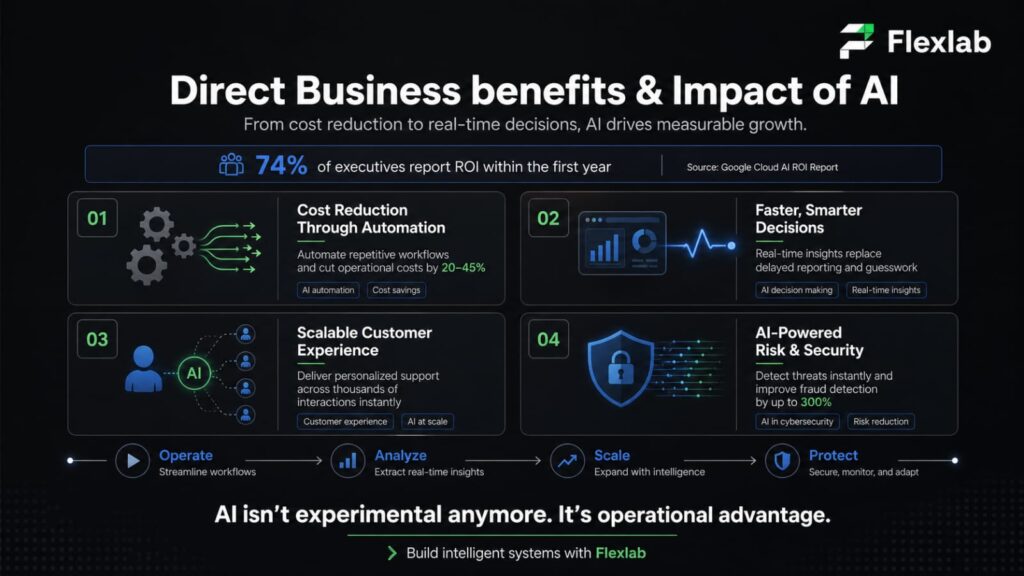
Custom AI solutions deliver value across almost every function in a business, from operations and customer service to sales, finance, and security. In fact, according to Google Cloud’s ROI of AI report, 74% of executives report achieving ROI within the first year of deploying AI agents. Not bad for a technology people spent years calling “experimental.”
Can AI Really Automate Repetitive Tasks and Cut Operational Costs?
Yes, and the savings are significant. Businesses that use AI to automate repetitive tasks report cutting operational costs by 20 to 45% in the functions where AI is deployed. As per Hype Studio, think about every hour your team spends on data entry, invoice processing, report generation, and manual approvals. AI handles all of it, faster and with fewer errors, while your team focuses on higher-value work.
How Does AI Drive Smarter, Faster Business Decisions?
AI systems process data at a scale and speed that no human team can match. They surface trends, flag anomalies, and generate recommendations in real time. As a result, instead of waiting for a weekly report to spot a problem, your team gets an alert the moment something shifts. Businesses using AI-driven decision tools consistently report faster response times and better forecasting accuracy across sales, inventory, and risk management.
How Do AI Assistants Elevate Customer Experience at Scale?
AI assistants resolve queries, personalize recommendations, and handle follow-ups across thousands of customer interactions simultaneously. Moreover, they remember customer preferences, adapt tone based on context, and escalate to a human only when genuinely needed. The result is a customer experience that feels personal even at a massive scale, without the headcount required to deliver it manually.
Why Is AI-Powered Cybersecurity Now a Business Necessity?
AI-powered cybersecurity monitors your systems around the clock and detects threats in milliseconds, far faster than any human security team. According to Mastercard Fullview, AI improved fraud detection by an average of 20%, and up to 300% in specific cases. For businesses handling sensitive customer or financial data, that’s not an optional upgrade. It’s a baseline requirement in today’s threat environment.
Real-World AI Use Cases & Strategic Impacts
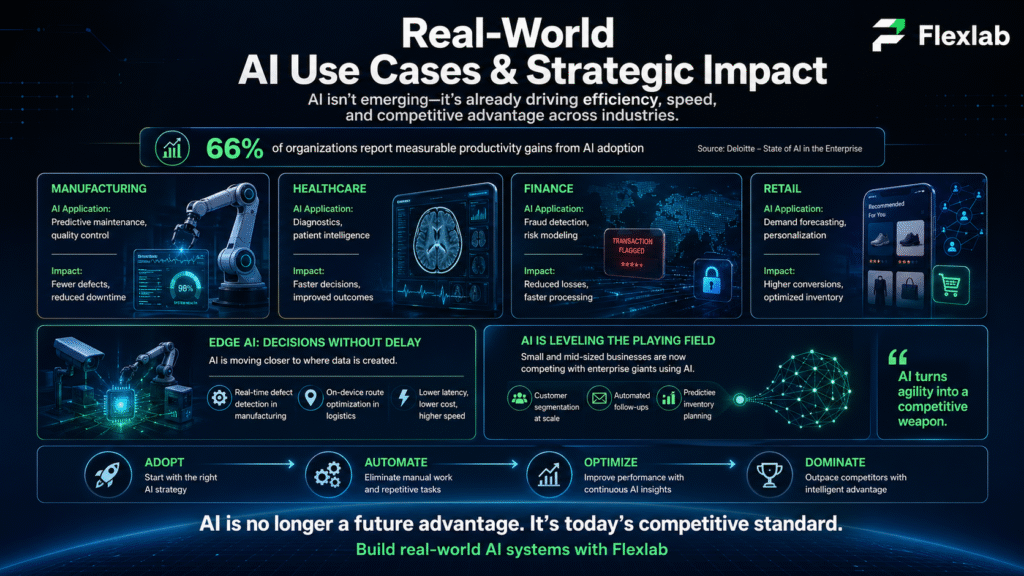
AI for manufacturing, healthcare, finance, and retail isn’t a future concept. It’s happening right now, in businesses of every size, across every geography. According to Deloitte’s State of AI in the Enterprise report, 66% of organizations are already reporting productivity and efficiency gains from AI adoption. Here’s what that looks like across specific industries.
AI in Manufacturing, Healthcare, and Finance, Sector-by-Sector Breakdown
AI product development is reshaping the following industries faster than any other:
| Industry | AI Application | Business Impact |
| Manufacturing | Predictive maintenance, quality control | Fewer defects, less downtime |
| Healthcare | Diagnostics, patient management | Faster decisions, better outcomes |
| Finance | Fraud detection, risk assessment | Reduced losses, faster processing |
| Retail | Demand forecasting, personalization | Higher conversion, lower waste |
Edge AI in Manufacturing and Logistics
Edge AI implementations are transforming operations that can’t afford cloud latency. Instead of sending data to a remote server and waiting for a response, edge AI runs directly on local devices, sensors, and machines. In manufacturing, this means quality defects are caught on the assembly line in real time. In logistics, it means route optimization happens on the vehicle itself. The result is faster decisions, lower data costs, and better performance in environments with limited connectivity.
How SMBs Are Using AI to Compete With Enterprise Giants
Small and mid-sized businesses are closing the gap faster than most people realize. Artificial intelligence developers are now building affordable, scalable AI tools specifically designed for smaller operations. An SMB using AI for customer segmentation, automated follow-ups, and inventory forecasting can now compete directly with an enterprise brand that has ten times the headcount. The playing field is leveling out, and AI is the reason why.
Overcoming Key AI Implementation Challenges
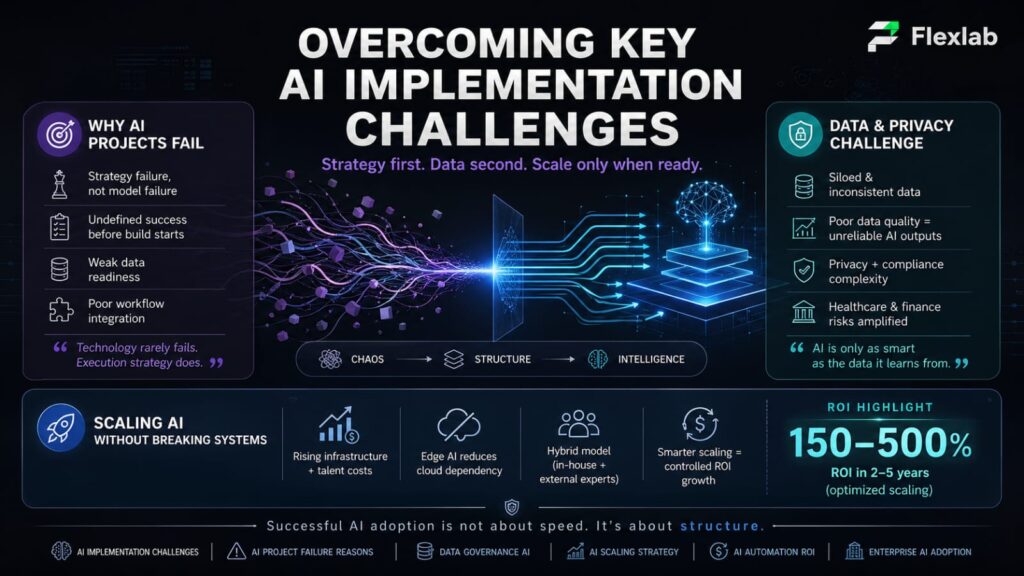
AI automation agency partners and in-house teams both face the same core obstacles when bringing AI into a business. Understanding these challenges up front saves time, money, and a lot of frustration down the road.
-
Why AI Projects Fail: Strategy vs. Technology
Most AI projects fail not because the technology is broken, but because the strategy is. According to the MIT Project NANDA (MIT via SR Analytics), the failure is seldom the model. It is data readiness, workflow integration, and the absence of a defined outcome before build starts. In other words, businesses that define success clearly before they start and choose the right implementation partner dramatically improve their odds.
-
Data Quality and Privacy: The Hidden Obstacles Nobody Talks About
Digital transformation strategy starts with data, and that’s exactly where most businesses run into trouble. If your data is incomplete, inconsistent, or siloed across multiple systems, your AI model will produce unreliable outputs. Garbage in, garbage out. Additionally, privacy and compliance requirements add another layer of complexity, particularly for businesses in healthcare, finance, or any industry handling sensitive customer information. Solving this requires a proper data governance framework before any model is built.
-
How to Scale AI Without Breaking Your Budget or Your Team
Scaling AI is where things can get expensive quickly, especially as infrastructure and AI talent costs start to add up. That’s why it’s important to stay focused early on, rather than trying to build everything at once.
At the same time, many businesses are turning to edge AI to reduce cloud costs and improve performance. On top of that, a hybrid approach often works best, keeping a lean in-house team focused on strategy while relying on external experts for development and maintenance, which helps reduce pressure on internal teams and keeps costs under control.
As a result, AI automation ROI shows that companies that scale the right way often see 150–500% returns over 2–5 years, with smaller businesses seeing results even sooner.
The Future of AI: Trends for 2026 and Beyond
Artificial intelligence developers who are paying attention to where AI is heading are preparing their clients for a business landscape that looks very different from today. The pace of change is accelerating, and businesses that wait to engage are going to find themselves playing an increasingly expensive game of catch-up.
Top AI Trends for Businesses (2026–2030)
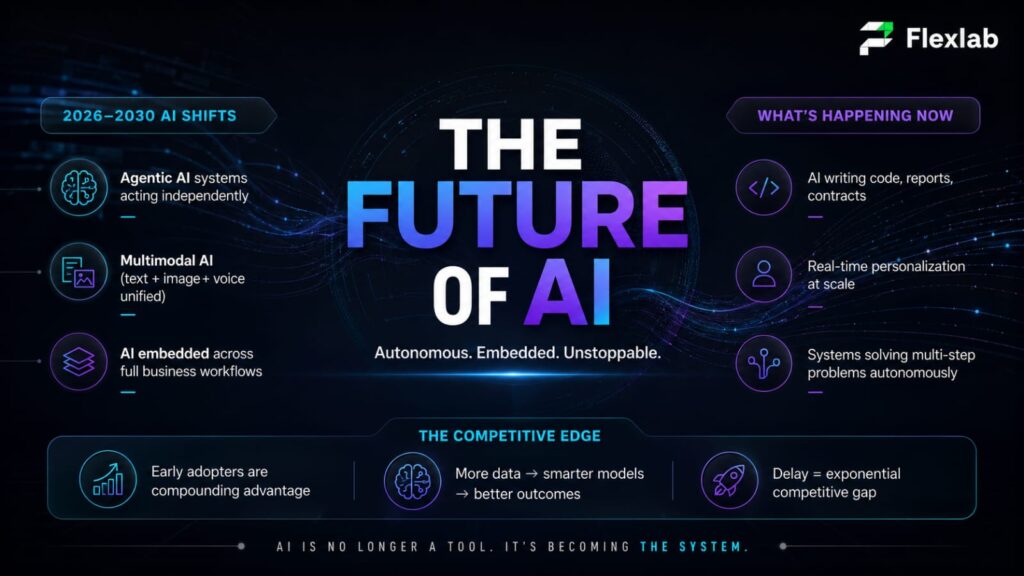
The biggest shifts coming are in agentic AI, multimodal models, and deeply embedded AI systems that run autonomously across entire business functions. According to Deloitte, agentic AI usage is poised to rise sharply in the next two years, but only one in five companies currently has a mature governance model for autonomous AI agents. (Deloitte) The businesses building that governance framework now will have a significant head start.
How Generative AI Is Reshaping Business Operations Right Now
Generative AI is no longer a demo. It’s inside live business workflows, writing code, generating reports, personalizing customer communications, and drafting contracts. AI machine learning models are also becoming far more capable at reasoning through complex, multi-step problems autonomously. Consequently, the line between a tool that assists humans and a system that handles work independently is blurring faster than most business owners expected.
Why Businesses That Invest Now Will Lead Tomorrow’s Market
The window to get ahead is still open, but it’s narrowing. AI strategy consulting data consistently shows that early adopters are compounding their advantage over time. Every month of AI use generates more training data, which produces better models, which deliver better results. In contrast, businesses that delay aren’t just missing out on efficiency gains today. They’re falling further behind on the learning curve that will determine market leadership in three to five years.
Drive Real Business Results with Flexlab Artificial Intelligence Development Services
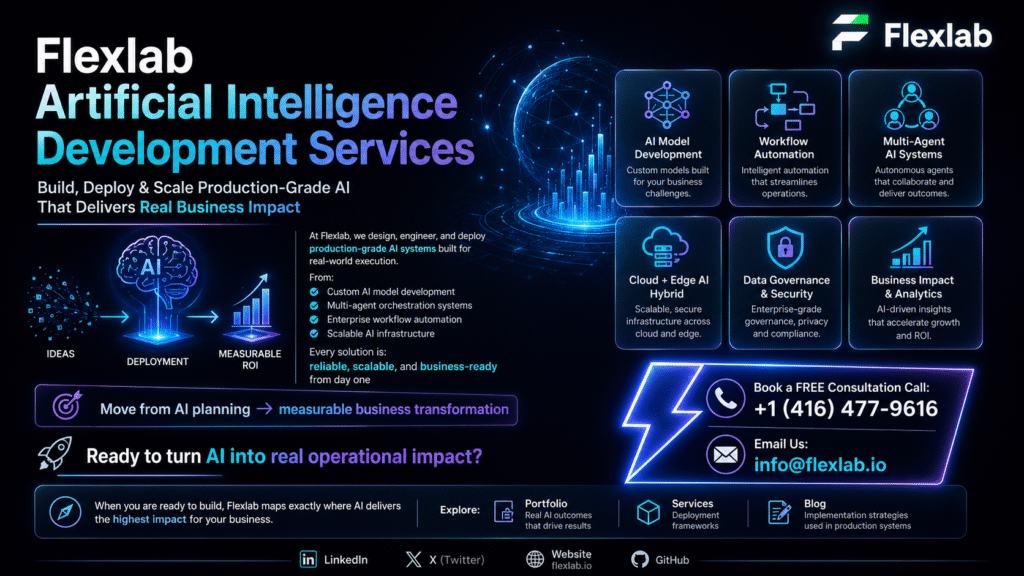
At Flexlab, we design, engineer, and deploy production-grade artificial intelligence development services built for real-world execution. From custom model development and multi-agent orchestration to enterprise workflow automation, every solution is scalable, reliable, and business-ready from day one.
This is the right moment to act. Visit our services page to see exactly how we architect and deploy AI for specific business use cases. Ready to go deeper? Our blog covers real implementation strategies businesses are executing right now. Such as:
When you are ready to build, contact us, and we will map out exactly where AI delivers the highest impact for your operation. Stay connected on LinkedIn for case studies, implementation insights, and emerging AI strategies worth acting on.
The Final Verdict on How to Maximize Artificial Intelligence Development Services for Your Business
Probably, yes. And waiting has a real cost. Throughout this guide, you’ve seen what AI can do across operations, customer experience, security, and decision-making. You’ve also seen why the implementation approach matters just as much as the technology itself.
The businesses winning with AI right now aren’t the ones with the biggest budgets. They’re the ones that started with a clear problem, chose the right partner, and built from there. That’s a formula any business can follow.
The technology is ready. The results are proven. The only question left is whether your business will be in the group that leads, or the one that catches up later.
Ready to move from planning to measurable impact?
📞 Book a FREE Consultation Call: +1 (416) 477-9616
📧 Email Us: info@flexlab.io
How much do custom AI development services actually cost for a mid-sized business?
Pilot projects usually land between $20k and $50k to get a working prototype off the ground. While that range depends on your specific data, the goal is to target one high-impact problem to prove ROI early. Furthermore, starting with a focused sprint prevents you from overspending on features your team won’t actually use. Ultimately, it’s about buying a solution that scales with you, rather than a massive, one-size-fits-all package.
Will implementing AI require me to overhaul my company’s entire existing tech stack?
Actually, you don't need to scrap your current tools because modern AI is built to plug directly into your existing CRM or ERP. By using secure APIs, we can handle the heavy lifting in the background while your team stays in the software they already know. Moreover, this approach keeps your transition smooth and prevents the productivity dip that usually comes with new tech. Consequently, you get a smarter business without the nightmare of a total digital migration.
How do I know if my business data is clean enough to start an AI project?
No one has perfect data, but as long as you have a specific goal, we can usually find enough signal to start. Instead of waiting for a total cleanup, we audit your key systems to ensure the model is learning from your most reliable information. In addition, the development process itself helps organize your data, making it more valuable for the long haul. Therefore, you don't need a pristine database to start seeing a measurable impact on your operations.
How do I start using AI for my business effectively?
To start using AI, first identify one specific problem in your business, such as slow processes or customer response delays. Then, choose a simple AI solution that directly solves that problem instead of trying to automate everything at once. After that, test it on a small scale to measure performance and results. Finally, scale gradually based on ROI and real business impact.