

Exploring the Future of AI Automation in Canada with Flexlab
AI Automation in 2026 | AI Automation Agency in Toronto | Innovative AI Applications
The future of AI automation is changing how businesses across Canada operate, make decisions, and scale in a practical way. Today, companies are not just testing ideas. Instead, they are integrating smarter systems into everyday workflows. This shift is becoming more outcome-focused.
According to BusinessWire, AI adoption is growing rapidly across Canadian workplaces. In fact, there is a strong year-over-year increase in employee usage. At the same time, global projections suggest that AI could contribute up to $15.7 trillion to the economy by 2030. Meanwhile, improvements in machine learning methods are making AI more accessible.
Even with this momentum, many organizations still struggle to turn AI into measurable results. In many cases, they invest in tools but fail to connect them to real business goals. As a result, outcomes remain limited, and understanding the future of AI automation in business is essential for companies that want to scale efficiently and stay competitive.
At this point, the real question arises: where is this heading next, and more importantly, which companies are actually leading this shift in a meaningful way?
Understanding the Future of AI Automation in Canada
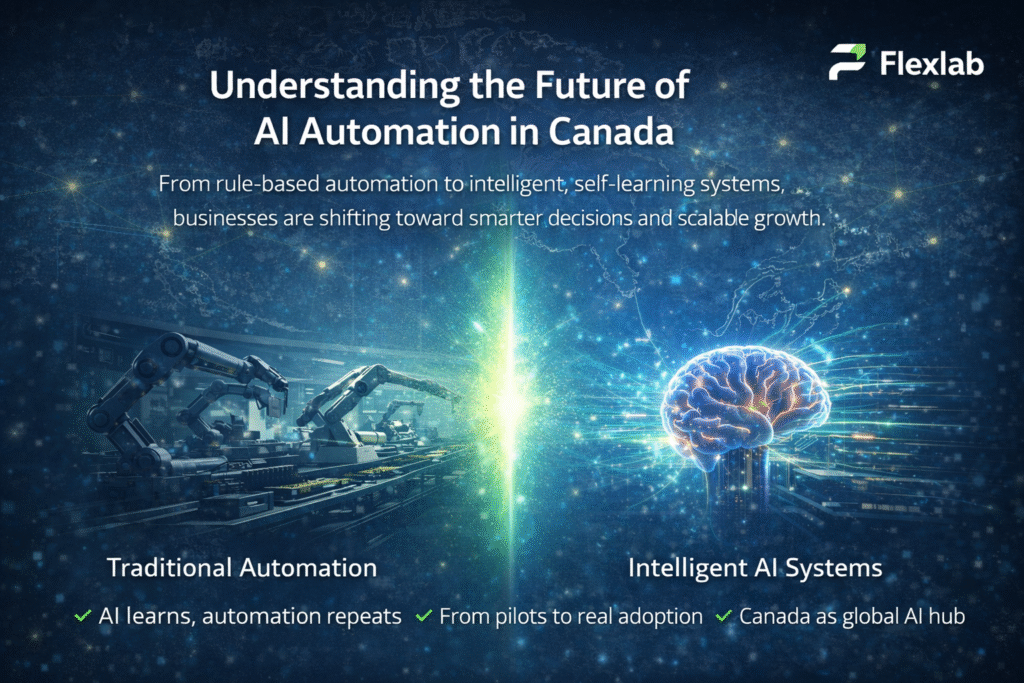
AI is evolving quickly across Canada, and businesses are moving beyond basic tools toward more intelligent systems. Instead of focusing only on efficiency, companies are now aiming for smarter decision-making and scalable growth. In this shift, artificial intelligence is becoming a core part of how organizations operate, plan, and compete in a fast-changing market.
From Traditional Automation to Intelligent Systems
In the past, automation focused mainly on repetitive, rule-based tasks; however, things are changing rapidly. Today, systems can learn from data, adjust in real time, and improve outcomes with minimal human input. This is where AI and automation become important; AI adds learning and adaptability. As a result, businesses can manage complex workflows more efficiently while improving speed, accuracy, and overall performance. At the same time, organizations are reducing delays and creating more responsive operations.
Canada’s Role in the Global AI Ecosystem
Canada continues to strengthen its position as a global AI hub, attracting both investment and skilled talent. Research institutions and tech companies are actively contributing to innovation, especially in areas driven by deep learning techniques. Hence, businesses operating in Canada have access to advanced tools and expertise, which helps them build smarter solutions and stay competitive in a rapidly evolving digital landscape.
From Experimentation to Real Business Adoption
Many companies have already moved past the testing phase and are now applying AI in real-world scenarios. Instead of isolated pilots, businesses are integrating AI into daily operations, customer interactions, and decision-making processes. With the rise of AI technologies, organizations are improving efficiency, reducing manual work, and scaling faster. However, those who fail to adopt AI strategically may struggle to keep up as competitors continue to evolve.
Why Is AI Automation Accelerating Across Canada?
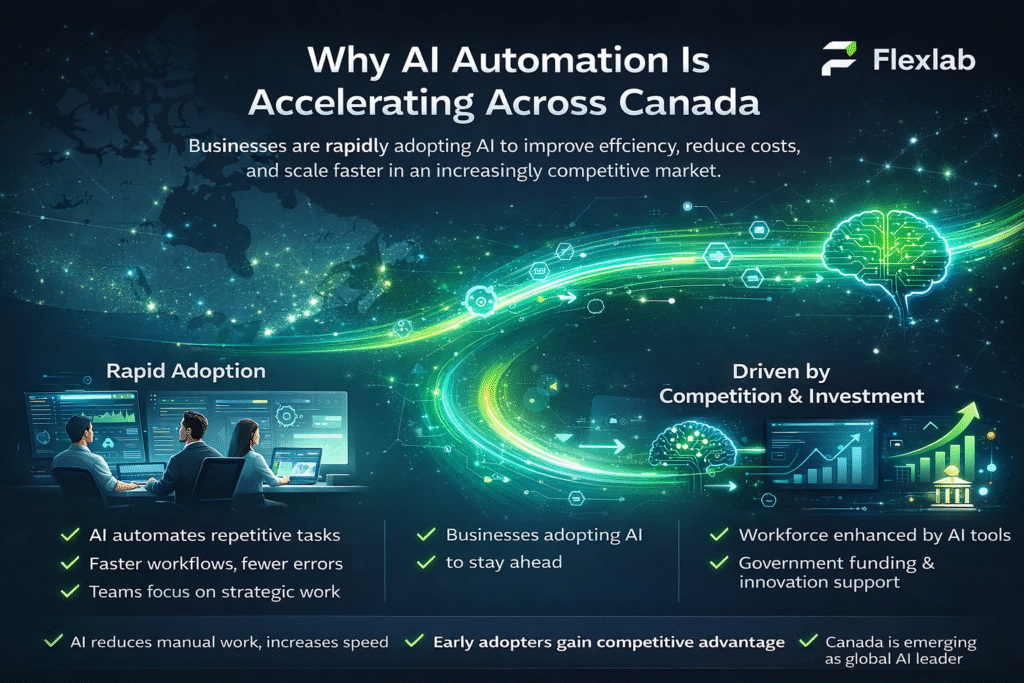
AI adoption is gaining real momentum across Canada, and businesses are moving faster than ever to integrate smarter systems into their operations. As competition intensifies and customer expectations evolve, companies are increasingly focusing on efficiency, speed, and scalability. In this environment, AI trends are not just shaping innovation; they are actively influencing how organizations grow and compete in modern markets.
Rapid Adoption Across Businesses
Businesses across industries are adopting AI to streamline operations and reduce manual effort. Instead of relying on traditional processes, companies are using AI automation tools to handle repetitive tasks and improve productivity. As a result, teams can focus more on strategic work rather than routine activities. This shift is helping organizations operate faster, reduce errors, and scale their processes without significantly increasing costs.
Competitive Pressure Driving Transformation
As markets become more competitive, businesses are under pressure to innovate and adapt quickly. Companies that adopt AI early are gaining an advantage, while others risk falling behind. The impact of AI in the workforce is becoming visible, as employees are using AI to enhance performance and decision-making. Therefore, organizations are rethinking how work gets done and investing more in technologies that improve efficiency and output.
Government Support and Increasing Investments
Government initiatives and private investments are playing a key role in accelerating AI adoption across Canada. With continuous funding and innovation programs, businesses are gaining better access to advanced tools and infrastructure. At the same time, improvements in machine learning methods are making AI more accessible and practical for organizations of all sizes. This combination of support and technology is helping businesses move forward with greater confidence and speed.
Key Trends Shaping the Future of AI Automation
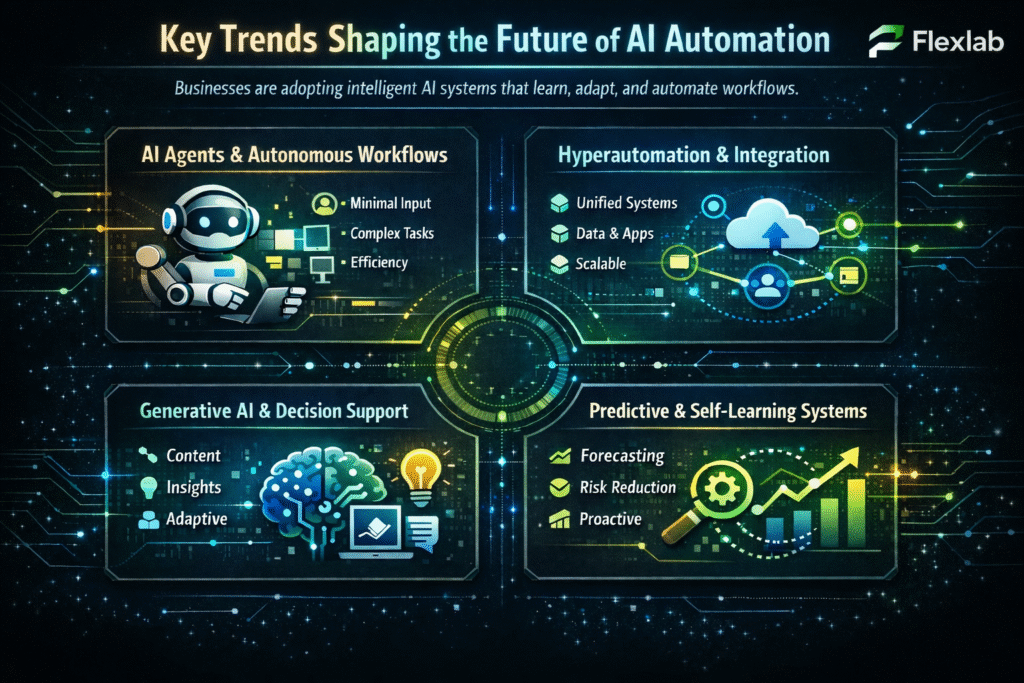
The future of AI automation is not evolving in one direction; instead, multiple innovations are converging to reshape how businesses operate. As companies adopt more advanced systems, they are focusing on automation that can think, adapt, and improve over time. In this shift, generative AI is playing a leading role, especially in content creation, decision support, and workflow optimization across industries.
AI Agents and Autonomous Workflows
AI agents are changing how work gets done by enabling systems to operate with minimal human input. Instead of relying on step-by-step instructions, these systems can make decisions and execute tasks independently. With the rise of autonomous AI, businesses are automating complex workflows that previously required constant supervision. As a result, organizations are improving efficiency, reducing delays, and creating more responsive operations across different functions.
Hyperautomation and Integrated Systems
Businesses are now combining multiple technologies to create seamless, connected workflows. Rather than automating individual tasks, companies are building systems where tools work together. Through intelligent automation, organizations can integrate data, processes, and applications into one unified system. Because of this, workflows become faster, more accurate, and easier to scale, enabling businesses to handle increasing demands without adding unnecessary complexity.
Predictive and Self-Learning Systems
Modern AI systems are becoming more advanced, capable of learning from data and continuously improving. Instead of reacting to problems, businesses can anticipate outcomes and take proactive steps. By using AI models, organizations can analyze patterns, forecast trends, and make better decisions. This shift toward predictive intelligence is helping companies reduce risks, improve planning, and stay ahead in competitive markets.
Challenges Slowing AI Automation Adoption in Canada
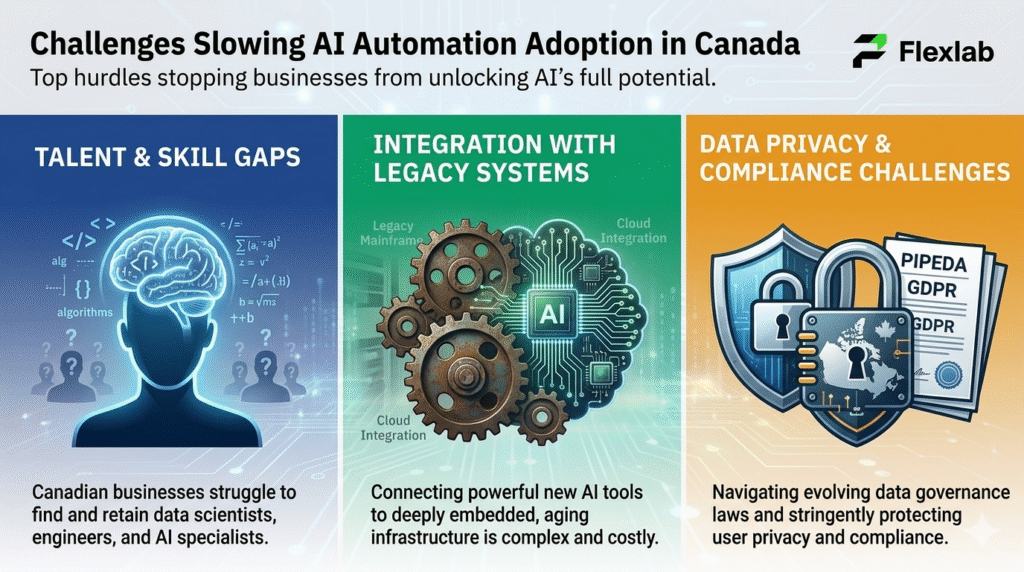
Even though AI adoption is growing, many businesses still face real barriers to implementation. While the potential is clear, execution often becomes complex due to technical, operational, and regulatory factors. Hence, challenges in AI automation adoption continue to slow down progress, especially for organizations that lack a clear strategy or the right expertise.
Talent and Skill Gaps
One of the biggest challenges businesses face is the shortage of skilled professionals who can build and manage AI systems. While demand is increasing, the supply of experienced talent is still limited. Working with advanced technologies often requires expertise in areas such as big data analytics, which many organizations continuously struggle to access. As a result, companies either delay adoption or rely on external support to move forward effectively.
Integration with Legacy Systems
Many organizations still depend on older systems that were not designed to support modern AI technologies. As a result, integrating new solutions becomes complex and time-consuming. When systems are not properly aligned, even powerful tools like AI in operations fail to deliver expected results. As a result, businesses must invest in upgrading infrastructure or carefully planning integration to ensure smooth implementation and long-term success.
Data Privacy and Compliance Challenges
As AI adoption grows, concerns around data security and compliance are also increasing. Businesses must ensure that their systems follow legal requirements while handling sensitive data responsibly. With the help of AI governance tools, organizations can manage risks, maintain transparency, and ensure compliance. However, without proper frameworks in place, companies may face delays, legal risks, and ultimately reduced customer trust.
Real-World Use Cases of AI Automation in Canada
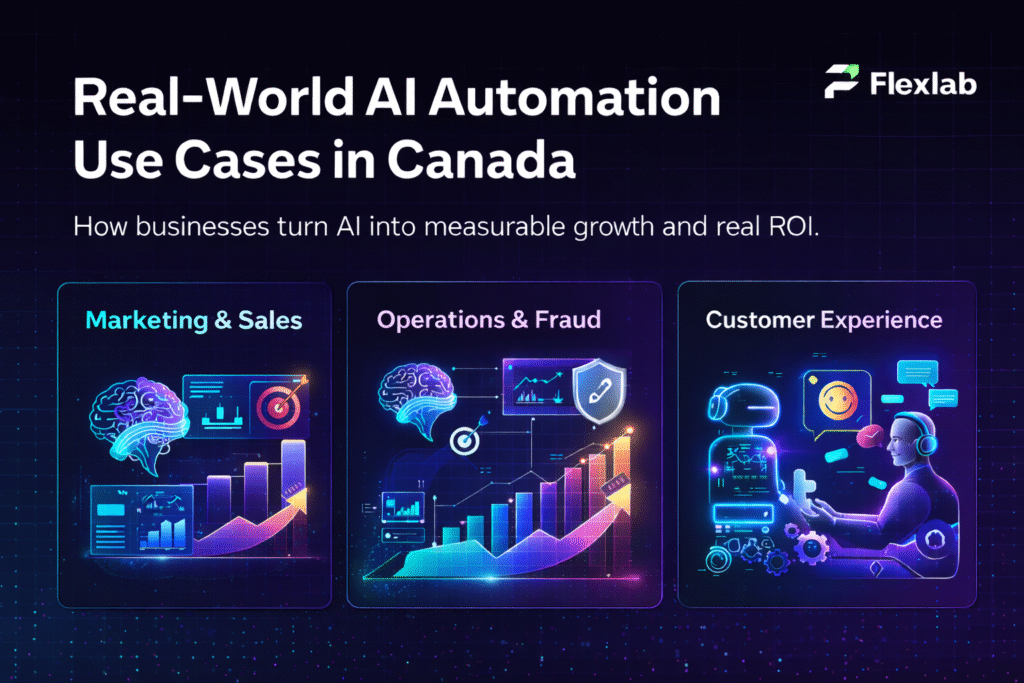
AI is no longer theoretical; businesses across Canada are seeing tangible results by applying intelligent systems in real-world scenarios. These use cases show how AI business solutions are driving efficiency, innovation, and measurable growth across industries. By learning from practical examples, companies can understand how to implement AI successfully in their own operations.
AI in Marketing and Sales
Companies are leveraging AI to optimize campaigns, personalize customer experiences, and boost revenue. With AI in marketing, organizations can analyze customer behavior, predict trends, and tailor messaging for higher engagement. Similarly, AI in sales allows teams to prioritize leads, forecast demand, and close deals faster. This combination of predictive analytics and automation is helping businesses achieve stronger ROI and more consistent growth.
AI in Operations and Fraud Detection
AI is transforming operational workflows, reducing errors, and increasing efficiency. From inventory management to logistics, companies are applying AI in operations to streamline processes and cut costs. In addition, AI in fraud detection is helping financial and e-commerce organizations identify unusual patterns, prevent losses, and protect customers. These applications prove that AI can safeguard both resources and revenue simultaneously.
AI-Powered Customer Experience
Customer service is another area where AI is delivering real impact. Businesses are deploying AI-powered chatbots and virtual assistants to provide 24/7 support, answer queries instantly, and personalize interactions. By automating routine tasks, companies free up human agents to handle complex problems, creating a faster, more satisfying customer experience. These solutions demonstrate that AI can enhance relationships while maintaining operational efficiency.
How Flexlab Is Leading the AI Automation Shift in Canada
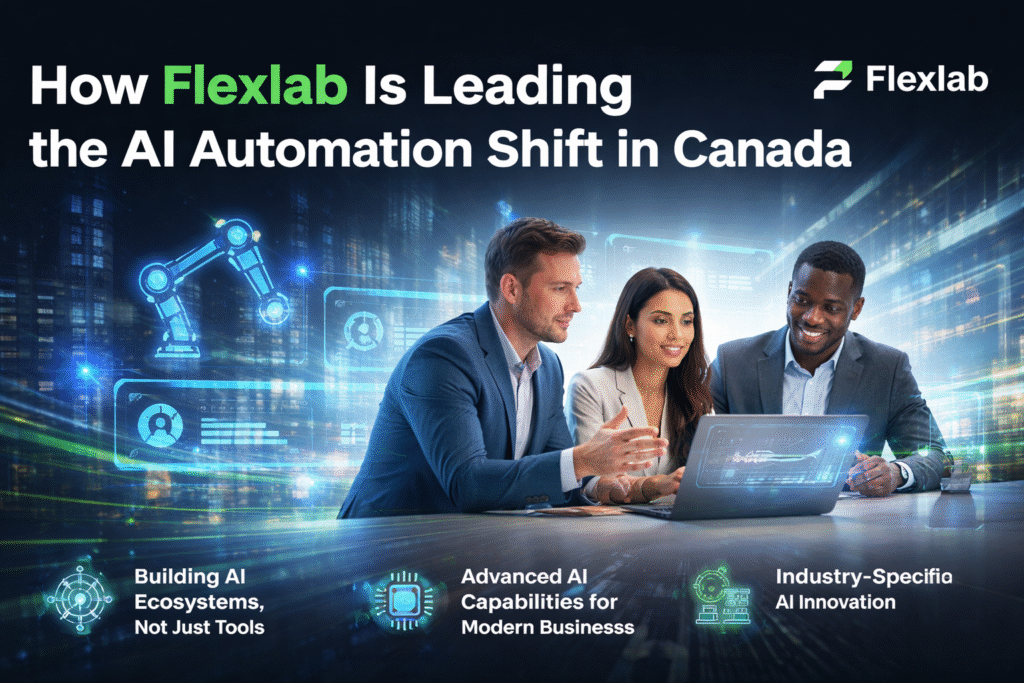
As AI adoption grows, businesses are looking for partners who can turn ideas into real, scalable solutions. This is where Flexlab stands out by focusing on execution, strategy, and long-term impact. Instead of offering isolated tools, Flexlab operates as an AI automation agency, enabling companies to build systems designed for real business outcomes.
Building AI Ecosystems, Not Just Tools
Many providers focus on individual solutions; however, Flexlab takes a broader approach by building connected systems. By combining AI and automation, the company ensures that workflows, data, and processes work together seamlessly. As a result, businesses can move beyond fragmented tools and operate with fully integrated systems that improve efficiency, visibility, and overall performance across departments.
Advanced AI Capabilities for Modern Businesses
Flexlab leverages cutting-edge technologies to deliver flexible and scalable solutions tailored to each client’s needs. By using open source large language models, the company creates systems that are adaptable, cost-effective, and future-ready. This approach allows businesses to innovate faster, customize their solutions, and stay ahead in a competitive environment where technology is constantly evolving.
Industry-Specific AI Innovation
Different industries require different solutions, and Flexlab understands that deeply. By applying AI across sectors, the company delivers targeted innovation that solves real problems. For instance, in logistics and mobility, AI in transportation is enabling businesses to optimize routes, reduce delays, and improve operational efficiency. This focus on practical, industry-specific outcomes ensures that clients achieve measurable results, not just technical upgrades.
Scale Your Business with Flexlab’s AI Automation Solutions
If you’re serious about scaling with the future of AI automation, now is the time to act. While many businesses are still testing ideas, Flexlab is already enabling companies to turn AI into real, measurable growth. Instead of getting stuck in experimentation, you can start building systems that actually deliver results, drive efficiency, and create long-term competitive advantage.
Once you’re ready to move forward, explore how Flexlab approaches AI transformation. Review services to find what fits your business.
If you prefer to start with a conversation, simply contact us and discuss your goals. You can also stay up to date with the latest trends and insights by connecting on LinkedIn. Finally, if you want to keep learning before making a decision, explore our blog, where you’ll find in-depth guides, strategies, and real-world insights.
such as:
- Detailed Guide to AI Automation Services in 2026
- How Flexlab Helps Toronto Businesses Scale Faster With AI Automation
- What are Enterprise AI Solutions? A Complete Guide for Large Organizations
The opportunity is here, the shift is happening, now it’s your move.
Final Thoughts: AI Automation in Canada 2026
AI is reshaping how businesses across Canada operate, compete, and scale, and this shift is becoming more practical with every passing day. Companies that take action early are already building smarter systems, while others are still working to connect strategy with execution. Therefore, the gap between adoption and real results is becoming more noticeable.
At the same time, success with the future of AI automation is not just about using tools; it is about building systems that align with real business goals. Organizations that focus on scalability, efficiency, and long-term value will stay ahead in a competitive market.
This is where Flexlab creates real impact. By turning complex AI ideas into practical solutions, Flexlab enables businesses to move forward with clarity and confidence. As adoption continues to grow, companies that invest in the right approach today will be better positioned to lead in the long run.
Ready to Turn AI Into Real Business Growth?
📞 Book a FREE Consultation Call: +1 (416) 477-9616
📧 Email Us: info@flexlab.io
What is the difference between AI and traditional automation?
Traditional automation follows fixed rules, so it can only handle repetitive tasks. AI, on the other hand, learns from data and improves over time. AI can handle more complex and dynamic processes. In simple terms, automation does what it’s told, while AI figures out better ways to do it.
Which industries are benefiting the most from AI automation in Canada?
Several industries are seeing strong results, especially finance, healthcare, logistics, and SaaS. For example, financial companies use AI for fraud detection, while logistics firms optimize routes and operations. At the same time, customer-focused businesses use AI to improve engagement and support. As adoption grows, more industries are ready to see real value.
How can a business start implementing AI automation successfully?
The best way to start is by identifying one or two high-impact areas where AI can make a difference. Instead of trying to automate everything at once, businesses should focus on clear goals and measurable outcomes. It also helps to work with experienced partners who understand both strategy and execution. This approach reduces risk and leads to better long-term results.