
Where Is OpenAI Headquartered

Where Is OpenAI Headquartered?

Where is OpenAI headquartered? OpenAI is headquartered in San Francisco, California. Its official corporate address is 1455 Third Street, San Francisco, CA 94158, United States.

The company’s main base is in San Francisco’s Mission Bay neighbourhood. OpenAI also operates through offices, legal entities and teams in several countries, including the United Kingdom, Ireland, France, Germany, Japan and Singapore.

This guide covers OpenAI’s headquarters address, international presence, contact methods, founders and current ownership structure.

Where Is OpenAI Headquartered?

OpenAI’s principal corporate base is in San Francisco, California. The address used across its legal, privacy, invoicing and corporate materials is:

OpenAI
1455 Third Street
San Francisco, CA 94158
United States

The building is located in Mission Bay, a modern business and research district near Chase Center and several major technology, healthcare, and life sciences organisations.

Although this is OpenAI’s main corporate address, not every employee or business function operates from this location.

The company has teams in multiple cities and relies on large cloud and data-centre networks to deliver its products worldwide.


OpenAI Headquarters Quick Facts

Detail Information
Company OpenAI
Headquarters city San Francisco
State California
Country United States
Official address 1455 Third Street, San Francisco, CA 94158
Neighbourhood Mission Bay
Approximate coordinates 37.7701, -122.3890
Founded 2015
Chief executive officer Sam Altman
Main activity Artificial intelligence research and deployment

Older websites may still show previous OpenAI locations, including 3180 18th Street in San Francisco.

That address is connected with the company’s earlier operations and should not be presented as its current headquarters.

For accurate corporate information, OpenAI’s latest legal and company documents should take priority over old business directories.

What Are the OpenAI Headquarters Coordinates?

The approximate coordinates for the OpenAI headquarters address are:

  • Latitude: 37.7701
  • Longitude: -122.3890
  • Postal code: 94158
  • Area: Mission Bay, San Francisco

These coordinates can be entered into Google Maps, Apple Maps or another navigation service.

The San Francisco office should not be treated as a public visitor attraction. OpenAI does not advertise regular public tours, walk-in technical support or customer service appointments at its corporate address.

Customers who need help with ChatGPT, API access, billing or account problems should use OpenAI’s official online support channels instead of visiting the building.

Why Is OpenAI Based in San Francisco?

San Francisco gives OpenAI access to one of the world’s largest technology and artificial intelligence talent networks.

The wider Bay Area includes experienced software engineers, AI researchers, startup founders, investors, universities and technology infrastructure providers.

This makes the region suitable for recruiting, research partnerships and product development.

Mission Bay also provides access to modern offices, transport links and nearby research institutions.

However, OpenAI’s headquarters should not be confused with the computing infrastructure used to train and operate its models.

AI systems require large amounts of computing power. That processing takes place through cloud platforms and data centres that may be located far from OpenAI’s corporate offices.


  • Is OpenAI a US-Based Company?

Yes. OpenAI is a US-based artificial intelligence company.

It was founded in the United States, maintains its main corporate address in California and operates important legal entities registered in Delaware.

This can be confusing because a business may be incorporated in one state while maintaining its headquarters in another. Delaware is commonly used for corporate registration, while OpenAI’s principal operating base remains in San Francisco.

Therefore, the answer to where is OpenAI headquartered? is San Francisco, not Delaware.

Delaware relates to the legal formation of certain OpenAI entities. It is not the physical location of the company’s main office.


  • Where Does OpenAI Have Offices?

OpenAI has expanded beyond San Francisco to support customers, recruit employees and work with governments, businesses and research communities in different regions.

Its international presence includes offices, registered entities or active teams in locations such as:

United States

    • San Francisco is OpenAI’s main headquarters and a major centre for leadership, research, engineering, product development and business operations.
    • New York City supports business deployment, customer operations, sales and technical roles.
    • Seattle is connected with engineering, enterprise deployment and commercial activity.
    • OpenAI also recruits for roles in other US locations, including Washington, DC.
  • Europe

  • London became OpenAI’s first international office in 2023. Its teams work across research, engineering, communications and business functions.
  • Dublin supports European operations, trust and safety, legal work, security, customer support and go-to-market activities. OpenAI Ireland Ltd. is also registered in Dublin.
  • Paris strengthens OpenAI’s presence in France and mainland Europe.
  • Munich supports German and wider European business, technical and deployment teams.

OpenAI also hires in other European markets, but an active job listing does not always mean that a location serves as a full corporate office.

  • Asia-Pacific

Tokyo was OpenAI’s first office in Asia and supports its Japanese customers, partners and local operations.

Singapore serves as an important base for OpenAI’s Asia-Pacific growth, sales, recruitment, deployment and communications activity.

OpenAI also has staff or is actively recruiting in locations such as Seoul and Sydney.

The company’s office network may continue to change. Businesses planning formal meetings, employment applications or legal correspondence should confirm the appropriate location through OpenAI’s official website.

Does OpenAI Have a European Headquarters?

OpenAI has notable operations in Europe, yet it does not consistently designate a single location as its main European headquarters.

London was the company’s first international office. It supports research, engineering and commercial teams.

Dublin has a separate role. It is the registered location of OpenAI Ireland Ltd. and supports several operational, legal and customer-related functions within Europe.

The registered address is:

OpenAI Ireland Ltd.
1st Floor, The Liffey Trust Centre
117–126 Sheriff Street Upper
Dublin 1, D01 YC43
Ireland

It is therefore more accurate to describe OpenAI as having a distributed European presence.

London is its first international office, Dublin is the registered base of OpenAI Ireland Ltd., and Paris and Munich support additional regional operations.

Calling one of these locations the undisputed European headquarters could give readers an incomplete picture of the company’s structure.

How Can You Contact OpenAI Headquarters?

OpenAI does not promote a general headquarters telephone number for ChatGPT users, billing questions or technical support.

Phone numbers listed on third-party directories may be outdated, unofficial, or not associated with the correct OpenAI department.

The best contact method depends on the reason for the enquiry.


  • ChatGPT and Account Support

For login problems, subscription charges, account restrictions, refunds or technical issues, use the OpenAI Help Center.

Support is generally available through the help chat option. Users may need to log in or provide details connected with their OpenAI account.


  • Business and Enterprise Enquiries

Companies interested in ChatGPT Enterprise, API deployment or other organisational solutions should use OpenAI’s official sales contact form.

This directs the request to a business team instead of a general corporate address.


  • Careers

Employment applications should be submitted through the OpenAI careers portal.

Sending a résumé to the San Francisco headquarters is unlikely to improve an application or reach the relevant hiring team.


  • Legal and Copyright Notices

Formal notices should follow the instructions provided in the applicable OpenAI agreement, policy or terms of use.

Certain legal notices may require both an email and a physical copy sent to the relevant OpenAI entity.


  • Media and Security Enquiries

Journalists should use OpenAI’s official press or communications contact route.

Security researchers should follow OpenAI’s designated security-reporting process rather than sending sensitive vulnerability information to a general support channel.

In most cases, online support, sales, legal or careers forms provide a faster and more reliable response than writing to the headquarters.

Who Owns OpenAI?

OpenAI is not wholly owned by Microsoft, Sam Altman, Elon Musk or a traditional parent company.

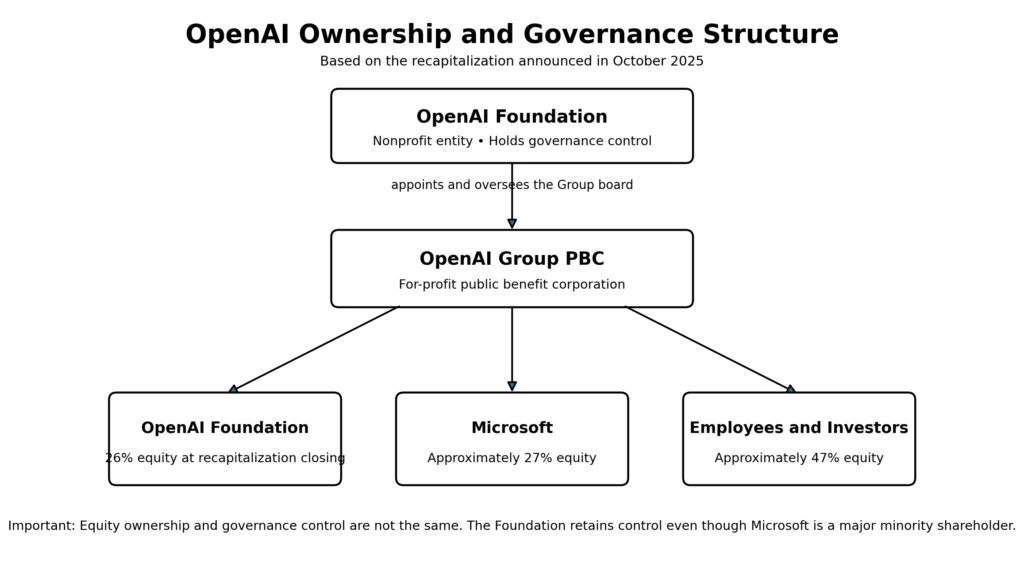
Its current structure combines a nonprofit foundation with a commercial public benefit corporation.

The nonprofit organisation is called the OpenAI Foundation. The commercial company is called OpenAI Group PBC.

This structure was completed in October 2025 to assist OpenAI in raising capital while maintaining the Group under nonprofit governance.


OpenAI Ownership Hierarchy

OpenAI Foundation

  • Holds special governance and voting rights
  • Appoints the members of the OpenAI Group board
  • Can replace Group directors
  • Held 26% of OpenAI Group at the October 2025 recapitalisation
  • Holds a warrant that may provide additional equity if specified conditions are met

Controls

OpenAI Group PBC

  • OpenAI Foundation: 26%
  • Microsoft: approximately 27%
  • Current and former employees and other investors: approximately 47%

These percentages represent the ownership structure at the time the recapitalization concluded in October 2025. They should always be presented with a date because private-company ownership may change after new funding rounds or share transactions.
OpenAI headquarters coordinates


Who Controls OpenAI?

The OpenAI Foundation controls OpenAI Group through special governance rights.

It appoints the Group’s directors and can replace them. This gives the Foundation control even though it does not hold more than 50% of the company’s economic equity.

This distinction is important because ownership and control are not the same thing.

An investor may hold a large financial stake without having the right to control the company’s board or mission.

Who Are the Main OpenAI Shareholders?

OpenAI’s shareholders can be divided into three main groups.


  • OpenAI Foundation

The OpenAI Foundation owned 26% of the OpenAI Group as of October 2025 after the recapitalisation.

It also maintained governance control and obtained a warrant related to potential future equity.


  • Microsoft

Microsoft held approximately 27% of OpenAI Group at the closing of the recapitalisation.

This makes Microsoft one of OpenAI’s largest shareholders, but not its sole owner.


  • Employees and Other Investors

Current and former employees and other investors held the remaining 47%.

OpenAI does not publish a complete public list showing the exact shareholding of every employee, executive, fund or private investor.

Exact ownership percentages should be assigned to individuals when supported by an official and current disclosure.

Does Microsoft Own OpenAI?

No. Microsoft does not own OpenAI outright. Microsoft is a major minority shareholder, technology partner and cloud infrastructure provider.

It held approximately 27% of OpenAI Group when the October 2025 recapitalisation closed.

However, the OpenAI Foundation retained governance control. Microsoft does not own the Foundation and cannot independently control OpenAI in the same way a parent company controls a wholly owned subsidiary.

Microsoft remains OpenAI’s primary cloud partner. Under partnership terms announced in April 2026, OpenAI products are expected to launch first on Azure unless Microsoft cannot or chooses not to support the required capabilities.

Microsoft also retained a licence to OpenAI models and products through 2032. That licence became non-exclusive, allowing OpenAI greater flexibility to serve customers through other cloud providers.

Microsoft owns a major minority stake in OpenAI Group, but it does not fully own or independently control OpenAI.

Who Founded OpenAI?

OpenAI was established in 2015 as a nonprofit artificial intelligence research organisation.

Its commonly identified founding team includes:

  • Sam Altman
  • Elon Musk
  • Greg Brockman
  • Ilya Sutskever
  • John Schulman
  • Wojciech Zaremba

The organisation also received support from other technology leaders, researchers, advisers and early donors.

Sam Altman later became OpenAI’s chief executive officer. Greg Brockman also held senior leadership roles, while several original researchers later left for other companies or AI projects.

Portraying OpenAI as founded solely by Sam Altman and Elon Musk omits significant contributions from other original team members.

Is Elon Musk Still Involved with OpenAI?

Elon Musk is no longer involved in OpenAI’s management, governance or present ownership structure.

He left OpenAI’s board in 2018. At the time, the company said his departure would reduce potential conflicts as Tesla expanded its own artificial intelligence work.

Later statements and legal disputes revealed wider disagreements about funding, governance, control, and OpenAI’s future direction.

OpenAI has said Musk discussed gaining greater control and explored combining the organisation with Tesla. Musk disputes aspects of OpenAI’s account and has criticised its move towards commercial operations.

He later founded xAI, which competes in the artificial intelligence market.

Given the divergent interpretations of their shared history, claims regarding the dispute must be clearly attributed rather than presented as indisputable fact.


  • Does Elon Musk Still Fund OpenAI?

There is no current public evidence that Elon Musk continues to fund OpenAI.

He is not listed as a present director, executive or controlling shareholder. His relationship with OpenAI is now competitive and legally disputed rather than operational.

Why Do OpenAI’s Address and Ownership Matter?
How to contact OpenAI headquarters

OpenAI’s location and legal structure affect more than company trivia.

They will specify the corporate entity that appears in a contract, designate where formal notices must be sent, and establish the relevant privacy or consumer regulations.

For example, many customers in the European Economic Area interact with OpenAI Ireland Ltd., while customers in other regions may contract with a US OpenAI entity.

The ownership structure also matters when assessing claims about control.

Saying that “Microsoft owns OpenAI” ignores the governance powers held by the OpenAI Foundation.

Saying that the Foundation owns all of OpenAI would also be inaccurate because Microsoft, employees and other investors hold substantial economic interests.

Clear information helps businesses, journalists and researchers distinguish between:

  • Corporate address and customer-support location
  • Legal registration and physical headquarters
  • Share ownership and governance control
  • Regional offices and data-centre infrastructure
  • Strategic partnership and full corporate ownership

Conclusion: Where Is OpenAI Headquartered?

OpenAI’s principal corporate address is 1455 Third Street, San Francisco, California 94158.

The company is based in the United States but operates through a growing international network. Its presence includes London, Dublin, Paris, Munich, Tokyo, Singapore and other locations with active teams.

OpenAI’s ownership structure is more complex than that of a standard technology company. The OpenAI Foundation controls governance, while the Foundation, Microsoft, employees and private investors hold economic stakes in OpenAI Group PBC.

The most important distinction is simple: Microsoft is a major investor and partner, but it does not fully own or independently control OpenAI.

Businesses also need more than basic knowledge of AI companies. They need a clear plan for using artificial intelligence to improve operations, customer service and product development.

Explore Flexlab, an AI and machine-learning solutions or book a strategy session to identify practical opportunities within your organisation.

Where Is OpenAI Headquartered? FAQs

1. Where is OpenAI headquartered?

OpenAI is headquartered in San Francisco, California. Its official corporate address is 1455 Third Street, San Francisco, CA 94158, United States.

2. Is OpenAI a US company?

Yes. OpenAI is a US-based artificial intelligence company with its principal corporate base in San Francisco and major legal entities incorporated in Delaware.

3. Does OpenAI have a European headquarters?

OpenAI has major European operations but does not consistently identify a sole European headquarters. London was its first international office, while OpenAI Ireland Ltd. is registered in Dublin.

Leave a Reply

Your email address will not be published. Required fields are marked *

What is a blockchain SDK? A blockchain SDK is a software development kit that provides developers with ready-made tools, libraries, APIs, documentation, and code samples to build blockchain applications faster, more safely, and with less manual coding.

In blockchain development, an SDK is not just a convenience tool. It helps developers connect wallets, call smart contracts, send transactions, read blockchain data, manage tokens, and build decentralized applications with a cleaner structure.

For businesses, the right blockchain SDK can reduce development time, improve security, support compliance, and make blockchain products easier to scale.

However, the wrong SDK can create dependency risks, weak security controls, and long-term maintenance problems.

This guide explains how blockchain SDKs work, what they include, how they differ from APIs, who uses them, how to install them, how much they cost, and how to choose one safely for real-world Web3 and enterprise projects.

What Is a Blockchain SDK?

A blockchain SDK is a toolkit designed to help developers build software that interacts with blockchain networks.

It brings important development resources into a single package, so teams do not need to implement every blockchain function from scratch.


  • Simple Meaning of a Blockchain SDK

A blockchain SDK helps developers build blockchain applications using ready-made tools instead of writing every function from scratch.

It provides development teams with a structured way to connect blockchain networks, wallets, smart contracts, tokens, and on-chain data.

This makes the build process faster, cleaner, and easier to maintain.

A blockchain SDK can help developers:

  • Connect an app to a blockchain network
  • Read wallet balances and transaction history
  • Send and verify blockchain transactions
  • Connect wallets for user login and approvals
  • Call smart contract functions
  • Track smart contract events
  • Manage token transfers
  • Test blockchain features before launch
  • Reduce repeated coding work
  • Improve development speed and security

For businesses, this matters because blockchain products often involve real assets, user funds, private keys, compliance checks, and irreversible transactions.

A strong SDK helps reduce technical faults and gives developers safer building blocks.


  • What a Blockchain SDK Usually Includes

A strong blockchain SDK may include:

  • Software libraries
  • API connectors
  • Smart contract interaction tools
  • Wallet connection functions
  • Transaction signing support
  • Token balance tools
  • Testing utilities
  • Code examples
  • Developer documentation

Together, these tools create a smoother path from idea to working blockchain product.


  • Why Blockchain SDKs Matter

Blockchain development has more risk than normal web development because it involves assets, wallets, signatures, smart contracts, and irreversible transactions.

That is why a blockchain SDK matters. It provides developers with tested building blocks and reduces the chance of repeated coding mistakes.

For enterprise teams, it also supports better structure, audit readiness, and safer product delivery.


  • What Is a Blockchain SDK Example?

What is a blockchain SDK example? A wallet SDK is a simple example. It helps an app connect to a user’s wallet, request a signature, check token balances, and send transactions.

Another example is a smart contract SDK. It helps developers call contract functions, read on-chain events, and interact with decentralized protocols from a web or mobile app.

Types and Core Features of Blockchain SDKs

Not all blockchain SDKs are designed for the same purpose. Certain SDKs specialize in wallets, others in smart contracts, and many are essential for building comprehensive blockchain infrastructure.

By understanding these primary types, teams must decisively select the right toolkit to meet their specific requirements.


  • Wallet SDKs

Wallet SDKs help developers connect blockchain apps with user wallets. They support login flows, wallet permissions, transaction signing, and token display.

For example, a crypto payment app may use a wallet SDK so users can connect their wallet and approve payments securely. This saves development time and improves user experience.


  • Smart Contract SDKs

Smart contract SDKs help apps interact with deployed smart contracts. They allow developers to call functions, read contract data, estimate gas, and process transactions.

For example, a DeFi app can use a smart contract SDK to let users stake tokens, claim rewards, or swap assets without manually coding every contract call.


  • Chain-Specific SDKs

Chain-specific SDKs are designed for one blockchain ecosystem. These SDKs help developers build apps for networks such as Ethereum, Solana, Polygon, Cosmos, or other blockchain platforms.

They often include network-specific functions, transaction formats, and development standards. This makes them useful when a product is focused on one blockchain ecosystem.


  • Enterprise and Custody SDKs

Enterprise SDKs often support permissioned access, audit logs, identity controls, custody workflows, and compliance-focused processes.

These SDKs are useful for financial platforms, institutional custody products, regulated token systems, and business-grade blockchain applications where security and governance are critical.

What is an SDK Used For in Real Blockchain Projects?

What is a SDK used for

What is an SDK used for? In blockchain, SDKs are utilized to simplify complex development tasks, including wallet connections, transaction handling, smart contract interactions, and access to blockchain data.


  • Building dApps and Web3 Platforms

Developers use blockchain SDKs to build decentralized applications for finance, gaming, identity, supply chain, and digital ownership.

A dApp may need wallet login, token balance display, smart contract interaction, and on-chain transaction history. An SDK helps developers add these features faster and with less manual work.


  • Creating Wallets, Payments, and Token Tools

Wallets, token platforms, and crypto payment systems often depend on SDKs. These products need secure transaction signing, balance checks, address validation, and network communication.

For example, a fintech company can use a blockchain SDK to build a token payment feature inside its existing app. This helps the team avoid building each blockchain layer from scratch.


  • Supporting Enterprise Use Cases

Blockchain SDKs also support business use cases outside crypto trading. Companies use them for supply chain tracking, digital identity, document verification, loyalty programs, and asset tokenization.

For example, a logistics company can use a blockchain SDK to record product movement on-chain. This creates a tamper-resistant record that different partners can verify.


  • Improving Security and Compliance Workflows

From a security view, what is a blockchain SDK? It is a trusted development dependency that can either reduce risk or create risk, depending on how it is built and used.

A strong SDK can support safer transaction flows, better access control, clearer errors, and structured logging. These features help security teams review activity and reduce operational risk.

SDK vs API: What Is the Difference?

SDKs and APIs are closely related, but they are not the same. This section clarifies the confusion, as many businesses conflate both terms when planning blockchain products.

Comparison Point SDK API
Full form Software Development Kit Application Programming Interface
Main purpose Helps developers build software Helps software systems communicate
What it includes Libraries, APIs, tools, documentation, and code samples Endpoints and rules for data exchange
Developer effort Lower because many tools are pre-built Higher because developers write more logic manually
Blockchain use Wallet connection, smart contract calls, transaction signing, and dApp development Reading balances, sending requests, and fetching transaction data
Best for Building complete blockchain features Connecting systems or getting specific data
Example Wallet SDK for transaction signing REST API for transaction history
  • What Is an SDK vs an API?

An SDK allows developers to build software with a complete toolkit, while an API allows two software systems to exchange data.

An API is usually one part of a system. An SDK may include APIs, code libraries, helper functions, documentation, testing tools, and sample projects.


  • What Is the Difference Between SDK and REST API?

A REST API lets software send and receive data through HTTP requests such as GET, POST, PUT, and DELETE.

An SDK can wrap those API calls into easier developer functions. For example, instead of writing multiple REST API calls for a token transfer, an SDK may provide one clean function with built-in validation and error handling.


  • When Should You Use an SDK?

Use an SDK when your team needs to build a complete product that requires repeated blockchain operations.

For example, if your app needs wallet login, smart contract calls, token transfers, and on-chain data, an SDK will usually save more time than working with raw APIs.


  • When Should You Use an API?

Use an API when you only need specific data or a lightweight system connection.

For example, a dashboard may use an API to show transaction history, token prices, or compliance records. Many enterprise blockchain products use both SDKs and APIs for a clean and scalable architecture.

How to Choose, Install, and Secure a Blockchain SDK

How do I install an SDK

Choosing a blockchain SDK should be a technical and security decision, not only a development choice. The SDK will become part of your product foundation, so it must be reviewed carefully.


  • How Do I Install an SDK?

Most SDKs are installed through a package manager such as npm, yarn, pip, Cargo, Maven, or Gradle.

A normal installation process looks like this:

  1. Choose the official or trusted SDK.
  2. Install it through the correct package manager.
  3. Import it into your project.
  4. Configure the blockchain network.
  5. Connect a wallet or node provider.
  6. Test basic functions in a safe environment.
  7. Review errors, permissions, and transaction behavior.

For production systems, never install an SDK without checking the source, version, and dependency history.


  • How to Choose the Right SDK

A good blockchain SDK should match your product goals, blockchain network, programming language, security needs, and long-term roadmap.

Before choosing one, check:

  • Official source or trusted publisher
  • Clear documentation
  • Active maintenance
  • Security update history
  • Strong community or vendor support
  • Commercial license compatibility
  • Smart contract support
  • Wallet and key management behavior
  • Testing and monitoring features
  • Enterprise integration support

If an SDK has poor documentation or has not had recent updates, it can become a risk to your product.


  • Is Using an SDK Safe?

Yes, using an SDK can be safe when it comes from a trusted source, is actively maintained, and follows secure development standards.

However, blockchain teams should still review dependencies, transaction flows, private key handling, and permissions. This is important because blockchain mistakes can lead to asset loss, failed transactions, or smart contract exposure.


  • Common SDK Security Mistakes

Many teams make the mistake of installing an SDK quickly and trusting it fully. That approach is risky.

Common mistakes include:

  • Using outdated SDK versions
  • Ignoring dependency alerts
  • Exposing private keys
  • Skipping transaction validation
  • Not testing wallet permissions
  • Using weak error handling
  • Not reviewing smart contract interactions
  • Forgetting audit logs and monitoring

A secure blockchain product needs more than a working SDK. It needs proper review, testing, and continuous monitoring.

Cost, Challenges, and Build-vs-Buy Decisions

Blockchain SDKs can reduce development effort, but they do not remove all costs. Teams still need developers, infrastructure, testing, audits, maintenance, and support.


  • How Much Does an SDK Cost?

Many blockchain SDKs are free and open source, but the real cost depends on how you use them.

A business may still need to pay for developers, smart contract audits, node providers, API usage, cloud hosting, monitoring tools, custody systems, compliance checks, and technical support.

For enterprise projects, the cost can also include licensing, vendor support, custom integration, and long-term maintenance.

Common cost and technical challenges include:

  • Weak documentation that slows development
  • Version conflicts between packages
  • Unsupported chains or limited network coverage
  • Dependency vulnerabilities
  • Rate limits from API or node providers
  • Breaking updates after SDK upgrades
  • Poor error messages
  • Limited enterprise support
  • Compliance gaps
  • Vendor lock-in
  • Hidden long-term maintenance costs

These issues can slow development and increase risk after launch. That is why SDK selection should include technical review, security review, and long-term maintenance planning.


  • Can I Create My Own SDK?

Can I create my own SDK? Yes, you can create your own SDK if your company has a blockchain platform, API, wallet system, protocol, or smart contract suite that other developers need to use.

A custom SDK makes sense when your team repeats the same technical tasks across many products. It also helps external developers adopt your ecosystem faster.


  • What a Custom SDK Should Include

A custom blockchain SDK should include installation guides, code examples, authentication support, smart contract helpers, testing tools, version control, error handling, and security guidance.

It should also include safe defaults. For example, it should never expose private keys, hide risky permissions, or allow unclear transaction requests.

Future of Blockchain SDKs

The future of blockchain SDKs will focus on safer development, better user experience, stronger enterprise adoption, and easier multi-chain integration. As blockchain products move from experiments to real business systems, SDKs will need to support both innovation and risk control.

Future blockchain SDKs will likely improve in these areas:

  • Multi-chain support: Developers will need SDKs that work across Ethereum, Polygon, Solana, Layer 2 networks, and private blockchain systems.
  • Security by default: Strong SDKs will include safer transaction handling, better wallet prompts, dependency alerts, and clearer permission checks.
  • Enterprise readiness: Businesses will need SDKs with audit logs, access controls, identity tools, reporting features, and compliance-friendly workflows.
  • Better developer experience: SDKs will become easier to install, test, update, and integrate with existing development stacks.
  • Smart contract safety: Future SDKs may include better contract testing tools, event tracking, and safer transaction execution.
  • Custody and institutional support: More SDKs will support regulated asset custody, transaction policies, approval workflows, and risk monitoring.

The strongest blockchain SDKs will not only help developers build faster. They will also help businesses build secure, scalable, and compliant blockchain products.

Final Thoughts: What Is a Blockchain SDK?

It is a development toolkit that helps teams build blockchain applications faster, safer, and with better structure. It supports wallet connections, smart contract calls, token transfers, transaction signing, blockchain data access, and enterprise integrations.

The right blockchain SDK can reduce development time, improve product quality, and support secure Web3 adoption. However, teams should not choose an SDK only because it is popular or free.

They should review its source, documentation, update history, security model, dependency risks, and long-term support.

For startups, fintech companies, enterprises, and Web3 teams, a blockchain SDK can become the foundation of a reliable product.

If your business is planning a wallet, dApp, smart contract platform, crypto exchange, custody solution, or enterprise blockchain system, Flexlab can help you build it with the right architecture, secure development practices, and real-world scalability.

FAQs – What Is a Blockchain SDK?

1. What Is a Blockchain SDK?

A blockchain SDK is a toolkit that helps developers build apps connected to blockchain networks. It includes tools such as libraries, APIs, wallet functions, smart contract helpers, documentation, and sample code.

2. What Is an SDK Example?

An SDK example outside blockchain is the Android SDK, which helps developers build Android apps. A blockchain SDK example is a wallet SDK that helps apps connect wallets, sign transactions, and show token balances.

3. Who Uses an SDK?

Developers, Web3 engineers, fintech teams, blockchain startups, gaming studios, and enterprise IT teams use SDKs. Business owners may not use SDKs directly, but their product teams use them to build blockchain applications.

How to create a private blockchain? The process involves choosing a permissioned blockchain platform, defining governance rules, and building a secure network for approved participants.

Unlike public blockchains, private networks give organizations greater control over data, access, and transaction validation.

Businesses across finance, healthcare, supply chain, and government sectors use private blockchains to improve security, transparency, and operational efficiency while maintaining compliance.

In this guide, you’ll learn how to create a private blockchain network, explore popular platforms, review real-world private blockchain examples, understand costs and challenges, and discover best practices for building a secure enterprise blockchain solution.

How to Create a Private Blockchain in 9 Steps

  1. Define business objectives.
  2. Select a blockchain platform.
  3. Choose a consensus mechanism.
  4. Establish governance policies.
  5. Deploy network infrastructure.
  6. Develop smart contracts.
  7. Integrate enterprise systems.
  8. Test and audit the network.
  9. Launch, monitor, and maintain operations.

The following sections explain each step in detail.


Step 1: Define Business Objectives

Every successful blockchain project starts with a clearly defined use case.

Ask questions such as:

  • What problem are we solving?
  • Who will participate in the network?
  • What data requires protection?
  • What processes can be automated?

Clear objectives help organizations avoid unnecessary complexity and control development costs.


Step 2: Select a Blockchain Platform

The platform serves as the foundation of the entire blockchain network. Selecting the right technology stack directly impacts security, scalability, and development flexibility.


  • Hyperledger Fabric

Hyperledger Fabric is one of the most widely adopted enterprise blockchain frameworks.

Key advantages include:

  • Permissioned architecture
  • Modular design
  • Private communication channels
  • Strong identity management
  • Enterprise-grade security


  • Ethereum Private Blockchain

Many organizations choose an Ethereum private blockchain because of Ethereum’s mature ecosystem and smart contract capabilities.

Benefits include:

  • Extensive developer support
  • Flexible smart contracts
  • Large tooling ecosystem
  • Customizable configurations


  • Quorum

Quorum extends Ethereum with enterprise-focused privacy and performance enhancements.

It is commonly used for financial applications and institutional blockchain deployments.


  • R3 Corda

R3 Corda focuses on regulated industries and financial services.

Its architecture supports secure information sharing between trusted parties.


Step 3: Choose a Consensus Mechanism

Consensus mechanisms determine how participants validate transactions and maintain ledger integrity.

Popular options include:


  • Proof of Authority (PoA)

PoA relies on trusted validators rather than anonymous miners.

Benefits include:

  • Fast transaction speeds
  • Lower operating costs
  • High efficiency


  • Practical Byzantine Fault Tolerance (PBFT)

PBFT enables the network to remain operational even when some participants behave incorrectly.

Benefits include:

  • Strong fault tolerance
  • Reliable performance
  • Suitable for consortium blockchain networks


  • Raft Consensus

Raft provides a simple and efficient consensus model for trusted environments.

Many enterprise deployments use Raft because of its ease of implementation.


Step 4: Establish Governance Policies

Governance determines how the blockchain network operates over time.

Organizations should define:

  • Validator selection criteria
  • Membership requirements
  • Voting procedures
  • Network upgrade processes
  • Smart contract approval workflows

Expert Insight:

In many enterprise blockchain projects, governance planning takes longer than technical implementation. Organizations that define governance frameworks early often experience fewer operational disputes and smoother deployments.


Step 5: Deploy Network Infrastructure

Infrastructure planning affects network reliability, security, and scalability.

Key considerations include:

  • Number of nodes
  • Geographic distribution
  • Cloud or on-premise hosting
  • Backup strategies
  • Disaster recovery planning

A resilient infrastructure ensures uninterrupted blockchain operations.


Step 6: Build Smart Contracts and Applications

This phase focuses on how to build blockchain application functionality around business requirements.

Developers create smart contracts that automate workflows and enforce business rules.

Common applications include:

  • Digital asset management
  • Supply chain tracking
  • Trade finance automation
  • Identity verification
  • Compliance reporting

Every smart contract should undergo rigorous testing before deployment.


Step 7: Integrate Enterprise Systems

Most blockchain networks must connect with existing systems.

Common integrations include:

  • ERP platforms
  • CRM systems
  • Payment gateways
  • Databases
  • Identity management solutions

Successful integration improves adoption and maximizes business value.


Step 8: Test and Audit

Before deployment, organizations should validate every component of the network.

Testing should include:

  • Functional testing
  • Security testing
  • Smart contract audits
  • Performance testing
  • Compliance reviews

Thorough testing helps identify vulnerabilities before they affect production environments.


Step 9: Launch and Monitor

After deployment, organizations should continuously monitor network performance and security.

Key monitoring areas include:

  • Node health
  • Transaction throughput
  • System availability
  • Security events
  • Infrastructure utilization

Ongoing monitoring helps maintain a secure and reliable blockchain environment.

How to Create a Private Blockchain on Ethereum

For organizations seeking flexibility and smart contract functionality, Ethereum remains one of the most popular blockchain platforms. Understanding how to create a private blockchain on Ethereum can help businesses leverage Ethereum’s ecosystem while maintaining complete control over network participation.

The process typically involves:

  1. Installing the Geth client.
  2. Creating a custom genesis block.
  3. Configuring a unique network ID.
  4. Initializing blockchain nodes.
  5. Connecting nodes through peer discovery.
  6. Defining validator permissions.
  7. Deploying smart contracts.
  8. Launching applications on the network.

An Ethereum private blockchain allows organizations to build custom blockchain applications while maintaining privacy, governance, and operational control.

This is the first ~1,450 words of the fully optimized version. The remaining sections (Examples, Security, Challenges, Cost, Future, Conclusion, FAQs, Meta Description, Slug, and SEO checklist) are still needed to complete the 2,500-word article.

Private Blockchain Examples

Real-world implementations demonstrate how private blockchain networks solve business challenges while improving transparency, security, and operational efficiency. These examples show why enterprises continue investing in permissioned blockchain solutions.


  • IBM Food Trust

IBM Food Trust uses Hyperledger Fabric to improve food traceability across global supply chains. Retailers, manufacturers, and suppliers can track products from source to shelf through a shared, permissioned network.

Key benefits include:

    • Faster product recalls
    • Improved supply chain visibility
    • Enhanced food safety
    • Better collaboration among stakeholders
  • JPMorgan Quorum

JPMorgan developed Quorum to support secure financial transactions and institutional settlement processes. The platform combines Ethereum’s flexibility with enterprise-grade privacy features.

Key benefits include:

  • Faster transaction processing
  • Improved transaction confidentiality
  • Reduced settlement risk
  • Enhanced operational efficiency


  • Healthcare Data Sharing Networks

Healthcare organizations are embracing private blockchain networks as a powerful solution for securely sharing patient information among authorized providers. This innovative approach not only enhances data security but also fosters collaboration and trust among healthcare professionals, ultimately leading to better patient care.

Key benefits include:

  • Better interoperability
  • Stronger patient privacy
  • Improved data accuracy
  • Faster access to medical records


  • Trade Finance Platforms

Many financial institutions use consortium blockchain networks to streamline trade finance operations. These platforms automate documentation, improve transparency, and reduce delays in cross-border transactions.

Key benefits include:

  • Reduced paperwork
  • Faster processing times
  • Improved trust among participants
  • Lower administrative costs

These private blockchain examples demonstrate how organizations can improve efficiency while maintaining control over sensitive information.

What Is a Private Blockchain?

A private blockchain is a permissioned blockchain network where only authorized participants can access data, validate transactions, and interact with the ledger.

Unlike public blockchains that allow anyone to join, private networks restrict participation to approved users and organizations.

This controlled environment helps businesses maintain privacy while benefiting from blockchain’s transparency, immutability, and automation capabilities.

Private blockchains typically provide:

  • Controlled network access
  • Faster transaction processing
  • Enhanced data privacy
  • Simplified regulatory compliance
  • Greater governance flexibility
  • Lower operational costs


  • Can a Blockchain Be Private?

Yes, a blockchain can be private. Many enterprise blockchain deployments operate as private networks because organizations need more control over data access, participant permissions, and governance policies.

Instead of relying on anonymous validators, private blockchains use known and trusted participants to verify transactions. This approach improves efficiency and makes blockchain technology practical for business environments that handle sensitive information.

Why Build a Private Blockchain?

Organizations choose private blockchains when they need the benefits of distributed ledger technology without exposing confidential data to public networks.


  • Enhanced Data Privacy

Private blockchain networks restrict access to approved participants. This enables organizations to share sensitive information securely while preventing unauthorized access.

Industries such as healthcare, banking, insurance, and government services often require strict privacy controls that public blockchains cannot provide.


  • Faster Transaction Processing

Public blockchain networks can experience congestion and slower confirmation times. Private blockchains use lightweight consensus mechanisms that process transactions much faster.

As a result, businesses can achieve predictable performance and support high transaction volumes.


  • Greater Governance Control

Organizations maintain direct control over validators, permissions, network upgrades, and governance policies. This level of control helps businesses align blockchain operations with internal requirements.


  • Improved Regulatory Compliance

Permissioned blockchain networks can incorporate identity verification, access controls, auditing features, and reporting mechanisms that support compliance requirements.


  • Reduced Operational Costs

Private networks eliminate energy-intensive mining and use more efficient validation methods. This reduces infrastructure costs and improves operational efficiency.

Public Blockchain vs Private Blockchain

Businesses often compare public and private blockchain models before starting development. The following table highlights the key differences.

Feature

Public Blockchain

Private Blockchain

Access Open to anyone Restricted to approved participants
Governance Decentralized Controlled by organization(s)
Privacy Limited High
Transaction Speed Slower Faster
Compliance More difficult Easier
Scalability Moderate Higher
Consensus Proof of Work, Proof of Stake PoA, PBFT, Raft
Enterprise Adoption Limited Extensive

For most enterprise applications, private blockchain networks offer better performance, stronger privacy, and greater operational control.

Types of Private Blockchain Networks

Private blockchain networks can follow different governance structures depending on business requirements. Choosing the right model is one of the most important decisions when learning how to create a private blockchain.


  • Fully Private Blockchain

A fully private blockchain is managed by a single organization, ensuring streamlined decision-making and enhanced security. The organization manages validators, permissions, governance rules, and network operations.

Common use cases include:

  • Internal record management
  • Enterprise workflow automation
  • Asset tracking
  • Compliance reporting

This model offers maximum control and privacy.


  • Consortium Blockchain

A consortium blockchain distributes governance across multiple organizations. Instead of one company controlling the network, participating members share responsibility for validation and decision-making.

Common use cases include:

  • Banking networks
  • Trade finance platforms
  • Supply chain ecosystems
  • Healthcare data sharing

A consortium blockchain reduces reliance on a single authority while maintaining privacy and efficiency.


  • Hybrid Blockchain

A hybrid blockchain incorporates features of both private and public blockchains.

Organizations can keep sensitive information private while publishing selected records or proofs to a public blockchain for transparency and verification.

This model works well for businesses that require both confidentiality and public trust.

Private Blockchain Architecture

 A well-designed architecture improves security, scalability, performance, and maintainability.

Most enterprise blockchain infrastructures include the following components.


  • Validator Nodes

Validator nodes verify transactions and create new blocks according to the network’s consensus mechanism.

Because validators are known participants, private networks can achieve faster consensus than public blockchains.


  • Peer Nodes

Peer nodes maintain copies of the ledger and synchronize blockchain data across the network.

These nodes improve reliability and ensure data availability.


  • Membership and Identity Layer

The membership layer manages participant identities, permissions, authentication, and access controls.

This component plays a critical role in permissioned blockchain environments.


  • Smart Contract Layer

Smart contracts automate business processes by executing predefined rules without manual intervention.

Organizations commonly use smart contracts for:

  • Asset transfers
  • Trade agreements
  • Identity verification
  • Supply chain tracking
  • Payment processing


  • Application Layer

Users interact with the blockchain through applications, dashboards, APIs, and enterprise software systems.

This layer connects blockchain infrastructure with real-world business operations.

How to Create a Private Blockchain Network

how to build a private blockchain

Organizations that want to create their own blockchain network should follow a structured development process.

The following framework helps reduce implementation risks while improving long-term scalability and security.

Blockchain Security Best Practices

Security should be a priority from the earliest planning stages of blockchain development. While private blockchains provide controlled access, organizations must still address risks such as smart contract vulnerabilities, insider threats, infrastructure misconfigurations, and compromised credentials.

To strengthen the security of a private blockchain network:

  • Implement role-based access controls (RBAC) to limit permissions based on responsibilities.
  • Protect validator and administrator accounts using multi-factor authentication (MFA).
  • Store private keys in Hardware Security Modules (HSMs) or enterprise-grade custody solutions.
  • Conduct regular smart contract audits before deploying updates or new applications.
  • Encrypt sensitive information both at rest and in transit.
  • Continuously monitor network activity for suspicious behavior and unauthorized access attempts.
  • Create backup and disaster recovery procedures to minimize downtime.
  • Update blockchain clients, infrastructure components, and security configurations regularly.
  • Define clear governance policies for onboarding and offboarding participants.
  • Perform periodic penetration testing and security assessments.

Organizations that invest in security early typically reduce operational risks, avoid compliance issues, and strengthen stakeholder confidence.

Challenges of Building a Private Blockchain

Although private blockchain technology offers significant advantages, organizations should understand the challenges before starting development. Addressing these issues early improves project success rates and helps avoid costly mistakes.

Some of the most common challenges include:

  • Governance complexity is particularly prevalent in consortium blockchain environments involving multiple organizations.
  • Integration challenges when connecting blockchain infrastructure with legacy business systems.
  • Smart contract vulnerabilities can arise from coding errors or inadequate testing.
  • Key management risks that can expose sensitive information if credentials are compromised.
  • Scalability concerns as transaction volumes, participants, and nodes increase.
  • Regulatory uncertainty across different jurisdictions and industries.
  • Challenges in user adoption arise when blockchain workflows differ from current processes.
  • Long-term maintenance requirements, including monitoring, upgrades, and security audits.

Organizations that proactively plan for these challenges are better positioned to build sustainable blockchain ecosystems.

How Much Does It Cost to Build a Private Blockchain?

How much does it cost to build a private blockchain

How much does it cost to build a private blockchain? The answer depends on the project’s scope, complexity, infrastructure requirements, and security expectations. A simple proof of concept may require a relatively small investment, while a production-ready enterprise blockchain can involve substantial development and operational costs.

Several factors influence the final budget:

  • Blockchain platform selection
  • Number of nodes and validators
  • Smart contract complexity
  • Security audits and compliance reviews
  • Enterprise system integrations
  • Application development requirements
  • Infrastructure and hosting costs
  • Ongoing maintenance and support

The following estimates provide a general benchmark.

Project Type

Estimated Cost

Proof of Concept $15,000–$40,000
Small Business Deployment $40,000–$100,000
Mid-Sized Enterprise Solution $100,000–$250,000
Enterprise Consortium Blockchain $250,000–$500,000+

Organizations often begin with a pilot project to validate business value before expanding into a larger deployment.

The Future of Private Blockchain Networks

Private blockchain adoption is accelerating as organizations seek secure, scalable, and compliant solutions for data sharing and business automation. Several trends are expected to shape the future of private blockchain networks:

  • Greater Interoperability: Private and public blockchains will increasingly connect, enabling seamless data and asset transfers across networks.
  • Asset Tokenization: More organizations will tokenize real-world assets such as real estate, bonds, and commodities to improve liquidity and efficiency.
  • AI Integration: Businesses will combine blockchain with AI to leverage trusted data for automation, analytics, and smarter decision-making.
  • Digital Identity Solutions: Private blockchains are increasingly important for managing identities, verifying credentials, and controlling access.
  • Stronger Regulations: Clearer regulatory frameworks will encourage broader enterprise adoption and investment.
  • Enterprise Expansion: Industries such as finance, healthcare, supply chain, and government will continue increasing blockchain adoption.

As the technology matures, private blockchain networks will become an essential part of enterprise digital transformation and secure business collaboration.

Closing Insights

Learning how to create a private blockchain involves more than selecting a technology platform.

Organizations must define clear objectives, establish governance policies, design secure infrastructure, and develop applications that solve real business problems.

Whether you’re building an Ethereum private blockchain, launching a consortium blockchain, or planning to create your own blockchain network, success depends on careful planning, strong security practices, and a long-term operational strategy.

Private blockchain technology continues to gain momentum because it delivers a unique combination of transparency, privacy, automation, and control.

By following the framework outlined in this guide, organizations can confidently create blockchain networks that support scalability, compliance, and business growth.

If your organization is exploring blockchain adoption, partnering with experienced blockchain specialists can help accelerate development while reducing implementation risks. Flexlab helps businesses design, develop, secure, and deploy enterprise-grade blockchain solutions tailored to their specific goals and industry requirements.

FAQs

1. What platform is best for building a private blockchain?

Hyperledger Fabric is a popular choice for enterprise applications that require strong permissions and governance controls. Ethereum private blockchain networks are often preferred when smart contract flexibility and ecosystem support are priorities.

2. How long does it take to build a private blockchain network?

A proof of concept may take a few weeks to develop, while a production-ready blockchain network can take several months, depending on integrations, security requirements, testing, and overall complexity.

3. Which industries benefit most from private blockchains?

Finance, healthcare, supply chain management, manufacturing, insurance, and government sectors benefit significantly from private blockchain networks because they require secure data sharing, compliance, and controlled access.

Knowing how to find blockchain token market makers determines whether your token trades with tight spreads or sits frozen on an order book nobody touches.

Most teams launch with a strong product and a dead market. The reason is almost always the same: no committed liquidity partner stood behind the token at listing.

A token without a market maker is a token without a market. This guide explains who these firms are, the types worth knowing, how to vet them, and where real programs like Keyrock and Vortex fit in. By the end, you’ll have a step-by-step process you can apply this week.

Here’s what you’ll walk away with:

  • A clear definition of crypto market makers and how they operate
  • A vetting framework to separate real liquidity providers from spread-chasers
  • Real examples, common traps, and where the industry is heading

Who Are Market Makers in Crypto?

Thin liquidity kills tokens silently. A buyer wants in, finds a 4% spread, and walks away. That lost order never shows up in your analytics,  but it compounds across thousands of users.

Market makers in crypto are firms that continuously quote buy and sell prices for a token, narrowing the spread and guaranteeing that trades execute.

They place resting orders on both sides of the book, bids and asks, and profit from the gap between them. In return, your token gets depth, stability, and a price that reflects real demand rather than panic.

These firms run automated systems that update quotes in milliseconds across multiple venues.

They absorb sell pressure during dumps and supply tokens during rallies. Without them, a single large order swings your price by double digits. That volatility scares off the exact institutional capital most projects want.

Token market making is not optional infrastructure for a serious launch. It is the difference between a tradable asset and a stranded one.

Types of Market Makers in the Token Market

crypto market maker program

Picking the wrong type wastes capital and damages your order book. A retail-focused maker on a tier-3 exchange does nothing for an institutional listing, and a high-touch desk is overkill for a small community token.

Three structural models dominate token market making, and each fits a different stage and budget. Match the model to your listing goals before you sign anything.


  • Principal (proprietary) Market Makers

These firms trade their own capital and take real inventory risk. They commit to spread and uptime targets and absorb price moves on their balance sheet. Keyrock market makers and similar desks operate this way. This model suits projects that need genuine depth and can afford performance-based agreements.


  • Designated Market Makers (loan/option model)

Here, you lend the firm tokens and stablecoins, and they receive a call option as compensation. They quote both sides using your capital. The arrangement lowers your cash cost, but ties returns to token performance. Read the option strike terms carefully; misaligned strikes drain your treasury.


  • Algorithmic and DEX Liquidity Providers

On decentralized exchanges, automated market makers (AMMs) replace human desks with liquidity pools and pricing curves. Some firms specialize in managing concentrated liquidity positions on Uniswap v3 and similar protocols. This fits DeFi-native tokens, where on-chain depth matters more than centralized order books.

Comparing the Main Types of Token Market Makers

Type

Pros

Watch-outs

Best for

Principal Real inventory risk, deep books Higher fees Mid-to-large listings
Designated (loan/option) Lower cash cost Option terms can favor the maker Early-stage tokens
Algorithmic/DEX On-chain depth, transparent Impermanent loss exposure DeFi-native projects

 Benefits of Token Market Making for Your Project

Founders often treat market-making as a listing checkbox. That mistake surfaces three months later when volume collapses and the token trends downward with no buyers.

Token market making protects price discovery, attracts institutional flow, and keeps your token listable on top exchanges. Each benefit ties directly to survival, not vanity metrics.

  • Tighter spreads: Buyers and sellers transact near fair value, which raises trade completion rates. In highly liquid crypto markets, spreads can remain below 1%, while illiquid tokens may experience spreads exceeding 3–5%, making trading significantly less attractive for investors.
  • Reduced volatility: Committed quotes absorb shocks that would otherwise trigger cascading liquidations. Consistent liquidity provision helps reduce price swings and improves confidence among both retail and institutional traders.
  • Exchange compliance: Major exchanges require minimum depth and spread thresholds. A maker keeps you above them.
  • Institutional access: Funds will not touch a token they can’t exit cleanly. Depth signals exit liquidity.
  • Healthier metrics: Genuine volume, not wash trades, builds the on-chain reputation that listings and partners check.

The payoff is structural. A liquid token compounds trust; an illiquid one bleeds it.

How to Find Blockchain Token Market Makers: A Step-by-Step Process

token market making

Most teams find market makers through a Telegram intro and sign within a week. That speed is exactly how projects end up with wash-trading desks that inflate volume and vanish at the first audit.

Finding a blockchain token market maker is a vetting exercise, not a sourcing one; the supply is large, the quality is not. Follow a deliberate sequence, and you’ll filter out the firms that damage your order book.


Step 1: Define your Liquidity Requirements

Name your targets before you talk to anyone. Specify the exchanges, the maximum acceptable spread (for example, under 0.5%), and the minimum order-book depth at each price level. Without these numbers, you can’t compare bids or hold a partner accountable.

Based on what we commonly see across token launches, projects that define liquidity targets before exchange negotiations tend to achieve more stable trading conditions after listing.

Teams that skip this step often struggle to evaluate whether a market maker is actually delivering value.


Step 2: Build a List of Market Makers

Compile a shortlist from exchange referral lists, industry directories, and the partner pages of comparable projects.

A reliable list of market makers includes both centralized-desk specialists and DEX-focused firms. Cross-check each name against past projects they’ve supported.


Step 3: Verify Track Record and Reputation

Ask for references and check whether their existing tokens hold tight spreads today. A firm that quotes well at launch but disappears afterward fails the only test that matters.

Confirm they avoid wash trading; many exchanges now delist tokens caught faking volume.


Step 4: Compare Engagement Models & Fees

Decide between a retainer (monthly fee, you keep upside) and a loan/option model (lower cash, shared upside).

Request the full term sheet, including option strikes, lockups, and exit clauses. Hidden terms here are where treasuries quietly leak.


Step 5: Demand Transparent Reporting

Require real-time dashboards showing spread, uptime, and depth across venues. If a firm resists transparency during negotiation, expect zero accountability after signing. This single requirement separates professional desks from the rest.


Step 6: Run a Trial Period

Start with a 30-to-60-day pilot tied to measurable KPIs. Track whether they hit the spread and uptime numbers you defined in Step 1. Renew only on proven performance, never on promises.

That sequence is the practical answer for finding blockchain token market makers without inheriting someone else’s listing failure.

Real-World Examples and Crypto Market Maker Programs

Abstract advice doesn’t help when you’re choosing a partner. Names and program structures do.

Established firms and exchange-run programs give you reference points for what professional token market making looks like.

Alongside firms such as Keyrock and Vortex, industry participants frequently evaluate providers like Wintermute, GSR, and Cumberland due to their experience supporting exchange listings and institutional trading activity.  Study them before you evaluate smaller or newer desks.


  • Keyrock Market Makers

Keyrock market makers operate as a principal trading firm providing liquidity across centralized and decentralized venues.

They take inventory risk on their own balance sheet and serve token projects, exchanges, and institutions. Their model represents the higher-commitment end of the market, strong depth, and performance-based terms.


  • Vortex Market Maker

The Vortex market maker model focuses on algorithmic liquidity provision, often emphasizing automated quoting across multiple pairs.

Firms in this category compete on execution speed and pricing consistency. They suit projects that prioritize tight, continuous quotes managed by systems rather than manual desks.


  • Crypto Market Maker Programs on Exchanges

A crypto market maker program is run directly by an exchange to incentivize liquidity provision, usually through fee rebates or reduced trading costs for qualifying participants.

Programs like these let qualified firms and even sophisticated individuals earn by quoting both sides of the book. Joining one is also the entry point for anyone studying how to become a crypto market maker.


  • How to Become a Crypto Market Maker

If you’re asking how to become a crypto market maker yourself, start by qualifying for an exchange’s crypto market maker program, then deploy automated quoting strategies with disciplined risk limits.

You’ll need capital, low-latency infrastructure, and tight inventory controls. The barrier is operational discipline, not just code.

Top Blockchain Token Market Makers Compared

Market Maker Model Best For
Keyrock Principal Market Making Institutional and large-scale token launches
Wintermute Principal Market Making High-volume centralized exchange trading
GSR Institutional Liquidity Provider Growth-stage blockchain projects
Cumberland OTC & Liquidity Services Large transactions and institutional investors
Vortex Algorithmic Market Making Automated liquidity and multi-exchange support

Challenges in Token Market Making

The biggest risk isn’t finding a maker, it’s signing one whose incentives work against you.

Misaligned terms, fake volume, and weak oversight cause most market-making relationships to fail. Recognize these traps before they cost you a listing.

  • Wash trading: Some firms inflate volume with self-trades. Exchanges detect and delist this. Demand genuine, reportable flow.
  • Option misalignment: In loan/option deals, an aggressive strike can incentivize the maker to suppress your price. Model the payoff before agreeing.
  • Opacity: No dashboard means no accountability. You can’t manage what you can’t measure.
  • Over-reliance on one venue: Liquidity concentrated on a single exchange collapses if that venue delists or fails.
  • Lockup and exit risk: Long contracts with no performance exit lock you to underperformers.

Treat the contract as a security control, not a formality. The terms are where the risk lives.

The Future of Token Market Making

Today’s manual, opaque arrangements won’t survive rising institutional standards. Regulators and exchanges already demand cleaner, auditable liquidity.

Token market making is moving toward on-chain transparency, regulatory alignment, and automated, verifiable execution.

As institutional participation in digital assets grows, exchanges and regulators are placing greater emphasis on genuine trading activity, transparent reporting, and verifiable liquidity metrics.

 Three shifts are underway and worth planning around now.

  • First, on-chain market making is growing as concentrated-liquidity DEX strategies mature, making depth publicly verifiable.
  • Second, compliance is tightening, anti-wash-trading enforcement and real-volume reporting are becoming table stakes.
  • Third, AI-driven quoting systems are improving spread efficiency and risk response across fragmented venues.

Projects that adopt transparent, compliant partners early will list and raise more easily. Those clinging to opaque deals will face delistings and lost trust.

Conclusion:How to Find Blockchain Token Market Makers?

Learning how to find blockchain token market makers comes down to one discipline: vet for proven performance, not promises.

Projects that invest time in evaluating liquidity providers before launch are generally better positioned to maintain healthy trading activity, attract investors, and meet exchange liquidity requirements over the long term.

Define your spread and depth targets, build a real list of market makers, verify track records, compare engagement models, demand transparent reporting, and pilot before you commit.

Names like Keyrock and the Vortex market maker model show what professional token market making looks like, and exchange-run programs offer a path for those studying how to become a crypto market maker.

A liquid token earns trust and attracts institutional capital. An illiquid one bleeds both. The right partner protects your price discovery and keeps you listable on the venues that matter.

If you’re ready to secure transparent, performance-driven liquidity for your token, explore Flexlab market-making solutions. You can also learn more about our blockchain development services, token launch solutions, and Web3 consulting offerings to support your project’s long-term growth strategy. 

FAQs: How to Find Blockchain Token Market Makers?

1. What should I look for when choosing a blockchain token market maker? 

When choosing a blockchain token market maker, evaluate the firm’s track record, supported exchanges, reporting transparency, spread targets, liquidity depth commitments, and compensation model. A reputable provider should be able to demonstrate measurable results and provide references from previous token projects.

2. How do I create a list of market makers to evaluate?

Build your list of market makers from exchange referral pages, industry directories, and the partner sections of comparable projects. Then verify each firm’s live spreads, references, and anti-wash-trading practices before shortlisting.

3. How can I become a crypto market maker?

To become a crypto market maker, qualify for an exchange’s crypto market maker program, then run automated two-sided quoting with strict inventory and risk limits. You’ll need capital, low-latency infrastructure, and operational discipline.

What is a block in a blockchain? A block is a digital container that stores verified transactions and network data on a blockchain.

Each block contains a unique cryptographic hash and the hash of the previous block, creating a secure, transparent, and tamper-resistant chain of records.

Blockchain technology powers cryptocurrencies, smart contracts, and enterprise applications across industries.

Whether a company tracks supply chain activity, secures digital assets, or automates agreements, blockchain relies on blocks to record and verify information.

Because every transaction must pass through a block before becoming part of the ledger, understanding blockchain blocks is essential for anyone exploring Web3, cryptocurrency, or enterprise blockchain solutions.

In this guide, you will learn what a block in a blockchain is, how it works in real-world systems, what information it stores, and how it connects to other blocks. You will also explore blockchain mining, the genesis block, security concepts, practical examples, benefits, limitations, and future developments of blockchain technology. 

Understanding Blockchain Fundamentals

Before exploring how blockchain blocks work, it’s important to understand the foundation of blockchain technology.

Although blockchain and blocks are closely related, they serve different purposes within the network.

  • What Is Blockchain?

A blockchain is a distributed digital ledger that records transactions across multiple computers. Instead of relying on a central database, blockchain stores identical copies of data across a network of participants.

As a result, participants can verify transactions independently while maintaining a shared source of truth.

Curious to know what blockchain is in simple words? Think of it as a shared digital notebook. Everyone can view the entries, but nobody can secretly alter them after verification.

This structure improves transparency, security, and trust across decentralized systems.

  • What Is a Block in a Blockchain?

A block is the basic building unit of a blockchain. It groups verified transactions and stores them in a secure format before adding them to the distributed ledger.

A blockchain block is a data container that records verified transactions, timestamps, and cryptographic information before being permanently added to a blockchain network.

Every block serves as a permanent record of network activity. Consequently, blockchain networks can organize information efficiently while maintaining integrity and transparency.

Understanding what is a block in blockchain technology is essential because blocks form the foundation on which every blockchain operates.

  • What Is a Chain in Blockchain?

A blockchain derives its strength from the way it links blocks together.

Each block contains the cryptographic hash of the previous block. Therefore, every new block extends the chain while preserving the integrity of earlier records.

This linking mechanism explains what is a chain in blockchain and why blockchain networks can maintain trust without a central authority.

What Is a Block in a Blockchain With Example? From Transaction to Validation

Understanding the lifecycle of a blockchain block becomes easier when viewed through a practical example.

  • Bitcoin Transaction Example

Suppose Alice sends 1 Bitcoin to Bob.

The transaction follows a series of steps before becoming part of the blockchain:

Stage Action
Transaction Created Alice sends 1 BTC to Bob
Validation Network nodes verify the transaction
Block Formation The transaction joins other verified transactions
Consensus The network validates the block
Finalization The block becomes part of the blockchain

This process demonstrates what is a block in a blockchain with an example, because the block acts as the container that securely records and preserves the transaction.

Without blocks, blockchain networks would struggle to organize, validate, and store transaction history efficiently.


  • Enterprise Blockchain Example

Blockchain blocks support far more than cryptocurrency transactions.

For example, a supply chain company can record every product movement inside blockchain blocks. Whenever goods move between manufacturers, warehouses, and retailers, the network creates a permanent record of the event.

Similarly, healthcare organizations can store updates to patient records on a blockchain. Each authorized modification becomes part of an immutable audit trail that improves accountability and data integrity.

These examples highlight how blockchain blocks create trust across industries that require transparency and verification.


  • Security Perspective

From a blockchain security perspective, the integrity of an entire network depends on the integrity of individual blocks. If attackers could alter validated blocks, they could undermine trust in the entire ledger.

Therefore, blockchain networks use cryptographic mechanisms and consensus algorithms to protect every block from unauthorized modification.

What Information Is Stored in a Blockchain Block? Breaking Down the Structure

what is the first block in a blockchain called


The structure of a blockchain block plays a critical role in maintaining security, transparency, and data integrity. While blocks may appear simple, they contain multiple components that work together to verify and protect network activity.


  • What Is Inside a Block in Blockchain?

When people ask what is inside a block in blockchain, the answer generally falls into two categories:

  1. Block Header
  2. Block Body

The block header contains metadata used for validation and identification. Meanwhile, the block body stores the transactions and state changes recorded by the network.

Together, these components create a secure and verifiable record.


  • Block Header Components

The block header contains information that helps the network verify authenticity and maintain continuity.

Block Version

Identifies the protocol rules used to create the block.

Timestamp

Records the exact time the network created the block.

Previous Block Hash

References the preceding block and establishes the blockchain connection.

Merkle Root

Provides a cryptographic summary of all transactions inside the block.

Nonce

Supports the consensus process by helping miners or validators verify the block.


  • Block Body Components

The block body contains the actual network activity recorded within the blockchain.

Typical contents include:

  • Cryptocurrency transactions
  • Smart contract executions
  • Token transfers
  • Network state updates
  • Transaction fees
  • Account balance changes

Because these records represent verified activity, they become a permanent part of the blockchain ledger.


  • Key Components of a Blockchain Block

The following table summarizes the most important elements found within a blockchain block.

Component Purpose
Timestamp Records when the block was created
Transactions Stores network activity and transfers
Previous Hash Links the block to the previous block
Nonce Supports validation and consensus
Merkle Root Verifies transaction integrity
Block Version Defines protocol compatibility


  • Why Block Structure Matters

Every field inside a block serves a specific purpose.

For example, the previous block hash protects chain integrity, while the Merkle root allows efficient verification of large transaction sets. Likewise, timestamps establish chronological order across the network.

As a result, blockchain systems can maintain trust even when participants do not know or trust one another.

How Does a Block Connect to Other Blocks? The Power of Cryptographic Linking

A single block can store valuable information. However, blockchain technology derives its true power from the way blocks connect to form a secure and immutable chain.


  • The Role of Cryptographic Hashing

Cryptographic hashing converts data into a fixed-length string of characters.

Even a tiny change to the original data produces a completely different hash value. Because of this property, blockchain networks use hashes to verify data integrity and detect unauthorized changes.

Hashing helps blockchain networks:

  • Verify information
  • Detect tampering
  • Secure transaction records
  • Link blocks together

Consequently, cryptographic hashing becomes one of the core security mechanisms behind blockchain technology.


How Blocks Form a Chain

Blockchain follows a simple but highly effective structure:

Genesis Block → Block 1 → Block 2 → Block 3 → Block 4

Each block stores the hash of the previous block. Therefore, every new block strengthens the chain while preserving the integrity of earlier records.

This design enables participants to verify the full transaction history of the blockchain network.


Why Altering One Block Is Difficult

Suppose an attacker modifies a transaction inside Block 2.

The modification immediately alters the block’s hash.

As a result:

  • Block 3 becomes invalid
  • Block 4 becomes invalid
  • Every subsequent block becomes invalid

The attacker would then need to recalculate and validate all following blocks while simultaneously overcoming the network’s consensus mechanism.

Because this requires enormous computational resources, blockchain networks achieve a high level of tamper resistance.


  • Security Perspective

Cryptographic linking is one of the primary reasons organizations trust blockchain for financial transactions, digital asset management, and enterprise record keeping.

Rather than relying on a single authority, blockchain distributes trust across mathematics, cryptography, and network consensus.

What Is a Genesis Block in Blockchain? The Beginning of Every Network

Every blockchain starts with a single block. Before transactions can flow through the network, the blockchain must establish an initial point of trust.


  • What Is the First Block in a Blockchain Called?

The first block in a blockchain is called the Genesis Block.

Unlike all subsequent blocks, the Genesis Block lacks a reference to a previous block since none exists.

Instead, developers create it as the starting point of the blockchain network.

Understanding what the first block in a blockchain is called helps explain how blockchain systems establish their initial state before processing transactions.


  • Why the Genesis Block Matters

The Genesis Block serves several critical functions.

It:

  • Initializes the blockchain network
  • Establishes foundational rules
  • Creates the first trusted record
  • Defines key protocol parameters
  • Serves as the starting point for all future blocks

Without a Genesis Block, a blockchain would have no origin from which to build its chain of trust.


  • Famous Genesis Block Examples

The most famous Genesis Block belongs to Bitcoin.

Bitcoin was launched in January 2009, with its Genesis Block representing the first recorded block in the Bitcoin blockchain, marking the start of decentralized digital currency.

Ethereum also launched with its own Genesis Block, which established the network’s initial configuration and token distribution.

Although every blockchain includes a Genesis Block, each network defines its own parameters, rules, and starting conditions.

Key Takeaways

  • A block stores verified transactions and network data.
  • Blocks connect through cryptographic hashes.
  • The Genesis Block serves as the starting point of every blockchain.
  • Blockchain blocks create transparency, integrity, and trust.
  • Together, connected blocks form an immutable digital ledger.

What Is a Block in a Blockchain Mining Process? Creating Verified Records


what is a blockchain in crypto

Blockchain networks do not simply create blocks automatically. Instead, they rely on a structured validation process known as mining (in Proof of Work systems) or validation (in Proof of Stake systems).


  • How Mining Creates New Blocks

Mining is the process of collecting, verifying, and adding transactions into a new block.

The workflow typically follows this sequence:

  • Users submit transactions
  • Nodes broadcast transactions across the network
  • Transactions enter the mempool (waiting area)
  • Miners or validators select transactions
  • A candidate block is created
  • The network has confirmed the block.
  • The block is added to the blockchain

This process explains what is a block in a blockchain mining because mining is the mechanism that transforms pending transactions into permanent blockchain records.


  • Proof of Work Block Creation

In Proof of Work (PoW) systems like Bitcoin, miners compete to solve complex mathematical puzzles.

They attempt to find a valid nonce that produces a hash below a required target. Once a miner succeeds, the block is broadcast to the network for verification.

Key elements include:

  • Computational power
  • Hash difficulty
  • Nonce discovery
  • Block reward incentives

This system ensures security by making it expensive and difficult to alter blockchain data.


  • Proof of Stake Validation

In Proof of Stake (PoS) systems like Ethereum (post-merge), validators replace miners.

Instead of solving puzzles, validators are selected based on the amount of cryptocurrency they stake in the network.

Advantages include:

  • Lower energy consumption
  • Faster block validation
  • Improved scalability
  • Reduced hardware dependency

Both systems serve the same purpose: ensuring that only valid blocks are added to the blockchain.

What Is the Purpose of a Block? Ensuring Data Integrity

A blockchain block serves multiple critical functions that go beyond simple data storage.

  • Data Organization

Blocks group transactions into structured units, making it easier for the network to process large volumes of data efficiently.

  • Transaction Verification

Every transaction inside a block must be validated by the network before the block is accepted. This prevents fraud and double-spending.

  • Network Consensus

Blocks help the network reach agreement on the current state of the ledger. Without blocks, consensus would be difficult to maintain across distributed systems.

  • Permanent Record Keeping

Once a block is added to the blockchain, its data becomes permanent and cannot be altered without invalidating the entire chain.

Benefits of Blockchain Blocks

Blockchain blocks provide several advantages that make decentralized systems reliable and secure:

  • Improved transparency across networks
  • Strong cryptographic security
  • Tamper-resistant data storage
  • Traceable transaction history
  • Decentralized trust model
  • Efficient verification of data
  • Reduced reliance on intermediaries

Together, these benefits make blockchain suitable for financial systems, supply chains, healthcare, and digital identity management.

Challenges and Limitations of Blockchain Blocks

Despite their advantages, blockchain blocks also introduce certain limitations:

  • Scalability constraints as networks grow
  • Limited transaction throughput in some systems
  • Increasing storage requirements over time
  • Network congestion during high activity
  • Energy consumption in Proof of Work systems
  • Governance complexity in decentralized networks

These challenges are actively addressed through innovations such as Layer 2 scaling, sharding, and improved consensus algorithms.

Real-World Blockchain Examples Across Industries

Blockchain blocks are not limited to cryptocurrency systems. They are widely used across multiple industries.

  • Cryptocurrency Transactions

Cryptocurrencies like Bitcoin and Ethereum use blocks to record peer-to-peer financial transactions securely.

  • Supply Chain Management

Companies use blockchain blocks to track goods from manufacturing to delivery, ensuring transparency and authenticity.

  • Digital Identity Systems

Blockchain helps store and verify identity data without centralized control.

  • Healthcare Records

Medical systems use blockchain blocks to maintain secure, tamper-proof patient histories.

  • Asset Tokenization

Real-world assets such as real estate or stocks can be represented as digital tokens stored and transferred via blockchain blocks.

  • Cross-Border Payments

Banks and financial institutions use blockchain to reduce settlement time and improve transparency in international payments.

Common Misconceptions About Blockchain Blocks

Many beginners misunderstand how blockchain blocks work. Let’s clarify some common misconceptions.

  • Is 1 Block 1 Bitcoin?

No, one block is not equal to one Bitcoin. A block is a data structure that can contain many transactions, including Bitcoin transfers.

  • How Many BTC Are in 1 Block?

The number of BTC in a block depends on the block reward and transaction fees. This value changes over time due to Bitcoin halving events.

  • How Many Blocks Are in Blockchain Networks?

There is no fixed number of blocks. Blockchain networks grow continuously as new blocks are added over time.

Is Blockchain 100% Safe? Understanding Security Realities

Blockchain is highly secure, but it is not completely risk-free.

Common Security Risks

  • Smart contract vulnerabilities
  • Private key theft
  • Phishing attacks
  • Coding errors in decentralized applications

Network-Level Risks

  • 51% attacks in smaller networks
  • Validator collusion in Proof of Stake systems
  • Protocol-level vulnerabilities

Security Best Practices

Organizations improve blockchain security through:

  • Regular smart contract audits
  • Secure key management systems
  • Real-time monitoring tools
  • Multi-signature authentication

While blockchain strengthens trust through decentralization, user behavior and system design still play a critical role in overall security.

What Is a Block Explorer in Blockchain Technology? Transparency in Action

A block explorer is a tool that allows users to view and analyze blockchain data in real time.

How Block Explorers Work

Block explorers index blockchain data and present it in a readable format. Users can easily. search transactions, addresses, and blocks.

Information Available Through Block Explorers

  • Transaction history
  • Wallet balances
  • Block height
  • Confirmation status
  • Network activity

Why Businesses Use Block Explorers

Organizations use block explorers for:

  • Auditing transactions
  • Ensuring compliance
  • Monitoring network activity
  • Verifying payments

Block explorers improve transparency by making blockchain data publicly accessible and easy to verify.

Future of Blockchain Blocks

Blockchain technology continues to evolve, and so does the role of blocks in modern systems.

Key developments include:

  • Layer 2 scaling solutions to reduce congestion
  • Sharding for improved scalability
  • Zero-knowledge proofs for enhanced privacy
  • Rollups for efficient transaction bundling
  • Cross-chain interoperability
  • Enterprise blockchain adoption
  • Integration with AI-driven systems

These innovations aim to improve speed, scalability, and efficiency while maintaining security and decentralization.

Conclusion

Understanding what is a block in a blockchain is essential for grasping how blockchain technology maintains trust, security, and transparency without centralized control.

Blocks store verified transactions, connect through cryptographic hashes, and form an immutable chain that powers cryptocurrencies, enterprise systems, and decentralized applications.

As blockchain adoption continues to grow, blocks will remain the fundamental building units that ensure data integrity across all networks.

If you’re building or scaling blockchain systems, ensuring proper block structure, validation, and security design is critical. This is where expert guidance becomes valuable.

Flexlab helps businesses design secure blockchain architectures, audit smart contracts, and build scalable Web3 infrastructure for real-world use cases.

FAQs

1. What is a block in a blockchain, with an example?

A blockchain block is a container that stores verified transactions. For example, Bitcoin groups multiple transactions into a block, validates them, and adds them permanently to the ledger.

2. What is inside a block in blockchain?

A block contains a block header and a block body. The header stores metadata, while the body stores transactions and network activity.

3. What is a block in a blockchain mining process?

In mining, a block is created when miners or validators collect transactions, verify them, and add them to the blockchain through consensus mechanisms.

How many patents does OpenAI have? Public patent databases suggest OpenAI has a growing patent portfolio in the low hundreds, with dozens of granted patents and more pending applications still moving through examination.

The number of patents can vary as patent databases count filings differently. Some databases only count granted patents. Others include pending applications, international filings, continuations, and patent families.

For readers, the simple answer is this: OpenAI does have patents, but its real advantage is not only the number of patents it owns.

Its strength comes from the mix of patents, trade secrets, model development, product adoption, cloud infrastructure, enterprise use cases, and brand authority around ChatGPT.

In this guide, you will read what OpenAI’s patent records reveal, whether ChatGPT is patented, how the OpenAI patent pledge works, and why AI patent strategy matters for businesses, investors, and technology teams.

How Many Patents Does OpenAI Have?

The most accurate public answer is that OpenAI appears to have more than 100 public patent assets, including granted patents and pending applications.

This number is not fixed. It changes when new applications are published, older filings are granted, and international patent family records are updated.

OpenAI has a growing patent portfolio in the low hundreds, including granted patents and pending applications. Public counts vary because databases count patent families, global filings, continuations, and active grants differently.

That means no serious patent analysis should rely on a number. The better approach is to review the filing status, assignee name, claim scope, family records, and commercial relevance of each patent.

Why OpenAI Patents Matter

OpenAI patents matter because they show how the company may protect parts of its AI systems, user workflows, model interaction methods, code generation tools, and enterprise AI features.

In artificial intelligence, patents are not only legal documents. They can reveal product direction, technical priorities, and competitive positioning before a company fully commercializes an idea.

For businesses, investors, SaaS founders, and technology teams, OpenAI’s patent activity offers useful clues about where generative AI is heading next.

Key reasons OpenAI patents matter include:

  • They show which AI use cases may become commercially valuable.
  • They help competitors understand potential freedom-to-operate risks.
  • They reveal technical areas linked to ChatGPT and related AI systems.
  • They support enterprise confidence in OpenAI’s long-term innovation strategy.
  • They show how AI companies protect product-layer innovation, not just models.

This is why the question “How many patents does OpenAI have?” matters beyond curiosity. It helps businesses gain insights into the intellectual property landscape of a major AI company.

What Counts as an OpenAI Patent?

A patent count is only useful when you know what is being counted. OpenAI-related patent records can include granted patents, pending patent applications, patent families, and international filings under related assignee names.

This is where many online patent counts become confusing. A single invention can appear as several documents across different countries. It may also appear as one original filing, one continuation, and one family member.


  • Granted Patents

A granted patent has been reviewed, obtaining legal rights over the claimed invention. These rights depend on the exact wording of the claims, not just the title or abstract.


  • Pending Patent Applications

A pending application is not yet granted. It may become a patent, change during examination, or be rejected. Pending applications still matter because they show where a company is trying to protect future technology.


  • Patent Families

A patent family group’s filings that protect the same invention in different regions. Patent family counts help avoid double-counting, especially when the same invention appears in the United States, Europe, or other jurisdictions.

Does OpenAI Have Any Patents?

Yes. OpenAI has public patent records connected to AI systems, large language model workflows, code generation, natural language processing, multimodal interfaces, and user interaction methods.

Many records list OpenAI OpCo, LLC as the assignee. This matters because assignee data helps connect a patent to the business entity that owns or controls the rights.

OpenAI’s patents appear to focus less on broad claims like “owning AI” and more on practical systems that support real products. These may include:

  • Interacting with large language models
  • Generating or explaining code
  • Improving AI-assisted workflows
  • Managing user input and model responses
  • Supporting multimodal AI experiences
  • Building safer and more useful AI systems

For commercial teams, this is important. OpenAI’s patents are not just research documents. They point to product-level innovation.

Is ChatGPT Patented?

Is ChatGPT patented

ChatGPT is not protected by a single patent that covers the entire product. Instead, it consists of multiple layers of technology, and some of these layers may be protected by patents, trade secrets, copyrights, trademarks, contracts, and proprietary knowledge.

A single patent usually protects a specific invention. For example, a patent may cover a method for interacting with a language model, generating code, processing user prompts, formatting responses, or improving the user experience.

So, ChatGPT itself is not protected by one master patent. Instead, parts of the technology and workflows around ChatGPT may be covered by several forms of intellectual property.

A smartphone is protected by multiple patents, including those for the screen, chip, camera, gestures, battery, and security system. ChatGPT operates similarly at the AI software layer.

OpenAI Patent Pledge: What It Means

The OpenAI patent pledge is an important part of the company’s IP position. In simple terms, it signals that OpenAI intends to use its patents defensively under certain conditions.

This does not mean OpenAI’s patents have no commercial value. It also does not mean every company can freely copy OpenAI’s technology. A patent pledge usually comes with boundaries, conditions, and a legal context.

Businesses should understand three points:

  • The pledge is not the same as giving away all patent rights.
  • It does not remove the need for freedom-to-operate review.
  • It does not protect companies that make legal threats or misuse protected technology.

For AI startups and SaaS teams, the practical lesson is clear. Do not treat the OpenAI patent pledge as unlimited permission.

Review your own product architecture, claims risk, open-source use, and patent exposure before launching high-value AI features.

How to Check OpenAI Patents on Google Patents

Google Patents is one of the easiest tools for reviewing OpenAI patent records. It helps users search by assignee, inventor, title, filing date, publication number, and legal status.

To check OpenAI patents correctly, follow this process:

  1. Search for OpenAI OpCo, LLC.
  2. Separate granted patents from applications.
  3. Review patent families to avoid double-counting.
  4. Open the claims section, not only the abstract.
  5. Make sure to check the names of inventors, such as Heewoo Jun, related to OpenAI whenever relevant.
  6. Review filing dates, publication dates, and legal status.
  7. Compare similar records across countries.
  8. Group patents by technology area, such as code generation, LLM interaction, or multimodal AI.

This method gives a better answer to “How many patents does OpenAI have?” than a quick search result. It also helps identify which filings may have real commercial value.

OpenAI OpCo, LLC and Patent Ownership

OpenAI OpCo, LLC appears as an important assignee name in public patent records. This is useful because patent ownership often sits with a specific legal entity rather than the public-facing brand name.

 Who owns 51% of OpenAI? OpenAI does not have a simple public ownership structure where one ordinary shareholder clearly owns 51% in the way a traditional company might.

Its structure is unusual because nonprofit governance, capped-profit economics, investors, employees, and strategic partners all play different roles.

Ownership of a company and ownership of a patent portfolio are not always the same thing. Always check the assignee field in the patent record.

What OpenAI Patents Reveal About Its Strategy

OpenAI’s patent activity points toward a practical IP strategy. The company appears focused on protecting systems that improve how AI products work in real-world settings.

The strongest signals appear in areas such as:

  • Large language model interaction
  • AI-assisted code generation
  • Natural language workflows
  • Multimodal input and output
  • Enterprise AI features
  • User interface methods
  • Agentic AI systems
  • Personalization and context handling

This shows that OpenAI is not only protecting model research. It is also protecting how users, developers, and businesses interact with AI.

That distinction matters. In the AI market, product experience often creates the strongest commercial value.

The company that makes AI easier, safer, faster, and more useful can win adoption even if competitors have strong models.

OpenAI Patents vs Anthropic Patents

OpenAI and Anthropic both operate in frontier AI, but their patent strategies may reflect different business priorities.

OpenAI’s public records are primarily related to product workflows, language models, code generation, and methods of AI interaction.

In contrast, Anthropic’s patents focus more on safety, model behavior, enterprise reliability, and assistant design.

However, patent volume does not prove market leadership by itself.

A company can own fewer patents and still lead in product quality, safety, developer trust, or enterprise adoption. Another company can own more patents but fail to turn them into useful products.

For competitive analysis, the smarter approach is to compare:

  • Patent quality
  • Claim scope
  • Product relevance
  • Filing momentum
  • Commercial use cases
  • Enterprise adoption
  • Technical differentiation

This gives a more useful view than simply asking which company has more patents.

Who Has the Most AI Patents?

Does OpenAI have any patents

Who has the most AI patents? Large technology companies often lead broad AI patent rankings because they have filed patents for many years across hardware, cloud computing, search, data processing, machine learning, and software systems.

Companies often seen near the top of broad AI patent landscapes include Google, IBM, Microsoft, Samsung, Nvidia, Adobe, and major Chinese technology firms.

OpenAI is not necessarily the largest AI patent holder by volume. Its strength comes from influence, adoption, product execution, developer ecosystem, and the commercial success of ChatGPT.

This is why “How many patents does OpenAI have?” should not be judged in isolation. A smaller but focused portfolio can be more valuable than a larger portfolio with weak commercial relevance.

Real-World Use Cases Behind OpenAI Patent Activity

OpenAI’s patent filings matter because they connect to real business use cases. These are not abstract legal documents sitting in a database. They reflect how AI tools may work across industries.

Common use cases include:

  • Customer support assistants who understand documents and draft accurate replies
  • Developer tools that generate, explain, and debug code
  • Sales assistants who summarize calls and prepare follow-ups
  • Research tools that analyze long documents and extract key insights
  • Creative tools that generate text, images, concepts, and campaign ideas
  • Enterprise agents that complete multi-step workflows with user approval
  • Education tools that explain difficult topics in a personalized way

These examples show why AI patents can become commercially important. They protect the workflows where AI creates measurable business value.

Step-by-Step Process to Analyze an AI Patent Portfolio

A serious AI patent review should go beyond counting documents. It should connect patent data with product strategy, market risk, and commercial opportunity.

Use this process:

  1. Define the goal of the analysis.
  2. Search by assignee names such as OpenAI OpCo, LLC.
  3. Separate granted patents from applications.
  4. Group records by patent family.
  5. Read claims instead of relying on titles.
  6. Categorize patents by technology area.
  7. Map patents to real-world products and workflows.
  8. Compare filings with competitors such as Anthropic, Google, and Microsoft.
  9. Identify crowded areas and white-space opportunities.
  10. Turn insights into business action.

This process helps founders, investors, and product teams understand whether a patent portfolio supports real defensibility or simply looks impressive on paper.

Benefits of AI Patent Intelligence

AI patent intelligence helps companies make better decisions before they invest heavily in products, features, or markets.

The main benefits include:

  • Clearer product strategy
  • Better investor confidence
  • Lower legal risk
  • Stronger market positioning
  • Smarter R&D planning
  • Better acquisition and partnership decisions
  • Stronger protection for high-value technical ideas

For AI startups, this can be the difference between building a feature that gets copied and building a product with defensible value.

For enterprise teams, it helps reduce risk before adopting, licensing, or building AI systems.

Common Mistakes to Avoid

Patent analysis can help companies move smarter, but only if the analysis is done correctly. Many teams make mistakes because they focus on numbers instead of meaning.

Avoid these mistakes:

  • Counting patents without reading the claims
  • Assuming more patents always means stronger technology
  • Ignoring pending applications
  • Forgetting that one invention can appear in many countries
  • Treating the OpenAI patent pledge as unlimited permission
  • Ignoring trade secrets and internal know-how
  • Waiting until after launch to review IP risk
  • Copying competitor workflows without legal review

The best strategy is simple: protect what makes your AI product valuable, review the competitive landscape early, and connect IP decisions with business goals.

Future of OpenAI Patents and AI IP

The future of AI patents will likely move toward applied systems, not broad claims about artificial intelligence. As AI tools become more useful in business workflows, companies will try to protect the specific ways those tools operate.

Future AI patent activity will likely focus on:

  • AI agents that complete tasks
  • Multimodal systems using text, image, audio, and video
  • Enterprise security and permission controls
  • Model routing and cost optimization
  • Personalized AI assistants
  • AI memory and context systems
  • Synthetic data generation
  • AI evaluation and safety workflows
  • Edge AI and device-based AI systems

This means the answer to “How many patents does OpenAI have?” will keep changing. As OpenAI expands deeper into enterprise software, search, automation, coding, education, and productivity, its patent activity will likely continue to grow.

Best Practices for Companies Building AI Products

Companies developing AI products should consider intellectual property early. An IP strategy should begin when the product starts showing real commercial value.

Best practices include:

  • Document inventions early.
  • Confirm ownership with employees and contractors.
  • Review competitor patents before launch.
  • Protect trade secrets when disclosure would hurt the business.
  • File patents for technical features that competitors may copy.
  • Connect patent strategy with revenue goals.
  • Monitor competitors regularly.
  • Build product differentiation beyond prompts and surface-level features.

A strong AI company does not rely on one protection method. It combines patents, product quality, data strategy, brand trust, speed, partnerships, and customer results.

Conclusion: How Many Patents Does OpenAI Have?

Public records suggest OpenAI has a growing portfolio in the low hundreds, including granted patents and pending applications.

The exact number depends on how databases count patent families, applications, grants, continuations, and international filings.

Still, the bigger insight is clear. OpenAI uses patents as one part of a wider strategy that includes trade secrets, product adoption, enterprise partnerships, model performance, and rapid commercialization.

For businesses, this is the real lesson. AI growth is no longer only about building fast. It is about building defensible products, understanding the patent landscape, reducing risk, and protecting the ideas that create commercial value.

If your company is building AI tools, automation systems, SaaS products, or data-driven platforms, Flexlab can help you turn complex technology into a clearer digital strategy, stronger positioning, and smarter growth decisions.

FAQs

1. Does OpenAI have any patents?

Yes, OpenAI has public patent records for AI systems, workflows, and model interaction methods. Many filings appear under OpenAI OpCo, LLC in patent databases.

2. Is ChatGPT patented?

ChatGPT is not protected by a single patent covering the entire product. However, specific systems behind ChatGPT-like workflows may be safeguarded by patents or trade secrets.

3. Who owns 51% of OpenAI?

OpenAI does not have a simple public structure where one person clearly owns 51%.
Its governance and economic structure involve nonprofit control, investors, partners, and capped-profit interests.

CALL NOW