
What are Generative AI Applications? A 2025 Beginner’s Guide

What Are Generative AI Applications? A Beginner’s Guide

What Are Generative AI Applications and How Do They Work?

Smart Contracts | AI and Blockchain | AI Voice Agents

Let’s start from the beginning. When someone refers to artificial intelligence (AI), they typically mean systems designed to predict outcomes. For instance, given an image, decide whether it has a dog or a cat; given a loan applicant’s data, decide whether he will pay or not. However, there is another significant aspect of AI: one that doesn’t just classify or predict, but also helps with the creation of new content for consumers. That is the realm of generative AI. Generative AI generally refers to algorithms or computer systems capable of generating new content, such as images, text, music, etc. Generative AI models are trained on large volumes of existing data, learn the pattern, and then generate something entirely new of a similar kind.

In this blog, we will discover what Generative AI applications are, agentic AI vs. generative AI, use cases, and examples of generative AI

How Does it Work? In Simple Terms

How does generative AI work? You don’t need to be an expert to get the gist of how generative AI applications work. However, here is the analogy.

  • A model is given a vast collection of information, including numerous articles, numerous pictures of bags, or lots of music tracks.
  • With the help of AI data analysis, it tends to find the pattern, how words are arranged, and how they follow each other. It identifies how pixels in a picture are related to each other, and how chords follow in musical melody.
  • Once it is trained, you give it a ‘prompt’ or input- maybe a short text, for example, ‘draw a red bag in a minimalist room, and it uses what it learned to generate something new consistent with the pattern.

In more technical terms, large ‘foundation models’ such as large language models (LLMs) are trained on massive datasets and can then be adapted to many tasks with relatively little extra training. Some examples of these models that derive from deep learning techniques include Generative Adversarial Networks (GANs) and Variational Autoencoders (VAEs). These models are revolutionizing various industries by enabling novel innovations. 

So, from a beginner’s point of view, the system learns from what humans have made and then creates something in the same pattern. That’s the basic essence of generative AI. 

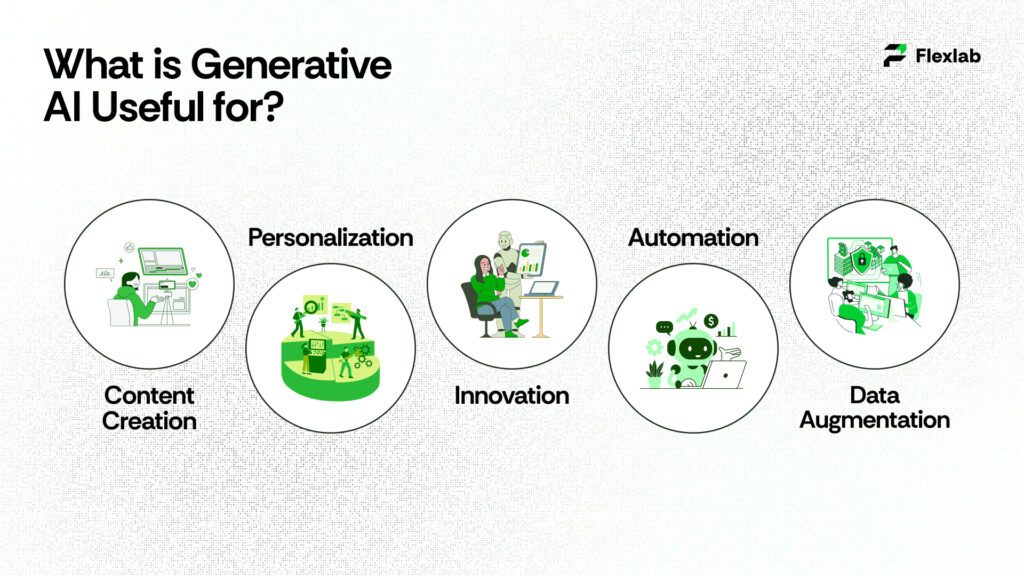
Why is Generative AI Useful?
Benefits of using AI technology

Here are some of the main reasons why this smart technology has gained traction recently.

  • Content Creation: Generative AI applications can help speed up creative work by creating drafts of texts, images, and even videos or music. 
  • Personalization: Generative AI allows content and services to be unique and tailored to users’ individual goals more easily. 
  • Innovation: It can help people explore new ideas, designs, or formats that might not easily come up through manual effort. 
  • Automation: Repetitive or tedious manual tasks, such as creating multiple variants of a picture and writing variants of marketing content, can be offloaded with generative AI. 
  • Data Augmentation: Generative AI can help with data augmentation and simulations. In fields like healthcare and manufacturing, geerative AI models can generate synthetic data to simulate scenarios or train other systems. 

In short, generative AI is useful for many reasons because it changes what AI-assisted humans look like – not just categorizing or analyzing, but generating. 

Top Applications of Generative AI
Common uses of generative AI

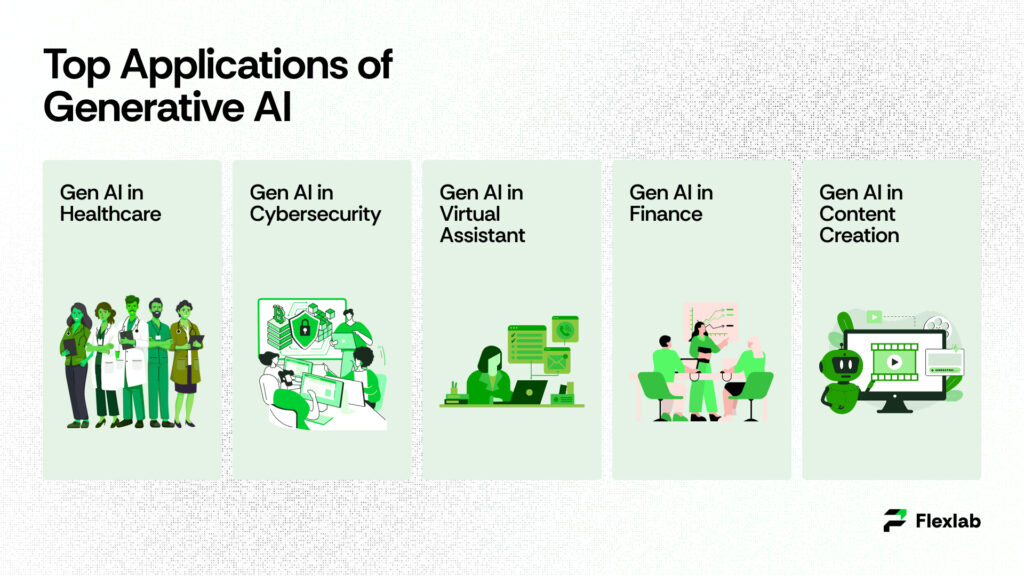
Generative AI is revolutionizing various industries by creating designs, content, and smart solutions. From enhancing productivity to improving creativity, its potential applications are vast and varied. Below are some of the major areas where generative AI is being applied. 

  • Generative AI in Healthcare
  • Generative AI in Cybersecurity
  • Generative AI in Virtual Assistants
  • Generative AI in Finance
  • Generative AI in Content Creation

Generative AI in Healthcare

Generative AI in healthcare is transforming the industry through drug discovery, personalized medicine, and medical imaging. It analysis of patient records helps bring customized treatment plans, therefore, increasing successful outcomes for patients. For instance, several companies are utilizing AI to create treatments tailored to individual patient profiles, taking into account their family and genetic history. 

Additionally, tools such as Insilico Medicine utilize generative AI to generate synthetic patient data, enabling the training of machine learning models without compromising patient privacy. Generative AI also helps with the early detection of diseases. For example, there are apps like SkinVision that use AI systems to analyze and examine images of the skin to help with diagnosis and detect early signs of skin cancer. 

AI Applications in Cybersecurity

Generative AI is revolutionizing cyber risk management by improving threat detection and automating incident response. It is redefining cybersecurity by proactively recognizing threats, simulating attack scenarios, and strengthening incident response capabilities. 

Generative AI helps analyze large datasets to recognize normal behavior within a network. For instance, it can detect an unusual spike in traffic that may demonstrate unauthorized access or a malware attack. Furthermore, advanced phishing attacks can also be encountered through generative AI, which utilizes natural language processing (NLP). It works by analyzing the content of emails and social media interactions in order to look for slight anomalies of unusual or false activities. 

In addition to this, generative AI also plays an important role in incident analysis and prioritization. Generative AI models can automatically analyze security incidents in real time. These models then prioritize incidents based on severity, enabling security teams to respond quickly and effectively.

The Role of AI in Virtual Assistants

Virtual assistants or AI-powered chatbots utilize generative models to provide a more human-like interaction with customers in customer service fields, effectively answering queries and resolving consumer issues. For example, Erica is a virtual financial assistant at the Bank of America that can assist up to 25 million users in managing their accounts, paying bills, and getting spending insights into their transactions. It helps make banking more accessible and efficient for users. Amazon’s Alexa uses conversational AI to deliver personalized product recommendations based on consumer preferences and past purchases, making shopping a fun experience for millions of customers. Another example of generative AI in virtual assistants is Duolingo. It employs a virtual assistant to tailor language lessons according to the user’s progress. Moreover, it provides real-time feedback and delivers gamified learning challenges to enhance the learning experience. 

How AI Is Used in Finance

Generative AI is revolutionizing the finance industry by enhancing fraud detection and risk mitigation. It helps create customized investment plans and improve risk management in the finance sector. One major application is automated report creation. AI generates real-time financial summaries, investment insights, and market trend briefs with high accuracy. In wealth management, advisors use generative AI to create personalized portfolio strategies, scenario analyses, and communication drafts for clients. It helps streamline workflows while significantly improving customer experience. Another use case is synthetic data generation, which allows companies to train models without exposing sensitive data, speeding up generative AI adoption across compliance-heavy environments. 

In addition to this, generative AI strengthens and supports regulatory teams by drafting compliance documents, analyzing policy advancements, and summarizing complex regulations. 

AI in Content Creation

Generative AI in content creation is redefining content creation across various industries. From images and text to music and videos, AI-driven systems streamline workflows, enhance creativity, and boost productivity while maintaining scalability and consistency. Writers and marketers can draft scripts, articles, and posts in minutes, allowing them to focus on ideas rather than time-consuming first drafts. Generative AI also tailors content to specific audiences by analyzing tone and user preferences.

A well-known example is Netflix, where AI algorithms analyze viewing habits, likes, and preferences to provide personalized recommendations. This personalization drives nearly 80% of the content streamed on the platform. Sephora uses a similar approach through its augmented reality tool, Virtual Artist, which lets users try makeup products virtually, enhancing the shopping experience with more interactive engagement.

Generative AI also supports writers by creating blog drafts, headings, and SEO metadata. These autonomous systems help overcome writer’s block, reduce effort, and ensure consistent, high-quality content with greater ease.

Things to Keep in Mind While Using Generative AI
Important considerations when using AI tools

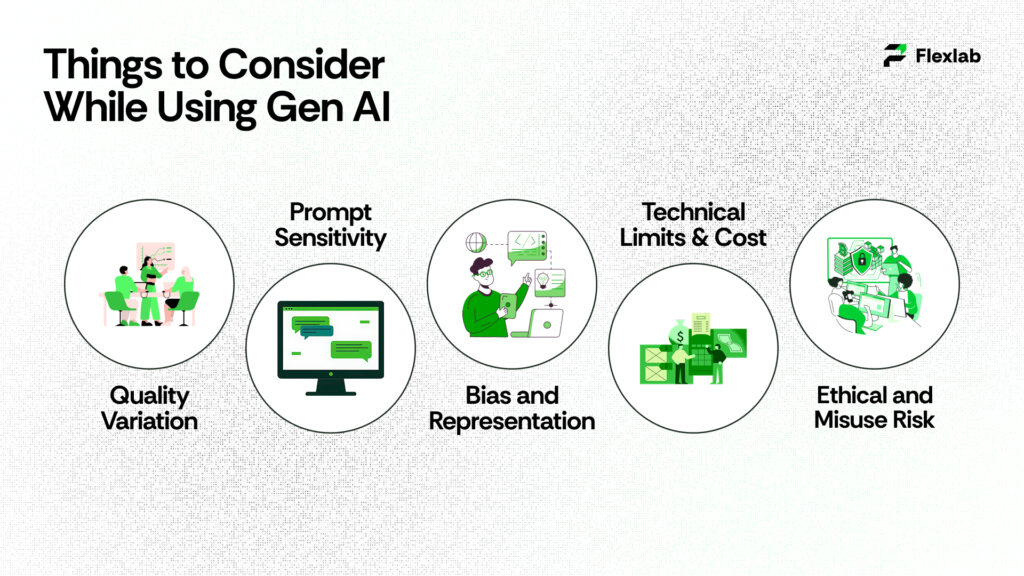
While the potential is significant and exciting, it is better to stay grounded. Here are some important caveats and considerations to keep in mind to make the best use of Generative AI applications. 

  • Quality May Vary: The output you get from generative AI may vary in terms of quality. They are not always perfect. It may make mistakes, be inconsistent, or produce something unexpected.
  • Prompt Sensitivity: The content or output you receive depends heavily on how the user explains the prompt. The more precise, the better the outputs. 
  • Bias and Representation: Since the generative models learn from human-made data, they can also inherit biases present in the data. Therefore, the use of these systems demands careful consideration. 
  • Technical Limits and Cost: Training and running such huge models can be expensive, and using them wisely with responsibility requires knowledge and skills. 
  • Ethical and Misuse Risk: Generative AI can easily be used to create misleading content, such as deepfakes or fake news. Also, it can be used in ways that can raise security and privacy concerns. Therefore, taking such sensitive things into account is really important. 

Keeping these in mind helps you approach generative AI with caution and curiosity. 

How to Start Using Generative AI as a Beginner?
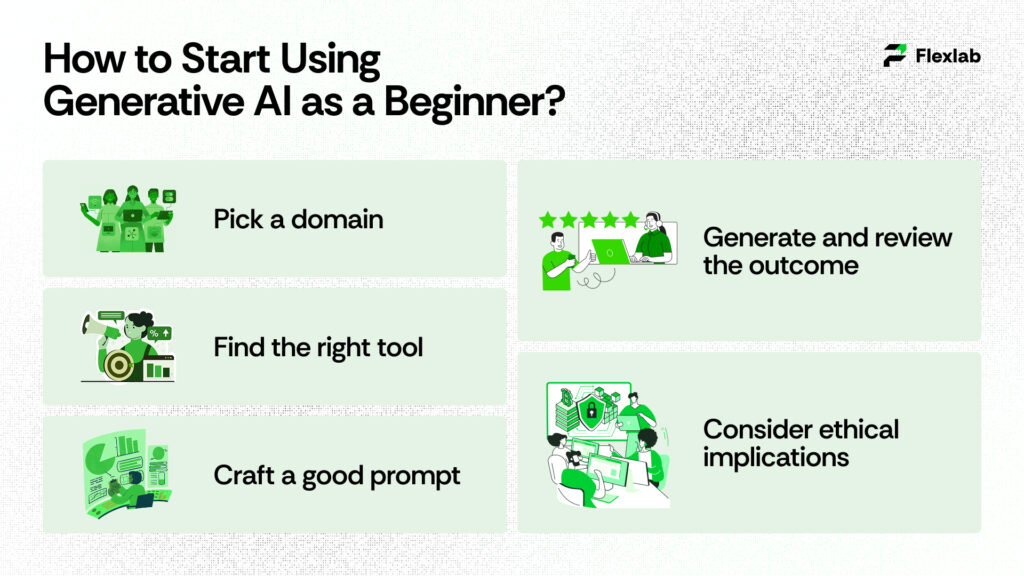
Beginner guide to getting started with AI

If you are just starting out and wondering how you can experiment with generative AI, here are some simple yet effective steps;

  1. Pick a domain you want to work on. You could write blogs, make graphics, or teach.
  2. Find a tool. There are plenty of generative AI tools for different purposes that you can try. 
  3. Craft a good prompt. Be specific about what you want, such as style, tone, or constraints, etc. 
  4. Generate and review the content. After the output is created, edit and refine it. 
  5. Consider ethical implications, especially if you are publishing or sharing the output. Do take care of credit, accuracy, and originality. 

By using this approach, you can get the benefit of generative AI even without being an expert in machine learning. 

Concluding Keyphrases on Applications of Generative AI

Generative AI is transforming how we think, create, and solve problems these days. Its unique abilities to produce text, images, and ideas open new opportunities and possibilities across work, art, and everyday life. As these technologies grow more capable and advanced, they are becoming powerful partners with humans that help us move faster, discover new opportunities, explore new directions, and minimize the limits of traditional workflows. Yet the real significance of generative AI lies in how users choose to use it– with intention, creativity, and awareness. When human judgment meets AI advancements, the result comes out to be more efficient and imaginative way of working.

By developing and deploying AI technologies with the right safety and ethical measures, we can create systems that promote fairness and protect users. Generative AI is not the future of innovation on its own. However, it is becoming an essential part of how we shape our future.

Looking for a Trusted Generative AI Development Company?
Get Reliable AI development services with Flexlab

Unlock the power of generative AI with Flexlab, where innovation, engineering, and strategy come together to drive real and measurable results. Our team of skilled developers develops tailored AI solutions for industries like finance, healthcare, retail, and logistics, helping them cut operational costs with increased workflow efficiency through automation and intelligent content creation. From custom AI models to end-to-end deployment, Flexlab turns complex data into smarter decisions, faster processes, and new revenue opportunities. 

Ready to Grow Your Business?

📞 Book a FREE Consultation Call: +1 (416) 477-9616

📧 Email us: info@flexlab.io

Discover real-world success stories in our portfolio, explore our solutions, and start your AI solution development journey today. Contact us or have a look at our services. See firsthand what our clients say about us and how we’ve transformed their generative AI vision into measurable success.

To have more detailed insights into different topics, explore our blog page for more blogs like public vs private blockchain, benefits of using white label crypto exchanges for startups, and what is multimodal AI? 

FAQs

1. What is the most common use of Generative AI?

The most common use of generative AI is creating and improving content, such as text, images, and code, based on simple user prompts. It’s widely used in writing assistance, marketing content, design, and customer support to save time and boost productivity.

2. What is the most used generative AI tool?

The choice of the right tool depends on what you need: writing, designing, coding, or industry-specific solutions. There is no single best generative AI tool, but leading options like OpenAI’s ChatGPT, Google Gemini, and Adobe Photoshop dominate their fields for text, multimodal tasks, and image generation.

3. What are the seven main types of AI?

The seven main types of AI are reactive machines, limited memory AI, theory-of-mind AI, self-aware AI, narrow AI, general AI, and superintelligent AI. These types range from simple rule-based systems to advanced forms that could one day think, learn, and reason like— or even beyond—humans.


3 Responses

Leave a Reply

Your email address will not be published. Required fields are marked *

How Do Smart Contract Audit Services Work?

Blockchain Audit | White Label Crypto Exchange | Crypto Wallets

Do you want to know what a smart contract audit is? Smart contract audits are comprehensive, independent code reviews that expose security vulnerabilities, bugs, and inefficiencies in blockchain applications before immutable deployment. Expert auditors use manual analysis, automated tools, and formal verification to harden smart contracts against exploits, ensuring reliability when a single flaw can trigger million-dollar disasters in DeFi or dApps.

In this complete guide, discover audit types, the step-by-step process, real-world costs and timelines, essential tools, common vulnerabilities like flash loans and oracle manipulation, and why Flexlab’s audit-first expertise powers secure launches for Toronto’s enterprise blockchain projects.

What Is a Smart Contract Audit?

A smart contract audit is a detailed analysis of a protocol’s smart contract code to detect security vulnerabilities, poor coding practices, and inefficiencies. It suggests fixes to solve these issues. Audits make sure decentralized applications in Web3 are secure, reliable, and fast.

During the audit, a team of security experts reviews the code, logic, architecture, and security measures. They use automated tools and hands-on checks to spot issues. Specifically, they hunt for spots where hackers could attack and ways to improve the code.

Smart contract code is deployed to a blockchain such as Avalanche, BNB Chain, or Ethereum. Once the contracts are live, they can be used by anyone, from end-users to malicious actors. This is why all flaws and vulnerabilities must be fixed before launching or updating the decentralized app in the blockchain ecosystem.

After the audit wraps up, auditors share a summary report that contains details about their findings, how issues were fixed, other problems, and a plan for leftovers. As a result, projects can launch confidently, knowing the app is solid and user funds are safe from catastrophic risk.

Types of Smart Contract Audit

Types of Smart Contract Audit

Smart contract audits ensure that blockchain code is safe in many ways: automated scans for rapid vulnerability detection, manual expert reviews for logic flaws, and specialized audits such as Tokenomics and zero-knowledge proofs. These security audits target high-risk vulnerabilities, including reentrancy attacks (where hackers drain funds by looping calls), weak access controls, and wasteful gas use that could crash the app. Most end with a report listing fixes to avoid hacks and protect users.

Let’s read some of the key types of smart contract audits:

1. Automated Audits (Static/Dynamic Scans)

Teams often use automated tools like Slither, Mythril, or Securify to quickly check code. Specifically, static scans read the code without running it, thereby spotting syntax errors or common bugs. Meanwhile, dynamic scans execute the code to detect runtime issues, such as overflows, which makes them great for catching basic problems in just a few hours. In addition, combining both methods ensures a more thorough audit.

2. Manual Code Reviews

Experts read every line by hand to get the full picture. They spot tricky logic flaws, like reward miscalculations, that tools miss. Plus, they confirm the code matches your project goals, using the docs as a guide. Thus, it’s essential since machines can’t grasp intent.

3. Functional Testing & Simulation

Smart contract auditors test in a fake setup, such as Hardhat and Ganache networks. They run functions under stress-high loads, weird inputs to check behavior, and gas efficiency. For instance, they simulate user flows to ensure deposits and withdrawals work without breaking.

4. Competitive Audits / Contests

Platforms like Code4rena or Sherlock run contests where many auditors examine the same code. This provides more comprehensive coverage than a single firm, often uncovering rare issues. It’s competitive, so top spotters win prizes, boosting thoroughness.

5. Tokenomics Audit

These focus on your token’s economics. Specifically, experts review incentives, supply rules, inflation risks, and how they integrate into smart contracts, such as whether staking rewards dilute value unfairly. This helps prevent pump-and-dump schemes or unfair distributions.

6. Zero-Knowledge (ZK) Circuit Audits

Specialized smart contract auditing uses ZK-proof protocols that hunt bugs in arithmetic circuits and ensure the integrity of privacy-focused apps. This is especially critical for rollups or shielded transactions where correctness is everything.

Why is a Smart Contract Audit Needed?

A smart contract audit is important for rectifying security vulnerabilities, bugs, and inefficiencies in code before deployment. It also prevents irrevocable financial losses. Blockchain code is immutable and acts as law. Therefore, audits are essential for ensuring security, reliability, and functionality in DeFi and dApps. Moreover, it protects against hacks that cost billions of dollars.

Have a glance at the key reasons for smart contract audits:

  • Security & Vulnerability Mitigation: Audits identify critical flaws like reentrancy attacks, integer overflows, and unchecked external calls that lead to theft.
  • Irreversibility of Transactions: Once deployed, smart contract code cannot change. Hence, flawed code can lead to irreversible loss of funds.
  • Financial Protection: Audits prevent and minimize massive financial losses, as over $5B has been lost to DeFi hacks.
  • Trust and Credibility: A clean audit report proves you’re serious about smart contract security. It wins over investors, users, and partners.
  • Compliance and Logic Verification: Experts verify that your code matches business rules and meets regulations, such as token standards. No surprises in how it runs.
  • Efficiency and Optimization: Audits trim wasteful code too, cutting gas fees for users and improving speed.

How Does Smart Contract Audit Work?

Flowchart explaining how a smart contract audit works

A smart contract audit is a detailed and comprehensive process. It consists of thousands or even tens of thousands of lines of code that uncover bugs, security gaps, sloppy coding, and anything that is missed. Tools and expert reviewers team up to check both what’s there and what’s not. Here’s the full process, broken down in detail.

Gather All Documentation First

Firstly, the auditor needs to gather all the relevant documents related to the project. This includes the white paper outlining the big idea, the complete codebase, architecture diagrams, tokenomics details, and a full spec sheet explaining exactly what the smart contract should do. Auditors read the documentation to grasp a high-level understanding of blockchain application goals, such as how users interact, where funds move, and the core business logic.

Without having access to the documentation, a smart contract developer can’t determine whether the code delivers on your vision or not. For instance, if your DeFi protocol promises locked staking rewards, the docs spell that out clearly. At this stage, developers and auditors lock in a “code freeze”; no more edits after this point, or anything new gets ignored in the review. This prevents mid-audit changes from messing up the analysis. Expect this prep phase to take a day or two, depending on project complexity.

Run Automated Tests

Once auditors understand the code and app, they run automated tests with specialized tools. This is the fastest way to spot potential problems. For instance, they run integration tests across big code chunks, unit tests on single functions, and penetration tests to poke for security holes. They also track line coverage; a high percentage means tests hit most code lines. After this wraps up, they shift to manual checks.

Manual Code Review

Automated tests flag some issues, but they miss the big picture, like what developers intended or subtle logic flaws. Plus, they sometimes give false alarms. That’s why a hands-on review is crucial. Auditors read every line, map how parts connect, and cross-check against project specs to catch what tools overlook. Combining both methods ensures nothing sneaky slips by during Ethereum Virtual Machine execution.

Fix the Issues

When problems surface, auditors team up with blockchain developers to patch them. This back-and-forth can drag on, but it’s key to success. Fixing everything upfront ensures contracts are deployment-ready. In blockchain technology, security is everything; user funds depend on it, so budget time for pros to hunt and squash risks during this quality assurance phase.

Deliver the Audit Report

Finally, auditors hand over a detailed report on findings. It lists issues, fixes applied, and a plan for leftovers. This becomes your roadmap for polishing the project and sharing proof of security with users and investors.

How Long Does a Smart Contract Security Audit Take?

Smart contract security audit takes 1 to 6 weeks. However, timelines vary depending on project size and complexity. For instance, simple ones wrap faster, while DeFi protocols stretch longer due to thorough checks.

Factors Affecting Duration

Code size and complexity matter when considering time. A basic ERC-20 token might take 3-5 days, while advanced apps with custom logic require 3-4 weeks or even more. Moreover, poor documentation or messy code adds time, as auditors must reverse-engineer intent. Team responsiveness during fixes also matters; unresponsive devOps services extend remediation.

Typical Timelines by Project

Here’s a breakdown from industry standards:

Project Type

Estimated Time

Examples

Simple tokens (ERC-20/BEP-20) 3-5 days Basic mint/burn/transfer logic 
Medium dApps 1-2 weeks Lending platforms or governance DAOs ​
Complex DeFi/DAOs 3-4 weeks Multi-contract ecosystems with integrations 
Enterprise-grade 1-2 months+ Large codebases with heavy custom features 

How Much Does a Smart Contract Audit Cost?

Smart contract audit cost anywhere from $5,000 to $500,000+ in 2026, depending on project complexity and scope. Most standard DeFi projects fall in the $50,000-$100,000 range.

Key 2026 Audit Cost Benchmarks

  • Simple/Basic Projects: $1,500 – $15,000 (e.g., standard ERC-20 tokens, simple NFTs).
  • Medium Complexity: $15,000 – $50,000 (e.g., standard staking, basic DAO).
  • DeFi/Complex Protocols: $50,000 – $150,000+ (e.g., DEXs, lending protocols, cross-chain bridges).
  • Top-Tier Firm Audits: $20,000 – $50,000+ for standard, and much higher for complex work by a smart contract development company.

Cost Factors

There are some factors that affect smart contract audit cost. For instance, prices hinge on codebase size, like lines of code, logic complexity (e.g., custom math or cross-chain features on blockchain infrastructure), blockchain (Solana/Rust audits cost 20-30% more than Ethereum/Solidity), urgency (rush fees add 30-50%), and firm reputation. Moreover, poor docs or extra services like formal verification also increase the cost price. Retainers for ongoing fixes charge $5k-$30k/month.

The Top 6 Smart Contract Audit Tools in 2026

Icons of top blockchain security tools for 2026

Here are the main tools for smart contract development. Let’s read each tool below:

  • Slither
  • Mythril
  • Echidna
  • Securify
  • Madmax
  • Certora Prover

1. Slither

Slither is a free static analyzer for Vyper contracts and Solidity code. For example, it has over 90 detectors for issues like reentrancy and overflows. Additionally, it runs seamlessly in CI/CD pipelines like Hardhat and has low false positives.

2. Mythril

Mythril performs symbolic execution on EVM bytecode to detect bugs such as unchecked calls or timestamp tricks. It works via CLI or SaaS and requires only contract addresses.

3. Echidna

Echidna fuzzes contracts with random inputs to crash invariants. Specifically, it is perfect for property-based testing on key functions like token balances.

4. Securify

Securify automates pattern matching for compliance and basic logic errors using 37+ templates. In addition, it provides quick scans with code snippets in reports.

5. MadMax

MadMax specializes in gas griefing detection, for example, spotting unbounded loops that enable denial-of-service attacks through high fees.

6. Certora Prover

Certora uses formal verification to mathematically prove that specs hold, making it particularly ideal for complex DeFi invariants on blockchain protocols like Aave.

Common Smart Contract Vulnerabilities

Illustration of common blockchain vulnerabilities and risks

Common smart contract bugs can wipe out millions in hacks, but audits catch them early. Here’s a rundown of the top ones from OWASP’s 2026 list, explained simply.

Access Control Flaws

Hackers sneak into admin functions they shouldn’t touch. For example, anyone can call a “mint” button and create unlimited tokens. Always lock down roles with checks like “if msg.sender is owner.”

Price Oracle Manipulation

Bad price feeds let attackers fake asset values. Then, they borrow huge loans cheaply or liquidate unfairly. Fix it by using trusted oracles like Chainlink with multiple sources.​

Logic Errors

Code does the wrong thing, like wrong reward math or bad voting. Users get overpaid, or votes flip. Test every business rule step-by-step.

Flash Loan Attacks

Borrow tons instantly, exploit a tiny bug, and repay in one go. As a result, it drains pools fast. To prevent this, implement rate limits or checks, and ensure effects and interactions occur in the correct order.

Bad Input Validation

No checks on user data, crashes, or tricks the code. Like huge numbers breaking math. Always sanitize inputs first.

Unchecked External Calls

Call another contract, assume it worked, but it fails silently. Leads to stuck funds. Add “require(success)” after calls.

Arithmetic Errors

Math glitches beyond simple overflows, like division by zero. Wrap numbers with SafeMath libraries.

Reentrancy Attacks

Contract calls out before updating balances. Hacker loops back and drains funds, like the 2016 DAO $60M hack. Update the state first, then call out.​

Integer Overflows/Underflows

Numbers wrap around (255 + 1 = 0), minting fake tokens. To prevent this, use Solidity 0.8+ safe math or libraries.

Proxy/Upgrade Issues

Upgradable contracts letthe attackers hijack versions or reset states. Therefore, double-check init logic and admin controls.

The Role of Flexlab in Smart Contract Security

The Role of Flexlab in performing blockchain security assessments

Flexlab plays a key role in smart contract security as a blockchain development and AI automation agency. They offer smart contract audit services to keep blockchain applications safe.

Flexlab’s Audit Expertise

Flexlab provides detailed smart contract audits following 10 critical steps, from docs review to ongoing monitoring. First, they check documentation for mismatches. Then, static tools like Slither spot basic bugs like reentrancy. Manual reviews catch tricky logic errors next.

Hands-On Testing and Fixes

They run unit, integration, and fuzz tests to simulate attacks. Plus, they review external dependencies and optimize gas use. After the findings, Flexlab helps fix issues and retests everything. For example, their 2025 guide stresses secure access controls and no timestamp tricks.​

Why Flexlab Stands Out

As your go-to for AI-blockchain workflows, Flexlab uses an “audit-first” approach for DeFi platforms. As a result, this builds trust, cuts hacking risks, and ensures compliance. Additionally, their full reports give clear fixes, making deployment confident—perfect for enterprise automation and private chains.

Moreover, explore our blockchain and AI blog page and discover how Flexlab helps Toronto businesses, NFT Marketplace Development Company, Custodial vs Non-Custodial Wallet, Crypto Trading Bot, and Public vs Private Blockchain.

Conclusion: Smart Contract Audit

Smart contract audit services aren’t a luxury; they’re the armored vault protecting your blockchain empire from exploits that drained $385 million in January 2026 alone. By blending automated precision, manual mastery, and rigorous testing, audits mitigate reentrancy risks, access control gaps, and logic errors, delivering 135:1 ROI against average $13.5 million incidents while building unbreakable user trust.

Choose Flexlab for your next audit: our AI-enhanced workflows, 10-step process from docs review to post-deployment monitoring, and proven expertise in DeFi, NFTs, and private chains ensure compliant, gas-optimized code ready for Toronto’s booming Web3 scene. Contact us now and visit our LinkedIn page for more insights.

Ready to Take Your Smart Contract Project?

📞 Book a FREE Consultation Call: +1 (416) 477-9616

📧 Email Us: info@flexlab.io

FAQs

Q1: Can ChatGPT audit smart contracts?

No, ChatGPT cannot reliably perform full smart contract audits on its own. While tools like AuditGPT (built on GPT models) show promise in spotting ERC rule violations with high precision (96.6%) but low recall (37.8% F1-score), it misses many vulnerabilities and serve best as an auxiliary for code parsing or PoC generation.

Q2: Who audits smart contracts?

Leading smart contract auditors include Sherlock (top-ranked for lifecycle security with contests and AI monitoring), Halborn, Trail of Bits (research-grade for rollups), BlockSec, ConsenSys Diligence, Nethermind Security (formal methods), Quantstamp, and QuillAudits. Firms like INORU and Hashlock handle multi-chain audits, while platforms like Code4rena crowdsource via contests. For enterprise needs, Flexlab offers AI-blockchain audits.

Q3: How to become a smart contract auditor?

Master Solidity/Rust programming, blockchain fundamentals (EVM, consensus), Web3 security (OWASP top 10 like reentrancy), and auditing tools (Slither, Mythril). Then, build hands-on experience via CTFs (Capture The Flag), bug bounties on Immunefi/Code4rena, open-source contributions, and personal audits, while also developing critical thinking, communication for reports, and continuous learning on new exploits.

How AI Predictive Analytics Enhances Supply Chain Efficiency

Enterprise AI Solutions | Innovative AI ApplicationsAI Automation Services in 2026

AI predictive analytics is transforming how organizations plan, operate, and protect modern supply chains in an environment defined by uncertainty and speed. As global networks become increasingly complex, businesses can no longer rely on static forecasts or manual planning to maintain supply chain efficiency and consistently meet customer expectations.

Today’s supply chains generate massive volumes of data across sales, inventory, logistics, production, and transportation. However, when powered by business intelligence, advanced data analysis techniques, and AI models, this data shifts from an operational burden to a strategic asset. As a result, instead of reacting to delays, shortages, or cost spikes after they occur, organizations can anticipate outcomes and act proactively.

Moreover, AI predictive analytics enables organizations to improve demand forecasting, strengthen inventory optimization, reduce operational risk, and increase OTIF on time in full performance. By combining machine learning algorithms and applications, artificial neural networks, and real-time ecosystem signals, predictive systems continuously learn and adapt to changing conditions.

In this guide, we explain what AI predictive analytics means for supply chains, how it works, where it delivers the highest impact, and how organizations can use it to build resilience, agility, and long-term competitive advantage.

What Is AI Predictive Analytics in Supply Chain Management?

What Is AI Predictive Analytics in Supply Chain Management?

AI predictive analytics in supply chain management refers to the use of intelligent systems and advanced algorithms to analyze historical and real-time data to forecast future outcomes. Rather than relying on assumptions or static reports, organizations use predictive analytics to anticipate demand shifts, supply disruptions, and operational bottlenecks before they affect performance.

By combining data from sales, manufacturing, logistics, and external market signals, predictive systems transform uncertainty into actionable insight. Consequently, businesses move from reactive planning to proactive execution, improving accuracy, efficiency, and decision speed across the entire supply chain.

Business Challenges AI Predictive Analytics Solves

Modern supply chains face persistent challenges, including demand volatility, forecast inaccuracies, excess inventory, stockouts, and poor OTIF performance. In addition, limited visibility into disruptions often forces organizations into costly last-minute decisions.

AI predictive analytics addresses these challenges by providing early visibility into potential risks and opportunities. As a result, organizations can stabilize operations, reduce inefficiencies, and improve customer service while maintaining cost control.

How Predictive Analytics Models Work in Supply Chains

At the core of AI-driven forecasting are predictive analytics models that identify patterns, trends, and anomalies across large datasets. These models evaluate historical demand, seasonality, supplier performance, and transportation data to predict what is likely to happen next.

Unlike traditional forecasting methods, predictive models continuously improve as new data becomes available. Therefore, supply chain leaders can adjust plans in near real time, significantly reducing errors and minimizing costly surprises.

Core AI Technologies Powering Predictive Supply Chains

Diagram illustrating machine learning models in logistics operations

At the core of modern predictive supply chains are intelligent AI technologies that enable organizations to transform data into foresight. These technologies support advanced pattern recognition, continuous learning, and faster decision-making across complex and fast-moving supply networks.

By combining scalable data processing with adaptive analytical capabilities, organizations can enhance planning accuracy, anticipate disruptions, and support more resilient and responsive supply chain operations.

Data Requirements for AI Predictive Analytics

The effectiveness of AI predictive analytics depends heavily on data quality and consistency. While organizations do not need perfect data, they do need reliable inputs across the supply chain.

Key data sources typically include historical sales data, inventory levels, supplier lead times, production schedules, transportation data, and external signals such as weather patterns and market trends. When integrated into a unified environment, these datasets enable more accurate and actionable predictions.

Core AI Technologies Explained

AI predictive analytics is powered by machine learning algorithms and applications that allow systems to learn from data without explicit programming. Over time, these models adapt to changing conditions, improving forecast accuracy and responsiveness.

More advanced use cases rely on artificial neural networks and deep learning techniques to model complex, non-linear relationships. This capability is especially valuable for demand sensing, risk detection, and managing highly dynamic global supply chain environments.

Key Components of AI Predictive Analytics in Modern Supply Chains

Flowchart of data integration across inventory, sales, and transportation systems

AI predictive analytics delivers value through interconnected components that transform raw data into forecasts, recommendations, and automated actions. When implemented correctly, these components improve both operational performance and strategic decision-making.

1. Demand Forecasting Powered by AI Intelligence

AI-driven demand forecasting evaluates customer behavior, market trends, promotions, and external signals, rather than relying solely on historical averages. As a result, organizations achieve higher forecast precision while reducing overproduction and stockouts.

Real-world impact: Retailers using AI-based forecasting report forecast accuracy improvements of 20–30%, according to industry studies.

2. Inventory Optimization and OTIF Performance

Predictive inventory optimization ensures the right products are available at the right time and location, without tying up excess working capital. Consequently, improved inventory decisions directly enhance OTIF (on time in full) performance, strengthening customer trust and operational reliability.

3. Predictive Maintenance and Quality Assurance

Predictive maintenance uses AI to monitor asset health, sensor data, and performance trends to anticipate failures before they occur. As a result, organizations reduce downtime, prevent quality issues, and maintain consistent production schedules.

4. Transportation and Logistics Optimization

AI enhances logistics planning by analyzing routes, carrier performance, fuel costs, and delivery constraints in real time. When integrated with transportation management systems, predictive analytics enables dynamic routing, smarter carrier selection, and faster exception handling.

5. KPIs Impacted by AI Predictive Analytics

AI predictive analytics directly improves key performance indicators, including forecast accuracy, inventory turnover, service levels, OTIF performance, logistics cost per unit, and working capital efficiency. Together, these improvements deliver measurable business impact.

How AI Predictive Analytics Improves Supply Chain Efficiency and Resilience

How AI Predictive Analytics Improves Supply Chain Efficiency and Resilience

AI predictive analytics reshapes supply chains by enabling faster responses, smarter planning, and stronger risk preparedness. Additionally, by forecasting outcomes, organizations improve operational continuity while adapting to changing market conditions.

  • Driving End-to-End Supply Chain Efficiency

AI-powered insights help eliminate inefficiencies across sourcing, production, warehousing, and distribution. Therefore, organizations achieve faster cycle times, lower operating costs, and better demand–supply alignment.

  • Strengthening Supply Chain Resilience Against Disruptions

Predictive analytics enhances supply chain resilience by modeling risk scenarios and estimating their potential impact. Consequently, teams can reroute shipments, shift sourcing strategies, or adjust inventory buffers before disruptions affect customers.

  • Smarter Supply Chain Strategies Through Predictive Insight

Predictive insights support data-driven supply chain strategies related to network design, capacity planning, and supplier diversification. As a result, strategies remain aligned with business goals and customer expectations.

Implementing AI Predictive Analytics Successfully

Successfully implementing AI in supply chains requires a structured approach that balances technology, data, and human expertise. Organizations must begin with focused pilot projects, ensuring that data quality, integration with existing systems, and user adoption are prioritized from the outset.

By carefully planning each stage, organizations can leverage AI predictive analytics to generate actionable insights while minimizing risks. Proper governance, continuous monitoring, and cross-functional collaboration are critical to ensure that predictive models remain accurate, relevant, and aligned with business goals.

Core Components of AI Predictive Analytics in Supply Chain

Component Primary Function Business Impact
Demand Forecasting Predict future customer demand Higher accuracy, reduced stockouts
Inventory Optimization Balance stock levels and service Lower holding costs, better OTIF
Predictive Maintenance Anticipate equipment failures Less downtime, higher output
Transportation Optimization Improve routing and delivery Lower logistics costs, faster delivery

Implementation Considerations and Best Practices

Successful adoption requires more than advanced technology. Organizations should start with focused pilot use cases, prioritize data quality, integrate with ERP enterprise resource planning systems, and maintain human oversight during early automation stages.

Common Pitfalls to Avoid

Common pitfalls include over-automation too early, weak data governance, unrealistic ROI expectations, and treating AI as a one-time deployment. Organizations that view AI as a continuous improvement capability achieve more sustainable results.

Real-World Use Cases of AI Predictive Analytics Across the Supply Chain

Example of real-time inventory tracking and demand forecasting results

AI predictive analytics delivers measurable value across industries by enabling proactive, data-driven execution. Across sectors such as retail, manufacturing, logistics, and pharmaceuticals, organizations are increasingly leveraging predictive intelligence to optimize operations, reduce costs, and improve service levels.

Demand Forecasting and Inventory Optimization at Scale

Organizations using predictive analytics report inventory holding cost reductions of up to 20% while simultaneously improving service levels. Consequently, smarter stock positioning enhances cash flow, reduces waste, and ensures customers receive products on time. Moreover, predictive forecasting allows companies to anticipate seasonal spikes and market shifts, which can improve forecast accuracy by 15–30% according to industry benchmarks.

Predictive Maintenance Using IoT and AI Systems

By combining IoT sensors with AI models, predictive maintenance identifies early warning signs of equipment failure. As a result, unplanned downtime can be reduced by up to 30%, extending asset lifespan and preventing costly operational disruptions. Additionally, organizations benefit from optimized maintenance schedules, reduced repair costs, and improved production reliability. This capability is particularly valuable for manufacturers and logistics providers managing high-value machinery or fleets.

ERP Integration and Automated Decision-Making

Modern ERP platforms increasingly embed predictive analytics to enable automated decision-making. With AI copilots, planners receive contextual recommendations rather than static reports, accelerating decision cycles and minimizing human error. Consequently, companies achieve faster response times, higher operational efficiency, and improved OTIF (on-time, in-full) performance. Furthermore, integration with ERP systems allows predictive insights to flow directly into procurement, production, and distribution planning, enhancing overall supply chain agility.

AI in Transportation and Logistics Optimization

AI predictive analytics is transforming transportation and logistics by enabling smarter routing, predictive maintenance, and real-time decision-making across complex supply networks. By leveraging these technologies, organizations can proactively manage shipments, avoid bottlenecks, and reduce costs, even in volatile conditions.

According to Statista, companies adopting AI in logistics report transportation cost reductions of up to 15% while improving delivery speed by 12–18%. Moreover, AI-driven routing optimizes carrier selection, fleet utilization, and delivery scheduling, which directly enhances OTIF (on-time, in-full) performance and customer satisfaction.

In addition, integrating IoT technology with predictive analytics allows organizations to monitor vehicles and warehouse assets in real time. Consequently, predictive maintenance reduces unplanned downtime by up to 30%, extends asset lifespan, and prevents costly delays. Furthermore, AI systems can dynamically adjust routes during peak demand or unexpected disruptions, ensuring shipments are delivered efficiently while minimizing fuel consumption and operational risk.

By combining AI technologies with transportation management systems (TMS), companies achieve higher operational reliability, improved cost efficiency, and increased overall supply chain agility. For example, global logistics providers using AI-driven networks report up to 20% faster turnaround times across multi-node supply chains. Meanwhile, predictive insights help planners make informed decisions, reducing human error and enabling automated rerouting when conditions change.

Overall, AI in transportation and logistics not only lowers costs and improves speed but also strengthens resilience, responsiveness, and operational transparency across the supply chain.

Future Trends in AI Predictive Analytics for Supply Chains

Graph showing future supply chain trends and automation growth

The future of supply chains is becoming increasingly autonomous and intelligent, driven by rapid advancements in AI predictive analytics. According to Gartner (2026), over 65% of leading organizations are expected to adopt autonomous AI agents and predictive analytics at scale, improving operational efficiency by up to 25%.

Generative AI for Strategic Decision-Making

Generative AI is reshaping strategic planning by enabling scenario simulation, optimized decision-making, and advanced forecasting. Consequently, supply chain leaders can model multiple sourcing strategies, evaluate demand fluctuations, and design resilient networks before disruptions occur. Real-world applications show that companies using generative AI for scenario planning can reduce supply chain costs by up to 12% while maintaining high service levels.

Autonomous AI Agents for Self-Healing Supply Chains

Autonomous AI agents detect disruptions, reroute shipments, and trigger replenishment workflows without human intervention. As a result, organizations experience faster response times, reduced emergency shipping costs, and improved OTIF performance. Moreover, by continuously monitoring real-time signals from suppliers, transportation networks, and warehouses, these agents enhance supply chain resilience and support proactive risk mitigation.

Who Should Use AI Predictive Analytics?

AI predictive analytics is most effective for organizations operating complex, multi-node supply chains with high demand variability. Industries that benefit significantly include retail, manufacturing, logistics, pharmaceuticals, consumer packaged goods (CPG), and global distribution networks.

Moreover, enterprises with multiple warehouses, regional distribution centers, or international suppliers can leverage predictive analytics to optimize inventory, reduce costs, and enhance customer satisfaction. Consequently, organizations adopting these technologies gain a competitive edge by making faster, smarter, and more data-driven decisions.

Flexlab Leading the Future of Predictive Supply Chain Analytics

Flexlab Leading the Future of Predictive Supply Chain Analytics

If you’re ready to move beyond reactive planning and fully unlock the value of AI predictive analytics in your supply chain, now is the time to act with confidence. At Flexlab, we design and deliver intelligent, data-driven solutions that elevate forecasting accuracy, reduce operational risk, and strengthen end-to-end supply chain resilience.

Whether you are adopting AI for the first time or scaling existing predictive capabilities, our team works alongside you to build solutions that drive measurable performance gains, faster decision-making, and long-term competitive advantage.

Ready to Move from Reactive to Predictive Supply Chain Performance
📞 Book a FREE Consultation Call: +1 (416) 477-9616
📧 Email Us: info@flexlab.io

To understand how we deliver real impact, explore our services, and see how we enable AI-driven transformation across industries. You can also review our portfolio to discover real-world solutions we’ve implemented. If you’re ready to start the conversation, connect with us through our contact us page.

For ongoing insights on AI, automation, and advanced analytics, visit our website, explore our latest perspectives on the blog, or follow us on LinkedIn to stay ahead of emerging trends, use cases, and expert insights.

Conclusion: AI Predictive Analytics Driving Future-Ready Supply Chains

AI predictive analytics transforms supply chains from reactive to proactive by improving forecast accuracy, inventory management, OTIF performance, and operational efficiency. By leveraging machine learning, deep learning, and AI copilots, organizations gain actionable insights that drive resilience and competitive advantage. Organizations that embrace AI predictive analytics today build supply chains that are efficient, adaptive, resilient, and ready for tomorrow’s challenges.

FAQ’s 

1. How long does it take to implement AI predictive analytics in a supply chain?

Implementation time varies depending on the complexity of the supply chain and data quality. For most mid-to-large organizations, initial pilots can take 3–6 months, while full-scale deployment may take 12–18 months. Starting with a small, focused project often helps teams gain quick insights and build confidence before scaling. Additionally, continuous monitoring and model adjustments are essential for long-term success, as supply chain conditions evolve over time.

2. Can small businesses benefit from AI predictive analytics in supply chains?

Absolutely! While AI is often associated with large enterprises, small businesses can leverage cloud-based predictive analytics tools. By analyzing sales, inventory, and supplier data, even smaller operations can optimize stock, improve delivery reliability, and anticipate disruptions without huge infrastructure investments. Over time, this can create significant cost savings and give smaller companies a competitive edge in their markets.

3. What types of supply chain decisions can AI predictive analytics improve?

AI predictive analytics supports decisions across demand planning, inventory management, transportation, and risk mitigation. It helps organizations decide when to replenish stock, how to route shipments, and how to prepare for supplier delays. Essentially, it turns data into actionable insights that reduce cost and improve service levels. Moreover, predictive analytics can guide strategic decisions like supplier selection and capacity planning to strengthen overall supply chain resilience.

How AI in Marketing Can Benefit Small Businesses

AI Marketing ToolsMarketing Automation | Best AI Automation Agency 

AI in marketing has crossed the line from experimental curiosity to essential infrastructure for small businesses trying to stay competitive in 2026. Yet, many teams still struggle with the same pressure, shrinking organic reach, limited time, and rising customer expectations. As a result, AI marketing automation is no longer optional; it now shapes how products and services are discovered, evaluated, and purchased.

At the same time, AI in digital marketing is influencing how customers compare brands, trust recommendations, and make buying decisions through conversational and agentic interfaces. However, for small business owners managing lean teams and tight budgets, the real concern is not what AI marketing is, but whether the investment actually pays off.

Furthermore, that tension is real. When AI is treated as a shortcut, it often becomes an expensive distraction. However, when it operates as a connected system, it multiplies efficiency, insight, and revenue. In 2026, traditional search has already shifted, with benchmarks pointing to nearly a 50 percent drop in organic traffic as users rely more on AI-driven answers. Therefore, this guide breaks down the real ROI, time savings, and structural changes, including the Universal Commerce Protocol, so you can decide with clarity and confidence.

Why Is AI in Marketing Essential for Small Businesses in 2026?

Why Is AI in Marketing Essential for Small Businesses in 2026

Small businesses now operate in a digital landscape that experienced a hard reset in early 2026. Specifically, buyer behavior and discovery channels rely heavily on AI-driven systems that summarize and recommend options rather than simply listing links.

  • The Shift From SEO to Generative Engine Optimization (GEO)

Search behavior has transitioned from keyword matching to Generative Engine Optimization. In this environment, visibility depends on being cited as a trusted source within AI-generated responses. Moreover, businesses that publish structured marketing data analytics and high factual density are significantly more likely to be referenced by agents such as ChatGPT and Gemini.

  • Higher-Intent Traffic From AI Recommendations

Visitors arriving through AI-assisted search typically sit further along in the buying journey. According to early-adopter data, traffic originating from AI assistants converts at approximately 4.4 times the rate of traditional organic search. Because AI systems already filter results based on context and intent, the leads that reach your site arrive pre-qualified.

  • Influencing the Modern Buying Reality

We have entered a phase where nearly 70 percent of the B2B buyer journey happens before a vendor is contacted. Additionally, buyers increasingly scan Reddit discussions, watch practitioner deep dives, and use AI-powered voice assistants to compare solutions. As a result, appearing in AI summaries has become just as critical as ranking first in traditional search was once.

What Is the Real ROI of AI for Small Business Marketing?

Chart showing return on investment from marketing automation tools

ROI is where many marketers draw a firm line. Tools alone do not generate revenue; outcomes do. Because we are now in a maturity phase, industry benchmarks in 2026 place average B2B marketing ROI near a 5:1 ratio.

The Worth It Equation for Financial Planning

AI predictive analytics should focus on three measurable outcomes:

  • Revenue lift, 
  • Cost savings, and 
  • Risk reduction

For clarity, many small businesses use the following formulas:

  • Efficiency Ratio:
    ROI% = (Business Benefit − Total Cost) ÷ Total Cost × 100
  • Payback Period:
    Payback Period = Total Cost ÷ Monthly Benefit

Together, these formulas allow teams to justify investment using concrete financial logic rather than assumptions.

Revenue Growth Signals for SMBs

Small businesses often benefit disproportionately from AI adoption. Industry reports suggest SMBs are roughly 23 percent more likely than large organizations to see ROI from blog-driven demand generation. Similarly, teams working with an AI automation agency or an integrated CRM have reported lead acquisition increases of more than 100 percent when AI is implemented systemically rather than tactically.

How Does AI Save Time for Lean Marketing Teams?

Small business team reviewing performance analytics

Time remains the most constrained resource for small businesses. AI delivers immediate value by eliminating repetitive, low-impact tasks and reclaiming an average of 11 to 12 hours per user each week.

AI Marketing Automation and Reclaiming Your Work Week

Routine activities such as reporting, scheduling, and campaign management are now automated. For instance, AI-powered design platforms enable non-designers to produce professional visuals within minutes, reducing bottlenecks that once delayed campaigns. Additionally, modern marketing automation software can now handle more than 40 percent of routine customer queries without human intervention.

From Executor to Architect

Marketers are evolving from individuals who write every word to strategic Vibe Directors of intelligent systems. Rather than producing assets manually, teams oversee AI-driven content creation engines that generate, test, and optimize content continuously.

What Are the Hidden Risks of Investing in AI Marketing?

Business owner evaluating new technology adoption risk

Despite its upside, AI can quietly undermine growth if it is applied without a clear human strategy and oversight. While automation accelerates execution, unmanaged systems can amplify inefficiencies just as quickly.

The Zombie Catalog Trap

AI predictive analytics and automated bidding systems are often profit-blind. When fed only top-line revenue data, AI may prioritize so-called Zombie products, low-margin items that look strong on ROAS reports but weaken net profit over time. Because of this, human teams must apply market segmentation to separate true margin drivers from low-potential inventory before automation scales the wrong outcomes.

Beating AI Fatigue With Human Taste

At the same time, a growing trust gap has emerged. More than 80 percent of consumers now expect disclosure when AI is involved in marketing decisions. In contrast, campaigns rooted in human values and supported by sentiment analysis consistently outperform generic automation. As a result, brands that lead with an authentic perspective and human judgment are far more likely to influence purchasing behavior.

AI Governance and Brand Trust in 2026

In 2026, AI governance is no longer just an enterprise concern. Even small businesses are expected to explain how AI is used in personalization, targeting, and customer interactions. As AI influences pricing, recommendations, and messaging, transparency has become a trust signal rather than a compliance checkbox.

Because of this shift, businesses that add human review, document data sources, and apply ethical oversight don’t just reduce risk; they actively build credibility with both customers and AI recommendation systems. Ultimately, strong AI governance protects brand trust while limiting long-term exposure.

Ultimately, strong AI governance protects brand trust and limits long-term risk. In practice, trust is now earned through responsible AI use, clear accountability, and human-led judgment.

The AI-First Architect Model

Sustainable success comes from combining AI and machine learning with human judgment rather than replacing it.

Human Vibe Director AI Commercial Infrastructure
Taste and POV through content marketing Scale and speed across workflows
Ethical oversight and AI skills Agentic readiness via UCP
Context and empathy for customer experience Predictive intelligence powered by generative AI

Universal Commerce Protocol (UCP): The 2026 Visibility Revolution

Introduced in early 2026, the Universal Commerce Protocol represents a major shift in how products are discovered and sold. Once adopted, AI agents can browse, evaluate, and even complete purchases on a user’s behalf without requiring a visit to a traditional website.

  • Becoming Machine-Readable Through UCP Manifests

To remain competitive, businesses now publish a UCP manifest file that allows AI systems to clearly understand, evaluate, and recommend their products. While storefronts serve human aesthetics, UCP manifests serve machine certainty. Because artificial neural networks power these agents, they require precise data such as pricing, materials, and stock availability.

  • Agentic Commerce and Zero-Click Purchasing

With UCP in place, products surface naturally within AI conversations. When users ask for recommendations, UCP-compliant businesses appear instantly. As a result, even small teams can compete with large digital marketing services by maintaining superior data hygiene.

Which AI Tools for Marketing Are Actually Worth the Investment?

The great news for small businesses in 2026 is that the right AI tools can unlock efficiency, creativity, and measurable ROI, even with lean teams. By using integrated, strategic AI systems, SMBs can save time, scale operations, and produce high-quality content without adding headcount.

Top AI Tools for Marketing to Consider:

  1. HubSpot AI: All-in-One Infrastructure
  2. LTX Studio: High-ROI Media Production
  3. Canva: High-ROI Media Production
  4. Gumloop: Custom Automation
  5. Make.com: Custom Automation

Software comparison screen with automation features

These tools are effective because they cover core infrastructure, high-ROI media, and flexible automation layers, providing small teams the power to operate like enterprise-level teams without the complexity.

1. All-in-One Infrastructure: HubSpot AI

HubSpot remains a top choice for SMBs because it centralizes CRM, email, analytics, and conversational AI chatbot in one platform. Its AI agents help optimize email campaigns, automatically score leads, and forecast sales pipelines. Studies show that SMBs using HubSpot AI see up to 34% faster lead response times and a 5–1 ROI on marketing campaigns, making it a clear choice for teams that need scale and reliability.

2. High-ROI Media: LTX Studio and Canva

Short-form video continues to deliver the highest ROI in 2026. Tools like LTX Studio and Canva allow teams to create professional videos, social graphics, and marketing assets in hours rather than weeks, reducing production costs by up to 60% compared to traditional workflows. Early-adopter SMBs report a 49% higher engagement rate when these AI-driven media tools are used strategically in campaigns.

3. Custom Automation: Gumloop and Make.com

These low-code platforms enable teams to build autonomous workflows across multiple AI applications. Such as blogs can automatically generate social media posts, CRM updates, and email sequences. Companies using these automation tools report saving 10–12 hours per week per team member, while campaign accuracy improves by up to 38%, allowing SMBs to scale efficiently without adding new hires.

How Should a Small Business Start Investing in AI in Digital Marketing?

The exciting news for small businesses in 2026 is that investing in AI in digital marketing doesn’t have to be overwhelming. With a clear plan, even lean teams can maximize ROI while experimenting safely. The key is balancing core infrastructure, experimental media, and innovation in a structured approach.

The 70-20-10 Budget Framework

Many small teams find the 70-20-10 framework to be the most effective:

  • 70% toward core infrastructure such as CRM, email automation, and analytics
  • 20% toward experimental media formats like short-form video, AI-driven ad creatives, or interactive content
  • 10% toward innovation, testing autonomous agents, or programmatic advertising

Following this framework ensures that the majority of your budget goes toward reliable systems, while still leaving room for experimentation and future-ready innovations. Teams applying this structure report 5x higher efficiency in campaign execution compared to unplanned spending.

Owning First-Party Data for a 2.9X Conversion Boost

With third-party cookies disappearing, first-party data has become a critical competitive asset. Businesses that collect and leverage their own email addresses, phone numbers, and website behavior see conversion rates nearly three times higher than those relying solely on external data sources.

At the same time, owning your data allows smarter AI-driven recommendations, personalization, and targeted campaigns, all while maintaining privacy compliance. This means your investment in AI in digital marketing becomes tactical as well as strategically transformative.

The 2026 AI Marketing Strategy Shift for Small Businesses

Metric Old Experimental Approach 2026 Systemic Approach
Primary Goal Task efficiency Revenue growth
Search Focus Keywords GEO visibility
Data Usage Third-party cookies First-party CRM
Human Role Content executor Architect

Why Investing in AI in Marketing Is a Game-Changer for Small Businesses 

Small business owner analyzing digital growth strategy

For small businesses in 2026, AI in marketing has evolved from a support tool into the core engine behind growth and efficiency. The benefits are tangible: improved decision-making, accelerated campaigns, and higher-quality leads. Meanwhile, the cost of doing nothing has become measurable, making AI adoption a strategic necessity rather than an option.

The Real Cost of Doing Nothing

Industry estimates show that staying manual can cost between $500 and $2,000 per month in lost time, missed opportunities, and inefficient campaigns. For instance, a small e-commerce business that delays AI-driven email marketing optimization loses over $1,200 in potential monthly revenue because manually curated campaigns fail to convert high-intent leads on time. Clearly, delaying AI adoption can directly impact both revenue and market positioning.

Balancing AI With Human Judgment 

AI delivers scale and speed, but human oversight ensures campaigns are ethical, accurate, and customer-focused. Brands that succeed in the agentic era feed structured data through GEO and UCP, while maintaining messaging that resonates with real people. For instance, a local service provider automated lead scoring and follow-up reminders with AI, while the marketing manager assembled the messaging tone. Within two months, conversion rates improved by 32%, showing the power of combining human insight with AI automation.

Turning AI Insights Into Measurable Results 

Small businesses can leverage AI insights immediately to drive real growth. A boutique retail brand implemented predictive analytics to identify products likely to sell out, adjusting campaigns in real time. This resulted in a 20% increase in monthly sales and reduced overstock costs by 15%, demonstrating that actionable AI insights deliver both efficiency and revenue. To learn more about how these strategies work, explore our full range of services or check our AI marketing blog for case studies and insights.

Drive Higher ROI in AI Marketing With Flexlab

Flexlab marketing analytics platform interface on laptop screen

Take your business marketing to the next level with AI-powered systems that actually deliver results. At Flexlab, we build fully integrated solutions that combine automation, predictive insights, and human-led strategy to boost revenue and efficiency.

Curious how we’ve delivered results for other businesses? Explore our portfolio to see real examples of AI-driven campaigns and success stories. Want to dive deeper into AI strategies? Check out our services or read more insights on our blog. Stay connected and ahead of the curve by following us on LinkedIn for the latest in AI marketing, automation, and digital growth.

Act now and move with intent. When deployed with the right structure, AI transforms campaigns, accelerates workflows, and drives qualified leads at scale. Flexlab turns advanced technology into a measurable growth engine built for performance, not experimentation. To expand your strategy further, explore insights that sharpen execution and decision-making:

When you’re ready to move faster and smarter, contact us today to turn strategy into a revenue-driving AI marketing system.

Final Thoughts on AI in Marketing for Small Businesses

AI in Marketing Worth the Investment for Small Businesses has moved from theory to real-world results. When applied with clear goals and the right strategy, it gives small teams a genuine edge, not someday, but right now. By investing in the right infrastructure, owning first-party data, and balancing AI speed with human judgment, AI shifts from an expense into a measurable growth driver.

Instead of chasing every new tool, the businesses that win in 2026 focus on connected systems, trust-driven marketing, and smart execution. They use AI to strengthen decision-making, deepen customer relationships, and scale what already works. Ultimately, AI delivers the most value when it amplifies strategy, supports human creativity, and drives sustainable revenue growth.

Ready to Take Your AI Marketing Strategy to the Next Level?
📞 Book a FREE Consultation Call: +1 (416) 477-9616
📧 Email Us: info@flexlab.io

How long does it take for AI in marketing to show results for small businesses?

Most small businesses see early results from AI in marketing within 30 to 60 days, especially from email automation, ad optimization, and lead scoring. Over time, stronger gains come from improved visibility in AI-driven search and better-qualified leads. However, consistent use and clear goals matter more than speed. When AI supports strategy instead of replacing it, results compound faster.

Is AI marketing expensive for small businesses to maintain?

AI marketing doesn’t have to be expensive. Many small businesses start with affordable tools that replace multiple manual tasks at once. In fact, AI often lowers overall marketing costs by saving time and improving conversion rates. The real expense usually comes from poor setup, not the technology itself. When used strategically, AI becomes a cost saver, not a budget drain.

Can AI marketing work without paid ads or large marketing budgets?

Yes, AI marketing works even without paid ads. Small businesses can use AI for content optimization, email personalization, CRM automation, and AI search visibility. These channels drive long-term traffic and leads without ongoing ad spend. When paired with strong first-party data, AI helps businesses grow organically while staying competitive against larger brands.


Why Toronto Businesses Choose Flexlab for AI Automation?

What Is Marketing Automation | Automation Testing | AI Strategy Consulting

AI automation represents the most significant shift in business operations since the dawn of the internet, especially for companies in Canada’s economic heartland. While traditional automation follows a rigid script, the intelligent systems designed by Flexlab learn, adapt, and evolve alongside your Toronto business. By blending cognitive intelligence with seamless execution, we empower enterprises to scale without the proportional increase in overhead. 

In this post, we’ll explore how Flexlab’s tailored approach to automation can not only help your business scale faster but also reduce costs and, ultimately, outpace the competition.

What is AI Automation?

AI automation refers to the use of AI technologies combined with automation tools to handle complex, repetitive tasks with minimal human input. It leverages machine learning algorithms, natural language processing, and data analysis to process information, recognize patterns, and make intelligent decisions that improve over time.

Key Components:

  • Machine Learning: Enables systems to learn from data and adapt without explicit programming.
  • Robotic Process Automation (RPA): Automates rule-based workflows, enhanced by AI for smarter handling of unstructured data like documents or emails.
  • AI Workflow Automation: Specifically streamlines dynamic processes by analyzing patterns and executing actions autonomously.
  • Business Process Automation (BPA): Provides structured frameworks to identify, analyze, and optimize end-to-end business processes for greater efficiency.

To sum up, AI automation boosts efficiency by reducing manual errors, speeding up operations, and freeing teams for strategic work, as seen in applications like anomaly detection and customer service routing.

Why Use AI Automation?

Why Use AI Automation

AI automates routine processes seamlessly. As a result, people are more focused on other important tasks. But what are the results of enterprise AI solutions?  It enhanced business productivity, cost savings, and improved customer experiences.

Some of the key benefits include:

  • Increased Efficiency
  • Improved Accuracy
  • Cost Savings
  • Greater Scalability and Flexibility
  • Better Customer Experiences
  • Improved Decision-making
  • Risk Mitigation

Increased Efficiency

AI automation helps people by streamlining routine processes. It handles tasks such as processing documents, analyzing large datasets, and responding to customer inquiries. This approach frees up time, allowing you to invest more in strategic, creative, and value-driven work. As a result, it boosts efficiency and improves business outcomes.

Improved Accuracy

Artificial Intelligence systems deliver consistent performance by following rules precisely. For instance, it excels at detecting anomalies and flagging issues. As a result, it decreases manual errors and enables teams to make confident decisions with less rework. Ultimately, this enhances reliability and operational precision.

Cost Savings

Enterprise automation reduces operational costs by eliminating manual oversight and minimizing downtime. When businesses leverage an AI automation process. As a result, it reduces labor costs and eliminates human errors. Moreover, these savings can be reinvested into growth and innovation via AI business ideas.

Better Scalability and Flexibility

AI automation makes tasks easier to complete by improving efficiency and scalability. Moreover, AI automation tools allow businesses to scale operations smoothly and, at the same time, adapt to evolving needs without compromising quality.

Enhanced Customer Experiences

AI workflow automation delivers faster response times, personalized interactions, and consistent service. For instance, it enhances every touchpoint with tailored recommendations and instant support. Therefore, this approach boosts customer satisfaction and fosters long-term loyalty. An example of conversational AI that delivers personalized, 24/7 customer support.

Improved Decision-Making

Generative AI analyzes massive datasets to uncover actionable insights. As a result, it enables data-driven decisions by identifying patterns, predicting outcomes, and offering precise recommendations. Ultimately, teams make more informed, accurate choices with greater confidence.

Risk Mitigation

AI workflow automation detects anomalies and fraud patterns in vast data volumes swiftly. For example, it automates compliance checks to ensure regulatory adherence seamlessly. Consequently, businesses minimize risks, reduce compliance burdens, and safeguard operations effectively with AI in fraud detection.

Therefore, the benefits of AI automation add up quickly to develop more responsive, resilient, and future-ready organizations.

What’s the Difference Between AI and Automation? How do They Work Together?

Let’s figure out the key difference between AI vs automation. Firstly, automation follows fixed scripts (“if this, then that”) to execute predefined tasks reliably. AI, however, simulates human intelligence to interpret, reason, and solve novel problems dynamically.

Secondly, automation lacks learning; it demands manual updates for changes. AI continuously improves by training on new data, adapting performance over time without explicit reprogramming.  Thirdly, automation remains rigid, breaking down in unexpected scenarios. AI thrives on variability, adjusting to new inputs and contexts seamlessly. 

Lastly, automation excels at routine, repetitive operations while AI tackles intricate tasks requiring judgment, pattern recognition, and contextual understanding.

AI vs Automation: A Quick Comparison

Aspect Automation AI
Complexity Rule-based, repetitive tasks Handles complex, cognitive tasks like predictions
Adaptability Fixed instructions; no learning Learns and improves from data/experiences
Decision-Making Follows scripts only Independent decisions and problem-solving

How AI and Automation Work Together

AI and automation complement each other to build intelligent systems, blending cognition with execution.

  • Intelligent Process Automation (IPA): AI infuses decision-making into automation. For instance, reading and categorizing documents before routing them.
  • Enhanced Customer Service: AI interprets intent in chatbots, while automation updates records or processes refunds efficiently.
  • Predictive Maintenance: AI analyzes data patterns to forecast failures; as a result, automation schedules proactive repairs.
  • Data Analysis and Action: AI uncovers insights from vast datasets; consequently, it triggers automated responses such as fraud alerts.

The Toronto Business Challenge

Toronto businesses face intense market pressures, from global fintech rivals to supply chain disruptions in logistics and retail. For example, high operational costs, skilled labor shortages, and regulatory demands (like PIPEDA compliance) slow growth, especially for SMEs aiming to compete with giants.

Common pain points include repetitive manual workflows, delayed decision-making from siloed data, and scalability bottlenecks that hinder expansion. For instance, customer service teams drown in inquiries, while back-office tasks like invoicing consume valuable hours.

Moreover, Toronto’s vibrant tech ecosystem, home to MaRS Discovery District and the Vector Institute, offers AI opportunities, but many firms lack the expertise to implement them effectively. AI automation bridges this gap, turning challenges into competitive advantages through efficiency and insight.

How Flexlab Powers Toronto Businesses with AI Automation

How Flexlab Powers Toronto Businesses

As Toronto businesses face increasing competition, rising costs, and growing customer expectations, therefore, AI automation has become essential for sustainable growth. In response, Flexlab, a leading AI automation agency, helps companies across Toronto scale faster by replacing manual work with intelligent AI implementation and automated systems that enhance efficiency, accuracy, and speed.

1. Automating Repetitive Business Processes

We build AI automation systems that eliminate time-consuming manual tasks such as data entry, reporting, scheduling, and customer support. Hence, by automating these repetitive processes, businesses free up their teams to focus on strategy and growth.

Impact:

  • Faster operations
  • Lower labor costs
  • Fewer human errors

2. AI-Powered Decision Making

We leverage Artificial Intelligence models, predictive analytics, and AutoML to help businesses make smarter decisions based on real-time data. Additionally, Toronto companies gain insights into customer behavior, sales trends, and operational performance without waiting for manual analysis.

Impact:

  • Better forecasting
  • Faster decisions
  • Data-driven growth

3. Smart Customer Support Automation

Specifically, Flexlab develops AI chatbots and AI assistants powered by NLP and Large Language Models (LLMs) to handle customer inquiries 24/7. As a result, Toronto businesses can scale customer service efficiently without increasing headcount.

Impact:

  • Instant customer responses
  • Reduced support workload
  • Improved customer experience

4. Intelligent Workflow Orchestration

Flexlab connects AI automation across departments, including sales, marketing, finance, blockchain, and decentralized finance operations. As a result, workflows run seamlessly from start to finish, while AI agents automatically coordinate tasks, approvals, and updates.

Impact:

  • Faster project completion
  • Reduced bottlenecks
  • Smooth cross-team operations

5. Cost Reduction Through Automation

By replacing manual processes with AI-driven automation, we help Toronto businesses significantly reduce operational expenses while increasing output. Automation allows companies to scale without proportional increases in cost.

Impact:

  • Higher profit margins
  • Better resource utilization
  • Scalable growth

6. AI Automation Built for Scale

Flexlab designs cloud-based, modular automation systems that grow as your business grows. Whether you’re a startup or an enterprise, we ensure your AI automation infrastructure is secure, scalable, and future-ready.

Impact:

  • Easy scaling during growth
  • Stable systems during high demand
  • Long-term technology value

7. Industry-Specific AI Automation Solutions

Flexlab delivers customized AI automation for Toronto industries such as finance, real estate, healthcare, retail, events, SaaS, and Web3. Each solution is tailored to solve real operational challenges.

Impact:

  • Faster ROI
  • Better business fit
  • Measurable growth results

8. From Strategy to Execution

First and foremost, we support Toronto businesses throughout the entire automation journey:

  • Business process analysis
  • AI strategy & roadmap
  • Development & deployment
  • Monitoring & optimization

This end-to-end approach ensures faster implementation and real results.

Key Ways Flexlab Drives Scaling

Key Ways Flexlab Drives Scaling

Flexlab accelerates scaling through targeted AI automation that delivers immediate value.

  • Streamlined Workflows

AI agents automate routine tasks such as lead generation, CRM updates, and intelligent document processing, thereby reducing manual work by 80%. For example, Toronto retailers use Flexlab’s systems to manage orders seamlessly from start to finish.

  • Predictive Insights

In addition, advanced analytics uncover patterns in sales data and customer behavior; therefore, they enable more proactive decision-making. For example, clients like Hoodwinked Trades achieved 65% cost savings through AI-powered fraud detection.

  • Customer Experience Boost

Moreover, personalized chatbots provide 24/7 support with sentiment analysis; as a result, they boost satisfaction scores by 40% and improve retention for e-commerce firms.

  • Risk & Compliance

Anomaly detection flags fraud in real-time, while automated audits ensure regulatory adherence, reducing risks in finance and healthcare. Proven results include AppraiseAll’s 75% faster appraisals, 40% cost cuts, and onboarding 500+ dealerships, showcasing Flexlab’s impact.

Flexlab’s Proven Process for Toronto Clients

Flexlab follows a structured, client-centric process for flawless implementation.

  1. Discovery & Strategy: In-depth audits identify automation opportunities aligned with business goals, leveraging Toronto market insights.
  2. Architecture & Design: Specifically, custom blueprints integrate AI with existing systems, while prioritizing security and scalability.
  3. Agile Development: Through iterative builds and weekly demos, we ensure alignment, thereby minimizing disruptions.
  4. Optimization & Scaling: Following launch, post-launch monitoring, A/B testing, and continuous enhancements ensure ongoing growth, while 24/7 support provides reliability and peace of mind.

This methodology guarantees quick wins and long-term adaptability.

Real Toronto Success Stories

Real Toronto Success Stories

Flexlab’s portfolio demonstrates tangible impact through verified Toronto-based implementations, thereby showcasing their ability to deliver customized AI automation across key industries. Moreover, each case highlights measurable outcomes, rapid deployment, and seamless integration with existing infrastructure.

Finance/Fintech: Bay Street Trading Firm Transformation

A prominent Bay Street investment firm partnered with Flexlab to tackle slow settlement processes and compliance bottlenecks in high-volume trading. To solve these issues, we deployed an AI-powered platform integrating blockchain for immutable transparency and, at the same time, intelligent automation for real-time transaction validation.

Key Implementation Details:

  • AI Components: Predictive risk models analyzed market volatility; multi-agent systems orchestrated cross-border settlements.
  • Results: Settlement times slashed from 72 hours to under 12 hours (60% reduction); processed $500M+ monthly volumes with zero errors.
  • Additional Wins: As a result, embedded OSFI/PIPEDA compliance checks reduced audit times by 70%; additionally, margin expanded by 25% through optimized capital allocation.
  • Deployment Timeline: From discovery to live trading in 8 weeks, with ongoing ML retraining for market adaptation.

This solution positioned the firm as a fintech leader, handling volatile crypto-traditional asset flows flawlessly.

Retail/Logistics: GTA Distribution Center Optimization

A Greater Toronto Area logistics powerhouse serving major retailers faced equipment failures, inefficient routing, and frequent Black Friday capacity crunches. As a result, we engineered a comprehensive predictive maintenance and supply chain AI system to address these challenges effectively.

Key Implementation Details:

  • AI Components: IoT-integrated sensors fed machine learning models predicting failures 7-14 days in advance; dynamic route optimization cuts fuel waste.
  • Results: As a result, equipment downtime was reduced by 50% (from 12% to 6% utilization loss); additionally, real-time rerouting led to 30% fuel savings; moreover, automated warehousing efficiently handled three times the usual holiday volume surges.
  • Additional Wins: Inventory accuracy improved to 99.2%; reduced stockouts by 65% via demand forecasting integrated with POS/ERP systems.
  • Deployment Timeline: Phased rollout across 5 facilities in 10 weeks, scaling to full network coverage within 4 months.

The distributor gained competitive resilience amid supply chain disruptions, maintaining service levels during peak seasons.

Enterprise IT/Healthcare: Multi-Agent Cybersecurity for Major Provider

Toronto’s largest healthcare network struggled with escalating cyber threats, manual incident response, and patient data compliance risks. To address these challenges, Flexlab built a multi-agent cybersecurity platform that not only automates threat detection and response but also streamlines compliance workflows.

Key Implementation Details:

  • AI Components: Autonomous agents monitored network traffic, endpoints, and EHR systems; NLP parsed threat intelligence feeds for proactive hunting.
  • Results: As a result, the network achieved annual breach prevention savings of $1.2M; moreover, threat response time dropped from 4 hours to just 7 minutes—a 98% improvement; additionally, there have been zero major incidents post-deployment.
  • Additional Wins: Automated patient onboarding workflows reduced administrative time by 40%, while continuous compliance monitoring ensured full PHIPA adherence with a 100% audit pass rate.
  • Deployment Timeline: Pilot on critical systems in 6 weeks, enterprise-wide rollout in 12 weeks with zero downtime.

This fortified the provider’s digital infrastructure while streamlining operations, enabling focus on patient care innovation.

Why Choose Flexlab in Toronto?

Why Choose Flexlab in Toronto

Tired of generic agencies that promise the world but deliver delays? Flexlab redefines AI automation services through expert custom software development, powering enterprise automation and business process management (BPM) that drive real results for Toronto businesses.

Moreover, with deep roots in Ontario’s market, Flexlab offers in-person collaboration and lightning-fast response times that offshore providers can’t match. Additionally, their intimate knowledge of local regulations like PIPEDA ensures seamless compliance without guesswork.

Furthermore, our results-driven approach delivers ethical AI, crystal-clear pricing, and measurable savings that crush generic competitors. Clients see 3-5x ROI through streamlined workflows and scalable growth.

In contrast, unlike distant providers risking data exposure, Flexlab guarantees Canadian data sovereignty and perfect cultural alignment for your team.

Ready to unlock your scaling potential? Book a free workflow audit consultation today. Then, connect on LinkedIn and explore our AI and Blockchain development services to discover how we transform Toronto businesses. Your breakthrough awaits.

Conclusion

Flexlab revolutionizes Toronto businesses by deploying AI automation that streamlines operations, enhances insights, and fuels growth. In today’s AI-driven economy, partnering with Flexlab positions you ahead of the curve both in efficiency and innovation. Therefore, contact us now to scale smarter. Explore our Blockchain and AI blog and discover more detailed insights, including NFT Marketplace Development Company, Agentic AI vs Generative AI, AI Engineer Salary, Day Trading Strategies, Best AI Tools, and Can I Make $1000 a Day with Day Trading?

Ready to Launch Your AI Automation Project?

📞 Book a FREE Consultation Call: +1 (416) 477-9616

📧 Email us: info@flexlab.io

How to Make Money with AI Automation?

Start your own AI agency making chatbots for businesses. Each one sells for $100 to $400. Or do freelance writing and SEO work paying $20-$150 per hour. You can also sell ready-made templates online for passive income. Another easy way is creating AI YouTube videos that earn ad money while you sleep.

How Do I Get into AI Automation?

First, download the free UiPath software and learn basic Python coding. Then, practice automating simple tasks, such as invoices or emails, to get comfortable. Next, build three small projects and share them on LinkedIn to showcase your skills. Finally, start with small freelance jobs and gradually take on bigger clients as you gain experience.

What is an Example of AI Automation?

Banks use AI to automatically score which sales leads will actually buy something. Warehouse robots pick items off shelves 5 times faster than human workers. AI reads invoices and pays bills completely by itself with zero human help. These systems cut sales time by 25% and boost deals by 260%.

How Enterprise AI Solutions Modify Large Organizations

Agentic AI vs Generative AI | Marketing Automation | Automated Machine Learning

Looking at why we need enterprise AI solutions? Imagine cutting operational costs by 40%, predicting equipment failures before they happen, and serving customers 24/7 with human-like intelligence; all powered by enterprise AI solutions. In 2026, large organizations aren’t just adopting AI; they’re embedding agentic AI, autonomous agents, and generative AI models across CRM software, ERP systems, and cloud computing security frameworks to stay ahead.

This complete guide reveals how enterprise AI applications are transforming intelligent automation, risk management, and healthcare technology. Furthermore, if you’re ready to lead with enterprise AI, then let’s dive into the strategies, tools, and real-world results that are driving business transformation today.

What is Enterprise AI?

Enterprise artificial intelligence (AI) is the integration of advanced AI technologies within a large organization to enhance business functions and tackle challenges. It leverages machine learning, deep learning models, generative AI models, natural language processing (NLP), computer vision, retrieval augmented generation (RAG), and agentic process automation for large-scale operations. Using AI development tools, it automates processes, boosts decision-making, and creates innovative services while integrating with CRM software, enterprise resource planning (ERP), and cloud security frameworks.

Enterprise AI is not just simple automation; in fact, it goes beyond that. Specifically, enterprise automation uses AI to resolve complex business problems that require human-like intelligence. For example, this may include understanding customer behavior, optimizing logistics, or detecting fraud.

While handling large datasets and sophisticated algorithms, enterprise AI unlocks insights, optimizes operations, and brings innovation across numerous departments and functions.  

Examples of Enterprise AI 

Examples of AI applications in large organizations

Enterprise AI offers a wide range of use cases and has been supported by several industries and organizations. Here are some examples of organizations that are leveraging AI to drive tangible results.

AI Virtual Assistants and Agents

Klarna uses AI agents to handle over two-thirds of customer chats, thereby reducing response times and achieving high satisfaction rates. Similarly, L’Oréal deploys AI-powered beauty advisors in retail to deliver personalized product recommendations. Meanwhile, Volkswagen’s myVW app features a virtual assistant powered by Gemini for troubleshooting vehicle issues like tire changes or dashboard lights.

AI Sales Forecasting

Coca-Cola applies AI to internal and market data. Thus, it boosts sales forecasting accuracy by over 20%, optimizing production and minimizing waste. Sojern, a travel marketing platform, uses Vertex AI to process billions of traveler signals. As a result, it cuts audience generation time from weeks to days and improves cost-per-acquisition by 20-50%.

AI Predictive Maintenance

Manufacturing firms use AI to predict equipment failures from sensor data. Consequently, it reduces downtime by up to 50% through AI orchestration. Meanwhile, UPS Capital’s DeliveryDefense leverages enterprise machine learning on shipping data for delivery success predictions, thereby enhancing logistics reliability.

AI Fraud Detection

Banks use AI for real-time fraud detection by spotting unusual transaction patterns. Consequently, it outperforms rules-based systems and cuts response times by up to 60%, thereby enhancing risk management. For instance, Commerzbank integrates AI to streamline customer service while simultaneously flagging fraud risks efficiently.

Human Resources

Upwork uses Vertex AI for faster talent matching and hiring through text-to-speech capabilities. Meanwhile, Wotter’s Gemini-powered assistant analyzes employee sentiment, therefore predicting flight risks and suggesting retention strategies.

IT Operations

Accenture transforms retailer support by implementing self-service virtual assistants on Google Cloud. Meanwhile, Atmira’s SIREC platform handles 114 million monthly debt collection requests, thereby boosting recovery rates by 30–40% and cutting costs by 54%.

Benefits of Enterprise AI

Key benefits of using AI in business operations

Enterprise AI drives productivity via intelligent automation and generative AI models. It brings real advantages to big businesses by making them work smarter and faster. For example, it automates boring tasks so teams can focus on big ideas, and it helps companies save money while growing stronger.

1. Boosts Productivity

Enterprise AI platforms automate repetitive tasks such as data entry and basic checks, freeing employees to spend less time on routine work. Therefore, teams get more done and focus more on creative work. Moreover, companies would see up to 30% increase in output from streamlined operations. 

2. Cuts Costs

By optimizing processes, automating tasks, and fixing errors, AI solutions for enterprises significantly reduce costs. They detect inefficiencies and streamline operations so that the organization focuses on growing. For example, predictive maintenance stops machine breakdowns before they happen. Overall, businesses report 15-40% savings in operations.

3. Improves Decisions

AI crunches huge data piles quickly to spot trends and give smart insights. Therefore, leaders make better choices faster, like forecasting sales or spotting risks. This leads to quicker responses in changing markets.

4. Enhances Customer Service

Chatbots offer 24/7 help and personalize chats based on what customers like. Consequently, people feel heard, stay loyal, and satisfaction scores rise. Retailers use it for tailored recommendations that boost sales.

5. Scales Easily

As the business grows, AI handles more data or tasks without extra hires. Moreover, it adapts to changes like busy seasons. This keeps operations smooth even during rapid expansion.

6. Gives Competitive Edge

Companies using enterprise generative AI applications innovate faster and stay ahead of rivals. For example, new revenue ideas come from AI insights. In short, it turns data into real growth advantages.

Challenges of Enterprise AI

Common challenges faced when implementing AI in enterprises

Enterprise AI promises big gains, but it comes with real hurdles that slow things down. Companies often struggle with data problems, skill gaps, and high costs, which is why many projects stall or fail to deliver.

Data Quality Issues

Poor or biased data trips up 73% of projects. Thus, it leads to unreliable results and delays of six months or more. For instance, old datasets can bake in unfair patterns, creating legal risks in hiring or lending. Fixing this means cleaning data first, but that’s time-consuming and expensive.​

Talent Shortages

Most organizations lack experts to build and run AI systems, with 68% facing skill gaps. As a result, they rely on outside help or training, which adds costs and slows rollout. Upskilling teams helps, yet finding specialists remains tough.

High Costs and ROI Doubts

Upfront spending on tech, talent, and infrastructure is steep, and proving quick returns is hard; 42% struggle here. Moreover, leaders cut funding when benefits take too long to show. Starting small with clear metrics can build buy-in over time.​

Integration Challenges

Old systems don’t play nice with AI, causing bottlenecks in 86% of cases for things like real-time data flow. Consequently, scaling across departments becomes a nightmare without major upgrades.

Security and Compliance Risks

AI opens doors to breaches or biased decisions, therefore demanding constant monitoring. Otherwise, firms may face fines or damage to trust.

Change Resistance

Employees fear job loss or distrust AI outputs, stalling adoption. Therefore, training and clear communication are key to shifting mindsets.

Top 10 Enterprise AI Solutions

Icons show top 10 AI solutions for businesses

Here are the top enterprise AI tools and platforms that transform your business with scalable automation, smarter decisions, and real ROI. Leaders like these handle everything from IT support to predictive analytics, fitting seamlessly into CRM, ERP, and cloud stacks for 2026 enterprises.

1. Salesforce Einstein

It was launched in 2026. Salesforce Einstein embeds predictive AI directly into CRM, so you get insights without data prep hassles. It powers sales, service, and marketing with automation that feels native to Salesforce users. Furthermore, businesses report higher close rates and retention thanks to its no-code smarts.​

Key features:

  • Einstein Bots manage routine customer queries, escalating complex ones to humans.
  • Einstein Prediction Builder crafts models for lead scores or churn risks; therefore, no coding is required.
  • Einstein Vision and Language analyzes images and text for deeper customer insights.
  • AI Copilot features generate emails, summaries, and forecasts in real time.
  • Scales with Salesforce growth for enterprise-wide use.

2. H2O.ai

H2O.ai’s AI cloud platform shines in hybrid environments, as it blends cloud, on-prem, and edge setups effortlessly. Moreover, it is built for data scientists and business users alike, thereby speeding ML from prototype to production. Consequently, enterprises choose it for reliable, transparent AI that handles massive datasets securely.

Key features:

  • AutoML automates model selection and tuning for top accuracy fast.
  • Explainable AI breaks down decisions to build stakeholder trust.
  • NVIDIA RAPIDS integration accelerates workflows on CPUs and GPUs.
  • Supports Driverless AI for end-to-end automation.
  • Open-source core keeps costs down while scaling enterprise needs.

3. Google Cloud AI

Google Cloud AI delivers battle-tested performance with tools trusted by millions for a competitive edge. From search to recommendations, it processes unstructured data at scale. It’s perfect for businesses already in GCP, therefore, offering seamless security and global reach.​

Key features:

  • Customer Engagement Suite uses Tau VMs for cost-effective, high-performance AI.
  • Document AI extracts and classifies info from PDFs, scans, and forms accurately.
  • Vertex AI boosts e-commerce with personalized search and recs.
  • Multimodal AI handles text, image, and video inputs.
  • Built-in governance for compliant deployments.

4. Glean

Glean revolutionizes workplace search by unifying enterprise data into one AI-powered hub. Employees find answers instantly, while admins control access tightly. It powers agents and apps that automate routine work, saving hours weekly.​

Key features:

  • AI extracts and classifies document data for effortless entry.
  • Generative AI builds apps for FAQs, IT tickets, and custom content.
  • Data governance supports GDPR, CCPA, and sensitive data discovery.
  • Connectors to Slack, Google Workspace, Jira, and more.
  • Analytics track usage for continuous improvement.

5. Aisera

Aisera’s universal copilot brings agentic reasoning to every department, thereby unifying tools for proactive automation. As a result, it cuts tickets by over 50% through smart orchestration. Consequently, it is ideal for enterprises seeking a single AI layer over fragmented systems.

Key features:

  • AI search spans all data sources for precise, instant answers.
  • Single copilot integrates tools for seamless, department-wide support.
  • Agentic reasoning executes tasks accurately on the first try.
  • Low/no-code builders for custom agents.
  • ITSM, HR, and sales-specific LLMs.

6. Microsoft Copilot

Microsoft Copilot embeds generative AI across 365 apps, thereby turning everyday tools into smart assistants. In particular, it boosts output in Word, Excel, Teams, and PowerPoint. As a result, productivity jumps 29% on average for users.

Key features:

  • Content generation drafts docs, emails, and ideas quickly.
  • Excel data analysis spots trends, builds charts, and summarizes.
  • Meeting insights recap calls, highlight actions, and assign tasks.
  • Custom GPTs for company-specific needs.
  • Enterprise-grade security in familiar apps.

7. Microsoft Azure AI

Azure AI equips enterprises to create custom generative AI at any scale, while offering flexible pricing. Moreover, it spans everything from models to deployment, with end-to-end security. Consequently, it pairs perfectly with Microsoft stacks or hybrid environments.

Key features:

  • Model Catalog offers 1,700+ ready models from leaders.
  • Azure AI Foundry (ex-AI Studio) builds and manages agents/apps.
  • Content Safety filters for responsible outputs.
  • Marketplace for partners like Moveworks.
  • Pay-as-you-go avoids high upfront costs.

8. Coveo

Coveo transforms customer journeys with relevance-driven AI search and personalization. In addition, it uses LLMs to provide natural answers across web, mobile, and support channels. As a result, conversion rates rise as users find what they need quickly.

Key features:

  • Intent-aware search delivers spot-on results.
  • Generative answers from trusted LLMs.
  • Recommendations are predicted based on behavior.
  • Omnichannel for service, commerce, and site search.
  • Usage analytics are optimized continuously.

9. IBM Watson

IBM’s watsonx portfolio leverages decades of AI expertise to deliver trustworthy enterprise apps. Moreover, it scales data and models anywhere, while offering no-code options for all. In addition, its hybrid focus makes it well-suited for regulated industries.

Key features:

  • Watsonx.ai for tuning/deploying foundation models.
  • It handles petabyte-scale AI workloads.
  • Watsonx Assistant builds virtual agents code-free.
  • Governance toolkit for bias and ethics.
  • Open ecosystem with partners.

10. NVIDIA

NVIDIA powers the AI ecosystem with hardware and software optimized for generative AI at scale. As a result, it cuts training time from months to days. Furthermore, it is essential for high-compute enterprise inference.

Key features:

  • Generative AI stacks for production apps.
  • Data science acceleration with RAPIDS.
  • Inference engines for low-latency serving.
  • Enterprise support and NIM microservices.
  • Full-stack from chips to apps.

How Do I Implement Enterprise AI?

Implementing enterprise AI solutions needs a clear plan to avoid headaches like bad data or failed tests. First, get your leaders on board, then pick big-win opportunities. After that, prep your data, test small, and roll out step by step for real results.

Step 1: Define Strategy

Start by getting executives excited, secure 3-5% of revenue as budget, and build a team with IT, legal, and business folks. Next, pick 2-3 high-value problems like losing customers or supply delays where AI can shine. Finally, create a roadmap with clear goals, 18-36 month timelines, and targets like 20% cost savings.

Step 2: Assess Readiness

Check your data quality across all systems since poor data kills 73% of projects. Then, review your tech setup for cloud or hybrid needs and skills; most companies lack AI experts. Also, set up governance early for ethics, bias checks, and compliance to avoid fines later.

Step 3: Build Foundation

Clean and connect data pipelines for real-time use. Choose platforms like Vertex AI or Azure that fit your current tech. Meanwhile, train staff or hire experts, and build simple prototypes like chatbots to gain momentum.

Step 4: Run Pilots

First, choose low-risk, high-reward tests (8–16 weeks) with good data, for example, predicting machine breakdowns. Then, test autonomous agents thoroughly, track results against goals, and collect feedback. As a result, success proves value; for instance, Coca-Cola’s forecasts improved by 20% following this approach.

Step 5: Scale and Integrate

Roll out gradually: one department first, then company-wide over 6-18 months. Train users, watch performance closely, and connect to old systems smoothly. Use extra support to fix issues quickly during growth.

Step 6: Optimize and Govern

Keep tracking ROI with dashboards and tweak models as data changes. Also, manage change to reduce pushback. Finally, smart companies reinvest savings into new AI uses like Flexlab solutions.

Why Choose Flexlab for Enterprise AI?

Reasons to partner with Flexlab for custom AI solutions

Flexlab specializes as a leading AI automation agency, offering AI automation services and delivering custom enterprise AI solutions with blockchain integration for industries like finance, healthcare, supply chain, retail, legal, and cybersecurity. Unlike off-the-shelf platforms, Flexlab engineers tailored chatbots, predictive analytics, multi-agent workflows, and real-time decision systems using top models from OpenAI, Claude, Google Vertex AI, and Ollama.

For example, proven results include 65% fee reductions for traders at Hoodwinked Trades and 95% valuation accuracy for 500+ dealerships at AppraiseAll, making it ideal for organizations seeking scalable, secure AI that drives measurable ROI.

Conclusion

Enterprise AI solutions transform large organizations through intelligent automation, better decisions, and real cost savings. From AI virtual assistants to predictive analytics, the right solutions deliver measurable ROI when implemented strategically. 

For instance, partner with experts like Flexlab for custom enterprise AI that fits your CRM, ERP, and business needs. Then, contact us or visit our LinkedIn page for solutions that deliver 65% cost reductions and 95% accuracy.

Explore our blockchain and AI blog page and discover 11 Best AI Tools in 2026,10 Day Trading Strategies, Innovative AI Applications, Automation Testing, AI Strategy Consulting22 Best AI Marketing Tools, and What Are Generative AI Applications?

Ready to Implement Enterprise AI?

📞 Book a FREE Consultation Call: +1 (416) 477-9616

📧 Email us: info@flexlab.io

What is an enterprise AI solution?

An enterprise AI solution is scalable AI software or platform designed for large organizations, integrating with ERP, CRM, and legacy systems to automate workflows, provide predictive analytics, and ensure compliance/security. Unlike consumer AI, it handles massive data volumes with governance for business-wide use.

What is the difference between AI and enterprise AI?

Regular AI targets consumers and small businesses with simple, off-the-shelf tools and basic features. In contrast, enterprise AI delivers sophisticated, customized solutions for large organizations, integrating deeply with their systems for scale, security, and compliance.

Who provides the best AI solutions for enterprise?

Top providers in 2026 include Flexlab (custom AI automation with blockchain), SiliconFlow (fastest inference), Google Vertex AI (comprehensive ML), IBM Watson (compliance), Microsoft Azure AI (model variety), and Kore.ai (agents). In short, Best depends on needs, Vertex for GCP users, and Azure for Microsoft stacks.

Why Blockchain Development Services Are Essential for Businesses Today?

Blockchain and IoT | AI and Blockchain Application Development | Blockchain Marketing

Blockchain development services are revolutionizing how businesses operate securely and efficiently in a digital infrastructure landscape. These powerful solutions harness decentralized ledgers, smart contracts, and Web3 technologies to eliminate middlemen, slash costs by up to 65%, and deliver unbreakable transparency across industries like finance, healthcare, and supply chains. 

Whether you’re building DeFi platforms, NFT marketplaces, or custom enterprise blockchains, this comprehensive guide reveals everything you need to know, including core concepts as well as blockchain infrastructure, real-world applications, and blockchain app development. Therefore, let’s discover why 2026 is the year to future-proof your business with blockchain software development.

What is Blockchain Technology?

Blockchain technology is a method of recording information that makes it impossible for the systems to be changed, hacked, or tampered with. It is a digital distributed ledger that tracks digital assets and records transactions using cryptography across the network of distributed computers that participate in it.

Think of it as a chain of locked boxes. Each box, called a block, holds transaction details like “Alice sent Bob $10.” Computers on the network, called nodes, check and agree on what’s inside before locking it in with math codes known as cryptography. Once added, you cannot erase or fake it without breaking the whole chain. No single boss runs the show. It spans hundreds or thousands of machines worldwide, so hackers need to trick most of them at once. This proves way harder than cracking one bank’s database, and every block links to the last one, making tampering obvious. You hear about it with Bitcoin, but it pops up everywhere: tracking food from farm to store so you know it’s fresh, verifying art is not fake, speeding up house sales without endless paperwork, and businesses love it for cutting middlemen and costs.

Types of Blockchain

Types of Blockchain

Blockchain technology comes in four main types: public, private, hybrid, and consortium, also called federated. Let’s read more about different types of blockchain technology.

Public Blockchain

Public blockchains allow anyone with internet access to join, view records, or validate transactions with no permission required. They rely on consensus mechanisms like proof-of-work (as in Bitcoin) for blockchain security and transparency. However, they can be slow, energy-intensive, and vulnerable to 51% attacks if bad actors control most nodes. Therefore, they’re ideal for open systems like Bitcoin or NFTs, where trust comes from transparency.

Private Blockchain

A single organization runs it on a closed network, so only approved users can participate. As a result, it’s faster and more efficient for internal operations, offering full control over access and data. That said, it’s less decentralized, which leads some critics to question if it’s a true blockchain. Consequently, it’s perfect for sensitive internal uses, such as healthcare records or supply chain tracking.

Hybrid Blockchain

Hybrid architecture blends public and private elements, allowing organizations to keep sensitive data private while verifying or sharing public parts through smart contracts. Thus, it balances privacy, speed, and scalability without requiring full openness. For this reason, it’s well-suited to industries such as finance, real estate listings, or retail, where selective public access adds value.

Consortium Blockchain

Multiple organizations collaborate on a semi-private network, where a few preset blockchain nodes manage consensus. Because of this setup, it’s more secure and scalable than public blockchains, with consistently low fees. However, any changes require group approval, which can slow things down. Overall, it’s commonly used in banking for inter-bank payments or in shared supply chains like food and pharmaceuticals.

Benefits of Blockchain Development

Benefits of Blockchain Development

Here are the key benefits of blockchain technology, perfectly suited for enterprise blockchain deployment.

  • Enhanced Security
  • Transparency and Traceability
  • Cost Efficiency
  • Global Accessibility
  • Improved Data Privacy

1. Enhanced Security

Blockchain development gives a high level of security for modern digital transactions. Blockchain creates custom software systems with a decentralized structure, powered by a consensus mechanism and cryptography. Due to this, nobody can hack, alter, or tamper with this technology. Moreover, no single user can alter the transaction records, and there are no loopholes or any point of failure in the blockchain database.

2. Transparency and Traceability

Every transaction can be recorded on a permanent, distributed ledger. Hence, it enhances trust, transparency, and immutability of blockchain. Moreover, it makes it ideal for tracking and verifying data and goods from origin to delivery through supply chains. This shared supply chain view delivers real-time visibility into processes and eliminates information silos. Blockchain development services create end-to-end product traceability and unbreakable audit trails.

3. Cost Efficiency

Who doesn’t love lower costs? Blockchain development services deliver exactly that for businesses. They boost transaction speed while automating manual tasks such as data collection, editing, auditing, and reporting. Additionally, they save money by eliminating middlemen such as third-party providers and vendors.

4. Global Accessibility

Blockchain runs on decentralized blockchain networks that validate transactions anytime and anywhere. As a result, this 24/7 global operation keeps your business borderless, resilient, and always on, regardless of location or time zone.

5. Improved Data Privacy

Privacy is inherently built into blockchain development. As a result, it verifies information without directly exposing sensitive details; therefore, your data remains secure by design throughout every transaction.

Our Core Blockchain Development Services

Our Core Blockchain Development Services

FlexLab is the leading blockchain development company that offers targeted blockchain and Web3 development services. Each one builds secure, scalable solutions for businesses.

  • Smart Contract Development
  • DApps 
  • NFT Marketplace Development
  • Wallet Integration
  • Tokenomics & DeFi Platform Development

Smart Contract Development (Solidity, Rust)

FlexLab writes self-executing code on blockchain networks. Solidity powers Ethereum-based contracts, while Rust secures high-speed chains like Solana. These automate deals, like payments when goods ship, with built-in audits, unit testing, and quality assurance to block hacks and ensure compliance.

DApps (Ethereum, Polygon, Solana)

They build full decentralized applications that run entirely without central servers. For example, Ethereum offers broad compatibility, while Polygon cuts fees to improve scalability; meanwhile, Solana delivers lightning-fast performance. As a result, users can interact peer-to-peer for trading, gaming, or voting, often enhanced with AI for smarter, more adaptive features.

NFT Marketplace Development

Flexlab creates platforms to mint, buy, and sell unique digital assets like art or collectibles. Moreover, features include wallet connections, royalty splits, and cross-chain support. As a result, this powers creator economies with secure ownership proofs and low-gas auctions.

Wallet Integration

They embed crypto wallets into apps or sites for seamless storage and transfers. Additionally, it supports multi-chain (EVM-compatible) with hot/cold storage, seed phrase backups, and biometric logins. As a result, users send and receive tokens without leaving your platform.

Tokenomics & DeFi Platform Development

Flexlab designs token economies, supply rules, staking rewards, and utility models, then builds DeFi apps like lending pools or yield farms. As a result, platforms enable borrowing, swapping, or liquidity mining with risk controls and regulatory alignment for fintech growth.

Applications of Blockchain Technology Across Industries

Applications of Blockchain Technology Across Industries

Applications of blockchain span finance, healthcare, supply chains, and more, revolutionizing trust, transparency, and efficiency across industries. By 2026, its adoption will accelerate with smarter contracts and AI integration for real-world automation.

  • Finance and DeFi

Blockchain enables decentralized finance (DeFi) platforms like lending protocols (Aave), yield farming, and decentralized exchanges (DEXs such as Uniswap) for peer-to-peer loans, trading, and staking without traditional banks. Cross-border payments settle in seconds using stablecoins like USDT. As a result, it cuts SWIFT fees by up to 80% and offers 24/7 availability. Central banks explore CBDCs on blockchain for programmable money, while tokenized securities open stock markets to global retail investors with fractional ownership.​

  • Supply Chain

Immutable ledgers track goods from raw materials to shelves, verifying origins and reducing fraud, for instance, IKEA and Maersk use it to spot counterfeits instantly. Every step (manufacturing, shipping, customs) is logged transparently. As a result, it enables real-time audits, faster recalls (like contaminated food), and ESG compliance proofs for carbon footprints. Smart contracts auto-trigger payments upon delivery, slashing disputes and paperwork by 50%.

  • Healthcare

Permissioned blockchains secure patient records for seamless sharing across hospitals while preserving privacy via zero-knowledge proofs, and patients control access. Drug supply chains combat fakes (10% of global meds), tracing pills from factory to pharmacy. Tokenized health data fuels AI research without exposing identities, and clinical trials gain tamper-proof audit trails for faster FDA approvals.

  • Real Estate

Property tokenization divides buildings into tradable digital shares, letting everyday investors buy fractions via platforms like RealT. Moreover,  smart contracts automate title transfers, escrow, and rent collection. Therefore, it closes deals in hours, not months. Cross-border ownership becomes simple with blockchain deeds, reducing fraud and intermediary fees by 30-40%.​

  • Gaming and NFTs

NFTs grant true ownership of in-game assets (skins, weapons), which can be tradable across games or metaverses like Decentraland. For instance, play-to-earn models (Axie Infinity) pay players in tokens for quests, thereby creating gig economies. Furthermore, blockchain verifies rarity and provenance, thus powering creator royalties and virtual land sales worth millions.

Future Trends in Blockchain Development 

Blockchain technology continues to evolve and brings innovation and the latest trends across several industries. Let’s have a look at the 2026 emerging Blockchain development trends that are set to redefine the digital landscape.

1. Scalability & Layer-2 Solutions Will Dominate

Blockchain networks (like Ethereum and others) are focusing heavily on scalability to handle increasing transaction volumes with lower costs and higher speed. Layer-2 solutions (such as rollups, sidechains, and sharded networks) will continue to evolve and become mainstream to make blockchains usable for mass adoption.

Key Points:

  • Layer-2 protocols like Optimistic Rollups and zk-Rollups reduce congestion and fees.
  • Modular blockchain architectures separate consensus, execution, and data layers to increase throughput.

2. Interoperability & Cross-Chain Connectivity

A fragmented ecosystem limits blockchain utility. Therefore, future development will prioritize cross-chain bridges and protocols that enable smooth communication, data sharing, and asset transfers between multiple blockchains.

Impact:

  • Users can interact with dApps and assets across many networks seamlessly.
  • Enhanced liquidity and deeper ecosystem integration.

3. Integration with AI, IoT, & Automation

When blockchain is combined with artificial intelligence (AI) and the Internet of Things (IoT), it will enable smarter systems that can automate processes securely and efficiently.

Examples:

  • AI-powered analytics, predictive contracts, and fraud detection.
  • IoT data authenticated through secure blockchain logs boosts trust across supply chains and smart devices.

4. Decentralized Finance (DeFi) & Financial Innovation

DeFi continues to disrupt traditional finance by offering decentralized lending, insurance, and asset management without relying on intermediaries. Moreover, growth trends point toward more sophisticated financial services that are hosted on blockchain.

Emerging Trends:

  • Tokenization of real-world assets (RWA) such as real estate, bonds, and funds.
  • Institutional-grade on-chain compliance and identity verification.

5. NFTs Beyond Art — Real Utility

NFTs will mature past just digital art:

  • Representing real estate ownership, gaming assets, and intellectual property rights.
  • Used in decentralized identity and licensing systems.

6. Enterprise Blockchain Adoption & Compliance

As large organizations increasingly adopt blockchain, they will benefit from operational efficiency, supply chain transparency, and smart contract development, which automates agreements while providing built-in audit trails and compliance.

Examples:

  • Secure tracking of goods from origin to delivery
  • On-chain identity for secure KYC & verification

7. Enhanced Security & Privacy Technologies

Security enhancements through zero-knowledge proofs (ZKPs) and privacy-preserving protocols will gain traction. Therefore, it enables users to prove possession or the validity of a transaction without revealing the underlying data.

8. Sustainability & Energy-Efficient Blockchains

Environmental concerns are reshaping blockchain development away from energy-intensive consensus mechanisms (like Proof of Work) toward greener alternatives, such as Proof of Stake (PoS) and eco-efficient architectures.

9. Blockchain-as-a-Service (BaaS) & Easier Adoption

As platforms that simplify blockchain integration (similar to SaaS) continue to grow, they will therefore enable businesses to deploy blockchain development solutions without requiring deep technical expertise.

10. Regulatory Clarity & Institutional Involvement

With clearer regulatory frameworks and institutional participation (banks, asset managers), blockchain’s role in mainstream finance will become more legitimate and expansive. Consequently, this trend enhances investor confidence and promotes large-scale adoption.

Why Choose Flexlab’s Blockchain Development Services

Why Choose Flexlab’s Blockchain Development Services

Flexlab leads as Toronto’s top AI automation agency and your trusted partner for custom blockchain solutions, private blockchain development, Web3 development, UI/UX design, and blockchain consulting. Our full-stack development services blend cutting-edge tech with proven results. Here’s what sets us apart.

Proven Track Record

We’ve delivered hits like Hoodwinked Trades (with 65% fee cuts, $1.2M saved for 50K+ traders, and 99.99% uptime) and Web3PayHub (achieving 70% faster presales and 90% risk reduction). Moreover, Clutch reviews praise our timely delivery, professional backend devs, and consistent over-delivery on expectations.

End-to-End Expertise

From idea validation to deployment, we guide you through an agile SDLC while integrating AI-blockchain fusion. This means smart contracts in Solidity/Rust, dApps on Solana/Polygon, DeFi platforms, and NFT marketplaces. As a result, zero breaches occur, with full GDPR/CCPA compliance across healthcare, fintech, and logistics.

Client-First Approach

Our 2-week sprints build working prototypes fast, with satisfaction-based payments and constant collaboration. 100% of clients’ feedback on LinkedIn highlights our responsiveness, enthusiasm, and value. Thus, it saves clients 40-80% on time/costs while scaling globally.

Ready to secure your business with unbreakable blockchain solutions? Contact us now and unlock custom smart contracts, DeFi platforms, and NFT marketplaces that cut costs by 65%+ while future-proofing for 2026 trends like AI integration and RWAs. Don’t get left behind—Start your project now at Flexlab!

Explore our Blockchain and AI blog and discover NFT Marketplace Development Company, AI Automation Services, 10 Day Trading Strategies, How Can You Make $1000 a Day with Day Trading, Custodial vs Non-Custodial Wallet, and Public vs Private Blockchain.

Conclusion: Blockchain Development Services

Blockchain development services empower businesses to harness secure, scalable decentralized technology, including smart contracts and dApps, as well as DeFi platforms and NFT marketplaces, thereby cutting costs, boosting trust, and future-proofing operations across industries.

Flexlab delivers proven expertise with real results, such as 65% fee reductions in Hoodwinked Trades and zero-breach compliance, while blending AI innovation with full-stack execution tailored to your needs.

Ready to Launch Your Blockchain Project?

 Book a FREE Consultation Call: +1 (416) 477-9616

 Email Us: info@flexlab.io

FAQs

Q1: What are blockchain development services?

Providers offer end-to-end solutions, including smart contracts, dApps, custom chains, NFT/DeFi platforms, wallet integration, audits, and consulting. Additionally, they handle Ethereum/Solana builds, ensure compliance, and integrate AI fusion for industries like fintech and logistics.

Q2: What is blockchain development used for?

Blockchain development builds decentralized apps, smart contracts, and networks for secure transactions, supply chain tracking, DeFi lending, NFTs, and data privacy. Businesses use it to cut intermediaries, prevent fraud, and enable 24/7 global operations, such as Walmart’s food tracing or JPMorgan’s Onyx payments.

Q3: What is an example of blockchain development?

Uniswap, a DEX on Ethereum, is a prime example: developers coded smart contracts for automated token swaps via liquidity pools, thereby handling $1T+ volume without banks. Similarly, Flexlab’s Hoodwinked Trades cut trading fees 65% through custom Solana dApps.