
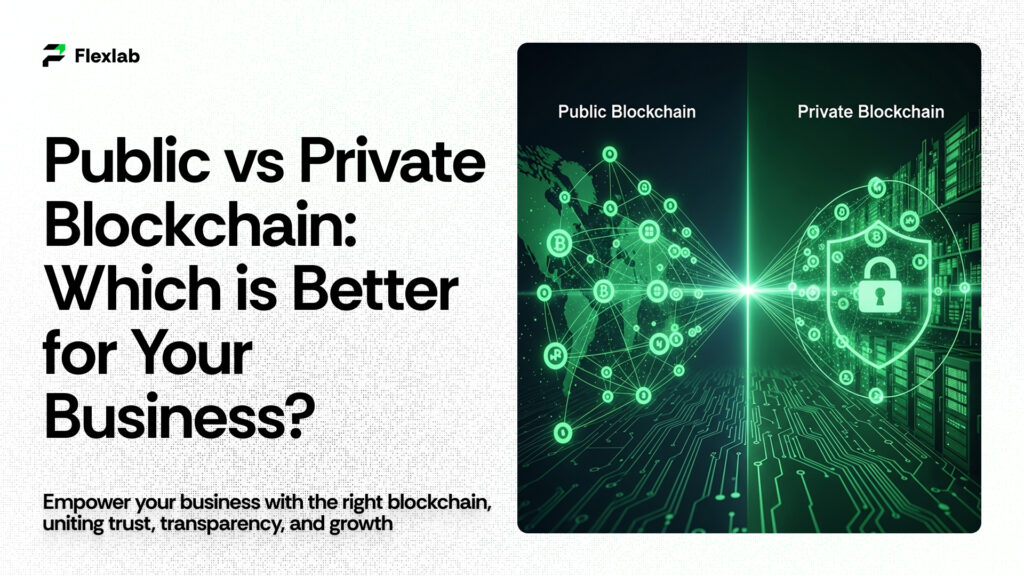
Public vs Private Blockchain: Which is Better for Business?

Public vs Private Blockchain: Which is Better for Your Business?

Public vs Private Blockchain: Finding the Right Fit for Your Enterprise

Blockchain App DevelopmentSmart Contracts | Blockchain and IoT

Trust is the new currency for digital businesses. With public vs private blockchain solutions, companies can share and protect data with full confidence, transparency, and security. It is built for the upcoming digital future. Understanding the difference between public and private blockchains can help you select the right track for your business growth.

One major question that divides today’s innovators and executives alike is whether your business should build on the open transparency of a public blockchain or rely on the controlled environment of a private blockchain. The difference goes far beyond technical design; it shapes how your organization operates, secures data, and earns customer confidence.

In this blog, we’ll discover how both blockchain models work, explore their advantages and challenges, and reveal which is better suited for your specific business goals. At the end of this blog, you’ll know how to choose the blockchain foundation that strengthens your organization’s future.

Understanding the Basics of Blockchain Technology

To understand why businesses are turning to blockchain, imagine a digital ledger that records every transaction in real-time, visible to all participants, and it’s impossible to tamper with it. That’s the core of blockchain technology. It is a shared, transparent system designed to remove intermediaries and build trust through automation.
Basics of Blockchain Technology

Each block in this chain stores verified data and is linked to the previous one using advanced cryptography techniques. These mathematical safeguards make it nearly impossible to alter the information that has been recorded once. Instead of relying on one central database, blockchain distributes its records across multiple computers, making it secure, transparent, and highly resistant to attacks or errors. There are different types of blockchain models, including public, private, consortium, and hybrid, each tailored to meet specific business needs such as scalability, privacy, and governance.

Consequently, this innovation opens doors to new opportunities for companies. From supply chains and healthcare to digital finance, blockchain for business provides faster verification, improved traceability, and stronger accountability. It’s not just about new emerging technology; it’s about redefining how trust works in a digital-first economy.

What is a Public Blockchain?

A public blockchain is a digital network where anyone can participate, validate, and store information independently. It serves as the foundation of decentralized systems like Bitcoin and Ethereum, where transparency replaces trust, and data integrity is maintained collectively by the community instead of a single organization. Let’s explore some key features that make public blockchains truly open and transformative.

  • Open, Transparent, and Decentralized

A public blockchain functions as an open digital ecosystem, where anyone from anywhere in the world can join, verify transactions, and contribute to the network’s growth. There is no central authority involved in controlling it, which makes it one of the purest forms of decentralization. Most common examples include Bitcoin and Ethereum, where users rely on community-driven consensus other than corporate or government control.

  • The Power of Transparency

In a public blockchain, every transaction is recorded on a transparent ledger that anyone can audit, therefore ensuring complete visibility. Because of this openness, digital currencies thrive on public blockchains; in fact, they allow users to exchange value globally without the need for intermediaries or restrictive oversight. However, transparency comes with trade-offs: because everyone can participate, these networks often process fewer transactions per second compared to private systems.

  • Resilience and Security

A primary strength of public blockchain is its network resilience. In any case, if part of the system goes offline or fails, the remaining parts continue to operate seamlessly, ensuring the data remains secure and accessible. This inherent durability makes public blockchains ideal for applications where transparency, community trust, and long-term reliability are essential. 

What is a Private Blockchain?
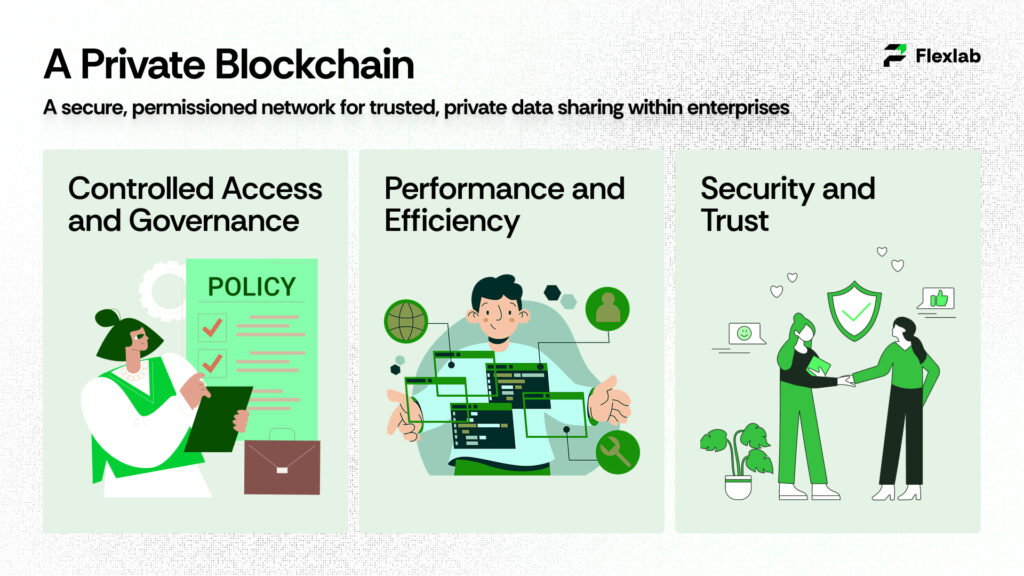
A Private Blockchain

A private Blockchain is a network built for trust, where only permissioned participants can access, verify, and share data securely. It’s the essence of a private blockchain. It follows the same foundational principles of blockchain technology, including immutability, transparency, and security, but within a restricted environment designed for privacy and control. Organizations adopt private Blockchain to automate internal workflows,  manage sensitive information, and meet regulatory requirements without exposing data to the public. Let’s break down the fundamental traits that highlight why private blockchains stand out in the digital landscape.

  • Controlled Access and Governance

Only verified members can join and participate in private blockchain networks. This requires that every node or user must authorize before they can participate. This limitation makes it ideal for enterprises that handle confidential and sensitive data, such as finance and logistics. Furthermore,  blockchain technology in healthcare relies on private blockchains to ensure compliance and protect patient or customer information.

  • Performance and Efficiency

Private blockchains are optimized for speed and scalability due to the involvement of trusted participants. These systems can process a higher number of transactions per second, ensuring smooth and reliable real-time data processing. This makes them a go-to choice for enterprise blockchain implementations seeking efficiency and consistency.

  • Security and Trust

Advanced cryptography techniques and permission-based access play a vital role in maintaining security in private blockchains. Each transaction is validated and traceable, minimizing risks of tampering or fraud. This built-in accountability allows organizations to maintain both security and trust within their networks.

Public vs Private Blockchain: A Detailed Comparison

Choosing between a public blockchain and a private blockchain isn’t just about technology; it’s about aligning your business goals with the right infrastructure. Both have unique advantages and trade-offs that determine how your organization handles security, speed, and transparency. To help you make an informed decision, let’s compare the two side by side.

1. Accessibility and Participation

A public blockchain is open to everyone. Anyone can read, write, or verify transactions without requiring any approval. This openness encourages innovation and network resilience, but it can slow down the overall performance.

In contrast, a private blockchain requires permission; only verified members can join. This model is best for enterprises that prioritize data protection, compliance, and operational efficiency over full decentralization.

2. Security and Trust

Public blockchain networks rely on consensus-building techniques such as Proof of Work or Proof of Stake, which use distributed nodes to validate every block. This makes them highly secure and tamper-resistant. 

On the other hand, Private blockchains utilize cryptography techniques and controlled access to protect data. Trust is established among authorized participants, making them ideal for blockchain and for business use cases where confidentiality is mandatory.

Both public and private systems utilize different consensus-building techniques, such as Proof of Work, Proof of Stake, or Proof of Authority, to ensure that all participants agree on valid transactions while maintaining data integrity.

3. Performance and Speed

Since thousands of nodes must agree before confirming a transaction, public blockchains usually handle fewer transactions per second. 

Conversely, private blockchains eliminate this bottleneck by limiting validator access. It enables faster real-time data processing, which is crucial for industries that require immediate results. Private networks also enable efficient real-time data processing, allowing businesses to execute transactions instantly while maintaining control and accuracy.

4. Use Cases

Public blockchains are best for decentralized applications, digital currencies, and platforms that demand transparency.

However, private blockchains excel in internal business processes such as enterprise blockchain systems and blockchain technology in healthcare, where privacy and scalability are essential.

5. Maintenance and Costs

In Public blockchain networks, no single entity bears the cost because it relies on a decentralized worldwide community of users. Many organizations now utilize Blockchain as a Service (BaaS) platforms to build, host, and scale their blockchain solutions without maintaining extensive infrastructure.

By contrast, private blockchains require dedicated blockchain development services. A blockchain network provides a service platform that helps to maintain, set up, and scale. While they may cost more upfront, they often deliver greater control and compliance benefits in the long run.

Public vs Private Blockchain: A Detailed Comparison

Feature Public Blockchain Private Blockchain
Accessibility Open to anyone, no central authority. Anyone can join, verify, or store data. Access is restricted; only verified or authorized members are allowed to participate.
Transparency Fully transparent, all transactions are visible on the public ledger. Transactions are private and visible only to permitted participants.
Security Model Utilize decentralized consensus-building techniques like Proof of Work or Proof of Stake for validation. Relies on permissioned access, internal validation, and advanced cryptography techniques.
Performance Slower due to multiple validators; fewer transactions per second. High-speed and real-time data processing is necessary due to the limited number of participants.
Control No central authority, governed by the community. Managed by a single organization or consortium.
Scalability Harder to scale due to public verification. Easier to scale within private networks and enterprises.
Use Cases Best for digital currencies, decentralized apps (DApps), and public transparency projects. Ideal for enterprise blockchain, supply chain management, and blockchain technology in healthcare.
Cost & Maintenance Lower maintenance — community-driven, but may require more computational power. Higher setup cost, maintained via blockchain development services or a blockchain as a service provider.
Network Resilience Extremely resilient,  continues operating even if parts of the network fail. Resilient within its permissioned structure, but it depends on centralized control.

A public blockchain is perfect for businesses that thrive on openness, collaboration, and global participation.
A private blockchain is ideal for organizations that demand performance, privacy, and control over sensitive data.

Both models reflect the future of blockchain technology, but the best choice depends on your industry goals, compliance needs, and the transparency you are ready to adopt.

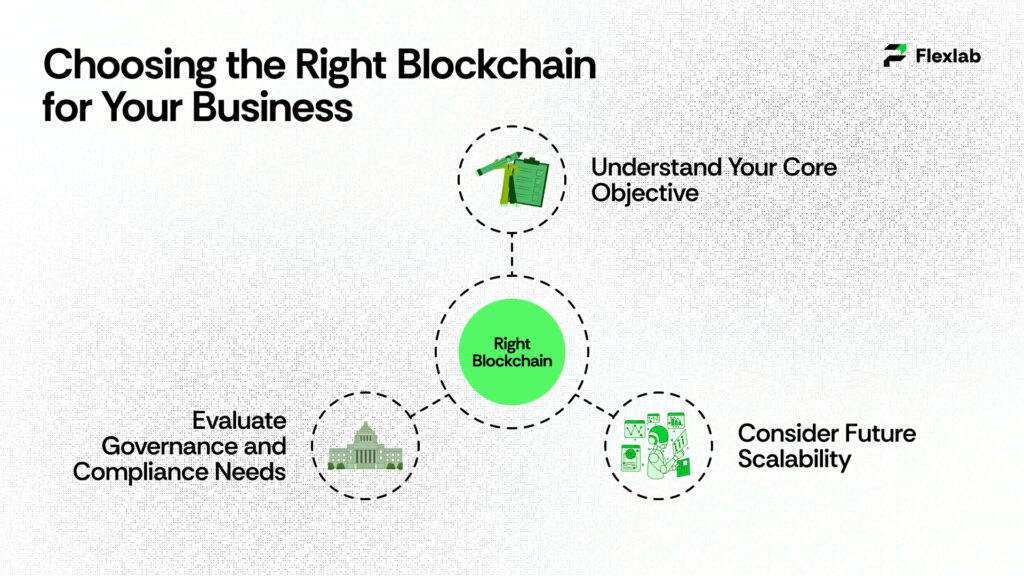
Choosing the Right Blockchain for Your Business

Selecting between a public and private blockchain is more than a technical decision; it’s about aligning technology with your business goals. The right choice totally depends on how much transparency, control, and scalability your organization requires.

1. Understand Your Core Objective

If your goal is open collaboration, public participation, or decentralized transactions, a public blockchain like Ethereum or Solana may be best for you. However, if you prioritize privacy, data ownership, and compliance, a private blockchain such as Hyperledger Fabric or Corda could be the better fit for you.
Choosing the Right Blockchain for Your Business

2. Evaluate Governance and Compliance Needs

Industries with strict data protection laws, including finance, healthcare, and supply chain management, often rely on private blockchains for permissioned access, auditable records, and regulatory compliance. In contrast, public blockchains offer global visibility and decentralized governance, but with less direct control over network rules.

3. Consider Future Scalability

Think strategically, will your blockchain need to support growing transactions, cross-border operations, or multi-party integrations?

Private networks deliver speed and customization, while public blockchains enable broader ecosystem participation and interoperability.

Starting with a pilot project by using a private or hybrid blockchain, then expanding to a public network once your model is identified as secure, compliant, and scalable. Collaborating with an experienced blockchain development company can simplify deployment, ensure compliance, and help align the technology with your long-term business strategy. That’s where Flexlab comes in, a leading blockchain development company helping businesses implement secure, scalable blockchain ecosystems tailored to their industry. Next, let’s take a closer look at how businesses across industries are putting these blockchain models to work in the real world. 

Real-World Use Cases of Public and Private Blockchains

Understanding how organizations apply public vs private blockchains in practice reveals their true business value and real-world potential to adopt blockchain technology.
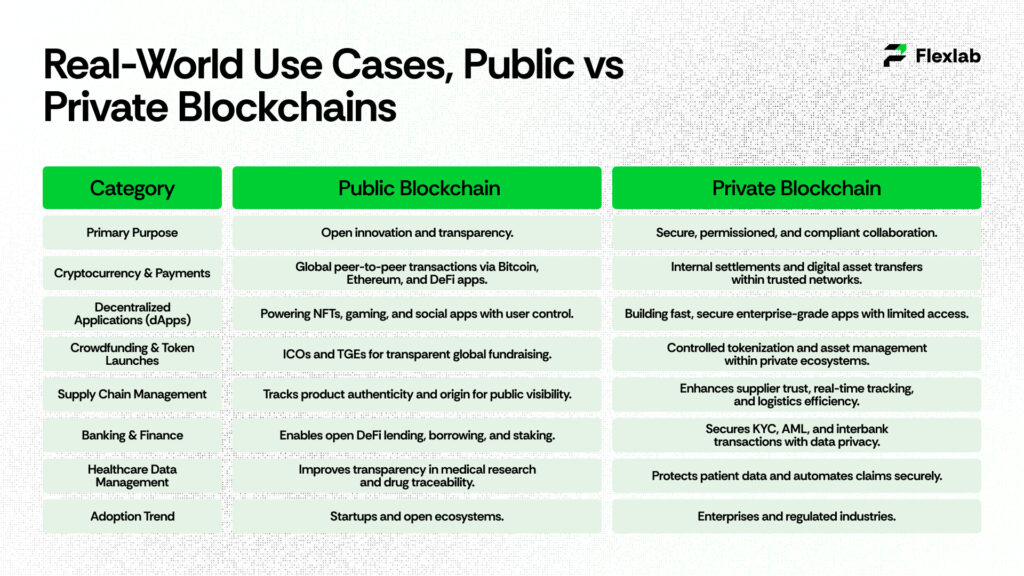
Real-World Use Cases, Public vs Private Blockchains

Public Blockchain Use Cases

  1. Cryptocurrency and Payments
    Public blockchains such as Bitcoin and Ethereum enable peer-to-peer transactions without intermediaries. They’re ideal for global payments, DeFi platforms, and tokenized assets, where transparency and decentralization are crucial. Public blockchains also power secure crypto wallets, enabling users to store, send, and verify digital assets globally without relying on centralized intermediaries.
  2. Decentralized Applications (dApps)
    Developers build dApps on public networks to offer open access, trustless operations, and smart contract automation. Examples include NFT marketplaces, gaming platforms, and social apps that empower users to control their data.
  3. Crowdfunding and Token Launches
    Moreover, through Initial Coin Offerings (ICOs) and Token Generation Events (TGEs), startups can leverage public blockchains to raise capital globally while connecting directly with investors, thus cutting out traditional financial barriers.

Private Blockchain Use Cases

  1. Supply Chain Management
    Enterprises such as  Walmart and Maersk use private blockchains to track goods, verify authenticity, and improve transparency across suppliers. It builds their trust and efficiency in complex logistics networks. These networks enhance supply chain transparency, allowing real-time tracking, product verification, and trust across suppliers and logistics partners.
  2. Banking and Finance
    Financial institutions launch private blockchains for secure interbank transactions, trade settlements, and KYC/AML verification. These systems ensure data privacy and regulatory compliance while reducing transaction costs.
  3. Healthcare Data Management
    Hospitals and medical providers prioritize private blockchains to secure patient records, control data access, and share information safely among trusted parties, ensuring accuracy, security, and confidentiality.  Additionally, private blockchains enable automated claims processing, reducing paperwork, minimizing delays, and improving data accuracy across healthcare systems.

Many forward-thinking organizations are adopting hybrid blockchain solutions, amalgamating the transparency of public networks with the control of private systems, offering the perfect balance of trust, speed, and privacy.

The Future of Blockchain for Businesses

The Future of Blockchain

As blockchain technology continues to evolve, its impact on business transformation is becoming impossible to ignore. The future will not be about choosing between public and private blockchains, but about how effectively and efficiently organizations can integrate and innovate using both.

1. Rise of Hybrid and Consortium Blockchains

The next generation of blockchain adoption is moving forward towards hybrid and consortium models, combining the openness of public systems with the security of private networks. These solutions enable interconnected ecosystems, where multiple companies can collaborate securely while maintaining data privacy and operational control.

2. Interoperability and Cross-Chain Integration

Today, businesses are increasingly demanding cross-chain communication, as it enables different blockchains to share data and assets seamlessly. Consequently, projects focusing on interoperability—such as Polkadot, Cosmos, and Chainlink—are paving the way for a more connected blockchain landscape. As a result, enterprises can operate more efficiently and collaboratively across diverse networks.

3. Blockchain Meets Artificial Intelligence (AI)

The integration of AI and blockchain is reshaping how businesses handle data automation, analytics, and decision-making. Blockchain ensures data integrity and transparency, while AI enhances predictive insights and process optimization, together delivering smart, trustworthy business ecosystems.

4. Greater Focus on Sustainability

As environmental awareness grows, future blockchain solutions will emphasize energy efficiency and green consensus mechanisms such as Proof of Stake (PoS) and Proof of Authority (PoA). This advanced shifting ensures that blockchain innovation aligns with global sustainability goals and eco-friendly business practices.

5. Regulatory Maturity and Enterprise Confidence

Governments and regulatory bodies are now developing clear frameworks for blockchain adoption. Providing more confidence to enterprises to increase investment. With standardized compliance, identity verification, and data protection laws evolving, blockchain will become a global mainstream infrastructure for industries. 

The future of blockchain isn’t about replacing traditional systems; it’s about enhancing them with transparency, trust, and automation. Companies that adopt blockchain early will be better positioned for innovation and long-term growth.

Explore How Flexlab Empowers Blockchain Solutions

Transform Your Business with Blockchain Innovation

Ready to elevate your business with innovative blockchain solutions? Flexlab enables organizations to design, develop, and deploy scalable blockchain systems that foster transparency, trust, and optimal performance. From private and public networks to consortium models, Flexlab delivers bespoke blockchain development services engineered to achieve your strategic goals.

📞 Book a FREE Consultation Call: +1 (201) 347-8591
📧 Email us: info@flexlab.io

Discover real-world success stories in our portfolio, explore our solutions, and start your blockchain journey. Contact us. See firsthand what our clients say about us and how we’ve transformed their blockchain vision into measurable success.

Keep expanding your knowledge by exploring the blog page for trending topics and expert insights, such as What is Web3? Why Web3 is the Future of the Digital Economy, What are NFTs and How Do They Work in Real Life, and A Step-by-Step Guide on Private Blockchain Development in 2025. Stay inspired and up to date by following Flexlab on LinkedIn for the latest innovations, success stories, and industry trends.”

Public vs Private Blockchain Insights: Finding the Perfect Business Fit

The Public vs Private Blockchain debate isn’t about which is better overall; it’s about what fits your business needs. Public blockchains bring transparency and global collaboration, while private blockchains offer privacy, control, and faster performance. Many organizations now prefer hybrid models, integrating both for greater trust and scalability. In today’s digital economy, blockchain is more than a trend; it’s a catalyst for growth, security, and innovation. Choosing the right blockchain today means staying ahead tomorrow. Businesses that implement blockchain early will gain a competitive edge, future-proof their operations, and open the door to new opportunities in the digital economy.

What is a private version of a public blockchain?

A private version of a public blockchain is a customized, permissioned network that uses the same foundational technology as a public blockchain but restricts participation to approved users. For instance, Quorum is a private version of Ethereum designed for enterprise applications. It maintains Ethereum’s smart contract functionality while providing enhanced privacy, scalability, and access control for business use.

What are the disadvantages of private blockchains?

Private blockchains, though efficient and secure for internal operations, have certain drawbacks. They can become overly centralized, which reduces the trustless nature of blockchain technology. Transparency is limited since only authorized members can view data. Because consensus mechanisms involve fewer participants, they may also offer lower security and resilience compared to public networks. These factors make private blockchains less suitable for open, decentralized ecosystems.

What is a consortium blockchain, and how is it different from public vs private blockchains?

A consortium blockchain is a semi-decentralized network governed by a group of organizations rather than a single entity or the public. For example, Energy Web Foundation and IBM Food Trust use consortium models. It offers a balance between transparency and control, combining the efficiency of private blockchains with the shared governance of public ones.


2 Responses

Leave a Reply

Your email address will not be published. Required fields are marked *

10 Common Pitfalls to Watch Out For in Crypto Transactions

Crypto Wallets | White Label Crypto Exchange | Blockchain Audit

Crypto transactions are permanent, fast, and unforgiving. Unlike traditional banking, where you can call customer support to reverse a mistake, crypto transactions cannot be reversed once confirmed due to blockchain immutability. Over $12.4 billion vanished from beginner wallets in 2024 alone, with $2.17 billion lost in just the first half of 2025. Most of these losses were completely preventable if people had avoided basic transaction mistakes. 

Whether you’re just learning about ways to invest in crypto or you’re an experienced trader, understanding these errors is crucial for protecting your digital assets. Here are the top 10 errors that cost crypto users the most money. Let’s read below.

1. Sending Crypto to the Wrong Address

Sending Crypto to the Wrong Address

This is the nightmare scenario that haunts the user. You copy an address, paste it, hit send, and then realize you sent thousands of dollars to the wrong place. Sending crypto to the wrong address typically results in permanent loss, as blockchain transactions are irreversible.

What makes this worse is that crypto addresses are long strings of random-looking characters. One wrong character and your money is gone forever. A single wrong character in the recipient’s wallet address can send funds into the void, or worse, into a stranger’s wallet.

Even more frightening is address poisoning, where hackers place look-alike addresses in your transaction history. Address-poisoning swaps a look-alike address into your clipboard. You think you’re copying your friend’s address from a recent transaction, but you’re actually copying a scammer’s address that looks almost identical. This is a critical part of security measures that every trader must understand.

A real-world example shows how costly this can be. A single copy-paste mistake where a crypto trader loses $26 million in Renzo Restaked ETH. That’s not a typo, twenty-six million dollars gone because of one careless moment. This highlights why a proper risk management process should be your top priority when performing any transfers.

How to Avoid this:

  • Always send a small test transaction first before sending large amounts
  • Verify the full address character by character, not just the first and last few
  • Never copy addresses from transaction history; always get them directly from the recipient
  • Use QR codes when possible to avoid typing errors
  • Double and triple-check before hitting send; your money depends on it
  • Consider using a crypto portfolio tracker to monitor all your movements and addresses

2. Choosing the Wrong Blockchain Network

New to crypto? This mistake trips up cryptocurrency for beginners constantly and can be just as devastating as sending to the wrong address.

Many cryptocurrencies like USDT, USDC, and ETH exist on multiple blockchains, including Ethereum, Binance Smart Chain, Polygon, Arbitrum, and others. Sending Tether USDT over Ethereum instead of Tron is a classic mistake, and choosing the wrong network can result in permanent loss.

Each blockchain operates independently, meaning assets sent to an incorrect network will not automatically appear where you expect them to be. Your crypto doesn’t disappear; it just becomes trapped on the wrong blockchain, where your digital wallets can’t see it. Understanding blockchain technology is essential here, as each decentralized network operates with its own rules and infrastructure.

If you send cryptocurrency to the wrong network, your funds don’t disappear; they become inaccessible on the intended network. For example, if you send USDT as an ERC-20 token to a BEP-20 address on Binance Smart Chain, the tokens land on Binance Smart Chain but won’t show up in your Ethereum wallet.

Recovery is sometimes possible but complicated. You need to export your cryptographic keys and import them into a wallet that supports the blockchain where your funds ended up. However, many exchanges won’t help you recover funds sent on unsupported networks. 

How to Avoid this:

  • Confirm that both sender and receiver support the same network before transacting
  • Read exchange deposit instructions carefully; they always specify which network to use
  • When withdrawing, match the network selection to where you’re sending
  • Send a tiny test amount first on the correct network
  • Never rush, network mistakes are one of the costliest errors you can make

3. Storing Your Seed Phrase Digitally

Storing Your Seed Phrase Digitally

Your seed phrase is the master key to your entire portfolio. Seed phrase exploits and front-end compromises were the primary attack methods in the first half of 2025, accounting for over 80% of losses. Yet people still make the common mistake of storing their seed phrases digitally. Proper management of public and private keys is a cornerstone of protection in the crypto ecosystem.

Taking screenshots, saving in cloud drives, or writing seed phrases in notes apps is a common mistake. Some users think they’re being smart by taking a photo of their seed phrase and storing it in Google Photos or iCloud. That’s basically handing hackers the keys to your vault.

A victum recently lost $100,000 when their photographed seed phrase got compromised through phishing. Malware can scan your devices for text files containing common seed phrase words. Cloud storage gets hacked. Your phone can be stolen. Digital storage of seed phrases is asking for trouble.

Even browser extensions can be traps. A malicious Chrome extension called “Safery: Ethereum Wallet” ranked as the fourth result for “Ethereum wallet” on the Chrome Web Store and was designed to steal seed phrases by encoding them into micro-transactions on the Sui blockchain. It looked completely legitimate with clean branding and fake five-star reviews. Want to learn more? Read about the malicious chrome extension exfiltrates seed phrases.

  How to Avoid this:

  • Write your seed phrase on paper or engrave it on metal, never digitally
  • Store physical backups in multiple secure locations, like safes or bank deposit boxes
  • Never enter your seed phrase on any website or in any app except when recovering your actual wallet
  • No legitimate service will ever ask for your seed phrase
  • Consider metal backup solutions that survive fire and water damage
  • Implement these protections as part of your overall crypto trading strategies

Ready to Bulletproof Your Crypto Security Today?

Don’t let these mistakes cost you millions—secure your transactions with expert help from Flexlab.

📞 Book a FREE Consultation Call: +1 (201) 347-8591
📧 Email us: info@flexlab.io

4. Not Testing Transactions First

Sending large amounts in one transaction without testing is gambling with your money. Professional traders with a solid plan know this; beginners learn it the hard way. A test transaction means sending a tiny amount first, like $10 or $20, to verify everything works before sending the full amount.

Always send a test amount to ensure the address works and is correct, and once confirmed, proceed with the full amount. Yes, you pay transaction fees twice. Yes, it takes a few extra minutes. But that small cost and time investment can save you from a big loss. This is essential advice that can save your entire portfolio.

Test crypto transactions catch multiple types of errors. They verify the address is correct, confirm the network matches, ensure the receiving wallet can accept that token, and prove the funds actually arrive where you expect. If something’s wrong, you lose $20 instead of $20,000.

This is especially important when:

  • Sending to a new address for the first time
  • Using a new exchange or wallet
  • Transferring between different blockchains
  • Moving significant amounts of money
  • Dealing with any unfamiliar process
  • Managing your holdings across multiple platforms

How to Avoid this:

  • Always test with a small amount first when sending to new addresses
  • Wait for full confirmation before sending the main amount
  • Keep records of successful test transactions for future reference
  • Budget for the extra fees, it’s cheap insurance
  • Never skip this step just to save a few dollars in fees
  • Use AI automation tools or tracking software to log all test movements

5. Forgetting About Transaction Fees

Forgetting About Transaction Fees

Transaction fees, known as gas fees, fluctuate dramatically from pennies to hundreds of dollars, driven by network congestion and timing. During Ethereum peak periods, a single transaction can cost $50–$100 or even more. Understanding fee structures is crucial when figuring out how to trade cryptocurrency profitably.

Underpaying gas fees can leave your transaction stuck or pending indefinitely. Your transaction sits in limbo, not confirmed but not canceled either. Meanwhile, your funds are essentially frozen, and you can’t use them.

The bigger problem hits small portfolio holders. If you’re trying to move $200 worth of cryptocurrency and the fee is $75, you just lost over one-third of your money to fees. This happens constantly with Ethereum-based tokens. A Paxful user mistakenly set a $500,000 transaction fee for a Bitcoin transfer, significantly exceeding standard fees, and because mining fees are automatically distributed to miners, recovering the funds was nearly impossible.

Different blockchains have vastly different fee structures. Bitcoin and Ethereum tend to have higher fees, especially during busy times. Networks like Polygon, Arbitrum, Solana, and Binance Smart Chain usually have much lower fees, often just pennies per transaction. This impacts which might be the best cryptocurrencies to invest in for frequent transfers.

How to Avoid this:

  • Check current network fees before making transactions
  • Use the fee estimation tools available in most wallets
  • For Ethereum, check sites like Etherscan Gas Tracker to see current rates
  • Consider timing, fees are often lower during weekends and off-peak hours
  • Make sure you have enough of the network’s native token to cover fees
  • For small amounts, use low-fee networks when possible
  • Factor fees into your management approach and overall strategy

6. Ignoring Memo/Tag Requirements

Some cryptocurrencies require a memo, destination tag, or payment ID in addition to the wallet address. This is common with coins like XRP (Ripple), Stellar (XLM), EOS, and Binance Chain (BEP-2) tokens. Some networks, such as XRP, Stellar, and Binance Smart Chain, require an additional memo or destination tag to ensure funds are routed correctly, and failure to include it may result in lost funds.

Think of it like this: the wallet address is the bank, and the memo is the account number within that bank. Exchanges and custodial services use one address for many users, and they identify who owns what through these memos or tags. Send without the correct memo, and your funds arrive at the exchange, but they have no way to credit your account.

This is particularly frustrating because the funds aren’t lost in the technical sense; they arrived at the destination. But without the proper memo, the receiving platform can’t identify whose funds they are. Some exchanges will help you recover, but it often requires contacting support, proving ownership, and waiting days or weeks. For cases where a unique deposit memo or tag is required but was submitted incorrectly or was missing, you might be asked to make another minimum deposit from the same address with the correct memo/tag included so they can verify you are the owner. Some platforms charge recovery fees or won’t help at all.

How to Avoid this:

  • Always check if the cryptocurrency requires a memo, tag, or payment ID
  • Read the deposit instructions carefully on exchanges
  • Copy and paste the memo exactly as provided; don’t type it manually
  • Verify both the address and the memo before confirming
  • If unsure, contact support before sending rather than after
  • Track memo requirements in your portfolio software for different exchanges

7. Using Public Wi-Fi for Transactions

Using Public Wi-Fi for Transactions

Performing transfers on public Wi-Fi at coffee shops, airports, or hotels is extremely risky. Public networks are hunting grounds for hackers using tools to intercept data. Public Wi-Fi networks can be exploited by hackers, so avoid making any crypto transactions on them, and if you must access an exchange or wallet, use a VPN to encrypt your connection.

Hackers on the same public network can potentially see your transaction details, steal login credentials, or inject malicious code into your connection. Man-in-the-middle attacks let them intercept communication between you and the exchange or wallet you’re using. This vulnerability in the ecosystem has cost countless users their investments.

Even worse, some “public Wi-Fi” networks are actually fake hotspots set up by scammers specifically to steal cryptocurrency. They name them things like “Coffee Shop Guest WiFi” or “Airport Free WiFi” and wait for victims to connect. Once you’re on their network, they can see everything you do, including accessing your wallets.

How to Avoid this:

  • Never perform transfers on public Wi-Fi
  • If you absolutely must, use a reputable VPN service to encrypt your connection
  • Use your phone’s mobile data instead; it’s much more secure
  • Wait until you’re on a trusted private network
  • Consider using a separate device only for cryptocurrency that never connects to public networks
  • Essential protections for safeguarding your investments

8. Not Verifying Smart Contract Addresses

When interacting with DeFi protocols, swapping tokens on decentralized exchanges, or adding tokens to your wallet, you often need to input smart contract addresses. Using the wrong contract address can send your funds to a scam token or drain your wallet completely. Understanding smart contracts is part of both fundamental vs technical analysis in the ecosystem.

Scammers create fake tokens with names identical to popular cryptocurrencies. They might call it “Ethereum” or “USDT,” but it’s actually a worthless scam token. If you add the wrong contract address to your wallet and then try to send or swap, you could lose everything. This is especially important when evaluating which assets to purchase.

Phishing websites are everywhere in the space. They look exactly like popular DEXes or token websites, but with slightly different URLs. Once you connect your wallet and approve transactions, they drain your funds. Some sophisticated scammers even create fake initial coin offering (ICO) websites to steal funds from investors.

How to Avoid this:

  • Always get contract addresses from official sources like the project’s official website
  • Verify URLs carefully, scam sites use look-alike domains
  • Check contract addresses on block explorers like Etherscan
  • Be suspicious of contracts shared in Telegram groups or Discord
  • Use token lists from reputable sources in DEX interfaces
  • Never connect your wallet to suspicious sites
  • Consider consulting a custom software development firm if you’re launching your own token to ensure proper implementation

9. Approving Unlimited Token Allowances

When using decentralized exchanges and DeFi protocols, you need to approve them to spend your tokens. Many platforms default to requesting “unlimited” approval, meaning they can spend unlimited amounts of that token from your wallet forever. Infinite allowances to sketchy routers or blind-signing typed data let drainers empty wallets.

While this is convenient because you only approve once, it’s also dangerous. If that protocol gets hacked or turns out to be malicious, they can drain every token you gave unlimited approval to. This has happened countless times in the decentralized ecosystem.

Users should prefer exact-amount approvals and review and revoke approvals monthly. You can check what approvals you’ve given using tools like Revoke cash or Unrekt. You might be shocked to see dozens of old approvals from protocols you used years ago. Some traders use the best crypto AI trading bots that manage these approvals automatically as part of their toolkit.

How to Avoid this:

  • Never approve unlimited spending unless necessary
  • Set approval amounts to exactly what you need for that specific transaction
  • Regularly review and revoke old approvals
  • Be especially careful with new or unaudited protocols
  • Use approval management tools to see who has access to your wallet
  • Implement this as a core protection in your overall approach

10. Not Keeping Transaction Records

Failing to keep detailed records of your transfers causes massive problems, especially at tax time. Starting January 1st, 2025, the IRS requires wallet-based cost tracking, meaning transaction records need to match disposals exactly. Understanding cryptocurrency regulation is crucial for compliance.

Every movement is a taxable event in the United States. Selling, swapping, spending, or even moving between your own wallets can trigger tax obligations. Without proper records, you can’t accurately calculate what you owe using methods like the FIFO method first in first out. That leads to either overpaying taxes or underpaying and risking audits, penalties, and interest.

All exchanges will have to report their gains and losses to the IRS on Form 1099-DA starting in 2025. The IRS is getting much more sophisticated at tracking cryptocurrency. They’re not messing around with regulatory compliance.

But tax compliance isn’t the only reason to keep records. If you need to dispute a transfer, prove ownership, or recover funds, detailed records are essential. They’re also crucial for understanding your own performance and portfolio management. Good tracking software becomes invaluable here, especially when you’re trying to understand profitability consistently.

How to Avoid this:

  • Use tax software like CoinTracker, Koinly, or CryptoTraxer to automatically track movements
  • Export transaction histories from exchanges regularly
  • Keep records of wallet addresses you own
  • Document the date, amount, price, and purpose of each transfer
  • Store records securely for at least 7 years
  • Don’t wait until tax season to organize everything
  • Tracking software can automate much of this process
  • Understand regulations in your jurisdiction

Extra Tips for Safe Crypto Transactions

Beyond these top 10 mistakes, here are additional best practices that combine analysis methods with practical crypto trading tips:

  • Use Address Whitelisting: Many exchanges let you whitelist addresses, meaning only pre-approved addresses can receive withdrawals. This prevents mistakes and adds protection even if someone hacks your account.
  • Enable All Security Features: Two-factor authentication, withdrawal confirmations via email, anti-phishing codes, and all other features should be turned on. Every layer helps protect your holdings.
  • Stay Calm and Focused: Many mistakes happen when people are rushed, distracted, or emotional. The FOMO fear of missing out can lead to rushed decisions and costly errors. Take your time with every transfer. There’s no undo button. This is especially important when dealing with the volatility of cryptocurrency.
  • Educate Yourself Continuously: The space evolves constantly. New scams, new protocols, new risks. Stay informed through reputable sources and learn from others’ mistakes. Whether you’re learning fundamentals or perfecting your approach, education is ongoing.
  • Consider Using Automation Wisely: Some traders use bots or other tools to manage their portfolios. While these can be helpful, always maintain control over your private keys and never give unlimited access to any automated system.
  • Understand Blockchain Finality: Once a transaction is confirmed on the blockchain, it’s permanent and unchangeable, and no central authority, like a bank or support desk, can change, delete, or recall a transaction. This is a fundamental principle of the technology and decentralized structure. This isn’t like traditional finance, where chargebacks exist. You’re responsible for getting it right the first time.
  • Diversify Your Approach: Don’t put all your eggs in one basket. When researching which assets to purchase, consider multiple projects and use both analytical methods. Your protection plan should include portfolio diversification.

The Bottom Line About Crypto Transactions

Crypto transactions offer incredible power but demand unwavering vigilance. Avoiding these top 10 mistakes safeguards your assets from billions in preventable losses. Mastering test transactions, secure key storage, and network verification turns risks into routine safety, empowering confident trading in this decentralized world.

How Flexlab Helps Your Crypto Security

How Flexlab Helps Your Crypto Security

Flexlab delivers tailored cybersecurity solutions for crypto users, including automated key management to prevent seed phrase leaks and address poisoning. Custom AI tools monitor transactions in real-time, flag wrong networks or unlimited approvals, and enforce whitelisting for seamless security. Partner with Flexlab for expert audits, recovery strategies, and compliance tracking, ensuring your portfolio thrives without the pitfalls.

Ready to explore more? Contact us now and check out our LinkedIn to see our projects. You can also glance at our insightful AI and blockchain blogs, including;

FAQs

Q1: What are crypto transactions?

Crypto transactions are digital asset transfers recorded on a blockchain, involving the sender, receiver, amount, and a digital signature to verify authenticity. They occur on decentralized networks, eliminating the need for a central authority, thereby ensuring peer-to-peer trust and security.

Q2: Can I withdraw crypto directly to my bank?

You cannot withdraw cryptocurrency directly to a bank account. Instead, you first need to sell or convert your crypto into fiat currency through a cryptocurrency exchange or broker. After conversion, you can transfer the fiat money to your linked bank account. Direct crypto-to-bank transfers are not supported because banks operate with fiat funds, not crypto.

Q3: How can I see crypto transactions?

You can view crypto transactions using your wallet’s transaction history or public blockchain explorers. Blockchain explorers are websites that display all transactions on a blockchain, showing details like transaction amount, sender and receiver addresses, and the transaction’s status. These tools help verify and trace transactions transparently on chains like Bitcoin or Ethereum blockchain technology.

Hot Wallet vs Cold Wallet: How to Pick the Right One

Public vs Private Blockchain | White Label Crypto ExchangeWeb3 Technology

Are you worried about choosing the wrong crypto wallet and unsure whether a hot wallet vs cold wallet is best for keeping your digital assets safe? If you hold any cryptocurrency, you already play a major role in your own security. A crypto wallet is the tool that gives you control by storing the keys that prove you own the blockchain coins.

Most people quickly encounter the choice between hot wallet vs cold wallet, and this distinction shapes everything from convenience to long-term security. For example, hot wallets provide fast access to your funds, DeFi platforms, and NFTs. In contrast, cold wallets keep your keys offline, therefore offering stronger protection.

With millions now using crypto and billions already lost to hacks, therefore, this decision matters more than ever. This guide explains how each wallet works, how keys protect your assets, how to pick the one that fits your habits, and which setup will matter most in 2026.

What Are Crypto Wallets and How Do They Work

A crypto wallet is more than a place to hold digital assets. It is a secure form of digital wallets powered by blockchain technology. It manages public keys and private keys, which act as proof of ownership. 

Understanding what are crypto wallets is essential because these tools allow users to send, receive, and control their cryptocurrency without relying on a bank or central authority.

Cryptographic hashes play a crucial role because they create tamper-resistant digital signatures that secure transactions. Consequently, wallets rely on these hashes to validate ownership, ensuring that crypto transactions remain safe and verifiable across global blockchain networks.

  • Public & Private Keys: The Invisible Locks Protecting Your Crypto

Comparison between public and private keys

To understand hot and cold wallets, you must first know how public and private keys work. These two elements function as a digital lock-and-key system that keeps crypto secure on the blockchain.

Public Key
A public key is similar to a bank account number. Specifically, it is safe to share, as it is used to receive cryptocurrency and helps generate the wallet address. In other words, it identifies a wallet on the blockchain without exposing any security details.

Private Key
A private key is like a highly sensitive PIN. Therefore, it must never be shared, because it provides complete control over your funds. Additionally, it is used to sign and authorize transactions, and consequently, anyone who gains access to it can move the crypto.

There is no customer support, no fraud reversal, and no undo button if a private key is compromised. As a result, selecting the right wallet becomes a critical security decision. Moreover, since the primary purpose of wallets is to store and protect the private key, they must also enable transactions securely and efficiently.

  • How Wallets Keep Your Crypto Safe Or Put It At Risk

Crypto wallets protect private keys in different ways. Specifically, hot wallets store keys on devices like phones, laptops, or browser extensions. While they provide fast access when online, they are also more exposed to malware, phishing, and other cybersecurity threats.

Cold wallets store keys offline in a hardware device. As a result, they reduce online threats and offer stronger protection for long-term storage. Although they require extra steps to use, they still provide greater security. Therefore, understanding this balance between convenience and safety is essential for safeguarding crypto assets.

  • Types of Crypto Wallets

Crypto wallets come in two main types, each storing and protecting keys differently:

  1. Hot Wallets: Online and connected to the internet. Often available as mobile apps or browser extensions.
  2. Cold Wallets: Offline, usually hardware devices. Offer stronger protection for long-term storage.

Both types interact with the blockchain technology network, yet they differ in terms of security and convenience. Therefore, the key question for any crypto user is simple: Which wallet is best for keeping crypto safe—hot wallet vs cold wallet?

What Are Hot Wallets and How They Fit into Daily Crypto Life

Diagram shows about what is hot wallet

Hot wallets are decentralized applications connected to the internet. They are ideal for users who require quick access to funds or frequently interact with NFT marketplaces, decentralized finance (DeFi), or web3 platforms.

Think of a hot wallet like the wallet you carry every day, ready whenever it’s needed.

How Hot Wallets Work

Hot wallets store private keys in software on a browser, desktop, or mobile device. Being online lets users send, receive, and manage crypto instantly.

When a transaction is made:

  • The private key signs the transaction, proving ownership.
  • The wallet broadcasts it to the blockchain network.
  • Blockchain nodes verify it using cryptographic rules.
  • Once approved, the transaction is added to the blockchain.

Therefore, this online connectivity makes hot wallets extremely convenient. They enable quick token swaps, staking, NFT trading, and seamless interaction with Web3 platforms, all without requiring device switching or waiting for manual approvals.

Types of Hot Wallets

Hot wallets come in different forms, each offering varying levels of convenience and security.

1. Mobile Wallets

Apps like MetaMask Mobile or Trust Wallet run on smartphones. They provide quick access to crypto, staking, DeFi apps, and NFT marketplaces on the go. They are user-friendly but depend on the security of the mobile device.

2. Desktop Wallets 

Software such as Electrum or Exodus runs on computers. Desktop wallets offer advanced features, including portfolio tracking and exchange integration. Their security relies on the computer’s protections.

3. Web/Browser Wallets 

Browser extensions, such as MetaMask, or exchange-based web wallets, connect directly to decentralized applications and blockchain services. While they are convenient, they are also more exposed to phishing and browser attacks.

Top Benefits of Hot Wallets

Hot wallets are built for convenience and fast crypto management, making them ideal for everyday users. Key advantages include:

  • Instant Access to Funds: Send, receive, or swap crypto immediately, perfect for traders and active users.
  • Beginner-Friendly Setup: Easy to install and simple to use, making them great for newcomers.
  • Seamless DeFi & NFT Integration: Connect quickly to staking platforms, DEXs, token swaps, and NFT marketplaces.
  • Low or Zero Cost: Most hot wallets are free, making them ideal for managing small to medium-sized crypto amounts.
  • Highly Portable: Mobile wallets like MetaMask and Trust Wallet allow management anywhere, at home, or on the go.
  • Supports Multi-Token Portfolios: Store and manage coins and tokens from multiple blockchains in one place.

Major Risks of Hot Wallets

Hot wallets offer convenience, but they carry significant security risks:

  • Hacking Vulnerability: Private keys on internet-connected devices can be targeted by hackers.
  • Dependence on Device Security: Malware, viruses, or lost/stolen devices can compromise crypto.
  • Exchange-Related Risks: Exchange-based wallets face risks such as platform hacks, withdrawal freezes, or insolvency.
  • Phishing & Social Engineering: Scammers use fake sites, wallet pop-ups, and emails to steal seed phrases or login details.

Essential Security Tips for Protection

Enhance crypto safety with these tools:

  • Identity Protection PINs can add a personal layer of security to prevent unauthorized access.
  • Two-Factor Authentication (2FA) strengthens login security with an extra verification step.
  • Multi-Party Computation (MPC) Wallets distribute key control across multiple parties for sensitive transactions.

However, these measures don’t eliminate all risks, but they significantly reduce exposure to common attacks.

Cold Wallets: Offline Security for Long-Term Storage

What are cold wallets

Cold wallets store private keys offline, providing maximum safety. Transactions can even use quick response code signing to simplify offline operations.

How Cold Wallets Work

A cold wallet stores private keys within a physical device, such as a USB-style hardware wallet. When a transaction is made, it is first prepared on a computer or phone, and then signed offline by the cold wallet. Importantly, the private keys never leave the device. Finally, once signed, the transaction is broadcast to the blockchain.

Types of Cold Wallets

Cold wallets come in several forms, each offering strong offline protection:

1. Hardware Wallets 

Devices like Ledger Nano X or Trezor store private keys offline. Transactions are signed on the device, so keys never touch the internet. They are highly secure, portable, and considered the gold standard for serious investors.

2. Paper Wallets 

A physical printout of public and private keys can serve as a secure option. Although it is immune to online threats, it is still vulnerable to loss, theft, or damage. Therefore, it is best used as a backup or secondary storage method.

3. Air-Gapped Devices 

Offline computers or USB devices are used solely to sign transactions without requiring an internet connection. Extremely secure but requires technical knowledge.

Top Benefits of Cold Wallets

  • Cold wallets keep private keys offline, offering the highest level of protection. They are ideal for long-term investors and high-value portfolios.
  • Maximum Offline Security: Keys never touch the internet, protecting against hacking, malware, spyware, and phishing.
  • Perfect for Long-Term Storage: Safely hold crypto for months or years without online risk.
  • Full Self-Custody: Maintain complete control, no exchanges, third-party risks, or centralized dependence.
  • Multi-Signature & MPC Security: Advanced wallets allow multiple devices or parties to approve transactions for extra security.
  • Peace of Mind: Offline keys provide serious investors with confidence that their assets are safe.

Main Risks of Cold Wallets

Meanwhile, cold wallets are highly secure, but they have limitations that affect convenience, usability, and cost:

  • Higher Upfront Cost: Hardware wallets require an initial investment, unlike free hot wallets, which may not suit casual users.
  • Less Convenient for Daily Transactions: Transactions require connecting the device, confirming actions, and following multiple steps. Quick swaps or routine transfers are slower.
  • Physical Damage or Loss: Cold wallets can be damaged by fire, water, impact, or misplacement. Moreover, losing the device without a properly stored seed phrase means that your funds become permanently inaccessible.
  • Technical Setup Required: New users may struggle with seed phrases, wallet restoration, passphrases, and security steps. Mistakes during setup can result in loss of access.

Highly Recommended Security Tips

To strengthen protection, cold wallet users should employ multiple layers of cybersecurity when managing long-term assets. Protect a cold wallet with these steps:

  • Secure Backup: Store seed phrases in a fireproof safe or use distributed storage.
  • Enable Passphrase Protection: Adds an extra layer of security to the wallet.
  • Use Hot Wallets for Daily Use: Keep long-term assets offline and small amounts in a hot wallet for everyday use.

This approach combines convenience with maximum security.

Hot Wallet vs Cold Wallet: The Ultimate 2026 Comparison

Key Difference with cold wallet vs hot wallet

The differences between a cold wallet vs hot wallet become clearer when you compare their security, convenience, and use cases. All wallets are not the same. Hot wallets prioritize speed and convenience, perfect for daily transactions and active trading. Cold wallets focus on security, keeping assets offline for long-term protection. Understanding their strengths and trade-offs helps protect investments while staying flexible in a fast-moving crypto market.

Feature Hot Wallet Cold Wallet
Connectivity Online Offline
Security Level Moderate; vulnerable to cybersecurity threats Very high; immune to online hacking
Accessibility Instant access; ideal for trading and daily use Slower access; best for long-term storage
Best For Frequent transactions, DeFi, NFT marketplaces Large holdings, long-term investors, cold storage cryptocurrency
Cost Usually free or minimal fees Paid hardware wallets; paper wallets are free but less convenient
Private Key Storage Stored online; risks if device/exchange compromised Stored offline; keys never touch the internet
Integration Works seamlessly with dApps, exchanges, and DeFi platforms Can integrate via QR code or wallet connect, but less convenient
Recovery & Backup Easy; depends on app/exchange backup Requires careful storage of seed phrases or backup devices
Risk Level High for large amounts Very low for long-term security
Recommended Use Day-to-day trading and interactions Long-term holding, cold wallet storage, and maximum security

A simple rule to remember is that if you engage in frequent trading or NFT/DeFi interactions, a hot wallet is more suitable. In contrast, larger, long-term holdings should use a cold wallet for maximum security and peace of mind.

Choosing the Right Wallet Strategy for 2026

Choosing the Right Wallet Strategy for 2026

Selecting the right wallet is about more than convenience or security; in fact, it also depends on your habits, as well as your risk tolerance and overall crypto goals. Many users adopt a hybrid approach, combining a hot wallet vs cold wallet for the best of both worlds.

  • Hot Wallet for Everyday Transactions

A hot wallet acts like your digital pocket money, always online for instant access. Use it for:

  • Daily trading or small crypto spending
  • Participating in NFT drops or marketplaces
  • Quick interaction with DeFi protocols
  • Managing multiple types of tokens without offline devices

For added security, hot wallets are convenient; however, they also expose your keys to cybersecurity risks. Therefore, it is important to enable strong protections, such as PINs and two-factor authentication (2FA).

  • Cold Wallet for Long-Term Savings

A cold wallet works like a digital safe. It keeps keys offline, protecting assets from hackers and malware. Use it for:

  • Large crypto holdings
  • Long-term investments
  • Protecting assets from online threats
  • Advanced security (multi-party computation or passphrases)

Cold wallets may feel slower, but they provide peace of mind. Hardware devices or QR-code signing can simplify offline transactions.

  • The Hybrid Wallet Approach

Combine both strategies:

  • Keep a hot wallet for small, daily transactions
  • Store most assets in a cold wallet for long-term security

For example, 10% of crypto is in a hot wallet for trading, 90% in cold storage for protection. This approach strikes a balance between speed, convenience, and security.

  • How to Stay Safe with Any Wallet

Your crypto is only as secure as the habits you practice. Follow strong security protocols by protecting private keys and seed phrases, enabling PINs, biometric authentication, and two-factor authentication (2FA). To enhance security, use offline methods for cold wallet transactions, and always double-check URLs when connecting hot wallets to dApps or Web3 platforms. Additionally, keep your devices updated and consider multi-party computation wallets for extra protection. By regularly reviewing your setup and following best practices, you can ensure that your funds remain safe and accessible.

Flexlab Wallet Solutions: Safeguard Your Crypto in 2026

Flexlab Wallet Solutions: Safeguard Your Crypto in 2026

From managing a few tokens to handling millions in crypto, Flexlab provides custom wallet solutions that protect your assets and streamline digital operations. By using advanced security features, such as multi-signature wallets, MPC, cold storage, and biometric authentication, your crypto stays safe. At the same time, it remains ready for DeFi platforms, NFT marketplaces, and multichain ecosystems. Get started with Flexlab today to safeguard your crypto assets and future-proof your investments.

Ready to Grow Your Business?

📞 Book a FREE Consultation Call: +1 (201) 347-8591
📧 Email us: info@flexlab.io

Explore our proven expertise through our portfolio. To inspect real-world projects where we implemented secure crypto solutions, dive deeper into our services. To experience how we custom-build wallets for DeFi platforms, NFT marketplaces, and multichain ecosystems.  Check out our blog to gain expert insights and strategies to protect and grow your crypto assets. Connect with us on LinkedIn to stay updated with industry trends, success stories, and professional insights. Elevate your digital strategy. Contact us to explore custom-built solutions designed to scale your business.

Recommended Reads from Flexlab Blog:

Closing Insights: Hot Wallet vs Cold Wallet

Hot wallets provide speed and convenience for daily cryptocurrency activities, such as trading, DeFi, and NFT interactions. On the other hand, cold wallets offer maximum security, making them ideal for long-term storage and high-value holdings. The most effective approach is a hybrid system, utilizing a hot wallet for everyday transactions and a cold wallet to safeguard the majority of your funds. This way, your crypto stays secure, easy to access, and prepared for whatever the future holds in 2026.

FAQs

Q1: How to set up a crypto wallet?

Setting up a crypto wallet is simple and depends on the type you choose. For a hot wallet, you can download an app like MetaMask, Trust Wallet, or Coinbase Wallet, create an account, and make sure you securely save your seed phrase. For a cold wallet, you set up a device like Ledger or Trezor, write down the seed phrase, and store it offline. Then you can safely transfer crypto from exchanges or hot wallets for long-term storage.

Q2: Can I recover crypto if I lose my hardware wallet?

Yes, recovery is possible if you have securely backed up your seed phrase. Hardware wallets such as Ledger or Trezor generate a recovery phrase during setup, which allows you to restore funds on a new device. Never store this phrase online or in cloud storage. Keeping it offline ensures your crypto remains safe even if the device is lost or damaged.

Q3: What is a wallet address?

A wallet address is a unique string of letters and numbers that you use to receive your cryptocurrency. It is generated from your public key and, therefore, is safe to share with others when someone wants to send you crypto. However, your private key must always remain secret, because it gives full access to your funds. Think of it like your bank account number in the blockchain world.

The Impact of Blockchain Audit on DeFi, NFT, and Web3 Ecosystems

MVP Development in BlockchainWhat is Web3Blockchain App Development

Big hacks are still rocking the Web3 applications world, showing continuous smartness every year. Recall the Ronin bridge hack in 2022? That massive breach set the stage for what was coming next. By 2024, there were over 300 major incidents, around $2.2 billion in losses across DeFi and the blockchain ecosystem.

Then 2025 hit even harder. Bybit reportedly lost $1.5 billion, Cetus lost $223 million in just minutes, and GMX v1 took a $40 million hit. What’s even more alarming is that off-chain attacks, which happen outside smart contracts, made up more than 80% of total losses in 2024. To make matters worse, AI and automation-driven exploits rapidly increased by over 1,000% year over year, as hackers are now combining artificial intelligence with blockchain vulnerabilities.

These failures shake trust. Users fear losing funds. Teams ship slower, investors hesitate, and real adoption stalls. That hurts everyone building in DeFi, NFTs, and Web3 ecosystems. In a nutshell, blockchain audits become mandatory. It is the first line of defense against evolving threats in DeFi, NFTs, and Web3 applications.

The fix starts before launch. A focused blockchain audit finds logic bugs, oracle risks, key management gaps, and access controls that attackers hunt. Identify issues early, then patch, retest, and monitor. In October 2025, as DeFi TVL and non-fungible tokens (NFT) activity rise again, the cost of skipping audits continues to increase.

Here is what you will get from this post. We will explain how audits work for DeFi blockchain protocols, NFT mints and marketplaces, and  Web3 applications. We will share real cases, checklists, and quick wins that followed immediately.

If you run a private blockchain, marketplace, wallet, or L2, do not wait. An audit is less expensive than a post-mortem, and it’s better for your brand in the long term. Ready to protect users and grow with confidence? Reach out to our Flexlab team for a blockchain audit and a fast security review.

Understanding Blockchain Audits, Why They Matter

In the rapidly expanding world of distributed ledger technology, trust and transparency are key factors. Whether it’s a new DeFi platform, NFT project, or layer-one blockchain, users want to know their data and funds are secure. That’s where blockchain audits step in to ensure everything runs safely. They act as a crucial safety check, ensuring that the blockchain architecture running behind these digital systems is reliable, efficient, and designed to run smoothly without hidden risks.

What is a Blockchain Audit?

A blockchain audit is a detailed review of the code, systems, and operations behind a blockchain-based project. It focuses on examining smart contract security, blockchain protocols, and how data flows through the peer-to-peer network to ensure everything works securely and efficiently.

The primary objective of a blockchain audit is to identify bugs, security vulnerabilities, or design weaknesses before they can lead to real-world issues, such as hacks, data loss, or financial loss.

Audits are performed by independent blockchain developers or specialized security firms such as Flexlab. They utilize a combination of automated tools, manual code reviews, and test simulations to ensure the project behaves as intended.

In short, a blockchain audit builds trust, transparency, and confidence, protecting users, funds, and the overall reputation of the project. Most projects schedule audits before launch or after major updates to maintain high regulatory compliance and security integrity.

In the advanced blockchain world, the smallest coding mistake can lead to massive financial losses or irreversible damage. This is the reason that blockchain security audits play such a crucial role in building trust, protecting user assets, and ensuring long-term project success.

Why Blockchain Audits Matter?

Why Blockchain Audits Matter

Blockchain audits are essential because they help to prevent costly mistakes and protect users from irreparable harm. In decentralized systems, once a smart contract is implemented, it’s nearly impossible to change, meaning any bug or loophole can be exploited instantly and permanently. Some important points are mentioned below to describe  why blockchain audits matter:

  • Catch Errors before Launch

Audits help developers identify and fix bugs, logic flaws, or misconfigurations before the platform goes live. This action reduces the risk of hacks or system failures that could hurt the project’s reputation in the industry.

  • Protect User Funds and Data

A well-audited blockchain system ensures that users’ assets and personal information are safe from theft, manipulation, or unauthorized access. This is especially critical in DeFi platforms and NFT marketplaces where large sums and sensitive data are at stake.

  • Build Trust with Users and Investors

When any project is audited, it signals transparency and accountability. Users feel more secure and confident when using the platform, and investors are more likely to support it knowing that blockchain experts have addressed risks.

  • Meet Legal and Regulatory Requirements

Audits help platforms comply with international standards such as GDPR, ISO 27001, and financial regulations. This is essential for long-term growth and for working with financial institutions such as banks, governments, or enterprise clients.

Key Steps in Conducting a Blockchain Audit

The steps mentioned below describe how audit firms and security teams run secure, fast audits in 2025. Each step eliminates risk at a different layer, which is why skipping any one step leaves a gap.

Key Steps in Conducting a Blockchain Audit

1. Define Scope and Threat Model

When defining your audit scope, include contracts, proxies, upgraders, scripts, oracles, admin multisigs, bridges, chain IDs, and external dependencies. A well-defined scope is crucial, as it helps prevent blind spots that often highlight security risks.

Notably, many DeFi incidents originate in upgrade flows or external calls rather than within the main contract. To minimize such risks, document roles and assumptions, and map out potential attack surfaces across your blockchain technology to prevent blind spots.

2. Set up Automated Scanning and AI Analysis

To strengthen your audit workflow, set up AI and automation tools that run static analysis, linters, dependency checks, known-vulnerability signatures, and AI-based pattern matching. 

Automation is essential because it quickly detects low-hanging bugs and flags risky patterns across large codebases. With the 2025 upgrade, AI analyzers can now cluster findings by risk level, making the review process faster and more focused. 

This approach allows security teams to prioritize high-impact issues and dedicate human expertise where it is most essential.

3. Manual Code Review by Senior Engineers

During the process, senior engineers review the code line by line. As they do so, they track how data changes and ensure that it follows the established rules. Consequently, this thorough review enables the detection of logical errors, money flaws, and hidden access issues that are typically missed by automated tools.

In DeFi projects, experts examine reentrancy bugs, price oracle use, rounding, interest math, liquidation paths, and asset interactions.

In NFT projects, they focus on mint limits, allowlist logic, metadata freezing, marketplace approvals, and royalty settings. Senior auditors also manually inspect smart contract security to detect logic errors and hidden access flaws. For NFTs, they review ERC 721 and ERC 1155 minting standards to ensure safe and compliant transactions.

4. Security Testing and Attack Simulation

We run multiple tests to find weak spots before attackers do. These include fuzzing, property-based testing, testnet forks, and targeted attacks on off-chain parts such as APIs, signers, and bots.

This matters because many 2024 losses came from off-chain issues. Testing both code and operations helps close those gaps.

Examples are: For DeFi, we simulate oracle delays, MEV attacks, and liquidity shocks.
For NFTs, we stress test batch mints, operator approvals, and freeze–unfreeze actions.

5. Formal Verification and Rule Checks

We verify core math and economic rules using advanced zero-knowledge proofs to validate blockchain protocols without revealing sensitive data. In turn, this helps lower the risk in important contracts such as vaults, bridges, and stablecoins. However, it’s best to use these checks specifically on high-risk components to ensure the greatest value for the effort invested.

6. Compliance and Operations Check

Assure that admin controls, key handling, access reviews, logs, and incident plans are all in one place. Even secure code can fail if operations are weak. Clear records, open reports, and stablecoin disclosures build trust with users, partners, and regulators.

7. Report, Fix, and Retest

Once issues are identified, share a clear report with supporting evidence, detailed impact information, and straightforward fixes. Focus on what matters most and act fast. A quick patch and retest cycle reduces the chance of attacks. Finally, publish a concise, redacted report so your community is aware of the improvements made and the reasons behind them.

8. Continuous Monitoring

Keep an eye on your system at all times. Add alerts, track unusual activity, and monitor signers or contract upgrades. Threats change fast, so constant checks help to detect new issues and live incidents before they cause any damage.

Quick Use Cases You Can Relate To

Let’s briefly check how this works in real life. In a stablecoin vault, AI scans can identify risky math errors in interest calculations, helping fix rounding issues before they drain yield. 

For an NFT mint, testing tools catch bugs that could allow unlimited minting, saving the creator revenue. Moreover, in a perpetual DEX, simulations can reveal liquidation problems caused by delayed price feeds, leading to a secure trading buffer.

What Results Should You Expect After an Audit?

What Results Should You Expect After an Audit

A good blockchain audit delivers lasting peace of mind. You will notice fewer major issues in future releases and enjoy stronger admin controls with secure upgrade paths. 

Your project will have clear documentation ready for listings, partners, and exchanges, making it easier to build trust and grow. When alerts go off, your team will respond faster because everything is better organized and verified.

At Flexlab, we combine expert auditors with AI-powered tools to make this process faster and more accurate. We help you identify hidden risks, strengthen your contracts, and prepare your project for confident, secure long-term growth.

How Blockchain Audits Boost Security in DeFi and NFTs

How Blockchain Audits Boost Security in DeFi and NFTs

Security isn’t just about code; it’s about people, operations, and how your system reacts when markets move fast. Audits give you a structured way to test all of that before attackers do. That’s why Flexlab’s right-fit audit programs for DeFi protocols and NFT platforms help reduce losses, speed up listings, and maintain community confidence when others are struggling. In a space where one exploit can erase years of trust, proactive auditing turns uncertainty into resilience, helping projects stay strong even in volatile markets.

Preventing Major Hacks and Financial Losses

DeFi platforms and NFT projects often lose funds in ways that could have been avoided. weak upgrades, broken mint rules, missing access checks, or flawed price logic. Big hacks prove the risk. 

A proper audit changes that whole scenario. It identifies areas where things can fail and the potential damage that could result, before it happens. Audits catch reentrancy bugs, bad oracle logic, unlimited NFT mints, admin privilege leaks, and weak key handling.

Think of it as turning unknown risks into a simple, clear, fixed list. That list costs far less than a breach and gives real peace of mind. Practically means that:

  • Stablecoin projects added buffers and limits to protect collateral.
  • NFT drops test mint limits and approvals to stop fake collections.
  • Bridges and L2s check signer rules and replay protection for secure transfers.

Conclusively, most losses arise from known issues. A smart, detailed audit finds and fixes them before attackers do.

Building User Trust and Meeting Regulations

Trust and compliance now go hand in hand in Web3. A public audit report is a technical document; it is the proof that your team takes security and responsibility seriously. When users and partners can access your audit summary, changelog, and retest notes, confidence grows naturally.

In 2025, being audit-ready is as important as being listing-ready. Projects are expected to show:

  • Clear admin roles and transparent upgrade rules.
  • Open documentation on token mechanics and controls.
  • KYC and AML checks were needed for user safety.
  • Regular security reviews as the code and tools evolve.

The reason it matters is simple: global regulations are tightening. Non-compliance can now cost a million in penalties or lost partnerships. In the U.S., clearer crypto rules mean stronger demands for audit-backed disclosures and record-keeping. Moreover, as banks are involved in digital custody, the bar for audits and security logs is rising. Here’s how audits make it easier:

  • Public summary report: shows what was tested and fixed.
  • Controls review: verifies admin permissions and safety delays.
  • Monitoring setup: adds alerts for key changes and large transfers.
  • Readiness pack: a small folder with your audit report, policies, and response plan ready for partners and exchanges.

Overall, audits simplify compliance and security by providing clear documentation and safeguards. In addition, a public summary report outlines what was tested and fixed, thereby ensuring transparency. Furthermore, the controls review verifies administrative permissions and safety delays to maintain proper oversight. Finally, continuous monitoring adds alerts for critical changes and large transfers, thus enhancing real-time security.

Finally, a readiness pack compiles the audit report, key policies, and response plan into a concise folder, making it easy to share with partners and exchanges.

Therefore, transparency builds lasting trust. When your project ships with a verified audit, clear fixes, and active monitoring, users feel safe, and that’s what keeps them engaged.

Emerging Trends and Best Practices for Web3 Audits in 2025

Web3 security is evolving fast. In 2025, attackers no longer just target smart contracts; they also go after bots, admin keys, and upgrade systems. That’s why modern audits now focus on the entire stack, not only the code.

The new approach is all about continuous protection. Security is not a one-time task; you review, patch, and retest after every update. Audits now cover everything: smart contracts, APIs, signers, oracles, and even front-end apps; however, most losses often occur due to off-chain gaps.

Emerging Trends and Best Practices for Web3 Audits in 2025

AI tools help spot potential risks quickly, but final reviews still rely on senior auditors who can judge the real-world impact. Teams also use selective formal testing, applying deep verification only where it matters most, such as vaults, bridges, and stablecoin logic.

To stay safe, it’s essential to develop strong controls, multisigs, time locks, and clear admin roles so that the chances of misuse are reduced. Moreover, the best teams don’t stop there—they continually learn and share. By studying new hacks, identifying attack patterns, and publishing their findings, they help keep the entire community informed and resilient.

Hence, Web3 security isn’t just a checkbox; it is a culture. Train your team, stay alert, and grow by embedding security into every stage of development, from smart contract design to ongoing monitoring. Do remember that in a decentralized world, trust is your strongest currency.

With Flexlab’s audit solutions, you get continuous protection, AI-powered insights, and expert guidance to keep your Web3 stack resilient and future-ready.

Real-World Examples of Successful Audits

  • Ronin Network

After a major hack, Ronin strengthened its defenses by adding more validators, improving key management, and enhancing its encryption protocols as part of reinforcing its blockchain architecture. This continuous monitoring ensures safe updates and stronger fund protection.

Real-World Examples of Successful Audits

  • CertiK DeFi Reviews

CertiK’s audit data revealed common issues in oracles and bots, helping teams focus on real risks. By testing oracles, limiting withdrawals during periods of high volatility, and verifying vault logic, early projects can avoid costly errors. For deeper insights, check the trend takeaways in Hack3d H1 2025.

  • Deloitte Web3 Programs

Deloitte works with enterprises to combine audits, compliance checks, and role mapping, building transparency and trust with both regulators and users. Keeping audit records and clear admin plans ready helps speed up approvals and boost credibility. See Deloitte’s overview of enterprise Web3 programs.

Ultimately, Real audits prevent real losses. With Flexlab, expert-led audits and live monitoring to keep your project secure and trusted.

Explore How Flexlab Delivers Blockchain Audit Excellence

Empower your vision with secure and scalable blockchain solutions. Whether you’re building a DeFi platform, launching an NFT marketplace, or expanding a Web3 application, Flexlab is the partner you can count on. As a trusted blockchain development company, Flexlab provides full-cycle services, including smart contract audits, protocol design, and compliance consulting.

📞 Book a FREE Consultation Call: +1 (201) 347-8591
📧 Email us: info@flexlab.io

Explore How Flexlab Delivers Blockchain Audit Excellence

Our team utilizes AI and automation to detect vulnerabilities early, and we specialize in securing platforms built on ERC 721, ERC 1155, and private blockchain frameworks. You can explore our portfolio to see how we’ve empowered clients to develop safer, scalable blockchain ecosystems. For insights on smart contract security, Web3 trends, and audit strategies, visit our blog page. 

For foundational context and clarification, read  What Are Smart Contracts? How Do They Work? A Beginner’s Guide. For NFT projects, don’t forget to cover mint rules, royalties, and marketplace hooks. You can learn more in What are NFTs and How Do They Work in Real Life?.

Ready to take the next step? Contact us to discuss your project, or connect with us on LinkedIn to stay updated about blockchain security innovations.

Closing Insights: Blockchain Audit Is the New Trust Layer

Blockchain audit is no longer optional. It’s the trust layer that enables secure DeFi, reliable NFTs, and resilient Web3 applications. It protects users, satisfies regulators, and empowers blockchain developers to innovate safely.

Whether you’re building a new protocol, launching an NFT collection, or scaling a Web3 platform, an audit should be part of your strategy from day one. The blockchain ecosystem depends on it.

FAQs

1. What are the most common mistakes teams make before a blockchain audit?

One of the biggest mistakes teams make is rushing into audits without defining a clear scope or understanding their system’s dependencies. This lack of preparation often results in missed vulnerabilities or incomplete reviews. Many teams also fail to document code changes or admin roles, which can slow down the audit process. Proper planning, documentation, and early involvement of auditors make the entire process faster, more effective, and cost-efficient.

2. How often should blockchain projects get audited?

Blockchain audits shouldn’t be treated as one-time tasks. A comprehensive audit is recommended before launch, followed by additional audits after every major upgrade, code change, or feature release. Continuous monitoring and smaller re-audits after every 6–12 months help detect new risks introduced by evolving threats. This proactive approach ensures consistent security and maintains user trust.

3. What’s the difference between a blockchain audit and a smart contract audit?

A blockchain audit reviews the technical and operational ecosystem, covering smart contracts, APIs, admin controls, bridges, and off-chain systems, to ensure total platform security. In contrast, a smart contract audit focuses solely on analyzing the logic, vulnerabilities, and code behavior within the contract itself. Together, they provide complete protection, ensuring your blockchain project is both technically sound and operationally resilient.

How Public and Private Keys Work: A Detailed Breakdown

Blockchain Trends | Digital Transformation Strategy | Private Blockchain Development

Public and private keys form a pair of mathematically linked numbers that help protect information in cryptography. You can share the public key with anyone and use it to lock or encrypt messages. The owner keeps the private key secret and uses it to unlock or decrypt those messages. Together, they create a secure way to communicate, with the private key also used to make digital signatures that the public key can verify. This system ensures that only the intended recipient can read the message and confirms the sender’s identity, enhancing overall digital security.

Do you know that public and private encryption keys are gaining popularity? Their adoption increased from 45% in 2023 to 58% in 2025. Growing concerns about cybersecurity risk assessment and the need for secure digital communication drive this rise. Let’s read more detailed insights below.

What are Encryption Keys?

Encryption keys are special strings of characters that lock (encrypt) and unlock (decrypt) data, ensuring that only authorized people can read it. Think of a key like the key to a door: it secures the data (like locking the door) so no one else can access it without the right key. This technology is widely used in crypto wallets, which rely on robust key management to secure users’ assets.

There are different types of encryption keys. Some keys act as shared secrets that both the sender and receiver use to scramble and unscramble messages. Others work as key pairs: anyone can use the public key to lock the data, and only the owner uses the private key to unlock it.

These keys protect information during transmission or storage, ensuring that only the intended people can access the original message or data. Moreover, encryption uses complex mathematical algorithms to ensure the security of the encrypted content. Let’s break down the algorithms below. This is especially important for blockchain address protection and the validation of crypto transactions.

Cryptographic Algorithms

Let’s read some mathematical cryptographic algorithms that are used to generate the public and private keys.

Rivest-Shamir-Adleman (RSA) is the oldest public-key system. It’s usually used to send shared keys for other types of encryption.

Digital Signature Standard (DSS) is a government standard that sets the rules for how to create digital signatures. NIST uses it to make sure signatures are done securely.

Elliptic curve cryptography (ECC) uses special math with elliptic curves to create keys. It’s often used to agree on keys and make digital signatures. 

These methods operate under the public key infrastructure model. They help secure various systems, including a virtual private network (VPN), and ensure compliance with regulatory standards. All of these encryption methods can generate asymmetric key pairs of various sizes.

Types of Encryption Keys

Types of Encryption Keys

There are two cryptographic approaches that are designed to solve specific security issues. Let’s read below.

  • Symmetric encryption keys
  • Asymmetric encryption keys

Symmetric Encryption Keys

Symmetric encryption is like a single key that both people use to lock and unlock messages. It’s fast and efficient, making it good for protecting a lot of data quickly. The challenge is making sure everyone who needs the key gets it safely and that nobody else intercepts it.

Asymmetric Encryption Keys

Asymmetric encryption works differently. Instead of one key, two keys work together: a public key and a private key. One key locks the message, and only the other can unlock it. This solves the problem of safely sharing keys because the public key can be shared openly while the private key is kept secret. It takes more computer power than symmetric encryption, but makes secure communication between strangers possible. RSA (Rivest-Shamir-Adleman) is one well-known example of this kind. Systems like SSH authorized keys use this form of encryption to provide secure access control.

Overall, symmetric keys excel at speed and efficiency, while asymmetric keys are better at securely sharing encryption capabilities when people don’t know each other yet.

What is a Private Key?

A private key is a secret code used in cryptography that only the owner knows and keeps safe. It works with a public key infrastructure in asymmetric encryption. Anyone can use the public key to encrypt a message, but only the private key can decrypt it, keeping the information secure.

Private keys are also used to create digital certificates and digital signatures, which prove that a message or document really comes from the owner. Software usually generates these keys automatically, and you should never share the private key because anyone who has it can access the encrypted data or impersonate the owner.

In simple terms, think of the private key as a super-secret password that you keep hidden, while the public key is like an open mailbox anyone can put mail into, but only you can open with your secret key. This system allows secure communication even between people who don’t know each other beforehand.

What is a Public Key?

A public key is one part of a pair of cryptographic keys used in public-key (or asymmetric) cryptography. Unlike a private key, the public key cryptography can be freely shared with anyone. It is used to lock or encrypt data so that only the matching private key can unlock or decrypt it.

You use public keys to send messages securely or verify digital signatures. For example, to send a secure message, you encrypt it with the recipient’s public key, and only they can decrypt it with their private key. Public keys solve the problem of sharing encryption keys safely because you don’t need to keep them secret.

This system makes secure communication possible even between strangers, and it’s the foundation for many internet security protocols like SSL/TLS, which keep websites safe when you browse online. In simple terms, the public key is like an open lock anyone can use to secure a message, but only the person with the private key has the key to open it.

Public and Private Key Example

Let’s take two entities, Alice and Bob, and let you explain how public and private keys work together.

Bob wants to send an encrypted email to Alice. For this, he takes Alice’s public key and encrypts his message to her. When Alice receives the message, she uses the matching private key to decrypt Bob’s message.

Attackers might try to compromise the server to access the encrypted information. However, they will be unable to do so because they do not have the private keys to decrypt the message. Alice is the only person who carries the private key. Therefore, Alice is the only one to decrypt and access the message. Whenever Alice wants to reply to Bob’s message, she simply repeats the process.

Public and Private Key Example

Uses of Public and Private Key Encryption

Use Category Public Key Encryption Private Key Encryption
Key Usage Uses a pair of keys: one public (shared openly), one private (kept secret) Uses a single secret key known to both parties
Encryption & Decryption Public key encrypts, private key decrypts The same key is used for both encrypting and decrypting
Main Use Cases Secure key exchange, digital signatures, email encryption, SSL/TLS for websites Fast encryption of large data, VPNs, and disk encryption
Strengths Solves key sharing safely, supports identity verification via digital signatures Efficient and fast for bulk data encryption
Weaknesses Slower and requires more computing power Key distribution and management are a challenge
Examples RSA, ECC, Diffie-Hellman key exchange AES, DES

1. Digital Signatures

A public key can sometimes be used to decrypt a private key. Here comes the creation of digital signatures that assure the person sending the message is who they claim to be.

Generally, the recipient’s public key is used to encrypt the data, and the recipient employs their private key to decrypt it. However, there is no other way to verify the authenticity of the message. Mike could access Alice’s public key because it’s public and send an end-to-end encryption message to Alice while pretending to be Bob. These are considered to be man-in-the-middle attacks.

If Alice uses a digital signature system, she will only trust a message if it has a special signature that proves it really came from the sender. So, Alice will check for Bob’s digital signature on the message. If the message lacks Bob’s digital signature, Alice will proceed cautiously because someone else, like Mike, could be pretending to be Bob.

Present example on Digital Signatures

Thus, Bob needs to create a digital signature by signing in to his email account with his private key. Once Alice receives the message from Bob, she can verify the digital signature by using his public key. If the digital signature matches Bob’s public key, since Bob is the only one who created it, then Alice can proceed with confidence that the sender is only Bob, not a middleman or attacker.

2. Diffie-Hellman Key Exchange

The Diffie-Hellman key exchange shows how people can safely exchange cryptographic keys even when communicating over a public or open channel.

Before, to send encrypted messages securely, people had to share keys through safe methods, like handing over paper lists of keys through someone they trusted.

The Diffie-Hellman key exchange method allows two people who don’t know each other to create a secret key together, even if they’re using an insecure connection. They both end up with the same secret key, which they can then use to lock their messages so others can’t read them. In a nutshell, the Diffie-Hellman key exchange allows two parties to use symmetric cryptography to encrypt and decrypt the message.

Flexlab has completed numerous projects embedding both public and private key cryptography, significantly enhancing digital security for clients. Their implementations include secure key management and encryption protocols that safeguard communications and data integrity. By integrating robust cryptographic solutions like the Diffie-Hellman key exchange, Flexlab ensures encrypted interactions even over unsecured channels. 

Ready to strengthen your digital security?

📞 Book a FREE Consultation Call: +1 (201) 347-8591
📧 Email us: info@flexlab.io

Difference Between Private key and Public key Encryption

Here is the breakdown between public keys and private keys.

  • Visibility and Access

Private keys should be kept confidential and should never be revealed to any third party. They require

  • Secure storage
  • Makeup procedures
  • Strict access controls

On the other hand, you can distribute public keys easily and share them openly through directories, websites, or direct communication without compromising security.

  • Encryption and Decryption Roles

The encryption and decryption roles of these keys are opposite but complementary. Anyone can use your public key to encrypt a message meant for you, but only your private key can decrypt it. This ensures confidentiality even when communicating with strangers because you never share your private key. This asymmetric process is crucial for secure communications over untrusted networks such as the Internet.

  • Authentication Use Cases

You use private keys to create digital signatures—unique codes attached to documents or messages that prove their origin and integrity. Since you alone hold your private key, anyone who verifies the signature with your public key can trust that you sent the message and that it remains unaltered. It works like a digital version of a handwritten signature or a wax seal on a letter.

  • Key Management and Security

Managing private keys is the most sensitive task in cryptography. Losing your private key means losing access to encrypted data or accounts, and unauthorized access can lead to identity theft or data breaches. As a result, private keys are often stored in Hardware Security Modules (HSMs) or encrypted vaults. Public keys don’t require these strict measures, avoiding additional administrative overhead.

  • Role in Asymmetric Encryption

Private keys are the heart of asymmetric encryption, enabling decryption and digital signing, which proves identity. Public keys are the enablers that allow anyone to send encrypted data or verify signatures without compromising security, facilitating safe, one-to-many communications.

  • Speed and Performance

Operations involving private keys tend to be faster because they use less complex mathematical processes compared to public key operations. This speed difference matters when you decrypt many messages or generate many signatures quickly. Public key operations require more computational resources but offer security and flexibility that symmetric systems cannot.

  • Scalability in Networks

One private and one public key per user is enough, regardless of how many correspondents they communicate with. This linear scalability is vital for internet-scale security solutions, avoiding the cumbersome key exchange problems of symmetric encryption and keeping secure communications manageable in large organizations.

Public Key vs Private Key: A Brief Table

Difference Between Public Key and Private Key

Advantages of Public and Private Keys

Cryptography public key and private key each have unique advantages that make them essential in modern cryptography. Public key encryption allows secure communication without needing to share a secret key beforehand, making it highly scalable and suitable for large networks. 

It provides strong security benefits like confidentiality, authenticity through digital signatures, and non-repudiation, meaning the sender cannot deny sending a message. Sharing the public key openly simplifies key distribution and lets people communicate securely with encryption, even if they don’t know each other. However, it requires more computational power and is slower than private key encryption.

Private key encryption, on the other hand, is much faster and uses less computing power, making it ideal for encrypting large amounts of data quickly. It excels in efficiency and speed for tasks such as bulk data encryption, real-time applications, and devices with limited processing capabilities. 

The main challenge with private keys is securely sharing the secret key between parties. These two types of keys often work together: you use public keys to exchange private keys securely and private keys to encrypt the actual data quickly and efficiently. This combination offers both security and performance advantages

Limitations of Public and Private Keys

Here are some limitations of public and private keys. Let’s have a glance at them.

Limitations of Public Key Encryption

  • Slower Performance: Public key encryption takes more computing power and time compared to private key methods. This makes it less ideal for encrypting large files or when speed is critical, like real-time communications.
  • Complex Setup: It involves many steps, like generating key pairs, managing certificates, and verifying keys. This setup can become complicated, and users may make errors if they don’t handle it carefully.
  • Key Security Risks: If the private key gets stolen or leaked, all messages encrypted with the matching public key are at risk. Protecting private keys requires strong security measures.
  • Vulnerable to Future Threats: Emerging technologies like quantum computers could crack current public key algorithms, pushing the need for new quantum-safe encryption methods.
  • Man-in-the-Middle Attacks: Without proper authentication, attackers can intercept and impersonate parties, potentially gaining access to keys and data.

Limitations of Private Key Encryption

  • Key Sharing Challenges: Both sender and receiver need the same secret key. Sharing this key safely before communicating is tricky and risky. If the key is intercepted, security is lost.
  • Poor Scalability: As the number of participants grows, managing unique secret keys for everyone becomes complicated and hard to maintain.
  • No Identity Verification: Private key encryption cannot confirm the sender because both sides use the same key, and it does not support digital signatures.
  • Vulnerable to Key Loss: Losing the secret key means permanently losing access to all encrypted data using that key.
  • Risk of Brute-Force Attacks: As computing power advances, attackers can eventually guess or crack secret keys unless you use long, complex keys.

How Flexlab Helps You Manage Digital Security

How Flexlab Helps You Manage Digital Security

Flexlab is the leading AI and blockchain application development company that helps protect your digital world by securely managing public and private keys through comprehensive key management. It keeps your information safe and secure and verifies your online identity.

We protect your private keys with top-level security and strict access controls, and we share your public keys seamlessly to support secure communication. Flexlab’s solutions easily fit into your existing systems, providing monitoring, regulatory compliance, and expert support to stay ahead of cyber threats. 

Ready to boost your security? Contact us today. Explore more about our services and insights by visiting our LinkedIn page and reading our latest updates on our blog. Protect your data with confidence, powered by Flexlab.

Conclusion

Public and private keys form the cornerstone of modern digital security, enabling safe, encrypted communication and trusted identity verification. By using a public key to lock messages and a private key to unlock them, this cryptographic duo ensures that only intended recipients can access sensitive information and confidently verify who sent it. 

With increasing adoption driven by growing cybersecurity concerns, these keys safeguard everything from emails and VPNs to blockchain transactions.

Explore More:

FAQs

Q1: Can a public key be used to decrypt?

You cannot use a public key to decrypt data; you use it to encrypt data or verify signatures. Only the matching private key can decrypt data encrypted with the public key.

Q2: How to decode a private key?

To decode a private key, you can use tools like OpenSSL with commands such as openssl rsa -in privatekey.pem -text -noout, which reveals the components of the private key.

Q3: How to decrypt a file with a public key?

You use a private key to decrypt a file because the public key only encrypts it. Cryptography systems do not allow decryption with a public key, and this method is not part of standard encryption practices.

What Are Generative AI Applications and How Do They Work?

Smart Contracts | AI and Blockchain | AI Voice Agents

Let’s start from the beginning. When someone refers to artificial intelligence (AI), they typically mean systems designed to predict outcomes. For instance, given an image, decide whether it has a dog or a cat; given a loan applicant’s data, decide whether he will pay or not. However, there is another significant aspect of AI: one that doesn’t just classify or predict, but also helps with the creation of new content for consumers. That is the realm of generative AI. Generative AI generally refers to algorithms or computer systems capable of generating new content, such as images, text, music, etc. Generative AI models are trained on large volumes of existing data, learn the pattern, and then generate something entirely new of a similar kind.

In this blog, we will discover what Generative AI applications are, agentic AI vs. generative AI, use cases, and examples of generative AI

How Does it Work? In Simple Terms

How does generative AI work? You don’t need to be an expert to get the gist of how generative AI applications work. However, here is the analogy.

  • A model is given a vast collection of information, including numerous articles, numerous pictures of bags, or lots of music tracks.
  • With the help of AI data analysis, it tends to find the pattern, how words are arranged, and how they follow each other. It identifies how pixels in a picture are related to each other, and how chords follow in musical melody.
  • Once it is trained, you give it a ‘prompt’ or input- maybe a short text, for example, ‘draw a red bag in a minimalist room, and it uses what it learned to generate something new consistent with the pattern.

In more technical terms, large ‘foundation models’ such as large language models (LLMs) are trained on massive datasets and can then be adapted to many tasks with relatively little extra training. Some examples of these models that derive from deep learning techniques include Generative Adversarial Networks (GANs) and Variational Autoencoders (VAEs). These models are revolutionizing various industries by enabling novel innovations. 

So, from a beginner’s point of view, the system learns from what humans have made and then creates something in the same pattern. That’s the basic essence of generative AI. 

Why is Generative AI Useful?

Benefits of using AI technology

Here are some of the main reasons why this smart technology has gained traction recently.

  • Content Creation: Generative AI applications can help speed up creative work by creating drafts of texts, images, and even videos or music. 
  • Personalization: Generative AI allows content and services to be unique and tailored to users’ individual goals more easily. 
  • Innovation: It can help people explore new ideas, designs, or formats that might not easily come up through manual effort. 
  • Automation: Repetitive or tedious manual tasks, such as creating multiple variants of a picture and writing variants of marketing content, can be offloaded with generative AI. 
  • Data Augmentation: Generative AI can help with data augmentation and simulations. In fields like healthcare and manufacturing, geerative AI models can generate synthetic data to simulate scenarios or train other systems. 

In short, generative AI is useful for many reasons because it changes what AI-assisted humans look like – not just categorizing or analyzing, but generating. 

Top Applications of Generative AI

Common uses of generative AI

Generative AI is revolutionizing various industries by creating designs, content, and smart solutions. From enhancing productivity to improving creativity, its potential applications are vast and varied. Below are some of the major areas where generative AI is being applied. 

  • Generative AI in Healthcare
  • Generative AI in Cybersecurity
  • Generative AI in Virtual Assistants
  • Generative AI in Finance
  • Generative AI in Content Creation

Generative AI in Healthcare

Generative AI in healthcare is transforming the industry through drug discovery, personalized medicine, and medical imaging. It analysis of patient records helps bring customized treatment plans, therefore, increasing successful outcomes for patients. For instance, several companies are utilizing AI to create treatments tailored to individual patient profiles, taking into account their family and genetic history. 

Additionally, tools such as Insilico Medicine utilize generative AI to generate synthetic patient data, enabling the training of machine learning models without compromising patient privacy. Generative AI also helps with the early detection of diseases. For example, there are apps like SkinVision that use AI systems to analyze and examine images of the skin to help with diagnosis and detect early signs of skin cancer. 

AI Applications in Cybersecurity

Generative AI is revolutionizing cyber risk management by improving threat detection and automating incident response. It is redefining cybersecurity by proactively recognizing threats, simulating attack scenarios, and strengthening incident response capabilities. 

Generative AI helps analyze large datasets to recognize normal behavior within a network. For instance, it can detect an unusual spike in traffic that may demonstrate unauthorized access or a malware attack. Furthermore, advanced phishing attacks can also be encountered through generative AI, which utilizes natural language processing (NLP). It works by analyzing the content of emails and social media interactions in order to look for slight anomalies of unusual or false activities. 

In addition to this, generative AI also plays an important role in incident analysis and prioritization. Generative AI models can automatically analyze security incidents in real time. These models then prioritize incidents based on severity, enabling security teams to respond quickly and effectively.

The Role of AI in Virtual Assistants

Virtual assistants or AI-powered chatbots utilize generative models to provide a more human-like interaction with customers in customer service fields, effectively answering queries and resolving consumer issues. For example, Erica is a virtual financial assistant at the Bank of America that can assist up to 25 million users in managing their accounts, paying bills, and getting spending insights into their transactions. It helps make banking more accessible and efficient for users. Amazon’s Alexa uses conversational AI to deliver personalized product recommendations based on consumer preferences and past purchases, making shopping a fun experience for millions of customers. Another example of generative AI in virtual assistants is Duolingo. It employs a virtual assistant to tailor language lessons according to the user’s progress. Moreover, it provides real-time feedback and delivers gamified learning challenges to enhance the learning experience. 

How AI Is Used in Finance

Generative AI is revolutionizing the finance industry by enhancing fraud detection and risk mitigation. It helps create customized investment plans and improve risk management in the finance sector. One major application is automated report creation. AI generates real-time financial summaries, investment insights, and market trend briefs with high accuracy. In wealth management, advisors use generative AI to create personalized portfolio strategies, scenario analyses, and communication drafts for clients. It helps streamline workflows while significantly improving customer experience. Another use case is synthetic data generation, which allows companies to train models without exposing sensitive data, speeding up generative AI adoption across compliance-heavy environments. 

In addition to this, generative AI strengthens and supports regulatory teams by drafting compliance documents, analyzing policy advancements, and summarizing complex regulations. 

AI in Content Creation

Generative AI in content creation is redefining content creation across various industries. From images and text to music and videos, AI-driven systems streamline workflows, enhance creativity, and boost productivity while maintaining scalability and consistency. Writers and marketers can draft scripts, articles, and posts in minutes, allowing them to focus on ideas rather than time-consuming first drafts. Generative AI also tailors content to specific audiences by analyzing tone and user preferences.

A well-known example is Netflix, where AI algorithms analyze viewing habits, likes, and preferences to provide personalized recommendations. This personalization drives nearly 80% of the content streamed on the platform. Sephora uses a similar approach through its augmented reality tool, Virtual Artist, which lets users try makeup products virtually, enhancing the shopping experience with more interactive engagement.

Generative AI also supports writers by creating blog drafts, headings, and SEO metadata. These autonomous systems help overcome writer’s block, reduce effort, and ensure consistent, high-quality content with greater ease.

Things to Keep in Mind While Using Generative AI

Important considerations when using AI tools

While the potential is significant and exciting, it is better to stay grounded. Here are some important caveats and considerations to keep in mind to make the best use of Generative AI applications. 

  • Quality May Vary: The output you get from generative AI may vary in terms of quality. They are not always perfect. It may make mistakes, be inconsistent, or produce something unexpected.
  • Prompt Sensitivity: The content or output you receive depends heavily on how the user explains the prompt. The more precise, the better the outputs. 
  • Bias and Representation: Since the generative models learn from human-made data, they can also inherit biases present in the data. Therefore, the use of these systems demands careful consideration. 
  • Technical Limits and Cost: Training and running such huge models can be expensive, and using them wisely with responsibility requires knowledge and skills. 
  • Ethical and Misuse Risk: Generative AI can easily be used to create misleading content, such as deepfakes or fake news. Also, it can be used in ways that can raise security and privacy concerns. Therefore, taking such sensitive things into account is really important. 

Keeping these in mind helps you approach generative AI with caution and curiosity. 

How to Start Using Generative AI as a Beginner?

Beginner guide to getting started with AI

If you are just starting out and wondering how you can experiment with generative AI, here are some simple yet effective steps;

  1. Pick a domain you want to work on. You could write blogs, make graphics, or teach.
  2. Find a tool. There are plenty of generative AI tools for different purposes that you can try. 
  3. Craft a good prompt. Be specific about what you want, such as style, tone, or constraints, etc. 
  4. Generate and review the content. After the output is created, edit and refine it. 
  5. Consider ethical implications, especially if you are publishing or sharing the output. Do take care of credit, accuracy, and originality. 

By using this approach, you can get the benefit of generative AI even without being an expert in machine learning. 

Concluding Keyphrases on Applications of Generative AI

Generative AI is transforming how we think, create, and solve problems these days. Its unique abilities to produce text, images, and ideas open new opportunities and possibilities across work, art, and everyday life. As these technologies grow more capable and advanced, they are becoming powerful partners with humans that help us move faster, discover new opportunities, explore new directions, and minimize the limits of traditional workflows. Yet the real significance of generative AI lies in how users choose to use it– with intention, creativity, and awareness. When human judgment meets AI advancements, the result comes out to be more efficient and imaginative way of working.

By developing and deploying AI technologies with the right safety and ethical measures, we can create systems that promote fairness and protect users. Generative AI is not the future of innovation on its own. However, it is becoming an essential part of how we shape our future.

Looking for a Trusted Generative AI Development Company?

Get Reliable AI development services with Flexlab

Unlock the power of generative AI with Flexlab, where innovation, engineering, and strategy come together to drive real and measurable results. Our team of skilled developers develops tailored AI solutions for industries like finance, healthcare, retail, and logistics, helping them cut operational costs with increased workflow efficiency through automation and intelligent content creation. From custom AI models to end-to-end deployment, Flexlab turns complex data into smarter decisions, faster processes, and new revenue opportunities. 

Ready to Grow Your Business?

📞 Book a FREE Consultation Call: +1 (201) 347-8591
📧 Email us: info@flexlab.io

Discover real-world success stories in our portfolio, explore our solutions, and start your AI solution development journey today. Contact us or have a look at our services. See firsthand what our clients say about us and how we’ve transformed their generative AI vision into measurable success.

To have more detailed insights into different topics, explore our blog page for more blogs like public vs private blockchain, benefits of using white label crypto exchanges for startups, and what is multimodal AI? 

FAQs

1. What is the most common use of Generative AI?

The most common use of generative AI is creating and improving content, such as text, images, and code, based on simple user prompts. It’s widely used in writing assistance, marketing content, design, and customer support to save time and boost productivity.

2. What is the most used generative AI tool?

The choice of the right tool depends on what you need: writing, designing, coding, or industry-specific solutions. There is no single best generative AI tool, but leading options like OpenAI’s ChatGPT, Google Gemini, and Adobe Photoshop dominate their fields for text, multimodal tasks, and image generation.

3. What are the seven main types of AI?

The seven main types of AI are reactive machines, limited memory AI, theory-of-mind AI, self-aware AI, narrow AI, general AI, and superintelligent AI. These types range from simple rule-based systems to advanced forms that could one day think, learn, and reason like— or even beyond—humans.

How AI and Blockchain Are Shaping the Future of the Internet

AI agents | AI automation tools | What are NFTs?

In recent years, the internet has shifted the way we think, connect, work, and live. In these digital times, two transformative technologies– Artificial Intelligence and Blockchain are emerging as pillars of innovation across companies. Together, they are not just improving the existing internet; they are also laying the foundation for the Next Internet or Web 3.0. Blockchain provides trust, transparency, immutability, and decentralization, whereas AI ensures automation, intelligence, and personalization. When AI and Blockchain are integrated, they come with the power to reshape how digital innovation operates– making it smart, reliable, and secure.

This blog will be your guide to why AI and blockchain are the pillars of the Next Internet, observing their individual and combined strengths, and the impact they will have on businesses and daily life. 

Limitations of Today’s Internet

Limitations of Today’s Internet

Before exploring how blockchain and AI will redefine the digital landscape, it is essential to acknowledge the challenges and limitations of today’s internet. Here are some of the areas where today’s internet falls short;

  1. Security Risks: In this constantly evolving digital landscape, cyber threats, identity theft, and data breaches are prevalent, highlighting the vulnerability of centralized systems.
  2. Bandwidth Limitation: Insufficient capacity in today’s network backbones can result in bottlenecks. It prevents the efficient handling of a large volume of data from voice and video. 
  3. Malware and Viruses: cyber threats like malware and viruses can infect internet systems, resulting in data loss and unproductivity. 
  4. Information overload: The vast volumes of data and content online make it challenging to filter out accurate information, leading to confusion and the spread of misinformation, including fake news. 
  5. Architecture problems: Existing network architecture and topologies are not always efficient, especially when it comes to maintaining communication among multiple users. 

The Role of AI in the Next Internet

Role of AI in the Next Internet

Artificial intelligence (AI) is basically the simulation of human intelligence in machines and technology. The key capabilities of AI technologies are;

  1. Machine Learning (ML) is referred to as an AI algorithm that learns and improves over time.
  2. Natural Language Processing (NLP) helps understand and interpret human language. 
  3. Predictive analytics helps forecast results and outcomes based on data history. 

Here is how AI plays a crucial role in the Next Internet. 

  • Makes Internet Smarter

Artificial intelligence (AI) makes the internet smarter by using different AI techniques. AI has successfully enabled machines to collect data, analyze patterns, and make informed decisions. Moreover, this technology ensures that platforms deliver personalized and context-aware information. As a result, search engines can now provide users with far more relevant results. For example, Netflix’s search engine uses AI to recommend shows or movies based on viewers’ viewing history. 

  • Solving the Information Overload Issues

Today’s internet tends to produce more data in a day than a person could consume in a lifetime. However, AI helps solve the problem of information overload by filtering, classifying, and processing large volumes of data. AI technology helps users consume meaningful and helpful data instead of being buried in the noise of information.

  • Intelligent Automation

AI helps bring automation to the next Internet. Companies can benefit from AI automation in different aspects, like customer support, supply chain logistics, and many more. For instance, in healthcare, AI helps keep patient records and assists doctors in diagnosing diseases. In the next internet, this intelligence and automation of AI systems will seamlessly integrate into platforms and services.

Role of Blockchain Technology in the Next Internet

Role of Blockchain Technology in the Next Internet

Blockchain is a distributed ledger technology that helps record data in a blockchain, making it immutable and tamper-proof. Each block is chronologically linked and encrypted, guaranteeing transparency and decentralization. The key features of blockchain technology are:

  1. Decentralization: No central authority or middleman controls the data, thereby reducing single points of failure.
  2. Immutability: The information stored on blockchain cannot be altered. 
  3. Transparency: All transactions are visible to authorized owners. 

Here is what role blockchain is playing in this era of the next internet.

  • Decentralized Control

Blockchain technology makes use of distributed ledgers; therefore, no single authority owns the system. As a result, it helps eliminate the dominance of large companies over internet services. For users, this also means greater fairness, enhanced autonomy, and true freedom.

  • Transparency and Trust

Blockchain provides verifiable authenticity because every transaction is recorded on an immutable ledger. Therefore, this provides trust among participants because the records cannot be altered or deleted. 

  • Privacy and Ownership

Currently, user data is managed and controlled by tech giants and big corporations. However, blockchain is transforming this landscape by shifting power to individuals, thereby allowing users to own and control their data. Moreover, the decentralized structure of blockchain further eliminates the need for intermediaries, which in turn improves both privacy and security.

How are AI and Blockchain Shifting the Game?

Individually, both AI and blockchain are very impactful and transformative technologies. But their integration unlocks a major transformation, ensuring accurate and real-time data is used to make informed decisions. When combined, AI and blockchain address each other’s limitations and form the Pillars of the next internet. 

  1. Auditability and Explainable AI
  2. Intelligence Meets Trust
  3. Enhanced Cybersecurity
  4. Automating Smart Contracts with AI
  5. Better Data for AI
  6. Token-Based Incentives for Data Contribution
  7. Real-time Decision Making 

1. Auditability and Explainable AI

One of the biggest challenges that AI presents is its “Black Box” nature. Fortunately, blockchain helps address this issue by recording every transaction and AI data input on a tamper-proof log. As a result, this approach not only improves trust and transparency but also facilitates regulatory compliance and, ultimately, builds confidence in AI outcomes.

2. Intelligence Meets Trust

While AI can make powerful decisions, however, it often works in a black box. It means users cannot see how these AI-powered decisions are made. This raises concerns of bias, accountability, and fairness. Whereas blockchain provides transparency, it lacks scalability and the ability to process large datasets. AI and blockchain combined provide the best of both worlds. Blockchain makes AI auditable, trustworthy, and transparent. On the other hand, AI helps blockchain with scalability, intelligence, and automation. 

3. Enhanced Cybersecurity

Blockchain and AI together help strengthen cybersecurity by integrating intelligent AI fraud detection with tamper-proof systems. Integrating AI in blockchain, systems can analyze unusual activity in real time, detecting cyber threats before they spread and cause harm. In addition to this, a blockchain developer can incorporate AI models into smart contracts and decentralized applications, ensuring data integrity while minimizing human error. Along with AI in fraud detection, blockchain technology ensures transparency and immutability, creating a dual layer of protection for networks. 

4. Automating Smart Contracts with AI

AI and blockchain help transform automation by turning smart contracts more adaptive and intelligent. Through smart contract development, AI helps analyze data inputs and trigger smart contract execution based on pre-defined conditions. Additionally, AI integration helps improve accuracy, efficiency, and decision-making in blockchain-powered business operations. When it comes to dApp development, AI-powered contracts can self learn from transaction history, predict risks, and automate complex workflows. 

5. Better Data for AI

AI thrives on data. However, access to secure, unbiased, and quality data remains a concern. That’s when blockchain comes into play. Through blockchain and IoT, real-time data from all the connected devices is securely stored on a decentralized ledger, guaranteeing immutability and accuracy. This transparent data serves as a strong and reliable foundation for machine learning and deep learning models. It helps improve the AI model’s ability to conduct predictive analysis and make informed decisions. Therefore, blockchain technology helps prevent data breaches and manipulation, while AI recognizes patterns and insights from these trustworthy datasets. 

6. Token-Based Incentives for Data Contribution

AI and blockchain complement each other by introducing token-based incentives. In this way, the approach encourages customers to share their data with brands. Furthermore, blockchain technology ensures that this data sharing remains secure and safe. Through the tokenization of assets, customers are rewarded with digital, verifiable tokens in exchange for quality data sharing. With blockchain technology in business, decentralized platforms manage these token-based incentives, preventing fraud and ensuring accountability. Resultantly, it leads to a self-sustaining ecosystem where secure data fuels AI advancements, while clients gain tangible value for their contribution. 

7. Real-Time Decision Making

Integration of AI and blockchain helps empower real-time decision-making by ensuring accuracy, transparency, and speed. For instance, blockchain technology provides supply chain transparency by recording every transaction and product movement on a decentralized, secure, and immutable ledger. AI then instantly processes and analyzes this data to detect risks or predict delays. As a result, this enables organizations to act and respond quickly, preventing disputes and fraudulent activities. Integrated with the Internet of Value, blockchain technology enables seamless digital asset and payment transfers in real time, further strengthening decision efficiency. 

Real-World Use Cases of AI and Blockchain Integration

Real life examples of emerging digital technologies in action

The integration of AI and blockchain makes a robust alliance that addresses issues of data security, transparency, and efficiency. Furthermore, it has made the combined market size of blockchain and AI technologies exceed USD 703 million by the year 2025, increasing with a CAGR of 25.3% from 2020 to 2025. Here is how this powerful combination of technologies is benefiting various industries. 

  1. Healthcare
  2. Finance
  3. Media Industry
  4. Digital Identity

Healthcare

Artificial intelligence (AI) helps analyze and predict patient diagnoses. On the other hand, blockchain helps maintain transparent and secure patient records, ensuring they stay private yet easily shareable with authorized professionals. Combined, they deliver a secure, accurate, and transparent healthcare internet.

Finance

AI powers financial forecasting by helping detect cyber threats and vulnerabilities. Whereas, Blockchain technology enables fast and secure transactions even across borders. Together, they establish a financial ecosystem where transparency meets intelligence, minimizing costs and risks.

Media Industry

AI helps curate personalized entertainment. However, Blockchain enables the protection of intellectual property rights, ensuring that the artists get fair royalties. Their integration can redefine the content and media industries, such as music, gaming, art, etc. 

Digital Identity

AI technology improves facial recognition and verification. On the contrary, blockchain ensures that identities cannot be forged and are stored securely through distributed ledger technology. AI-powered blockchain technology helps prevent identity theft while giving users control over their shared information. 

The Next Internet: Web 3.0 and Beyond

The concept of the Next Internet, often referred to as Web 0.3, is rooted in intelligence, decentralization, and user empowerment. Web 1.0 refers to a static Internet of read-only websites, while Web 2.0 is the interactive Internet that includes social media apps, but is controlled by a centralized authority. Web 3.0 is the emerging era of the Internet, powered by AI and blockchain, where users have control over their data, decisions are intelligent, and services are decentralized.  This modern phase of the internet is characterized by;

  1. User-Centric Approach: People have control of their data and choose how to use it.
  2. Transparent Interactions: Trustworthiness of blockchain eliminates the need for intermediaries. 
  3. Smart Ecosystems: Blockchain-powered AI systems make platforms more adaptive, predictive, and consumer-friendly.

Closing Insights: The Internet Revolution by AI and Blockchain

The internet is on the verge of having a major transformation. The problems of Web 2.0– centralization, misuse of data, security concerns, and information overload- need more than small fixes. These problems demand a complete redesign of the internet architecture. 

The powerful fusion of AI and blockchain offers a solution to all these concerns. AI brings intelligence and scalability, whereas blockchain adds trust and transparency. When integrated, they make up the foundation of Web 3.0, the Next Internet, which is smarter, fairer, and user-centric. 

From healthcare to finance, and from the media industry to digital identities, this combined technology is already revolutionizing multiple sectors. Indeed, the vision is clear: the Next Internet will not only connect us but also empower us to take greater control of our digital lives.

With Flexlab, Get the Best of Both Worlds: AI and Blockchain

A Trusted Partner for AI and Blockchain Development

At Flexlab, we believe the companies that embrace the combined power of AI and blockchain hold the future. Our team of experts specializes in AI automation and custom blockchain development, thereby helping organizations build more secure, smarter, and future-ready solutions. Moreover, as one of the most trusted and cutting-edge software development companies, we take pride in delivering advanced AI and blockchain solutions to businesses across the globe. By combining intelligence with trust, we create systems that not only automate operations but also ensure data ownership, transparency, and resilience. From healthcare to finance to supply chain management, Flexlab delivers solutions tailored to your business needs. Explore our services and have a look at what our clients have to say about us.

To have detailed insights into topics like AI in digital marketing, AI and blockchain application development, and Web3 Technology, explore our blog page. 

📞 Book a FREE Consultation Call: +1 (201) 347-8591
📧 Email us: info@flexlab.io

What is the relationship between AI and Blockchain?

AI and blockchain complement one another’s capabilities. Therefore, we can say that they are complementary technologies. They are not directly related, but they complement each other by combining AI’s ability to analyze and learn from data with blockchain’s secure and immutable data storage. They both improve each other’s abilities.

What technology will someday replace blockchain?

No single technology is fully set to replace blockchain. However, Directed Acyclic Graphs (DAGs) and Holochains are emerging as more scalable technologies. These technologies are designed to handle large volumes of data with minimal energy consumption. However, instead of replacement, they may coexist and evolve alongside blockchain technology.

Which language does blockchain use?

Blockchain developers utilize languages such as Solidity for smart contracts on Ethereum, as well as Go and Rust for blockchain platform development, and JavaScript or Python for dApp development. The choice of language depends on the blockchain network and application type.