
How Does AI in Transportation Support Autonomous Driving?

How Does AI in Transportation Support Autonomous Vehicles? A Comprehensive Guide

The Role of AI in Transportation for Autonomous Vehicles

Multi-Agent Systems | Web3 Technology | AI Development Company

Transportation underpins modern society, helping with the movement of people and goods across distances. In 2022, the global transportation industry had a market value of $7.31 trillion, underscoring its significant economic impact. Self-driving cars once felt like science fiction. However, today they are quietly navigating test routes, highways, and city streets worldwide. Behind this technological innovation, there is not a single breakthrough, but a collection of intelligent systems working together. At the center of it all is artificial intelligence (AI), processing millions of decisions like human drivers, without thinking. From self-driving cars to smart traffic management systems, AI in transportation is improving mobility while reducing congestion and environmental impact. 

AI does not just replace the driver; it replaces perception, judgment, reaction, and learning, all at machine speed. This blog will break it all down in a simple and precise way and explain how AI-powered solutions are the backbone of autonomous driving. 

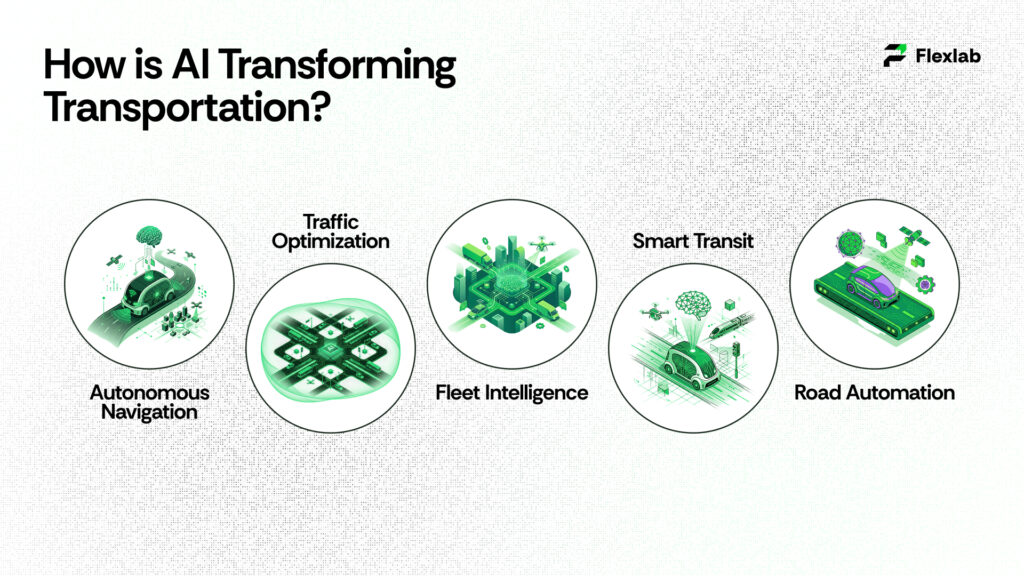
How is AI Transforming Transportation?
Smart traffic system using sensors and data analytics to manage vehicle flow

AI is integrated into different operations and aspects of transportation, streamlining operations and enhancing user experiences. Here is how AI is transforming the transportation industry. 

  • AI in self-driving cars, trucks, and buses helps navigate roads safely with the help of cameras, sensors, and deep learning models. 
  • With the help of AI algorithms, autonomous technology helps analyze real-time and historical data to optimize traffic signals, improve urban mobility, and significantly reduce congestion. 
  • In the fleet management system, AI solutions help logistics companies evaluate vehicle performance, optimize routes, and predict maintenance needs. 
  • AI, with the help of machine learning algorithms, helps improve public transportation by predicting demand, adjusting schedules, and enhancing user or passenger experiences. 
  • AI-powered road monitoring systems help establish smart city infrastructure by detecting hazards, automating toll collection, and improving the overall quality of transport.

Shortly, autonomous vehicles depend on AI not just to move forward, but to move safely and smoothly in real-world scenarios. 

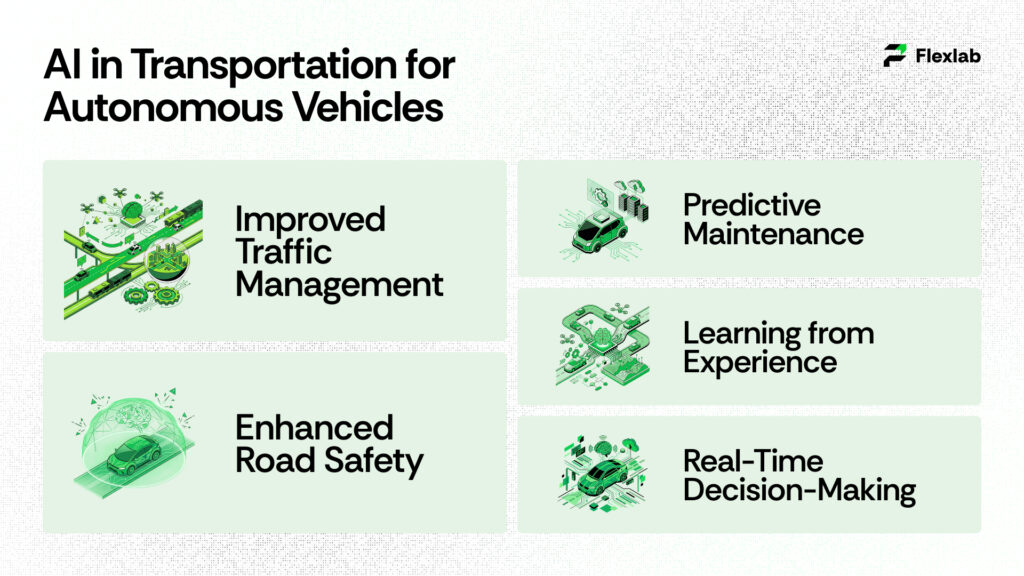
AI in Transportation for Autonomous Vehicles
Autonomous vehicle using AI-based sensors and real-time decision systems

1. Improved Traffic Management System

AI-powered intelligent traffic management systems are redefining how cities deal with congestion. By monitoring and analyzing real-time data from cameras, sensors, and GPS systems, AI helps optimize traffic flow, helping reduce delay and fuel consumption. 

For instance, AI-driven traffic lights in Pittsburgh, Pennsylvania, have helped reduce travel time by 25% and vehicle emissions by 20%. Through sensor fusion, these autonomous systems adjust signal timings based on real-time traffic conditions, avoiding unnecessary stops and helping ease congestion. 

AI also supports high-definition maps like Google Maps and Waze, providing people with the fastest routes based on live traffic condition updates. Urban mobility will continue to improve, as more cities tend to adopt AI-driven smart traffic solutions.

Artificial intelligence in autonomous vehicles also supports route optimization. It evaluates traffic patterns, weather conditions, and road usage to select routes that reduce congestion and improve efficiency. This is not just about getting from one location to another faster, but about smoother traffic flow for everyone.

2. Teaching Vehicles to See the Road

One of the greatest challenges for autonomous vehicles is perception. Just like human drivers depend on vision and hearing to understand what is happening around them, autonomous vehicles rely on AI. Cameras, radar, and sensors collect raw information from the surroundings. On their own, these inputs or pieces of information are meaningless streams of data. However, AI helps turn them into understanding. 

Moreover, AI models identify lanes, traffic lights, pedestrians, cyclists, vehicles, road edges, and obstacles. They make real-time vehicle tracking possible, even when conditions are not ideal. Unforeseen environments like fog, rain, shadows, or poor lighting can confuse traditional systems. However, AI learns from vast and different datasets in different environments, allowing it to recognize subjects even when they are partially hidden or distorted. 

This ability to ‘see’ accurately is essential. Without AI-powered perception, autonomous vehicles would not know where the road ends or where danger begins. 

3. Enhanced Road Safety

AI is significantly improving road safety by preventing human errors, which account for over 90% of traffic accidents all around the globe. Advanced Driver Assistance Systems (ADAS) driven by artificial intelligence can detect lane violations and issue warnings. It can also evaluate driver behavior to avoid drowsy or distracted driving. Furthermore, on top of it all, it can automatically apply brakes to avoid collisions. AI-powered dashcams and in-cabin monitoring systems are also becoming standard for commercial fleets, helping recognize unsafe driving behaviors and ensuring compliance with safety standards. 

Additionally, AI systems do not miss signals, ignore signs, or drive unsafely under emotional stress. AI systems are tested extensively in simulated environments before being implemented or deployed. They are exposed to millions of scenarios, including rare and dangerous ones, to make them even more efficient. 

4. Predictive Maintenance

Traditional vehicle maintenance is often reactive, resulting in costly breakdowns and unforeseen repairs. However, AI-enabled predictive maintenance tools tend to analyze sensor data to recognize potential mechanical issues before they become serious problems that need extensive solutions. For example, AI-driven systems in commercial fleets help monitor engine health, tire pressure, and brake performance. If a problem is detected, the system warns the operator to schedule maintenance, avoiding expensive downtime. 

In the aviation industry, AI-powered predictive maintenance is helping airlines minimize delays and maintenance costs. Such advanced transportation systems help reduce operational costs and enhance reliability, making transportation more efficient and reliable for both businesses and consumers. 

According to a study by UIC, operators who installed predictive maintenance saw a 15% boost in reliability and a 20% reduction in maintenance costs.

5. Learning From Experience 

One of the greatest advantages of AI in autonomous vehicles is its ability to learn from experience. Every mile driven generates data. This data feeds into autonomous vehicle software, helping it enhance object-detection, prediction accuracy, and decision-making strategies. When a vehicle comes across a rare event, that experience can be shared across an entire fleet. This translates into the improvement of the whole fleet because of one vehicle’s experience. Human drivers learn individually; however, autonomous vehicle software integrates AI systems to learn collectively. 

Over time, this shared learning reduces errors, improves safety, and helps autonomous systems handle edge cases that are difficult to program manually.

6. Decision-Making in Real Time

Once an autonomous vehicle understands its surroundings, it decides on its own about what to do. This is where AI becomes the decision-maker, adjusting its behavior based on the required level of autonomy, whether it is helping a human driver or working fully on its own. 

Should the vehicle completely stop or slow down? Is it safe to switch lanes? How close is too close? With AI integration in vehicles, these decisions are made continuously while balancing safety, comfort, and traffic rules. 

AI systems balance multiple factors at once. They tend to consider speed limits, road conditions, nearby vehicles, and legal constraints. This kind of visual understanding is often driven by a Convolutional Neural Network (CNN), which helps the vehicle interpret camera images and recognize critical objects on the road. Unlike human drivers, AI does not get distracted or fatigued, and it applies the same rules and decision logic consistently every time.

What makes this strong is adaptability. AI does not rely on a single rigid rule. It evaluates situations dynamically, choosing the safest and most efficient action based on real-time data.

7. Understanding Movement and Behaviour

Seeing and identifying objects is only the first step. Autonomous vehicles must also understand and detect what other vehicles are likely to do next. 

AI helps vehicles analyze movement patterns to predict behavior. It also identifies whether a pedestrian is about to cross the road, whether a nearby car is going to change lanes, or whether a cyclist is slowing down. All of this happens in fractions of a second. 

With AI implementation in transportation, this is very critical because safe driving depends on the right anticipation. It mimics human drivers who constantly make assumptions based on their experience. Similarly, AI also works like this, but at a much larger scale. It learns from millions of scenarios that allow it to detect even minor signals that indicate risk or change. 

With the help of collision avoidance systems, autonomous vehicles predict motion rather than just reacting to it. Consequently, it helps autonomous vehicles drive more smoothly and responsibly, avoiding sudden and unsafe maneuvers. 

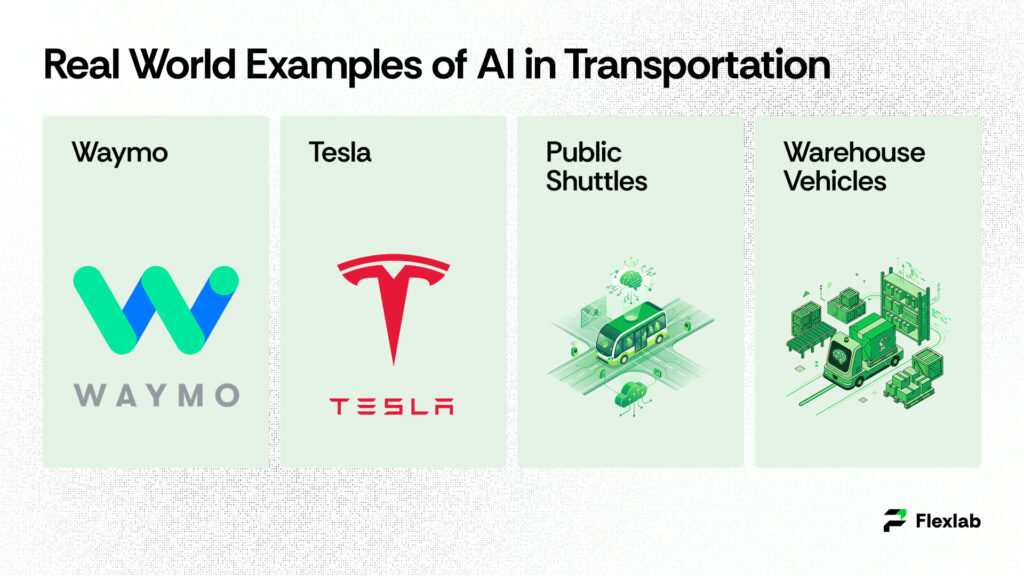
Real World Examples of AI in Transportation
Self-driving cars and intelligent traffic signals operating in a smart city

Autonomous vehicles are no longer a science-fiction concept; they are making a real appearance all over the globe now. Here are some of the real-world examples of AI in transportation; 

  • Waymo uses AI to operate driverless taxis in selected cities. The taxis use AI to handle pedestrians, complex turns, and heavy traffic using real-time learning and decision-making. 
  • Tesla uses camera-based AI instead of heavy dependence on maps. Their vehicles improve continuously through data collected from different vehicle experiences on the road. 
  • Public Shuttles: Self-driving public shuttles mostly operate on fixed routes in airports, campuses, and business parks. These vehicles have AI integration to safely navigate pedestrians and short-distance routes. 
  • Warehouse Vehicles: AI-driven warehouse vehicles are used to transport goods inside the warehouse and ports. These autonomous vehicles help improve efficiency and reduce accidents in controlled environments. 

Challenges of Autonomous Vehicles
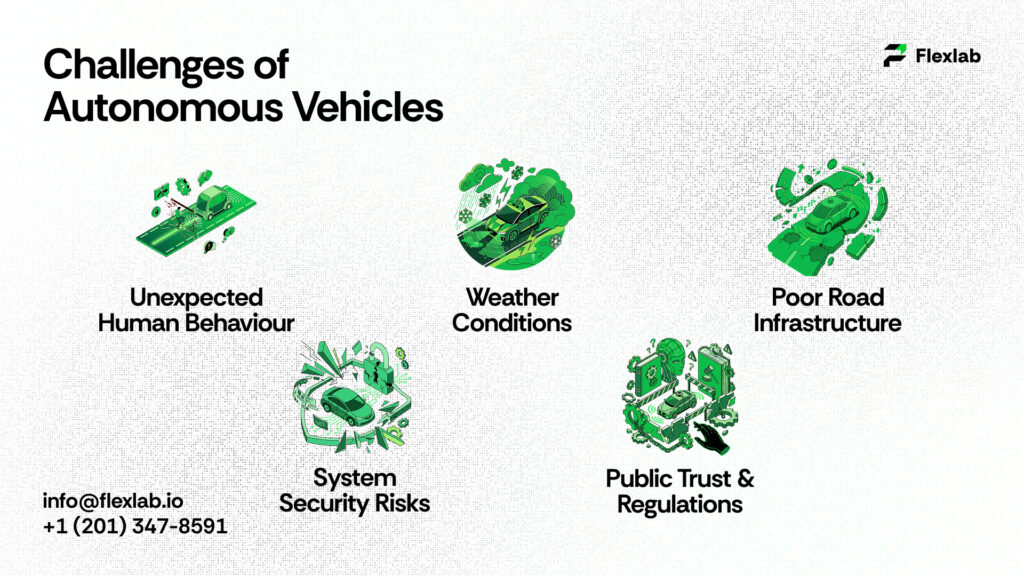
Illustration showing safety, regulation, and infrastructure challenges for self-driving cars

Alongside a huge number of benefits, there are some challenges as well that autonomous vehicles have to come across. 

  • Human Behaviour: Human behaviour can be unpredictable; drivers may ignore rules, and pedestrians may jaywalk. AI must constantly adjust to human mistakes. 
  • Weather Conditions: Unforeseen or difficult weather conditions, such as snow, fog, rain, and glare, may interfere with sensors and the AI-driven vision system. 
  • Poor road infrastructure, such as faded lane markings, broken signals, and unclear signage, tends to confuse AI systems.
  • System Security Risks: Autonomous vehicles are prone to security risks. Therefore, they must be protected from system failures and cyber threats. 
  • Public Trust and Regulations: Many people still doubt the accuracy of AI-driven self-driving cars or autonomous vehicles. Governments must set safety standards and regulations before the mass adoption of AI-integrated autonomous vehicles. 

Concluding Remarks About AI in Transportation

Autonomous vehicles are not driven by magic or mystery. They are driven by systems driven by intelligent automation that see, learn, decide, and adapt in real time. From understanding the road to predicting behavior and making split-second decisions, Artificial intelligence supports every important function of autonomous transportation. What makes this technology powerful is not just automation, but intelligence. AI allows vehicles to grow safer with experience, smarter with data, and more responsive to the world around them.

As transportation continues to evolve, AI will remain the engine behind autonomy, secretly transforming how we move through the world. As AI continues to strengthen, autonomous vehicles will become more capable, more reliable, and more integrated into everyday life. They will perform logistics, public transport, personal travel, and emergency services in ways that go beyond driving itself.

Move Ahead with AI Automated Business Operations
Move Ahead with AI Automated Business Operations

The future of transportation is intelligent, connected, and automated with AI, and Flexlab is here to help you bring that change. Whether you run a logistics company, fleet service, mobility startup, or public transport operation, we build AI software that turns your data into real action. From route optimization and vehicle tracking to autonomous system support and safety analytics, Flexlab designs solutions tailored to your unique business goals, not generic templates.

Our team works closely with you to have a clear and detailed understanding of your workflows, challenges, and growth plans, then builds reliable AI tools that improve efficiency, reduce costs, and enhance safety across your operations. 

Ready to Grow Your Business

📞 Book a FREE Consultation Call: +1 (416) 477-9616

📧 Email us: info@flexlab.io

Discover real-world success stories in our portfolio, have a look at our solutions, and get your AI development solutions today. Contact us or have a look at our services. See what our clients have to say about us and how you can start your AI-powered transport journey with us.

To have more detailed insights into different topics, explore our blog page for more blogs like public vs private blockchain, benefits of using white label crypto exchanges for startups, and what is multimodal AI? 

FAQs

How will AI transportation change the world?

AI transportation will reduce accidents, cut travel time, and make mobility safer by removing human error from the road. It will reshape cities with cleaner traffic flow, lower emissions, and smarter, more accessible transport for everyone. Also, it will ensure reduced labor costs while providing higher profits. 

Which car brands are using AI? 

Car brands utilizing AI today include Tesla, Mercedes-Benz, BMW, Toyota, and Hyundai, all of which integrate AI for features such as autonomous driving assistance, smart navigation, and in-car intelligence. Other examples include Audi, General Motors (GM), Ford, and Chinese manufacturers such as Baidu’s robotaxi projects and AITO, which utilizes Huawei AI, demonstrating AI applications across driving, safety, and user interface. 

What is the future of AI in travel?

AI will make travel smoother by planning trips for you, avoiding delays, and keeping journeys safer and less stressful. It will also create more personalized experiences, so travel feels easier, greener, and built around real people’s needs.


Leave a Reply

Your email address will not be published. Required fields are marked *

Choosing Between Agentic AI vs Generative AI for Your Business

Best AI Tools | AI in FinTech | AI Assistants 

Agentic AI vs generative AI is quickly becoming one of the most important decisions businesses face as AI adoption accelerates across every industry. Currently, AI is everywhere; however, clarity is lacking. 

Nearly 70 percent of companies are already using or actively testing AI tools, yet many teams still cannot explain what kind of AI they are actually paying for. Some tools help people write faster, summarize information, or generate ideas. Others go further by moving data, triggering actions, and completing tasks across systems without constant human input.

Agentic AI is built to act, not just respond. Generative AI focuses on creating content, while agentic workflows focus on execution. In practical terms, one supports your team, and the other behaves like a digital operator inside your workflows.

As 2026 unfolds, leaders are no longer asking whether they need AI that talks or AI that works independently. The answer affects cost, risk, scalability, and long-term ROI. In this blog, we break down these technologies so you can easily make decisions that drive real results.

Agentic AI vs Generative AI: What They Are, and Why It Matters?

Agentic AI vs Generative AI—What They Are and Why It Matters


In the current business landscape, the shift toward modern AI systems is accelerating faster than most teams can keep up with, making clarity more important than ever.

At its core, the choice between these two technologies comes down to whether you require a creative partner or a digital employee. Agentic AI is designed to coordinate actions across your existing tools and workflows, while generative AI is built to support the thinking and writing process.

Understanding this distinction early enables teams to evaluate tools more clearly, set realistic expectations, and focus on outcomes rather than features.

  • Generative AI: The Creative Content Engine

Generative AI has become a go-to tool for teams that require content urgently. Furthermore,  knowledge of generative AI fundamentals explains why it performs so well at scale.

Additionally, generative AI models are the engines behind this ability. Specifically, they empower businesses to turn ideas into polished outputs without slowing down workflows. They prove especially useful for tasks requiring creativity, research, or summarization at scale. In fact, a 2025 survey found that over 65% of marketing teams use generative AI to produce content weekly, saving hours of manual work. Some micro-examples are presented that are in practice:

  • Summarizing five long reports into a single one-page brief
  • Drafting multiple versions of a social media ad from one product description
  • Cleaning up rough emails to make them professional and concise
  • What Generative AI Is Designed to Do

Generative AI models are designed to empower people to create faster. Moreover, they leverage patterns learned from vast datasets to generate output such as text, images, code, or audio that feels almost human-like.

  • Where Generative AI Fits in Daily Business Work

In real business settings, generative AI applications are commonly used for summarizing documents, drafting emails, and effectively organizing ideas, as well as creating marketing copy. It performs best in both scenarios—whether tasks start with a blank page or involve too much information.

  • Strengths and Natural Limits

Generative AI truly shines in its ability to deliver lightning-fast results at a large scale, making it an invaluable asset for high-pressure projects. It can process and rework information far faster than a human. However, these tools rely on machine learning models; their role usually ends once content is created. It does not move data, trigger workflows, or take action inside your systems without human direction.

Agentic AI: The Autonomous Task Executor

In contrast to reactive tools, agentic AI systems are designed to execute tasks across tools with minimal human input, operating as AI agents that can carry out actions across all connected business systems.  It is created to go beyond suggestions.

Agentic AI systems act like digital team members, executing tasks across tools and workflows while reducing manual effort. According to Gartner, by the end of 2026, 40% of enterprise applications will include agentic AI for autonomous task execution, meaning these systems will operate alongside teams rather than just assist them. Some real-life examples make it more relatable:

  • Automatically qualifying new leads and updating your CRM
  • Sending personalized email responses when the criteria are met
  • Monitoring shipments and notifying customers of delays
  • How Agentic AI Operates

Agentic AI systems operate through AI agentic workflows, meaning they act on defined goals instead of waiting for constant prompts. They are given goals and the ability to decide what steps to take next.

  • Interaction with Tools and Workflows

These systems enable agentic process automation by connecting directly to business software and automatically handling workflows across tools, such as CRMs, ticketing systems, and internal dashboards. This allows them to operate more like a digital operator rather than a traditional assistant, making them feel like an active part of the team instead of just a support tool.

  • Oversight and Control Considerations

Agentic AI interacts directly with real systems; security information and event management practices are essential to maintain control. Therefore, clear permissions, defined boundaries, and human approval for high-impact actions help ensure control while still reducing manual workload.

Generative AI vs Agentic AI: Core Differences in 2026

Generative AI vs Agentic AI: Core Differences in 2026

In 2026, the gap between using AI and winning with AI comes down to one choice: agency. While 70% of companies experiment with content-focused tools, those deploying execution-focused models capture the real ROI. To scale, you must move beyond the prompt and start managing AI as an autonomous part of your workforce.

Let’s break down the key differences of agentic AI vs generative AI, so you can see exactly how each AI type operates and where it fits into your business workflow.

1. Purpose & Function

  • In contrast to execution-focused tools, conversational AI vs generative AI highlights how content creation differs from system-driven action. Enabling teams to generate ideas, write copy, or analyze information.
  • Agentic AI is built to execute tasks across systems, moving beyond content creation into autonomous action.

Businesses using generative AI for content report up to 50% faster output for routine tasks, for instance, summarizing reports or drafting emails.

2. Autonomy & Human Interaction

  • Generative AI models are reactive: they wait for prompts and respond; they don’t act independently.
  • Agentic AI systems are proactive: these systems function more like autonomous agents, completing tasks with minimal human involvement. 
  • They take high-level goals and complete tasks with minimal human intervention, a key capability associated with AGI (artificial general intelligence).

This distinction changes how teams interact with the AI. Generative AI supports decision-making, while agentic AI can save teams 20–30% of manual effort by automating workflows.

3. Implementation & Risk

Agentic AI relies on a defined agentic AI architecture. However, generative AI carries less operational risk but cannot automate processes independently.  Requires strong permissions and governance, safety checks, and human oversight for high-risk actions.

This isn’t just a technical upgrade; it’s an operational shift. While generative AI handles the intelligence, thinking, and drafting, agentic AI handles the orchestration, doing, and finishing. Below is the breakdown of how these two autonomous systems work together to reclaim your team’s manual bandwidth and transform your approach to business execution:

Features Generative AI Agentic AI
Primary Goal Creating content and summaries Executing workflows across systems
Autonomy Initially, Reactive: Operates when prompted. Specifically, Proactive: Acts independently on goals
Memory Session-based: Resets after interaction Persistent: Learns and improves over time
Interaction Within a chat interface Additionally, it connects directly to CRM, ERP, and Email
Human Role Constant prompting and supervision High-level strategy and oversight only
Best Use Cases Marketing, research, and idea generation Sales automation, logistics, and operations

The strategic winner is the hybrid workflow. By 2026, the standard for excellence is using generative AI to spark the idea and agentic AI to carry it across the finish line. This synergy allows your employees to stop being ‘operators’ and start being ‘architects’ of high-value business growth.

This comparison highlights that not all AI serves the same purpose. Some tools enhance human thinking and communication, while others operate across systems and complete work independently. Recognizing these distinctions early helps organizations avoid mismatched expectations as automation becomes more deeply embedded in everyday business processes.

Practical AI Solutions for Multiple Teams

Practical AI Solutions_ Transforming Workflows


How AI solutions powered by generative and agentic AI can be applied across teams. Enable organizations to save time, reduce errors, and scale efficiently. How organizations apply AI across teams, using process intelligence to decide what should be created by humans and what can be handled automatically. The goal is not replacement, but smarter coordination between people and software.

1. Marketing: Creating & Executing Content

  • While Generative AI models draft high-quality social media posts, Agentic AI systems
  • Consequently, Agentic AI systems take over scheduling, performance analysis, and CRM updates automatically, saving time and reducing manual effort.

2. Sales: From Insights to Action

  • Generative AI summarizes call transcripts, drafts personalized emails, and generates sales proposals.
  • Agentic AI workflows log leads, send follow-ups, and track pipeline actions without constant human intervention.

3. Operations: Monitoring & Automating Tasks

  • Generative AI creates process documentation, generates reports from raw data, and identifies trends in shipment delays.
  • Agentic AI automates shipment monitoring, sends alerts for delays, and triggers corrective actions across systems.

4. Finance: Streamlining Accounts

  • Primarily, generative AI summarizes invoices, creates financial summaries, and analyzes budget reports.
  • However, Agentic AI handles matching invoices with purchase orders, scheduling payments, and notifying teams of exceptions. Consequently, the risk of human error in accounts payable is virtually eliminated.

5. IT & Support: Intelligent Assistance

  • Generative AI writes knowledge base articles, summarizes system logs, and generates troubleshooting guides.
  • Agentic AI automates ticket triage, assigns issues to the right engineers, and triggers system updates based on alerts.

These examples show that AI delivers the most value when applied with intent, not everywhere at once. Teams that clearly define where AI should assist and where it should act tend to see faster adoption and better results. When used thoughtfully, AI becomes a support layer that reduces friction across teams rather than another tool employees have to manage.

How to Choose the Right AI for Your Business?

How to Choose the Right AI for Your Business: Decision Checklist

Choosing AI for enterprise is about aligning technology with real needs, existing systems, and acceptable levels of automation. Use this checklist to evaluate what actually fits your organization today and what can scale tomorrow.

Start With the Type of Work You Want to Improve

Before evaluating tools, clearly define the kind of work you want AI to support. If your challenge is writing, summarizing, or analyzing information, content-focused AI may be enough. If your challenge is coordination, execution, or follow-through, you’ll need systems. that can act. This step helps you avoid purchasing tools that appear impressive but don’t actually improve outcomes.

Evaluate How Much Autonomy You’re Comfortable With

Some organizations prefer full control, while others are willing to let the software take the initiative. AI that operates independently can deliver efficiency, but it also requires trust, governance, and oversight.

Be honest about where automation is acceptable and where human approval must remain in place, especially when evaluating multimodal AI systems that combine text, data, and operational signals.

Check System Integration Requirements

Moreover, AI delivers more value when IoT integration and system connectivity are considered from the start. As a result, before committing, you must confirm whether the solution integrates smoothly with email, CRM, and analytics platforms. Ultimately, disconnected tools often create more work instead of reducing it.

Measure ROI Beyond Time Savings

Time saved is important, but it’s not the only metric to consider. Look at error reduction, faster response times, better customer experience, and operational consistency. These indicators show whether AI is delivering real value or just surface-level productivity gains.

Start Small and Scale With Confidence

For this reason, many teams partner with an AI automation agency to start small and scale deliberately. Moreover, as test results accumulate over time, they help identify edge cases. Ultimately, this ensures a stable environment before AI becomes deeply embedded in your operations. Scaling works best when learning is intentional, not rushed.

Checklist Summary

If your priority is creating information, focus on tools that enhance thinking and communication. On the other hand, if you prioritize executing work, look for systems that can operate reliably with minimal supervision. The right choice of tools supports people, strengthens processes, and grows with your business, rather than locking you into rigid tools.

Turn Your Vision into Autonomous Action with Flexlab’s AI Solutions

Turn Your Vision into Autonomous Action with Flexlab


At Flexlab, we transform ideas into automated AI workflows that save time, reduce errors, and let your team focus on high-impact decisions. Whether it’s optimizing business operations, automating processes, or integrating AI into existing systems, we provide the tools and expertise to make your vision a reality.

Ready to Automate Your Business Workflows with AI?

📞 Book a FREE Consultation Call: tel:+1 (416) 477-9616

📧 Email Us: info@flexlab.io

Explore our success stories in the portfolio, check our services, or gain insights from our blog. Ready to get started? Contact us or connect with us on LinkedIn, and let’s turn your AI strategy into action.

Curious to learn how AI can drive real results for your business? Read our latest blog for actionable insights and expert tips.

Final Thoughts on Agentic AI vs Generative AI for Business Decisions

Choosing the right AI comes down to clarity, not complexity. When leaders understand what each approach is designed to do, decisions become easier, risks are reduced, and outcomes improve. The businesses that win are the ones that align technology with real needs, apply it thoughtfully, and scale with purpose instead of chasing trends.

FAQs

1. Can generative AI eventually become agentic?

Think of generative AI as the brain and agentic AI as the brain plus the hands. While a standard text generator doesn’t automatically become an agent, you can upgrade it by connecting it to external tools and giving it a set of goals. When you give a language model the power to use your calendar or send emails, it transitions from a simple content creator into a proactive system that can handle tasks from start to finish.

2. What is the biggest risk when moving from generative to agentic systems?

The main challenge shifts from accuracy to security and control. With generative AI, the biggest worry is usually a typo or a factual error in a draft that you can easily catch. With agentic AI, since the system can actually take actions like moving files or contacting customers, the risk is giving it too much autonomy without the right boundaries. Successful teams manage this by starting with human-in-the-loop setups where the AI drafts the action, but a person still gives the final click to execute it.

3. Can businesses use Generative AI and Agentic AI together effectively? 

Yes, many organizations do. Generative AI handles content creation, analysis, and idea generation, while Agentic AI executes tasks and workflows automatically. When used together, they complement each other: one powers thinking and planning, and the other handles follow-through and coordination. The key is defining clear roles for each type so teams gain efficiency without overlap or confusion.

How AI Automation Services Transform Business Operations?

What Is Marketing Automation | Automation Testing | AI Strategy Consulting

AI automation services are revolutionizing business in 2026 and slashing 30-70% of wasted time on repetitive tasks, while unlocking a $1.3T market by 2030.

Discover 10 business processes that you can transform, ranging from intelligent invoicing and AI-powered chatbots to fraud detection and HR onboarding. By leveraging smart AI agents, robotic process automation (RPA), and generative AI applications, these processes can learn, adapt, and scale to meet your business needs.

FlexLab’s expert AI automation agency offers custom intelligent process automation across AI in marketing, AI in fintech, and AI in human resources. As a result, it can cut costs by 20–50% while boosting conversions by 30%, thanks to proven business process optimization.

Want to learn more? Let’s dive into helpful insights!

What is AI Automation?

AI automation leverages advanced technology to handle everyday business tasks by enabling computers to scan data, identify patterns, and make logical decisions independently. It takes responsibility to do repetitive or time-consuming work that requires human effort, and makes them free to do more strategic and creative work. Whether it is data entry, invoicing customers, managing inventory, or setting prices, AI agents or AI assistants independently manage all work and allow people to do more highly valued work.  

Unlike old-school automation that sticks to rigid rules, AI systems learn and get better over time through machine learning (ML), which crunches past data to predict outcomes, and natural language processing (NLP), which understands human speech or text. Agentic AI takes it further by acting like a virtual teammate, trained to mimic human choices, take actions across apps, and improve with feedback or reinforcement learning. Large language models (LLMs) and generative AI models supercharge this, letting AI-powered chatbots create content, chat naturally, or solve problems beyond canned responses.

For example, a basic chatbot only provides pre-set answers to customer questions, whereas an AI agent can dig deeper into the issue, check databases, process refunds, and troubleshoot tech glitches—all in real time, enabling smarter fixes across AI in customer service. Consequently, this shift allows businesses to operate faster, cheaper, and smarter across sales, HR, finance, and support through intelligent process automation.

What are AI Automation Services?

AI automation services are expert-led solutions that blend artificial intelligence, machine learning, and automation technologies to streamline and supercharge business process management. Unlike generic software or plug-and-play tools, these intelligent automation services are custom-built by an AI engineer to fit your company’s unique systems, workflows, and goals.

They typically cover:

  • Process discovery and strategy: Digging into your ops to spot bottlenecks, map workflows, and pick high-ROI targets like invoicing or support tickets.
  • Custom AI agent development: Building smart agents that handle complex tasks, like end-to-end claims or personalized marketing.
  • System integrations and data orchestration: Seamlessly connecting your CRM, ERP, or blockchain tools for smooth data flow.
  • Ongoing training and optimization: Keeping models sharp with fresh data and feedback for continuous improvement.

These services start by shadowing your teams to understand real pain points. Then, they deliver tailored AI and automation solutions, along with a roadmap for lasting transformation. Moreover, hands-on experts ensure real ROI—for example, 30–70% time savings—rather than just relying on off-the-shelf apps.

How AI Automation Works

How Intelligent Automation Works

AI automation works by using smart AI tech with structured workflows to handle tasks that require human brains or hands. AI automation systems run on three main techs:

  • Automated Machine Learning learns from past data to make smarter calls over time, such as spotting fraud patterns or predicting sales.
  • Natural Language Processing (NLP) enables the understanding of human language, which powers chatbots and automated responses. Now, this capability leverages Generative AI with Large Language Models (LLMs) to craft fresh, natural-sounding replies.
  • Robotic Process Automation (RPA) uses software bots to handle repetitive digital tasks with precision, such as data entry or form approvals.

Why Startups Seek AI Automation

Why Startups Adopt Automation Technologies

Startups turn to AI-powered automation to punch above their weight, handling big-company tasks with lean teams and tight budgets. Recent analyses show it levels the playing field by automating grunt work and unlocking smart growth.​

  • Cut Costs Without Cutting Corners

Hiring full-time staff for routine jobs like data entry or customer replies drains startup cash. AI handles these 24/7 for a fraction of the price, saving 20-40% on ops and letting founders invest in product or marketing instead.​

  • Boost Speed and Efficiency

With small teams juggling everything, AI quickly handles repetitive tasks—such as invoices, lead sorting, or ticket triage—in just seconds, thereby freeing hours for innovation. As a result, you can expect 20–40% productivity jumps without causing burnout.

  • Scale Effortlessly as You Grow

AI grows with you: manage 10 or 10,000 customers without hiring sprees. It auto-scales workflows for demand spikes, keeping costs flat while revenue climbs.​

  • Make Smarter Calls with Data

No more relying on gut feelings, because AI crunches real-time data on trends, customer behavior, and churn risks, enabling spot-on decisions. Furthermore, predictive tools help you identify hot leads or detect market shifts early.

  • Wow, Customers and Beat Rivals

Personalized chats, instant support, and tailored marketing powered by AI combine to create pro-level experiences that delight users while giving you an edge over slower competitors. As a result, retention and conversions soar.

  • Spark Innovation and Agility

Automation kills bottlenecks, so teams focus on building cool features or pivoting fast. It’s like giving your startup superpowers for quick experiments and market wins

Benefits of Using AI Automation Services

Benefits of Using AI Automation Services

AI automation services make business run smoother and cheaper by handling boring, repetitive stuff that eats up time. As a result, they have become a true game-changer for modern organizations.

1. Saves Tons of Time

Imagine this: employees spend hours and hours on data entry, approvals, or chasing emails. Not only is this exhausting, but it also wastes significant operational time. Fortunately, AI automation steps in as the real solution, handling tasks such as, including invoice scanning or lead sorting in seconds. Therefore, AI saves time brilliantly. This frees up teams to reclaim 30-70% of their day for high-impact stuff, such as sealing deals or sparking fresh ideas

2. Cuts Costs Big Time

Automation reduces payroll for manual jobs. Hence, you need no extra staff for routine paperwork or night-shift monitoring. Companies save 20-50% on ops expenses, grab early payment discounts, and avoid pricey errors like duplicate bills or fraud hits.

3. Fewer Mistakes, More Accuracy

Humans can make mistakes when tired or dealing with bad handwriting, but AI achieves 99% accuracy on tasks like OCR receipt reads or contract checks. As a result, there are no more overpayments, compliance fines, or lost leads caused by sloppy routing.

4. Runs 24/7 Without Breaks

AI chatbots answer customers anytime, fraud detectors watch transactions non-stop, and workflows keep humming on holidays. Your business never sleeps, boosting satisfaction and catching issues before they blow up.

5. Smarter Decisions Fast

Dashboards provide real-time insights—such as sales trends or inventory needs—without relying on spreadsheets or guesswork. Additionally, you can predict churn, spot hot leads, and forecast demand, helping you stay ahead of competitors.

6. Scales Without Hiring Headaches

Looking to grow from 10 to 100 employees? With AI, onboarding, support tickets, and marketing blasts can be handled effortlessly. As a result, there are no training lags or overload—you simply plug in more volume while still keeping quality high.

7. Happier Employees and Customers

Staff love being able to ditch grunt work and focus instead on creative tasks, which helps cut burnout and turnover. Meanwhile, customers get instant replies, faster reimbursements, and personalized perks, thereby lifting loyalty scores by 20–40%.

Top 10 AI-Automated Business Processes in 2026

Top 10 AI-Automated Business Processes in 2026

In 2026, the US business landscape has shifted from basic Robotic Process Automation (RPA) to Agentic AI Automation. AI vs automation means evolving from rule-based tasks to full decision-making workflows.

1. Intelligent Invoice & Accounts Payable

Traditional systems struggle to handle the many different invoice formats that exist. Fortunately, AI steps in with OCR (Optical Character Recognition) and Natural Language Processing (NLP) to read and scan any invoice, extracting data such as vendor name, total amount, taxes, and line items. Next, it matches this data with your purchase orders in systems like SAP, Oracle, or QuickBooks. Additionally, it flags anomalies like duplicates or overcharges immediately. Finally, once approved via quick mobile notifications or e-signatures, payments are processed automatically, allowing you to capture early-bird discounts.

AI Tools: UiPath Document Understanding, Rossum, Nanonets.

Real Impact: AI automation tools reduce processing from days to hours. Additionally, it saves up to 70% time, prevents 90% of errors, and keeps perfect audit trails for taxes or compliance checks.

2. Autonomous Customer Support & Triage

AI agents do not only provide canned responses. They handle complex issues such as processing refunds, resetting passwords, and technical fixes, while also diving into your databases to evaluate order history. Moreover, they even update record apps like Shopify or CRM without human intervention. They spot urgent VIP tickets and bump them to experts while solving 80% of everyday questions 24/7. Customers get instant replies with real ETAs too.

AI Tools: Intercom Fin, Zendesk AI, Sierra, Ada.

Real Impact: It provides non-stop support and cuts response time by 50%. Moreover, it boosts satisfaction scores and frees your team for big customer wins.

3. Predictive Sales Lead Scoring

AI analyzes CRM history along with fresh signals—such as website clicks, email opens, or LinkedIn views—to score leads as hot or cold and automatically notify sales reps for timely follow-ups. Some popular AI tools for this include HubSpot AI, Salesforce Einstein, and 6sense.

Real Impact: These AI tools for businesses lift conversion rates 30%, shorten sales cycles by weeks, and help reps focus on winners instead of chasing duds.

4. Hyper-Personalized Marketing Campaigns

Are you fed up with one-size-fits-all emails? Don’t worry—because AI systems can create custom messages, product picks, and ads for each person, based on their clicks, purchases, and even the weather in their area. Moreover, it A/B tests on the fly, predicts the best send times, and scales campaigns across email, social, or SMS without requiring extra staff. This makes it perfect for e-commerce businesses or agencies that are running client promotions.

AI Marketing Tools: Jasper AI, Klaviyo AI, Insider, Phrasee.

Real Impact: It doubles open rates to 40-50%, hikes ROI on ads by 25%, and grows revenue through smarter targeting.

5. Smart HR Onboarding & Recruitment

AI examines thousands of resumes for skills and fits them according to the criteria, ranks candidates, books interviews across busy calendars, and manages all the new-hire paperwork, such as e-signing tax forms, verifying IDs, setting up email/IT gear, and assigning training. Managers get dashboards on hiring pipelines and bottlenecks. Thus, AI for the HR role works wonders and speeds up the whole process.

AI Tools: Paradox, Rippling AI, Eightfold.ai, Workable AI.

Real Impact: It speeds up the hiring process by 30-40%, cuts no-shows with auto-reminders, and gets new folks productive in days, not weeks.

6. Supply Chain & Demand Forecasting

AI pulls in sales data, market news, weather, and trends to accurately predict the inventory you’ll need next month. Then, it automatically triggers reorders, reroutes stock between warehouses, and alerts you to any delays from suppliers. As a result, it helps prevent empty shelves and overstock headaches.

AI Tools: Peak.ai, Blue Yonder, Amazon Forecast, C3 AI.

Real Impact: AI for data analysis predicts inventory, drops stockouts 50% using Blue Yonder. Moreover, it trims storage costs by 20-30%, and smooths ops during peak seasons like holidays.

7. Real-Time Fraud Detection & Compliance

AI in fintech monitors every transaction or contract live, highlighting fishy patterns, such as odd login spots or sketchy clauses, in seconds. It blocks bad payments, auto-flags docs for legal review, and logs everything for audits. Hence, it keeps you safe in finance, e-commerce, or regulated fields.

AI Tools: Darktrace, Feedzai, Ironclad, Sift.

Real Impact: Stops losses before they hit, ensures 100% compliance, and cuts investigation time from hours to minutes.

8. Automated Meeting Summarization & Task Routing

AI joins your Zoom or Teams calls, AI voice agents transcribe everything, pulls out action items, decisions, and deadlines. Then, it dumps tasks right away into Asana, Jira, or Trello, assigned to the right people with set due dates. Now, there is no more “who said what?” confusion.

AI Tools: Fireflies.ai, Otter.ai, Microsoft Copilot, Fathom.

Real Impact: Kills manual notes, ensures 100% follow-through on tasks, and saves teams 5-10 hours a week on recaps.

9. Predictive Maintenance for Manufacturing

IoT sensors feed AI data on machine vibes, heat, or wear, predicting breakdowns days ahead so you can schedule fixes and order parts automatically. No more surprise shutdowns halting production lines.

AI Tools: Google Vertex AI, Azure IoT, IBM Maximo, Uptake.

Real Impact: Slashes downtime 50%, extends equipment life 20-30%, and saves big on emergency repairs.

10. IT Operations (AIOps) & Incident Response

AI keeps a constant eye on your servers, cloud, and network 24/7. Moreover, it spots slowdowns early, auto-fixing common glitches like restarting services or rerouting traffic, and alerts humans only for the rare tough ones. Ties into Slack or PagerDuty for team updates.

AI Tools: PagerDuty AI, Datadog Bits AI, Splunk, New Relic.

Real Impact: Drops Mean Time To Resolution (MTTR) by 60%, prevents outages, and enables IT to focus on growth projects instead of firefighting.

Best AI Automation Services That Transform Your Business

Automation Solutions That Help Businesses Scale

Flexlab stands out as a top AI automation agency, delivering cutting-edge intelligent automation and tailored AI solutions that transform businesses through seamless custom blockchain development. With proven success across diverse niches, from AI in marketing and AI in transportation to AI-powered chatbots in healthcare. Additionally, they consistently exceed client expectations, powering everything from predictive analytics to secure workflow automation with unmatched expertise and results.

Here are the core AI automation‑related services Flexlab provides:

1. AI Chatbots & Virtual Agents

FlexLab builds chatbots and conversational AI that can handle customer queries, support tickets, and sales leads 24/7 by understanding natural language, pulling data from databases, and taking actions like booking demos or processing refunds. Unlike basic bots, these AI solutions also integrate with blockchain for secure data or trading platforms for real-time quotes. As a result, they are perfect for day trading clients, reducing response times by up to 80%.

2. Predictive Analytics & Forecasting

By combining machine learning models trained on historical data with real-time signals such as market trends and user behavior, Flexlab builds powerful tools for demand forecasting, churn prediction, and trade fee detection. For example, one of our clients, Hoodwinked Trades, used this approach to uncover hidden costs and save $1.2 million. Meanwhile, agencies apply these insights to optimize marketing ROI and inventory planning, boosting accuracy to 95% while significantly reducing manual analysis.

3. AI Agent & Multi-Agent Systems

Autonomous AI agents manage complex workflows end-to-end, like claims processing or vehicle appraisals (Another client, AppraiseAll: 75% faster with 95% valuation accuracy). Multi-agents collaborate, one analyzes data, another approves, a third notifies, across apps, with blockchain for tamper-proof logs.​

4. Workflow Automation & RPA

FlexLab automates repetitive tasks like onboarding, invoicing, or supply chain routing via RPA enhanced by AI for smart decisions (e.g., auto-reorders or policy checks). Integrates OpenAI, Claude, or Google Vertex for adaptive flows, slashing paperwork 80% in client cases.​

5. Fraud Detection & Compliance Engines

AI scans transactions and documents in real time to detect anomalies, while blockchain audits provide added security. This makes it ideal for fintech and trading applications. Additionally, these tools flag risks, ensure GDPR and CCPA compliance, and maintain 99.99% uptime. As a result, they help prevent losses while enabling zero-breach operations.

6. Custom AI-Blockchain Integrations

Tailored AI solutions include smart contract automation combined with AI predictions for DeFi trades or dApps. For agencies, this also means SEO-optimized bots and automated content pipelines, with full lifecycle support ranging from strategy to scaling.

Visit our blockchain and AI blog page and discover more about What Is Marketing Automation, Automation Testing, AI Strategy Consulting, and Multimodal AI.

Conclusion: AI Automation Services

AI automation services isn’t just a trend; in fact, it’s the powerhouse that is transforming 10 key business processes—from invoicing to fraud detection—into efficient, scalable engines that save 30–70% time and boost ROI. Moreover, as FlexLab’s tailored AI solutions prove, partnering with a top AI automation agency can unlock intelligent process automation for fintech, marketing, healthcare, and beyond, while blending generative AI models with blockchain to ensure secure growth.

Instead of letting manual drudgery hold you back, embrace AI-powered chatbots, AI agents, and robotic process automation today. By doing so, you can enjoy the benefits of business automation, such as smarter decisions and happier teams. Additionally, FlexLab’s best AI tools deliver business process optimization across areas like AI in customer service, AI in marketing, and more.

Ready to Launch Your AI Automation Project?

📞 Book a FREE Consultation Call: +1 (416) 477-9616

📧 Email us: info@flexlab.io

Ready to automate? Contact us now, visit our LinkedIn page, and supercharge your operations now. The future of work is AI and automation—start yours today

FAQs

Q1: Which AI tool is best for automation?
UiPath leads as the top AI automation tool in 2026, blending RPA with ML for enterprise workflows like invoicing and support. It handles complex, unstructured data via OCR/NLP, scaling from startups to Fortune 500s. Power Automate excels for Microsoft ecosystems, while Zapier suits no-code SMBs. Choose based on integration needs.

Q2: How to automate business processes with AI?
Start by mapping repetitive tasks—such as invoices and support tickets—and gathering data from sources like CRM and ERP systems. Then, pilot automation with tools like UiPath or Power Automate, starting small to achieve quick wins. Next, integrate AI for decision-making, including ML scoring and NLP routing, and train the system using human feedback. Finally, monitor ROI through dashboards, iterate, and scale—with FlexLab streamlining the process end-to-end.

Q3: What are the 4 types of automation?

The four types of automation are Basic/RPA, using rule-based bots for data entry and forms like invoice matching; Workflow/BPA, managing end-to-end processes such as approvals with tools like Zapier; Intelligent/IPA, applying AI and ML for decisions and patterns like fraud detection; and Hyperautomation/Autonomous, featuring self-learning agents that orchestrate multi-systems.

AI Engineer Salary: What to Expect in 2026

AI in Transportation | Automated Machine Learning | AI in FinTech

The average AI engineer salary in 2026 ranges from $134,000 to $185,000 USD, reflecting total compensation in the US, according to Glassdoor ($134k base median) and Built In ($184,757 average), with a BLS proxy at $140,910 median for research scientists. However, your actual salary varies based on experience, location, and technical skills.

Factors such as LLMs/MLOps skills, Big Tech employers, and experience can boost pay 20–50% above national medians. If you want to know how to get high pay salary, explore the article and learn the AI engineer skills to expand your knowledge. 

What is an AI Engineer?

An AI engineer is a professional software engineer who develops, deploys, and optimizes artificial intelligence models. Specifically, they utilize machine learning, deep learning, and data science to address real-world problems. They created scalable AI models through deep research that automate tasks, generate insights, or enhance decision-making in applications such as recommendation engines, chatbots, and predictive analytics. Moreover, they work in several sectors, including the tech industry, healthcare, finance, and e-commerce.

According to an IDC report, AI will contribute up to 19.9 trillion to the global economy by 2030. As a result, it increases 3.5% in global GDP. This projected growth tells how much organizations leverage AI to empower their business decisions and increase efficiency. 

In addition, AI engineering focuses on creating practical tools, systems, and workflows that take artificial intelligence into everyday use across industries. These systems enable machines to replicate human-like abilities, such as problem-solving, pattern recognition, and adaptive learning from experience. 

  • Everyday Example of AI Engineering

Voice assistants like Siri or Alexa rely on prompt engineering to process natural language, understand context, and respond accurately. For instance, they handle millions of queries seamlessly. Additionally, in finance, fraud detection uses data pipeline tools to perform real-time scans, flagging suspicious patterns before losses occur and protecting users without interrupting normal operations.

What Does an AI Engineer Do?

What Does an AI Engineer Do?

AI engineers play a significant role in implementing AI. Specifically, machine learning engineers turn cutting-edge models into functional applications by writing code, integrating algorithms, and training models with data to perform human-like tasks, solve problems, and automate business processes. In doing so, these professionals bridge the gap between data science and software engineering through AI and ML training. They focus on creating AI practical and production-ready in areas such as recommendation engines, chatbots, and autonomous systems.

Here are the core responsibilities of an AI Engineer:

  • Model Development and Training: They create and train complex algorithms and neural networks using machine learning and deep learning frameworks such as TensorFlow or PyTorch.
  • Data Handling: AI engineers source, clean, and prepare massive datasets to fuel accurate model training, using tools such as SQL, Pandas, or Spark.
  • Code Implementation and Integration: Engineers write production-ready Python code and, moreover, leverage APIs to embed AI models seamlessly into software, apps, websites, or enterprise systems.
  • Deployment and Scaling: They deploy models reliably at scale with Docker, Kubernetes, and DevOps services; furthermore, utilizing cloud services like AWS SageMaker, ensuring low-latency performance in live environments.
  • Problem Solving and Optimization: AI engineers tackle real challenges like content personalization or customer service automation, iterating models for peak performance, and add ethics (e.g., bias checks).

What is an Average AI Engineer Salary?

According to the U.S. Bureau of Labor Statistics, the average annual median salary for an AI engineer is $145,080. Meanwhile, Glassdoor reports a median base salary of $134,023 for AI engineers in the USA.

However, the salary range varies by experience, location, and company, but demand keeps pay competitive well above the national median wage of $65,470. 

AI Engineer Salary by Experience

One significant factor that increases an AI engineer salary is experience. Naturally, the more expertise and experience you have, the higher your earnings can be. In fact, experience plays a key role in boosting your payroll and accelerating your salary growth.

Let’s have a look at how experience works better for an AI engineer. According to a Glassdoor report:

  • 0–1 years: $103,015
  • 1–3 years: $121,513
  • 4–6 years: $138,185
  • 7–9 years: $155,008
  • 10–14 years: $172,361
  • 15+ years: $185,709

Moreover, if you switch into a leadership role—such as AI architect, director, or vice president of ML or AI—you can boost your salary by $50,000–$100,000+ annually through larger team bonuses and equity stakes. Alternatively, you may choose to focus on your expertise rather than managing a team. In this case, you can demonstrate your value by showcasing your talent and negotiating for a higher salary.

Top 10 Most In‑Demand AI Engineering Skills and Salary Ranges in 2026

Top 10 Most In‑Demand AI Engineering Skills and Salary Ranges in 2026

The following list combines demand signals from employer job postings, recruiter salary reports, and industry insights for 2026. Accordingly, the AI engineer salary shown represents approximate ranges (primarily for the U.S. market) and may vary by region, company, and candidate experience.

1. LLM (Large Language Model) Fine‑Tuning & Optimization

Description: Expertise in training, adapting, and fine‑tuning large language models for specific tasks and industries. 

Salary Ranges:

  • Entry: ~$100K–$130K
  • Mid: ~$140K–$175K
  • Senior: ~$195K–$250K
  • Staff/Principal: ~$250K–$350K+

2. Deep Learning Engineering

Description: This covers advanced neural networks and architectures that power perception, prediction, and automation systems.

Salary Ranges:

  • Mid: ~$145K–$180K
  • Senior: ~$180K–$213K
  • Staff: ~$213K–$280K+

3. Natural Language Processing (NLP) Engineering

Description: Building models that understand, generate, and interact with human language drives the creation of the best AI chatbots, virtual assistants, and text-generation systems. This capability is crucial for delivering the best user experiences.

Salary Ranges:

  • Mid: ~$130K–$160K
  • Senior: ~$160K–$200K
  • Staff: ~$200K–$250K

4. MLOps (Machine Learning Operations)

Description: A machine learning engineer deploys, monitors, and scales machine learning systems in production. Moreover, MLOps bridges development and operations.

Salary Ranges:

  • Mid: ~$140K–$175K
  • Senior: ~$175K–$220K
  • Staff: ~$220K–$270K

5. Computer Vision Engineering

Description: AI applications enable machines to interpret and act on visual data, such as images and video. They are especially ideal for autonomous systems and industrial automation.

Salary Ranges:

  • Mid: ~$135K–$165K
  • Senior: ~$165K–$200K
  • Staff: ~$200K–$240K

6. AI/ML Infrastructure & Cloud Engineering

Description: AI/ML engineer with the ability to architect and maintain cloud environments and distributed systems to support AI workloads (e.g., AWS, GCP, Azure).

Salary Ranges: Typical AI cloud specialists command salaries comparable to specialized AI roles (~$140K–$220K+, depending on experience).

7. AI Prompt Engineering & Human‑AI Interaction

Description: Crafting effective prompts and interfaces guides generative AI to produce reliable and safe outputs. This role is emerging as a strategic specialization across products.

Salary Ranges: ~$110K–$160K+ (based on UK primary market estimates for similar roles).

8. Data Engineering for AI

Description: Building scalable pipelines and data frameworks powers training and inference workflows. This capability is an essential precondition for all AI systems.

Salary Ranges: ~$130K–$170K for mid to senior data engineers focusing on AI‑ready data ecosystems.

9. Robotics and Intelligent Systems Engineering

Description: Integrating AI with robotics and physical intelligence enables automation and autonomous processes. It covers perception, control systems, and embedded AI.

Salary Ranges: ~$140K–$220K+, depending on specialization and industry context.

10. AI Software Engineering & Full‑Stack AI Software Development

Description: Integrating learned models into scalable applications, APIs, and user-facing systems drives real-world AI functionality. This process combines classic software engineering with AI deployment expertise.

Salary Ranges: ~$140K–$200K for mid to senior roles.

Complete AI Solutions from Prompt Engineering to Full Deployment

Complete AI Solutions from Prompt Engineering to Full Deployment


Flexlab delivers top-tier AI consulting services, with expert AI developers skilled in the most in-demand areas. Moreover, whether you need DevOps services, AI/ML engineers, AI prompt engineering, or full AI software development, we have you covered—all in one place.

Launching a startup with just basic AI knowledge? No stress! We provide complete AI solutions tailored to your needs.

Book your free strategy call today to discuss your project and get started!

Ready to Launch Your Blockchain Project?

📞 Book a FREE Consultation Call: +1 (416) 477-9616

📧 Email us: info@flexlab.io

Top U.S. Artificial Intelligence Salaries by State

AI developer and AI engineer salaries in the US vary significantly by location, influenced by tech hubs, cost of living, and company density. For instance, the top cities often pay 20–50% above the national averages of $140k–$185k.


Top-Paying Cities (2026 Estimates)

City vs Salary

Mid-Tier and Emerging Hubs

City Average Base Salary Total Comp Range Notes
Austin, TX $130k–$139k $150k–$200k Lower taxes, rising AI ​
Los Angeles, CA $158k–$190k $180k–$240k Entertainment AI ​
Chicago, IL $106k $130k–$170k Enterprise focus ​
Washington, DC $192k $210k–$270k GovTech, policy ​

National remote averages sit around $150k total compensation, providing flexibility without coastal premiums. This option is ideal for balancing a strong lifestyle with competitive pay. Therefore, specializing in LLMs or MLOps can help you reach upper salary ranges anywhere.

AI Engineer Salaries in 2026: Global Country Comparison

AI engineer salaries in 2026 reflect intense global demand, with stark regional differences driven by tech ecosystems, living costs, and talent availability. The US leads premiums at 3–10x emerging markets, making cross-border hiring strategic for companies like Flexlab scaling AI/blockchain teams.​

Global Overview Table (Annual USD)

Region/Country Junior Mid-Level Senior/Lead Key Notes
USA $95k–$140k $150k–$220k $220k–$350k+ SF/NYC peaks; equity heavy ​
Canada $80k–$110k $110k–$150k $150k–$200k Toronto/Vancouver hubs ​
Australia $90k–$120k $120k–$160k $160k–$220k Sydney/Melbourne strong ​
UK $55k–$80k $70k–$110k $110k–$160k London £60k–£100k avg ​
Germany $50k–$75k $65k–$100k $100k–$140k Berlin/Munich €70k+ ​
Switzerland $100k–$130k $130k–$170k $170k–$220k+ Zurich tops Europe ​
Poland $30k–$45k $45k–$65k $65k–$90k Eastern European leader ​
Ukraine $25k–$35k $35k–$50k $50k–$70k Remote outsourcing favorite ​
Singapore $80k–$110k $110k–$150k $150k–$200k Asia’s pay king ​
Japan $45k–$65k $60k–$90k $90k–$130k Tokyo ¥8M–¥12M ​
India $10k–$25k $25k–$45k $45k–$80k Bangalore tops at ₹40L ​
China $50k–$80k $80k–$120k $120k–$180k Shanghai/Beijing high ​
Mexico $25k–$40k $40k–$65k $65k–$100k Nearshore US advantage ​
Brazil $20k–$35k $35k–$55k $55k–$85k São Paulo rising ​
UAE (Dubai) $80k–$110k $110k–$150k $150k–$200k+ Tax-free + expat perks ​
Saudi Arabia $70k–$100k $100k–$140k $140k–$190k Vision 2030 boom ​

Regional Highlights

  • North America: The US dominates with an average total compensation of $147k–$250k, while Canada trails closely, showing similar demand for skilled AI professionals
  • Western Europe: Switzerland and the UK offer the highest pay (€100k+), whereas Germany and France provide solid opportunities with better work-life balance.
  • Eastern Europe: 40–60% US savings with strong LLM/MLOps talent, while Poland/Ukraine is ideal for remote.​
  • Asia-Pacific: Singapore crushes ($115k+); India volume leader but low per-capita ($17k avg).​
  • Latin America: Mexico/Argentina offer $50k+ experienced at 1/3 US cost, which is perfect timezone overlap.​ Meanwhile, the UAE/Saudi hit $100k+ tax-free, fueled by AI diversification investments

Factors Raising AI Engineer Salaries

AI engineering commands premium pay that varies sharply based on expertise and context. However, beyond location, these key factors drive higher salaries for AI engineers in 2026.

Specialization Matters: Experts in deep learning, NLP, computer vision, generative AI, or reinforcement learning earn 20–40% more than general ML practitioners. Furthermore, mastering niches such as LLMs, RAG systems, or AI agents can unlock top compensation brackets of $220k–$350k total.

Academic Background Can Boost Pay: Master’s or PhDs in AI, computer science, or related fields open research-intensive roles at labs and startups, lifting offers 15–30% over bachelor’s alone. Furthermore, pair with AWS ML or Google certifications for maximum impact.

Industry Plays a Huge Role: Tech giants lead, but finance (AI in fraud detection), healthcare (diagnostics), defense/autonomous systems, and biotech pay equally well due to mission-critical AI deployments and regulatory demands.

Project Maturity Makes a Difference: Engineers who deliver production MLOps pipelines, scalable deployments, and revenue-driving systems often outearn research-focused roles. Moreover, quantifying business wins—such as “reduced inference costs 40%”—on resumes can lead to bigger salary jumps.

Ethical AI is in Demand: Amid rising scrutiny on bias, fairness, explainability, and regulations such as the EU AI Act, responsible AI specialists who build auditable, robust systems often earn $20k–$50k premiums across industries.

How to Become an AI Engineer (Simple Steps)

How to Become an AI Engineer (Simple Steps)

Here are the simple steps to become an AI developer:

  1. Learn Python + Math Basics:  Master Python and other programming skills, as well as linear algebra, statistics, and calculus (free resources: Khan Academy, freeCodeCamp). This stage takes 2–3 months.
  2. Study Machine Learning: Begin with Andrew Ng’s Coursera ML course, then move to fast.ai for deep learning with PyTorch. Build projects such as image classifiers over 3–4 months.
  3. Master Key Tools: Learn TensorFlow or PyTorch, scikit-learn, Pandas, SQL, Docker, and cloud platforms (AWS/GCP free tiers). Additionally, practice on Kaggle datasets. This stage takes 2–3 months.
  4. Build Portfolio + Apply: Create 3 GitHub projects (chatbot, RAG app, prediction model). Get AWS ML cert. Apply for AI engineering jobs for entry-level roles ($95k-$140k). Meanwhile, network on LinkedIn.

Timeline: 8–12 months from zero to your first job. To reach $200k+ roles, focus on production skills such as MLOps and LLMs. In fact, you can start by completing one project this week!

Also Read: How to Become a Blockchain Developer?

Tools and Technologies Must Be Known by AI Engineering

Tools and Technologies Must Be Known by AI Engineering

AI engineers rely on a dynamic, expansive tech stack that evolves rapidly. Mastering these tools accelerates workflows, production deployment, and AI engineer salary potential (often +20–30% for multi-tool experts). Below are essential categories with high-impact additions for 2026 roles.

  • Programming and Modeling

Python dominates as the universal AI language for its libraries and simplicity. Moreover, add Rust for high-performance inference engines, Julia for numerical computing speed, alongside R, C++, and Java for enterprise systems and low-latency apps.

  • Machine Learning and Deep Learning Frameworks

Core tools like TensorFlow, PyTorch, Keras, and scikit-learn handle model building/training. Additionally,  level up with JAX for accelerated research, Hugging Face Transformers for LLMs, Ray for distributed training, and ONNX for cross-framework model export.

  • NLP, Computer Vision & Multimodal

Hugging Face Transformers and spaCy excel in language, while OpenCV leads vision tasks. Additionally, you can expand to LangChain or LlamaIndex for agentic/RAG pipelines, Diffusers for generative image and video, MediaPipe for real-time edge CV, and CLIP for multimodal AI embeddings.

  • Cloud, MLOps & DevOps

Scale with AWS SageMaker, Azure ML, and GCP Vertex AI. Similarly, essential DevOps services include Docker, Kubernetes, plus MLflow for experiment tracking, Kubeflow for K8s ML pipelines, Weights & Biases for monitoring, and Terraform for infra-as-code.

  • Data, Vector & Production Tools

For data preparation, use Pandas or Polars, and add Pinecone for data infrastructure, as well as Weaviate or FAISS for vector search and RAG. Meanwhile, Apache Kafka handles real-time streams, while TensorRT optimizes GPU inference for edge deployment.

Conclusion: Launch Your High-Paying AI Engineering Career in 2026

In a nutshell, AI engineering stands at the forefront of a $19.9 trillion global opportunity by 2030. They deliver salaries from $95k entry-level to $350k+ for senior specialists in hot niches like LLMs, MLOps, and AI agents. For instance, US hubs like San Francisco ($200k–$300k) lead globally, but smart hiring taps Eastern Europe/LATAM for 50–70% savings without sacrificing quality. 

Are you ready to build your project? Contact us now and visit our LinkedIn page. Discover more helpful insights, such as 10 Day Trading Strategies, Best AI Tools in 2026, What Is Marketing Automation, and 22 Best AI Marketing Tools.

FAQs

Q1: Are AI engineers highly paid?

AI engineers rank among the highest-paid tech professionals in the USA, with median salaries exceeding $145,000 annually, well above the national average. Demand for their expertise in machine learning and data systems drives premium compensation, often including bonuses and equity.

Q2: How much do AI engineers get paid?

Average AI engineer salaries in the US range from $122,000 to $153,000 base pay, with total compensation often reaching $160,000+, including bonuses. Factors such as location (e.g., San Francisco premiums), experience, and company size significantly influence earnings.

Q3: What is the salary of an entry-level AI engineer?

Entry-level AI engineers in the USA earn $70,000–$120,000 annually, starting around $85,000 median for those with relevant degrees or certifications. Salaries rise quickly with 1–2 years’ experience, hitting $130,000+ in tech hubs like California or New York.

10 Essential Day Trading Strategies for Beginners

Crypto WalletsCrypto Trading BotWhite Label Crypto Exchange

Day trading strategies are available for anyone interested in making a profit from short-term market moves while taking control of their financial future. However, success requires structure, discipline, and a clearly defined plan. With the right approach, traders can work from anywhere while managing trades efficiently and strategically.

As markets evolved, and 2026 began, the market environment had noticeably changed. As a result, fast-moving AI-driven algorithms, high trading volume, and real-time global news mean beginners need structure more than ever. Without a clear plan, day trading often becomes inconsistent and emotional. Understanding proven trading techniques substantially builds confidence and removes guesswork.

With that foundation in place, this guide presents 10 practical, beginner-friendly strategies for modern markets. Each one focuses on clarity, disciplined risk management, and real-world application so you can easily learn before putting real money at risk.

Choosing the Battle: Which Strategy Fits Your Style?

Choosing the Right Day Trading Strategy in 2026

In the 2026 market, one-size-fits-all is a myth. The rapid rise of AI-driven liquidity and predictive analytics has made the markets more efficient. Furthermore, it has also created distinct areas of opportunity for retail traders who know where to look. Day trading is just one of several types of trading, alongside swing trading, position trading, and long-term investing, each requiring a different mindset and time commitment.

In practical terms, before we explore the technical mechanics of each setup, it’s vital to understand that your success depends on matching a strategy to your daily schedule and personal risk tolerance. This alignment also depends on the financial instruments you trade, such as stocks, futures, forex, or cryptocurrencies.

Whether you’re a morning person looking to capitalize on the 9:30 AM opening bell or a systematic thinker who prefers the set-it-and-forget-it nature of moving averages, the following breakdown will help you identify your best entry point into the world of day trading.

Strategy Comparison at a Glance

Strategy Complexity Time Commitment Market Condition Best For
Trend Trading Low Moderate Strong Trends Beginners
Breakout Trading Moderate Moderate High Volatility Momentum Seekers
Mean Reversion Moderate High Overextended Patient Traders
Scalping High Extreme High Liquidity Fast Thinkers
Gap and Go Moderate Low (9:30 AM) Morning Moves Morning Traders
Pullback Trading Low Moderate Healthy Trends Disciplined Entry
Range Trading Low High Sideways Markets Quiet Markets
News Trading High Low (Burst) Major Events Reactive Traders
MA Crossover Low Moderate Trending Markets Systematic Fans
Reversal Trading High Moderate Exhausted Trends Contrarians

How to Navigate These Strategies

At a high level, the above table presents a bird’s-eye view; the secret sauce is in the execution. Below, we break down each of these 10 strategies into three critical components: 

  • The Setup (what to look for), 
  • The Tools (what indicators to use), and 
  • The Reality Check (a common beginner pitfall to avoid).

More importantly, don’t try to master all ten at once. Pick one that fits your current schedule, such as Gap and Go if you only have an hour in the morning, and master it in a simulator first. One of the most practical day trading tips for beginners is to build consistency with a single setup before expanding further.

The Anatomy of a Trade: Your 2026 Blueprint 

The Anatomy of a Trade: Your 2026 Blueprint 

Before executing any trade, you must visualize the three pillars of a professional setup. From a risk perspective, in a market dominated by algorithms, entering and hoping is a guaranteed way to blow an account. Using fractional shares allows beginners to apply these day trading strategies/principles precisely, even when trading higher-priced stocks with limited capital.

  1. The Entry Trigger: The exact price point where your strategy is confirmed. Clearly defining your entry points prevents impulsive trades and improves execution discipline.
  2. The Stop Loss: Your safety net, the price at which your market thesis is proven wrong.
  3. The Take Profit: Your target. We recommend a 1:2 risk-to-reward ratio as the baseline for beginners.

The 1% Rule: A Survival Guide for Beginners 

The 1% Rule: A Survival Guide for Beginners

In reality, in the volatile 2026 landscape, the difference between a professional and a gambler is position sizing. This principle is one of the foundational day trading rules that professionals follow to protect capital. This rule ensures that no single market move can end your trading career. When trading on margin, ignoring risk limits can rapidly magnify losses, making strict discipline essential.

How it works in practice:

  • Account Balance: $10,000
  • Max Risk per Trade (1%): $100
  • The Calculation: If your stop loss is $2 away from your entry, you buy exactly 50 shares ($100 risk ÷ $2 distance).

By following this evaluation, you would need to lose 100 trades in a row to blow your account. This discipline allows your strategy’s edge to play out over time.

10 Proven Day Trading Strategies That Work in 2026

1. Trend Trading (The Trend Is Your Friend)

Trend trading is one of the most reliable day trading strategies for beginners because it aligns with the market’s natural direction. As a result, traders avoid emotional reversals and focus on momentum. Instead of guessing reversals, you trade with momentum, which simplifies decision-making and reduces impulsive trades.

  • Spotting the Trend

A healthy trend forms higher highs and higher lows in an uptrend or lower highs and lower lows in a downtrend. Think of price action as a staircase; consistent steps give a surety of direction.

  • Tools and Timing

The 200-period EMA is the primary trend filter. When the price stays high, it focuses on long trades. On the contrary, it focuses on shorts. Advanced traders sometimes combine moving averages with Ichimoku trading to confirm trend strength and momentum. The 20-period moving average helps identify pullback entries within the trend.

  • Real-World Case

During tech sector rallies, traders who entered on pullbacks to the 20 MA captured steadier gains than those chasing breakouts near the highs.

2. Breakout Trading (Catching the Big Move)

By contrast, breakout trading targets assets that are about to make strong directional moves. It’s popular because it captures momentum rather than slow price action.

  • Identifying Breakouts

Search for stocks consolidating between clear support and resistance. A valid breakout occurs when the price closes above resistance with strong trading volume. This approach is a classic form of momentum trading, designed to capture rapid price expansion. Low volume often signals a fake move.

  • Tools and Confirmation

Volume is the key confirmation tool. Many traders wait for a breakout retest before entering, which helps reduce the number of false entries.

  • Real-World Example

A biotech stock, which had been trading between $42 and $44, broke above $44 with heavy volume. Traders who waited for confirmation captured a clean daily fluctuation, while early entries were stopped out.

3. Mean Reversion Trading (The Rubber Band Strategy)

Mean reversion is one of the most misunderstood trading techniques, yet it remains effective when used correctly. When a price swings too far, too fast, it often snaps back toward its average.

  • When Price Moves Too Far

In numerous instances, markets rarely move in straight lines. Sharp moves typically attract late buyers or sellers, pushing prices beyond reasonable levels. Mean reversion traders look for exhaustion, not prediction.

  • The Core Tool: RSI

The Relative Strength Index (RSI) helps spot extremes. Readings above 70 suggest overbought conditions, while readings below 30 indicate oversold levels.

  • Managing Risk

This strategy requires great patience. Waiting for the price to slow down before entering improves consistency and protects capital.

4. Scalping (Fast Trades, Small Profits)

Scalping focuses on capturing small price movements within seconds or minutes. However, this day trading strategy demands speed, discipline, and precise execution. The goal is consistency, not large wins.

  • Speed and Discipline

Under fast-moving conditions, scalping works best during peak market hours when liquidity is high. These peak trading hours provide tighter spreads and faster order execution. Fast execution and clean charts matter more than complex technical analysis.

  • Tools That Matter

Short-term moving averages and volume spikes are common tools because profits are lower; commissions and platform speed both play a significant role.

  • A Common Beginner Mistake

Overtrading and ignoring stop losses. One bad trade can wipe out several small wins, making discipline essential.

5. Gap and Go (Trading the Opening Bell)

Typically, a gap occurs when a stock opens significantly higher or lower than its previous closing, usually due to news or earnings.

  • Finding the Right Gap

The best setups show strong pre-market volume and clear catalysts. Many gap opportunities appear in penny stocks, though they carry higher volatility and execution risk. Liquid stocks tend to perform more accurately than thinly traded names.

  • Executing the Trade

Most traders focus on the first 5–15 minutes after the opening. A break above the initial range with momentum often leads to continuation.

6. Pullback Trading (Entering at a Better Price)

Pullback trading rewards patience. Instead of chasing price, you wait for a retracement within an existing trend.

  • Why Pullbacks Matter

Strong trends pause before continuing. These pauses offer lower-risk entry points and reduce instinctive decision-making.

  • Tools for Entry

Common tools include Fibonacci retracements (50% and 61.8%) and short-term moving averages.

  • Mistake to Avoid

Entering too early. Waiting for confirmation improves results.

7. Range Trading (Sideways Markets)

During consolidation phases, range trading works best when markets lack direction. Price tends to bounce between support and resistance.

  • Identifying a Range

A valid range forms when price repeatedly respects the same upper and lower levels.

  • Helpful Tools

Bollinger Bands help visualize range extremes. Some traders also apply pivot point trading to identify short-term support and resistance levels. Low volume supports range behavior, while rising volume warns of breakouts.

8. News Trading (React, Don’t Predict)

That said, news trading can be risky for beginners. In contrast, structured day trading strategies such as trend trading or pullbacks offer more predictable outcomes. Prices often move violently right after the major announcements.

  • How News Affects Price

Algorithms react first, causing sharp slashes. Waiting for the initial reaction to settle provides clearer opportunities.

  • Risk Control

News can ignore technical levels. This risk is amplified in over-the-counter markets, where liquidity can disappear instantly. Tight stop losses and strong trading psychology are mandatory.

9. Moving Average Crossover (Rule-Based Trading)

This strategy uses predefined rules to reduce sentiment-driven trading.

  • How It Works

A fast-moving average rising above a slower one indicates a possible buy; in contrast, dropping below suggests a sell. 

  • Why Beginners Like It

Clear rules help to maintain discipline, especially during strong trends.

10. Reversal Trading (The Contrarian Approach)

By definition, reversal trading goes against the trend and carries higher risk.

  • Why It’s Challenging

Trends usually last longer than expected. Trying to call tops or bottoms too early leads to losses.

  • When It Makes Sense

Extreme price moves combined with candlestick patterns like hammers or shooting stars can signal exhaustion. Tight stops are essential.

The 2026 Infrastructure: Powering Your Strategy

Power Your 2026 Trades with High-Speed AI

At the same time, in today’s market, having a great strategy is only half the battle.  Professional day trading software is essential for executing trades with speed and reliability.

To execute these 10 techniques or day trading strategies effectively, your technical setup must be as sharp as your analysis. High-frequency AI algorithms now account for over 70% of daily volume, meaning speed and reliability are non-negotiable.

Execution Platforms: Utilize institutional-grade platforms such as TradingView or Interactive Brokers that support real-time API hooks. These tools are widely regarded as some of the best online trading platforms for active traders.

Edge Computing: Many pro traders now use Virtual Private Servers (VPS) to ensure their trades execute in milliseconds. Working with the best brokers for day trading further reduces slippage and execution delays. Even if their home internet sparks.

AI-Assisted Scanning: Don’t waste hours hunting for setups. Modern tools like Flexlab’s proprietary scanners can monitor 500+ tickers simultaneously, alerting you only when a strategy like the Gap and Go or Mean Reversion meets your exact criteria.

Beyond the Bot: Why Human Intuition Is Still the Greatest Asset

While automation excels at rocket speed. Within a millisecond, high-frequency algorithms can process a million data points; they only lack the one thing that defines the world’s most successful traders: context. In 2026, the most profitable strategies are augmented. They combine the raw speed of AI with the nuanced judgment of a human brain.

While a bot can identify a staircase trend, it cannot sense the subtle shift in market sentiment during a geopolitical event when a breakout is driven by social media hype rather than institutional volume. Success doesn’t come from fighting the machines; it comes from utilizing Flexlab’s engineering to automate the complaint work, freeing you to focus on high-level decision-making where the real value is created.

2026 Market Outlook: Why Traditional Methods Are Evolving 

Looking ahead, the trading landscape of 2026 is defined by predictive liquidity and volatility compression. Unlike the markets of five years ago, today’s price action is heavily influenced by large-scale AI models that can front-run traditional retail indicators.

To survive, beginners must shift from static analysis to dynamic execution. This means not just looking for an RSI crossover but understanding the volume profile behind it. We expect 2026 to favor those who utilize hybrid systems and strategies that are technically sound but flexible enough to adapt when institutional algorithms shift their bias.

From Manual to Algorithmic: Scaling Your Success

Over time, most beginners start with manual execution, staring at charts and clicking buttons. However, the true path to consistent profitability in 2026 is automation. Manual trading is likely to lead to fat-finger errors and emotional exhaustion.

By converting these 10-day trading strategies into automated agentic workflows, you remove human bias entirely. Imagine a system that never sleeps, calculates your risk-to-reward ratio instantly, and executes a Moving Average Crossover at 3:00 AM while you rest. This isn’t just a convenience; it’s how you scale a small account into a professional operation.

Dominate the Markets: Secure Your 2026 AI Strategy with Flexlab

Dominate the Markets in 2026 with Flexlab’s AI Trading Systems

Average traders rely on luck, but elite performers rely on architecture. In a market dominated by lightning-fast algorithms, you need more than just a plan; you need a technical advantage. Flexlab engineers the high-performance frameworks and AI-driven workflows required to outpace the competition. Stop reacting to the market and start commanding it with systems built for precision, scale, and relentless reliability.

Whether you are looking to automate complex trading logic or deploy sophisticated agentic workflows, we possess the expertise to turn your vision into a live, high-speed reality.

Ready to Automate Your Day Trading Strategies?

📞 Book a FREE Consultation Call: +1 (201) 347-8591
📧 Email us: info@flexlab.io

Elevate Your Technical Infrastructure

Success in the digital age demands a partner who understands the intersection of finance and cutting-edge automation. You can explore the full spectrum of our high-tier services to understand how we architect elite solutions or navigate through our portfolio to examine the high-speed automation projects we’ve already successfully deployed. If you are ready to stop theorizing and start building, contact us immediately to initiate your transformation. We also invite you to sharpen your edge by absorbing the technical insights found on our blog or by syncing with our latest breakthroughs on LinkedIn.

Expand Your Knowledge:

Conclusion: Master Day Trading Strategies for Consistent Success

Day trading doesn’t have to feel overwhelming. The right day trading strategies for beginners, combined with strong trading psychology, make consistency possible. Focus on clear setups, manage risk carefully, and utilize tools such as the 200 EMA, RSI, Fibonacci levels, and volume to guide decisions. Practice first using a real-time trading simulator, start with small amounts, and treat trading as a skill that is built over time. Remember that it’s not a shortcut to generate quick money.

FAQs

  1. How much money do I need to start day trading?

It really depends on what you’re trading. Some crypto or offshore accounts let you start with as little as $100, but realistically, you’ll want a bigger cushion to handle early losses. In the U.S., if you’re trading stocks frequently, there’s a $25,000 minimum for pattern day trading. On the other hand, micro-futures, forex, or fractional shares allow beginners to start smaller while still practicing solid risk management.

  1. What technical tools and software are essential for day trading in 2026? 

Modern-day trading requires a high-speed internet connection and a dedicated trading platform that offers Level 2 market data and real-time execution. In 2026, the use of AI-powered screening tools and advanced charting software with built-in back testing capabilities has become the industry standard for gaining a competitive edge. Beginners should prioritize platforms that offer a paper trading simulator to test strategies against live market data safely.

  1. What are the primary factors that determine day trading profitability?

Profitability comes from a solid strategy, strict risk management, and emotional control. Data reveals that the majority of retail traders fail due to over-leveraging and a lack of ability to follow a trade plan during periods of high volatility. Long-term success requires treating trading as a business, where consistent execution of a backtested system outweighs the pursuit of occasional large wins.

How Can You Start a Career as a Blockchain Developer?

Public vs Private Blockchain | Blockchain Audit | What are NFTs

To become a blockchain developer, start by learning the fundamentals of blockchain and core programming languages, such as Python or JavaScript. Then, specialize in smart contracts using Solidity, build hands-on projects with frameworks like Hardhat or Truffle. Learn Web3 libraries, such as ethers.js, and contribute to open-source projects to gain practical skills and real-world experience. Certified blockchain developer training often begins with online courses or a computer science foundation for solid technical knowledge

Do you want to earn $120K+ as a junior blockchain developer in just 6–12 months? If so, read on, because the steps below will help you gradually become an expert in the field of blockchain development.

What is Blockchain Development?

Blockchain development creates decentralized applications (DApps) and blockchain networks using data base technology superior to traditional systems. A blockchain is a decentralized digital ledger that records transactions across thousands of computers worldwide, structured to make alterations nearly impossible. This blockchain technology enhances security, accelerates information exchange, reduces costs, and boosts transparency while eliminating intermediaries like banks or notaries that traditionally provided trust verification.

Moreover, blockchain’s significance has drawn widespread interest from organizations across industries, with banking leading adoption. It has sparked thousands of new jobs and startups, spanning mobile payments to healthcare solutions.

Types of Blockchain

Diagram showing public, private, and hybrid blockchain networks

Blockchain comes in four main types, each designed for different needs, from open crypto networks to private business systems. Here’s a simple breakdown to help you pick the right one for your project.

  • Public Blockchain
  • Private Blockchain
  • Consortium (Federated) Blockchain
  • Hybrid Blockchain

1. Public Blockchain

Public blockchain is where anyone can join, view transactions, and validate blocks. Think Bitcoin or Ethereum, which are fully decentralized and transparent, using consensus like Proof-of-Work (PoW) or Proof-of-Stake (PoS).

Pros: Maximum security, no central control, global access.

Cons: Slow speeds, high energy use, and public visibility of all data.

Best for: Cryptocurrencies, DeFi, public dApps.​

2. Private Blockchain

Private blockchain development controlled by one organization with restricted access, where only approved users can read/write data. Like Hyperledger Fabric for internal company use.

Pros: Fast transactions, high privacy, easy compliance.
Cons: Less decentralized, relies on the controlling entity.
Best for: Enterprise operations, internal records, banking backends.​

3. Consortium (Federated) Blockchain

Multiple organizations collaborate, sharing control across a group (e.g., banks in R3 Corda). Pre-selected nodes validate transactions.

Pros: Balanced decentralization, efficient for partners, customizable permissions.
Cons: Complex governance among members.
Best for: Supply chain tracking, cross-company finance, healthcare data sharing.​

4. Hybrid Blockchain

Combines public and private features, some data public, some permissioned. Dragonchain or XinFin examples let companies control sensitive info while tapping public security.

Pros: Flexible privacy, scalability, and regulatory compliance.
Cons: Risk of centralization in private parts.
Best for: Government records, tokenized assets, enterprise Web3 pilots.

After getting a basic introduction to blockchain app development and its types. Let’s read what a blockchain developer is

Who is a Blockchain Developer?

A blockchain developer is a software engineer who designs, builds, and maintains decentralized applications (DApps), smart contracts, core blockchain protocols, and blockchain-based solutions. They focused on secure, transparent, peer-to-peer systems rather than centralized ones. 

Unlike traditional developers who work with centralized servers (like AWS or Google Cloud), blockchain developers work with distributed ledgers where data is stored across thousands of computers globally, making it nearly impossible to hack or alter. Moreover, these developers work with cryptography, consensus mechanisms, and distributed ledger technology to create immutable, tamper-proof digital solutions. 

Types of Blockchain Developers

Diagram showing different roles in software development for blockchain

There are two main types of blockchain developers.

  • Blockchain Core Developers
  • Blockchain Software Developers

1. Blockchain Core Developer

These types of developers focus on design and implementation of core blockchain protocols and consensus mechanisms, as well as cryptography and security patterns, for systems like Ethereum or custom chains. They are expert in:

They design the fundamental framework of a blockchain. Moreover, they craft algorithms like proof of work (PoW), proof of stake (PoS), or proof of history (PoH). They ensure that their blockchain software development is tamper-proof and resistant to cyber attacks. In short, these professionals ensure network scalability, reliability, and low-level optimizations

2. Blockchain Software Developers

Software developers build decentralized applications dApps and smart contracts that run on existing blockchains. They apply languages like Solidity or Rust to build user-facing blockchain solutions such as DeFi tools or NFTs. They are expert in:

These types of developers develop dApps that operate on decentralized blockchain networks. Additionally, they write smart contracts to handle things like NFTs or DeFi. They develop and integrate the user interface with blockchain-based backend systems. In a nutshell, their work emphasizes application logic, testing, and interoperability with protocols designed by core developers.

What Does a Blockchain Developer Do?

Graphic showing coding, testing, and deployment activities on a computer

Most blockchain developers fall into two categories: Core Developers (who build the network itself) and dApp Developers (who build applications on top of the network).

1. Designing Blockchain Protocols

Core developers create the “rules” of the network. In particular, they design consensus mechanisms, which are math-based systems, such as Proof of Stake. As a result, these mechanisms allow thousands of computers to agree on a transaction securely and without relying on a central authority.

2. Writing and Auditing Smart Contracts

This is the most common task. A developer writes self-executing code (often in Solidity or Rust) that automatically moves funds or data when specific conditions are met.

In 2026, developers will spend a huge portion of their time on Security Auditing. Since a single bug can lead to millions of dollars in losses, they use AI automation tools and manual “war games” to find vulnerabilities before the code goes live.

3. Building Decentralized Applications (dApps)

Developers create the front-end websites and mobile apps that users interact with. To do this effectively, they must ensure these applications can “talk” to the blockchain by using libraries such as Ethers.js. As a result, users can connect their crypto wallets, for example, MetaMask, directly to the service.

4. Implementing Advanced Cryptography

Modern developers also integrate Zero-Knowledge Proofs (ZKP). In other words, this technology allows a user to prove something is true, for example, “I am over 18,” without revealing the actual data, such as their birthdate. Consequently, ZKPs are essential for the privacy-focused Web3 of 2026.

How To Become a Blockchain Developer: Step-By-Step Guide

Infographic of learning steps for blockchain skills

Becoming a blockchain developer is not an easy approach. You need to master programming, cryptography, and decentralized systems through structured learning and gain expertise in hands-on projects.

Step 1: Build Foundations

First things first, you need to start with core programming and computer basics if you’re new to development. Then, learn languages such as Python, JavaScript, Solidity, Rust, or Go. These languages are essential for blockchain development. Next, you should pursue a computer science degree, bootcamps, or free resources like Coursera’s Python for Everybody or Introduction to Blockchain Technologies.​

Step 2: Master Blockchain Concepts

Study blockchain architecture, including consensus mechanisms (e.g., proof-of-stake), cryptography (hash functions, digital signatures), data structures (Merkle trees), and types of blockchain (public, private, hybrid). Complete courses on smart contracts and decentralized apps (dApps) via platforms like Udemy or Algorand bootcamps.​

Step 3: Develop Key Skills

Focus on smart contract development with Solidity or Rust, security auditing, and dApp building using tools like Truffle, Hardhat, or Web3.js. Gain knowledge in distributed systems, tokenomics, and multi-chain interoperability, which are critical for 2026 roles.​​

Step 4: Practice with Projects

Build hands-on projects: for example, create a simple blockchain, deploy smart contracts on Ethereum testnets, or develop a basic dApp/NFT marketplace. Additionally, contribute to open-source on GitHub and audit contracts for vulnerabilities to build a portfolio.

Step 5: Earn Certifications and Network

Obtain blockchain developer certifications, such as Certified Blockchain Developer or Blockchain Specialization from Coursera. Then, join communities (Discord, Reddit, LinkedIn), attend hackathons, and follow 2026 roadmaps for AI-blockchain trends.

Step 6: Land a Job

Apply for junior roles at blockchain firms, starting in traditional dev if needed, and then specialize. Tailor resumes with projects and skills; for example, US opportunities emphasize enterprise blockchain solutions like supply chain or DeFi. Additionally, freelance on platforms showing 6,000% growth to gain experience.

7 Skills Needed for a Blockchain Developer

Blockchain developers need to be experts in programming, cryptography, and decentralized systems to develop secure dApps and blockchain protocols. Here are seven essential skills a blockchain developer needs to know to succeed in 2026, drawn from industry standards and recent trends.​

  • Smart Contract Development: You need to be proficient in Solidity, Rust, or Vyper for writing, testing, and auditing self-executing contracts on Ethereum, Solana, or similar platforms. This emphasizes gas optimization and security.
  • Cryptography Knowledge: Understanding hash functions, digital signatures, Merkle trees, zero-knowledge proofs, and encryption for tamper-proof transactions and data protection.​
  • Blockchain Architecture: Mastery of consensus mechanisms (PoS, DPoS), peer-to-peer networks, data structures like Patricia tries, and multi-chain interoperability.​
  • Programming Languages: Expertise in JavaScript/TypeScript, Python, Go, or C++ for backend logic, alongside Web3.js or ethers.js for blockchain interactions.​
  • Distributed Systems: Skills in fault tolerance, scalability solutions (Layer 2 rollups, sharding), and tools like IPFS for decentralized storage.​
  • Security Practices: Ability to conduct vulnerability audits, threat modeling, and secure coding to prevent exploits in high-value DeFi or NFT environments.​
  • dApp Development: Frontend integration with React/Vue.js and backend frameworks like Hardhat/Truffle to create user-friendly decentralized applications

Blockchain Developer Salary in 2026

Blockchain developer salaries in 2026 vary by location, experience, and role, with global averages around $150,000 USD annually amid high demand for Web3 and enterprise skills. In the USA, expect $120,000–$220,000+ USD depending on seniority, while in Pakistan, figures range from 900,000–1,250,000 PKR yearly. Remote and freelance opportunities often command premiums, up to $262,000 max base.

Entry-level blockchain developers earn about $120,000 USD per year, mid-level $140,000–$165,000, and seniors/leads $187,000–$220,000+. Averages hover at $127,000–$150,000 nationally, with highs in tech hubs like San Francisco reaching $217,500 for remote roles. Factors like Solidity expertise or DeFi projects boost pay up to $70–$150/hour for freelancers.

How Much Time Does it Take to Become a Blockchain Developer?

Generally, it takes 6-24 months to become a blockchain developer. However, it depends on prior experience, learning abilities, daily study time, and dedication to hands-on projects. Those with programming backgrounds can accelerate to entry-level readiness in 6-12 months, while complete beginners often need 1-2 years for proficiency.​

Factors Affecting Timeline

Learning speed depends on your dedication and starting skills. Experienced programmers learn fundamentals in 3-6 months. In contrast, novices take a longer time to grasp basics such as Python or data structures. Daily commitment matters a lot and makes a big difference. 3-5 hours per day speeds up learning to 8-10 months total. However, part-time learning can take years. Continuous practice through projects and staying current with blockchain development trends, such as Layer 2 solutions, can add 6-12 months to job readiness.​​

Beginner Path (12-24 Months)

You need to spend 3-6 months on foundations (programming, cryptography, blockchain basics), 4-8 months on smart contracts and dApps, then 6 months building a portfolio. Bootcamps cut this to 3-6 months of intensive training but require follow-up projects.​

Experienced Path (6-12 Months)

Web developers transition faster. Specifically, 2–3 months on Solidity/Rust, followed by 3–4 months on security and platforms like Ethereum/Solana, plus project work. Additionally, roadmaps from roadmap.sh or YouTube guides target 8–10 months with consistent effort.

Is Blockchain Development a Good Career?

Yes, a blockchain developer is generally considered a very strong career choice. It offers high demands and excellent salaries (often $120k+ even for juniors in the US). Additionally, the career provides diverse opportunities in DeFi, gaming, supply chain, and AI-blockchain integration. This makes it a lucrative, innovative, and future-proof path for skilled programmers amid 2026’s Web3 expansion.

  • Why it’s a Good Career

High Demand & Growth:
Blockchain roles surged 45% in 2025, with projections for 35%+ annual growth through enterprise adoption in finance, healthcare, and gaming. This role ensures job security for specialists.​

Excellent Compensation:
US averages hit $146k–$150k, with seniors exceeding $220k and remote gigs up to $262k; Pakistan offers 900k–1.25M PKR locally but $50k+ USD equivalents remotely.​

Innovation & Impact:
Developers pioneer smart contracts, dApps, zero-knowledge proofs, and scalable protocols, thereby driving real-world disruption in decentralized finance and beyond.

Diverse Paths:
Progress from junior Solidity coder to architect, DAO contributor, or consultant in DeFi, NFTs, or enterprise solutions, while enjoying freelance flexibility.

Essential Blockchain Tools for Blockchain Developers

Icons of software tools like Solidity, Hardhat, MetaMask, and Remix

It’s important to have the right blockchain development tools to boost efficiency, enhance security, and enable smooth collaboration for smart contracts and dApps development. Let’s have a look at the top blockchain platforms for developers in 2026:

  • Solidity

Solidity continues dominating as the top high-level, object-oriented language for Ethereum and EVM chains. Furthermore, influenced by Python, JavaScript, and C++, it powers complex dApps, DeFi protocols, and NFTs, offering features like inheritance, libraries, events, and gas-optimized contracts for blind auctions, governance, and token systems.

  • Hardhat

Hardhat is a professional Ethereum development environment for compiling, testing, deploying, and debugging smart contracts. Moreover, it offers TypeScript support, plugin extensibility, local nodes, and stack traces. Consequently, these features make it essential for enterprise-grade workflows and Layer 2 blockchain solutions.

  • Foundry

Foundry provides a Rust-powered toolkit for rapid testing and deployment of Ethereum smart contracts. Consequently, developers favor its speed, fuzzing capabilities, and forge scripting. Moreover, these features excel for complex audits and formal verification, while the toolkit outperforms slower JavaScript alternatives.

  • MetaMask

MetaMask serves as the standard browser extension wallet for Ethereum and multi-chain interactions. Thus, it enables secure wallet connections, transaction signing, NFT management, and dApp access across EVM chains. Additionally, this tool supports hardware wallets for institutional security.

  • Alchemy

Alchemy delivers scalable Web3 APIs, node infrastructure, and enhanced APIs for real-time blockchain data across Ethereum, Polygon, and Optimism. As a result, developers use it for NFT APIs, wallet abstractions, and analytics without managing RPC nodes.

  • Truffle

Truffle offers an end-to-end framework for Ethereum dApp development with built-in testing, Ganache integration, migrations, and script automation. Thus, it streamlines contract verification and deployment while supporting external data feeds.

  • Chainlink

Chainlink provides decentralized oracle networks so smart contracts can securely access off-chain data. Furthermore, its CCIP enables cross-chain messaging and interoperability for DeFi, gaming, and real-world assets, using the LINK token to incentivize nodes.

  • Ganache

Ganache creates personal Ethereum testnets for rapid prototyping and debugging. Thus, developers leverage its deterministic block mining, account prefunding, and blockchain explorer to simulate mainnet conditions before live deployments.

  • Remix IDE

Remix is a browser-based IDE for Solidity development, offering an integrated compiler, debugger, testing suite, and plugin ecosystem. As a result, beginners and auditors can use it for quick iterations, while also performing static analysis and deploying directly to testnets or the mainnet. Additionally, its plugin ecosystem enhances flexibility and streamlines the development process.

  • thirdweb

thirdweb supplies pre-audited smart contract SDKs and dashboards for rapid dApp launches across 10+ chains. It handles NFT drops, token launches, and paymasters, accelerating MVP development for AI blockchain startups and indie teams.

Build the Future of Blockchain with Flexlab’s Expert Blockchain Developer

Team collaborating on digital projects in an office

Flexlab is a leading custom blockchain development and AI automation agency. Specifically, we offer blockchain software development services tailored to your business needs. In addition, we have strong expertise in building secure and scalable dApps, smart contracts, and Web3 technology that power DeFi protocols, NFTs, and enterprise systems. With over 10 years of experience delivering audited code for 200+ clients and handling millions in TVL, we consistently provide production-ready projects. Moreover, our cost-efficient approach allows accelerated 6-week MVP timelines. Therefore, hire a blockchain developer from our team ensures production-ready blockchain solutions across all top blockchain platforms.

Skip the learning curve and get your free blockchain audit, custom tech roadmap, and 30-minute strategy call with our CTO today!

Ready to Launch Your BLOCKCHAIN PROJECT?

📞 Book a FREE Consultation Call: +1 (416) 477-9616

📧 Email us: info@flexlab.io

Conclusion

You’ve now got the complete 2026 blockchain developer roadmap, from blockchain fundamentals and Solidity mastery to building audited dApps with Hardhat, Foundry, and Chainlink. 

With 6-12 months of focused effort, you can land $120K+ junior roles amid 35% annual job growth, or leverage Flexlab’s expert team to skip the learning curve entirely. Contact us now or visit our LinkedIn page to secure your Web3 projects. If you want to learn more about blockchain and AI-related stuff, visit our blog page and discover Public vs Private Blockchain, Blockchain Audit, and What are NFTs.

FAQs

Q1: Is it easy to become a blockchain developer?

No, blockchain development has a steep learning curve, because it requires expertise in programming, cryptography, and smart contracts. For instance, programmers typically need 6–12 months to become proficient, whereas complete beginners may face 12–24 months of dedicated study. Therefore, a daily commitment of 3–5 hours, combined with hands-on projects, is essential for achieving mastery.

Q2: Is blockchain a high-paying job?

Yes, blockchain developers command premium salaries because of a shortage of specialized skills. For example, junior developers in the US earn $120K+, while the average salary reaches $150K, and seniors can make between $220K and $262K, even remotely. In Pakistan, local salaries range from 900K–1.25M PKR, but remote work for US or EU companies can pay $50K+ USD equivalent. Moreover, freelance rates for Solidity or DeFi experts on global platforms can reach $70–$150 per hour.

Q3: Is it worth learning blockchain in 2026?

Absolutely, blockchain development is experiencing over 35% annual job growth, which outpaces traditional software development. Furthermore, DeFi, enterprise adoption, and AI-blockchain integration are creating massive demand. As a result, professionals gain future-proof skills along with global remote opportunities, benefiting from a talent shortage advantage. Consequently, entry-level salaries start at $120K+, making it one of the most lucrative career paths in tech.

Best AI Tools of 2026: 11 Solutions for Your Business

Multimodal AIAI in Digital Marketing | AI in FinTech

The landscape of the best AI tools in 2026 has shifted from simple assistance to total autonomy. Today, AI in digital marketing and enterprise operations is no longer a luxury; over 60% of corporate workflows are now projected to run autonomously.

By integrating multimodal AI and AI workflow automation tools, high-performance teams are replacing manual bottlenecks with intelligent AI assistants. This transition allows employees to reclaim their time, shifting focus from data entry to high-level strategic innovation. Each platform listed below has been tested for real business impact in 2026.

How Autonomous Intelligence Is Reshaping Workflows

In 2026, the definition of automation has evolved into autonomous intelligence. This refers to AI systems that move beyond simple prompts to plan, reason, and execute multistep tasks with minimal human intervention, including AI for writing and decision support.

  • Replacing Manual Tasks with AI Workflow Automation

One of the most immediate impacts of this technology is the total removal of administrative bottlenecks. Modern businesses are currently deploying AI workflow automation tools for scheduling, detailed reporting, and customer follow-ups. As a result, error rates are declining while operational speed increases. Instead of losing hours to data entry, teams can now dedicate their energy to innovation and revenue-generating activities.

  • Redefining Team Productivity and AI Assistants

Autonomous systems are reshaping the workforce. For instance, a single employee supported by an AI voice assistant can now accomplish work that previously required an entire department.

Moreover, the adoption of AI in marketing automation allows brands to adjust campaigns dynamically, while responding faster to customer behavior and improving performance without increasing manual effort.

Modern teams are under constant pressure to do more with limited resources, which has made structured task management and time optimization essential. Consequently, many organizations are adopting intelligent productivity tools to support daily planning and execution.

AI Tools Tested for Real Business Impact in 2026

Notably, AI tools have moved beyond the experimental stage. Today, high-performance teams are deploying them to cut manual work, sharpen decision-making, and scale operations instantly. Each platform listed below plays a vital role in building a modern, agentic workflow.

AI Tools Tested for Real Business Impact in 2026

1. Perplexity Enterprise: Streamlining Research & Discovery

Perplexity Enterprise has redefined how teams gather intelligence by providing verified, real-time answers. Instead of opening countless browser tabs, users get the information they need instantly.

  • The 2026 Edge: It blends live web data with your internal company files, ensuring all research is relevant and kept behind a secure enterprise firewall.
  • How Teams Use It: Strategy departments leverage Perplexity to track competitor moves and validate market shifts without the delay of manual searching.
  • Efficiency Gain: This effectively eliminates the search phase of research. Empowering leaders to move directly into decision-making.

2. CrewAI: Orchestrating Autonomous Multi-Agent Teams

CrewAI is the premier platform for businesses wanting to deploy specialized AI agents that work together. For example, you can assign different roles, such as a researcher, a writer, and a quality-check agent, to collaboratively work on a single complex goal.

  • Core Functionality: These agents communicate with each other to divide tasks and resolve problems without requiring constant human prompts.
  • Practical Example: A growth team might use a crew to identify high-value leads and automatically draft personalized outreach sequences.
  • Primary Benefit: It removes the need for manual hand-offs, completing multistep projects with significantly higher speed.

3. Cognigy.AI: High-Scale Conversational Automation

Cognigy.AI is an enterprise-grade conversational AI chatbot designed to manage complex voice and chat workflows.

  • Key Innovation: It offers native integration with deep-stack systems such as your CRM and billing software for autonomous issue resolution.
  • Global Impact: Large organizations use Cognigy.AI to maintain consistent service quality across multiple countries and languages simultaneously.
  • The Result: Companies consistently notice a sharp drop in support overhead and a measurable rise in customer satisfaction scores.

4. RunPod: Secure Infrastructure for Private AI

RunPod supports private deployment of generative AI models for sensitive business operations.

  • Privacy Milestone: It allows for the rapid deployment of Small Language Models within isolated, private environments.
  • Engineering Case: Developers use RunPod to host internal tools that handle proprietary data with near-zero response time.
  • The Bottom Line: You get the power of AI with the security of a private server, drastically reducing both risk and inference costs.

5. Adept AI: The Software Operator that Takes Action

While most AI just thinks, Adept AI actually does. It is designed to navigate software interfaces just like a human, executing workflows across different apps.

  • Breakthrough Tech: It understands UI elements and can click, type, and move data between programs based on a single goal.
  • Operational Usage: Operations managers rely on Adept to update messy databases and manage complex dashboards that usually require hours of manual work.
  • The Advantage: It bridges the gap between different software tools, making your entire tech stack feel like one unified system.

6. Harvey AI: Precision Intelligence for Legal Professionals

Harvey AI serves high-stakes industries where close enough isn’t good enough. By focusing on accuracy and compliance, it has become a staple in modern law firms.

  • Specialized Training: The model is trained on vast regulatory and legal datasets, featuring strict safeguards to prevent errors.
  • In-House Application: Legal teams use it to summarize massive filings and flag potential risks in contracts before a human ever sees them.
  • Strategic Outcome: It allows legal experts to focus on high-level strategy and litigation, rather than the exhausting work of document review.

7. Sierra AI: Autonomous Customer Operations

Sierra AI goes beyond traditional AI chatbots by resolving customer issues end-to-end.

  • The 2026 Edge: It connects directly with your internal CRM, billing, and inventory systems to act on behalf of the customer.
  • Practical Application: E-commerce brands use Sierra to process refunds and update order statuses without any human intervention.
  • Strategic Value: This results in shorter resolution times and significantly higher customer loyalty.

8. Pika Labs: Next-Gen Generative Video Creation

Pika Labs enables fast, cost-effective video creation and is widely adopted among AI tools for marketing.

  • Core Capability: Advanced text-to-video generation that is specifically optimized for branded social media content.
  • Case Study: Creative departments utilize Pika to transform simple scripts into professional product explainers in just minutes.
  • Main Benefit: Drastically lowers creative costs while accelerating the pace of content production.

9. Rewind AI: Your Personal Knowledge & Memory Assistant

Rewind AI serves as a searchable digital memory for your professional life. It privately captures your meetings, chats, and tasks, making everything you’ve seen or heard instantly accessible.

  • Privacy Focus: A searchable timeline of all work activity that stays stored securely on your local device.
  • Who It’s For: Busy executives use Rewind to recall specific decisions or details from past meetings without the need to take manual notes.
  • The Result: Enhanced personal productivity and perfect knowledge retention across the workday.

10. Dust AI: Custom Internal Agents for Modern Teams

Dust AI allows organizations to build their own custom agents trained specifically on internal data. This ensures that the AI understands your unique company culture and processes.

  • Customization: These agents are built to navigate company-specific documentation and workflows securely.
  • Team Impact: Onboarding becomes faster as new hires can ask the Dust agent questions about company policy or project history.
  • The Advantage: Reduces the burden on senior staff and eliminates internal information gaps.

11. Figure AI: Bringing Intelligence to Physical Robotics

Figure AI bridges the gap between digital intelligence and the physical world through humanoid robots. These machines are designed to handle labor-intensive tasks in logistics and industrial settings.

  • Technological Shift: Robots capable of navigating warehouses and performing repetitive physical labor alongside human workers.
  • Real-World Use: Logistics giants deploy Figure robots to assist with material handling and heavy lifting in distribution centers.
  • Long-term Impact: Improved operational safety, reduced labor workload, and a more scalable physical supply chain.

As technology continues to mature, the discussion is shifting from experimentation to outcomes, while leaders increasingly focus on the measurable benefits of AI in terms of long-term performance, stability, and growth.

Key Benefits of AI Tools in 2026

In 2026, companies are becoming more selective about the best AI tools for business. As a result, they are focusing on solutions that deliver measurable impact rather than short-term hype or experimental features.

5 Game-Changing Benefits of AI for Business in 2026

1. Shifting from Speed to Effectiveness

In previous years, AI focused almost entirely on speed. However, modern AI automation tools are now about doing things better. Instead of generating 100 generic posts, AI marketing tools ensure content aligns with live sentiment trends and predicted market shifts.

  • The Advantage: Decisions are more precise, and as a result, strategic waste drops dramatically, since teams spend less time on trial-and-error and more time executing winning strategies.

2. The Rise of the Digital Workforce

AI agents now function as autonomous digital coworkers. They don’t wait for step-by-step instructions; instead, they understand high-level goals.

  • Case in Point: In AI-driven customer service, agents now manage full cases, including checking inventory, processing refunds, and updating the CRM. As a result, human staff can focus on high-judgment tasks and creative problem-solving.

3. Hyper-Personalization at Scale

Before 2026, personalization was both expensive and slow. By contrast, current AI tools for content creation allow brands to treat every customer like an individual without increasing overhead.

  • Practical Result: Brands use AI-powered video editing tools to produce personalized video messages for each client. As a result, every interaction feels one-on-one, thereby leading to higher brand loyalty and increased customer lifetime value.

4. Real-Time Operational Agility

In 2026, AI in transportation and supply chain management has reached a point where companies can respond to global disruptions in milliseconds. Additionally, small language models (SLMs) now allow AI to run locally on the edge, thereby enabling instant, localized decision-making without cloud delays.

  • In the Field, Retailers and warehouse operators use these systems to adjust logistics dynamically based on live weather data, sudden demand spikes, or fuel price fluctuations.
  • The Business Win: Operational costs such as fuel consumption often drop by 20–30%, while delivery delays are eliminated through dynamic routing.

5. Proactive Risk and Security Management

Waiting for a system breach or a compliance error is not acceptable. AI testing tools and security agents now act as a digital immune system, protecting corporate data in real-time while ensuring strict compliance with global regulations.

  • Security Insight: Modern conversational systems consist of built-in ethical safety measures that catch potential data leaks or false output before they reach the customer.
  • The Business Win: Organizations using these proactive controls report a 40% drop in cybersecurity false positives, allowing IT teams to focus on high-priority infrastructure rather than chasing ghosts.

The 2026 Success Formula

Illustration of operational efficiency improvements

To truly lead in this Agentic Era, high-performing companies follow a specific blueprint for AI adoption. It isn’t just about having the latest software; it’s about how that software is integrated into your business DNA.

  • Centralize Your Intelligence: Rather than using 50 isolated apps, leading firms rely on a unified stack, such as Microsoft Copilot or Google Gemini, to act as a single source of truth. This removes data barriers and ensures every department is working from the same insights.
  • Prioritize Action Over Answers: Insight alone is no longer the goal. The most successful teams move beyond simple research by deploying AI assistants that can actually execute tasks, from processing a refund to launching a targeted marketing campaign.
  • Trust, but Always Test: As AI gains more autonomy, human oversight remains the most critical component. Continuous monitoring with specialized AI testing tools ensures your automated systems stay accurate, ethical, and perfectly aligned with your brand’s voice.

Teams are increasingly using AI design tools to accelerate creative workflows, while producing professional-quality visuals and maintaining brand consistency without adding manual overhead.

How to Build a High-Performance AI Stack

Diagram of a modular technology stack architecture

Choosing the right AI stack is about more than just picking the most popular tools on the market. It is about building a connected ecosystem that aligns with your specific business goals, team workflows, and long-term growth plans. A truly effective stack combines AI adoption, workflow automation, and digital tools that work together as a single, unified engine.

1. Map Your Workflow Bottlenecks

Start by identifying the repetitive tasks that are currently draining your team’s energy. Whether it is in marketing, customer support, or operations, you should look for high-volume, low-judgment work. Deploying specialized tools such as  AI in customer service or AI marketing tools can instantly reclaim hours and virtually eliminate manual errors.

2. Prioritize Native Integration

The goal of a modern stack is to avoid software silos. Therefore, you should select AI tools that integrate seamlessly with your existing infrastructure. For example, platforms like Microsoft Copilot Studio and n8n are designed to scale alongside your business, ensuring that your data flows freely between different departments without manual intervention.

3. Focus on Security and Compliance

As AI becomes more autonomous, security cannot be an afterthought. Therefore, in 2026, protecting proprietary data is the top priority. To achieve this, we recommend using AI testing tools and small language models to keep your sensitive information private and local. Always ensure your workflows comply with both global regulations and your internal security policies.

4. Build an AI-Ready Culture

Even the most advanced technology is useless if your team is not empowered to use it. Success requires a proactive approach to AI adoption. This means providing hands-on training and, in many cases, partnering with AI consulting services to ensure your implementation is smooth, ethical, and built to last.

Future Trends & Predictions for AI in 2026

Forecast visualization highlighting emerging technology trends

1. Digital Coworkers and Agentic AI 

AI is no longer just a passive assistant; it is now working directly alongside human teams. In this new era, you can delegate complex goals, such as researching these leads and launching a personalized outreach campaign, and expect full execution. By late 2026, experts predict that 40% of enterprise applications will have embedded AI agents, allowing even tiny startups to manage thousands of autonomous digital coworkers.

2. Small Language Models for Data Privacy 

Small language models (SLMs) are rapidly taking over daily tasks, largely because they can process data locally on your device. Spending on AI-integrated digital tools is expected to reach $2 trillion as companies shift toward private clouds and local AI for their most sensitive operations. This move significantly reduces the risk of data leaks while maintaining high-speed performance.

3. The Transition from SEO to GEO 

Brands are increasingly leveraging AI in marketing automation to dynamically optimize campaigns, while responding to user behavior in real time, and thereby maximizing engagement without additional manual effort.

4. Physical AI in Transportation and Robotics

The impact of AI in transportation and logistics is becoming visible as drones and warehouse robots handle last-mile delivery and inventory management. AI-powered automation is already reducing operational costs, while customer service is expanding to include physical AI voice assistants in retail spaces. This bridge between digital intelligence and physical labor is a hallmark of the 2026 landscape.

5. Your 2026 Readiness Scorecard 

Companies that successfully embrace AI automation tools and agentic workflows will be the ones that stay ahead of the curve. To remain competitive, brands should begin mapping repeatable tasks to AI agents, optimizing for voice queries using conversational AI, and maintaining authenticity with high-quality AI tools for content creation. Consequently, in 2026, if your business isn’t AI-powered, it simply is incompetent.

The Flexlab Roadmap: Scale Your Growth with AI in 2026

Consulting team at Flexlab planning a digital transformation roadmap

The era of guessing your digital transformation is over. At the same time, at Flexlab, we turn the complexity of the 2026 AI landscape into a high-speed engine for your success. Moreover, as your strategic partner, we design and scale intelligent systems that deliver measurable ROI, faster operations, and sustainable growth. From autonomous agents and workflow automation to scalable engineering, we empower teams to adopt AI with total confidence.

Ready to Build Your 2026 AI Strategy?

📞 Book a FREE Consultation Call: +1 (201) 347-8591
📧 Email us: info@flexlab.io

Activate the power of agentic workflows and advanced engineering to solve your toughest operational challenges. First, explore our Services to see how we build high-performance solutions, or visit our portfolio to witness real-world automation projects built for speed and reliability. Then, contact us today and start transforming your operations. Additionally, stay ahead of the curve with actionable insights on our blog or follow our latest innovations on LinkedIn.

Related Reads:

The Bottom Line: Choosing the Best AI Tools in 2026

The benefits of AI in 2026 are undeniable. By adopting agentic workflows, businesses are achieving faster operations, lower overhead, and highly personalized customer experiences at scale. Whether through AI design tools that evolve a brand or AI in transportation that streamlines logistics, the goal remains the same: removing repetitive work, so teams can focus on strategy, creativity, and leadership.

As AI continues to evolve rapidly, the most successful leaders will treat adoption as a continuous journey rather than a one-time implementation. By prioritizing action over research and choosing tools that integrate seamlessly into existing systems, businesses will not only survive but thrive in this new era.

FAQs

  1. How are agentic AI tools different from the chatbots businesses used in 2025?

In 2025, most AI tools were still reactive, meaning they only answered questions or generated content after receiving a specific prompt. In 2026, agentic AI tools work toward broad goals. Instead of just assisting with a task, they plan the necessary steps, move between different platforms, and complete full workflows with minimal oversight.

  1. Why are small language models becoming the go-to option for privacy-focused companies? 

Small language models are gaining popularity because they can run locally on company devices or private systems. Consequently, sensitive data stays inside the organization rather than being sent to public cloud servers. For businesses handling financial records or internal strategy, this adds a critical layer of trust and control, while also making the AI faster and more reliable.

  1. Will AI tools replace human roles in creative and marketing teams? 

This is unlikely, as we are seeing a shift in how work is divided rather than a total replacement. AI now handles repetitive tasks like drafting and testing ideas, while humans focus more on high-level strategy and authentic brand voice. In fact, teams that use AI well often find that human judgment is more important than ever to ensure outputs remain ethical and aligned with the company’s vision.