How AI Agents are Transforming Asset Tokenization in 2026?

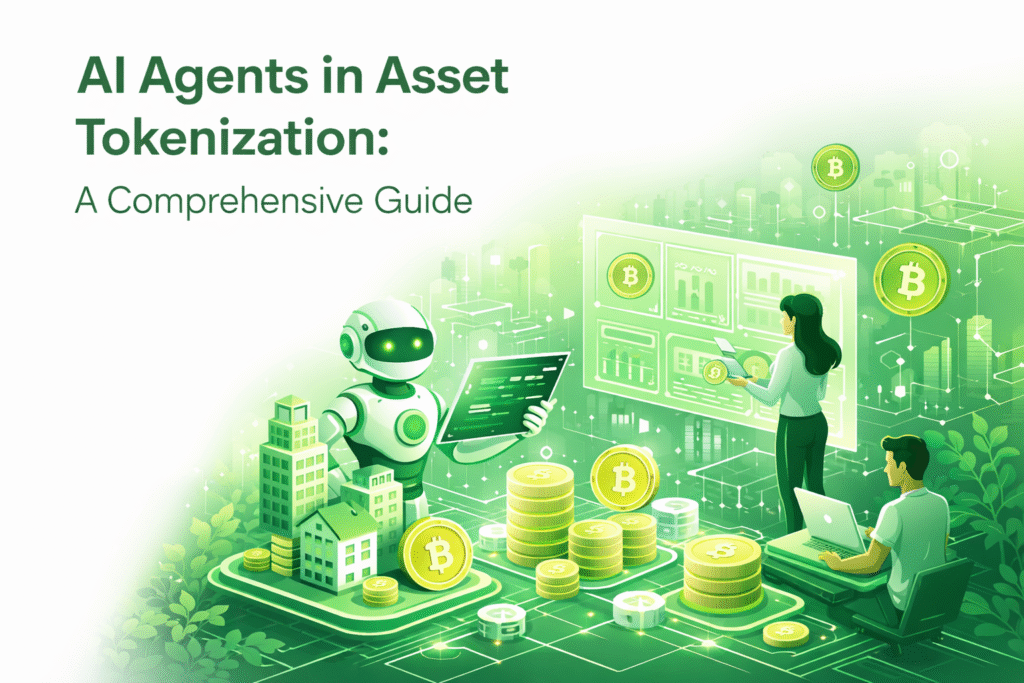
AI Agents in Asset Tokenization: A Comprehensive Guide

The Role of AI Agents in Asset Tokenization

 AI in FinTechAgentic AI vs Generative AIBest AI Tools 

Asset tokenization is rapidly transforming how assets are owned, traded, and managed in the digital economy. By converting physical and financial assets into secure, tradable digital tokens on a blockchain, businesses and investors can bypass slow paperwork, reduce reliance on intermediaries, and gain access to fractional ownership opportunities. The rise of digital ownership is reshaping investor expectations, making accessibility, liquidity, and efficiency more critical than ever.

As AI and blockchain continue to converge, intelligent systems are becoming essential for managing complex tokenized ecosystems at scale. According to Econ Market Research, the global asset tokenization market reached over $2,496 billion in 2026 and is projected to grow significantly through 2035, reflecting increasing demand for faster settlement, transparent systems, and broader investor access.

In this blog, you will learn what asset tokenization is, how it works, the role of AI agents in modern systems, key real-world use cases, and the challenges and opportunities shaping the future of tokenized markets.

Understanding Asset Tokenization and Its Impact

Understanding Asset Tokenization and Its Impact

Asset tokenization is revolutionizing the way ownership and investment work across industries. Representing physical and financial assets as secure digital units on a blockchain enables faster transactions, greater transparency, and broader market access. This shift is not just a technical upgrade; it’s redefining how real-world asset tokenization is approached and opening opportunities for fractional ownership, democratized investment, and streamlined compliance.

What Is Asset Tokenization 

Asset tokenization converts the rights to an asset, such as a building, a bond, or an artwork, into digital tokens that can be traded or managed on a blockchain. These tokens represent legal claims, cash flows, or voting rights. This approach eliminates cumbersome paperwork, reduces reliance on intermediaries, and ensures ownership can be verified instantly. As a result, tokenization creates efficiency while maintaining security, transparency, and traceability for both individuals and institutions.

Growth of Real World Asset Tokenization

The adoption of asset tokenization has accelerated in recent years, particularly in financial markets, real estate, and collectibles. Institutions are increasingly exploring tokenization to improve liquidity and broaden access for investors. Reports indicate that markets experimenting with tokenized assets are seeing faster settlement times, improved recordkeeping, and lower operational costs. The growth is also driven by regulatory clarity in certain jurisdictions, which makes tokenized assets a viable alternative to traditional ownership models for both retail and institutional investors.

Benefits of Digital Ownership

Digital ownership through asset tokenization provides transparency, security, and flexibility. Owners can track transactions in real time, verify authenticity, and participate in fractional ownership opportunities. This also allows for programmable features, such as automated dividend payments or voting rights, via smart contracts. Investors gain better access to previously illiquid markets, and businesses can optimize capital efficiency. Overall, digital ownership strengthens trust between participants and enables a more inclusive and efficient investment ecosystem.

Core Architecture of Tokenization Blockchain
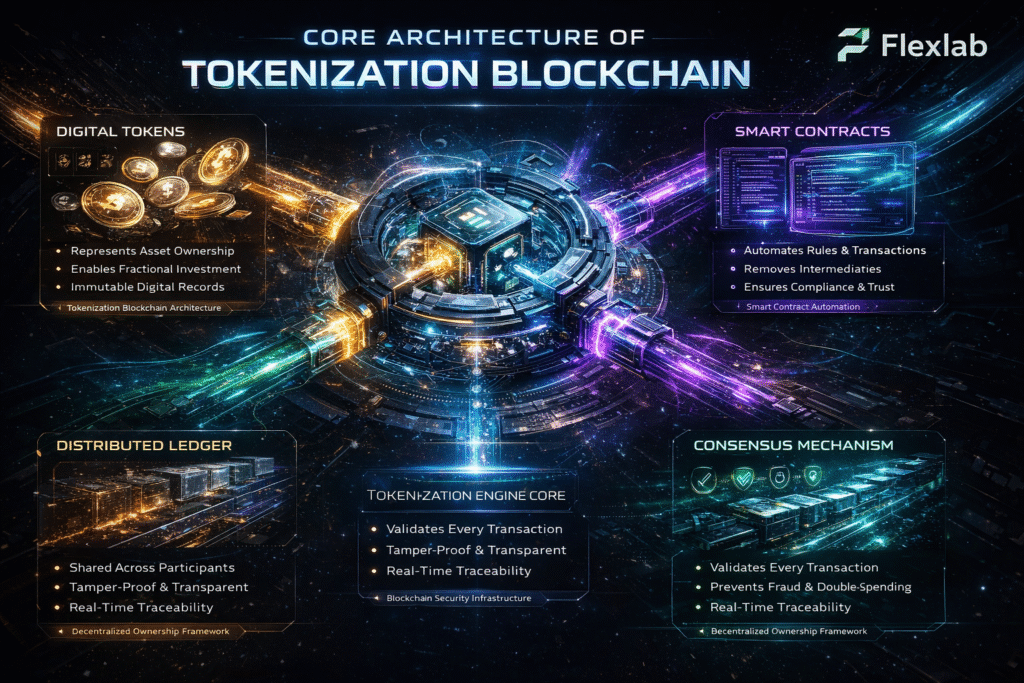
Blockchain architecture showing digital asset infrastructure

Understanding the core architecture of a tokenization blockchain is crucial to appreciating how asset tokenization works securely and efficiently. This architecture combines distributed ledgers, smart contracts, and consensus mechanisms to ensure ownership is transparent, tamper-proof, and verifiable. It also enables the management of digital tokens across multiple participants while supporting compliance and traceability. A clear grasp of this system is essential for investors, developers, and businesses exploring tokenized assets.

Digital Tokens and Their Role

Digital tokens represent ownership rights or claims over an asset on a blockchain. Each token is a unique record linked to an underlying asset, whether it’s real estate, a bond, or infrastructure assets. Tokens can carry programmable features such as voting rights, dividend distributions, or resale restrictions. By enabling fractional ownership, digital tokens make previously illiquid assets accessible to a wider audience, improve market efficiency, and provide a verifiable, immutable record for all transactions.

Smart Contracts as Rule Enforcers

Smart contracts are self-executing code stored on the blockchain that automates actions based on pre-defined rules. They handle tasks like payments, ownership transfers, and compliance triggers, reducing human error and operational delays. By using smart contracts, tokenized assets maintain security, transparency, and enforceable agreements without intermediaries. This is particularly important in regulated markets, as it ensures that all transactions follow consistent rules while reducing costs and improving trust among participants.

Consensus Mechanisms for Trust and Security

Consensus mechanisms, such as Proof of Stake or Proof of Authority, maintain a consistent and secure ledger across all blockchain participants. They verify transactions, prevent double-spending, and protect against tampering. For real-world asset tokenization, these mechanisms are critical because they ensure that ownership records are accurate and trustworthy, which strengthens investor confidence. Robust consensus protocols also make it possible for digital ownership systems to scale while maintaining security and integrity.

Role of AI Agents in Asset Tokenization
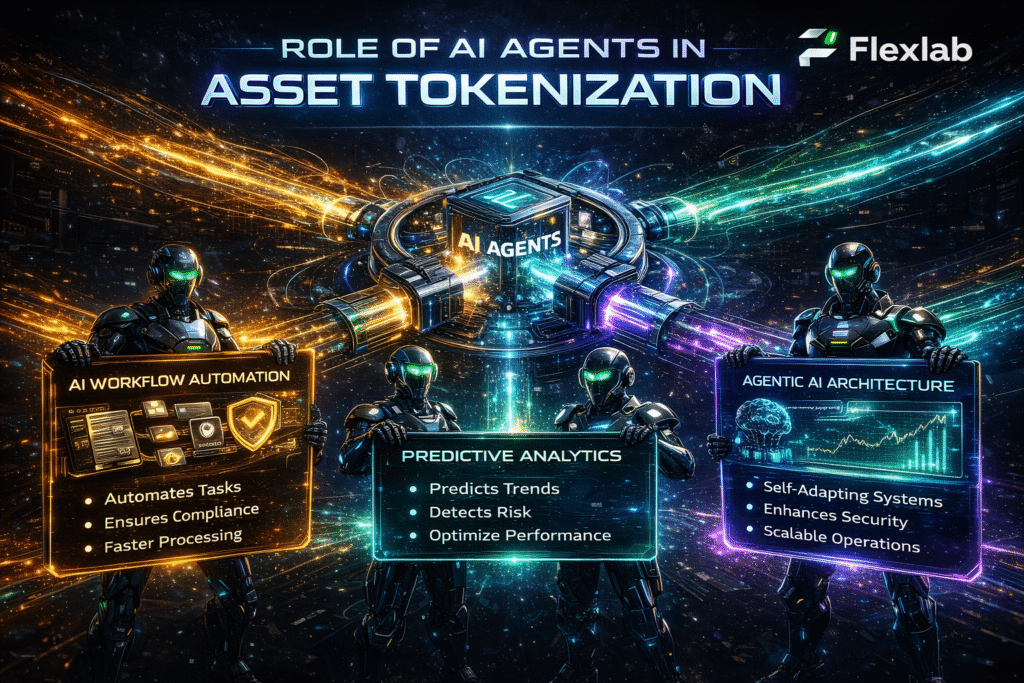
Role of AI Agents in Asset Tokenization

AI agents are becoming essential in modern tokenized ecosystems, bridging the gap between complex blockchain systems and practical asset management. By integrating AI and blockchain, these intelligent software agents automate repetitive workflows, monitor market activity, and support compliance. They help firms scale digital ownership operations efficiently while reducing human error. Understanding the role of AI agents is critical for businesses, investors, and developers exploring real-world asset tokenization opportunities.

AI Workflow Automation for Tokenized Assets

AI agents excel at AI workflow automation, handling repetitive tasks such as verifying investor documents, checking for regulatory compliance, and managing onboarding processes. By automating these workflows, organizations reduce processing time, minimize errors, and allow human teams to focus on higher-level decisions. In tokenized asset systems, this automation ensures transactions are accurate, compliant, and executed quickly. Firms leveraging AI-driven workflows can maintain trust, improve efficiency, and enhance the overall experience for investors in real-world tokenized markets.

Predictive Analytics for Smarter Decisions

AI agents use AI predictive analytics to analyze historical and real-time data, helping identify market trends, pricing shifts, and potential risks. In tokenized assets like securities, real estate, or infrastructure, predictive models provide actionable insights for investors and asset managers. By anticipating market changes, AI agents enable proactive decision-making, reduce exposure to fraud or volatility, and optimize portfolio performance. This integration of AI enhances digital asset management, making tokenized markets more reliable and data-driven.

Agentic AI Architecture for Adaptive Systems

Advanced tokenized platforms often deploy agentic AI architecture, where AI agents operate autonomously, coordinate actions, and adapt to evolving conditions. These architectures combine artificial intelligence technologies such as reasoning, anomaly detection, and memory to handle complex tasks. For asset tokenization, agentic AI ensures that operational processes, compliance checks, and ownership tracking remain efficient and accurate. By leveraging adaptive AI, businesses can scale tokenized systems while maintaining security, transparency, and trust.

Real-World Use Cases of Asset Tokenization
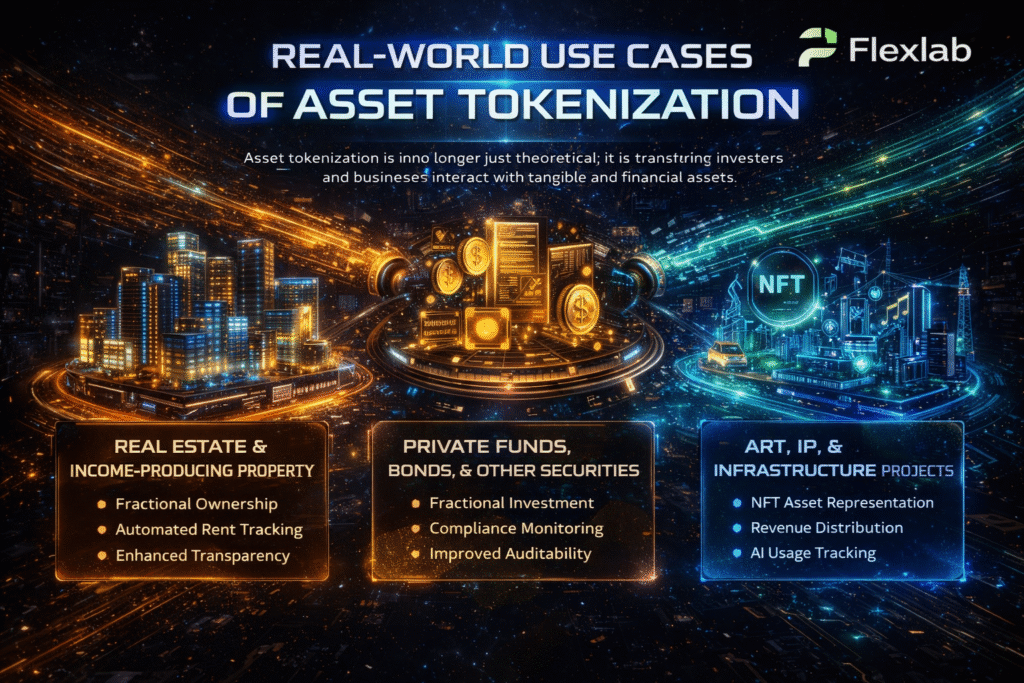
Real-world applications of blockchain in real estate and finance

Asset tokenization is no longer just theoretical; it is transforming how investors and businesses interact with tangible and financial assets. From real estate and private funds to art and infrastructure, tokenization creates tradable digital tokens that improve liquidity, transparency, and access. These real-world tokenization use cases demonstrate how AI agents support monitoring, compliance, and workflow automation, ensuring that operations are efficient, accurate, and trustworthy. Understanding these use cases helps investors and businesses evaluate practical benefits while maintaining regulatory standards.

  • Real Estate & Income-Producing Property

Real estate tokenization allows properties to be divided into tradable digital tokens, enabling fractional ownership and easier transfer of assets. AI agents assist by tracking rent payments, updating ownership records, and sending automated investor notifications. They can also flag irregularities in lease agreements or market data, improving operational accuracy. This combination of tokenization and AI reduces administrative workload while enhancing transparency for all participants. Investors can access smaller entry points into lucrative markets, making real estate investment more inclusive and efficient.

  • Private Funds, Bonds, and Other Securities

Tokenization of private funds and bonds allows fractional investment in previously inaccessible markets. AI agents monitor compliance with investor caps, track distribution deadlines, and ensure reporting obligations are met. By combining the tokenization of assets with predictive monitoring, financial institutions reduce operational risk and improve portfolio transparency. This system also enhances auditability, providing regulators and investors with verifiable records without slowing processes, which is essential in maintaining trust and meeting modern regulatory standards.

  • Art, Intellectual Property, and Infrastructure Projects

Non-fungible tokens (NFTs) are increasingly used to represent ownership of art, music royalties, and other intellectual property rights. In addition, these assets are commonly traded on the best NFT marketplaces, where transparency, liquidity, and authenticity are essential for both investors and creators. 

Infrastructure projects, such as energy or transport assets, are also tokenized to allow broader investor participation. AI agents support these markets by tracking usage rights, revenue splits, and maintenance signals. They help automate reporting, flag anomalies, and keep ownership records up to date. This integration of AI ensures that tokenized creative and infrastructure assets remain secure, transparent, and efficiently managed.

Benefits and Importance of Asset Tokenization
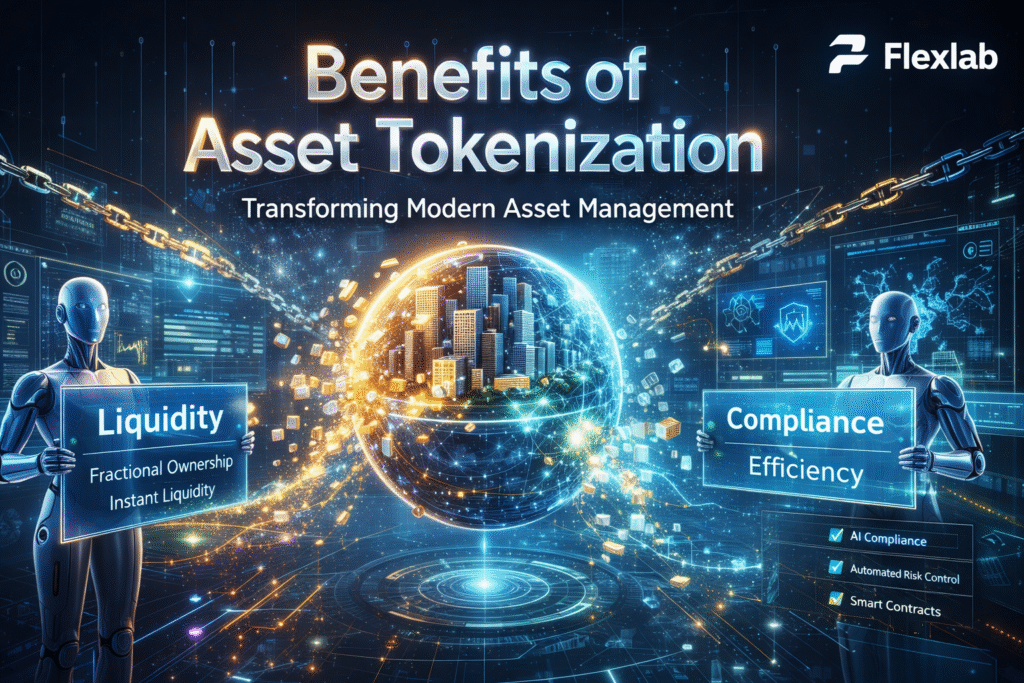
Infographic showing liquidity, compliance, and cost efficiency in digital assets

The growing adoption of asset tokenization highlights its ability to reshape modern financial systems. By combining blockchain infrastructure with advanced tools like digital asset management, businesses can streamline operations, reduce inefficiencies, and unlock new investment opportunities. This approach not only enhances transparency and accessibility but also supports better risk control and governance. As markets evolve, understanding the key benefits of tokenization becomes essential for investors and organizations aiming to stay competitive.

Increased Liquidity and Fractional Ownership

One of the most significant advantages of asset tokenization is improved liquidity. Traditionally, assets like real estate or infrastructure are difficult to sell quickly. Tokenization divides these assets into smaller, tradable units, allowing investors to buy and sell portions easily. This fractional ownership model lowers entry barriers and opens investment opportunities to a broader audience. It also enables faster transactions, making markets more dynamic and efficient compared to traditional systems that rely heavily on intermediaries.

Improved Compliance and Risk Management

Tokenized systems benefit from advanced tools such as compliance automation tools, which help monitor transactions and ensure regulatory requirements are met. These tools reduce manual oversight, minimize errors, and provide real-time alerts for potential risks. AI agents further enhance compliance by analyzing patterns and flagging unusual activities. This combination improves transparency and builds trust among investors, regulators, and institutions, making tokenized markets more secure and reliable in highly regulated environments.

Efficient Operations and Cost Reduction

Asset tokenization significantly reduces operational costs by eliminating intermediaries and automating processes. With the support of regulatory compliance software, businesses can streamline reporting, auditing, and recordkeeping. This automation minimizes delays and ensures accuracy across transactions. Additionally, smart contracts execute predefined rules automatically, reducing administrative overhead. As a result, organizations can operate more efficiently, scale faster, and allocate resources toward growth rather than manual processes, making tokenization a cost-effective solution for modern asset management.

Governance, Risks, and Future Outlook
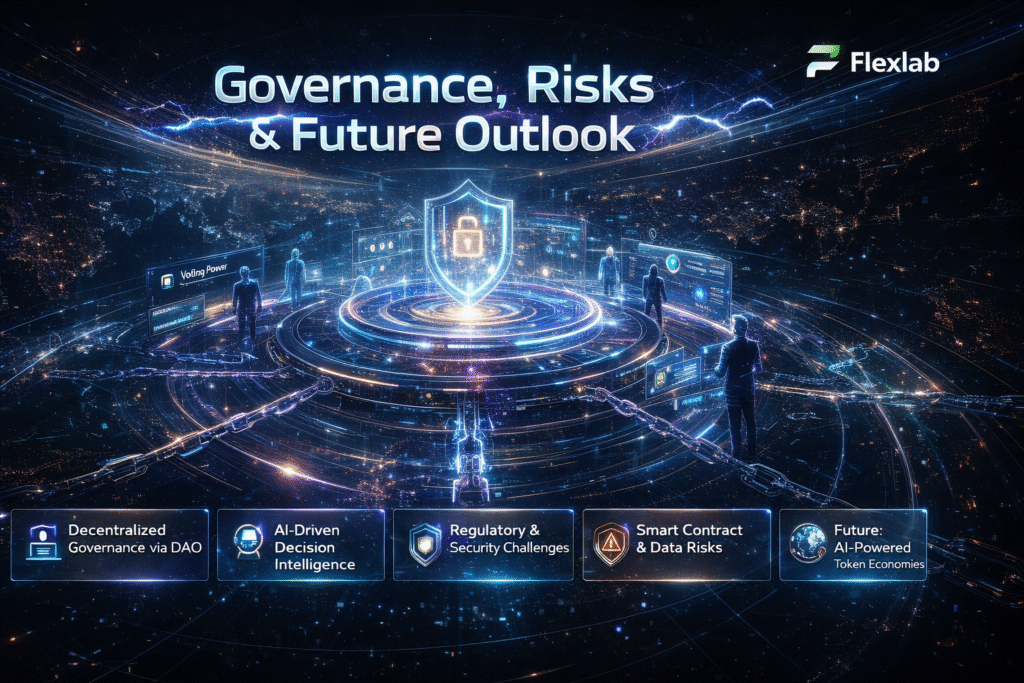
Governance, Risks, and Future Outlook

As asset tokenization continues to evolve, governance and risk management become critical for long-term success. In addition to technical infrastructure, systems must incorporate clear rules, accountability, and oversight. The concept of decentralized autonomous organization is emerging as a new governance model, enabling transparent and community-driven decision-making. However, alongside innovation, businesses must also address legal uncertainties, data risks, and operational challenges to build sustainable and trustworthy tokenized ecosystems.

Governance Through Decentralized Systems

Governance in tokenized ecosystems is increasingly supported by decentralized autonomous organization models, which allow stakeholders to participate in decision-making through voting mechanisms. Instead of relying solely on centralized authorities, these systems distribute control among participants, improving transparency and accountability. Moreover, AI agents can assist by analyzing proposals, tracking voting outcomes, and ensuring rules are followed. As a result, governance becomes more efficient, inclusive, and aligned with the community interests.

Key Risks and Regulatory Challenges

Despite its advantages, asset tokenization comes with several risks. For instance, regulatory uncertainty across different jurisdictions can create legal complications for investors and businesses. In particular, insights from Katten’s analysis of real-world asset tokenization emphasize how differences in legal frameworks, ownership rights, and enforcement mechanisms can impact tokenized systems. Therefore, businesses must adopt clear legal structures and compliance strategies.

Additionally, data quality issues, smart contract vulnerabilities, and security threats may impact system reliability. Therefore, organizations must implement strict auditing processes, access controls, and testing frameworks. By addressing these risks proactively, businesses can build trust, ensure compliance, and reduce the chances of operational failures in tokenized markets.

Future of AI Agents in Tokenized Markets

Looking ahead, the role of AI agents is expected to expand significantly, especially with the rise of AI agent development services tailored for blockchain ecosystems. These services enable businesses to deploy intelligent systems that automate workflows, enhance compliance, and improve decision-making. Furthermore, advancements in artificial intelligence technologies will allow AI agents to handle more complex tasks with greater accuracy. As adoption grows, AI-powered tokenized systems will become more scalable, efficient, and capable of supporting global digital economies.

Build Smarter Tokenization Systems with Flexlab

Flexlab's AI-powered platform for building automated financial systems

You’ve seen where the market is heading, and more importantly, how fast it’s evolving. The real question is: are you building for what’s next, or staying stuck in outdated systems?

At Flexlab, we design and deploy AI-powered tokenization ecosystems that don’t just function; they scale, adapt, and outperform. Whether you’re exploring real-world asset tokenization, refining your digital asset strategy, or integrating AI agents into blockchain workflows, this is where execution turns into real results. This isn’t a future trend; it’s already happening. The only question is: will you lead, or struggle to catch up?

Ready to Transform Asset Tokenization with AI Agents?

📞 Book a FREE Consultation Call: +1 (416) 477-9616
📧 Email Us: info@flexlab.io

If you want to see how this works in practice, explore our services or review real-world implementations in our portfolio. Or, if you’re ready to take action, contact us and start building a system designed for scale, speed, and long-term advantage. You can also stay connected and follow our latest innovations on LinkedIn

If you’re exploring broader AI applications, you can also dive into topics such as the benefits of AI in supply chains or discover Innovative AI Applications through our blog. And if you’re evaluating the best AI Automation Agency, you’ll find the insights through our blog resources. Then let’s make it happen.

Asset Tokenization with AI Agents Key Takeaways

Asset tokenization is changing how ownership, investment, and value exchange work in today’s digital economy. By turning physical and financial assets into digital tokens, businesses and investors can move faster, reduce friction, and unlock new opportunities that were difficult to access before.

As AI agents become more integrated into these systems, they bring greater efficiency, better decision-making, and improved scalability. At the same time, long-term success depends on getting the fundamentals right, including governance, compliance, and user trust.

Looking ahead, the combination of AI and tokenization will continue to shape how assets are managed and traded across global markets. Consequently, organizations that take a practical, well-structured approach today will be better positioned to stay competitive and create lasting value over time.

What types of assets can be tokenized?

A wide range of assets can be tokenized, including real estate, stocks, bonds, art, commodities, and even intellectual property. In addition, infrastructure assets and private funds are increasingly being converted into digital tokens. This flexibility allows businesses to unlock liquidity from traditionally illiquid assets. As a result, investors gain access to diversified opportunities that were previously limited to large institutions.

How do AI agents improve asset tokenization systems?

AI agents enhance asset tokenization by automating workflows, monitoring transactions, and improving decision-making through data analysis. For example, they can handle compliance checks, detect risks, and optimize asset performance in real time. In addition, AI predictive analytics helps identify trends and prevent fraud. This makes tokenized systems more efficient, secure, and scalable for businesses and investors.

Is asset tokenization safe and legally compliant?

Asset tokenization can be safe and compliant when supported by strong legal frameworks, secure smart contracts, and regulatory compliance tools. However, regulations vary by region, which can create challenges for businesses. Therefore, organizations must implement proper governance, audits, and security measures. When done correctly, tokenization offers a transparent and reliable way to manage digital ownership.


Leave a Reply

Your email address will not be published. Required fields are marked *

Which rollup service is best for blockchain projects? This is the fundamental question facing every founder, CTO, and lead architect in the 2026 decentralized ecosystem.

As blockchain adoption shifts from experimental DeFi protocols to large-scale enterprise and consumer integration, the reliance on high-throughput, low-latency execution has moved from a nice-to-have feature to an absolute operational requirement.

Choosing the right infrastructure is no longer just a technical checkbox; it is a business-critical decision that dictates your user acquisition costs, your finality speed, and your project’s long-term competitive moat.

This guide provides a comprehensive framework for navigating the 2026 rollup landscape to help scale effectively.

What Does Rollup Mean?

To optimize your scaling strategy, you must first clarify the fundamental mechanism.

What does rollup mean?

In the context of 2026 blockchain architecture, it refers to a Layer 2 scaling solution that offloads transaction execution from the main Layer 1 blockchain to a more efficient off-chain environment.


  • What is a rollup in blockchain?

A rollup takes thousands of individual transactions, executes them locally, and rolls them into a single, compressed data batch.

It then submits only a tiny state summary of this batch to the main L1.

The L1 acts as the ultimate court of truth, providing base-layer security, while the L2 handles the heavy lifting.

This process inherits the security and decentralization of the parent chain while achieving throughput speeds that were previously impossible on mainnets.

The architecture consists of three primary components.

  • First, the execution layer where transactions happen.
  • Second, the sequencer, which orders these transactions.
  • Third, the data availability layer, which ensures that anyone can reconstruct the state of the rollup at any time.

When you ask which rollup service is best for blockchain projects, you are essentially asking which provider manages these three components with the best balance of speed, cost, and security.


  • Why Rollups Define the 2026 Stack

The modular rollup stack solves the trilemma of security, decentralization, and scalability.

By separating the execution layer, where the computation happens, from the settlement layer, where the state is finalized, projects can now achieve the throughput of a centralized database with the trustless security of a decentralized network.

This shift is critical for gaming, social networks, and high-frequency trading platforms that simply cannot function on the congested base layer.

The Expanding Taxonomy of Rollups

What are the different types of blockchain rollups?


To understand what are the different types of blockchain rollups, we must look beyond the basic Optimistic vs. ZK dichotomy. The ecosystem has matured into a multi-layered landscape where architectural choice defines your operational bounds.


  • Optimistic Rollups

Optimistic rollups operate on the principle of guilty until proven innocent.

They assume all transactions are valid by default.

If a participant believes a transaction is fraudulent, they can submit a fraud proof within a challenge window, typically 7 days.

  • The developer experience is generally superior because these rollups are EVM equivalent.
  • The trade-off is the challenge window, which creates withdrawal latency for users, though third-party liquidity providers now mitigate this friction.


  • ZK Rollups

ZK rollups utilize validity proofs.

Every batch submitted to the L1 includes a cryptographic proof, such as a SNARK or STARK that guarantees the transactions were executed correctly.

  • These are the gold standard for financial applications because they provide instant finality.
  • The primary challenge historically was the high computational cost of generating proofs, but advances in prover hardware have made this significantly more efficient in 2026.


  • Sovereign Rollups

A sovereign rollup controls its own upgrade path and consensus rules.

Unlike standard rollups that rely on a parent L1 for settlement, a sovereign rollup publishes its data to a layer like Celestia or EigenDA and validates its state transitions.

This provides maximum autonomy for projects needing to customize their economic model, gas tokens, or block times without asking for permission from a central L1 governance body.


  • Validium and Volition

For enterprises that cannot store all transaction data on a public L1 due to cost or privacy concerns, Validiums and Volitions offer a hybrid path.

They keep data availability off-chain while still using validity proofs to secure the state.

This is highly effective for private enterprise supply chain tracking or internal corporate ledgers where you want the security of a proof but the privacy of a private database.

Comparison of Rollup Architectures 

Feature Optimistic Rollup ZK Rollup Sovereign Appchain
Finality Speed Slow (due to challenge period) Instant (validity proof) Variable (per design)
Compatibility High (EVM Equivalent) Moderate (ZK-EVM) Full Sovereignty
Best Use Case DeFi, General dApps Fintech, High-Freq Apps Gaming, AI, Enterprise
Cost Structure Lower computation cost Higher proof generation Flexible (token control)
Security Model Fraud-proof based Cryptographic proof-based Consensus based

Which Rollup Service Is Best for Blockchain Projects?

Founders often struggle with the question of which blockchain platform is the best.

The answer is rarely a single L1; it is about the liquidity and tooling stack that supports your growth.


  • Ethereum-Settled Ecosystems

Ethereum remains the primary hub for settlement because it hosts the highest Total Value Locked.

If your project relies on DeFi or global interoperability, Ethereum-based rollups are mandatory.

The network effects are significant, and the tooling for Solidity and Hardhat is the most mature in the industry.

Most RaaS providers prioritize Ethereum integration because that is where the capital resides.


  • High-Performance Alternative L1s

For projects that require sub-second latency and do not need the broad liquidity of Ethereum, alternative L1s or rollups built high-throughput L1s are gaining traction.

These platforms typically prioritize parallelized execution, allowing for thousands of transactions per second even before reaching the L1 settlement layer.

If you are building a consumer app with millions of users, these platforms often offer a cheaper path to market.


  • Modular Infrastructure Stacks

The most advanced projects in 2026 are using modular stacks.

They pick a specific layer for execution, a specific layer for data availability, and a specific layer for settlement.

This allows you the flexibility to swap components as your project scales, preventing vendor lock-in.

You might start with a managed sequencer and later move to a decentralized one without changing your entire application layer.

Navigating Your Blockchain Infrastructure Options

What does rollup mean?

Is it which rollup service is best for blockchain projects? This is the question that keeps founders up at night.

The answer depends on your project stage, technical talent, and compliance requirements.


  • Managed Rollups-as-a-Service

RaaS platforms like those provided by Alchemy, QuickNode, or specialized boutiques have commoditized the deployment of L2s.

They provide a one-click interface to launch a rollup, pre-configured with a sequencer, data availability layer, and block explorer.

  • This is the best path if you are a startup needing to deploy quickly without managing DevOps overhead.
  • The pros include rapid time-to-market, professional maintenance, and lower initial capital expenditure.
  • The cons involve vendor lock-in and less control over the underlying sequencer logic.


  • The Sovereign Appchain Path

If you require highly custom consensus rules, proprietary gas tokens, or private transaction mempools, you need to build a custom Appchain.

This is not just a service; it is a dedicated infrastructure instance.

At Flexlab, we help clients architect these chains, ensuring they retain the scaling benefits of a rollup while maintaining the sovereignty of a dedicated chain.

You own the infrastructure, you control the upgrade cycle, and you keep the revenue generated from transaction fees.

Real-World Implementation Scenarios

Rollups are no longer just for DeFi. We are seeing real-world adoption in high-stakes industries.


  • Supply Chain Transparency

Global logistics firms are using sovereign rollups to track physical goods from origin to end-user.

By using a rollup, companies can log thousands of location pings and status updates off-chain, only posting the critical handover events to the L1.

This slashes gas costs while maintaining an immutable, auditable trail that regulators can verify without trusting the company to tell the truth.


  • Decentralized Identity and Healthcare

Healthcare providers are using ZK-rollups to manage patient identities.

ZK proofs allow users to verify their age or insurance eligibility without revealing sensitive medical records.

It provides a privacy-by-design solution that meets modern regulatory standards.

For instance, GDPR and HIPAA. The proof is all that gets stored on the blockchain, keeping the actual sensitive data securely off-chain in private environments.


  • AI-Agent Orchestration

AI agents are now using dedicated rollups to manage thousands of micro-transactions for API calls.

By keeping the AI thought process and transaction history on a rollup, the agent can iterate and transact at high speeds without being gas-blocked by retail traffic on mainnets.

This allows for autonomous economic activity where agents can pay for data and resources in milliseconds.


  • Gaming Ecosystems

Gaming studios are utilizing rollups to handle in-game asset minting and trading.

The rollup can handle tens of thousands of transactions per second.

The game can mint thousands of items without clogging the main network.

Players enjoy a seamless experience that feels like a traditional web2 game, while the studio maintains the transparency of web3.

Challenges of Rollup Integration

Success requires acknowledging the friction points inherent in modular scaling.


  • The Interoperability Trap

If you launch your own rollup, you effectively silo your liquidity.

You will need robust bridging solutions to ensure your users can move assets in and out of your chain without friction.

Without a shared interoperability protocol, your users may face a walled garden experience where their assets are trapped in a single chain.


  • MEV and Sequencer Decentralization

The sequencer is the entity that sorts and bundles your transactions.

  • Centralized sequencers are fast and cheap, but they represent a single point of failure and a censorship risk.
  • Decentralized sequencers are the industry standard for projects managing significant financial assets. Prioritize providers that offer decentralized sequencing to ensure no single entity can manipulate the order of your transactions for profit.


  • Security Complexity

Using a RaaS provider does not mean you can ignore security.

You still have to manage the smart contract logic and the potential bugs in the rollup bridge contract.

Rigorous auditing is the only way to mitigate the risk of a bridge hack, which remains the single most common vulnerability in the rollup ecosystem today.


  • Data Availability Costs

While rollups reduce execution costs, they still need to pay for data availability.

If you are submitting every byte to Ethereum, the costs will scale with your usage.

Efficient rollups in 2026 are using off-chain DA layers to compress these costs to almost zero.

The Future of Rollup Service

The goal is for developers to deploy rollups as easily as they deploy a containerized microservice on AWS.

We are moving toward a modular stack where you can mix and match execution, data availability, and settlement layers based on the specific cost-performance profile of your application.

The best services will be those that provide this modularity without increasing the cognitive load on the developer.

We are also seeing the emergence of the AggLayer, a concept where all chains connected to a single settlement layer share a unified bridge and liquidity pool.

This solves the silo problem by making assets appear as if they are on a single chain, even if they are spread across a hundred rollups.

Conclusion: Strategic Scaling with Flexlab

Determining which rollup service is best for blockchain projects is a nuanced process that requires auditing your specific technical requirements, throughput needs, and security constraints.

There is no one-size-fits-all solution; there is only the right architecture for your specific business model.

Whether you require the rapid deployment of a RaaS platform or a fully custom, sovereign rollup instance, the decision you make today regarding your infrastructure will define your ability to scale in the coming years.

If you are struggling to map out your infrastructure stack, you do not have to do it alone.

At Flexlab, we specialize in deep-tech architecture consulting and rollup implementation. We help projects navigate the trade-offs between shared L2s and dedicated app-chains, ensuring that your infrastructure is secure, scalable, and built for the long term.

Let’s secure your project’s future.

Reach out to our expert team at Flexlab today to schedule your architectural audit.

Which Rollup Service Is Best for Blockchain Projects – FAQs

1. What is the difference between optimistic and ZK rollups?

Optimistic rollups assume all transactions are valid and rely on a challenge period to catch fraud, which is great for EVM compatibility. ZK rollups use complex math to prove transactions are valid instantly, offering better security and faster finality but requiring higher computational power to generate proofs.

2. Which rollup service is best for blockchain projects?

The best service is highly situational. For teams needing quick time-to-market, managed RaaS providers like Alchemy or specialized infrastructure partners are ideal. However, projects requiring absolute sovereignty, custom gas structures, or privacy-focused data handling should opt to build a custom sovereign app-chain rollup.

3. What is a rollup in blockchain?

A rollup is a scaling technique that moves transaction processing off the main blockchain to a secondary layer. In this layer, thousands of actions are executed, compressed into a single batch, and posted to the L1, drastically lowering costs and increasing speed for users while retaining the security of the underlying L1.


How does a hash help secure blockchain technology? It transforms raw, variable data into a fixed, tamper-proof digital fingerprint that serves as the foundation for decentralized trust.

Without hashing, blockchain ledgers would be vulnerable to simple edits, making them indistinguishable from standard, centralized databases.

By generating a unique output for every input, hashing ensures that even the smallest change in a transaction triggers a network-wide alert.

This cryptographic mechanism verifies the integrity of every block, confirms the state of the ledger across distributed nodes, and prevents unauthorized actors from altering historical data.

Businesses building on this infrastructure, whether for DeFi or enterprise supply chains, rely on these mathematical guarantees to maintain system security.

Understanding how this process functions is the first step toward leveraging decentralized technology for your operations.

Defining the Hash: Cryptography at the Core

Before examining complex blockchain architecture, one must define the underlying cryptographic mechanism.

A hash function is not encryption; it is a one-way mathematical transformation.


  • The Mechanism of a One-Way Function

A hash function takes an input, be it a single transaction or an entire block of data, and processes it through an algorithm to output a fixed-length string of characters.

You cannot reverse this process; given a hash, it is computationally impossible to reconstruct the original input.

This unidirectional nature is why hashing protects sensitive data while still allowing the network to verify its authenticity.


  • Creating Unique Digital Fingerprints

Every hash acts as a unique identifier.

Even if two transactions appear similar, changing a single character, timestamp, or public address in one will produce a drastically different hash. This is often called the avalanche effect.

By assigning a unique fingerprint to every block, the blockchain ensures that no two pieces of data are treated as identical, preventing replay attacks and ensuring each entry remains distinct.


  • Deterministic Data Verification

Hashing is deterministic.

The same input will consistently produce the same hash every time it is run through the algorithm.

This consistency is vital for nodes globally.

Thousands of disparate computers can run the same hashing function on the same block of data and arrive at the same hash.

If a single node reports a different hash, the network identifies that node as having corrupted or tampered data, automatically rejecting the invalid entry.

Technical Foundations: Cryptographic Algorithms

Blockchain security is only as strong as the algorithms protecting it. Developers choose these functions based on security requirements, speed, and hardware compatibility.


  • Selecting the Right Hash Algorithm

Different blockchains utilize specific algorithms to optimize for their unique needs.

Bitcoin relies on SHA-256, a function that prioritizes high collision resistance, making it ideal for proof-of-work mining.

Ethereum, conversely, utilizes Keccak-256, which offers flexibility and compatibility with the Ethereum Virtual Machine (EVM) architecture.

Modern blockchain development teams prioritize these algorithm selections to ensure long-term network resilience.


  • Comparison Table: Hashing Algorithms in Blockchain

Algorithm Primary Blockchain Key Security Strength Performance Profile
SHA-256 Bitcoin Extreme Collision Resistance High CPU demand
Keccak-256 Ethereum EVM Compatibility Moderate
BLAKE2 Enterprise Apps Speed and Efficiency Optimized for 64-bit
Argon2 Identity/Auth GPU/ASIC Resistance Memory-intensive


  • Balancing Security and Efficiency

Security is often a trade-off with speed. Memory-hard algorithms like Argon2 require substantial RAM to compute, which thwarts attackers using specialized hardware (ASICs) to brute-force the network.

However, these are slower to compute.

For enterprise applications where high transaction throughput is required, developers might lean toward faster alternatives like BLAKE2, provided the security parameters remain sufficient for the specific use case.

The Mechanics of Merkle Trees: Aggregating Data

How does a secure hash function work


To truly understand how hashing secures a blockchain, one must look at Merkle Trees (or binary hash trees).

In a blockchain, we do not just hash one transaction; we hash thousands.

A Merkle Tree aggregates these thousands of transactions into a single Merkle Root.


  • Efficient Data Verification

Instead of downloading the entire block, a node can verify if a specific transaction is included in a block by using only a small piece of the Merkle Tree, known as a Merkle Proof.

This makes the blockchain highly efficient. By hashing the transaction pairs repeatedly until only one hash remains, the network creates a single, immutable fingerprint for the entire block.


  • Preventing Data Tampering

If a malicious actor changes one transaction in the Merkle Tree, the parent hashes change, which in turn changes the Merkle Root.

Because the Merkle Root is stored in the block header, the change is immediately obvious.

This hierarchical structure allows for massive scaling without sacrificing security, ensuring that the integrity of every single micro-transaction is tied to the block’s header hash.

How Does a Block of Data Get Locked?

To understand how a block of data on a blockchain gets locked, one must view the blockchain as a series of connected, immutable records.


  • The Chaining Logic

Each block in a blockchain contains two critical pieces of data: its hash and the hash of the block that came before it.

This linkage is what creates the chain.

Because every block stores the fingerprint of its predecessor, the blocks are cryptographically bound together in a specific chronological order.


  • Ensuring Immutable History

If a bad actor wants to alter data in block 50, they must modify the transaction within that block. This modification changes the hash of block 50.

Because block 51 contains the original, un-modified hash of block 50, the link between the two blocks breaks.

The network nodes will immediately see the mismatch, recognize the tamper attempt, and reject the modified version of the chain in favor of the valid one.


  • Network Consensus

The network’s consensus rules enforce the locking mechanism. Validators (or miners) work to confirm the hash of the current block.

Once the consensus mechanism locks a block, it becomes exponentially harder to change as new blocks are added on top of it.

This makes the blockchain a write-only, tamper-evident ledger.

The Security Architecture of Public Networks

Since blockchain technology is public, how are the identities of users protected?

The answer lies in public-key cryptography and decentralized access.


  • Understanding Public Blockchain Access

Access to a public blockchain is permissionless, yet regulated by strict protocol rules.

Anyone can join, but only valid transactions signed by a private key are accepted.

This openness creates a paradox: the ledger is visible to everyone, yet users can participate independently. 


  • Protecting User Identities

Users do not store their real-world identities on the ledger. Instead, they use a public address, a hashed version of their public key, and a private key for signatures.

The hash obscures the public key, and the private key allows the user to prove ownership of the funds without ever revealing the secret key itself.

This protects privacy while ensuring that only the rightful owner can initiate a transaction.


  • Decentralization as a Defense

Because no single entity controls the network, there is no central database to hack.

Even if an attacker gains access to one node, they have not breached the system.

To compromise the network, they would need to control the majority of nodes or the majority of the network’s computing power, which is economically irrational and technically nearly impossible on established chains.

The Evolution of Consensus: How Hashing Drives Security

How does a secure hash function work

The security provided by hashing has evolved alongside the consensus mechanisms that govern decentralized networks.

Understanding this evolution is key to enterprise adoption.


  • Hashing in Proof of Work (PoW)

In classic PoW models, hashing is the engine of security.

Miners race to find a hash that meets a specific difficulty target. This computational work serves as a barrier to entry for attackers.

The network requires massive energy expenditure to create a valid hash; reversing the transaction history becomes economically impossible. The hash acts as the digital proof of energy invested.


  • Hashing in Proof of Stake (PoS)

In Proof of Stake networks, the role of hashing shifts. While blocks are still hashed to maintain immutability and chaining, the validation of these blocks is tied to the “stake” or capital held by the validator. The requirement for cryptographic hashing remains absolute. Validators must still produce valid, signed hashes to include transactions in the block; otherwise, the network would instantly reject the fraudulent attempt.


  • Scaling Through Sharding

As the industry scales, we are seeing the rise of sharding, where the blockchain is split into smaller, manageable pieces.

Each shard maintains its hash chain, which is then periodically “rolled up” and hashed into the main network.

This architecture allows thousands of transactions per second while maintaining high-security standards. 

Real-World Applications: From Royalties to Finance

The practical application of hashing goes beyond theoretical security.

It solves real-world problems in efficiency and transparency.


  • Ensuring Proper Royalty Payments

How could a blockchain help a record company ensure that royalty fees are paid properly?

By integrating smart contracts, the blockchain automates the payout process.

When a song is played, a smart contract executes, sending a fraction of the payment to the artist’s address instantly.

There is no middleman and no delay. The payment is transparent, immutable, and secured by the very hashing algorithms that verify the ledger.


  • Purpose of a Smart Contract

What is the purpose of a smart contract in a blockchain?

It is to replace human intermediaries with trustless code. A smart contract is a self-executing agreement where the terms are hashed onto the blockchain.

Once triggered by a specific event, it executes automatically.

Organizations seeking NFT marketplace development services must ensure their smart contracts undergo rigorous testing to maintain this level of trust.


  • Blockchain and Cryptocurrency

What best describes the relationship between blockchain technology and cryptocurrencies?

Think of blockchain as the foundational protocol, such as TCP/IP, and cryptocurrency as the application running on top of it. Bitcoin, the first blockchain, proved that value could be transferred securely.

Today, this technology powers everything from asset tokenization to various blockchain stocks that have emerged in the global financial market.

Challenges and Future Trends

Despite the robustness of hashing, the ecosystem faces hurdles that require constant innovation and oversight.


  • The Scalability Trilemma

The most persistent challenge is balancing security, decentralization, and scalability.

Complex hashing and validation take time and energy. As the network grows, transaction speeds can drop.

Developers are solving this through Layer 2 solutions and sharding, which allow for faster processing while maintaining the security benefits of the main chain.


  • Audit and Code Integrity

Even a perfectly secure hash function cannot save a poorly written smart contract.

Logic bugs can lead to vulnerabilities that bypass traditional security.

This makes the blockchain audit process a mandatory step for any project.

Audits ensure that the application logic correctly uses the underlying cryptographic proofs.


  • AI and Future-Proofing

The future of security is evolving rapidly.

The convergence of AI and blockchain explains how AI is already being used to monitor for anomalies, detect malicious hash patterns, and predict security threats before they manifest.

As quantum computing advances, the industry is also preparing by developing quantum-resistant hashing algorithms to ensure today’s data remains secure for tomorrow’s technology.

Conclusion: How Does a Hash Help Secure Blockchain Technology?

It serves as the immutable seal of integrity, transforming raw transaction data into a cryptographically verified, permanent record.

Through the chaining of blocks, hashing makes the history of a ledger unalterable, providing a level of security that traditional databases cannot match.

Whether you are building smart contracts for royalty distribution or securing a global supply chain, hashing is the mechanism that ensures the system remains transparent, private, and trustless.

As the industry matures in 2026, the intersection of AI, audited smart contracts, and efficient cryptographic standards will define the next generation of decentralized infrastructure.

If your organization is ready to build a secure future on blockchain, our consulting team at Flexlab is prepared to help you navigate these challenges. Let’s build the future, one block at a time.

FAQs: How Does a Hash Help Secure Blockchain Technology?

1. What is the primary role of hashing in blockchain technology?

The primary role is to create a unique digital fingerprint for data, ensuring immutability. If any transaction data is altered, the hash changes, alerting the entire network to tampering.

2. How does a secure hash function work?

A secure hash function takes any amount of input data and uses a mathematical algorithm to produce a fixed-length string, making it impossible to reverse-engineer the original input.

3. What is the purpose of a smart contract in a blockchain?

A smart contract is self-executing code that automates agreements without intermediaries. Its purpose is to enforce trust and transparency by executing transactions only when predefined conditions are met.

4. What best describes the relationship between blockchain technology and cryptocurrencies?

Blockchain is the underlying, secure infrastructure or ledger system, while cryptocurrencies are the digital assets or tokens that utilize this technology to record value and ownership.

Curious to explore how to get into AI automation, you have likely realized that the hype cycle is ending and the era of tangible utility has arrived.

Consequently, the market is shifting away from simple “chatting with an AI” and moving toward building robust, agentic systems that execute tasks autonomously.

Therefore, understanding the mechanics of these systems is the only way to remain competitive.

Furthermore, getting into AI automation requires a significant shift in mindset: you must transition from being a passive user of tools to becoming an architect of digital workflows.

Because this field rewards those who can connect disparate systems, many professionals are asking how to get into AI automation with a focus on delivering actual ROI rather than just novelty.

In this guide, we will break down the precise steps required to master this discipline.

Whether you are an entrepreneur building an agency or a developer advancing your career, learning AI automation is becoming an essential skill that connects modern software stacks.

The Modern Landscape of AI Orchestration

To understand how to get into AI automation, you must first acknowledge that AI is not a standalone solution; rather, it is a component of a larger machine.

Therefore, your goal is orchestration. You are essentially building a digital assembly line where AI acts as the worker that processes data, while the automation platform serves as the conveyor belt that moves it along.


Shifting from Chatbots to Agentic Orchestration

Most beginners make the mistake of focusing solely on the model, such as ChatGPT or Claude.

However, in reality, the value lies in the agent. An agent can take a prompt, execute an action in a CRM, check a database, and send an update.

By viewing AI as an agent, you start to see where the human bottlenecks are.

Consequently, you can design systems that handle these bottlenecks, which is the cornerstone of knowing how to get into AI automation.


The Role of the Automation Architect

As an architect, your job is to define the flow of data.

You must decide where a task starts, what AI model processes it, and where the output is stored.

Moreover, you need to account for failure. What happens if the API fails? What if the data format is wrong?

A professional architect builds for failure, not just for the ideal scenario. By focusing on stability, you ensure your automations actually provide value.


Bridging the Gap Between Business and Tech

The primary reason businesses hire consultants is that they cannot translate a business problem into a technical workflow.

Specifically, they know they have a manual task, but they don’t know how to bridge the gap.

By learning how top consultancies use AI and automation, you gain the ability to speak the client’s language, focusing on time and cost savings, while delivering the technical implementation they need.

The Technical Anatomy of a Resilient Workflow

Knowing how to get into AI automation requires more than just connecting two apps; it requires engineering for failure.

A perfect automation is a myth. A resilient automation, however, handles errors gracefully.


Designing Idempotent Systems

Idempotency means that performing the same operation multiple times results in the same outcome as performing it once.

In automation, this is non-negotiable. For instance, if your automation processes a payment or sends a contract, you must ensure that a network glitch doesn’t trigger that action twice.

Always design your workflows to check if a specific ID or transaction has already been processed before executing an action.


Implementing Schema Validation

Data formats change. An API you rely on might update its response structure, which can break your entire pipeline.

To prevent this, build schema validation steps into your workflows.

Before data is passed to your next module, have a validator check that the expected fields, such as email, amount, and customer_id, are present and in the correct format.

If they aren’t, the system should halt and alert you rather than attempting to pass bad data downstream.


Leveraging Middleware for Data Transformation

Avoid performing heavy data manipulation inside your automation tool.

Instead, use lightweight middleware, like a custom JavaScript function or a dedicated transformation step, to clean, format, and normalize your data.

This keeps your main automation flow clean, readable, and much easier to debug when something eventually goes wrong.


Real-World Use Cases and Tools

Theory is useful, but practice is essential. Let’s look at how these systems function in the wild.


Customer Support and Deflection

Many companies lose customers because they are too slow to respond.

By using tools like Voiceflow to design conversational agents, you can deflect routine tickets.

For example, if a customer asks about a refund policy, the AI can check the database and answer instantly.

Consequently, the support team is freed up to handle high-value, complex cases.


Financial Automation and Budgeting

In finance, precision is non-negotiable. Many businesses struggle with manual invoice processing.

By implementing systems that read invoices and update accounting software, you eliminate the risk of manual typos.

Additionally, automating budgeting allows companies to see their cash flow in real-time. Due to this, business owners make better decisions. 


Sales Enablement and CRM Sync

Marketing teams often struggle with lead tracking. By automating the sync between ad platforms and CRMs, you ensure that no lead is forgotten.

Moreover, you can even automate Instagram posts with AI to ensure a consistent brand presence.

When these systems are connected, you are essentially building a revenue machine for your client.

Identifying High-Value Automation Opportunities

how to get started in ai automation


You cannot automate everything, nor should you. Therefore, identifying the right opportunities is crucial.

Because businesses value outcomes, you must learn to spot the processes that are costing them the most money.


  • Auditing Repetitive Processes

Start by looking for tasks that happen daily and require zero creativity. For instance, data entry, email filtering, or scheduling.

Because these tasks are repetitive, human errors are more likely to occur.

Consequently, if you can prove that an automated system reduces error rates to zero, you have an immediate business case.


  • Pinpointing High-Volume Bottlenecks

Look for tasks that block other work. If a sales team cannot call leads because the leads aren’t being qualified in the CRM, that is a bottleneck.

Using an AI sales automation tool to qualify these leads instantly is a high-leverage move.

In this context, you aren’t just selling AI; you are selling increased sales velocity.


  • Measuring ROI for Clients

Before building anything, quantify the problem. Inquire of the client how many hours this takes per week.

If you save them 10 hours a week and their employee costs $50 an hour, you are saving them $2,000 a month.

Once you have this math, selling your services becomes significantly easier.

Indeed, this is the secret to scaling a Flexlab consultancy, selling results rather than time.

Avoiding Common Pitfalls in AI Automation

Many newcomers view automation as a magic wand.

In reality, it is a scalpel. If you use it incorrectly, you can cause more damage than the manual process you are trying to replace.

When you are learning how to get into AI automation, you must understand the risks as clearly as the benefits.


Don’t Automate a Broken Process

The golden rule of engineering is, don’t automate a bad process; you’ll just make it run faster.

If a business process is fundamentally flawed, disorganized, or based on incorrect assumptions, automating it will only scale the chaos.

Before building an automated workflow, spend time auditing the current process. If it isn’t efficient when done manually, simplify it, standardize it, and then automate it.


The Security and Compliance Blind Spot

When you move data across apps, you are effectively creating a bridge.

If that bridge isn’t secure, you are creating a massive liability for your clients.

Whether you are dealing with customer emails or financial records, you must ensure that your automations are compliant with data protection standards such as GDPR, HIPAA, or CCPA.

Never log sensitive PII (personally identifiable information) in unsecured text files or logs. 


Avoiding the Black Box Trap

A Black Box system is an automation that performs actions without explanation.

If your AI agent decides, such as denying a loan application or sending a harsh response to a customer, the business owner must be able to audit why that decision was made.

If you build systems that cannot explain their logic, you create a liability.

Always build human-in-the-loop checkpoints where the AI requires approval for sensitive actions, and ensure all logic is logged for easy review.

Selecting Your Tech Stack: A Comparative Breakdown

ai automation agency business model


When researching how to get into AI automation, you will receive countless tool recommendations. The key is to choose a stack that fits your specific business model.


The No-Code Heavyweights: Make vs. Zapier

Make (formerly Integromat) is best for complex, high-volume, and logic-heavy workflows.

Its visual builder allows for intricate branching, loops, and parallel processing, making it the preferred choice for those building enterprise-grade agentic workflows.

Conversely, Zapier is best for speed and simplicity.

If you need to connect two apps in five minutes, Zapier is unbeatable. Its ecosystem of integrations is massive, making it the top choice for rapid prototyping.


The Open-Source Powerhouse: n8n

For those who want more control and lower costs, n8n is the industry standard.

It can be self-hosted, meaning you own your data, and it allows for custom code execution within the workflow.

If you are learning how to get into AI automation to build custom software-as-a-service (SaaS) solutions for clients, n8n offers the flexibility that SaaS-based platforms lack.


Selecting the Right AI Provider

Avoid relying on a single model. The best automation architects build their systems to be model agnostic.

Use a framework that allows you to swap OpenAI for Anthropic or a localized Llama model with minimal changes to your workflow.

This protects you against pricing hikes and service outages.

Building a Scalable Agency: From Freelancer to Owner

Transitioning from a solo technician to an agency owner is the ultimate goal for many learning how to get into AI automation.

However, this requires a fundamental shift in how you operate.


Moving From Hourly Billing to Value-Based Pricing

Hourly billing is a trap. If you charge $100/hour, you are incentivized to take longer to build the solution.

Instead, sell outcomes. If your automation saves a client $5,000/month in labor costs, a $5,000 project fee is a massive win for the client.

By focusing on ROI, you create a sustainable business model that isn’t dependent on your time.


Creating Standard Operating Procedures (SOPs)

You cannot scale if the how-to lives only in your head. Document every workflow build.

Create template blueprints for common tasks, such as lead qualification, CRM syncing, or document processing.

When you bring on your first assistant or developer, these SOPs allow them to deliver work at your standard of quality without requiring your constant oversight.


The Hybrid Support Model

The most profitable agencies don’t just build; they maintain. Offer a scalable service package.

First, a one-time project fee for the build. Second, a monthly retainer for API monitoring, error log management, and minor system updates.

Finally, perform quarterly strategic reviews where you analyze their data to suggest new automations. This turns a one-off client into a lifetime partner.

How to Get Into AI Automation: Conclusion

How to get into AI automation is a journey of continuous adaptation.

As the technology evolves, the barrier to entry remains relatively low, but the requirement for strategic thinking remains high.

If you focus on solving real, boring, expensive problems, you will never lack for work.

Whether you are building an agency or internalizing these skills for your career, remember that the most valuable asset in the room is not the AI model itself; it is the strategy that directs it.

If you are ready to stop experimenting and start deploying reliable, enterprise-grade systems, visit Flexlab to explore our frameworks and consultancy resources designed for the modern AI-first business.

FAQs: How to Get Into AI Automation

1. How to make money with AI automation?

The most direct path is to build a productized service agency. Instead of general consulting, solve one specific, expensive concern for a niche audience (e.g., automated invoice processing for law firms). Charge a flat setup fee for the initial build and a monthly retainer for maintenance and API management.

2. How to start a career in AI automation?

Start by building a “Proof of Work” portfolio. Identify real-world business bottlenecks, use no-code or low-code tools to solve them, and document the process in case studies. Market yourself as an “Automation Architect” rather than a generalist to stand out to employers or clients.

3. Is AI a high-paid job?

Yes, specialized automation engineering is currently one of the highest-paying technical niches. Because these roles sit at the intersection of strategy, sales, and software, professionals who can prove they increase revenue or save significant labor costs are highly compensated compared to traditional development roles.

4. Is AI automation hard to learn?

It is not difficult if you have a logical mindset, but it requires patience for troubleshooting. The “hard” part is not the AI models themselves, but learning how to connect disparate systems, handle errors, and ensure that data flows reliably from one software tool to another.

How to sell AI automation is the most critical competency for consultants and agency owners in 2026.

As businesses move from the experimentation phase to full-scale operational deployment, the demand for experts who can bridge the gap between complex AI capabilities and bottom-line business value has never been higher.

Selling this technology is not about pitching artificial intelligence; it is about pitching operational leverage, the ability to eliminate the administrative tax that drains resources and stifles growth.

The market has shifted. Companies are no longer looking for AI tools; they are searching for outcome-oriented partners who can architect systems that drive measurable ROI.

This guide serves as your comprehensive playbook for identifying, positioning, and closing high-value automation contracts in the current landscape.

The Market Reality: Why Businesses Are Investing Now

The modern business environment is defined by operational fatigue.

As organizations attempt to scale, manual processes, data entry, invoice parsing, customer email triaging, and fragmented reporting, act as anchors.

The agitation in the market is palpable: executives realize that their competitors are deploying autonomous AI agents to reclaim thousands of hours of productivity while their teams remain trapped in status-quo workflows.

According to the 2026 McKinsey State of Organizations report, the focus has shifted from short-term resilience to sustained productivity powered by AI at the core of organizational transformation.

Businesses are seeking implementation partners who can guarantee reliability, security, and scalability.

The Three Drivers of Demand

  • Time Recapture

Executives are exhausted by the administrative tax.

They are willing to pay a premium for solutions that return 10+ hours per week to their high-value employees, allowing them to focus on revenue-generating strategy rather than maintenance.

  • Operational Precision

 Human error is a significant cost center.

By automating data-heavy tasks, companies mitigate the hidden expenses of shipping inaccuracies, compliance fines, and data entry errors.

AI provides consistency that humans cannot sustain over 40-hour workweeks.

  • Decoupled Scaling

Traditional revenue growth requires a linear increase in headcount.

AI allows firms to scale operations without a proportional increase in payroll, effectively decoupling revenue from labor costs.

This is the single most compelling financial argument you can make to a CEO or CFO.

The Automation Audit: How to Identify Immediate Opportunities

Selling begins with diagnosis. You cannot sell a solution if you have not fully diagnosed the ailment.

Before you pitch, you need a structured method to evaluate a client’s business.

Use a standardized automation audit framework to pinpoint exactly where a business is leaking capital and time.

The Audit Checklist for Success

  • The Frequency Metric

If an employee performs a task more than 10 times a week, it is a primary candidate for automation.

  • The Data-Density Test

Are the tasks document-heavy?

Do they involve moving data from email to spreadsheets to CRMs?

These are prime targets for AI parsing and intelligent document processing (IDP).

  • The Error-Cost Calculation

 Calculate the financial cost of a mistake.

If an incorrect shipping label or a missed invoice payment costs the company $500, that is your primary leverage for the sale. Always frame the automation cost against the cost of doing nothing.

  • Integration Mapping

Identify the walled gardens.

Businesses often have disjointed tools (e.g., Shopify, Slack, and an internal ERP).

The space between these tools is where your automation lives and breathes.

By conducting this audit, you shift from being a vendor to a strategic advisor, which is where the highest profit margins reside.

Your audit report should be the primary document used to sell the proposal.

Real-World Use Cases: Where AI Automation Drives Value

To sell effectively, you must speak in terms of outcomes. When you present to a prospect, they need to see themselves in the solution. Below are three specific, high-impact use cases where AI automation is currently transforming business operations in 2026.

  • Automated Accounts Receivable (AR) & Collections:

Many mid-sized firms struggle with chasing cash.

Instead of having an accountant manually check bank statements and send reminders, an AI agent can monitor incoming payments against open invoices in the ERP.

If a payment is overdue, the agent triggers a personalized email sequence that includes the invoice copy, saving the AR team 15–20 hours per week while accelerating cash flow and reducing Days Sales Outstanding (DSO) by up to 15%.

This creates an immediate, measurable financial win for the business.

  • Intelligent Customer Support Triage:

Support teams are often overwhelmed by Tier 0 requests (e.g., Where is my order? or How do I reset my password?).

An AI agent integrated into the CRM can analyze incoming support tickets, classify them by urgency and topic, and draft responses for human review or auto-resolve common queries.

This reduces response times from hours to seconds and ensures human agents only handle high-value, complex emotional issues.

This improves CSAT (Customer Satisfaction) scores while lowering cost-per-ticket.

  • Predictive Supply Chain Monitoring:

In logistics, reactive management is costly.

By integrating AI agents with real-time inventory and weather data, businesses can predict stockouts before they happen.

An agent can automatically trigger reorder requests when inventory dips below a dynamic safety stock level, calculated based on seasonal trends, effectively preventing the lost revenue associated with stockouts and minimizing storage costs.

This demonstrates how AI transforms a cost center into a competitive advantage.

Designing Solutions That Sell

The greatest mistake in the industry is building general AI solutions.

When you try to sell a tool that does everything, you end up selling to no one. You must design solutions that solve specific, documented pain points.

When presenting your solution, avoid technical jargon. Instead, use an ROI measurement approach that speaks the language of the C-suite.

Show them the Before (time and money lost) and the After (time and money recovered).

The Components of a Winning Solution:

  • Process Deconstruction

Don’t automate a bad process. Simplify it first, then automate it.

The best automation tool cannot fix a broken business model.

  • Model Tiering

Decide whether the task requires a Large Language Model (LLM) for reasoning or a rules-based system for rigid compliance.

Over-engineering a solution is a common pitfall.

  • The Human-in-the-Loop Interface

Always include a dashboard where the client can monitor and override the AI.

This builds trust, lowers the perceived risk of runaway AI, and gives the client a sense of control.

The Tooling Landscape: A Comparison

Clients are often paralyzed by the volume of tools available. Your role as a consultant is to act as a curator, not a vendor.

AI Automation Tool Best Use Case Integration Typical ROI Impact
UiPath Enterprise-grade RPA ERP, Legacy Databases Reduces manual work by 50%
Automation Anywhere Complex Finance/HR SAP, Salesforce Decreases error rates by 70%
Zapier SMB Workflows 3,000+ SaaS apps Saves 10–15 hours/month
Microsoft Power Automate Internal Office Ops Office 365, Teams Automates 60% of approvals
Make.com Marketing/eCommerce Shopify, Slack, Google Increases throughput by 40%
Python Custom Scripts Bespoke AI Models Any Internal System High customization/High ROI

As highlighted in Forrester’s Total Economic Impact framework, the key is to select tools that are stack-agnostic and capable of scaling as the organization evolves.

Never force a client onto a tool because it is popular; force it because it is the most stable solution for their specific environment.

The Evolution: From Simple Automation to Autonomous Agents

How to build & sell AI automations


As we move deeper into 2026, the industry is shifting away from simple if-this-then-that automations toward Autonomous AI Agents.

This is a critical distinction for your sales pitch.

Simple Automation (RPA/Rules-Based): This acts like a digital clerk. It follows rigid, pre-defined rules.

If a document enters the queue, it moves it to Folder B. It is fast and efficient but brittle. If a new document type appears, the automation breaks.

  • Autonomous Agents (Reasoning-Based)

These agents act like a junior analyst.

They don’t just follow rules; they have a goal.

If they encounter an ambiguous document, they can use reasoning to categorize it, ask a human for clarification via Slack, or search the company database to find context.

They can handle nuance, learn from past iterations, and adapt to changing environments.

Why You Should Upsell Agents Over Basic Automations:

  • Lower Maintenance

Because they adapt to minor changes, they break less often.

  • Higher Value

They solve complex problems that simple automations cannot touch, such as responding to personalized customer emails or negotiating vendor contracts.

  • Future-Proofing: Businesses are realizing that simple automation is just the start.

Offering agentic workflows positions you as a high-level consultant rather than a commodity developer.

By moving your clients from automation to autonomy, you increase your value proposition, create stickier relationships, and ensure your clients view you as their strategic AI partner for the long haul.

Common Implementation Pitfalls and How to Avoid Them

Even with a perfect plan, AI implementation can fail if you do not manage client expectations.

Here is how to handle the most common issues in 2026.


  • The Hallucination Fear

Clients are worried that AI will make things up. You must implement guardrails.

For every output an AI agent generates, have a verification step where the agent compares its answer against a ground-truth database.

If the confidence score is below 90%, it should route the task to a human supervisor.


  • The Black Box Problem

If the client doesn’t understand how the AI arrived at a decision, they will not trust it. Build “explainability” into your dashboards.

The AI should generate a brief log explaining why it made a specific decision (e.g., Categorized as ‘Urgent’ because the subject line included the word ‘Overdue).


  • Data Silos

Many businesses have data stored in formats that AI cannot easily read.

Do not promise an automation until you have verified the data accessibility.

If the data is trapped in an old PDF or a legacy server, budget time for Data Preparation as a separate, billable phase of the project.

Pricing and Packaging: Moving Beyond Hourly Rates

How to make money with automation

Hourly billing is a trap. If you become more efficient and automated yourself, you earn less money.

Instead, move toward value-based or outcome-based pricing to align your incentives with the client’s success.


  • The Subscription Model

Best for ongoing support, maintenance, and updates (e.g., AI Operations-as-a-Service).

This builds predictable monthly recurring revenue (MRR).


  • The Value-Based Model

If you save a logistics company $10,000 a month in wasted overhead, charging a $2,000 monthly fee is an easy yes.

You are selling profit, not just a service.


  • The Template Model

 If you have developed a robust, scalable automation strategy, package it as a proprietary template that you deploy for a flat project fee, followed by a lighter maintenance retainer.

Never be afraid to charge for the outcome.

If an automation saves 500 hours a year, do not price it based on the 10 hours it took you to build it.

Price it based on the 500 hours you returned to the client.

Drafting the Perfect Proposal

A proposal is not a price list; it is a vision of the future. Your proposal must contain four essential sections to convert


1. The Executive Summary

 A one-paragraph summary of the As-Is state, the To-Be state, and the estimated financial impact. This is all the CEO will read.


 2. The Risk Mitigation Strategy

 Address their fears directly. Detail the data security, the human-in-the-loop oversight, and the rollback plan if things go wrong.


 3. The Phased Roadmap

 Do not promise a big bang implementation. Break it into phases:

  • Phase 1 (Pilot/Proof of Concept)
  • Phase 2 (Core Workflow Integration)
  • Phase 3 (Scaling and Optimization).

This lowers the perceived risk.


4. The Investment vs. Value Matrix

Clearly show the cost of the project versus the 12-month return.

If the ROI is not at least 3x, re-evaluate the project.

Scaling Your Business and Client Retention

Once you have landed your first few clients, the goal shifts to operational efficiency for your own business.

You should be using the same tools you sell to your clients.

If you are struggling to keep up with demand, it is time to standardize.

Build a library of reusable assets.

Leverage insights on the future of AI in the workplace to predict which services will be in demand next quarter and pivot your marketing accordingly.


Marketing and Outreach Strategy


  • Content Authority

Don’t just post AI is great.

Post: Here is how a logistics firm saved 40 hours a week using a specific tool.

Use specific metrics, not vague promises.


  • Strategic Partnerships

Build relationships with local IT consultants.

They have the clients; you have the specialized AI expertise.


  • Interactive Demonstrations

Use interactive dashboards. A 30-minute demo that visualizes the time saved is worth more than a 10-page proposal.

Always use real-world industry case studies to demonstrate your track record.

The most successful firms in 2026 are those that focus on retention.

Treat your clients like partners. Schedule quarterly optimization reviews, where you show them the performance data of their automations and suggest further enhancements.

This is your chance to upsell them on new agentic workflows as they become available.

How to Sell AI Automation: Conclusion

The barrier to entry for selling AI automation is low, but the barrier to success is the ability to provide genuine, measurable value.

By moving away from AI hype and toward AI utility, you position yourself as an indispensable partner in your client’s growth.

Start small, focus on the ROI, and always keep the end user’s pain points at the center of your solution.

The tools exist, UiPath, Make.com, and Python scripts, but the strategy is what you are truly selling.

Ready to scale your consulting practice or business?

At Flexlab, we provide the foundation you need. From ready-to-use templates to high-level consulting methodology guidance, we help you unlock the revenue streams that AI automation makes possible.

FAQs: How to Sell AI Automation

Where can I sell AI automation?

Focus on B2B service sectors where manual document handling and data entry are common. Ideal industries include logistics, legal services, medical billing, accounting, and e-commerce operations. Cold outreach to SMEs and partnerships with existing IT consultancies are the most effective channels.

How do I prove ROI to a non-technical client?

Use Before vs. After metrics. Calculate the cost of the manual process (e.g., $30/hr salary x 10 hours/week) and show the cost of the automated solution vs. the savings. Visual dashboards that track hours saved or errors prevented are incredibly persuasive.

What if I don’t know how to code?

You do not necessarily need to be a developer. “Low-code” and “No-code” tools like Zapier, Make.com, and Microsoft Power Automate allow you to build sophisticated workflows by connecting existing APIs. Your value lies in process logic and system design.

How do I handle data security and client privacy concerns?

Always emphasize enterprise-grade security. Use tools that are SOC 2 compliant, and explain that you can use private, sandboxed instances of AI models where data is not used for training. Always have a clear data privacy agreement in your contracts.

How top consultancies use AI and automation is no longer a theoretical question.

Leading firms deploy intelligent software to crunch data at speed, automate tedious processes, and surface insights that guide strategy.

These technologies are embraced because they make projects faster, more accurate and more scalable, yet they complement rather than replace human expertise.

This article explains how AI transforms consulting, highlights real‑world examples and tools, lays out a simple process for spotting automation opportunities, and points to what’s next for the industry.

What Does AI and Automation Mean for Consulting Firms Today?

Consultancies worldwide are embracing AI because it makes them more efficient, more accurate and more scalable.

Instead of replacing humans, intelligent software allows teams to handle larger datasets, uncover hidden trends and reduce manual effort.

A 2025 McKinsey survey shows that 88 percent of organizations use AI in at least one business function,  up from 50 percent in 2022.

The same study found that executives who deploy AI tools in sales can see up to a 25 percent increase in conversion rates and 30 percent lower customer acquisition costs. Such numbers illustrate why consultancies can’t ignore automation.


What new expectations drive adoption? 

Clients expect answers quickly. Traditional consulting projects often took months; todays decision makers want insights in days.

AI speeds up research by scanning thousands of documents and data points, summarizing findings and flagging anomalies.

It also offers scale; even a small team can deliver complex analyses once reserved for large teams. Moreover, 80 percent of executives believe automation can apply to any business decision, which means clients increasingly look for consultancies that can harness AI’s potential.


How does AI improve efficiency and accuracy? 

AI automates repetitive tasks such as data extraction, document review, and pattern recognition.

This reduces errors and frees consultants to focus on creative problem-solving.

For example, Enterprise AI platforms can cut operational expenses by up to 40 percent and reduce downtime by 50 percent through predictive maintenance.

In supply chain consulting, AI forecasting improves demand accuracy by 30–50 percent, while Walmart maintains 98 percent on-shelf availability, and UPS saves $400 million annually on fuel through intelligent routing.


What misconceptions still hold firms back? 

Some consultants fear that AI will replace them, yet research shows it actually augments human expertise.

Only 32 percent of executives in McKinsey’s survey expect workforce decreases due to AI.

Another common myth is that faster work reduces revenue; however, automation allows firms to handle more projects and deliver value‑based outcomes, thereby increasing profitability. Finally, many organizations worry about AI’s maturity.

While adoption surged to 88 percent in 2025, only 18 percent of professional services firms measure ROI, showing that clear metrics and governance are still evolving.

How Are Leading Consultancies Using AI and Automation? 

Top consultancies integrate AI into research, strategy, operations and client engagement.

They develop proprietary platforms, partner with technology vendors and embed automation throughout their workflows. Adoption has accelerated recently as more professionals incorporate AI into their daily tasks.


Which consultancies lead the AI charge? 

Firms like Accenture, Deloitte, PwC and McKinsey have built dedicated AI practices. Accenture’s SynOps platform streamlines finance, supply chain and procurement by combining machine learning, robotic process automation (RPA) and data analytics.

Deloitte’s CortexAI helps clients analyze complex datasets, forecast scenarios and simulate outcomes. IBM Consulting leverages Watson and hybrid cloud platforms to automate processes and build custom AI solutions.

BCG’s Gamma team uses advanced analytics and AI to develop predictive models for marketing and operations. These examples show how consultancies create competitive advantage by developing their own AI ecosystems.


How do they embed AI into client work? 

Consultancies apply AI across the project lifecycle:

  • Market research and sentiment analysis: Natural language processing mines customer reviews and social media to reveal emerging trends, enabling targeted product and marketing strategies.
  • Strategy development: Machine learning models evaluate financial, market and operational data, simulate “what-if” scenarios, and identify key performance indicators.
  • Operational optimization: AI systems monitor sensors, predict equipment failures and optimize production schedules. Manufacturers using these tools reduce downtime by up to 50 percent.
  • Customer experience: Chatbots and virtual assistants handle inquiries 24/7. Klarna’s AI agents resolve two‑thirds of customer chats, while L’Oréal’s beauty advisors deliver personalized recommendations at scale.
  • Risk management and fraud detection: Banks employ AI to spot unusual transaction patterns, cutting response times by 60 percent.

What internal knowledge platforms amplify their impact? 

Leading consultancies build internal knowledge bases so teams can find past proposals, deliverables and industry benchmarks within seconds.

Tools like McKinsey’s “Periscope” or Bain’s “Vector” centralize proprietary data, best practices and frameworks. AI search engines index these resources and recommend relevant insights during client conversations.

Such platforms ensure that consultants start projects with the latest information, avoid reinventing the wheel and maintain consistency across offices.

What AI and Automation Tools Do Top Consultancies Use? 

consulting firms using ai

Although every firm customizes its stack, several categories of tools recur across the industry. Consultants should understand these categories to identify opportunities and avoid being overwhelmed by hype.


How do data analytics and visualization platforms help? 

Tools like Tableau, Power BI and Qlik allow consultants to visualize complex data in interactive dashboards.

They connect to multiple data sources and provide real‑time insights. When combined with cloud warehouses like Snowflake or BigQuery, they enable on‑demand, scalable analysis.

Leading firms also use specialized AI libraries (e.g., TensorFlow, PyTorch) to build predictive models. These platforms turn raw data into narratives that clients can understand.


Why are AI assistants becoming mainstream? 

Large language models (LLMs) power AI assistants that summarize reports, draft emails and answer questions during workshops.

Many consultancies build custom assistants tailored to their knowledge bases.

For instance, an AI copilot can generate a first draft of a strategic plan or compare client metrics against industry benchmarks.

However, consultants remain accountable for verifying outputs, interpreting nuances and providing human judgment.


What role does robotic process automation play? 

RPA tools such as UiPath, Automation Anywhere and Blue Prism automate repetitive tasks like data entry, invoice processing and report generation. 

By mimicking human actions across software applications, they reduce errors and free up time for higher‑value work.

When combined with AI (sometimes called intelligent automation), RPA bots can handle decisions based on structured data and call AI services for unstructured inputs like invoices or emails.

Will AI replace Consultants? 

Many worry that smart software might make consultants obsolete, but evidence suggests otherwise.

AI handles data‑intensive tasks, yet human expertise remains crucial for interpretation, creativity and relationship management.


Why does human judgment still matter? 

AI can recognize patterns and simulate scenarios, but it lacks context and empathy.

Consultants understand organizational politics, navigate stakeholder dynamics and craft compelling narratives.

Even Gartner predicts that by 2026, 40 percent of enterprise applications will include autonomous agentic AI, but these agents work alongside humans rather than replacing them. Only 32 percent of leaders anticipate workforce reductions due to AI.


Which tasks are best suited for AI versus people? 

AI excels at collecting data, summarizing documents, and running simulations.

Humans excel at defining goals, asking the right questions, negotiating agreements, and making ethical decisions.

Hybrid tasks, like strategy workshops, benefit from AI copilots that surface relevant data, while consultants interpret insights and steer discussions.


How can consultants upskill for the AI era? 

Professionals should learn data literacy, machine learning fundamentals and prompt‑engineering techniques.

At the same time, they must strengthen soft skills: storytelling, emotional intelligence and critical thinking. Continuous learning is essential: attending workshops, experimenting with new tools, and partnering with data scientists.

Firms that invest in training will be better positioned to lead clients through AI‑driven change.

How Do Firms Identify Automation Needs? 

how to get clients for ai automation agency

Implementing AI without a clear roadmap often leads to frustration. Consultants should follow a structured process to identify high‑value automation opportunities.


What steps help map opportunities? 

  1. Map current workflows: Document processes across research, analysis and client delivery, noting inputs, outputs and pain points.
  2. Prioritize repetitive, high‑volume tasks: Candidate processes include data collection, report drafting and meeting scheduling. In sales, AI helps qualify leads and update CRM records automatically.
  3. Assess data readiness: Determine whether data is structured, accessible and clean. Use AI to process unstructured data (e.g., PDFs or emails) when necessary.
  4. Evaluate ROI: Estimate potential savings, revenue uplift or risk reduction. AI strategy consulting can deliver 25–40 percent cost savings and twice‑as‑fast decisions.
  5. Pilot and measure: Start with small proofs of concept, track metrics and refine models. Only then scale successful initiatives.

Which tools assist with prioritization? 

Process‑mining tools like Celonis and Signavio visualize workflows and identify bottlenecks.

Task analytics platforms quantify time spent on each activity. AI maturity assessments help benchmark readiness.

For example, Flexlab offers a 30‑Day AI Blueprint that turns messy enterprise resource planning data into Amazon‑level efficiency.


How do firms manage change and governance? 

Successful automation requires clear governance.

Firms should establish data quality standards, ethical guidelines and compliance checks. Cross‑functional teams combining consultants, data scientists and change managers ensure balanced perspectives. Transparent communication helps stakeholders understand benefits, address concerns and adopt new tools.

Finally, measuring ROI and client satisfaction helps refine strategy over time.

Impact of AI on Management Consulting and Future Outlook  

AI is reshaping consulting business models and client expectations.

The economic stakes are enormous: AI is projected to contribute $15.7 trillion to global GDP by 2030. Yet the shift from experiments to enterprise‑wide use comes with growing pains.


How is AI transforming consulting work? 

AI reduces manual research, enabling consultants to focus on strategy and innovation.

Automated knowledge bases improve accuracy and consistency, while predictive models enhance scenario planning and real‑time analytics support dynamic decision‑making.

However, only 18 percent of professional‑services firms track AI ROI, highlighting a gap between usage and measurement.


What does the future business model look like? 

Firms are moving from hourly billing toward outcome‑based contracts and subscription models. Proprietary AI platforms and continuous analytics create ongoing value streams.

Consulting may become more productized, with packaged dashboards and AI‑driven recommendations sold as recurring services.

As AI tools become more sophisticated, consultancies will differentiate themselves based on domain expertise, data quality, and ethical practices rather than simply access to technology.


What should consultancies do now? 

Invest in AI capabilities, develop cross‑disciplinary teams and build ethical governance frameworks.

Upskill consultants in both hard and soft skills. Start with small, measurable automation projects and scale successes.

Partner with AI specialists and tech vendors when necessary. Remember that AI is a tool—human insight, empathy and creativity remain irreplaceable.

How Top Consultancies Use AI and Automation: Conclusion 

AI and automation are not optional extras for consulting firms; they are the engines driving faster insights, smarter decisions and better client outcomes.

From market research and strategy development to operational optimization and customer engagement, top consultancies are embracing AI to stay competitive.

Statistics indicate that adoption is accelerating, yet the need for clear ROI and thoughtful governance persists. By combining the right tools with human expertise, consultancies can unlock transformative value.

If you’re ready to explore what AI and automation can do for your organization, consider partnering with Flexlab.

As a specialist in AI‑powered consulting and automation solutions, Flexlab helps clients identify high‑impact opportunities, implement cutting‑edge tools and upskill teams for the future. 

Ready to take the next step? Reach out to Flexlab today and start your AI transformation journey.

FAQs: How Top Consultancies Use AI and Automation

1. How are top consultancies using AI and automation in project delivery?

Consultants employ AI assistants to surface relevant frameworks, answer questions in real time and generate first drafts of reports, significantly accelerating project timelines. Machine learning models analyze client data to reveal opportunities and risks, while RPA bots handle repetitive tasks.

2. Which consulting firms lead in AI adoption?

Firms such as Accenture, Deloitte, PwC, KPMG, Bain & Company, McKinsey & Company, Boston Consulting Group and IBM Consulting have established robust AI practices and proprietary platforms.

3. What are the best AI use cases across industries?

AI enhances demand forecasting, personalizes marketing, predicts equipment failure, detects fraud, and improves customer service. In healthcare, AI supports diagnosis; in finance, it assesses risk; in manufacturing, it optimizes production schedules; and in retail, it increases conversion rates.

4. How do consulting firms decide which tasks to automate? 

They map current processes, prioritize repetitive tasks, assess data readiness, evaluate return on investment, and run pilot projects before scaling. Tools like process mining and task analytics help identify the highest‑value opportunities.


An AI automation agency helps businesses use artificial intelligence, workflow automation, software integrations, and AI agents to reduce manual work, speed up operations, improve customer experience, and make better use of business data.

In place of selling a generic chatbot or another software subscription, a strong AI automation agency looks at how your business actually runs.

It studies your workflows, finds repetitive or slow tasks, connects your existing tools, and builds automated systems that save time or increase revenue.

How Does an AI Automation Agency Work?

An AI automation agency helps a business find slow, repetitive, or messy processes and turn them into automated workflows using AI, software integrations, and sometimes AI agents.

The goal is to remove work that wastes time, causes delays, or creates avoidable mistakes. For instance, a sales team may spend hours copying lead details from website forms into a CRM, sending the same follow-up emails, and reminding team members to call prospects.

An AI automation agency can connect the form, CRM, email platform, and calendar so the lead is captured, qualified, routed, followed up with, and automatically tracked. The process usually works like this:

Workflow discovery

The agency first studies how work gets done today. This includes reviewing the tools your team uses, who handles each step, where information moves, and where delays happen.

For example, they may review how a customer inquiry moves from a website form to sales, support, billing, or operations.

Automation audit

Next, the agency identifies which tasks are good candidates for automation. The best tasks are usually repetitive, rule-based, time-consuming, data-heavy, or dependent on fast responses.

Common examples include lead qualification, customer support replies, invoice processing, appointment reminders, report generation, CRM updates, and internal notifications.

Solution design

After the audit, the agency designs the right automation system, including AI agents, CRM automation, chatbot support, document processing, reporting dashboards, email workflows, and API integrations.

A good agency does not force one tool into every problem. It chooses the simplest and most reliable setup for the workflow.

Build and integration

Once the plan is clear, the agency connects the required platforms such as HubSpot, Salesforce, Slack, Google Workspace, Shopify, Airtable, Zapier, Make, n8n, or custom business software.

Once connected, the automation becomes functional and data starts moving between systems without someone manually copying and pasting it.


Testing and human review

Before launch, the automation is tested with real examples and the agency checks whether the system handles normal cases, edge cases, missing information, duplicate records, and handoffs to humans.

For urgent or sensitive tasks, such as customer complaints, financial approvals, or legal documents, human review is usually kept in the workflow.


Optimization

Lastly, after the automation goes live, the agency monitors its performance, adjusts prompts, improves routing rules, cleans up data fields, adds new steps, or removes unnecessary actions.

This is an essential step because useful automation should improve with the company, not break after the first process change.

An AI automation agency connects  people, processes, data, and platforms, and performs multiple tasks, including:

  • Customer support chatbots that answer FAQs and create tickets
  • AI sales assistants that qualify leads and update the CRM
  • Invoice and document processing workflows
  • Internal knowledge assistants trained on company documents
  • Marketing personalization systems
  • AI reporting dashboards
  • Email, scheduling, and follow-up automation
  • Predictive analytics for sales, inventory, or customer churn
  • AI agents that complete multi-step tasks using connected tools


What is an AI automation agent?

What is an AI automation agent

An AI automation agent is software that can understand a goal, use tools, follow steps, and complete a task with less human input.

For example, a basic chatbot can answer, What are your business hours? 

An AI automation agent can do more. It might read a customer request, check order history, create a support ticket, update the CRM, send a follow-up email, and alert the right team member.

OpenAI describes agents as applications that can plan, call tools, collaborate across specialists, and keep enough state to accomplish multi-step tasks.


AI Automation Agency Examples

Here are real-life examples of where an AI automation agency creates value.


1. Lead qualification for a service business

A law firm, clinic, or home services company receives leads from forms, ads, calls, and emails. AI can score each lead, ask missing questions, route it to the right person, and automatically create a CRM record.


2. Customer support for e-commerce

An online store gets hundreds of “Where is my order?” messages every week. 

AI can check order status, shipping data, return rules, and customer history before replying or escalating.


3. Invoice processing for finance teams

A company receives vendor invoices by email. AI can extract amounts, due dates, PO numbers, and vendor names, then push the data into accounting software for approval.


4. Sales follow-up for B2B teams

After a discovery call, AI can summarize notes, draft follow-up emails, update deal stages, schedule reminders, and suggest next actions.

5. Operations reporting for leadership

AI can collect data, summarize changes, flag risks, and create a dashboard instead of managers pulling reports from five tools every Monday.

These are not “nice to have” automations. They remove the kind of repetitive work that quietly eats hours every week.

AI automation agency tools

AI automation agency tools

The choice of the right toolkit depends on what the business wants to automate, how complex the workflow is, and which systems are already being used.


AI models and assistants

These tools provide the “intelligence” behind the automation.

Therefore, they can understand text, summarize information, write responses, classify requests, extract data, and help users make decisions. 

Common examples include ChatGPT, Claude, Gemini, Perplexity, and custom large language models. 

An agency may use these tools to power customer support bots, internal knowledge assistants, sales email drafts, document summaries, or AI agents.


Automation platforms

Automation platforms connect different apps and move data between them. 

Tools like Zapier, Make, n8n, Relay, and Bardeen are often used to build workflows without creating everything from scratch. 

For example, when a new lead fills out a form, the automation can add the lead to HubSpot, notify the sales team in Slack, send a personalized email, and create a follow-up task.


Agent frameworks

Agent frameworks are used when a business needs AI to handle multi-step tasks. 

An AI agent can follow instructions, use tools, check information, and take action across connected systems. 

Examples include OpenAI Agents SDK, LangChain, CrewAI, and AutoGen. 

These are useful for more advanced workflows, such as research assistants, sales agents, support triage agents, or operations assistants.

Databases and knowledge tools

Many AI systems require a place to store, search, and retrieve information. 

Tools like Pinecone, Supabase, Weaviate, Airtable, and Notion help manage business data, documents, FAQs, customer records, and internal knowledge. 

For example, an AI support assistant can search a company’s help docs, product policies, and past tickets before answering a customer.

Business platforms

Most automations need to connect with the tools a company already uses. 

These may include HubSpot, Salesforce, Shopify, Zendesk, Intercom, Slack, Google Workspace, Microsoft 365, or custom internal software. 

A good AI automation agency does not replace these systems unless needed. It usually makes them work together better.

Analytics and monitoring tools

Once an automation is live, businesses need to know if it is working. 

Tools like Looker Studio, Power BI, Datadog, and custom dashboards can track response time, completed tasks, failed workflows, customer satisfaction, lead conversion, and cost savings. 

Monitoring is important because even a small automation error can create problems if nobody is watching it.

The best tool depends on the workflow. A small business may only need ChatGPT, Airtable, and Zapier to automate lead follow-ups or customer replies. 

A growing company may need Make, HubSpot, Slack, and a reporting dashboard. 

An enterprise may need secure APIs, custom AI agents, private data handling, audit logs, approval flows, and role-based access.

The goal is to build the simplest system that reliably solves the business problem.

AI Automation Agency Business Model

The AI automation agency business model usually combines strategy, implementation, and ongoing support. Common models include:

Project-based builds

A fixed-price automation, such as a lead-routing system or AI chatbot.

Monthly retainers

Ongoing workflow support, monitoring, optimization, and new automation builds.

Paid discovery

A short audit where the agency maps processes and recommends automation opportunities.

Productized services

Repeatable packages for specific niches, like AI receptionists for clinics or AI sales assistants for agencies.

Custom enterprise builds

Larger, secure, multi-system automations with compliance, integrations, and support.The strongest agency model includes continuous monitoring and maintenance because tools change, APIs break, workflows evolve, and teams find new use cases after launch.

Is an AI Automation Agency Worth it?

Yes, an AI automation agency is worth it when the automation solves a measurable business problem. It is usually worth it when,

  • Your team spends too much time on repetitive admin work
  • Leads or customers wait too long for responses
  • Employees copy data between tools manually
  • Reporting takes hours every week
  • Support volume is growing faster than headcount
  • Your business has clear workflows, but poor system integration
  • You want AI, but do not have the internal team to build safely

It may not be worth it if your process is unclear, your data is messy, or the task changes every time. In that case, start with process cleanup before automation.

How to Start an AI Automation Agency

Start an AI automation agency by picking a niche, learning workflow automation, building proof, and selling business outcomes instead of tools. A practical path looks like this:

  1. Choose a niche, such as real estate, clinics, ecommerce, B2B sales, legal, or finance.
  2. Learn core tools like Zapier, Make, n8n, Airtable, HubSpot, and AI APIs.
  3. Build three demo workflows that solve real problems.
  4. Offer a paid automation audit.
  5. Turn successful projects into case studies.
  6. Create repeatable packages.
  7. Add monthly optimization and support.

The mistake many new agencies make is selling “AI” as the product. Clients do not really buy AI. They buy faster response times, fewer errors, lower admin costs, better reporting, and more booked calls.

How to get Clients for an AI Automation Agency

Get clients by targeting businesses with visible workflow pain and showing them the money or time they are losing. Good client channels include:

  • LinkedIn outreach with a specific workflow idea
  • Loom audits showing a broken process
  • Partnerships with CRM consultants or web agencies
  • Niche landing pages
  • Local business networking
  • Case-study-based email outreach
  • Webinars for one industry
  • Free workflow checklists that lead into paid discovery

A strong pitch sounds like this: “We noticed your intake form does not qualify leads before booking. We can build a workflow that automatically scores inquiries, sends the right follow-up, and updates your CRM.”That is much stronger than saying, “We build AI solutions.”

When should a business hire an AI automation agency?

Hire an AI automation agency when manual work is slowing growth, but your team does not have the time or technical skill to fix it internally. You are probably ready if you can answer these questions:

  • Which task do we want to reduce or remove?
  • How often does it happen?
  • Who owns the process today?
  • What tools are involved?
  • What would success look like?
  • How much time or revenue is at stake?

What is an AI Automation Agency? Final Take

An AI automation agency helps businesses replace repetitive, manual, and disconnected work with smarter systems that make daily operations easier to manage.

The best agencies do not push AI just because it is trending. They look at where your team is losing time, where customers are waiting too long, and where manual work is slowing growth.

Therefore, they build practical automations around those real business problems.

For most companies, the smartest move is to start small: one painful workflow, one clear goal, and one automation that proves value.

Once that works, you can expand AI automation into sales, support, reporting, operations, or customer experience with more confidence. Ready to find your best automation opportunity?

Contact Flexlab to start a focused AI automation audit.

FAQs

1. Can you make money with an AI automation agency?

Yes, you can make money with an AI automation agency if you solve real business problems for a clear target market. The most successful agencies build long-term automation systems, not just one-time AI bots.

2. How much do AI automation agencies charge?

AI automation agencies may charge from $2,500 to $15,000+ for smaller projects and more for complex enterprise systems. Monthly retainers often range from $500 to $5,000+, depending on support, integrations, reporting, and maintenance.

3. What does an AI agency do? 

An AI agency helps businesses use artificial intelligence to improve operations, reduce manual work, and make faster decisions. It may build chatbots, AI agents, workflow automations, reporting tools, and software integrations.


CALL NOW