

7 Powerful Blockchain Stocks to Invest in 2026 for Maximum ROI
Blockchain Audit | Blockchain Database | Enterprise Blockchain
Blockchain stocks are gaining attention as investors look for ways to benefit from the rapid expansion of blockchain technology without directly buying cryptocurrencies. Moreover, as blockchain platforms continue to evolve, they are increasingly powered by distributed ledger technology, which ensures transparency and security. As a result, more investors are shifting toward trading stocks connected to blockchain rather than relying only on cryptocurrencies. Once considered experimental, blockchain is now becoming a critical part of digital finance, enterprise systems, and emerging Web 3 platforms.
Industry data shows how quickly the sector is growing. According to Precedence Research, the global blockchain technology market was valued at about $41 billion in 2025 and is projected to reach nearly $62.9 billion in 2026, driven by increasing enterprise adoption and financial innovation. Corporate adoption is accelerating as well. A report cited by CryptoSlate notes that more than 60% of Fortune 500 companies already run blockchain initiatives, showing how the technology is moving into mainstream business operations.
For investors, this shift creates new opportunities. Instead of relying solely on volatile cryptocurrencies, publicly traded companies involved in blockchain infrastructure, software, and digital asset services allow investors to participate in the growth of the blockchain ecosystem through traditional equity markets.
What Are Blockchain Stocks and Why Are Investors Watching Them in 2026?

Blockchain stocks are publicly traded companies that build, use, or support blockchain technology as part of their core business. In addition, many of these companies operate on a decentralized blockchain network, using advanced protocols to enable secure, scalable operations.
Furthermore, blockchain software development plays a critical role in helping enterprises build real-world applications. Instead of buying cryptocurrencies directly, investors can invest in blockchain stocks that generate revenue from platforms, infrastructure, and digital asset services.
In other words, these companies underpin modern digital finance. For example, some operate crypto trading platforms, while others develop enterprise blockchain solutions or provide computing infrastructure that supports blockchain networks.
-
How Blockchain Technology Is Reshaping Major Industries
Over the past decade, blockchain has evolved into a powerful tool for improving transparency, security, and efficiency. In addition, modern blockchain protocols are enabling faster, more secure, and scalable systems across multiple industries. As a result, industries such as finance, logistics, healthcare, and technology are rapidly adopting blockchain solutions.
Moreover, enterprise demand continues to grow as businesses seek secure, scalable systems. Therefore, companies building real-world blockchain applications are gaining sustained strategic importance in the global market.
-
Blockchain Stocks vs Cryptocurrencies
Many investors assume that buying cryptocurrencies is the only way to benefit from blockchain growth. However, digital assets are often highly volatile and driven by market sentiment. In contrast, blockchain stocks provide a more structured and regulated investment approach. Instead of holding tokens, investors own shares in companies that build and support blockchain ecosystems.
As a result, this approach offers exposure to blockchain innovation while reducing direct exposure to crypto market volatility. At the same time, some investors explore advanced strategies such as CFD Contract for Difference trading; while this approach allows speculation on price movements, it also increases risk. Therefore, long-term investors often prefer to own shares.
-
Why Investors Are Paying Attention in 2026
Several key trends are driving interest in blockchain investments this year. First, institutional adoption is accelerating as banks and fintech companies explore blockchain-based systems.
Second, enterprise use cases such as digital identity, supply chain tracking, and secure data management are expanding rapidly. Therefore, as the ecosystem grows, blockchain stocks in 2026 are increasingly viewed as a strategic way to gain long-term exposure to this transformative technology.
How to Identify the Best Blockchain Stocks
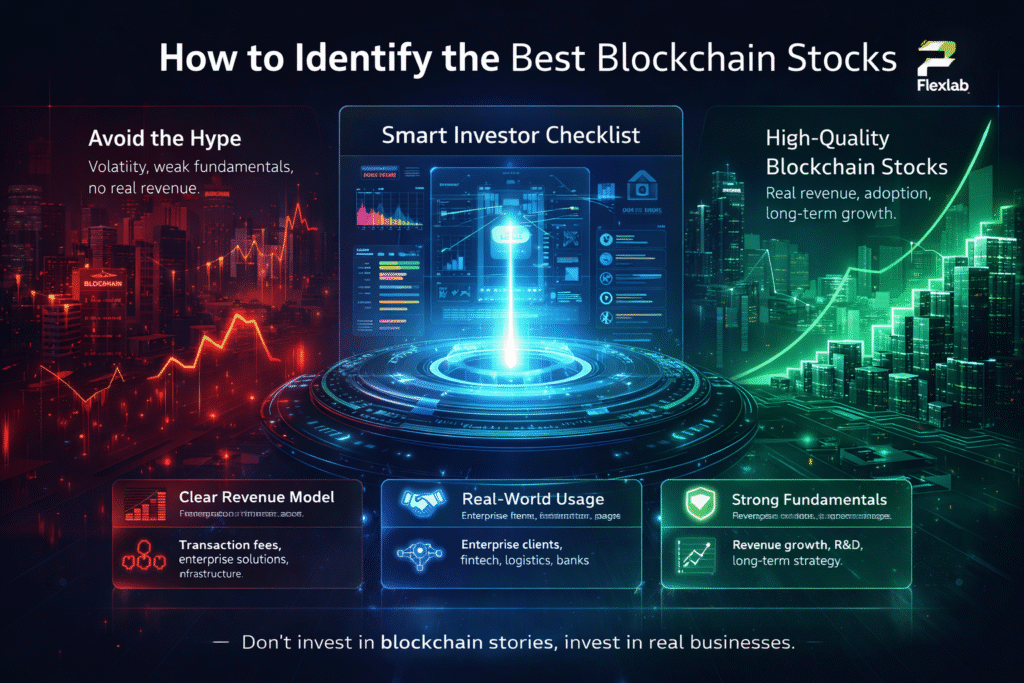
Now that you understand what blockchain stocks are, the next step is knowing how to choose the right ones. For example, while some emerging companies may appear attractive, they often behave like penny stocks due to high volatility and limited financial history. Therefore, careful evaluation is essential before investing.
However, investing in blockchain technology stocks is not about following hype. Instead, smart investors focus on companies with real revenue, strong adoption, and long-term value. Therefore, using a simple checklist can help you identify high-quality blockchain investments while avoiding risky options.
Evaluate the Company’s Blockchain Business Model
First, you need to understand how the company generates revenue from blockchain technology. For example, some companies earn through transaction fees, while others offer enterprise blockchain solutions or infrastructure services.
As a result, businesses with clear and consistent revenue streams are generally more reliable. In contrast, companies that only mention blockchain without real earnings often lack long-term potential.
Therefore, before investing, it is important to ask a simple question: Does this company generate real income from blockchain-related products or services? If the answer is yes, the business may have a stronger long-term investment case.
Check Real-World Adoption and Partnerships
Next, it is important to evaluate real-world adoption. After all, technology only matters if it is actually used. For instance, companies with enterprise clients, fintech integrations, or partnerships with banks and logistics firms usually show stronger demand. Moreover, real deployments demonstrate that the solution addresses real business problems. On the other hand, companies stuck in experimental stages may struggle to scale.
Analyze Financial Strength and Growth Potential
Finally, always review the company’s financial health. Even in the growing blockchain industry, weak fundamentals can increase risk.
For example, investors often evaluate:
- Revenue growth trends
- profitability or cash flow
- research and development investment
- long-term expansion strategy
In addition, companies that invest heavily in innovation often position themselves well for future blockchain adoption. As a result, businesses combining strong financial performance with technological innovation may offer more stable growth opportunities.
7 Best Blockchain Stocks to Watch in 2026 for Long-Term Growth

As blockchain adoption accelerates, investors are increasingly turning to blockchain stocks to gain exposure without directly holding cryptocurrencies. Moreover, companies building infrastructure, platforms, and enterprise solutions are becoming key drivers of long-term growth.
Therefore, identifying the best blockchain stocks in 2026 requires focusing on real-world use cases, scalable business models, and consistent innovation.
1. Coinbase Global: Blockchain Stock for Digital Asset Platforms
Coinbase Global remains one of the most direct ways to invest in the blockchain ecosystem. The company generates revenue through trading fees, subscriptions, and institutional services.
In addition, its expansion into staking and developer tools strengthens its position beyond a traditional exchange. As adoption grows, Coinbase continues to play a central role in connecting users and institutions to digital assets.
- Growth driver: Expanding ecosystem and institutional adoption
- Watch out for: Revenue sensitivity to market cycles and regulation
2. Riot Platforms: Blockchain Infrastructure Stock with Mining Focus
Another major player in blockchain infrastructure is Riot Platforms, which focuses on Bitcoin mining operations. Since mining is essential for securing decentralized networks, demand tends to rise alongside blockchain usage.
Furthermore, the company is scaling its mining capacity, which could improve efficiency and long-term profitability.
- Investment edge: Direct exposure to network expansion
- Potential downside: Strong dependence on crypto price movements
3. Core Scientific: Scalable Blockchain Technology Stock
A different approach comes from Core Scientific stock, which combines digital asset mining with hosting services. This dual model allows the company to serve both its own operations and other blockchain businesses.
Consequently, it offers broader exposure to the blockchain technology market, especially as demand for computing power continues to increase.
- Growth catalyst: Diversified revenue through mining and hosting
- What to monitor: Energy costs and operational efficiency
4. Globant: Enterprise Blockchain Development Stock
From an enterprise perspective, Globant focuses on blockchain development, cloud solutions, and AI integration. The company helps businesses adopt blockchain for real-world applications, which positions it well as enterprise demand grows.
As digital transformation accelerates, Globant continues to benefit from long-term adoption trends.
- Competitive advantage: Strong enterprise partnerships
- Risk consideration: Project-based and variable revenue streams
5. NVIDIA: Indirect Blockchain Technology Investment
Unlike pure-play blockchain companies, NVIDIA provides the computing power behind the ecosystem. Its GPUs are widely used in mining, AI systems, and data processing. Because of this, NVIDIA benefits indirectly from blockchain growth while also leveraging demand from multiple high-growth sectors.
- Core strength: AI and blockchain synergy
- Possible challenge: Exposure to cyclical hardware demand
6. IBM: Stable Enterprise Blockchain Solutions Stock
For a more stable option, IBM focuses on enterprise-grade blockchain solutions rather than cryptocurrency-driven revenue. Its platforms are widely used in supply chain management, secure data exchange, and business operations.
Therefore, IBM offers a more conservative way to gain exposure to blockchain adoption.
- Stability factor: Established enterprise presence
- Limitation: Slower pace of innovation compared to newer players
7. Block Inc.: Fintech and Blockchain Innovation Stock
Finally, Block Inc. operates at the intersection of fintech and blockchain, offering payment solutions and digital asset services. In addition, the company actively invests in open-source blockchain projects.
As a result, it continues to expand within the blockchain and cryptocurrency ecosystem, making it a strong long-term contender.
- Expansion focus: Growing fintech ecosystem and user base
- Key risk: Intense competition in fintech and digital payments
Blockchain Stock Comparison Table
To simplify your decision, here’s a quick comparison of the best blockchain stocks based on their role, growth potential, and risk level.
|
Company |
Blockchain Role | Best For |
Risk Level |
| Coinbase | Trading Platform | Direct crypto exposure | High |
| Riot Platforms | Mining Infrastructure | High-growth investors | High |
| Core Scientific | Hosting + Mining | Scalable infrastructure | High |
| Globant | Development Services | Enterprise adoption | Medium |
| NVIDIA | Computing Power | AI + blockchain exposure | Medium |
| IBM | Enterprise Solutions | Stability-focused investors | Low–Medium |
| Block Inc. | Fintech + Crypto | Ecosystem growth | Medium |
Blockchain ETFs and Other Ways to Invest in Blockchain
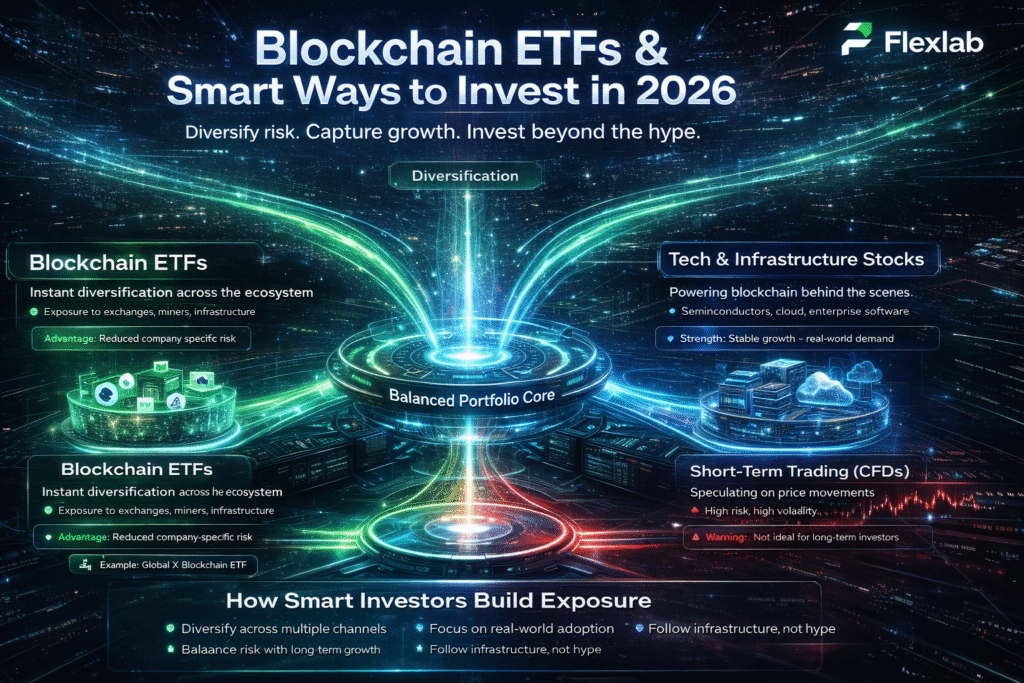
While investing in individual blockchain stocks offers direct exposure, many investors prefer diversified options to reduce risk. Moreover, alternative investment vehicles offer a simpler way to participate in the growth of blockchain technology.
Blockchain ETFs for Diversified Exposure
Blockchain ETFs (exchange-traded funds) invest in a basket of companies across the blockchain ecosystem, including exchanges, miners, and technology providers.
Meanwhile, some short-term traders also use instruments like CFD (contract for difference) to speculate on price movements; however, this approach involves higher risk compared to long-term investing. Therefore, instead of selecting individual stocks, investors can gain broad exposure while mitigating company-specific risk.
Example: Global X Blockchain ETF includes multiple top blockchain players, making it suitable for long-term blockchain investments.
Indirect Investment Through Technology and Infrastructure Stocks
Alternatively, investors can gain exposure indirectly by buying companies that support blockchain technology. In addition, emerging firms like Figure Technology Solutions are expanding blockchain use cases in finance, particularly in lending and asset tokenization.
These include semiconductor firms, cloud computing providers, and enterprise software companies. As a result, this approach allows participation in blockchain market growth while reducing dependency on volatile cryptocurrencies.
Combining Strategies for Balanced Blockchain Investments
Finally, many investors blend approaches: individual stocks, ETFs, and selective exposure to digital assets. This combination balances risk and return. Furthermore, staying aware of enterprise adoption and technological trends helps maximize long-term gains. By diversifying across these methods, investors can capitalize on blockchain innovation while minimizing exposure to market volatility.
Real-World Use Cases Driving Blockchain Adoption

Blockchain is no longer just hype; it’s actively transforming industries worldwide. Moreover, understanding practical applications helps investors identify companies positioned for growth in the blockchain market.
1. Supply Chain and Digital Identity Solutions
Blockchain in supply chains ensures transparency, traceability, and fraud prevention by recording every transaction on a secure, immutable ledger. Similarly, digital identity solutions use blockchain to provide secure, verifiable credentials, reducing fraud across industries.
For instance, Walmart leverages blockchain to track produce from farm to store, and banks adopt blockchain-based KYC systems. Therefore, companies offering supply chain or identity solutions benefit from consistent business adoption.
2. Financial Services and Tokenization of Assets
Blockchain enables faster, secure payments and on-chain settlements, improving efficiency in banking and finance. Additionally, tokenizing assets, such as real estate or stocks, creates new liquidity opportunities and fractional ownership.
Consequently, platforms and financial services integrating blockchain gain exposure to growing digital asset markets and recurring transaction fees.
3. Healthcare, IP, and Data Security Applications
Beyond finance, blockchain enhances healthcare records, intellectual property, and data security by providing immutable, verifiable records. For example, hospitals can securely share patient data, while software companies protect digital assets and IP rights.
As a result, companies developing blockchain solutions for healthcare or IP management are positioned for long-term adoption in regulated and high-growth sectors.
Blockchain Investment Trends Shaping the Market (2026–2030)

As blockchain technology continues to evolve, future growth will be driven by innovation, enterprise adoption, and integration with emerging technologies. Therefore, understanding key blockchain investment trends can help investors position themselves for long-term opportunities.
Institutional Adoption and Enterprise Blockchain Growth
First, institutional adoption is accelerating as banks, asset managers, and corporations integrate enterprise blockchain solutions into their operations. For example, financial institutions are using blockchain for payments, settlements, and data management.
As a result, this shift increases market stability, credibility, and long-term demand for blockchain infrastructure providers.
Tokenization and Expansion of Digital Asset Markets
Another major trend is the tokenization of real-world assets, including real estate, stocks, and commodities. By converting assets into digital tokens, blockchain enables fractional ownership, improved liquidity, and faster transactions.
Consequently, this innovation is expanding digital asset markets and creating new investment opportunities across industries.
AI Integration and Blockchain Security Demand
Meanwhile, the combination of AI and blockchain is unlocking new possibilities in automation, data verification, and transparency. At the same time, rising adoption is increasing the need for blockchain security and smart contract auditing.
Therefore, companies operating at the intersection of AI, security, and blockchain development are likely to benefit from sustained long-term growth.
Conclusion: Should You Invest in Blockchain Stocks in 2026?
Investing in blockchain stocks in 2026 is no longer driven solely by hype. Instead, the growth of blockchain technology, increasing enterprise adoption, and real-world use cases are shaping a more mature and sustainable market.
Moreover, as digital finance and decentralized systems continue to expand, blockchain investments are becoming a strategic way to gain long-term exposure to innovation without relying solely on cryptocurrencies.
Ultimately, investors who focus on strong business models, real adoption, and long-term trends are better positioned to benefit from the evolving blockchain ecosystem.
Turn Blockchain Ideas into Scalable Products with Flexlab

As blockchain technology reshapes industries, execution matters more than ideas. Therefore, whether you’re scaling blockchain investments, launching decentralized applications, or deploying enterprise systems, the right expertise defines the outcome.
At Flexlab, businesses get secure, scalable, and high-performance blockchain solutions engineered for real-world impact. From strategy to deployment, every solution is built for performance, security, and long-term growth.
Ready to Take Your Blockchain Strategy to the Next Level?
📞 Book a FREE Consultation Call: +1 (416) 477-9616
📧 Email Us: info@flexlab.io
Want to see how this translates into real results? Explore our services to understand what we build, connect with us on LinkedIn for real-time insights and updates, and dive into our blog for expert perspectives on blockchain innovation. When you’re ready to move from idea to execution, contact us. Flexlab is where it starts.
Read more:
- Why AI and Blockchain are the Pillars of the Next Internet?
- Public vs Private Blockchain: Which is Better for Your Business?
- How Does Blockchain for Startups Improve Transparency and Trust?
Should I invest in blockchain stocks instead of cryptocurrencies?
Many people ask this because crypto prices can swing wildly. Blockchain stocks give you exposure to the technology without holding tokens directly, so you’re investing in real companies with real revenue. They tend to be less volatile and fit better in traditional portfolios. That said, they’re not risk free, but they can be a more measured way to benefit from blockchain growth over time.
How do I know if a blockchain company is worth investing in?
A good place to start is looking at how the company actually makes money from blockchain, not just mentioning it in press releases. Check whether they have real customers, partnerships, and recurring revenue. Also, look at their competitive edge, financial health, and innovation pace. If these fundamentals are strong, the company is more likely to deliver long term returns.
Is it too late to jump into blockchain investing in 2026?
That’s a common concern, but the industry is still expanding into new sectors. More businesses are adopting blockchain for payments, supply chains, identity, and data security, with big, real world use cases. Plus, trends like tokenization and AI integration are just getting started. So if you’re thinking long term, there are still plenty of opportunities ahead.