Choosing Between Agentic AI vs Generative AI for Your Business
Best AI Tools | AI in FinTech | AI Assistants
Agentic AI vs generative AI is quickly becoming one of the most important decisions businesses face as AI adoption accelerates across every industry. Currently, AI is everywhere; however, clarity is lacking.
Nearly 70 percent of companies are already using or actively testing AI tools, yet many teams still cannot explain what kind of AI they are actually paying for. Some tools help people write faster, summarize information, or generate ideas. Others go further by moving data, triggering actions, and completing tasks across systems without constant human input.
Agentic AI is built to act, not just respond. Generative AI focuses on creating content, while agentic workflows focus on execution. In practical terms, one supports your team, and the other behaves like a digital operator inside your workflows.
As 2026 unfolds, leaders are no longer asking whether they need AI that talks or AI that works independently. The answer affects cost, risk, scalability, and long-term ROI. In this blog, we break down these technologies so you can easily make decisions that drive real results.
Agentic AI vs Generative AI: What They Are, and Why It Matters?
In the current business landscape, the shift toward modern AI systems is accelerating faster than most teams can keep up with, making clarity more important than ever.
At its core, the choice between these two technologies comes down to whether you require a creative partner or a digital employee. Agentic AI is designed to coordinate actions across your existing tools and workflows, while generative AI is built to support the thinking and writing process.
Understanding this distinction early enables teams to evaluate tools more clearly, set realistic expectations, and focus on outcomes rather than features.
-
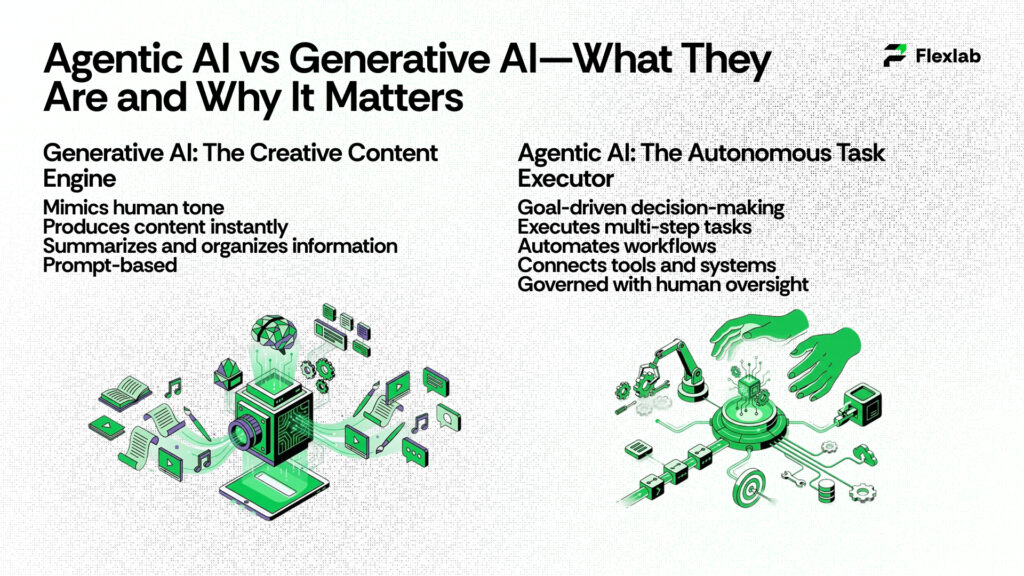
Generative AI: The Creative Content Engine
Generative AI has become a go-to tool for teams that require content urgently. Furthermore, knowledge of generative AI fundamentals explains why it performs so well at scale.
Additionally, generative AI models are the engines behind this ability. Specifically, they empower businesses to turn ideas into polished outputs without slowing down workflows. They prove especially useful for tasks requiring creativity, research, or summarization at scale. In fact, a 2025 survey found that over 65% of marketing teams use generative AI to produce content weekly, saving hours of manual work. Some micro-examples are presented that are in practice:
- Summarizing five long reports into a single one-page brief
- Drafting multiple versions of a social media ad from one product description
- Cleaning up rough emails to make them professional and concise
-
What Generative AI Is Designed to Do
Generative AI models are designed to empower people to create faster. Moreover, they leverage patterns learned from vast datasets to generate output such as text, images, code, or audio that feels almost human-like.
-
Where Generative AI Fits in Daily Business Work
In real business settings, generative AI applications are commonly used for summarizing documents, drafting emails, and effectively organizing ideas, as well as creating marketing copy. It performs best in both scenarios—whether tasks start with a blank page or involve too much information.
-
Strengths and Natural Limits
Generative AI truly shines in its ability to deliver lightning-fast results at a large scale, making it an invaluable asset for high-pressure projects. It can process and rework information far faster than a human. However, these tools rely on machine learning models; their role usually ends once content is created. It does not move data, trigger workflows, or take action inside your systems without human direction.
Agentic AI: The Autonomous Task Executor
In contrast to reactive tools, agentic AI systems are designed to execute tasks across tools with minimal human input, operating as AI agents that can carry out actions across all connected business systems. It is created to go beyond suggestions.
Agentic AI systems act like digital team members, executing tasks across tools and workflows while reducing manual effort. According to Gartner, by the end of 2026, 40% of enterprise applications will include agentic AI for autonomous task execution, meaning these systems will operate alongside teams rather than just assist them. Some real-life examples make it more relatable:
- Automatically qualifying new leads and updating your CRM
- Sending personalized email responses when the criteria are met
- Monitoring shipments and notifying customers of delays
-
How Agentic AI Operates
Agentic AI systems operate through AI agentic workflows, meaning they act on defined goals instead of waiting for constant prompts. They are given goals and the ability to decide what steps to take next.
-
Interaction with Tools and Workflows
These systems enable agentic process automation by connecting directly to business software and automatically handling workflows across tools, such as CRMs, ticketing systems, and internal dashboards. This allows them to operate more like a digital operator rather than a traditional assistant, making them feel like an active part of the team instead of just a support tool.
-
Oversight and Control Considerations
Agentic AI interacts directly with real systems; security information and event management practices are essential to maintain control. Therefore, clear permissions, defined boundaries, and human approval for high-impact actions help ensure control while still reducing manual workload.
Generative AI vs Agentic AI: Core Differences in 2026
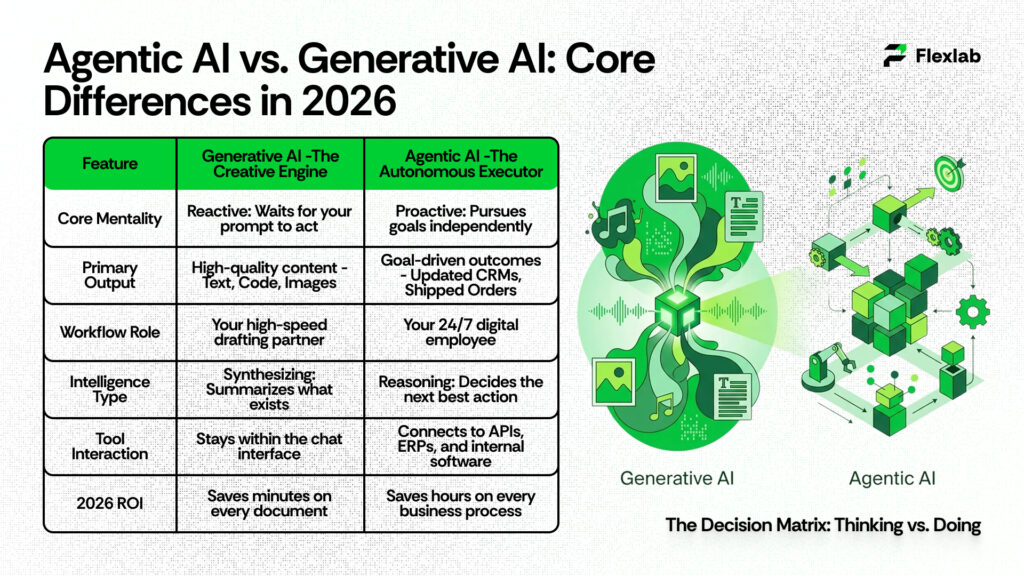
In 2026, the gap between using AI and winning with AI comes down to one choice: agency. While 70% of companies experiment with content-focused tools, those deploying execution-focused models capture the real ROI. To scale, you must move beyond the prompt and start managing AI as an autonomous part of your workforce.
Let’s break down the key differences of agentic AI vs generative AI, so you can see exactly how each AI type operates and where it fits into your business workflow.
1. Purpose & Function
- In contrast to execution-focused tools, conversational AI vs generative AI highlights how content creation differs from system-driven action. Enabling teams to generate ideas, write copy, or analyze information.
- Agentic AI is built to execute tasks across systems, moving beyond content creation into autonomous action.
Businesses using generative AI for content report up to 50% faster output for routine tasks, for instance, summarizing reports or drafting emails.
2. Autonomy & Human Interaction
- Generative AI models are reactive: they wait for prompts and respond; they don’t act independently.
- Agentic AI systems are proactive: these systems function more like autonomous agents, completing tasks with minimal human involvement.
- They take high-level goals and complete tasks with minimal human intervention, a key capability associated with AGI (artificial general intelligence).
This distinction changes how teams interact with the AI. Generative AI supports decision-making, while agentic AI can save teams 20–30% of manual effort by automating workflows.
3. Implementation & Risk
Agentic AI relies on a defined agentic AI architecture. However, generative AI carries less operational risk but cannot automate processes independently. Requires strong permissions and governance, safety checks, and human oversight for high-risk actions.
This isn’t just a technical upgrade; it’s an operational shift. While generative AI handles the intelligence, thinking, and drafting, agentic AI handles the orchestration, doing, and finishing. Below is the breakdown of how these two autonomous systems work together to reclaim your team’s manual bandwidth and transform your approach to business execution:
| Features | Generative AI | Agentic AI |
| Primary Goal | Creating content and summaries | Executing workflows across systems |
| Autonomy | Initially, Reactive: Operates when prompted. | Specifically, Proactive: Acts independently on goals |
| Memory | Session-based: Resets after interaction | Persistent: Learns and improves over time |
| Interaction | Within a chat interface | Additionally, it connects directly to CRM, ERP, and Email |
| Human Role | Constant prompting and supervision | High-level strategy and oversight only |
| Best Use Cases | Marketing, research, and idea generation | Sales automation, logistics, and operations |
The strategic winner is the hybrid workflow. By 2026, the standard for excellence is using generative AI to spark the idea and agentic AI to carry it across the finish line. This synergy allows your employees to stop being ‘operators’ and start being ‘architects’ of high-value business growth.
This comparison highlights that not all AI serves the same purpose. Some tools enhance human thinking and communication, while others operate across systems and complete work independently. Recognizing these distinctions early helps organizations avoid mismatched expectations as automation becomes more deeply embedded in everyday business processes.
Practical AI Solutions for Multiple Teams
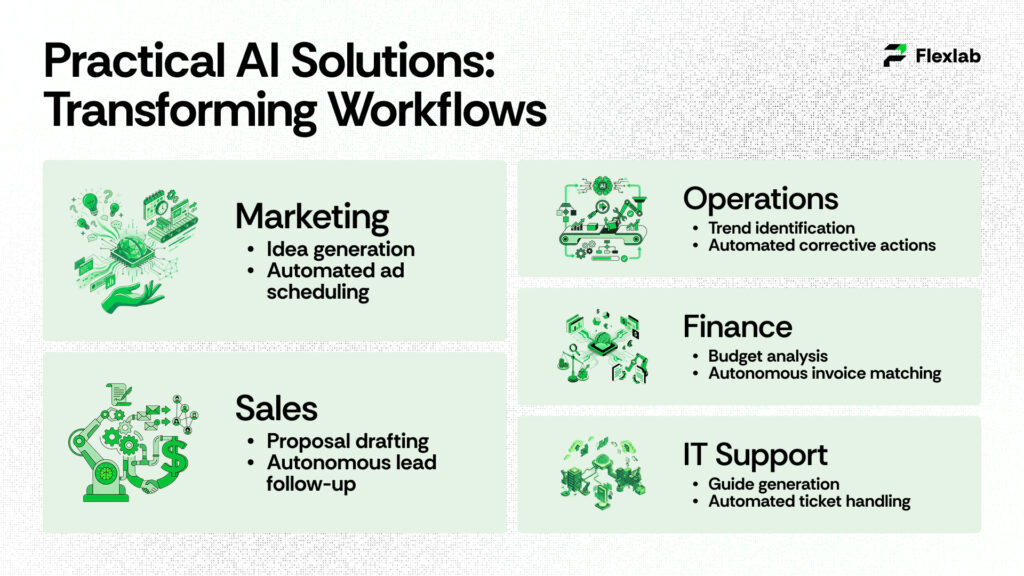
How AI solutions powered by generative and agentic AI can be applied across teams. Enable organizations to save time, reduce errors, and scale efficiently. How organizations apply AI across teams, using process intelligence to decide what should be created by humans and what can be handled automatically. The goal is not replacement, but smarter coordination between people and software.
1. Marketing: Creating & Executing Content
- While Generative AI models draft high-quality social media posts, Agentic AI systems
- Consequently, Agentic AI systems take over scheduling, performance analysis, and CRM updates automatically, saving time and reducing manual effort.
2. Sales: From Insights to Action
- Generative AI summarizes call transcripts, drafts personalized emails, and generates sales proposals.
- Agentic AI workflows log leads, send follow-ups, and track pipeline actions without constant human intervention.
3. Operations: Monitoring & Automating Tasks
- Generative AI creates process documentation, generates reports from raw data, and identifies trends in shipment delays.
- Agentic AI automates shipment monitoring, sends alerts for delays, and triggers corrective actions across systems.
4. Finance: Streamlining Accounts
- Primarily, generative AI summarizes invoices, creates financial summaries, and analyzes budget reports.
- However, Agentic AI handles matching invoices with purchase orders, scheduling payments, and notifying teams of exceptions. Consequently, the risk of human error in accounts payable is virtually eliminated.
5. IT & Support: Intelligent Assistance
- Generative AI writes knowledge base articles, summarizes system logs, and generates troubleshooting guides.
- Agentic AI automates ticket triage, assigns issues to the right engineers, and triggers system updates based on alerts.
These examples show that AI delivers the most value when applied with intent, not everywhere at once. Teams that clearly define where AI should assist and where it should act tend to see faster adoption and better results. When used thoughtfully, AI becomes a support layer that reduces friction across teams rather than another tool employees have to manage.
How to Choose the Right AI for Your Business?
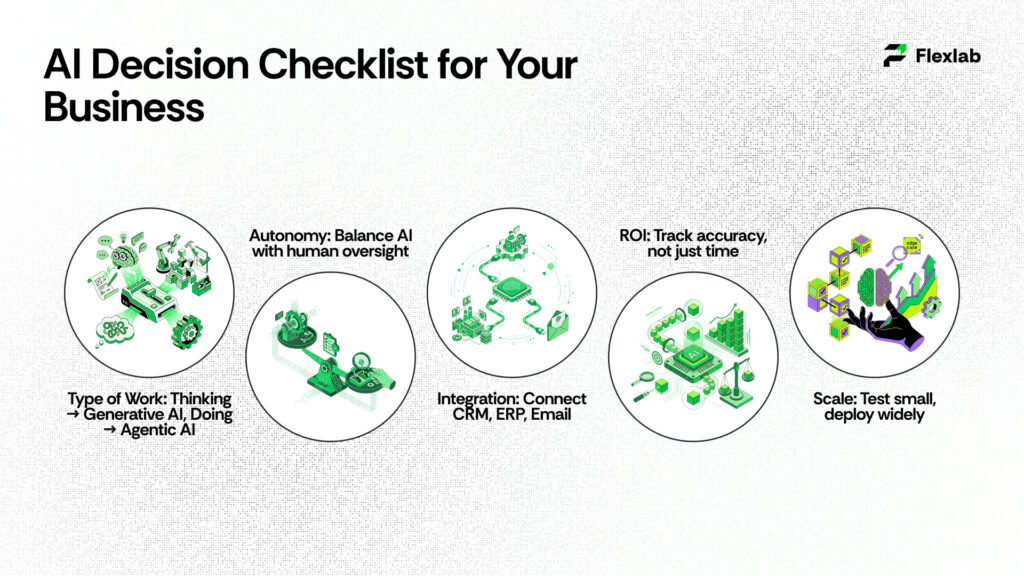
Choosing AI for enterprise is about aligning technology with real needs, existing systems, and acceptable levels of automation. Use this checklist to evaluate what actually fits your organization today and what can scale tomorrow.
Start With the Type of Work You Want to Improve
Before evaluating tools, clearly define the kind of work you want AI to support. If your challenge is writing, summarizing, or analyzing information, content-focused AI may be enough. If your challenge is coordination, execution, or follow-through, you’ll need systems. that can act. This step helps you avoid purchasing tools that appear impressive but don’t actually improve outcomes.
Evaluate How Much Autonomy You’re Comfortable With
Some organizations prefer full control, while others are willing to let the software take the initiative. AI that operates independently can deliver efficiency, but it also requires trust, governance, and oversight.
Be honest about where automation is acceptable and where human approval must remain in place, especially when evaluating multimodal AI systems that combine text, data, and operational signals.
Check System Integration Requirements
Moreover, AI delivers more value when IoT integration and system connectivity are considered from the start. As a result, before committing, you must confirm whether the solution integrates smoothly with email, CRM, and analytics platforms. Ultimately, disconnected tools often create more work instead of reducing it.
Measure ROI Beyond Time Savings
Time saved is important, but it’s not the only metric to consider. Look at error reduction, faster response times, better customer experience, and operational consistency. These indicators show whether AI is delivering real value or just surface-level productivity gains.
Start Small and Scale With Confidence
For this reason, many teams partner with an AI automation agency to start small and scale deliberately. Moreover, as test results accumulate over time, they help identify edge cases. Ultimately, this ensures a stable environment before AI becomes deeply embedded in your operations. Scaling works best when learning is intentional, not rushed.
Checklist Summary
If your priority is creating information, focus on tools that enhance thinking and communication. On the other hand, if you prioritize executing work, look for systems that can operate reliably with minimal supervision. The right choice of tools supports people, strengthens processes, and grows with your business, rather than locking you into rigid tools.
Turn Your Vision into Autonomous Action with Flexlab’s AI Solutions
At Flexlab, we transform ideas into automated AI workflows that save time, reduce errors, and let your team focus on high-impact decisions. Whether it’s optimizing business operations, automating processes, or integrating AI into existing systems, we provide the tools and expertise to make your vision a reality.
Ready to Automate Your Business Workflows with AI?
📞 Book a FREE Consultation Call: tel:+1 (416) 477-9616
📧 Email Us: info@flexlab.io
Explore our services, or gain insights from our blog. Ready to get started? Contact us or connect with us on LinkedIn, and let’s turn your AI strategy into action.
Curious to learn how AI can drive real results for your business? Read our latest blog for actionable insights and expert tips.
- How AI Strategy Consulting Boosts Business Growth
- 22 Best AI Marketing Tools to Transform Your Business for 2026
- How Does AI in Transportation Support Autonomous Vehicles? A Comprehensive Guide
Final Thoughts on Agentic AI vs Generative AI for Business Decisions
Choosing the right AI comes down to clarity, not complexity. When leaders understand what each approach is designed to do, decisions become easier, risks are reduced, and outcomes improve. The businesses that win are the ones that align technology with real needs, apply it thoughtfully, and scale with purpose instead of chasing trends.
FAQs
1. Can generative AI eventually become agentic?
Think of generative AI as the brain and agentic AI as the brain plus the hands. While a standard text generator doesn’t automatically become an agent, you can upgrade it by connecting it to external tools and giving it a set of goals. When you give a language model the power to use your calendar or send emails, it transitions from a simple content creator into a proactive system that can handle tasks from start to finish.
2. What is the biggest risk when moving from generative to agentic systems?
The main challenge shifts from accuracy to security and control. With generative AI, the biggest worry is usually a typo or a factual error in a draft that you can easily catch. With agentic AI, since the system can actually take actions like moving files or contacting customers, the risk is giving it too much autonomy without the right boundaries. Successful teams manage this by starting with human-in-the-loop setups where the AI drafts the action, but a person still gives the final click to execute it.
3. Can businesses use Generative AI and Agentic AI together effectively?
Yes, many organizations do. Generative AI handles content creation, analysis, and idea generation, while Agentic AI executes tasks and workflows automatically. When used together, they complement each other: one powers thinking and planning, and the other handles follow-through and coordination. The key is defining clear roles for each type so teams gain efficiency without overlap or confusion.