
Why Blockchain Development Services Are Essential for Businesses Today?
Blockchain and IoT | AI and Blockchain Application Development | Blockchain Marketing
Blockchain development services are revolutionizing how businesses operate securely and efficiently in a digital infrastructure landscape. These powerful solutions harness decentralized ledgers, smart contracts, and Web3 technologies to eliminate middlemen, slash costs by up to 65%, and deliver unbreakable transparency across industries like finance, healthcare, and supply chains.
Whether you’re building DeFi platforms, NFT marketplaces, or custom enterprise blockchains, this comprehensive guide reveals everything you need to know, including core concepts as well as blockchain infrastructure, real-world applications, and blockchain app development. Therefore, let’s discover why 2026 is the year to future-proof your business with blockchain software development.
What is Blockchain Technology?
Blockchain technology is a method of recording information that makes it impossible for the systems to be changed, hacked, or tampered with. It is a digital distributed ledger that tracks digital assets and records transactions using cryptography across the network of distributed computers that participate in it.
Think of it as a chain of locked boxes. Each box, called a block, holds transaction details like “Alice sent Bob $10.” Computers on the network, called nodes, check and agree on what’s inside before locking it in with math codes known as cryptography. Once added, you cannot erase or fake it without breaking the whole chain. No single boss runs the show. It spans hundreds or thousands of machines worldwide, so hackers need to trick most of them at once. This proves way harder than cracking one bank’s database, and every block links to the last one, making tampering obvious. You hear about it with Bitcoin, but it pops up everywhere: tracking food from farm to store so you know it’s fresh, verifying art is not fake, speeding up house sales without endless paperwork, and businesses love it for cutting middlemen and costs.
Types of Blockchain
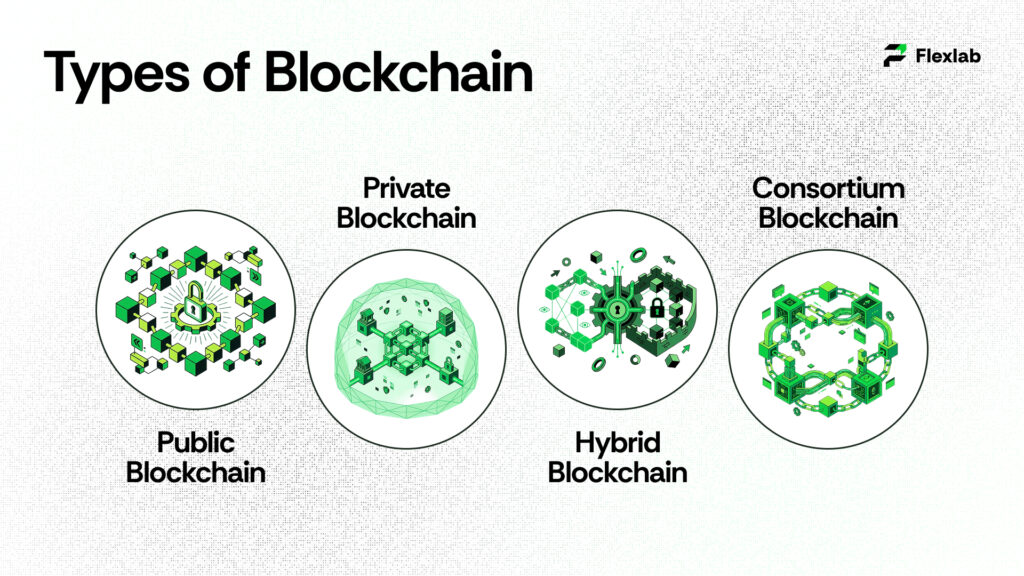
Blockchain technology comes in four main types: public, private, hybrid, and consortium, also called federated. Let’s read more about different types of blockchain technology.
- Public Blockchain
- Private Blockchain
- Hybrid Blockchain
- Consortium Blockchain
Public Blockchain
Public blockchains allow anyone with internet access to join, view records, or validate transactions with no permission required. They rely on consensus mechanisms like proof-of-work (as in Bitcoin) for blockchain security and transparency. However, they can be slow, energy-intensive, and vulnerable to 51% attacks if bad actors control most nodes. Therefore, they’re ideal for open systems like Bitcoin or NFTs, where trust comes from transparency.
Private Blockchain
A single organization runs it on a closed network, so only approved users can participate. As a result, it’s faster and more efficient for internal operations, offering full control over access and data. That said, it’s less decentralized, which leads some critics to question if it’s a true blockchain. Consequently, it’s perfect for sensitive internal uses, such as healthcare records or supply chain tracking.
Hybrid Blockchain
Hybrid architecture blends public and private elements, allowing organizations to keep sensitive data private while verifying or sharing public parts through smart contracts. Thus, it balances privacy, speed, and scalability without requiring full openness. For this reason, it’s well-suited to industries such as finance, real estate listings, or retail, where selective public access adds value.
Consortium Blockchain
Multiple organizations collaborate on a semi-private network, where a few preset blockchain nodes manage consensus. Because of this setup, it’s more secure and scalable than public blockchains, with consistently low fees. However, any changes require group approval, which can slow things down. Overall, it’s commonly used in banking for inter-bank payments or in shared supply chains like food and pharmaceuticals.
Benefits of Blockchain Development
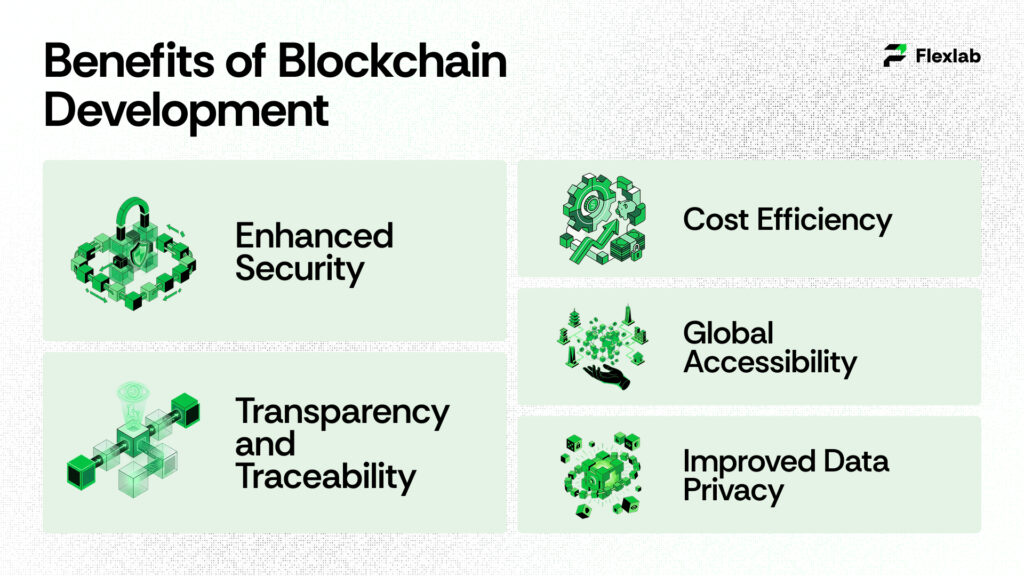
Here are the key benefits of blockchain technology, perfectly suited for enterprise blockchain deployment.
- Enhanced Security
- Transparency and Traceability
- Cost Efficiency
- Global Accessibility
- Improved Data Privacy
1. Enhanced Security
Blockchain development gives a high level of security for modern digital transactions. Blockchain creates custom software systems with a decentralized structure, powered by a consensus mechanism and cryptography. Due to this, nobody can hack, alter, or tamper with this technology. Moreover, no single user can alter the transaction records, and there are no loopholes or any point of failure in the blockchain database.
2. Transparency and Traceability
Every transaction can be recorded on a permanent, distributed ledger. Hence, it enhances trust, transparency, and immutability of blockchain. Moreover, it makes it ideal for tracking and verifying data and goods from origin to delivery through supply chains. This shared supply chain view delivers real-time visibility into processes and eliminates information silos. Blockchain development services create end-to-end product traceability and unbreakable audit trails.
3. Cost Efficiency
Who doesn’t love lower costs? Blockchain development services deliver exactly that for businesses. They boost transaction speed while automating manual tasks such as data collection, editing, auditing, and reporting. Additionally, they save money by eliminating middlemen such as third-party providers and vendors.
4. Global Accessibility
Blockchain runs on decentralized blockchain networks that validate transactions anytime and anywhere. As a result, this 24/7 global operation keeps your business borderless, resilient, and always on, regardless of location or time zone.
5. Improved Data Privacy
Privacy is inherently built into blockchain development. As a result, it verifies information without directly exposing sensitive details; therefore, your data remains secure by design throughout every transaction.
Our Core Blockchain Development Services
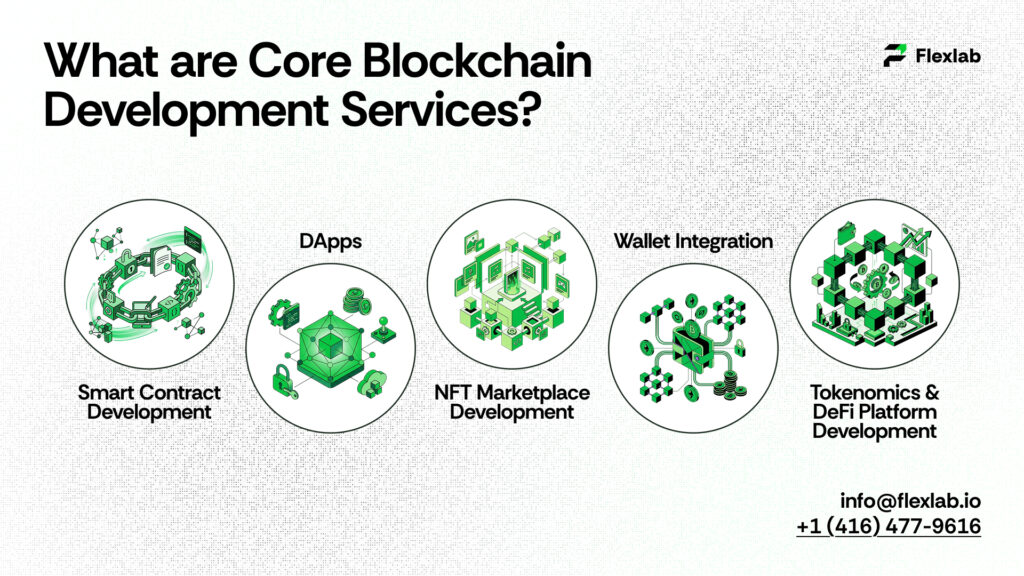
FlexLab is the leading blockchain development company that offers targeted blockchain and Web3 development services. Each one builds secure, scalable solutions for businesses.
- Smart Contract Development
- DApps
- NFT Marketplace Development
- Wallet Integration
- Tokenomics & DeFi Platform Development
Smart Contract Development (Solidity, Rust)
FlexLab writes self-executing code on blockchain networks. Solidity powers Ethereum-based contracts, while Rust secures high-speed chains like Solana. These automate deals, like payments when goods ship, with built-in audits, unit testing, and quality assurance to block hacks and ensure compliance.
DApps (Ethereum, Polygon, Solana)
They build full decentralized applications that run entirely without central servers. For example, Ethereum offers broad compatibility, while Polygon cuts fees to improve scalability; meanwhile, Solana delivers lightning-fast performance. As a result, users can interact peer-to-peer for trading, gaming, or voting, often enhanced with AI for smarter, more adaptive features.
NFT Marketplace Development
Flexlab creates platforms to mint, buy, and sell unique digital assets like art or collectibles. Moreover, features include wallet connections, royalty splits, and cross-chain support. As a result, this powers creator economies with secure ownership proofs and low-gas auctions.
Wallet Integration
They embed crypto wallets into apps or sites for seamless storage and transfers. Additionally, it supports multi-chain (EVM-compatible) with hot/cold storage, seed phrase backups, and biometric logins. As a result, users send and receive tokens without leaving your platform.
Tokenomics & DeFi Platform Development
Flexlab designs token economies, supply rules, staking rewards, and utility models, then builds DeFi apps like lending pools or yield farms. As a result, platforms enable borrowing, swapping, or liquidity mining with risk controls and regulatory alignment for fintech growth.
Applications of Blockchain Technology Across Industries
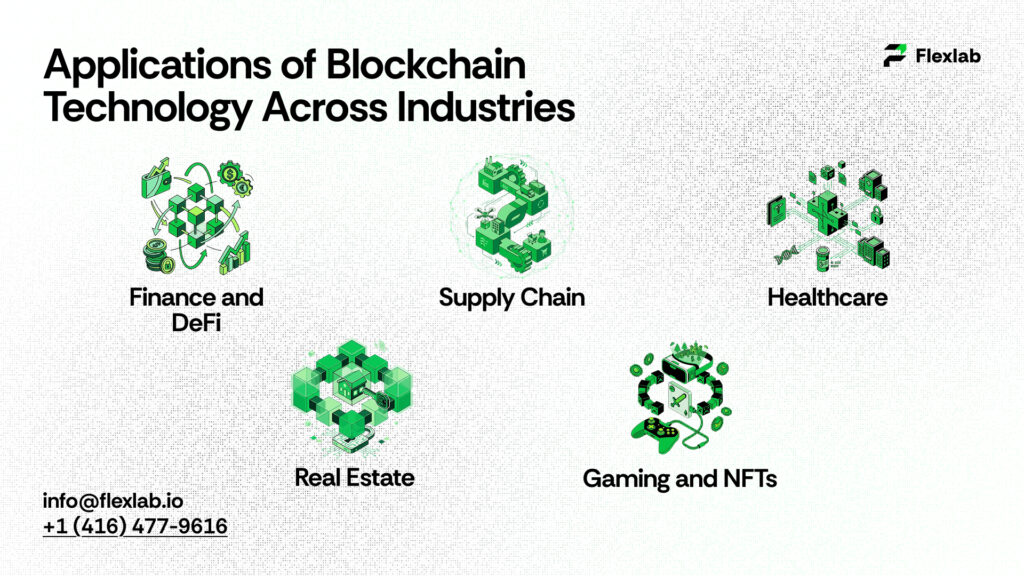
Applications of blockchain span finance, healthcare, supply chains, and more, revolutionizing trust, transparency, and efficiency across industries. By 2026, its adoption will accelerate with smarter contracts and AI integration for real-world automation.
-
Finance and DeFi
Blockchain enables decentralized finance (DeFi) platforms like lending protocols (Aave), yield farming, and decentralized exchanges (DEXs such as Uniswap) for peer-to-peer loans, trading, and staking without traditional banks. Cross-border payments settle in seconds using stablecoins like USDT. As a result, it cuts SWIFT fees by up to 80% and offers 24/7 availability. Central banks explore CBDCs on blockchain for programmable money, while tokenized securities open stock markets to global retail investors with fractional ownership.
-
Supply Chain
Immutable ledgers track goods from raw materials to shelves, verifying origins and reducing fraud, for instance, IKEA and Maersk use it to spot counterfeits instantly. Every step (manufacturing, shipping, customs) is logged transparently. As a result, it enables real-time audits, faster recalls (like contaminated food), and ESG compliance proofs for carbon footprints. Smart contracts auto-trigger payments upon delivery, slashing disputes and paperwork by 50%.
-
Healthcare
Permissioned blockchains secure patient records for seamless sharing across hospitals while preserving privacy via zero-knowledge proofs, and patients control access. Drug supply chains combat fakes (10% of global meds), tracing pills from factory to pharmacy. Tokenized health data fuels AI research without exposing identities, and clinical trials gain tamper-proof audit trails for faster FDA approvals.
-
Real Estate
Property tokenization divides buildings into tradable digital shares, letting everyday investors buy fractions via platforms like RealT. Moreover, smart contracts automate title transfers, escrow, and rent collection. Therefore, it closes deals in hours, not months. Cross-border ownership becomes simple with blockchain deeds, reducing fraud and intermediary fees by 30-40%.
-
Gaming and NFTs
NFTs grant true ownership of in-game assets (skins, weapons), which can be tradable across games or metaverses like Decentraland. For instance, play-to-earn models (Axie Infinity) pay players in tokens for quests, thereby creating gig economies. Furthermore, blockchain verifies rarity and provenance, thus powering creator royalties and virtual land sales worth millions.
Future Trends in Blockchain Development
Blockchain technology continues to evolve and brings innovation and the latest trends across several industries. Let’s have a look at the 2026 emerging Blockchain development trends that are set to redefine the digital landscape.
1. Scalability & Layer-2 Solutions Will Dominate
Blockchain networks (like Ethereum and others) are focusing heavily on scalability to handle increasing transaction volumes with lower costs and higher speed. Layer-2 solutions (such as rollups, sidechains, and sharded networks) will continue to evolve and become mainstream to make blockchains usable for mass adoption.
Key Points:
- Layer-2 protocols like Optimistic Rollups and zk-Rollups reduce congestion and fees.
- Modular blockchain architectures separate consensus, execution, and data layers to increase throughput.
2. Interoperability & Cross-Chain Connectivity
A fragmented ecosystem limits blockchain utility. Therefore, future development will prioritize cross-chain bridges and protocols that enable smooth communication, data sharing, and asset transfers between multiple blockchains.
Impact:
- Users can interact with dApps and assets across many networks seamlessly.
- Enhanced liquidity and deeper ecosystem integration.
3. Integration with AI, IoT, & Automation
When blockchain is combined with artificial intelligence (AI) and the Internet of Things (IoT), it will enable smarter systems that can automate processes securely and efficiently.
Examples:
- AI-powered analytics, predictive contracts, and fraud detection.
- IoT data authenticated through secure blockchain logs boosts trust across supply chains and smart devices.
4. Decentralized Finance (DeFi) & Financial Innovation
DeFi continues to disrupt traditional finance by offering decentralized lending, insurance, and asset management without relying on intermediaries. Moreover, growth trends point toward more sophisticated financial services that are hosted on blockchain.
Emerging Trends:
- Tokenization of real-world assets (RWA) such as real estate, bonds, and funds.
- Institutional-grade on-chain compliance and identity verification.
5. NFTs Beyond Art — Real Utility
NFTs will mature past just digital art:
- Representing real estate ownership, gaming assets, and intellectual property rights.
- Used in decentralized identity and licensing systems.
6. Enterprise Blockchain Adoption & Compliance
As large organizations increasingly adopt blockchain, they will benefit from operational efficiency, supply chain transparency, and smart contract development, which automates agreements while providing built-in audit trails and compliance.
Examples:
- Secure tracking of goods from origin to delivery
- On-chain identity for secure KYC & verification
7. Enhanced Security & Privacy Technologies
Security enhancements through zero-knowledge proofs (ZKPs) and privacy-preserving protocols will gain traction. Therefore, it enables users to prove possession or the validity of a transaction without revealing the underlying data.
8. Sustainability & Energy-Efficient Blockchains
Environmental concerns are reshaping blockchain development away from energy-intensive consensus mechanisms (like Proof of Work) toward greener alternatives, such as Proof of Stake (PoS) and eco-efficient architectures.
9. Blockchain-as-a-Service (BaaS) & Easier Adoption
As platforms that simplify blockchain integration (similar to SaaS) continue to grow, they will therefore enable businesses to deploy blockchain development solutions without requiring deep technical expertise.
10. Regulatory Clarity & Institutional Involvement
With clearer regulatory frameworks and institutional participation (banks, asset managers), blockchain’s role in mainstream finance will become more legitimate and expansive. Consequently, this trend enhances investor confidence and promotes large-scale adoption.
Why Choose Flexlab’s Blockchain Development Services
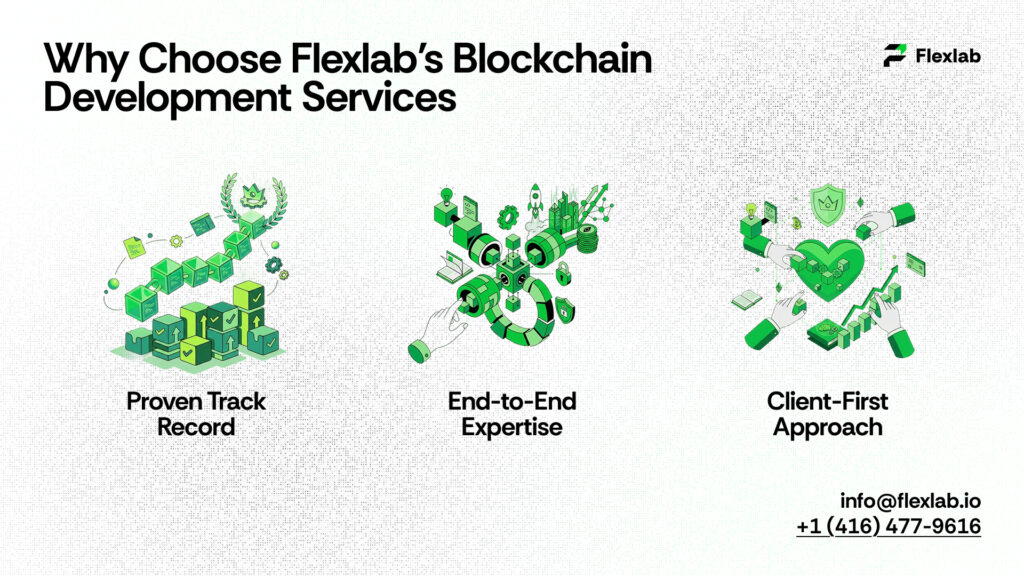
Flexlab leads as Toronto’s top AI automation agency and your trusted partner for custom blockchain solutions, private blockchain development, Web3 development, UI/UX design, and blockchain consulting. Our full-stack development services blend cutting-edge tech with proven results. Here’s what sets us apart.
Proven Track Record
We’ve delivered hits like Hoodwinked Trades (with 65% fee cuts, $1.2M saved for 50K+ traders, and 99.99% uptime) and Web3PayHub (achieving 70% faster presales and 90% risk reduction). Moreover, Clutch reviews praise our timely delivery, professional backend devs, and consistent over-delivery on expectations.
End-to-End Expertise
From idea validation to deployment, we guide you through an agile SDLC while integrating AI-blockchain fusion. This means smart contracts in Solidity/Rust, dApps on Solana/Polygon, DeFi platforms, and NFT marketplaces. As a result, zero breaches occur, with full GDPR/CCPA compliance across healthcare, fintech, and logistics.
Client-First Approach
Our 2-week sprints build working prototypes fast, with satisfaction-based payments and constant collaboration. 100% of clients’ feedback on LinkedIn highlights our responsiveness, enthusiasm, and value. Thus, it saves clients 40-80% on time/costs while scaling globally.
Ready to secure your business with unbreakable blockchain solutions? Contact us now and unlock custom smart contracts, DeFi platforms, and NFT marketplaces that cut costs by 65%+ while future-proofing for 2026 trends like AI integration and RWAs. Don’t get left behind—Start your project now at Flexlab!
Explore our Blockchain and AI blog and discover NFT Marketplace Development Company, AI Automation Services, 10 Day Trading Strategies, How Can You Make $1000 a Day with Day Trading, Custodial vs Non-Custodial Wallet, and Public vs Private Blockchain.
Conclusion: Blockchain Development Services
Blockchain development services empower businesses to harness secure, scalable decentralized technology, including smart contracts and dApps, as well as DeFi platforms and NFT marketplaces, thereby cutting costs, boosting trust, and future-proofing operations across industries.
Flexlab delivers proven expertise with real results, such as 65% fee reductions in Hoodwinked Trades and zero-breach compliance, while blending AI innovation with full-stack execution tailored to your needs.
Ready to Launch Your Blockchain Project?
Book a FREE Consultation Call: +1 (416) 477-9616
Email Us: info@flexlab.io
FAQs
Q1: What are blockchain development services?
Providers offer end-to-end solutions, including smart contracts, dApps, custom chains, NFT/DeFi platforms, wallet integration, audits, and consulting. Additionally, they handle Ethereum/Solana builds, ensure compliance, and integrate AI fusion for industries like fintech and logistics.
Q2: What is blockchain development used for?
Blockchain development builds decentralized apps, smart contracts, and networks for secure transactions, supply chain tracking, DeFi lending, NFTs, and data privacy. Businesses use it to cut intermediaries, prevent fraud, and enable 24/7 global operations, such as Walmart’s food tracing or JPMorgan’s Onyx payments.
Q3: What is an example of blockchain development?
Uniswap, a DEX on Ethereum, is a prime example: developers coded smart contracts for automated token swaps via liquidity pools, thereby handling $1T+ volume without banks. Similarly, Flexlab’s Hoodwinked Trades cut trading fees 65% through custom Solana dApps.

















One Response