How AI in Marketing Can Benefit Small Businesses
AI Marketing Tools | Marketing Automation | Best AI Automation Agency
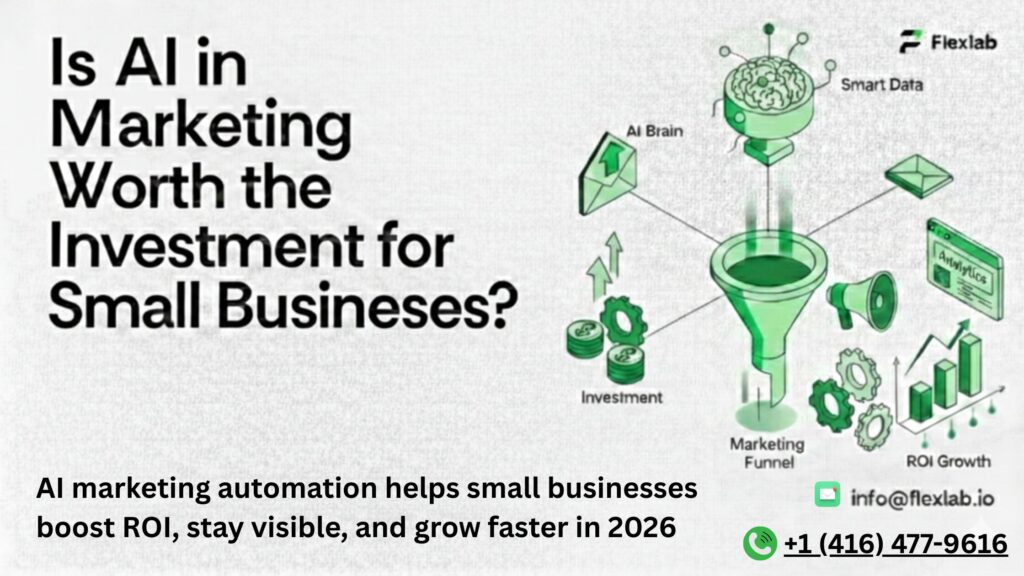
AI in marketing has crossed the line from experimental curiosity to essential infrastructure for small businesses trying to stay competitive in 2026. Yet, many teams still struggle with the same pressure, shrinking organic reach, limited time, and rising customer expectations. As a result, AI marketing automation is no longer optional; it now shapes how products and services are discovered, evaluated, and purchased.
At the same time, AI in digital marketing is influencing how customers compare brands, trust recommendations, and make buying decisions through conversational and agentic interfaces. However, for small business owners managing lean teams and tight budgets, the real concern is not what AI marketing is, but whether the investment actually pays off.
Furthermore, that tension is real. When AI is treated as a shortcut, it often becomes an expensive distraction. However, when it operates as a connected system, it multiplies efficiency, insight, and revenue. In 2026, traditional search has already shifted, with benchmarks pointing to nearly a 50 percent drop in organic traffic as users rely more on AI-driven answers. Therefore, this guide breaks down the real ROI, time savings, and structural changes, including the Universal Commerce Protocol, so you can decide with clarity and confidence.
Why Is AI in Marketing Essential for Small Businesses in 2026?
Small businesses now operate in a digital landscape that experienced a hard reset in early 2026. Specifically, buyer behavior and discovery channels rely heavily on AI-driven systems that summarize and recommend options rather than simply listing links.
-
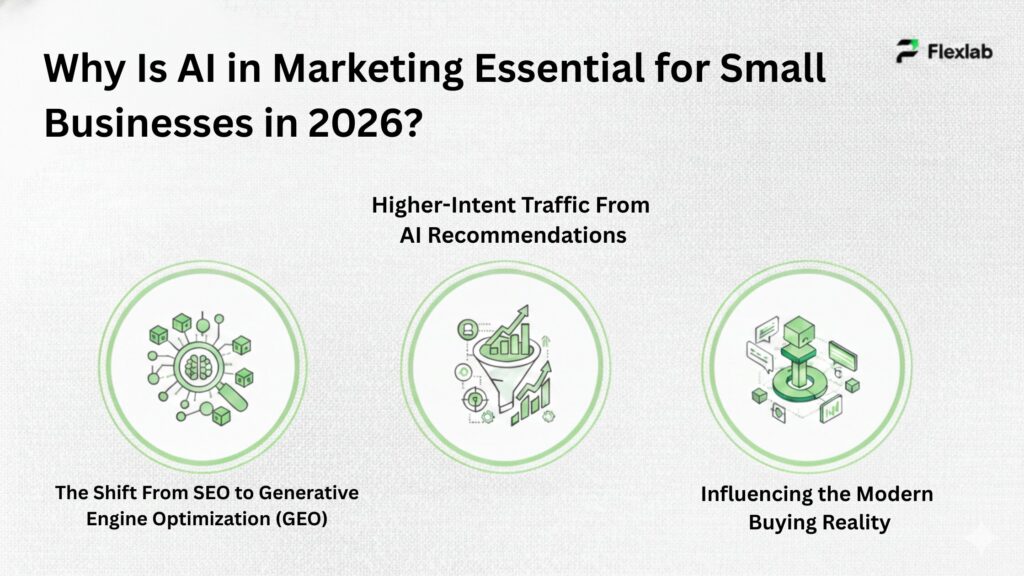
The Shift From SEO to Generative Engine Optimization (GEO)
Search behavior has transitioned from keyword matching to Generative Engine Optimization. In this environment, visibility depends on being cited as a trusted source within AI-generated responses. Moreover, businesses that publish structured marketing data analytics and high factual density are significantly more likely to be referenced by agents such as ChatGPT and Gemini.
-
Higher-Intent Traffic From AI Recommendations
Visitors arriving through AI-assisted search typically sit further along in the buying journey. According to early-adopter data, traffic originating from AI assistants converts at approximately 4.4 times the rate of traditional organic search. Because AI systems already filter results based on context and intent, the leads that reach your site arrive pre-qualified.
-
Influencing the Modern Buying Reality
We have entered a phase where nearly 70 percent of the B2B buyer journey happens before a vendor is contacted. Additionally, buyers increasingly scan Reddit discussions, watch practitioner deep dives, and use AI-powered voice assistants to compare solutions. As a result, appearing in AI summaries has become just as critical as ranking first in traditional search was once.
What Is the Real ROI of AI for Small Business Marketing?
ROI is where many marketers draw a firm line. Tools alone do not generate revenue; outcomes do. Because we are now in a maturity phase, industry benchmarks in 2026 place average B2B marketing ROI near a 5:1 ratio.
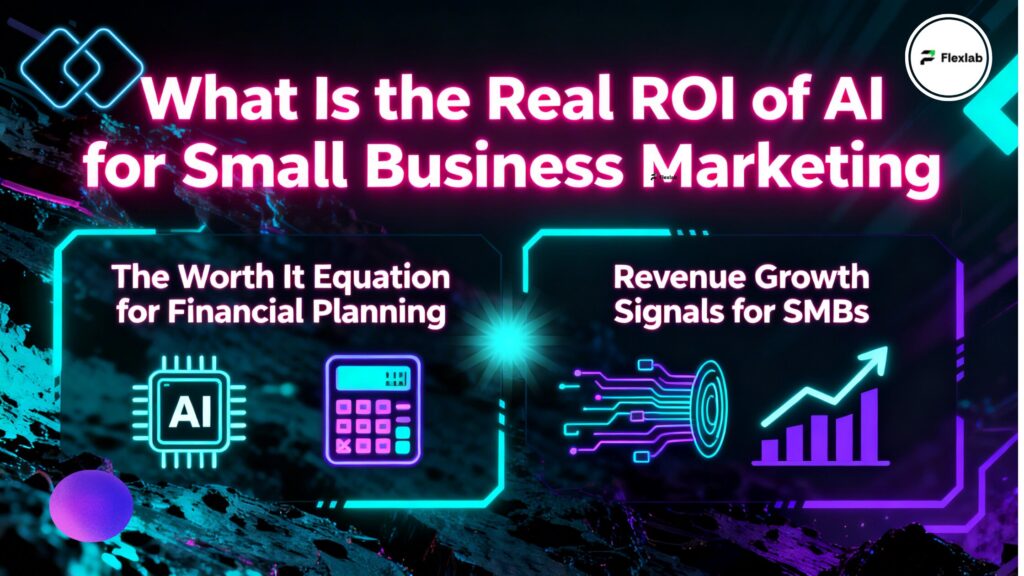
The Worth It Equation for Financial Planning
AI predictive analytics should focus on three measurable outcomes:
- Revenue lift,
- Cost savings, and
- Risk reduction
For clarity, many small businesses use the following formulas:
- Efficiency Ratio:
ROI% = (Business Benefit − Total Cost) ÷ Total Cost × 100 - Payback Period:
Payback Period = Total Cost ÷ Monthly Benefit
Together, these formulas allow teams to justify investment using concrete financial logic rather than assumptions.
Revenue Growth Signals for SMBs
Small businesses often benefit disproportionately from AI adoption. Industry reports suggest SMBs are roughly 23 percent more likely than large organizations to see ROI from blog-driven demand generation. Similarly, teams working with an AI automation agency or an integrated CRM have reported lead acquisition increases of more than 100 percent when AI is implemented systemically rather than tactically.
How Does AI Save Time for Lean Marketing Teams?
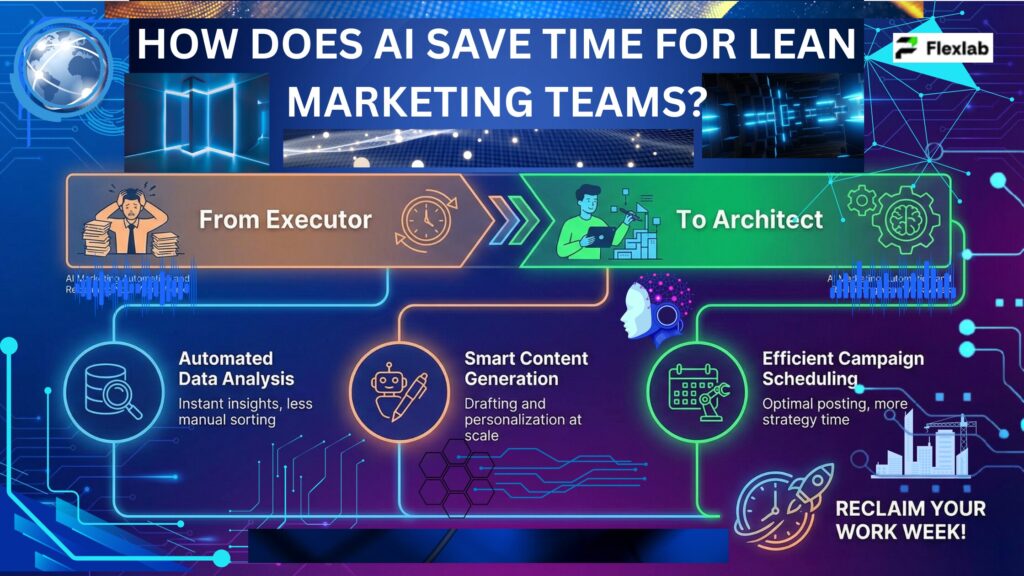
Time remains the most constrained resource for small businesses. AI delivers immediate value by eliminating repetitive, low-impact tasks and reclaiming an average of 11 to 12 hours per user each week.
AI Marketing Automation and Reclaiming Your Work Week
Routine activities such as reporting, scheduling, and campaign management are now automated. For instance, AI-powered design platforms enable non-designers to produce professional visuals within minutes, reducing bottlenecks that once delayed campaigns. Additionally, modern marketing automation software can now handle more than 40 percent of routine customer queries without human intervention.
From Executor to Architect
Marketers are evolving from individuals who write every word to strategic Vibe Directors of intelligent systems. Rather than producing assets manually, teams oversee AI-driven content creation engines that generate, test, and optimize content continuously.
What Are the Hidden Risks of Investing in AI Marketing?
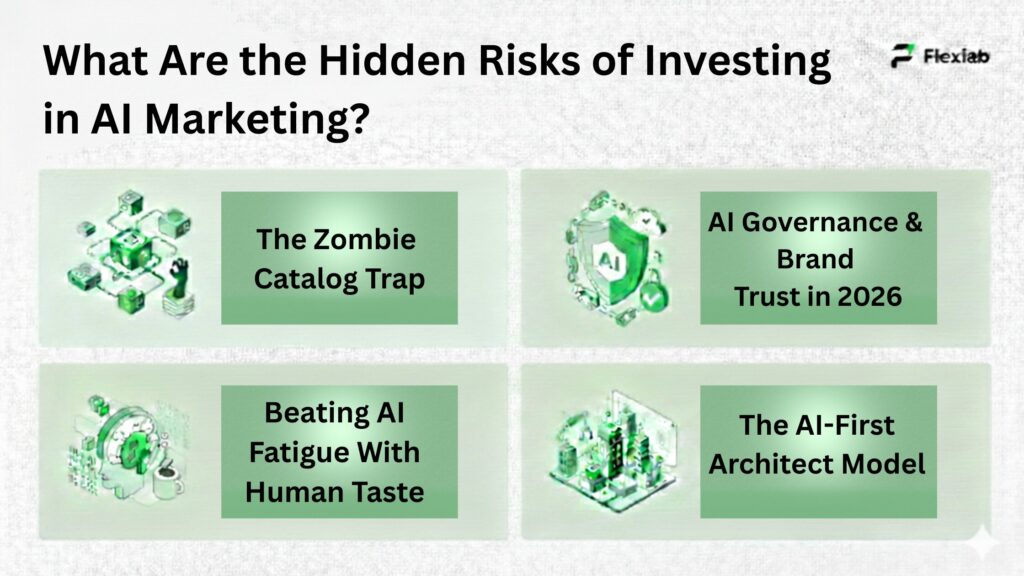
Despite its upside, AI can quietly undermine growth if it is applied without a clear human strategy and oversight. While automation accelerates execution, unmanaged systems can amplify inefficiencies just as quickly.
The Zombie Catalog Trap
AI predictive analytics and automated bidding systems are often profit-blind. When fed only top-line revenue data, AI may prioritize so-called Zombie products, low-margin items that look strong on ROAS reports but weaken net profit over time. Because of this, human teams must apply market segmentation to separate true margin drivers from low-potential inventory before automation scales the wrong outcomes.
Beating AI Fatigue With Human Taste
At the same time, a growing trust gap has emerged. More than 80 percent of consumers now expect disclosure when AI is involved in marketing decisions. In contrast, campaigns rooted in human values and supported by sentiment analysis consistently outperform generic automation. As a result, brands that lead with an authentic perspective and human judgment are far more likely to influence purchasing behavior.
AI Governance and Brand Trust in 2026
In 2026, AI governance is no longer just an enterprise concern. Even small businesses are expected to explain how AI is used in personalization, targeting, and customer interactions. As AI influences pricing, recommendations, and messaging, transparency has become a trust signal rather than a compliance checkbox.
Because of this shift, businesses that add human review, document data sources, and apply ethical oversight don’t just reduce risk; they actively build credibility with both customers and AI recommendation systems. Ultimately, strong AI governance protects brand trust while limiting long-term exposure.
Ultimately, strong AI governance protects brand trust and limits long-term risk. In practice, trust is now earned through responsible AI use, clear accountability, and human-led judgment.
The AI-First Architect Model
Sustainable success comes from combining AI and machine learning with human judgment rather than replacing it.
| Human Vibe Director | AI Commercial Infrastructure |
| Taste and POV through content marketing | Scale and speed across workflows |
| Ethical oversight and AI skills | Agentic readiness via UCP |
| Context and empathy for customer experience | Predictive intelligence powered by generative AI |
Universal Commerce Protocol (UCP): The 2026 Visibility Revolution
Introduced in early 2026, the Universal Commerce Protocol represents a major shift in how products are discovered and sold. Once adopted, AI agents can browse, evaluate, and even complete purchases on a user’s behalf without requiring a visit to a traditional website.
-
Becoming Machine-Readable Through UCP Manifests
To remain competitive, businesses now publish a UCP manifest file that allows AI systems to clearly understand, evaluate, and recommend their products. While storefronts serve human aesthetics, UCP manifests serve machine certainty. Because artificial neural networks power these agents, they require precise data such as pricing, materials, and stock availability.
-
Agentic Commerce and Zero-Click Purchasing
With UCP in place, products surface naturally within AI conversations. When users ask for recommendations, UCP-compliant businesses appear instantly. As a result, even small teams can compete with large digital marketing services by maintaining superior data hygiene.
Which AI Tools for Marketing Are Actually Worth the Investment?
The great news for small businesses in 2026 is that the right AI tools can unlock efficiency, creativity, and measurable ROI, even with lean teams. By using integrated, strategic AI systems, SMBs can save time, scale operations, and produce high-quality content without adding headcount.
Top AI Tools for Marketing to Consider:
- HubSpot AI: All-in-One Infrastructure
- LTX Studio: High-ROI Media Production
- Canva: High-ROI Media Production
- Gumloop: Custom Automation
- Make.com: Custom Automation
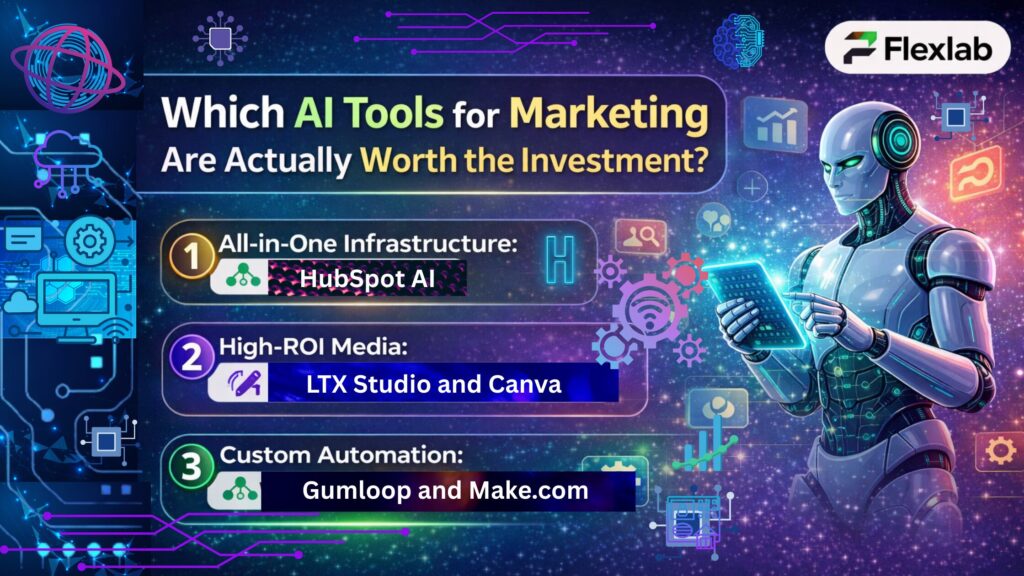
These tools are effective because they cover core infrastructure, high-ROI media, and flexible automation layers, providing small teams the power to operate like enterprise-level teams without the complexity.
1. All-in-One Infrastructure: HubSpot AI
HubSpot remains a top choice for SMBs because it centralizes CRM, email, analytics, and conversational AI chatbot in one platform. Its AI agents help optimize email campaigns, automatically score leads, and forecast sales pipelines. Studies show that SMBs using HubSpot AI see up to 34% faster lead response times and a 5–1 ROI on marketing campaigns, making it a clear choice for teams that need scale and reliability.
2. High-ROI Media: LTX Studio and Canva
Short-form video continues to deliver the highest ROI in 2026. Tools like LTX Studio and Canva allow teams to create professional videos, social graphics, and marketing assets in hours rather than weeks, reducing production costs by up to 60% compared to traditional workflows. Early-adopter SMBs report a 49% higher engagement rate when these AI-driven media tools are used strategically in campaigns.
3. Custom Automation: Gumloop and Make.com
These low-code platforms enable teams to build autonomous workflows across multiple AI applications. Such as blogs can automatically generate social media posts, CRM updates, and email sequences. Companies using these automation tools report saving 10–12 hours per week per team member, while campaign accuracy improves by up to 38%, allowing SMBs to scale efficiently without adding new hires.
How Should a Small Business Start Investing in AI in Digital Marketing?
The exciting news for small businesses in 2026 is that investing in AI in digital marketing doesn’t have to be overwhelming. With a clear plan, even lean teams can maximize ROI while experimenting safely. The key is balancing core infrastructure, experimental media, and innovation in a structured approach.
The 70-20-10 Budget Framework
Many small teams find the 70-20-10 framework to be the most effective:
- 70% toward core infrastructure such as CRM, email automation, and analytics
- 20% toward experimental media formats like short-form video, AI-driven ad creatives, or interactive content
- 10% toward innovation, testing autonomous agents, or programmatic advertising
Following this framework ensures that the majority of your budget goes toward reliable systems, while still leaving room for experimentation and future-ready innovations. Teams applying this structure report 5x higher efficiency in campaign execution compared to unplanned spending.
Owning First-Party Data for a 2.9X Conversion Boost
With third-party cookies disappearing, first-party data has become a critical competitive asset. Businesses that collect and leverage their own email addresses, phone numbers, and website behavior see conversion rates nearly three times higher than those relying solely on external data sources.
At the same time, owning your data allows smarter AI-driven recommendations, personalization, and targeted campaigns, all while maintaining privacy compliance. This means your investment in AI in digital marketing becomes tactical as well as strategically transformative.
The 2026 AI Marketing Strategy Shift for Small Businesses
| Metric | Old Experimental Approach | 2026 Systemic Approach |
| Primary Goal | Task efficiency | Revenue growth |
| Search Focus | Keywords | GEO visibility |
| Data Usage | Third-party cookies | First-party CRM |
| Human Role | Content executor | Architect |
Why Investing in AI in Marketing Is a Game-Changer for Small Businesses
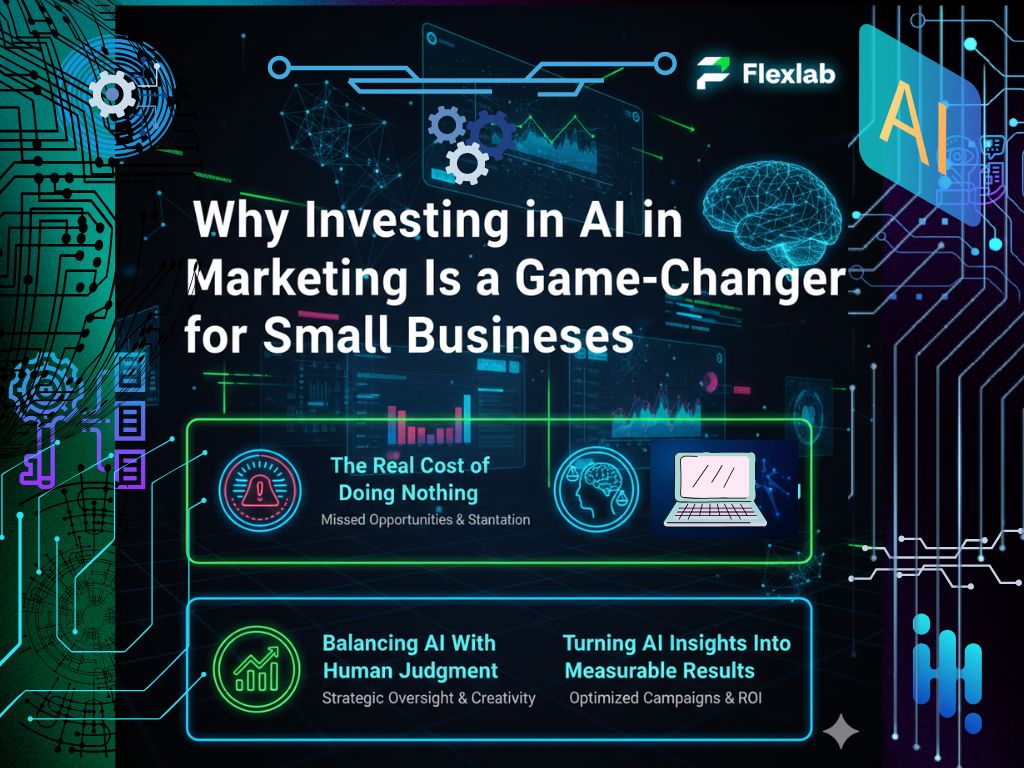
For small businesses in 2026, AI in marketing has evolved from a support tool into the core engine behind growth and efficiency. The benefits are tangible: improved decision-making, accelerated campaigns, and higher-quality leads. Meanwhile, the cost of doing nothing has become measurable, making AI adoption a strategic necessity rather than an option.
The Real Cost of Doing Nothing
Industry estimates show that staying manual can cost between $500 and $2,000 per month in lost time, missed opportunities, and inefficient campaigns. For instance, a small e-commerce business that delays AI-driven email marketing optimization loses over $1,200 in potential monthly revenue because manually curated campaigns fail to convert high-intent leads on time. Clearly, delaying AI adoption can directly impact both revenue and market positioning.
Balancing AI With Human Judgment
AI delivers scale and speed, but human oversight ensures campaigns are ethical, accurate, and customer-focused. Brands that succeed in the agentic era feed structured data through GEO and UCP, while maintaining messaging that resonates with real people. For instance, a local service provider automated lead scoring and follow-up reminders with AI, while the marketing manager assembled the messaging tone. Within two months, conversion rates improved by 32%, showing the power of combining human insight with AI automation.
Turning AI Insights Into Measurable Results
Small businesses can leverage AI insights immediately to drive real growth. A boutique retail brand implemented predictive analytics to identify products likely to sell out, adjusting campaigns in real time. This resulted in a 20% increase in monthly sales and reduced overstock costs by 15%, demonstrating that actionable AI insights deliver both efficiency and revenue. To learn more about how these strategies work, explore our full range of services or check our AI marketing blog for case studies and insights.
Drive Higher ROI in AI Marketing With Flexlab
Take your business marketing to the next level with AI-powered systems that actually deliver results. At Flexlab, we build fully integrated solutions that combine automation, predictive insights, and human-led strategy to boost revenue and efficiency.
Curious how we’ve delivered results for other businesses? Want to dive deeper into AI strategies? Check out our services or read more insights on our blog. Stay connected and ahead of the curve by following us on LinkedIn for the latest in AI marketing, automation, and digital growth.
Act now and move with intent. When deployed with the right structure, AI transforms campaigns, accelerates workflows, and drives qualified leads at scale. Flexlab turns advanced technology into a measurable growth engine built for performance, not experimentation. To expand your strategy further, explore insights that sharpen execution and decision-making:
- Innovative AI Applications You Can Implement Today
- Blockchain Marketing 101: How It Works and Why It Matters
- How to Choose the Right AI Automation Agency in Toronto (Checklist for 2026)
When you’re ready to move faster and smarter, contact us today to turn strategy into a revenue-driving AI marketing system.
Final Thoughts on AI in Marketing for Small Businesses
AI in Marketing Worth the Investment for Small Businesses has moved from theory to real-world results. When applied with clear goals and the right strategy, it gives small teams a genuine edge, not someday, but right now. By investing in the right infrastructure, owning first-party data, and balancing AI speed with human judgment, AI shifts from an expense into a measurable growth driver.
Instead of chasing every new tool, the businesses that win in 2026 focus on connected systems, trust-driven marketing, and smart execution. They use AI to strengthen decision-making, deepen customer relationships, and scale what already works. Ultimately, AI delivers the most value when it amplifies strategy, supports human creativity, and drives sustainable revenue growth.
Ready to Take Your AI Marketing Strategy to the Next Level?
📞 Book a FREE Consultation Call: +1 (416) 477-9616
📧 Email Us: info@flexlab.io
How long does it take for AI in marketing to show results for small businesses?
Most small businesses see early results from AI in marketing within 30 to 60 days, especially from email automation, ad optimization, and lead scoring. Over time, stronger gains come from improved visibility in AI-driven search and better-qualified leads. However, consistent use and clear goals matter more than speed. When AI supports strategy instead of replacing it, results compound faster.
Is AI marketing expensive for small businesses to maintain?
AI marketing doesn’t have to be expensive. Many small businesses start with affordable tools that replace multiple manual tasks at once. In fact, AI often lowers overall marketing costs by saving time and improving conversion rates. The real expense usually comes from poor setup, not the technology itself. When used strategically, AI becomes a cost saver, not a budget drain.
Can AI marketing work without paid ads or large marketing budgets?
Yes, AI marketing works even without paid ads. Small businesses can use AI for content optimization, email personalization, CRM automation, and AI search visibility. These channels drive long-term traffic and leads without ongoing ad spend. When paired with strong first-party data, AI helps businesses grow organically while staying competitive against larger brands.