How Enterprise AI Solutions Modify Large Organizations
Agentic AI vs Generative AI | Marketing Automation | Automated Machine Learning
Looking at why we need enterprise AI solutions? Imagine cutting operational costs by 40%, predicting equipment failures before they happen, and serving customers 24/7 with human-like intelligence; all powered by enterprise AI solutions. In 2026, large organizations aren’t just adopting AI; they’re embedding agentic AI, autonomous agents, and generative AI models across CRM software, ERP systems, and cloud computing security frameworks to stay ahead.
This complete guide reveals how enterprise AI applications are transforming intelligent automation, risk management, and healthcare technology. Furthermore, if you’re ready to lead with enterprise AI, then let’s dive into the strategies, tools, and real-world results that are driving business transformation today.
What is Enterprise AI?
Enterprise artificial intelligence (AI) is the integration of advanced AI technologies within a large organization to enhance business functions and tackle challenges. It leverages machine learning, deep learning models, generative AI models, natural language processing (NLP), computer vision, retrieval augmented generation (RAG), and agentic process automation for large-scale operations. Using AI development tools, it automates processes, boosts decision-making, and creates innovative services while integrating with CRM software, enterprise resource planning (ERP), and cloud security frameworks.
Enterprise AI is not just simple automation; in fact, it goes beyond that. Specifically, enterprise automation uses AI to resolve complex business problems that require human-like intelligence. For example, this may include understanding customer behavior, optimizing logistics, or detecting fraud.
While handling large datasets and sophisticated algorithms, enterprise AI unlocks insights, optimizes operations, and brings innovation across numerous departments and functions.
Examples of Enterprise AI
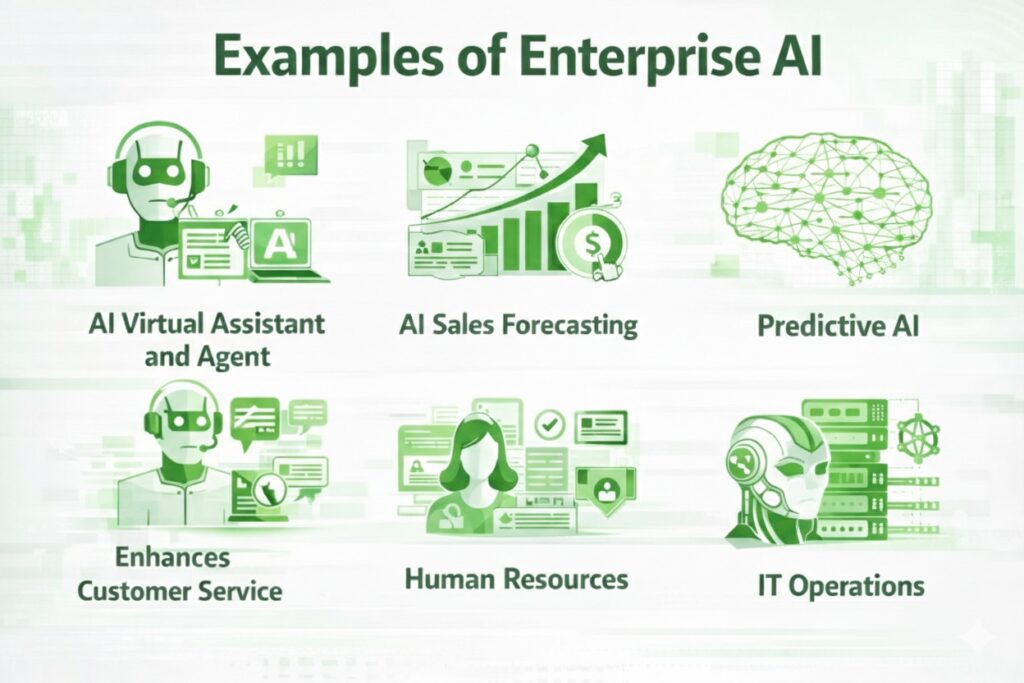
Enterprise AI offers a wide range of use cases and has been supported by several industries and organizations. Here are some examples of organizations that are leveraging AI to drive tangible results.
- AI Virtual Assistant and Agent
- AI Sales Forecasting
- Predictive AI
- AI in Fraud Detection
- Human Resources
- IT Operations
AI Virtual Assistants and Agents
Klarna uses AI agents to handle over two-thirds of customer chats, thereby reducing response times and achieving high satisfaction rates. Similarly, L’Oréal deploys AI-powered beauty advisors in retail to deliver personalized product recommendations. Meanwhile, Volkswagen’s myVW app features a virtual assistant powered by Gemini for troubleshooting vehicle issues like tire changes or dashboard lights.
AI Sales Forecasting
Coca-Cola applies AI to internal and market data. Thus, it boosts sales forecasting accuracy by over 20%, optimizing production and minimizing waste. Sojern, a travel marketing platform, uses Vertex AI to process billions of traveler signals. As a result, it cuts audience generation time from weeks to days and improves cost-per-acquisition by 20-50%.
AI Predictive Maintenance
Manufacturing firms use AI to predict equipment failures from sensor data. Consequently, it reduces downtime by up to 50% through AI orchestration. Meanwhile, UPS Capital’s DeliveryDefense leverages enterprise machine learning on shipping data for delivery success predictions, thereby enhancing logistics reliability.
AI Fraud Detection
Banks use AI for real-time fraud detection by spotting unusual transaction patterns. Consequently, it outperforms rules-based systems and cuts response times by up to 60%, thereby enhancing risk management. For instance, Commerzbank integrates AI to streamline customer service while simultaneously flagging fraud risks efficiently.
Human Resources
Upwork uses Vertex AI for faster talent matching and hiring through text-to-speech capabilities. Meanwhile, Wotter’s Gemini-powered assistant analyzes employee sentiment, therefore predicting flight risks and suggesting retention strategies.
IT Operations
Accenture transforms retailer support by implementing self-service virtual assistants on Google Cloud. Meanwhile, Atmira’s SIREC platform handles 114 million monthly debt collection requests, thereby boosting recovery rates by 30–40% and cutting costs by 54%.
Benefits of Enterprise AI
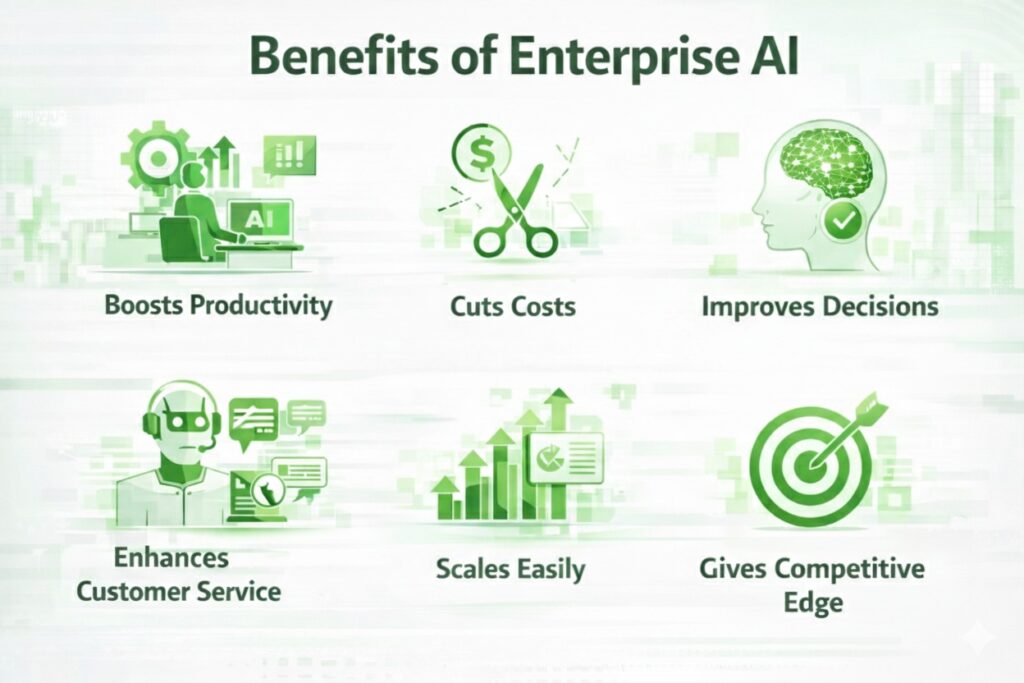
Enterprise AI drives productivity via intelligent automation and generative AI models. It brings real advantages to big businesses by making them work smarter and faster. For example, it automates boring tasks so teams can focus on big ideas, and it helps companies save money while growing stronger.
1. Boosts Productivity
Enterprise AI platforms automate repetitive tasks such as data entry and basic checks, freeing employees to spend less time on routine work. Therefore, teams get more done and focus more on creative work. Moreover, companies would see up to 30% increase in output from streamlined operations.
2. Cuts Costs
By optimizing processes, automating tasks, and fixing errors, AI solutions for enterprises significantly reduce costs. They detect inefficiencies and streamline operations so that the organization focuses on growing. For example, predictive maintenance stops machine breakdowns before they happen. Overall, businesses report 15-40% savings in operations.
3. Improves Decisions
AI crunches huge data piles quickly to spot trends and give smart insights. Therefore, leaders make better choices faster, like forecasting sales or spotting risks. This leads to quicker responses in changing markets.
4. Enhances Customer Service
Chatbots offer 24/7 help and personalize chats based on what customers like. Consequently, people feel heard, stay loyal, and satisfaction scores rise. Retailers use it for tailored recommendations that boost sales.
5. Scales Easily
As the business grows, AI handles more data or tasks without extra hires. Moreover, it adapts to changes like busy seasons. This keeps operations smooth even during rapid expansion.
6. Gives Competitive Edge
Companies using enterprise generative AI applications innovate faster and stay ahead of rivals. For example, new revenue ideas come from AI insights. In short, it turns data into real growth advantages.
Challenges of Enterprise AI
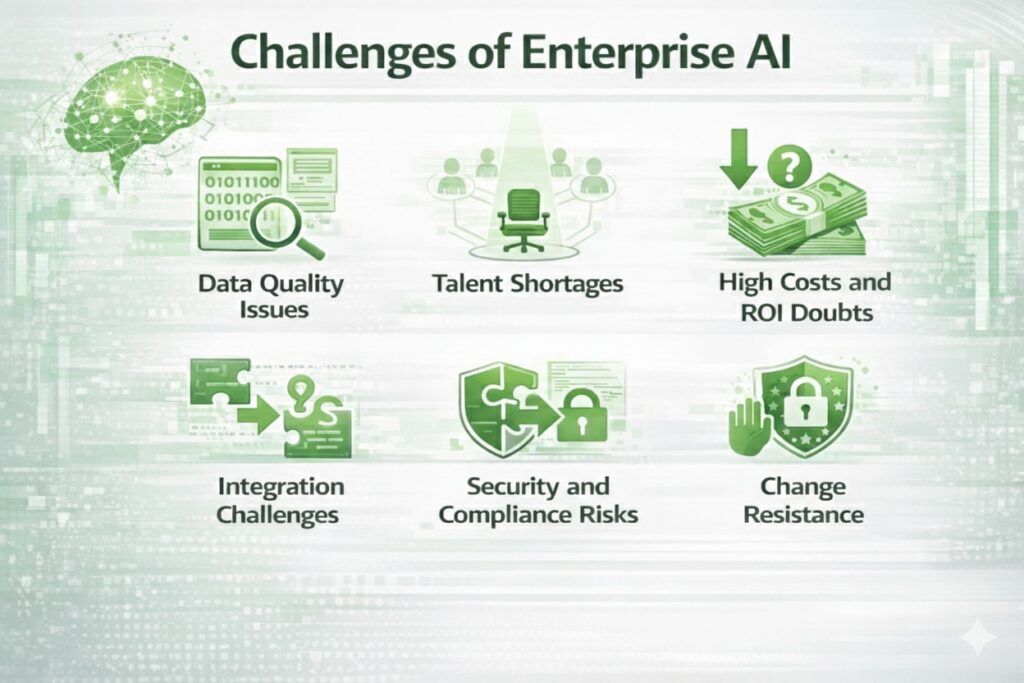
Enterprise AI promises big gains, but it comes with real hurdles that slow things down. Companies often struggle with data problems, skill gaps, and high costs, which is why many projects stall or fail to deliver.
Data Quality Issues
Poor or biased data trips up 73% of projects. Thus, it leads to unreliable results and delays of six months or more. For instance, old datasets can bake in unfair patterns, creating legal risks in hiring or lending. Fixing this means cleaning data first, but that’s time-consuming and expensive.
Talent Shortages
Most organizations lack experts to build and run AI systems, with 68% facing skill gaps. As a result, they rely on outside help or training, which adds costs and slows rollout. Upskilling teams helps, yet finding specialists remains tough.
High Costs and ROI Doubts
Upfront spending on tech, talent, and infrastructure is steep, and proving quick returns is hard; 42% struggle here. Moreover, leaders cut funding when benefits take too long to show. Starting small with clear metrics can build buy-in over time.
Integration Challenges
Old systems don’t play nice with AI, causing bottlenecks in 86% of cases for things like real-time data flow. Consequently, scaling across departments becomes a nightmare without major upgrades.
Security and Compliance Risks
AI opens doors to breaches or biased decisions, therefore demanding constant monitoring. Otherwise, firms may face fines or damage to trust.
Change Resistance
Employees fear job loss or distrust AI outputs, stalling adoption. Therefore, training and clear communication are key to shifting mindsets.
Top 10 Enterprise AI Solutions
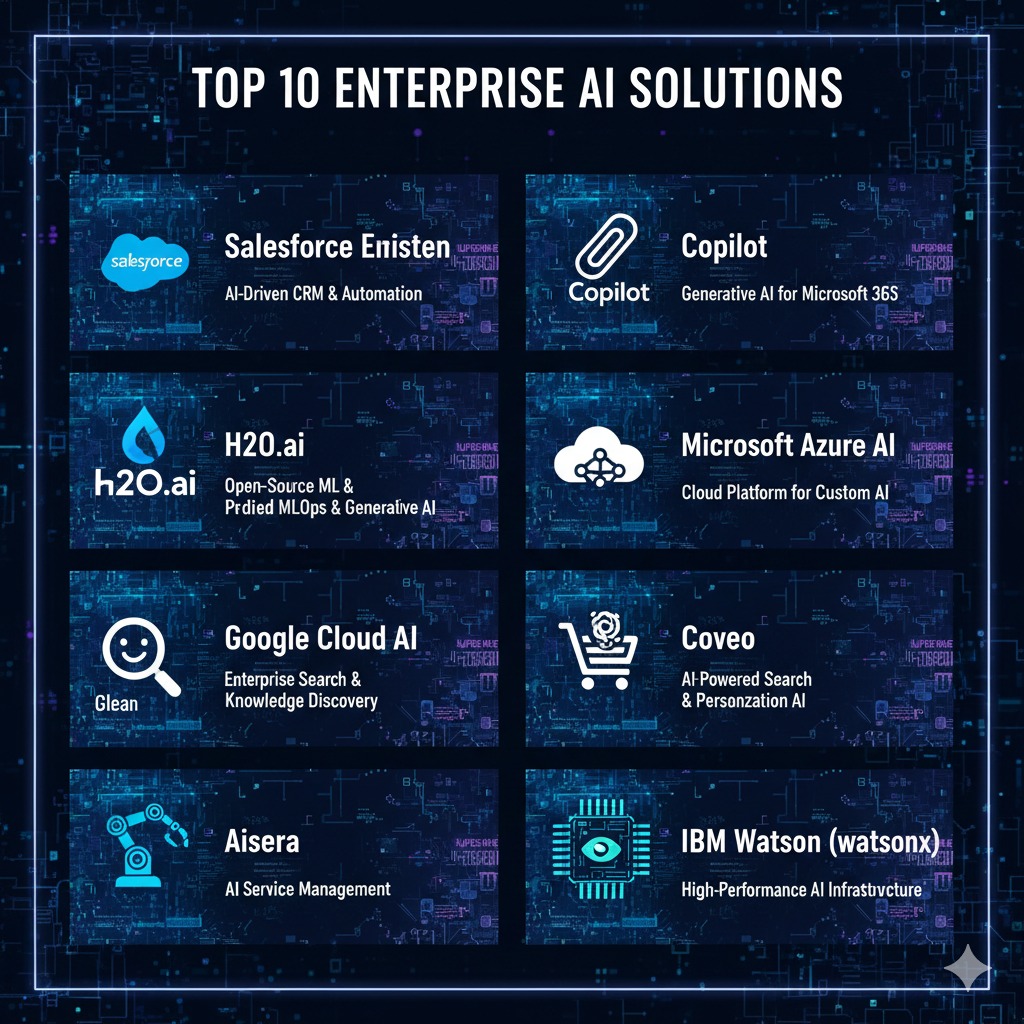
Here are the top enterprise AI tools and platforms that transform your business with scalable automation, smarter decisions, and real ROI. Leaders like these handle everything from IT support to predictive analytics, fitting seamlessly into CRM, ERP, and cloud stacks for 2026 enterprises.
1. Salesforce Einstein
It was launched in 2026. Salesforce Einstein embeds predictive AI directly into CRM, so you get insights without data prep hassles. It powers sales, service, and marketing with automation that feels native to Salesforce users. Furthermore, businesses report higher close rates and retention thanks to its no-code smarts.
Key features:
- Einstein Bots manage routine customer queries, escalating complex ones to humans.
- Einstein Prediction Builder crafts models for lead scores or churn risks; therefore, no coding is required.
- Einstein Vision and Language analyzes images and text for deeper customer insights.
- AI Copilot features generate emails, summaries, and forecasts in real time.
- Scales with Salesforce growth for enterprise-wide use.
2. H2O.ai
H2O.ai’s AI cloud platform shines in hybrid environments, as it blends cloud, on-prem, and edge setups effortlessly. Moreover, it is built for data scientists and business users alike, thereby speeding ML from prototype to production. Consequently, enterprises choose it for reliable, transparent AI that handles massive datasets securely.
Key features:
- AutoML automates model selection and tuning for top accuracy fast.
- Explainable AI breaks down decisions to build stakeholder trust.
- NVIDIA RAPIDS integration accelerates workflows on CPUs and GPUs.
- Supports Driverless AI for end-to-end automation.
- Open-source core keeps costs down while scaling enterprise needs.
3. Google Cloud AI
Google Cloud AI delivers battle-tested performance with tools trusted by millions for a competitive edge. From search to recommendations, it processes unstructured data at scale. It’s perfect for businesses already in GCP, therefore, offering seamless security and global reach.
Key features:
- Customer Engagement Suite uses Tau VMs for cost-effective, high-performance AI.
- Document AI extracts and classifies info from PDFs, scans, and forms accurately.
- Vertex AI boosts e-commerce with personalized search and recs.
- Multimodal AI handles text, image, and video inputs.
- Built-in governance for compliant deployments.
4. Glean
Glean revolutionizes workplace search by unifying enterprise data into one AI-powered hub. Employees find answers instantly, while admins control access tightly. It powers agents and apps that automate routine work, saving hours weekly.
Key features:
- AI extracts and classifies document data for effortless entry.
- Generative AI builds apps for FAQs, IT tickets, and custom content.
- Data governance supports GDPR, CCPA, and sensitive data discovery.
- Connectors to Slack, Google Workspace, Jira, and more.
- Analytics track usage for continuous improvement.
5. Aisera
Aisera’s universal copilot brings agentic reasoning to every department, thereby unifying tools for proactive automation. As a result, it cuts tickets by over 50% through smart orchestration. Consequently, it is ideal for enterprises seeking a single AI layer over fragmented systems.
Key features:
- AI search spans all data sources for precise, instant answers.
- Single copilot integrates tools for seamless, department-wide support.
- Agentic reasoning executes tasks accurately on the first try.
- Low/no-code builders for custom agents.
- ITSM, HR, and sales-specific LLMs.
6. Microsoft Copilot
Microsoft Copilot embeds generative AI across 365 apps, thereby turning everyday tools into smart assistants. In particular, it boosts output in Word, Excel, Teams, and PowerPoint. As a result, productivity jumps 29% on average for users.
Key features:
- Content generation drafts docs, emails, and ideas quickly.
- Excel data analysis spots trends, builds charts, and summarizes.
- Meeting insights recap calls, highlight actions, and assign tasks.
- Custom GPTs for company-specific needs.
- Enterprise-grade security in familiar apps.
7. Microsoft Azure AI
Azure AI equips enterprises to create custom generative AI at any scale, while offering flexible pricing. Moreover, it spans everything from models to deployment, with end-to-end security. Consequently, it pairs perfectly with Microsoft stacks or hybrid environments.
Key features:
- Model Catalog offers 1,700+ ready models from leaders.
- Azure AI Foundry (ex-AI Studio) builds and manages agents/apps.
- Content Safety filters for responsible outputs.
- Marketplace for partners like Moveworks.
- Pay-as-you-go avoids high upfront costs.
8. Coveo
Coveo transforms customer journeys with relevance-driven AI search and personalization. In addition, it uses LLMs to provide natural answers across web, mobile, and support channels. As a result, conversion rates rise as users find what they need quickly.
Key features:
- Intent-aware search delivers spot-on results.
- Generative answers from trusted LLMs.
- Recommendations are predicted based on behavior.
- Omnichannel for service, commerce, and site search.
- Usage analytics are optimized continuously.
9. IBM Watson
IBM’s watsonx portfolio leverages decades of AI expertise to deliver trustworthy enterprise apps. Moreover, it scales data and models anywhere, while offering no-code options for all. In addition, its hybrid focus makes it well-suited for regulated industries.
Key features:
- Watsonx.ai for tuning/deploying foundation models.
- It handles petabyte-scale AI workloads.
- Watsonx Assistant builds virtual agents code-free.
- Governance toolkit for bias and ethics.
- Open ecosystem with partners.
10. NVIDIA
NVIDIA powers the AI ecosystem with hardware and software optimized for generative AI at scale. As a result, it cuts training time from months to days. Furthermore, it is essential for high-compute enterprise inference.
Key features:
- Generative AI stacks for production apps.
- Data science acceleration with RAPIDS.
- Inference engines for low-latency serving.
- Enterprise support and NIM microservices.
- Full-stack from chips to apps.
How Do I Implement Enterprise AI?
Implementing enterprise AI solutions needs a clear plan to avoid headaches like bad data or failed tests. First, get your leaders on board, then pick big-win opportunities. After that, prep your data, test small, and roll out step by step for real results.
Step 1: Define Strategy
Start by getting executives excited, secure 3-5% of revenue as budget, and build a team with IT, legal, and business folks. Next, pick 2-3 high-value problems like losing customers or supply delays where AI can shine. Finally, create a roadmap with clear goals, 18-36 month timelines, and targets like 20% cost savings.
Step 2: Assess Readiness
Check your data quality across all systems since poor data kills 73% of projects. Then, review your tech setup for cloud or hybrid needs and skills; most companies lack AI experts. Also, set up governance early for ethics, bias checks, and compliance to avoid fines later.
Step 3: Build Foundation
Clean and connect data pipelines for real-time use. Choose platforms like Vertex AI or Azure that fit your current tech. Meanwhile, train staff or hire experts, and build simple prototypes like chatbots to gain momentum.
Step 4: Run Pilots
First, choose low-risk, high-reward tests (8–16 weeks) with good data, for example, predicting machine breakdowns. Then, test autonomous agents thoroughly, track results against goals, and collect feedback. As a result, success proves value; for instance, Coca-Cola’s forecasts improved by 20% following this approach.
Step 5: Scale and Integrate
Roll out gradually: one department first, then company-wide over 6-18 months. Train users, watch performance closely, and connect to old systems smoothly. Use extra support to fix issues quickly during growth.
Step 6: Optimize and Govern
Keep tracking ROI with dashboards and tweak models as data changes. Also, manage change to reduce pushback. Finally, smart companies reinvest savings into new AI uses like Flexlab solutions.
Why Choose Flexlab for Enterprise AI?
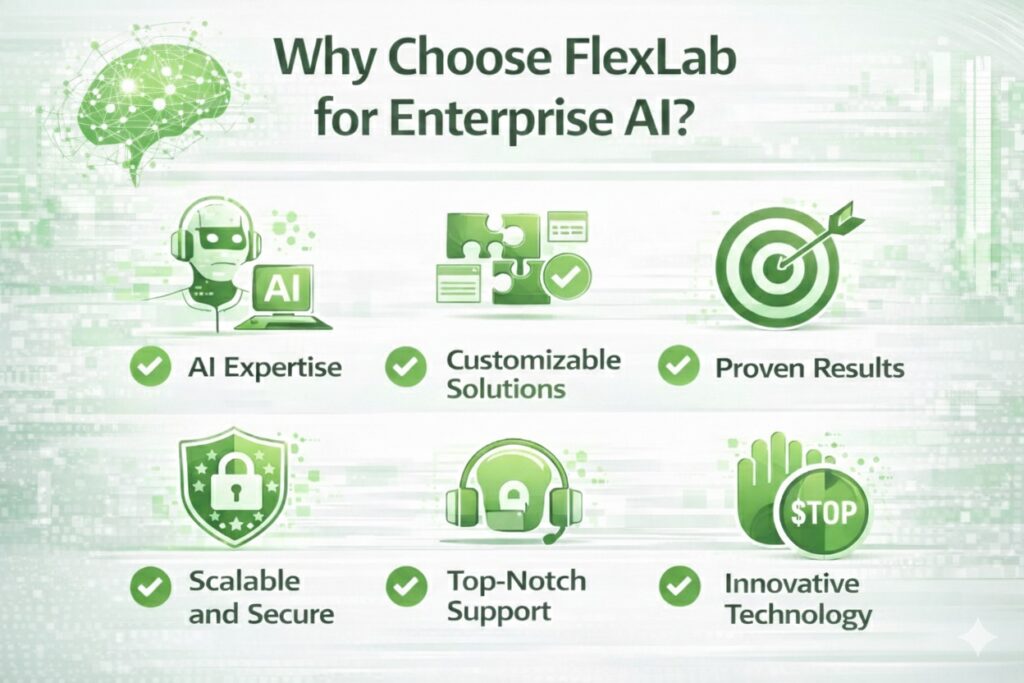
Flexlab specializes as a leading AI automation agency, offering AI automation services and delivering custom enterprise AI solutions with blockchain integration for industries like finance, healthcare, supply chain, retail, legal, and cybersecurity. Unlike off-the-shelf platforms, Flexlab engineers tailored chatbots, predictive analytics, multi-agent workflows, and real-time decision systems using top models from OpenAI, Claude, Google Vertex AI, and Ollama.
For example, proven results include 65% fee reductions for traders at Hoodwinked Trades and 95% valuation accuracy for 500+ dealerships at AppraiseAll, making it ideal for organizations seeking scalable, secure AI that drives measurable ROI.
Conclusion
Enterprise AI solutions transform large organizations through intelligent automation, better decisions, and real cost savings. From AI virtual assistants to predictive analytics, the right solutions deliver measurable ROI when implemented strategically.
For instance, partner with experts like Flexlab for custom enterprise AI that fits your CRM, ERP, and business needs. Then, contact us or visit our LinkedIn page for solutions that deliver 65% cost reductions and 95% accuracy.
Explore our blockchain and AI blog page and discover 11 Best AI Tools in 2026,10 Day Trading Strategies, Innovative AI Applications, Automation Testing, AI Strategy Consulting, 22 Best AI Marketing Tools, and What Are Generative AI Applications?
Ready to Implement Enterprise AI?
📞 Book a FREE Consultation Call: +1 (416) 477-9616
📧 Email us: info@flexlab.io
What is an enterprise AI solution?
An enterprise AI solution is scalable AI software or platform designed for large organizations, integrating with ERP, CRM, and legacy systems to automate workflows, provide predictive analytics, and ensure compliance/security. Unlike consumer AI, it handles massive data volumes with governance for business-wide use.
What is the difference between AI and enterprise AI?
Regular AI targets consumers and small businesses with simple, off-the-shelf tools and basic features. In contrast, enterprise AI delivers sophisticated, customized solutions for large organizations, integrating deeply with their systems for scale, security, and compliance.
Who provides the best AI solutions for enterprise?
Top providers in 2026 include Flexlab (custom AI automation with blockchain), SiliconFlow (fastest inference), Google Vertex AI (comprehensive ML), IBM Watson (compliance), Microsoft Azure AI (model variety), and Kore.ai (agents). In short, Best depends on needs, Vertex for GCP users, and Azure for Microsoft stacks.