
Top 8 Benefits of AI in Supply Chain Management in 2026

Benefits of AI in Supply Chain

Key Advantages of AI in Supply Chain Management

AI in Marketing | Enterprise AI Solutions | AI Applications

What are the benefits of AI in the supply chain? AI is slashing supply chain costs by 20-50%. Walmart keeps 98%of its  shelves stocked, UPS saves $400Mannuallyy on fuel, and Amazon delivers Prime in hours. But your supply chain operations? Stockouts are bleeding $1.2M, data silos are killing forecasts, and manual chaos is wasting millions.

This guide reveals exactly how AI delivers these results, from AI demand forecasting accuracy to predictive maintenance and the hidden challenges tripping up 87% of implementations. Most importantly, discover Flexlab’s 30-Day AI Blueprint that turns your messy enterprise resource planning ERP system data into Amazon-level efficiency without $2M setups or 12-month delays.

Ready to unlock 28% cost savings like your competitors? Let’s dive in.

What is AI in Supply Chain?

Businesses nowadays leverage AI to handle and optimize supply chain tasks, such as monitoring product quality, balancing the right amount of inventory stocks, and finding the best delivery routes via transportation management systems with more efficiency than traditional or old software.

Artificial Intelligence (AI) is a general term for applications that act like smart humans and do complex tasks. It is a big part of machine learning (ML), where systems learn from consuming tons of data instead of following step-by-step instructions. This lets AI beat regular supply chain management software at things like deciphering information from videos, understanding speech or text, guessing future markets with predictive modeling, deciding in tricky situations, and finding hidden info in huge data piles.

These skills help fix and speed up workflow in supply chains everywhere. For instance, supply chain systems powered by ML algorithms can spot patterns in data that people miss, so it forecasts what customers demand more accurately. Hence, it leads to more economically efficient inventory management without any waste. Moreover, AI in transportation also checks traffic and weather to suggest faster routes, cutting delays. It watches work areas to catch bad quality checks or safety problems using Internet of Things devices. And new ideas like generative AI in supply chain and autonomous AI agents keep popping up as people test AI more.

The Importance of AI in Modern Supply Chain Management
The Importance of AI in Modern Supply Chain Management

Supply chains, especially in the US, have faced more attention lately due to disruptions and risks. 

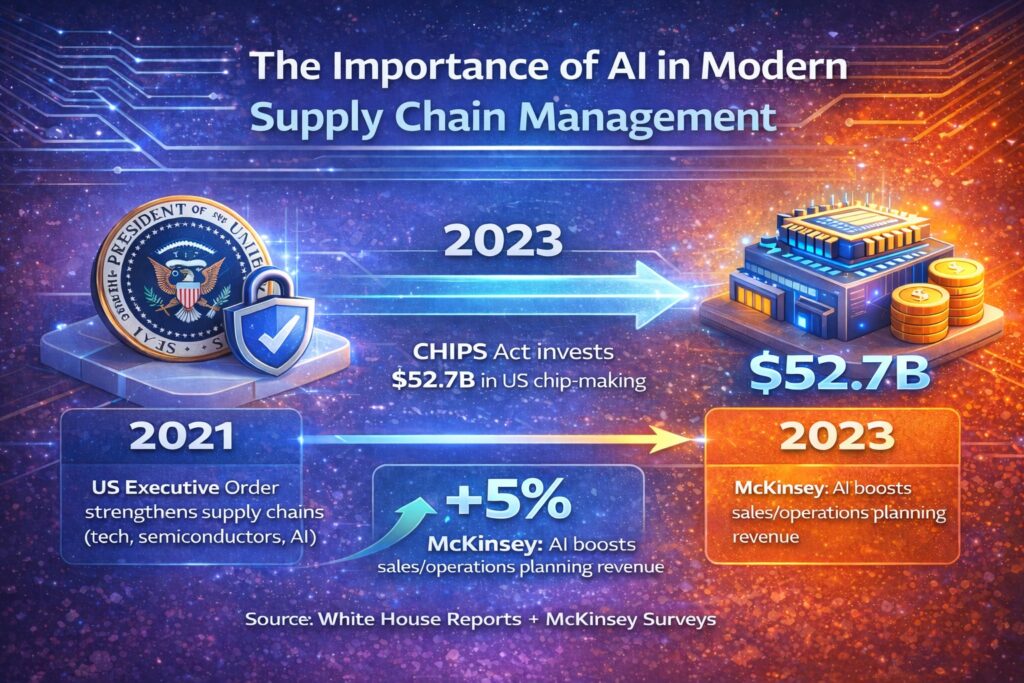
In 2021, the US President signed an Executive Order to strengthen key supply chains, like tech, semiconductors, and AI. The goal was to make America’s supply chains tougher against problems like foreign threats, cyberattacks, and climate issues, while keeping AI tech competitive and safe via a resilient supply chain.

By 2023, a White House progress report showed real steps forward. The CHIPS and Science Act poured $52.7 billion into US chip-making, which powers AI. They also boosted training and research to spark AI innovation.

A new Executive Order focused on safe, reliable AI. Additionally, partnerships like the Indo-Pacific Economic Framework built stronger global chains for digital products, cutting risks in raw materials and boosting US leadership in AI.

These moves not only fix weak spots but also drive AI-powered progress while protecting the technology behind the AI boom. Moreover, recent McKinsey surveys confirm the payoff. In fact, most companies report that AI has boosted sales and operations planning revenue by over 5%. As a result, businesses are increasingly prioritizing AI investments to stay competitive.

Why use AI in Supply Chains?

AI offers companies a great chance to simplify operations and beat competitors in supply chains. It helps businesses predict customer demand accurately, spot risks early via supply chain analytics, and make smart choices based on data, which saves money and boosts supply chain efficiency.

Moreover, AI also takes over routine jobs like managing stock levels, finding the best delivery routes, and picking suppliers. This lets workers focus on big-picture supply chain strategies instead of daily chores.

In short, achieving this level of precision and efficiency in today’s fast-moving supply chains without AI would be nearly impossible.

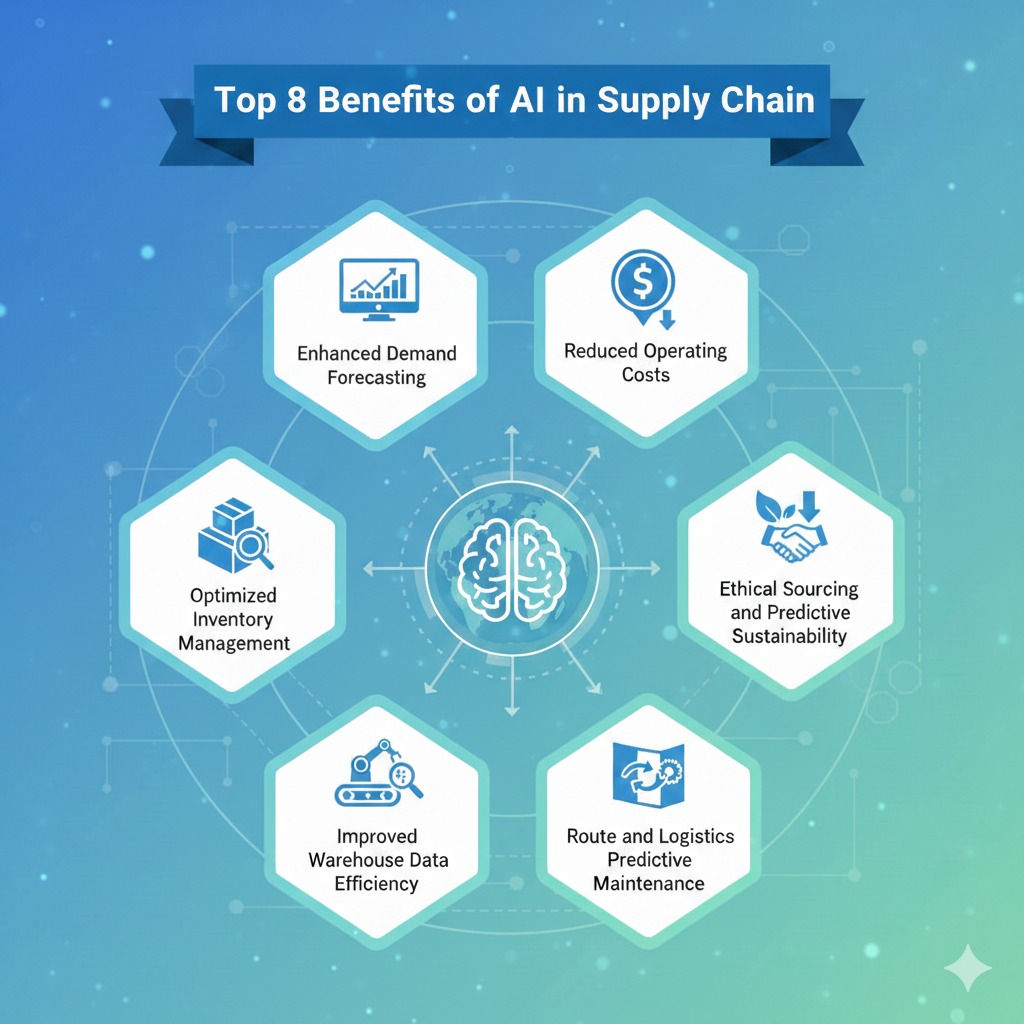
Top 8 Benefits of AI in Supply Chain 
Top 8 Benefits of AI in Supply Chain

The future of supply chain worked well with AI technology, where no manual intervention is required. Let’s read some of the potential benefits of AI in supply chain management.

  1. Enhanced Demand Forecasting
  2. Optimized Inventory Management
  3. Improved Warehouse Efficiency
  4. Real-Time Data Analysis
  5. Reduced Operating Costs
  6. Ethical Sourcing and Sustainability
  7. Route and Logistics Optimization
  8. Quality Control and Predictive Maintenance

1. Enhanced Demand Forecasting

AI systems ingest vast datasets, such as past sales, weather patterns, social media sentiment, economic indicators, and even geopolitical events, to accurately forecast customer demand. In contrast, traditional methods depend on human estimates or basic spreadsheets. Thus, this approach often misses 20-50% of real needs, whereas AI machine learning improves accuracy by 30-50% over time as they learn from new data. 

For example, retailers like Walmart use AI to forecast seasonal spikes, avoiding overstock during slow periods or shortages during peaks. Hence, it directly accelerates profits and customer satisfaction.

2. Optimized Inventory Management

AI optimizes inventory management. This can be done by analyzing sales data, supply chain dynamics, and external variables that maintain ideal stock levels. In this way, businesses strike a delicate balance between having enough stock to meet demand and avoiding excessive stock that incurs holding costs using supply chain tools. Moreover, AI systems automatically reorder stock when stock levels fall below a predefined threshold. 

Therefore, it ensures a smooth replenishment without human intervention. It automates reorder points and knows when to order and how much, so you save big on storage fees and never run out of products. For instance, companies like Amazon that integrate AI with robotics, where AI signals restocking in seconds after detecting low shelves. Hence, it ensures products move efficiently, minimizes obsolescence, boosts cash flow, and ROI on storage assets without human delays.

3. Warehouse Efficiency

AI makes warehouses work better and faster. AI coordinates, organizes, and manages autonomous robots, automated guided vehicles AGVs, and smart picking systems to streamline receiving, storage, order fulfillment, and shipping. It helps in organizing shelves and warehouse layouts smartly. Machine learning looks at how much stuff moves through each aisle. It then suggests the best floor plans to grab items quicker, from unloading trucks, to storage racks, to packing, and out the door. 

AI also maps the fastest paths for workers and robots to move goods around. This speeds up orders and cuts walking time. Plus, it checks demand clues from sales, marketing, and factories. This forecasts needs perfectly, balancing stock levels so warehouses don’t waste space or run empty.

For example, companies like Logiwa leverage AI in their warehouse and inventory management software to improve efficiency, accuracy, and decision-making capabilities. An AI system leads to a significant reduction in cost and enhances operational efficiency in warehouse operations.

4. Real-Time Data Analysis

AI systems improve real-time tracking that allows for better inventory management and the movements of goods and products. There are IoT sensors combined with AI that provide end-to-end tracking from suppliers to customers. Thus, it highlights issues such as temperature fluctuation for perishables or delays at ports instantly. Dashboards alert managers to anomalies, improving transparency and collaboration across partners. In practice, this helped companies during COVID disruptions by rerouting shipments proactively, reducing late deliveries from 25% to under 5%.

Furthermore, AI-powered supply chain systems improve logistics efficiency while optimizing delivery routes based on real-time data and AI predictive analytics. Thus, this approach improves resource allocation and faster delivery times.

5. Reduced Operating Costs

AI slashes supply chain operating costs by automating repetitive tasks via supply chain automation, boosting machinery performance, and cutting human errors for smoother operations. It perfects documentation accuracy, predicts equipment breakdowns early, and optimizes transportation routes by factoring in traffic, weather, and other conditions, suggesting faster alternatives that can trim logistics expenses by up to 30%. 

For example, Uber Freight uses algorithms to minimize empty truck miles through smart routing, while early AI adopters report 15% overall logistics savings, proving a massive impact across entire networks.

6. Ethical Sourcing and Sustainability

How can AI enhance sustainability in supply chains? AI checks supplier info against green standards, like fair labor, pollution levels, water use, and avoiding conflict minerals. Blockchain proves where materials really come from. It tests eco-friendly options, like low-carbon suppliers, to cut company emissions by 10-20%. 

AI Tools like Oracle spot bad suppliers instantly, helping follow rules such as Europe’s CSRD or US SEC laws. Businesses get “green” badges faster, cut waste with reusable packaging, and attract planet-friendly buyers. Sustainability becomes a money-saver and an edge over rivals, with generative AI in the supply chain simulating eco-scenarios for better decisions.

7. Route and Logistics Optimization

By processing live data on traffic, weather, fuel prices, vehicle capacity, and delivery windows, AI in transportation calculates the most efficient routes, sometimes rerouting mid-trip to avoid jams. This cuts transportation costs by 10-20%, reduces fuel use by 15%, and shortens delivery times by 18% on average. US logistics firms like UPS save millions yearly with tools like ORION, which optimizes 55,000 drivers’ paths daily, lowering miles driven and carbon emissions through transportation management systems TMS software.

8. Quality Control and Predictive Maintenance

Computer vision AI inspects products via cameras for defects at high speeds, catching issues humans miss, while predictive analytics forecasts equipment breakdowns using vibration and usage data from Internet of Things IoT devices. This drops defect rates by 40% and maintenance costs by 25%, extending machine life. Food manufacturers apply it to ensure compliance, avoiding recalls that cost millions. Food and pharma sectors use it for zero-defect compliance, while Oracle integrates it with ERP for automated holds/releases, preventing multimillion-dollar losses.

Challenges and Considerations in Implementing AI
Challenges and Considerations in Implementing AI

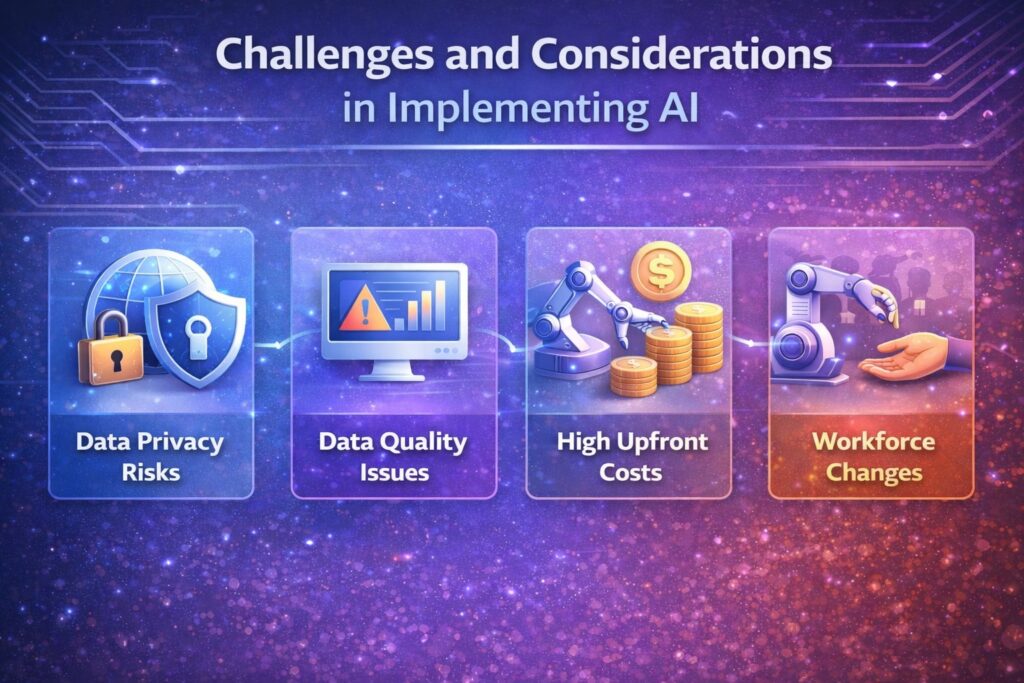
AI boosts supply chains significantly, but it also comes with real hurdles, especially for companies not ready for the switch.

  • Data Privacy Risk

Data privacy and security are the main concerns, as AI systems require vast amounts of sensitive data from suppliers, customers, and shipments, raising significant security concerns. To ensure security, businesses should comply with global regulations, such as the GDPR and the CCPA. This approach protects info and avoids fines.

For instance, EU companies face the strict EU AI Act, which demands strict data privacy, where small firms often struggle with these rules.

  • Data Quality Issues

AI algorithms work as they are trained. Therefore, companies must ensure that their data is accurate, relevant, and continuously updated to avoid erroneous predictions. Data security is a key challenge when it comes to AI adoption in industries. AI only works well with up-to-date data. Bad or messy info leads to wrong forecasts, like overstocking or missed delays.

Global supply chains make it worse: pulling data from suppliers in different countries, time zones, and formats creates integration headaches and errors.

  • High Upfront Costs

Implementing any new technology comes with upfront costs. Companies should carefully evaluate the potential benefits and ROI before investing in AI. Here are some key costs to consider:

  • Hiring AI experts to build and fix systems
  • Upgrading servers, cloud storage, and software
  • Running heavy AI models that eat power and money

However, smart firms weigh ROI first, knowing long-term savings (like 20-40% cost cuts) beat the initial hit.

  • Workforce Changes

AI impacts the workforce significantly by automating routine tasks like inventory checks and route planning, which reduces manual labor but creates an urgent need for reskilling and upskilling programs. Companies must strike a careful balance between rapid technological advancement and preserving their existing talent pool. Therefore, ensure employees don’t just survive but thrive alongside intelligent systems.

Real World Application in Supply Chain Management
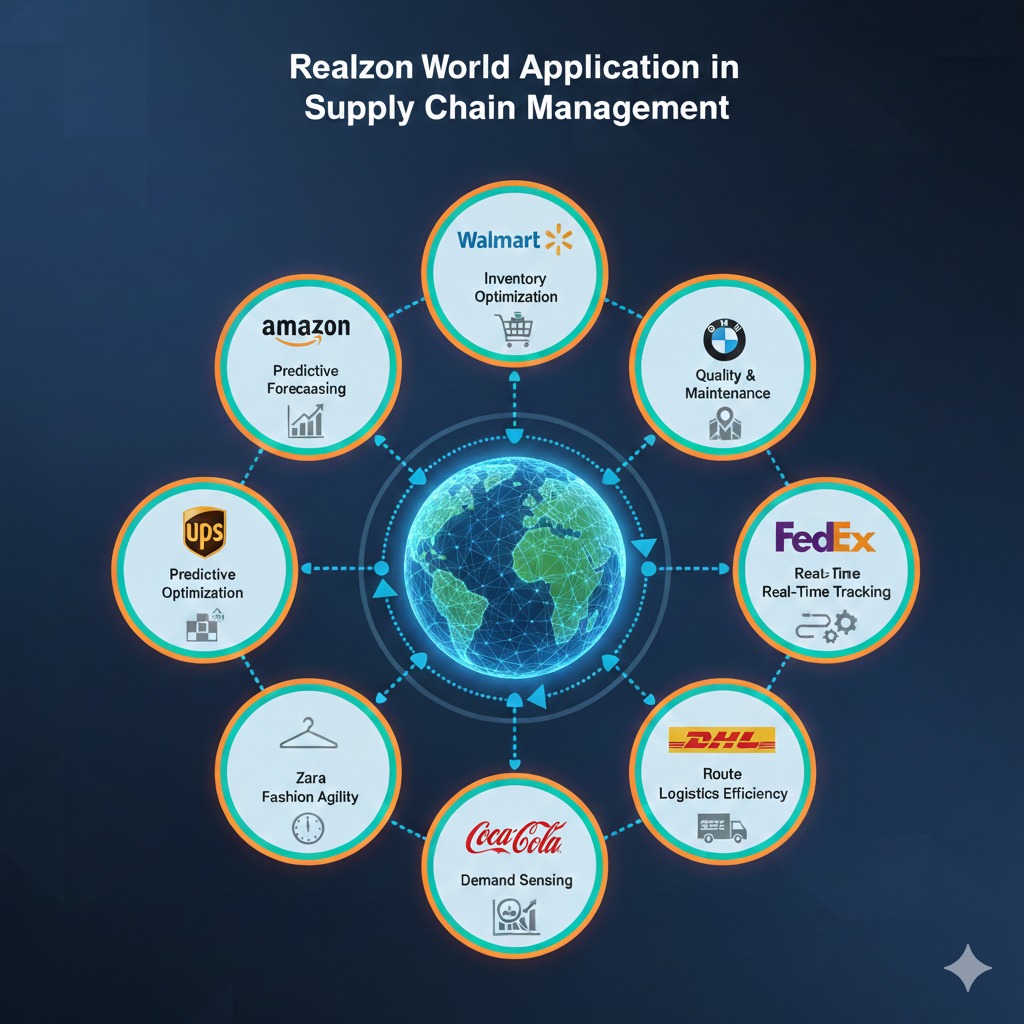
Example of AI-powered logistics and warehouse optimization in action

AI powers real-world supply chain wins at giants like Amazon and Walmart, cutting costs 20-50% via smarter forecasting and automation. Research highlights cases from UPS to Zara, proving massive ROI in efficiency and resilience.

Amazon: Predictive Forecasting

Amazon’s AI crunches sales, weather, and trends to stock warehouses perfectly. It auto-reorders 400M+ products, slashing stockouts 25% and saving billions on excess inventory, thus key to Prime’s fast delivery.

Walmart: Inventory Optimization

Walmart uses ML to adjust stock in real time across 10K+ stores based on local demand and delays. As a result, it reduced overstock 10–20% while boosting shelf availability to 98%, freeing $1B+ in tied-up cash yearly.

UPS: Route Optimization

UPS’s ORION AI plans 55K drivers’ routes daily, factoring in traffic and weather. As a result, it cuts 100M miles yearly, saves $400M in fuel, and speeds deliveries by 18%—thereby handling 20M+ packages seamlessly.

DHL: Logistics Efficiency

DHL’s AI optimizes global routes and warehouses while predicting disruptions. As a result, on-time rates improved 15%, fuel use dropped 10%, and real-time analytics now manage 1B+ shipments annually.

Zara: Fast Fashion Agility

Zara’s ML analyzes store/online sales to tweak inventory per location. Cuts markdowns 20%, sells out trends faster, thus turning 2-week design-to-shelf vs. industry’s 6 months.​

Coca-Cola: Demand Sensing

Coca-Cola’s AI blends POS, weather, social data for local forecasts. Reduced stockouts/overstocks 30%, optimized bottling/transport for 200+ countries.​

FedEx: Real-Time Tracking

FedEx Surround AI tracks fleets and predicts delays. Consequently, it reroutes critical shipments, reducing late deliveries by 20% across the global network.

BMW: Quality & Maintenance

BMW’s computer vision inspects parts on production lines, while AI predicts machine failures. As a result, defects drop 40%, and downtime falls 50% in factories.

Therefore, these apps show AI’s edge: 50% better forecasts, 65% fewer stockouts, and scalable globally.

Flexlab’s Perfect Solution: AI Supply Chain Blueprint – Built in 30 Days or FREE

Try Flexlab's 30-day AI blueprint transforming supply chain efficiency

You’ve seen the wins; Walmart’s 98% stocked shelves, UPS’s $400M fuel savings, Amazon’s zero stockouts. Flexlab makes this YOUR reality with a custom AI Supply Chain Blueprint that transforms your messy ERP data into enterprise-grade supply chain automation in 30 days, or it’s FREE.

Check our blockchain and AI blog page and discover AI Automation Agency in Toronto, Agentic AI vs Generative AI, Marketing Automation, Automation Testing, and Benefits of AI in FinTech for Businesses

Conclusion: Ai in Supply Chain Management

AI isn’t a “nice-to-have”; it’s table stakes for 2026 survival. Walmart’s 98% stocked shelves, UPS’s $400M fuel savings, and Amazon’s zero-stockout warehouses prove 20-50% efficiency gains are real and replicable. You’ve seen the benefits (65% fewer stockouts, 30% faster routes), government mandates (CHIPS Act, EU AI Act), and challenges (data silos, $500K costs, reskilling).

The gap? Execution. 87% of companies stall on implementation—you won’t.

Flexlab bridges it with your 30-Day AI Supply Chain Blueprint. Contact us now and visit our LinkedIn page to see real client feedback.

Ready to Cut Supply Chain Costs 28%?

📞 Book a FREE Consultation Call: +1 (416) 477-9616

📧 Email Us: info@flexlab.io

How do supply chains benefit from using generative AI?

Generative AI creates optimized replenishment plans, simulates what-if scenarios, and auto-generates supplier contracts from performance data boosting resilience 20-30% and cutting inventory costs via real-time demand signals. It also enhances risk mitigation by modeling disruptions proactively.

Is AI going to replace supply chain management?

No, AI evolves jobs, not eliminates them. Routine tasks (45% of roles) automate, creating new ones like AI governance, robot orchestration, and exception management. Amazon reskilled 700K+ workers into higher-paying AI-adjacent roles; supply chains gain job upgrades with less burnout.

How has artificial intelligence (AI) impacted supply chain management?

AI delivers 15-40% cost cuts, 50% better forecasts, 65% stockout reduction, seen in Amazon (zero-stockout warehouses), UPS ($400M fuel savings). 2026 trend: Agentic AI automates end-to-end planning; resilience jumps 30% via disruption modeling.


Leave a Reply

Your email address will not be published. Required fields are marked *

Smart Contract Security Standards and Principles

Blockchain Development ServicesBlockchain for StartupsBlockchain Marketing 101

Over $350 million was lost to crypto exploits in early 2026, with many attacks exploiting weak smart contract security and poorly designed protocols, according to the Reddit.com report on January 2026 crypto hacks. Every second a contract is live, attackers scan for vulnerabilities, and your code is under constant scrutiny.

Modern smart contract development demands structured threat modeling, hardened architecture, rigorous testing, and continuous monitoring. 

This guide will show you how to prevent critical smart contract vulnerabilities, implement defensive coding patterns, execute thorough audits, deploy resilient monitoring systems, and prepare a production-ready launch strategy that protects capital and builds long-term trust. Security is not optional. It is infrastructure.

Understanding Smart Contract Security

Understanding Smart Contract Security

Smart Contract Security is the backbone of any reliable blockchain system within modern blockchain technology ecosystems. Moreover, unlike traditional software, smart contracts are immutable once deployed, meaning any flaw can lead to permanent loss of funds or irreparable damage. Therefore, understanding smart contract security is essential for developers, organizations, and users engaging in decentralized finance or blockchain applications.

As per the CryptoSlate 2026 Report, in 2026 alone, over $350 million in crypto assets were lost due to insecure smart contracts. These incidents highlight why a strong foundation in security practices can prevent catastrophic financial loss. By focusing on smart contract vulnerabilities, threat modeling, and preventive principles, developers can significantly reduce risks before deployment.

What Is Smart Contract Security?

Smart contract security refers to designing, developing, and deploying blockchain contracts written in secure programming languages that are resistant to attacks, function exactly as intended, and preserve the integrity of digital assets. Unlike regular software:

  • Contracts are immutable once deployed.
  • They handle real financial value in a decentralized, trustless environment.
  • They interact with other contracts, oracles, and blockchain protocols.

A secure smart contract ensures code correctness, robust access control, and safe interactions with external systems. By anticipating potential threats, developers protect both funds and user trust in DApps.

Why Smart Contract Security Matters

Every deployed contract carries high stakes. Poor security can result in:

  • Financial loss: Millions lost in a single exploit.
  • Irreversible consequences: Unlike traditional apps, contracts cannot be patched post-deployment.
  • Reputational damage: Users lose trust instantly.
  • Regulatory scrutiny: Especially for DeFi or tokenized platforms.

According to CryptoPotato’s 2026 report, over $4 billion was lost globally in crypto hacks, with a majority targeting flawed smart contracts. Therefore, understanding vulnerabilities and planning mitigations is the foundation of blockchain security.

Common Smart Contract Vulnerabilities

Developers must be aware of frequent attack vectors to prevent costly mistakes. Key vulnerabilities include:

Vulnerability Description Potential Impact Mitigation / Best Practice
Reentrancy External call re-enters contract Theft of funds, double withdrawals Checks-Effects-Interactions, reentrancy guards
Overflow / Underflow Math operations exceed limits Token or balance errors Solidity ≥0.8 built-in checks, SafeMath
Weak Access Control Unauthorized actors access sensitive functions Admin abuse, critical failures Least privilege, multi-sig authorization
Oracle Manipulation Reliance on manipulated external data Price exploits, fund loss Multiple oracle feeds, sanity checks
Unchecked External Calls Calls to untrusted contracts without validation Funds stolen, contract hijacked Validate inputs, assume callee is hostile

Understanding these vulnerabilities is the first step toward building secure smart contracts and protecting decentralized ecosystems.

Core Security Principles

Beyond vulnerabilities, several conceptual principles guide secure development:

  1. Least Privilege: Grant only necessary permissions.
  2. Defense in Depth: Layered security across code, architecture, and operations.
  3. Fail-Safe Defaults: Contracts should default to safe states under unexpected behavior.
  4. Minimize Attack Surface: Only implement essential features.
  5. Explicit Upgrade Strategy: Plan governance and key management if upgrades are needed.

These principles prepare developers to implement smart contract best practices effectively in later stages of the lifecycle.

Smart Contract Security Best Practices

Best Ways to Secure the Smart Contracts

Building secure contracts is about preventing them through disciplined engineering. Additionally, structured review processes, such as a professional smart contract audit, significantly reduce overlooked vulnerabilities.

While understanding vulnerabilities is important, implementing smart contract security best practices is what truly protects decentralized applications from exploitation.

In modern Web3 ecosystems, security must be embedded throughout the design-to-deployment lifecycle. The following practices form the operational foundation of secure smart contract development.

Secure-by-Design Architecture

Security begins before a single line of Solidity is written.

A secure-by-design approach means:

  • Clearly defining contract responsibilities
  • Keeping logic modular and minimal
  • Reducing external dependencies
  • Avoiding unnecessary complexity

Over-engineered contracts increase attack surfaces. Instead, developers should separate storage, logic, and access control into clearly structured components.

Threat modeling at the architecture phase helps identify:

  • Who could attack the system
  • What assets are at risk
  • How funds move between contracts
  • Which permissions require strict validation

By thinking like an attacker early, teams prevent structural weaknesses later.

Code-Level Defensive Programming

Even well-designed contracts fail without disciplined coding standards. Defensive programming ensures contracts behave safely under unexpected conditions.

Key coding practices include:

  • Validate all inputs strictly
  • Use require and revert statements properly
  • Follow Checks-Effects-Interactions pattern
  • Implement reentrancy guards
  • Avoid unchecked external calls
  • Prefer pull-over-push payment models

Additionally, always use the latest stable Solidity version to benefit from built-in overflow protection and compiler improvements. Secure coding is about writing predictable, auditable code.

Auditing, Testing, and Continuous Monitoring

Security does not end at deployment. It evolves.

Robust smart contract security includes:

  1. Automated Testing
  1. Independent Security Audits
    Professional security audits identify logic flaws, gas inefficiencies, and economic attack vectors that internal teams may overlook.
  2. Formal Verification
    For high-value protocols, mathematical proofs can verify contract behavior against defined specifications.
  3. Bug Bounty Programs
    Incentivizing ethical hackers strengthens community-driven security.
  4. On-Chain Monitoring
    Real-time transaction monitoring helps detect suspicious patterns before damage escalates.

Consequently, Security is not a one-time checklist. It is an ongoing discipline.

Benefits of Implementing Best Practices

When development teams combine secure architecture, defensive coding, and continuous validation, they achieve:

  • Reduced exploit probability
  • Higher user trust
  • Improved protocol longevity
  • Better compliance readiness
  • Stronger investor confidence

In competitive Web3 markets, security maturity differentiates serious projects from risky experiments.

Smart Contract Security Tools and Frameworks

Tools & frameworks used in the security of smart contracts

While best practices define what developers should do, tools and frameworks determine how efficiently and accurately they can do it. In modern blockchain ecosystems, relying solely on manual code review is no longer sufficient. Instead, professional teams combine automated analysis, structured testing environments, and advanced verification tools to strengthen smart contract security.

The following categories represent the most widely adopted tools used in secure smart contract development today.

Static Analysis Tools

Static analysis tools examine smart contract code without executing it inside the Ethereum virtual machine. As a result, developers can quickly detect common vulnerabilities, logic flaws, and risky patterns before deployment.

Some of the most widely used tools include:

  • Slithe:  A Solidity static analyzer that detects reentrancy risks, incorrect inheritance, shadowing issues, and more.
  • Mythril: Uses symbolic execution to identify complex security flaws.
  • Oyente:  One of the early Ethereum contract analysis tools focused on vulnerability detection.

These tools significantly reduce the likelihood of overlooked weaknesses. However, they should complement, not replace, manual review.

Testing and Development Frameworks

Testing frameworks provide structured environments for writing, deploying, and validating smart contracts before mainnet release. Consequently, they improve reliability and smart developer productivity.

Leading frameworks include:

  • Hardhat:  A powerful development environment with built-in testing, debugging, and plugin support.
  • Foundry:  A fast, Rust-based toolkit for Solidity testing and fuzzing.
  • Truffle: A well-established framework offering testing and deployment pipelines.

By integrating automated unit tests, integration tests, and fuzz testing, teams can detect issues long before contracts handle real assets.

Formal Verification and Advanced Security Tools

For high-value DeFi protocols and enterprise-grade blockchain systems, standard testing may not be sufficient. In such cases, formal verification provides mathematical guarantees about contract behavior.

Advanced tools and approaches include:

  • Certora: Allows developers to define security rules and mathematically verify contract compliance.
  • Manticore:  Performs dynamic symbolic analysis for detecting deeper logic issues.

Although formal verification requires additional expertise, it dramatically increases assurance levels for critical systems.

Monitoring and Runtime Protection Tools

Security does not end at deployment. Therefore, runtime monitoring tools play a crucial role in detecting anomalies, suspicious transactions, or exploit attempts in real time.

Modern approaches include:

  • On-chain analytics platforms
  • Transaction monitoring systems
  • Automated alert mechanisms
  • Multi-signature governance dashboards

By continuously observing contract behavior, projects can respond quickly to abnormal patterns and minimize potential damage.

Key Advantages of Security Tools

Combining static analysis, structured testing, formal verification, and runtime monitoring creates a multi-layered defense strategy. Each tool addresses a specific risk individually. Together, however, they form a comprehensive smart contract security framework capable of protecting high-value blockchain applications.

Ultimately, secure development is not just about writing safe code. It is about building an ecosystem of tools that continuously validate, monitor, and strengthen contract integrity.

Comparison of Leading Smart Contract Security Tools and Frameworks

To help developers and blockchain teams, especially every smart contract developer responsible for production systems, choose the right solution, the following comparison highlights the strengths, ideal use cases, and limitations of the most widely adopted smart contract security tools and development frameworks. Each tool plays a different role within a comprehensive smart contract security strategy.

Tool Category Primary Purpose Best For Strength Limitation
Slither Static Analysis Automated vulnerability detection Early-stage code review Fast execution and developer-friendly reports Limited deep economic analysis
Mythril Symbolic Execution Advanced security flaw detection Complex exploit discovery Detects multi-transaction attack paths Slower than lightweight analyzers
Hardhat Development Framework Testing and deployment environment Structured development workflows Rich plugin ecosystem and debugging tools Requires configuration setup
Foundry Testing Toolkit Solidity testing and fuzzing High-performance test environments Extremely fast and powerful fuzzing Steeper learning curve for beginners
Certora Formal Verification Mathematical contract validation Enterprise-grade DeFi protocols Provides formal security guarantees Higher complexity and resource requirements

Choosing the Right Security Tool for Your Needs

Although no single tool guarantees complete protection, combining static analysis, structured testing frameworks, and formal verification tools creates a layered smart contract security framework. As a result, development teams can significantly reduce exploit risks while improving reliability and investor confidence.

Emerging Risks and Challenges in Smart Contract Security

Emerging Risks and Challenges in Smart Contract Security

While smart contract security practices continue to improve, new risks are evolving just as quickly. As blockchain adoption expands across DeFi, enterprise ecosystems, and cross-chain infrastructures, the overall attack surface continues to widen.

For this reason, understanding modern security challenges is essential for long-term resilience and sustainable growth.

Rising Technical and Economic Complexity

As decentralized finance protocols become more advanced, their underlying smart contracts grow significantly more complex. In particular, multi-layer integrations, automated liquidity strategies, oracle dependencies, and composability between protocols increase the likelihood of hidden vulnerabilities.

At the same time, economic attack vectors such as flash loan exploits and market manipulation introduce risks that traditional code audits may not fully capture. Instead of targeting syntax errors, these attacks exploit weaknesses in financial logic and game theory. Consequently, developers must evaluate not only technical security but also economic design risks when building secure smart contracts.

Cross-Chain and Governance Weak Points

With the rapid expansion of cross-chain bridges and multi-network deployments, new systemic vulnerabilities have emerged. Because bridges often custody large volumes of locked assets, they naturally become high-value targets for attackers.

Moreover, governance mechanisms and access control systems introduce additional exposure. For example, poorly designed admin privileges, upgrade functions, or DAO voting structures can enable malicious actors to manipulate contracts or seize control. As a result, secure key management, strict role-based permissions, and governance audits are becoming indispensable components of modern smart contract security frameworks.

Regulatory and Operational Uncertainty

Beyond technical vulnerabilities, regulatory scrutiny is increasing across global markets. As governments introduce evolving compliance requirements around digital assets and DeFi, projects must adapt quickly to avoid legal and financial consequences.

Additionally, operational risks such as weak key storage practices, misconfigured deployments, or insufficient monitoring tools can undermine even well-audited contracts. In many cases, security failures occur not during development but during deployment or maintenance. In particular, a weak configuration of deployment tools can expose contracts to avoidable operational risks.

Therefore, smart contract security must extend beyond code reviews. Ultimately, it requires operational discipline, compliance awareness, and continuous risk management to remain effective.

The Future of Smart Contract Security

Concept graphic of AI-driven blockchain monitoring system

As blockchain ecosystems continue to mature, smart contract security is evolving from reactive patching to proactive, intelligent protection. Projects are now integrating automated monitoring, AI-powered vulnerability detection, and systemic defenses to prevent attacks before they occur.

For developers and organizations, anticipating future threats is essential to maintain trust, resilience, and regulatory compliance.

  • AI-Powered Vulnerability Detection

Artificial intelligence is transforming how smart contracts are secured. Unlike traditional audits, AI-driven systems can analyze behavioral patterns and implement real-time anomaly detection, thereby identifying previously unseen attack vectors.

As a result, this enables real-time detection of unusual contract interactions, governance manipulations, and potential exploits; consequently, it reduces human error and, in turn, accelerates response times.

  • Automated Formal Verification

Automated formal verification is making high-assurance smart contracts accessible to more projects. By integrating verification into development pipelines, teams can mathematically validate contract logic before deployment.

As a result, this ensures that contracts behave exactly as intended; consequently, it significantly lowers the risk of bugs, economic exploits, and unintended interactions across blockchain networks. Moreover, by reinforcing predictable behavior, it strengthens overall system reliability and trust.

  • Ecosystem-Level and Cross-Chain Security

As decentralized applications increasingly operate across multiple chains, security must extend beyond individual contracts.

Future strategies will focus on:

  • Securing cross-chain bridges and interoperability layers
  • Implementing unified monitoring dashboards
  • Reducing single points of failure in governance and access control

As a result, this shifts security from contract-level defense to system-wide resilience; consequently, it protects value across entire blockchain ecosystems, thereby strengthening overall network stability and trust.

Why This Matters

Smart contract security is no longer optional; it is a competitive advantage. Projects that integrate AI, automation, and systemic protections will not only withstand attacks but also attract more users, investors, and regulatory trust.

Ultimately, the future of smart contract security depends on intelligent design, proactive monitoring, and cross-chain resilience.

Real-World Smart Contract Security Examples

Case study dashboard displaying exploit analysis metrics

While smart contract security frameworks continue to improve, real-world examples show that vulnerabilities can still cause significant financial and reputational damage. By examining these cases, smart contract developers and organizations can better understand how theoretical risks translate into practical consequences.

More importantly, these examples highlight the importance of proactive design, rigorous testing, and continuous monitoring.

The DAO Exploit (Reentrancy Vulnerability)

One of the earliest and most influential smart contract failures occurred with The DAO, where a reentrancy vulnerability allowed an attacker to withdraw funds before balances were updated repeatedly.

As a result, millions of dollars worth of ETH were drained, ultimately leading to a historic hard fork of the Ethereum network. This case demonstrated how a single overlooked logic flaw can reshape an entire ecosystem.

  • Security Insight from The DAO Exploit

Always protect against reentrancy attacks using checks-effects-interactions patterns and secure coding standards.

Cross-Chain Bridge Exploits

As cross-chain bridges gained popularity, they became high-value targets for attackers. Several bridge vulnerabilities allowed malicious actors to mint or withdraw assets without proper validation.

Because bridges often hold large liquidity pools, these weaknesses resulted in substantial losses across multiple ecosystems. These events exposed the risks of centralized validators, flawed signature verification, and weak monitoring systems.

  • Bridge Security Takeaway

Therefore, secure cross-chain validation mechanisms and implement multi-layer verification.

Flash Loan and Economic Manipulation Attacks

Flash loans introduced a new category of economic exploits. Instead of attacking code directly, attackers manipulated market prices and protocol logic within a single transaction.

Consequently, DeFi protocols with weak oracle protections or flawed pricing formulas suffered significant losses. These attacks proved that economic design vulnerabilities can be just as dangerous as coding errors.

  • Oracle & Pricing Defense Strategy

Combine technical audits, economic stress testing, and Oracle security reviews.

Why Leading Teams Trust Flexlab for Smart Contract Security?

Flexlab's security engineering team collaborating on blockchain audit

Every exploit begins as an overlooked assumption. Every loss begins as an unchecked vulnerability. In modern blockchain ecosystems, delay is exposure. Precision is protection. Flexlab engineers hardened smart contract architectures designed to withstand evolving attack surfaces, economic manipulation, and cross-chain complexity.

    Ready to Strengthen Your Smart Contract Security Strategy?

📞 Book a FREE Consultation Call: +1 (416) 477-9616
📧 Email Us: info@flexlab.io

Explore our services to see how secure architectures are engineered from the ground up. Review our portfolio to examine real-world blockchain security implementations across decentralized and AI-driven ecosystems.

If your protocol handles real values, now is the time to evaluate its resilience. Connect with us through our contact us page and initiate a focused security discussion.

For ongoing insights on blockchain protection, advanced verification, and AI-powered security intelligence, visit our website, explore the latest perspectives on our blog, or follow us on LinkedIn to stay ahead of emerging exploit patterns and industry shifts.

Read more:

Final Words on Smart Contract Security

Smart contract security determines whether blockchain innovation survives real-world pressure. Code executes exactly as written. Flaws execute just as precisely.

Taken together, best practices, testing frameworks, real-world failures, and emerging threats all point to one clear standard: discipline at every layer.

First, architecture must be intentionally designed for resilience. Next, verification must rigorously validate assumptions and logic. Furthermore, continuous monitoring is crucial for detecting anomalies early. Finally, economic design must align incentives to prevent exploitation.

In short, discipline is not optional; rather, it is required at every stage and across every layer.

Security is not a feature release. It is structural integrity. Protocols built on rigorous smart contract security endure. Those who ignore it disappear. In decentralized systems, security is the only lasting foundation.

Can smart contracts be protected from zero-day exploits?

Not completely. Audits and testing reduce known risks, but unknown vulnerabilities can still exist in complex logic or third-party integrations. That’s why continuous monitoring matters. In addition, bug bounties and upgrade mechanisms create a safety net. Security isn’t about being flawless; it’s about being prepared.

Do security audits really increase user trust?

Absolutely. When users deposit funds into a protocol, they are trusting code, not people. Therefore, public audits and transparent security reports signal professionalism and accountability. On the other hand, one major exploit can permanently damage credibility. Strong security practices build confidence before users even connect their wallets.

Are upgradeable contracts safer than immutable ones?

It depends on the structure. Upgradeable contracts allow fixes if vulnerabilities are discovered, which reduces long-term risk. However, they introduce governance and access control concerns. Immutable contracts remove upgrade risk, but mistakes cannot be corrected. The safest approach balances flexibility with strict permissions and clear governance rules.

Role of Public Key Vs Private Key in Blockchain Security

Public and Private KeysAI and BlockchainPublic vs Private Blockchain

Public key vs private key is the foundation of blockchain’s “trustless” security model. Blockchain secures billions and even trillions of dollars in digital value without relying on centralized authorities. Instead, it uses cryptographic systems that ensure data integrity, ownership, and authenticity across decentralized networks.

Imagine sending a message in a locked box to someone across the world. If anyone copies the key, they can unlock the box and read the message. Early digital security relied on symmetric cryptography, where one shared key encrypted and decrypted data. Algorithms like AES and Data Encryption Standard (DES) use this method.

To overcome its limitations, asymmetric cryptography was introduced. Also known as public vs private key encryption, it uses two mathematically linked keys. The public key is shared openly, while the private key remains secure. Data encrypted with a public key can only be decrypted using its corresponding private key.

This blog will be your guide to what public and private keys are and how public vs private key works in blockchain security in detail. 

Why Blockchain Needs Keys at All?

Why Blockchain Needs Keys at All?

Traditionally, systems rely on usernames and passcodes, a central authority, and banks acting as guardians of identity. Blockchain networks remove this central server, also known as a bank. But then, who will verify your identity and prove that you are you?

It’s the cryptographic keys. Instead of logging into an account with a username and password, you prove your ownership by mathematically proving that you own a private key. 

What Is a Private Key?

What is a private key? A private key is basically a randomly generated number, usually 256 bits long. It is a secret that is never shared and is the master key to your funds. If someone steals your private key, they control your crypto. A private key works like a password, but far more powerful. Anyone with the private key can access, transfer, or steal your digital assets. In blockchain security, the private key signs the transaction, and it helps verify that you are the rightful owner of a wallet address. Without your private key, you can never be able to recover your crypto funds. That is exactly why private keys can never be shared or stored online carelessly. Strong cryptocurrency security depends on protecting your private key using hardware wallets, offline backups, and encryption to prevent hacking, fraud, and irreversible loss. 

What Is a Public Key?

What is a public key? A public key is mathematically derived from your private key. A public key is a cryptographic code that allows others to send you assets on a blockchain network. In the blockchain ecosystem, your public key is used to create wallet addresses that appear in cryptocurrency transactions. When someone transfers funds, they essentially use your public key-derived address to identify you as the recipient. Public keys are safe to share, and they act like your account number in digital wallets. Together with private keys,  they guarantee secure verification, transparency, and trust without relying on middlemen.     

How Are Keys Generated?

The keys discussed here are not really keys, but rather large prime numbers that are mathematically related to one another. In this case, “related” means that only the corresponding private key can decrypt data encrypted with a public key. A secure random number generator usually generates the private key. It contains a large range, typically 256 bits long. Therefore, the chance of two people having the same key is practically zero. In addition to this, a public key is created using Elliptic Curve Cryptography (ECC). As its name implies, ECC depends on elliptic curves to generate keys. It is mostly used for key agreements and digital signature verification. This process is one-way, fast to compute forward. In addition to this, this process is impossible to reverse. This one-way creation process is what makes blockchain platforms safe.

How Keys Work Together in a Transaction?

How Keys Work Together in a Transaction?

To really understand blockchain security, it helps to understand what happens when a transaction is created and verified. When you start a transaction, your wallet software constructs a message explaining or describing what you want to do. For instance, the message says ‘Send 1 ETH to this address.’ This message is then signed using your private key. Furthermore, the signing process constructs a digital signature, which is unique to both the message and the private key. Even changing one micro detail in the transaction will entirely change the digital signature. 

Your transaction now contains the three most important elements;

  • The transaction data or message 
  • Your public key (or something derived from it)
  • The digital signature 

When the transaction is broadcast to the blockchain network, blockchain nodes independently verify it. These nodes use your public key to verify whether the signature matches the transaction data. If it matches, the blockchain network knows the real owner approved the transaction. 

In this process, you never reveal your private key. It stays safely on your device, while the system uses your public key to validate and verify your authority. Therefore, this process allows millions of strangers to agree on ownership without trusting each other or a central server. 

Basically, public and private keys work like a digital lock-and-key system. This system helps guarantee that online communication and transactions remain safe, private, and trustworthy. These keys work in two major ways; 

  1. Encryption & Decryption to keep the information private
  2. Digital signatures to prove identity and digital authenticity

Encryption & Decryption

Public and private keys ensure that the message reaches the intended recipient. When a user wants to share a private message with someone, they use their public key to encrypt that message; however, the receiver has to have their private key to decrypt that message. Even if someone other than the receiver intercepts the message, they would require the private key to decrypt or open that message. Encryption algorithms like RSA-OAEP and Elliptic Curve Integrated Encryption Scheme (ECIES) mostly use this method. Many secure websites (HTTPS), online banking platforms, and messaging apps also apply this hybrid approach.

Digital Signatures

Digital signatures prove that a specific sender sent the message and that no one has altered it. The sender uses their private key to create a digital signature, which is basically a unique stamp on the message. Afterwards, the receiver can verify that signature using your public key. If it checks out, they know two things. First, the message has been sent by you, and the message content has not been altered. 

How Public and Private Keys Build Trust Without Trust?

How Public Key Vs Private Key Build Trust Without Trust?

Traditional and old financial systems used to rely on intermediaries or banks to verify your identity and ownership. However, blockchain replaces those intermediaries with cryptography. Public and private keys create trust without trust by providing three major security properties; 

  • Authentication– They prove and verify who authorized a transaction.
  • Integrity– They guarantee that the transaction hasn’t been altered.
  • Non-repudiation– The signer or the owner cannot deny having signed the transaction.

Every transaction or message uses a private key to sign it and a public key to verify it, allowing the network to enforce rules automatically without third-party approval. This is what enables decentralized finance, NFTs, DAOs, and smart contracts to operate globally and continuously. Instead of trusting institutions and humans, users trust maths. 

Role of Keys in Wallets

When we talk about types of crypto wallets, the only word that comes to mind is custodial vs non-custodial wallet. How keys are stored and managed defines the security protocols of a wallet. When it comes to non-custodial wallets, the users control and manage the private keys themselves without trusting the middlemen. A non-custodial wallet simply helps generate, store, and use them. Consequently, the ownership solely belongs to the users. Examples include MetaMask, Trust Wallet, and Hardware Wallets like Ledger. 

However, when it comes to a custodial wallet, a third party or intermediary holds the private key on behalf of the user. Several exchanges help users store their private keys.

Future of Public and Private Keys in Blockchain Security

Future of Public and Private Keys in Blockchain Security

As blockchain technology continues to mature, the role of public and private keys is expanding beyond basic transaction security. Increasing adoption, growing transaction volumes, and evolving cyber threats push blockchain systems to rethink how they create, manage, and protect cryptographic keys. As a result, future blockchain security focuses not only on stronger encryption but also on smarter key control, improved resilience, and long-term sustainability.

Smarter Key Management and Automation

As blockchain adoption grows, key management is becoming more automated and intelligent. Instead of relying only on manual private key handling, future systems enforce security rules through programmable logic. As a result, transactions follow predefined conditions such as multi-approval workflows, spending limits, and time delays. This approach reduces human error while strengthening overall blockchain security.

Distributed Control to Eliminate Single Points of Failure

Future blockchain systems are moving away from storing private keys in a single location. Instead, they distribute control across multiple secure environments. Consequently, attackers cannot compromise ownership by accessing one system alone. This distributed model significantly improves resilience against hacks, insider threats, and operational failures.

Quantum-Resistant Cryptography and Long-Term Security

Although today’s encryption remains reliable, future computing advancements introduce new risks. Therefore, blockchain networks are actively preparing quantum-resistant cryptographic methods. These upgrades protect public and private keys without disrupting existing users. By planning, blockchain platforms ensure long-term trust and system stability.

The Evolving Role of Public and Private Keys in Blockchain

Role of Public Key Vs Private Key in Blockchain

As blockchain systems continue to scale, public and private keys now play a broader role beyond basic transaction security. Modern blockchain networks actively improve how they control, protect, and apply keys across complex environments. As a result, key management is becoming more resilient, automated, and better suited for large-scale adoption.

Programmable and Policy-Driven Key Control

Rather than relying on a single private key for full authority, blockchain platforms now apply programmable rules to key usage. For example, transactions may require multiple approvals, spending limits, or predefined conditions. Consequently, this approach reduces human error while strengthening operational security without compromising decentralization.

Distributed Key Protection Models

To eliminate single points of failure, modern systems avoid storing private keys in one place. Instead, they distribute key control across multiple secure environments. Therefore, attackers cannot gain full access by compromising a single system. This model significantly improves resilience against breaches, insider threats, and operational disruptions.

Improved Usability Without Weakened Security

Blockchain wallets are evolving to make key management more user-friendly. Instead of placing the full burden on users, modern solutions introduce recovery mechanisms and automated safeguards. As a result, users can maintain strong security while reducing the risk of permanent asset loss or access errors.

Take Your Blockchain Security to the Next Level with Flexlab

Take Your Blockchain Security to the Next Level with Flexlab

Understanding public and private keys is just the beginning. Whether you’re building secure wallets, integrating blockchain into your business, or exploring cutting-edge AI and crypto solutions, Flexlab can help you make it happen.

Check out our portfolio to see how we’ve empowered businesses with secure, scalable blockchain and AI solutions. If you’re curious about what we can do for your project, contact us today. Discover the future of secure technology with Flexlab, where innovation meets trust.

Explore our full range of services or dive into more insights on our blog. Connect with us on LinkedIn to stay updated on the latest in blockchain, AI, and digital security.

Curious to dive deeper into blockchain, secure systems, and real-world applications? These reads will help you level up your skills and see how blockchain can truly transform businesses and careers:

Conclusion: How Public Key Vs Private Key Secures Blockchain 

Public Key Vs Private Key encryption forms the foundation of blockchain security, ensuring that encrypted communication is safe and that identities are verified reliably. By using public keys to lock messages and private keys to unlock them, blockchain guarantees that only the intended recipient can access sensitive information.

These keys protect wallets and digital assets, and they also support scalable, efficient, and reliable blockchain systems. Moreover, understanding how public and private keys work together enables businesses and individuals to maintain trust, minimize risks, and confidently adopt decentralized technologies. As a result, proper key management strengthens security, ensures transparency, and allows blockchain networks to operate smoothly across global platforms.

Ready to Take Your Blockchain Security to the Next Level?

📞 Book a FREE Consultation Call: +1 (416) 477-9616
📧 Email Us: info@flexlab.io

FAQ’s 

1: What is a key ceremony, and why does it matter in blockchain? 

A key ceremony is a controlled process that securely generates and manages cryptographic keys in complex systems. In some blockchain setups, especially those using multiparty computation, participants create keys through a formal ceremony to ensure no single person ever controls the complete private key. This reduces the risk of leaks or insider threats and strengthens trust in environments with high security requirements.

2: Can blockchain use temporary keys instead of permanent ones? 

Yes, some advanced systems use transient-key cryptography, where they create key pairs for short time intervals and then destroy them. These temporary keys help timestamp and secure data without long‑term key exposure and can support features like forward secrecy. This approach can improve security for certain time‑sensitive applications on or alongside blockchains.

3: How do public keys relate to decentralized identities outside wallets? 

In decentralized identity systems, a decentralized identifier (DID) links an identity to one or more public keys in a verifiable document. Instead of traditional usernames and passwords, these public keys help confirm identity and allow authentication across Web3 applications. This approach gives users more control over their digital identity without relying on central authorities.

How Do Smart Contract Audit Services Work?

Blockchain Audit | White Label Crypto Exchange | Crypto Wallets

Do you want to know what a smart contract audit is? Smart contract audits are comprehensive, independent code reviews that expose security vulnerabilities, bugs, and inefficiencies in blockchain applications before immutable deployment. Expert auditors use manual analysis, automated tools, and formal verification to harden smart contracts against exploits, ensuring reliability when a single flaw can trigger million-dollar disasters in DeFi or dApps.

In this complete guide, discover audit types, the step-by-step process, real-world costs and timelines, essential tools, common vulnerabilities like flash loans and oracle manipulation, and why Flexlab’s audit-first expertise powers secure launches for Toronto’s enterprise blockchain projects.

What Is a Smart Contract Audit?

A smart contract audit is a detailed analysis of a protocol’s smart contract code to detect security vulnerabilities, poor coding practices, and inefficiencies. It suggests fixes to solve these issues. Audits make sure decentralized applications in Web3 are secure, reliable, and fast.

During the audit, a team of security experts reviews the code, logic, architecture, and security measures. They use automated tools and hands-on checks to spot issues. Specifically, they hunt for spots where hackers could attack and ways to improve the code.

Smart contract code is deployed to a blockchain such as Avalanche, BNB Chain, or Ethereum. Once the contracts are live, they can be used by anyone, from end-users to malicious actors. This is why all flaws and vulnerabilities must be fixed before launching or updating the decentralized app in the blockchain ecosystem.

After the audit wraps up, auditors share a summary report that contains details about their findings, how issues were fixed, other problems, and a plan for leftovers. As a result, projects can launch confidently, knowing the app is solid and user funds are safe from catastrophic risk.

Types of Smart Contract Audit

Types of Smart Contract Audit

Smart contract audits ensure that blockchain code is safe in many ways: automated scans for rapid vulnerability detection, manual expert reviews for logic flaws, and specialized audits such as Tokenomics and zero-knowledge proofs. These security audits target high-risk vulnerabilities, including reentrancy attacks (where hackers drain funds by looping calls), weak access controls, and wasteful gas use that could crash the app. Most end with a report listing fixes to avoid hacks and protect users.

Let’s read some of the key types of smart contract audits:

1. Automated Audits (Static/Dynamic Scans)

Teams often use automated tools like Slither, Mythril, or Securify to quickly check code. Specifically, static scans read the code without running it, thereby spotting syntax errors or common bugs. Meanwhile, dynamic scans execute the code to detect runtime issues, such as overflows, which makes them great for catching basic problems in just a few hours. In addition, combining both methods ensures a more thorough audit.

2. Manual Code Reviews

Experts read every line by hand to get the full picture. They spot tricky logic flaws, like reward miscalculations, that tools miss. Plus, they confirm the code matches your project goals, using the docs as a guide. Thus, it’s essential since machines can’t grasp intent.

3. Functional Testing & Simulation

Smart contract auditors test in a fake setup, such as Hardhat and Ganache networks. They run functions under stress-high loads, weird inputs to check behavior, and gas efficiency. For instance, they simulate user flows to ensure deposits and withdrawals work without breaking.

4. Competitive Audits / Contests

Platforms like Code4rena or Sherlock run contests where many auditors examine the same code. This provides more comprehensive coverage than a single firm, often uncovering rare issues. It’s competitive, so top spotters win prizes, boosting thoroughness.

5. Tokenomics Audit

These focus on your token’s economics. Specifically, experts review incentives, supply rules, inflation risks, and how they integrate into smart contracts, such as whether staking rewards dilute value unfairly. This helps prevent pump-and-dump schemes or unfair distributions.

6. Zero-Knowledge (ZK) Circuit Audits

Specialized smart contract auditing uses ZK-proof protocols that hunt bugs in arithmetic circuits and ensure the integrity of privacy-focused apps. This is especially critical for rollups or shielded transactions where correctness is everything.

Why is a Smart Contract Audit Needed?

A smart contract audit is important for rectifying security vulnerabilities, bugs, and inefficiencies in code before deployment. It also prevents irrevocable financial losses. Blockchain code is immutable and acts as law. Therefore, audits are essential for ensuring security, reliability, and functionality in DeFi and dApps. Moreover, it protects against hacks that cost billions of dollars.

Have a glance at the key reasons for smart contract audits:

  • Security & Vulnerability Mitigation: Audits identify critical flaws like reentrancy attacks, integer overflows, and unchecked external calls that lead to theft.
  • Irreversibility of Transactions: Once deployed, smart contract code cannot change. Hence, flawed code can lead to irreversible loss of funds.
  • Financial Protection: Audits prevent and minimize massive financial losses, as over $5B has been lost to DeFi hacks.
  • Trust and Credibility: A clean audit report proves you’re serious about smart contract security. It wins over investors, users, and partners.
  • Compliance and Logic Verification: Experts verify that your code matches business rules and meets regulations, such as token standards. No surprises in how it runs.
  • Efficiency and Optimization: Audits trim wasteful code too, cutting gas fees for users and improving speed.

How Does Smart Contract Audit Work?

Flowchart explaining how a smart contract audit works

A smart contract audit is a detailed and comprehensive process. It consists of thousands or even tens of thousands of lines of code that uncover bugs, security gaps, sloppy coding, and anything that is missed. Tools and expert reviewers team up to check both what’s there and what’s not. Here’s the full process, broken down in detail.

Gather All Documentation First

Firstly, the auditor needs to gather all the relevant documents related to the project. This includes the white paper outlining the big idea, the complete codebase, architecture diagrams, tokenomics details, and a full spec sheet explaining exactly what the smart contract should do. Auditors read the documentation to grasp a high-level understanding of blockchain application goals, such as how users interact, where funds move, and the core business logic.

Without having access to the documentation, a smart contract developer can’t determine whether the code delivers on your vision or not. For instance, if your DeFi protocol promises locked staking rewards, the docs spell that out clearly. At this stage, developers and auditors lock in a “code freeze”; no more edits after this point, or anything new gets ignored in the review. This prevents mid-audit changes from messing up the analysis. Expect this prep phase to take a day or two, depending on project complexity.

Run Automated Tests

Once auditors understand the code and app, they run automated tests with specialized tools. This is the fastest way to spot potential problems. For instance, they run integration tests across big code chunks, unit tests on single functions, and penetration tests to poke for security holes. They also track line coverage; a high percentage means tests hit most code lines. After this wraps up, they shift to manual checks.

Manual Code Review

Automated tests flag some issues, but they miss the big picture, like what developers intended or subtle logic flaws. Plus, they sometimes give false alarms. That’s why a hands-on review is crucial. Auditors read every line, map how parts connect, and cross-check against project specs to catch what tools overlook. Combining both methods ensures nothing sneaky slips by during Ethereum Virtual Machine execution.

Fix the Issues

When problems surface, auditors team up with blockchain developers to patch them. This back-and-forth can drag on, but it’s key to success. Fixing everything upfront ensures contracts are deployment-ready. In blockchain technology, security is everything; user funds depend on it, so budget time for pros to hunt and squash risks during this quality assurance phase.

Deliver the Audit Report

Finally, auditors hand over a detailed report on findings. It lists issues, fixes applied, and a plan for leftovers. This becomes your roadmap for polishing the project and sharing proof of security with users and investors.

How Long Does a Smart Contract Security Audit Take?

Smart contract security audit takes 1 to 6 weeks. However, timelines vary depending on project size and complexity. For instance, simple ones wrap faster, while DeFi protocols stretch longer due to thorough checks.

Factors Affecting Duration

Code size and complexity matter when considering time. A basic ERC-20 token might take 3-5 days, while advanced apps with custom logic require 3-4 weeks or even more. Moreover, poor documentation or messy code adds time, as auditors must reverse-engineer intent. Team responsiveness during fixes also matters; unresponsive devOps services extend remediation.

Typical Timelines by Project

Here’s a breakdown from industry standards:

Project Type

Estimated Time

Examples

Simple tokens (ERC-20/BEP-20) 3-5 days Basic mint/burn/transfer logic 
Medium dApps 1-2 weeks Lending platforms or governance DAOs ​
Complex DeFi/DAOs 3-4 weeks Multi-contract ecosystems with integrations 
Enterprise-grade 1-2 months+ Large codebases with heavy custom features 

How Much Does a Smart Contract Audit Cost?

Smart contract audit cost anywhere from $5,000 to $500,000+ in 2026, depending on project complexity and scope. Most standard DeFi projects fall in the $50,000-$100,000 range.

Key 2026 Audit Cost Benchmarks

  • Simple/Basic Projects: $1,500 – $15,000 (e.g., standard ERC-20 tokens, simple NFTs).
  • Medium Complexity: $15,000 – $50,000 (e.g., standard staking, basic DAO).
  • DeFi/Complex Protocols: $50,000 – $150,000+ (e.g., DEXs, lending protocols, cross-chain bridges).
  • Top-Tier Firm Audits: $20,000 – $50,000+ for standard, and much higher for complex work by a smart contract development company.

Cost Factors

There are some factors that affect smart contract audit cost. For instance, prices hinge on codebase size, like lines of code, logic complexity (e.g., custom math or cross-chain features on blockchain infrastructure), blockchain (Solana/Rust audits cost 20-30% more than Ethereum/Solidity), urgency (rush fees add 30-50%), and firm reputation. Moreover, poor docs or extra services like formal verification also increase the cost price. Retainers for ongoing fixes charge $5k-$30k/month.

The Top 6 Smart Contract Audit Tools in 2026

Icons of top blockchain security tools for 2026

Here are the main tools for smart contract development. Let’s read each tool below:

  • Slither
  • Mythril
  • Echidna
  • Securify
  • Madmax
  • Certora Prover

1. Slither

Slither is a free static analyzer for Vyper contracts and Solidity code. For example, it has over 90 detectors for issues like reentrancy and overflows. Additionally, it runs seamlessly in CI/CD pipelines like Hardhat and has low false positives.

2. Mythril

Mythril performs symbolic execution on EVM bytecode to detect bugs such as unchecked calls or timestamp tricks. It works via CLI or SaaS and requires only contract addresses.

3. Echidna

Echidna fuzzes contracts with random inputs to crash invariants. Specifically, it is perfect for property-based testing on key functions like token balances.

4. Securify

Securify automates pattern matching for compliance and basic logic errors using 37+ templates. In addition, it provides quick scans with code snippets in reports.

5. MadMax

MadMax specializes in gas griefing detection, for example, spotting unbounded loops that enable denial-of-service attacks through high fees.

6. Certora Prover

Certora uses formal verification to mathematically prove that specs hold, making it particularly ideal for complex DeFi invariants on blockchain protocols like Aave.

Common Smart Contract Vulnerabilities

Illustration of common blockchain vulnerabilities and risks

Common smart contract bugs can wipe out millions in hacks, but audits catch them early. Here’s a rundown of the top ones from OWASP’s 2026 list, explained simply.

Access Control Flaws

Hackers sneak into admin functions they shouldn’t touch. For example, anyone can call a “mint” button and create unlimited tokens. Always lock down roles with checks like “if msg.sender is owner.”

Price Oracle Manipulation

Bad price feeds let attackers fake asset values. Then, they borrow huge loans cheaply or liquidate unfairly. Fix it by using trusted oracles like Chainlink with multiple sources.​

Logic Errors

Code does the wrong thing, like wrong reward math or bad voting. Users get overpaid, or votes flip. Test every business rule step-by-step.

Flash Loan Attacks

Borrow tons instantly, exploit a tiny bug, and repay in one go. As a result, it drains pools fast. To prevent this, implement rate limits or checks, and ensure effects and interactions occur in the correct order.

Bad Input Validation

No checks on user data, crashes, or tricks the code. Like huge numbers breaking math. Always sanitize inputs first.

Unchecked External Calls

Call another contract, assume it worked, but it fails silently. Leads to stuck funds. Add “require(success)” after calls.

Arithmetic Errors

Math glitches beyond simple overflows, like division by zero. Wrap numbers with SafeMath libraries.

Reentrancy Attacks

Contract calls out before updating balances. Hacker loops back and drains funds, like the 2016 DAO $60M hack. Update the state first, then call out.​

Integer Overflows/Underflows

Numbers wrap around (255 + 1 = 0), minting fake tokens. To prevent this, use Solidity 0.8+ safe math or libraries.

Proxy/Upgrade Issues

Upgradable contracts letthe attackers hijack versions or reset states. Therefore, double-check init logic and admin controls.

The Role of Flexlab in Smart Contract Security

The Role of Flexlab in performing blockchain security assessments

Flexlab plays a key role in smart contract security as a blockchain development and AI automation agency. They offer smart contract audit services to keep blockchain applications safe.

Flexlab’s Audit Expertise

Flexlab provides detailed smart contract audits following 10 critical steps, from docs review to ongoing monitoring. First, they check documentation for mismatches. Then, static tools like Slither spot basic bugs like reentrancy. Manual reviews catch tricky logic errors next.

Hands-On Testing and Fixes

They run unit, integration, and fuzz tests to simulate attacks. Plus, they review external dependencies and optimize gas use. After the findings, Flexlab helps fix issues and retests everything. For example, their 2025 guide stresses secure access controls and no timestamp tricks.​

Why Flexlab Stands Out

As your go-to for AI-blockchain workflows, Flexlab uses an “audit-first” approach for DeFi platforms. As a result, this builds trust, cuts hacking risks, and ensures compliance. Additionally, their full reports give clear fixes, making deployment confident—perfect for enterprise automation and private chains.

Moreover, explore our blockchain and AI blog page and discover how Flexlab helps Toronto businesses, NFT Marketplace Development Company, Custodial vs Non-Custodial Wallet, Crypto Trading Bot, and Public vs Private Blockchain.

Conclusion: Smart Contract Audit

Smart contract audit services aren’t a luxury; they’re the armored vault protecting your blockchain empire from exploits that drained $385 million in January 2026 alone. By blending automated precision, manual mastery, and rigorous testing, audits mitigate reentrancy risks, access control gaps, and logic errors, delivering 135:1 ROI against average $13.5 million incidents while building unbreakable user trust.

Choose Flexlab for your next audit: our AI-enhanced workflows, 10-step process from docs review to post-deployment monitoring, and proven expertise in DeFi, NFTs, and private chains ensure compliant, gas-optimized code ready for Toronto’s booming Web3 scene. Contact us now and visit our LinkedIn page for more insights.

Ready to Take Your Smart Contract Project?

📞 Book a FREE Consultation Call: +1 (416) 477-9616

📧 Email Us: info@flexlab.io

FAQs

Q1: Can ChatGPT audit smart contracts?

No, ChatGPT cannot reliably perform full smart contract audits on its own. While tools like AuditGPT (built on GPT models) show promise in spotting ERC rule violations with high precision (96.6%) but low recall (37.8% F1-score), it misses many vulnerabilities and serve best as an auxiliary for code parsing or PoC generation.

Q2: Who audits smart contracts?

Leading smart contract auditors include Sherlock (top-ranked for lifecycle security with contests and AI monitoring), Halborn, Trail of Bits (research-grade for rollups), BlockSec, ConsenSys Diligence, Nethermind Security (formal methods), Quantstamp, and QuillAudits. Firms like INORU and Hashlock handle multi-chain audits, while platforms like Code4rena crowdsource via contests. For enterprise needs, Flexlab offers AI-blockchain audits.

Q3: How to become a smart contract auditor?

Master Solidity/Rust programming, blockchain fundamentals (EVM, consensus), Web3 security (OWASP top 10 like reentrancy), and auditing tools (Slither, Mythril). Then, build hands-on experience via CTFs (Capture The Flag), bug bounties on Immunefi/Code4rena, open-source contributions, and personal audits, while also developing critical thinking, communication for reports, and continuous learning on new exploits.

How AI Predictive Analytics Enhances Supply Chain Efficiency

Enterprise AI Solutions | Innovative AI ApplicationsAI Automation Services in 2026

AI predictive analytics is transforming how organizations plan, operate, and protect modern supply chains in an environment defined by uncertainty and speed. As global networks become increasingly complex, businesses can no longer rely on static forecasts or manual planning to maintain supply chain efficiency and consistently meet customer expectations.

Today’s supply chains generate massive volumes of data across sales, inventory, logistics, production, and transportation. However, when powered by business intelligence, advanced data analysis techniques, and AI models, this data shifts from an operational burden to a strategic asset. As a result, instead of reacting to delays, shortages, or cost spikes after they occur, organizations can anticipate outcomes and act proactively.

Moreover, AI predictive analytics enables organizations to improve demand forecasting, strengthen inventory optimization, reduce operational risk, and increase OTIF on time in full performance. By combining machine learning algorithms and applications, artificial neural networks, and real-time ecosystem signals, predictive systems continuously learn and adapt to changing conditions.

In this guide, we explain what AI predictive analytics means for supply chains, how it works, where it delivers the highest impact, and how organizations can use it to build resilience, agility, and long-term competitive advantage.

What Is AI Predictive Analytics in Supply Chain Management?

What Is AI Predictive Analytics in Supply Chain Management?

AI predictive analytics in supply chain management refers to the use of intelligent systems and advanced algorithms to analyze historical and real-time data to forecast future outcomes. Rather than relying on assumptions or static reports, organizations use predictive analytics to anticipate demand shifts, supply disruptions, and operational bottlenecks before they affect performance.

By combining data from sales, manufacturing, logistics, and external market signals, predictive systems transform uncertainty into actionable insight. Consequently, businesses move from reactive planning to proactive execution, improving accuracy, efficiency, and decision speed across the entire supply chain.

Business Challenges AI Predictive Analytics Solves

Modern supply chains face persistent challenges, including demand volatility, forecast inaccuracies, excess inventory, stockouts, and poor OTIF performance. In addition, limited visibility into disruptions often forces organizations into costly last-minute decisions.

AI predictive analytics addresses these challenges by providing early visibility into potential risks and opportunities. As a result, organizations can stabilize operations, reduce inefficiencies, and improve customer service while maintaining cost control.

How Predictive Analytics Models Work in Supply Chains

At the core of AI-driven forecasting are predictive analytics models that identify patterns, trends, and anomalies across large datasets. These models evaluate historical demand, seasonality, supplier performance, and transportation data to predict what is likely to happen next.

Unlike traditional forecasting methods, predictive models continuously improve as new data becomes available. Therefore, supply chain leaders can adjust plans in near real time, significantly reducing errors and minimizing costly surprises.

Core AI Technologies Powering Predictive Supply Chains

Diagram illustrating machine learning models in logistics operations

At the core of modern predictive supply chains are intelligent AI technologies that enable organizations to transform data into foresight. These technologies support advanced pattern recognition, continuous learning, and faster decision-making across complex and fast-moving supply networks.

By combining scalable data processing with adaptive analytical capabilities, organizations can enhance planning accuracy, anticipate disruptions, and support more resilient and responsive supply chain operations.

Data Requirements for AI Predictive Analytics

The effectiveness of AI predictive analytics depends heavily on data quality and consistency. While organizations do not need perfect data, they do need reliable inputs across the supply chain.

Key data sources typically include historical sales data, inventory levels, supplier lead times, production schedules, transportation data, and external signals such as weather patterns and market trends. When integrated into a unified environment, these datasets enable more accurate and actionable predictions.

Core AI Technologies Explained

AI predictive analytics is powered by machine learning algorithms and applications that allow systems to learn from data without explicit programming. Over time, these models adapt to changing conditions, improving forecast accuracy and responsiveness.

More advanced use cases rely on artificial neural networks and deep learning techniques to model complex, non-linear relationships. This capability is especially valuable for demand sensing, risk detection, and managing highly dynamic global supply chain environments.

Key Components of AI Predictive Analytics in Modern Supply Chains

Flowchart of data integration across inventory, sales, and transportation systems

AI predictive analytics delivers value through interconnected components that transform raw data into forecasts, recommendations, and automated actions. When implemented correctly, these components improve both operational performance and strategic decision-making.

1. Demand Forecasting Powered by AI Intelligence

AI-driven demand forecasting evaluates customer behavior, market trends, promotions, and external signals, rather than relying solely on historical averages. As a result, organizations achieve higher forecast precision while reducing overproduction and stockouts.

Real-world impact: Retailers using AI-based forecasting report forecast accuracy improvements of 20–30%, according to industry studies.

2. Inventory Optimization and OTIF Performance

Predictive inventory optimization ensures the right products are available at the right time and location, without tying up excess working capital. Consequently, improved inventory decisions directly enhance OTIF (on time in full) performance, strengthening customer trust and operational reliability.

3. Predictive Maintenance and Quality Assurance

Predictive maintenance uses AI to monitor asset health, sensor data, and performance trends to anticipate failures before they occur. As a result, organizations reduce downtime, prevent quality issues, and maintain consistent production schedules.

4. Transportation and Logistics Optimization

AI enhances logistics planning by analyzing routes, carrier performance, fuel costs, and delivery constraints in real time. When integrated with transportation management systems, predictive analytics enables dynamic routing, smarter carrier selection, and faster exception handling.

5. KPIs Impacted by AI Predictive Analytics

AI predictive analytics directly improves key performance indicators, including forecast accuracy, inventory turnover, service levels, OTIF performance, logistics cost per unit, and working capital efficiency. Together, these improvements deliver measurable business impact.

How AI Predictive Analytics Improves Supply Chain Efficiency and Resilience

How AI Predictive Analytics Improves Supply Chain Efficiency and Resilience

AI predictive analytics reshapes supply chains by enabling faster responses, smarter planning, and stronger risk preparedness. Additionally, by forecasting outcomes, organizations improve operational continuity while adapting to changing market conditions.

  • Driving End-to-End Supply Chain Efficiency

AI-powered insights help eliminate inefficiencies across sourcing, production, warehousing, and distribution. Therefore, organizations achieve faster cycle times, lower operating costs, and better demand–supply alignment.

  • Strengthening Supply Chain Resilience Against Disruptions

Predictive analytics enhances supply chain resilience by modeling risk scenarios and estimating their potential impact. Consequently, teams can reroute shipments, shift sourcing strategies, or adjust inventory buffers before disruptions affect customers.

  • Smarter Supply Chain Strategies Through Predictive Insight

Predictive insights support data-driven supply chain strategies related to network design, capacity planning, and supplier diversification. As a result, strategies remain aligned with business goals and customer expectations.

Implementing AI Predictive Analytics Successfully

Successfully implementing AI in supply chains requires a structured approach that balances technology, data, and human expertise. Organizations must begin with focused pilot projects, ensuring that data quality, integration with existing systems, and user adoption are prioritized from the outset.

By carefully planning each stage, organizations can leverage AI predictive analytics to generate actionable insights while minimizing risks. Proper governance, continuous monitoring, and cross-functional collaboration are critical to ensure that predictive models remain accurate, relevant, and aligned with business goals.

Core Components of AI Predictive Analytics in Supply Chain

Component Primary Function Business Impact
Demand Forecasting Predict future customer demand Higher accuracy, reduced stockouts
Inventory Optimization Balance stock levels and service Lower holding costs, better OTIF
Predictive Maintenance Anticipate equipment failures Less downtime, higher output
Transportation Optimization Improve routing and delivery Lower logistics costs, faster delivery

Implementation Considerations and Best Practices

Successful adoption requires more than advanced technology. Organizations should start with focused pilot use cases, prioritize data quality, integrate with ERP enterprise resource planning systems, and maintain human oversight during early automation stages.

Common Pitfalls to Avoid

Common pitfalls include over-automation too early, weak data governance, unrealistic ROI expectations, and treating AI as a one-time deployment. Organizations that view AI as a continuous improvement capability achieve more sustainable results.

Real-World Use Cases of AI Predictive Analytics Across the Supply Chain

Example of real-time inventory tracking and demand forecasting results

AI predictive analytics delivers measurable value across industries by enabling proactive, data-driven execution. Across sectors such as retail, manufacturing, logistics, and pharmaceuticals, organizations are increasingly leveraging predictive intelligence to optimize operations, reduce costs, and improve service levels.

Demand Forecasting and Inventory Optimization at Scale

Organizations using predictive analytics report inventory holding cost reductions of up to 20% while simultaneously improving service levels. Consequently, smarter stock positioning enhances cash flow, reduces waste, and ensures customers receive products on time. Moreover, predictive forecasting allows companies to anticipate seasonal spikes and market shifts, which can improve forecast accuracy by 15–30% according to industry benchmarks.

Predictive Maintenance Using IoT and AI Systems

By combining IoT sensors with AI models, predictive maintenance identifies early warning signs of equipment failure. As a result, unplanned downtime can be reduced by up to 30%, extending asset lifespan and preventing costly operational disruptions. Additionally, organizations benefit from optimized maintenance schedules, reduced repair costs, and improved production reliability. This capability is particularly valuable for manufacturers and logistics providers managing high-value machinery or fleets.

ERP Integration and Automated Decision-Making

Modern ERP platforms increasingly embed predictive analytics to enable automated decision-making. With AI copilots, planners receive contextual recommendations rather than static reports, accelerating decision cycles and minimizing human error. Consequently, companies achieve faster response times, higher operational efficiency, and improved OTIF (on-time, in-full) performance. Furthermore, integration with ERP systems allows predictive insights to flow directly into procurement, production, and distribution planning, enhancing overall supply chain agility.

AI in Transportation and Logistics Optimization

AI predictive analytics is transforming transportation and logistics by enabling smarter routing, predictive maintenance, and real-time decision-making across complex supply networks. By leveraging these technologies, organizations can proactively manage shipments, avoid bottlenecks, and reduce costs, even in volatile conditions.

According to Statista, companies adopting AI in logistics report transportation cost reductions of up to 15% while improving delivery speed by 12–18%. Moreover, AI-driven routing optimizes carrier selection, fleet utilization, and delivery scheduling, which directly enhances OTIF (on-time, in-full) performance and customer satisfaction.

In addition, integrating IoT technology with predictive analytics allows organizations to monitor vehicles and warehouse assets in real time. Consequently, predictive maintenance reduces unplanned downtime by up to 30%, extends asset lifespan, and prevents costly delays. Furthermore, AI systems can dynamically adjust routes during peak demand or unexpected disruptions, ensuring shipments are delivered efficiently while minimizing fuel consumption and operational risk.

By combining AI technologies with transportation management systems (TMS), companies achieve higher operational reliability, improved cost efficiency, and increased overall supply chain agility. For example, global logistics providers using AI-driven networks report up to 20% faster turnaround times across multi-node supply chains. Meanwhile, predictive insights help planners make informed decisions, reducing human error and enabling automated rerouting when conditions change.

Overall, AI in transportation and logistics not only lowers costs and improves speed but also strengthens resilience, responsiveness, and operational transparency across the supply chain.

Future Trends in AI Predictive Analytics for Supply Chains

Graph showing future supply chain trends and automation growth

The future of supply chains is becoming increasingly autonomous and intelligent, driven by rapid advancements in AI predictive analytics. According to Gartner (2026), over 65% of leading organizations are expected to adopt autonomous AI agents and predictive analytics at scale, improving operational efficiency by up to 25%.

Generative AI for Strategic Decision-Making

Generative AI is reshaping strategic planning by enabling scenario simulation, optimized decision-making, and advanced forecasting. Consequently, supply chain leaders can model multiple sourcing strategies, evaluate demand fluctuations, and design resilient networks before disruptions occur. Real-world applications show that companies using generative AI for scenario planning can reduce supply chain costs by up to 12% while maintaining high service levels.

Autonomous AI Agents for Self-Healing Supply Chains

Autonomous AI agents detect disruptions, reroute shipments, and trigger replenishment workflows without human intervention. As a result, organizations experience faster response times, reduced emergency shipping costs, and improved OTIF performance. Moreover, by continuously monitoring real-time signals from suppliers, transportation networks, and warehouses, these agents enhance supply chain resilience and support proactive risk mitigation.

Who Should Use AI Predictive Analytics?

AI predictive analytics is most effective for organizations operating complex, multi-node supply chains with high demand variability. Industries that benefit significantly include retail, manufacturing, logistics, pharmaceuticals, consumer packaged goods (CPG), and global distribution networks.

Moreover, enterprises with multiple warehouses, regional distribution centers, or international suppliers can leverage predictive analytics to optimize inventory, reduce costs, and enhance customer satisfaction. Consequently, organizations adopting these technologies gain a competitive edge by making faster, smarter, and more data-driven decisions.

Flexlab Leading the Future of Predictive Supply Chain Analytics

Flexlab Leading the Future of Predictive Supply Chain Analytics

If you’re ready to move beyond reactive planning and fully unlock the value of AI predictive analytics in your supply chain, now is the time to act with confidence. At Flexlab, we design and deliver intelligent, data-driven solutions that elevate forecasting accuracy, reduce operational risk, and strengthen end-to-end supply chain resilience.

Whether you are adopting AI for the first time or scaling existing predictive capabilities, our team works alongside you to build solutions that drive measurable performance gains, faster decision-making, and long-term competitive advantage.

Ready to Move from Reactive to Predictive Supply Chain Performance
📞 Book a FREE Consultation Call: +1 (416) 477-9616
📧 Email Us: info@flexlab.io

To understand how we deliver real impact, explore our services, and see how we enable AI-driven transformation across industries. You can also review our portfolio to discover real-world solutions we’ve implemented. If you’re ready to start the conversation, connect with us through our contact us page.

For ongoing insights on AI, automation, and advanced analytics, visit our website, explore our latest perspectives on the blog, or follow us on LinkedIn to stay ahead of emerging trends, use cases, and expert insights.

Conclusion: AI Predictive Analytics Driving Future-Ready Supply Chains

AI predictive analytics transforms supply chains from reactive to proactive by improving forecast accuracy, inventory management, OTIF performance, and operational efficiency. By leveraging machine learning, deep learning, and AI copilots, organizations gain actionable insights that drive resilience and competitive advantage. Organizations that embrace AI predictive analytics today build supply chains that are efficient, adaptive, resilient, and ready for tomorrow’s challenges.

FAQ’s 

1. How long does it take to implement AI predictive analytics in a supply chain?

Implementation time varies depending on the complexity of the supply chain and data quality. For most mid-to-large organizations, initial pilots can take 3–6 months, while full-scale deployment may take 12–18 months. Starting with a small, focused project often helps teams gain quick insights and build confidence before scaling. Additionally, continuous monitoring and model adjustments are essential for long-term success, as supply chain conditions evolve over time.

2. Can small businesses benefit from AI predictive analytics in supply chains?

Absolutely! While AI is often associated with large enterprises, small businesses can leverage cloud-based predictive analytics tools. By analyzing sales, inventory, and supplier data, even smaller operations can optimize stock, improve delivery reliability, and anticipate disruptions without huge infrastructure investments. Over time, this can create significant cost savings and give smaller companies a competitive edge in their markets.

3. What types of supply chain decisions can AI predictive analytics improve?

AI predictive analytics supports decisions across demand planning, inventory management, transportation, and risk mitigation. It helps organizations decide when to replenish stock, how to route shipments, and how to prepare for supplier delays. Essentially, it turns data into actionable insights that reduce cost and improve service levels. Moreover, predictive analytics can guide strategic decisions like supplier selection and capacity planning to strengthen overall supply chain resilience.

How AI in Marketing Can Benefit Small Businesses

AI Marketing ToolsMarketing Automation | Best AI Automation Agency 

AI in marketing has crossed the line from experimental curiosity to essential infrastructure for small businesses trying to stay competitive in 2026. Yet, many teams still struggle with the same pressure, shrinking organic reach, limited time, and rising customer expectations. As a result, AI marketing automation is no longer optional; it now shapes how products and services are discovered, evaluated, and purchased.

At the same time, AI in digital marketing is influencing how customers compare brands, trust recommendations, and make buying decisions through conversational and agentic interfaces. However, for small business owners managing lean teams and tight budgets, the real concern is not what AI marketing is, but whether the investment actually pays off.

Furthermore, that tension is real. When AI is treated as a shortcut, it often becomes an expensive distraction. However, when it operates as a connected system, it multiplies efficiency, insight, and revenue. In 2026, traditional search has already shifted, with benchmarks pointing to nearly a 50 percent drop in organic traffic as users rely more on AI-driven answers. Therefore, this guide breaks down the real ROI, time savings, and structural changes, including the Universal Commerce Protocol, so you can decide with clarity and confidence.

Why Is AI in Marketing Essential for Small Businesses in 2026?

Why Is AI in Marketing Essential for Small Businesses in 2026

Small businesses now operate in a digital landscape that experienced a hard reset in early 2026. Specifically, buyer behavior and discovery channels rely heavily on AI-driven systems that summarize and recommend options rather than simply listing links.

  • The Shift From SEO to Generative Engine Optimization (GEO)

Search behavior has transitioned from keyword matching to Generative Engine Optimization. In this environment, visibility depends on being cited as a trusted source within AI-generated responses. Moreover, businesses that publish structured marketing data analytics and high factual density are significantly more likely to be referenced by agents such as ChatGPT and Gemini.

  • Higher-Intent Traffic From AI Recommendations

Visitors arriving through AI-assisted search typically sit further along in the buying journey. According to early-adopter data, traffic originating from AI assistants converts at approximately 4.4 times the rate of traditional organic search. Because AI systems already filter results based on context and intent, the leads that reach your site arrive pre-qualified.

  • Influencing the Modern Buying Reality

We have entered a phase where nearly 70 percent of the B2B buyer journey happens before a vendor is contacted. Additionally, buyers increasingly scan Reddit discussions, watch practitioner deep dives, and use AI-powered voice assistants to compare solutions. As a result, appearing in AI summaries has become just as critical as ranking first in traditional search was once.

What Is the Real ROI of AI for Small Business Marketing?

Chart showing return on investment from marketing automation tools

ROI is where many marketers draw a firm line. Tools alone do not generate revenue; outcomes do. Because we are now in a maturity phase, industry benchmarks in 2026 place average B2B marketing ROI near a 5:1 ratio.

The Worth It Equation for Financial Planning

AI predictive analytics should focus on three measurable outcomes:

  • Revenue lift, 
  • Cost savings, and 
  • Risk reduction

For clarity, many small businesses use the following formulas:

  • Efficiency Ratio:
    ROI% = (Business Benefit − Total Cost) ÷ Total Cost × 100
  • Payback Period:
    Payback Period = Total Cost ÷ Monthly Benefit

Together, these formulas allow teams to justify investment using concrete financial logic rather than assumptions.

Revenue Growth Signals for SMBs

Small businesses often benefit disproportionately from AI adoption. Industry reports suggest SMBs are roughly 23 percent more likely than large organizations to see ROI from blog-driven demand generation. Similarly, teams working with an AI automation agency or an integrated CRM have reported lead acquisition increases of more than 100 percent when AI is implemented systemically rather than tactically.

How Does AI Save Time for Lean Marketing Teams?

Small business team reviewing performance analytics

Time remains the most constrained resource for small businesses. AI delivers immediate value by eliminating repetitive, low-impact tasks and reclaiming an average of 11 to 12 hours per user each week.

AI Marketing Automation and Reclaiming Your Work Week

Routine activities such as reporting, scheduling, and campaign management are now automated. For instance, AI-powered design platforms enable non-designers to produce professional visuals within minutes, reducing bottlenecks that once delayed campaigns. Additionally, modern marketing automation software can now handle more than 40 percent of routine customer queries without human intervention.

From Executor to Architect

Marketers are evolving from individuals who write every word to strategic Vibe Directors of intelligent systems. Rather than producing assets manually, teams oversee AI-driven content creation engines that generate, test, and optimize content continuously.

What Are the Hidden Risks of Investing in AI Marketing?

Business owner evaluating new technology adoption risk

Despite its upside, AI can quietly undermine growth if it is applied without a clear human strategy and oversight. While automation accelerates execution, unmanaged systems can amplify inefficiencies just as quickly.

The Zombie Catalog Trap

AI predictive analytics and automated bidding systems are often profit-blind. When fed only top-line revenue data, AI may prioritize so-called Zombie products, low-margin items that look strong on ROAS reports but weaken net profit over time. Because of this, human teams must apply market segmentation to separate true margin drivers from low-potential inventory before automation scales the wrong outcomes.

Beating AI Fatigue With Human Taste

At the same time, a growing trust gap has emerged. More than 80 percent of consumers now expect disclosure when AI is involved in marketing decisions. In contrast, campaigns rooted in human values and supported by sentiment analysis consistently outperform generic automation. As a result, brands that lead with an authentic perspective and human judgment are far more likely to influence purchasing behavior.

AI Governance and Brand Trust in 2026

In 2026, AI governance is no longer just an enterprise concern. Even small businesses are expected to explain how AI is used in personalization, targeting, and customer interactions. As AI influences pricing, recommendations, and messaging, transparency has become a trust signal rather than a compliance checkbox.

Because of this shift, businesses that add human review, document data sources, and apply ethical oversight don’t just reduce risk; they actively build credibility with both customers and AI recommendation systems. Ultimately, strong AI governance protects brand trust while limiting long-term exposure.

Ultimately, strong AI governance protects brand trust and limits long-term risk. In practice, trust is now earned through responsible AI use, clear accountability, and human-led judgment.

The AI-First Architect Model

Sustainable success comes from combining AI and machine learning with human judgment rather than replacing it.

Human Vibe Director AI Commercial Infrastructure
Taste and POV through content marketing Scale and speed across workflows
Ethical oversight and AI skills Agentic readiness via UCP
Context and empathy for customer experience Predictive intelligence powered by generative AI

Universal Commerce Protocol (UCP): The 2026 Visibility Revolution

Introduced in early 2026, the Universal Commerce Protocol represents a major shift in how products are discovered and sold. Once adopted, AI agents can browse, evaluate, and even complete purchases on a user’s behalf without requiring a visit to a traditional website.

  • Becoming Machine-Readable Through UCP Manifests

To remain competitive, businesses now publish a UCP manifest file that allows AI systems to clearly understand, evaluate, and recommend their products. While storefronts serve human aesthetics, UCP manifests serve machine certainty. Because artificial neural networks power these agents, they require precise data such as pricing, materials, and stock availability.

  • Agentic Commerce and Zero-Click Purchasing

With UCP in place, products surface naturally within AI conversations. When users ask for recommendations, UCP-compliant businesses appear instantly. As a result, even small teams can compete with large digital marketing services by maintaining superior data hygiene.

Which AI Tools for Marketing Are Actually Worth the Investment?

The great news for small businesses in 2026 is that the right AI tools can unlock efficiency, creativity, and measurable ROI, even with lean teams. By using integrated, strategic AI systems, SMBs can save time, scale operations, and produce high-quality content without adding headcount.

Top AI Tools for Marketing to Consider:

  1. HubSpot AI: All-in-One Infrastructure
  2. LTX Studio: High-ROI Media Production
  3. Canva: High-ROI Media Production
  4. Gumloop: Custom Automation
  5. Make.com: Custom Automation

Software comparison screen with automation features

These tools are effective because they cover core infrastructure, high-ROI media, and flexible automation layers, providing small teams the power to operate like enterprise-level teams without the complexity.

1. All-in-One Infrastructure: HubSpot AI

HubSpot remains a top choice for SMBs because it centralizes CRM, email, analytics, and conversational AI chatbot in one platform. Its AI agents help optimize email campaigns, automatically score leads, and forecast sales pipelines. Studies show that SMBs using HubSpot AI see up to 34% faster lead response times and a 5–1 ROI on marketing campaigns, making it a clear choice for teams that need scale and reliability.

2. High-ROI Media: LTX Studio and Canva

Short-form video continues to deliver the highest ROI in 2026. Tools like LTX Studio and Canva allow teams to create professional videos, social graphics, and marketing assets in hours rather than weeks, reducing production costs by up to 60% compared to traditional workflows. Early-adopter SMBs report a 49% higher engagement rate when these AI-driven media tools are used strategically in campaigns.

3. Custom Automation: Gumloop and Make.com

These low-code platforms enable teams to build autonomous workflows across multiple AI applications. Such as blogs can automatically generate social media posts, CRM updates, and email sequences. Companies using these automation tools report saving 10–12 hours per week per team member, while campaign accuracy improves by up to 38%, allowing SMBs to scale efficiently without adding new hires.

How Should a Small Business Start Investing in AI in Digital Marketing?

The exciting news for small businesses in 2026 is that investing in AI in digital marketing doesn’t have to be overwhelming. With a clear plan, even lean teams can maximize ROI while experimenting safely. The key is balancing core infrastructure, experimental media, and innovation in a structured approach.

The 70-20-10 Budget Framework

Many small teams find the 70-20-10 framework to be the most effective:

  • 70% toward core infrastructure such as CRM, email automation, and analytics
  • 20% toward experimental media formats like short-form video, AI-driven ad creatives, or interactive content
  • 10% toward innovation, testing autonomous agents, or programmatic advertising

Following this framework ensures that the majority of your budget goes toward reliable systems, while still leaving room for experimentation and future-ready innovations. Teams applying this structure report 5x higher efficiency in campaign execution compared to unplanned spending.

Owning First-Party Data for a 2.9X Conversion Boost

With third-party cookies disappearing, first-party data has become a critical competitive asset. Businesses that collect and leverage their own email addresses, phone numbers, and website behavior see conversion rates nearly three times higher than those relying solely on external data sources.

At the same time, owning your data allows smarter AI-driven recommendations, personalization, and targeted campaigns, all while maintaining privacy compliance. This means your investment in AI in digital marketing becomes tactical as well as strategically transformative.

The 2026 AI Marketing Strategy Shift for Small Businesses

Metric Old Experimental Approach 2026 Systemic Approach
Primary Goal Task efficiency Revenue growth
Search Focus Keywords GEO visibility
Data Usage Third-party cookies First-party CRM
Human Role Content executor Architect

Why Investing in AI in Marketing Is a Game-Changer for Small Businesses 

Small business owner analyzing digital growth strategy

For small businesses in 2026, AI in marketing has evolved from a support tool into the core engine behind growth and efficiency. The benefits are tangible: improved decision-making, accelerated campaigns, and higher-quality leads. Meanwhile, the cost of doing nothing has become measurable, making AI adoption a strategic necessity rather than an option.

The Real Cost of Doing Nothing

Industry estimates show that staying manual can cost between $500 and $2,000 per month in lost time, missed opportunities, and inefficient campaigns. For instance, a small e-commerce business that delays AI-driven email marketing optimization loses over $1,200 in potential monthly revenue because manually curated campaigns fail to convert high-intent leads on time. Clearly, delaying AI adoption can directly impact both revenue and market positioning.

Balancing AI With Human Judgment 

AI delivers scale and speed, but human oversight ensures campaigns are ethical, accurate, and customer-focused. Brands that succeed in the agentic era feed structured data through GEO and UCP, while maintaining messaging that resonates with real people. For instance, a local service provider automated lead scoring and follow-up reminders with AI, while the marketing manager assembled the messaging tone. Within two months, conversion rates improved by 32%, showing the power of combining human insight with AI automation.

Turning AI Insights Into Measurable Results 

Small businesses can leverage AI insights immediately to drive real growth. A boutique retail brand implemented predictive analytics to identify products likely to sell out, adjusting campaigns in real time. This resulted in a 20% increase in monthly sales and reduced overstock costs by 15%, demonstrating that actionable AI insights deliver both efficiency and revenue. To learn more about how these strategies work, explore our full range of services or check our AI marketing blog for case studies and insights.

Drive Higher ROI in AI Marketing With Flexlab

Flexlab marketing analytics platform interface on laptop screen

Take your business marketing to the next level with AI-powered systems that actually deliver results. At Flexlab, we build fully integrated solutions that combine automation, predictive insights, and human-led strategy to boost revenue and efficiency.

Curious how we’ve delivered results for other businesses? Explore our portfolio to see real examples of AI-driven campaigns and success stories. Want to dive deeper into AI strategies? Check out our services or read more insights on our blog. Stay connected and ahead of the curve by following us on LinkedIn for the latest in AI marketing, automation, and digital growth.

Act now and move with intent. When deployed with the right structure, AI transforms campaigns, accelerates workflows, and drives qualified leads at scale. Flexlab turns advanced technology into a measurable growth engine built for performance, not experimentation. To expand your strategy further, explore insights that sharpen execution and decision-making:

When you’re ready to move faster and smarter, contact us today to turn strategy into a revenue-driving AI marketing system.

Final Thoughts on AI in Marketing for Small Businesses

AI in Marketing Worth the Investment for Small Businesses has moved from theory to real-world results. When applied with clear goals and the right strategy, it gives small teams a genuine edge, not someday, but right now. By investing in the right infrastructure, owning first-party data, and balancing AI speed with human judgment, AI shifts from an expense into a measurable growth driver.

Instead of chasing every new tool, the businesses that win in 2026 focus on connected systems, trust-driven marketing, and smart execution. They use AI to strengthen decision-making, deepen customer relationships, and scale what already works. Ultimately, AI delivers the most value when it amplifies strategy, supports human creativity, and drives sustainable revenue growth.

Ready to Take Your AI Marketing Strategy to the Next Level?
📞 Book a FREE Consultation Call: +1 (416) 477-9616
📧 Email Us: info@flexlab.io

How long does it take for AI in marketing to show results for small businesses?

Most small businesses see early results from AI in marketing within 30 to 60 days, especially from email automation, ad optimization, and lead scoring. Over time, stronger gains come from improved visibility in AI-driven search and better-qualified leads. However, consistent use and clear goals matter more than speed. When AI supports strategy instead of replacing it, results compound faster.

Is AI marketing expensive for small businesses to maintain?

AI marketing doesn’t have to be expensive. Many small businesses start with affordable tools that replace multiple manual tasks at once. In fact, AI often lowers overall marketing costs by saving time and improving conversion rates. The real expense usually comes from poor setup, not the technology itself. When used strategically, AI becomes a cost saver, not a budget drain.

Can AI marketing work without paid ads or large marketing budgets?

Yes, AI marketing works even without paid ads. Small businesses can use AI for content optimization, email personalization, CRM automation, and AI search visibility. These channels drive long-term traffic and leads without ongoing ad spend. When paired with strong first-party data, AI helps businesses grow organically while staying competitive against larger brands.