
Understanding AI Automation in 2026 for Businesses
Agentic AI vs Generative AI | AI Automation Agency in Toronto | What Is Marketing Automation
AI automation in 2026 is not just a trend. It’s the engine empowering businesses to cut costs by up to 50%, boost efficiency 24/7, and outpace competitors with intelligent, adaptive workflows. Agentic AI handles complex decisions, while generative tools craft personalized customer experiences.
Do you want to boost productivity and grow your business? This guide covers everything you need: proven benefits, real-world case studies like Amazon’s 20% fulfillment savings, emerging trends, and strategies to measure ROI while overcoming common challenges.
Understanding AI Automation
AI automation uses advanced technology to handle tasks seamlessly and processes data by programming computer systems to review data, recognize patterns, and make decisions accordingly. It streamlines repetitive or time-consuming tasks that require human effort. From simple data entry and customer invoicing to complex inventory management and dynamic pricing, everything can be managed by AI agents, allowing people to spend more time on valuable work.
What Is Agentic AI and How Does It Differ?
However, computers are not capable of doing abstract reasoning or making moral judgments; here comes Agentic workflows powered by the best autonomous AI agents. It is a technology that can be trained to mimic human decision-making and take autonomous actions. In contrast to traditional automation, which streamlines a fixed set of rules that perform repetitive tasks. But AI agent orchestration enables systems to evolve and improve efficiently. In short, Agentic AI improves over time through reinforcement learning or human-in-the-loop (HITL) retraining. It learns from experience and adjusts its actions to deliver tangible results.
Moreover, AI automation leverages both machine learning and natural language processing (NLP). This is because it enables them to understand and respond to human language. It also evaluates large datasets and makes intelligent decisions. Machine learning (ML) allows AI to analyze datasets and then recognize and predict patterns. This way, it can make decisions based on historical data.
Additionally, the introduction of large language models (LLMs) has greatly enhanced these techniques. Businesses can unlock more opportunities by incorporating generative AI. They use AI systems to create content and engage in natural conversation with humans, rather than only predicting and analyzing data.
AI Agents vs Traditional Chatbots: A Real-World Example
A real‑world example of an AI agent vs chatbot in action is when a customer asks a question of a virtual agent on a company’s website. With a traditional chatbot, the customer would receive a preprogrammed response, but an AI automation model delivers a more comprehensive resolution. Since this model functions as an AI agent trained to analyze language and understand the issue, it can respond with a more relevant and tailored solution.
Benefits of Implementing AI Automation for Businesses
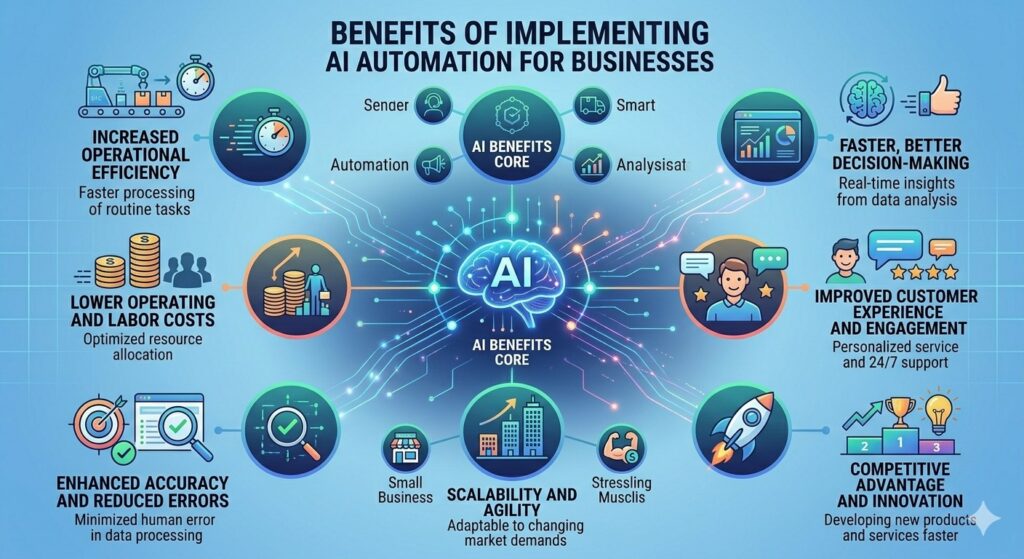
Implementing AI automation tools provides significant benefits in businesses. It makes up to 50% faster operational cycle times, saves costs, and enhances decision-making. Hence, businesses that adopt AI-driven workflows get tangible results. Let’s read each benefit in detail.
- Increased Operational Efficiency
- Lower Operating and Labor Costs
- Faster, Better Decision-Making
- Improved Customer Experience and Engagement
- Enhanced Accuracy and Reduced Errors
- Scalability and Agility
- Competitive Advantage and Innovation
1. Increased Operational Efficiency
AI automation in 2026 streamlines repetitive, rule-based tasks such as data entry, invoice processing, and report generation. As a result, it frees up employees to focus more on strategy and innovation. Additionally, it reduces bottlenecks, cuts cycle times, and enables 24/7 processing without human intervention.
2. Lower Operating and Labor Costs
Organizations cut labor costs via cognitive robotic process automation (RPA), optimizing resource allocation. As a result, it minimizes errors that lead to rework or delays. Research shows AI-driven automation can significantly reduce operational costs, especially in areas such as HR, supply chain, and customer service.
3. Faster, Better Decision‑Making
AI systems examine vast amounts of data in real time, surfacing trends, anomalies, and actionable insights more quickly than manual analysis. As a result, this supports more accurate demand forecasting, inventory management, and risk assessment. It leads to smarter strategic decisions.
4. Improved Customer Experience and Engagement
AI assistants, chatbots, and recommendation engines deliver fast, personalized responses, enhancing customer journey automation across websites and messaging channels. As a result, these tools reduce response times, increase resolution rates, and foster more consistent and satisfying experiences across touchpoints.
5. Enhanced Accuracy and Reduced Errors
AI systems significantly cut human errors in data processing, compliance checks, and quality control via intelligent document processing. Automation improves operational precision and reduces costly errors in roles such as document verification, order processing, and financial reporting.
6. Scalability and Agility
Multi-agent systems handle fluctuating workloads and scale operations without the immediate need for new hires. Whether handling seasonal spikes, expanding into new markets, or experimenting with new campaigns, AI-driven workflows adapt rapidly and maintain consistency.
7. Competitive Advantage and Innovation
Companies that implement AI agent frameworks get advantages in speed, personalization, and service quality. By automating routine work, teams can spend more time on innovation, experimentation, and strategic planning that sets the brand in the market.
Uses of AI Automation to Boost Productivity
AI automation 2026 in businesses boosts productivity by managing repetitive tasks, augmenting employee capabilities, and providing actionable insights through data analysis. Let’s read some of the key use cases of AI:
1. Customer Service and Support
AI-powered chatbots and virtual assistants resolve customer queries 24/7, providing accurate solutions via websites, apps, and messaging platforms. Moreover, they answer FAQs, guide users through processes, and escalate complex issues to human agents. As a result, it cuts response time, improves service availability, and boosts productivity.
2. Sales and Marketing Automation
Businesses leverage AI automation to personalize outreach through AI visibility monitoring, score leads, and recommend products based on behavior and preferences. Additionally, AI tools optimize ad targeting, content generation, and campaign performance. As a result, it helps teams to run seamlessly and build scalable marketing campaigns.
3. Data Processing and Reporting
AI systems extract, clean, and examine data from invoices, forms, emails, and databases. It turns raw data into structured reports. Hence, it speeds up financial close cycles, reduces manual errors, and enables faster decision-making.
4. Supply Chain and Inventory Management
AI in the supply chain forecasts demand, monitors inventory levels, and uses AI in predictive maintenance to anticipate disruptions. It automatically adjusts purchase orders and replenishment schedules. As a consequence, it helps businesses to avoid stockouts and overstock while improving delivery reliability.
5. Human Resources and Onboarding
AI automation helps in recruitment by screening resumes, scheduling interviews, and answering candidate questions. Additionally, it assists in the onboarding workflow while guiding new hires through forms, training, and system setup. Thus, it reduces time-to-productivity.
6. Document and Contract Management
AI tools can read, classify, and extract key information from contracts, emails, and other documents. Then, it highlights deadlines, risks, or non-standard clauses. In this way, it reduces manual review time and improves compliance in legal, procurement, and finance functions.
7. Cybersecurity and Risk Monitoring
AI automation in 2026 analyzes network traffic, user behavior, and system logs to detect anomalies that can signal fraud and security threats. It can trigger alerts or automated responses. Hence, it helps security teams respond so quickly and with fewer false positives.
Real-World Impact of AI Automation in Businesses
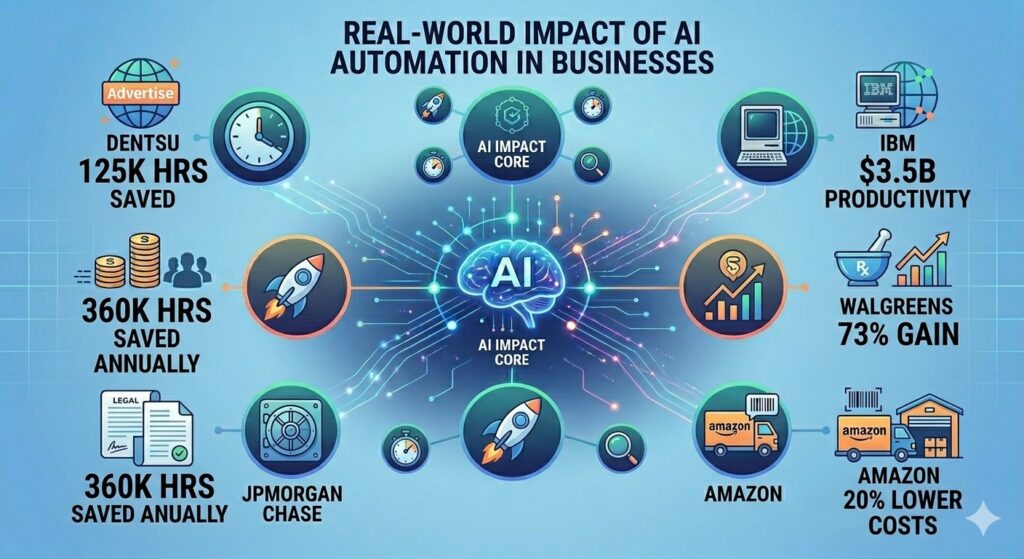
These case studies showcase how leading companies have harnessed AI automation services to achieve significant efficiency gains, cost savings, and enhanced performance. Let’s have a look at some of the impact.
1. Dentsu: 125,000 Hours Saved
The global marketing and advertising company deployed 60 software robots within 30 days. As a result, it saved over 125,000 hours through automated data extraction and migration tasks.
2. IBM: $3.5 Billion in Productivity Improvements
IBM implemented AI technology across all sectors, including IT and human resource management. As a consequence, they achieved $3.5 billion in productivity improvements.
3. Walgreens: 73% Performance Increase
Walgreens integrated RPA technology to their HR functions and saw a massive increase of around 73% in administrative performance efficiency in its services department.
4. Amazon: 20% Lower Fulfillment Costs
Amazon leverages AI‑driven robots and machine‑learning systems to route inventory, optimize packing, and schedule deliveries in its fulfillment centers. This approach has reduced fulfillment cost by around 20% while increasing order processing.
5. JPMorgan Chase: 360,000 Hours Saved Annually
JPMorgan deployed an AI‑based system called COiN to analyze thousands of legal and financial contracts, extracting key clauses and dates that previously required large teams of lawyers. The automation saves an estimated 360,000 hours of work per year.
Emerging Trends in AI Automation for Business
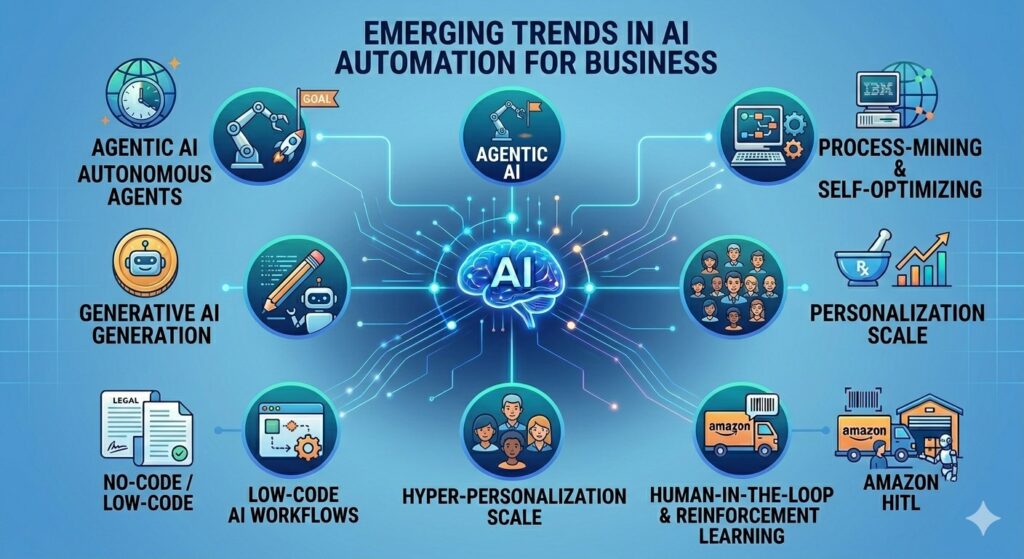
AI automation in 2026 is rapidly evolving from simple rule-based bots into new intelligent, adaptive, and customer-centric systems. These emerging trends are building blocks for how businesses design workflow, customer interaction, and compete in 2026 and beyond.
1. Agentic AI and Autonomous Workflows
Unlike rule‑based automation, which follows a fixed set of instructions, businesses are now using AI agents that can plan, reason, and execute multi‑step tasks on their own. These agents manage and streamline workflows such as order fulfillment and incident resolution while reducing the need for human intervention. For example, C3 AI Agentic Process Automation wraps AI business ideas and processes like order‑to‑cash, customer service, invoice processing, and supplier onboarding into intelligent workflows. This allows complex workflows to run seamlessly with minimal human oversight while maintaining transparency and auditability.
2. Generative AI‑Powered Automation
Generative AI is integrated into automation platforms so systems can create emails, reports, social posts, and code snippets on the fly. This enables companies to automate data handling and generate content, personalize, and communicate with customers at scale.
3. Human‑in‑the‑loop (HITL) and Reinforcement Learning
Many companies are combining automation with human feedback loops, where AI learns from corrections and approvals to improve its outputs over time. Reinforcement learning helps models refine their actions, such as routing customer tickets or suggesting next‑best offers, based on real‑world results.
4. No‑Code / Low‑Code AI Workflows
More business teams are developing AI-driven automation without coding while using visual tools that connect apps, data sources, and AI models with drag-and-drop workflows. This trend makes automation accessible, so marketing, sales, HR, and support teams implement their own AI-powered processes.
5. Hyper‑Personalization at Scale
AI automation allows hyper-personalized experiences across channels by analyzing behavior, preferences, and context in real time. Businesses leverage these systems to tailor product recommendations, pricing, content, and support. Hence, it makes generic mass-marketing feel increasingly outdated.
6. Process‑Mining and Self‑Optimizing Operations
AI tools scan existing business processes (e.g., order‑to‑cash, hire‑to‑retire) to discover inefficiencies and bottlenecks automatically. Then they suggest or even deploy automated fixes, gradually turning historical workflows into self‑optimizing, AI‑driven operations.
Challenges of AI Automation in Business
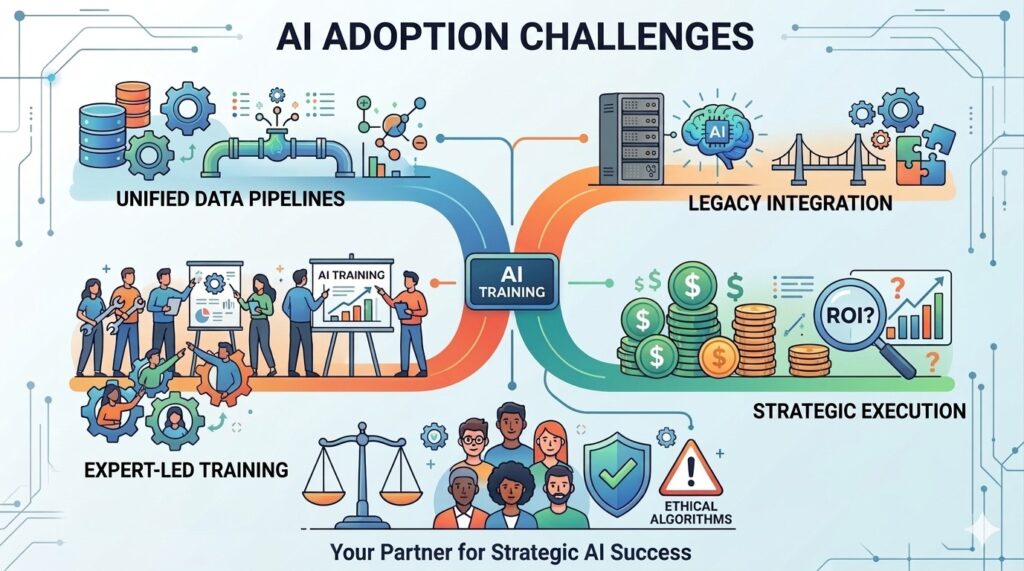
While the benefits of AI automation are clear, many organizations face challenges when getting started. However, with the right strategies, AI challenges can be resolved, resulting in successful outcomes. Here are some of the most common challenges:
1. Data Quality and Integration
AI systems depend on accurate, high-quality, and well-structured data to learn patterns, generate predictions, and automate decision-making. However, many companies have fragmented data sources, inconsistent formats, and missing or outdated records. As a result, AI models will produce misleading and inaccurate outcomes. This reduces the performance and reliability of automated workflows.
2. Integration with Legacy Systems
Many organizations have legacy infrastructure, such as CRM, core operational, and ERP software systems, that were not designed to support modern AI and APIs. Therefore, connecting AI automation to these systems can be complex, time-consuming, and prone to errors or performance bottlenecks.
3. Skills Shortage and Change Management
There is a shortage of skilled professionals who are capable of building and managing AI systems. AI automation projects require expertise in machine learning, data engineering, data science, and software development. Moreover, employees may also resist automation due to fear of job loss or lack of trust in AI‑driven decisions, making adoption and change management a major hurdle.
4. High Initial Cost and ROI Uncertainty
When building, testing, and deploying AI workflows, businesses need upfront investment in tools, licenses, infrastructure, and training. It is difficult to demonstrate clear, measurable ROI in the early stages, especially when the benefits are spread across efficiency, quality, and customer experience
5. Bias, Fairness, and Ethical Concerns
AI models can reflect and amplify biases present in training data. Thus, it leads to unfair or discriminatory outcomes in areas like hiring, pricing, and credit scoring. Moreover, ensuring fairness, transparency, and ethical use of AI automation is now a critical compliance and reputational issue.
How Flexlab Helps You Overcome AI Automation Challenges
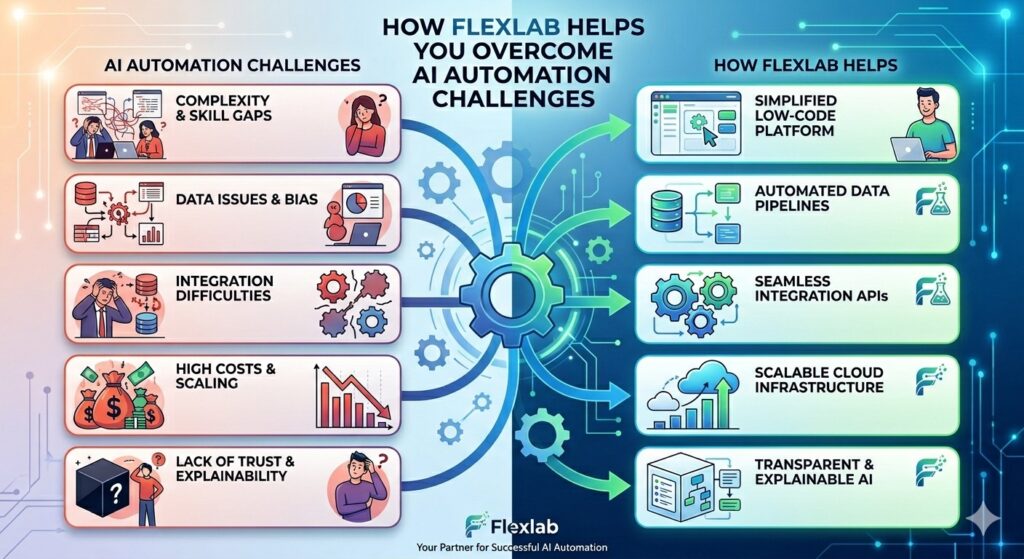
AI automation in 2026 may seem complex and intimidating at first, but with the right strategy and approach, it can be handled in a structured, manageable way. As an AI automation agency, Flexlab helps businesses turn these challenges into advantages with a partner‑led, end‑to‑end approach. We specialize in AI in fintech, AI automation in healthcare, and more, while integrating multi-agent systems with legacy ERP systems.
Is your data fragmented, are your systems legacy‑heavy, or does your team lack AI expertise? Don’t worry. We design, build, and implement AI workflows that are clean, compliant, and built for real‑world ROI.
We simplify data integration, modernize legacy stacks, and embed explainable AI into your workflows so you get reliable automation without sacrificing trust or transparency. Additionally, we guide you through change management, upskilling, and governance to help your organization embrace AI.
If you’re ready to move beyond AI pilot projects and deploy automation that scales, contact us today and visit our GBP profile to transform challenges into measurable business outcomes.
Furthermore, explore our Blockchain and AI blog page and discover the Best AI Automation Agency in Toronto, Role of AI Predictive Analytics, AI in Marketing, Enterprise AI Solutions, and How to Choose the Right AI Automation Agency in Toronto.
Conclusion: AI Automation in 2026 Guide
In 2026, AI automation stands as a transformative force for businesses, driving efficiency, innovation, and competitive edge through agentic AI implementation, generative tools, and scalable workflows. From Dentsu’s 125,000 hours saved to Amazon’s 20% cost reductions, real-world successes prove its impact, while emerging trends like no-code platforms and edge AI promise even greater agility.
The key? Strategic implementation that overcomes hurdles and unlocks value. At Flexlab, we’re here to guide you every step of the way to seamless integration to ethical, high-ROI automation.
Ready to Launch Your AI Projects?
Book a FREE Consultation Call:+1 (416) 477-9616
Email Us: info@flexlab.io
What is AI business automation?
AI business automation uses machine learning and NLP to perform and optimize business tasks, such as customer service, invoicing, HR, and supply chain workflows, with minimal human effort. It learns from data, handles unstructured inputs, and makes smarter decisions than fixed rule automation. The result is faster operations, fewer errors, and more time for strategic work.
How to make money with AI automation?
You can earn by building and selling custom AI workflows for SMEs, such as email bots, lead qualifier systems, or invoice processing, often as one time or recurring services. Another way is offering AI powered freelance work like content, SEO, or design, typically charging $20–$150+ per hour.
What is the Big 4 AI automation?
Big 4 AI automation refers to how Deloitte, PwC, EY, and KPMG use AI and automation in audit, tax, compliance, and back office workflows. It means chatbots, analytics engines, and agentic systems that cut manual work and improve consistency. This lets consultants focus on advisory instead of routine tasks.