AI Engineer Salary: What to Expect in 2026
AI in Transportation | Automated Machine Learning | AI in FinTech
The average AI engineer salary in 2026 ranges from $134,000 to $185,000 USD, reflecting total compensation in the US, according to Glassdoor ($134k base median) and Built In ($184,757 average), with a BLS proxy at $140,910 median for research scientists. However, your actual salary varies based on experience, location, and technical skills.
Factors such as LLMs/MLOps skills, Big Tech employers, and experience can boost pay 20–50% above national medians. If you want to know how to get high pay salary, explore the article and learn the AI engineer skills to expand your knowledge.
What is an AI Engineer?
An AI engineer is a professional software engineer who develops, deploys, and optimizes artificial intelligence models. Specifically, they utilize machine learning, deep learning, and data science to address real-world problems. They created scalable AI models through deep research that automate tasks, generate insights, or enhance decision-making in applications such as recommendation engines, chatbots, and predictive analytics. Moreover, they work in several sectors, including the tech industry, healthcare, finance, and e-commerce.
According to an IDC report, AI will contribute up to 19.9 trillion to the global economy by 2030. As a result, it increases 3.5% in global GDP. This projected growth tells how much organizations leverage AI to empower their business decisions and increase efficiency.
In addition, AI engineering focuses on creating practical tools, systems, and workflows that take artificial intelligence into everyday use across industries. These systems enable machines to replicate human-like abilities, such as problem-solving, pattern recognition, and adaptive learning from experience.
-
Everyday Example of AI Engineering
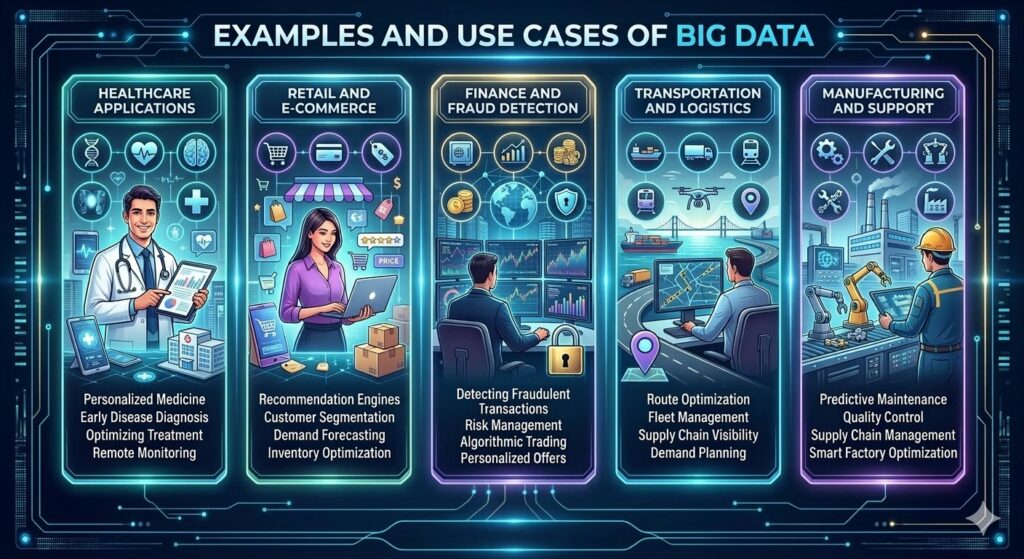
Voice assistants like Siri or Alexa rely on prompt engineering to process natural language, understand context, and respond accurately. For instance, they handle millions of queries seamlessly. Additionally, in finance, fraud detection uses data pipeline tools to perform real-time scans, flagging suspicious patterns before losses occur and protecting users without interrupting normal operations.
What Does an AI Engineer Do?
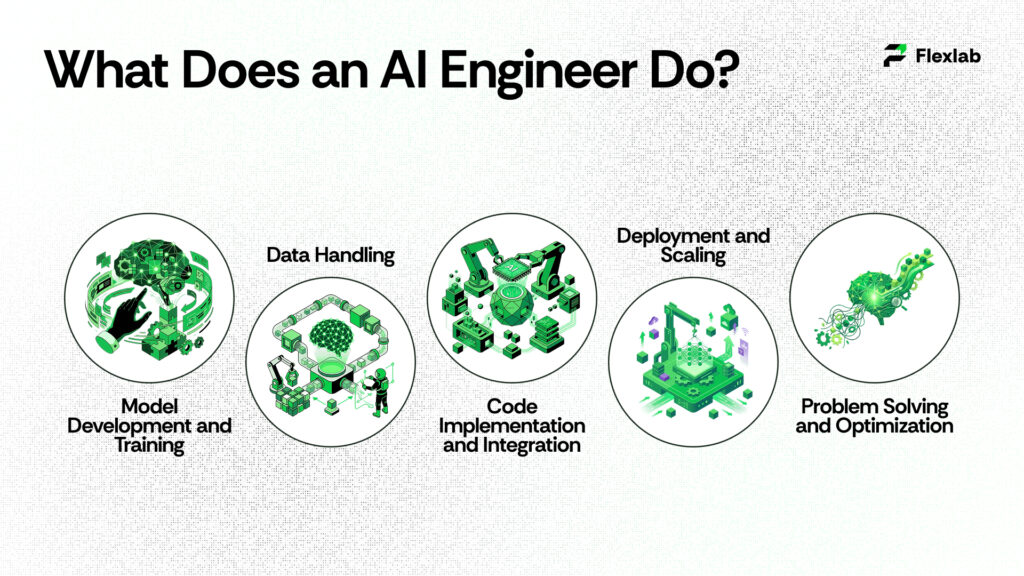
AI engineers play a significant role in implementing AI. Specifically, machine learning engineers turn cutting-edge models into functional applications by writing code, integrating algorithms, and training models with data to perform human-like tasks, solve problems, and automate business processes. In doing so, these professionals bridge the gap between data science and software engineering through AI and ML training. They focus on creating AI practical and production-ready in areas such as recommendation engines, chatbots, and autonomous systems.
Here are the core responsibilities of an AI Engineer:
- Model Development and Training: They create and train complex algorithms and neural networks using machine learning and deep learning frameworks such as TensorFlow or PyTorch.
- Data Handling: AI engineers source, clean, and prepare massive datasets to fuel accurate model training, using tools such as SQL, Pandas, or Spark.
- Code Implementation and Integration: Engineers write production-ready Python code and, moreover, leverage APIs to embed AI models seamlessly into software, apps, websites, or enterprise systems.
- Deployment and Scaling: They deploy models reliably at scale with Docker, Kubernetes, and DevOps services; furthermore, utilizing cloud services like AWS SageMaker, ensuring low-latency performance in live environments.
- Problem Solving and Optimization: AI engineers tackle real challenges like content personalization or customer service automation, iterating models for peak performance, and add ethics (e.g., bias checks).
What is an Average AI Engineer Salary?
According to the U.S. Bureau of Labor Statistics, the average annual median salary for an AI engineer is $145,080. Meanwhile, Glassdoor reports a median base salary of $134,023 for AI engineers in the USA.
However, the salary range varies by experience, location, and company, but demand keeps pay competitive well above the national median wage of $65,470.
AI Engineer Salary by Experience
One significant factor that increases an AI engineer salary is experience. Naturally, the more expertise and experience you have, the higher your earnings can be. In fact, experience plays a key role in boosting your payroll and accelerating your salary growth.
Let’s have a look at how experience works better for an AI engineer. According to a Glassdoor report:
- 0–1 years: $103,015
- 1–3 years: $121,513
- 4–6 years: $138,185
- 7–9 years: $155,008
- 10–14 years: $172,361
- 15+ years: $185,709
Moreover, if you switch into a leadership role—such as AI architect, director, or vice president of ML or AI—you can boost your salary by $50,000–$100,000+ annually through larger team bonuses and equity stakes. Alternatively, you may choose to focus on your expertise rather than managing a team. In this case, you can demonstrate your value by showcasing your talent and negotiating for a higher salary.
Top 10 Most In‑Demand AI Engineering Skills and Salary Ranges in 2026
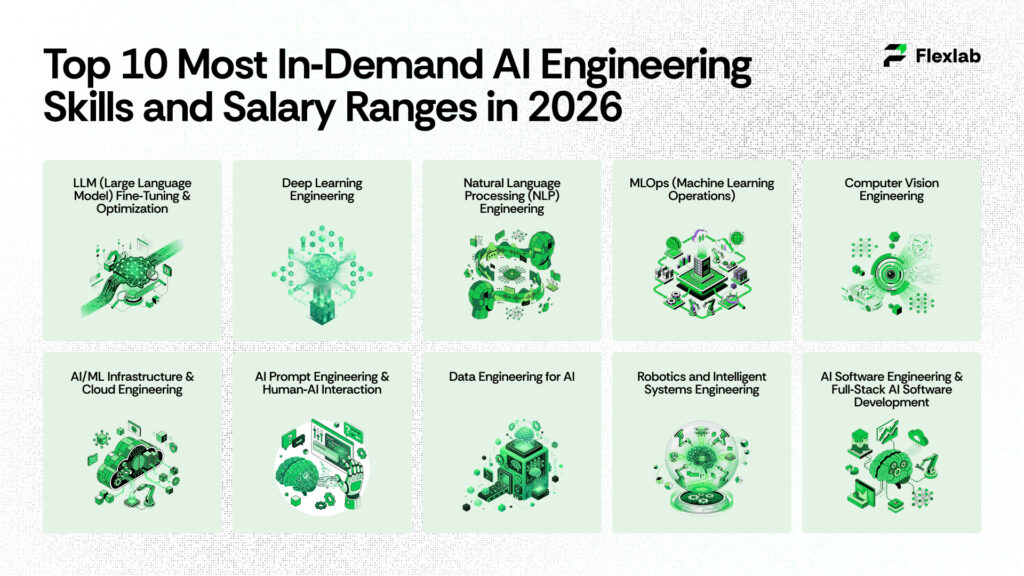
The following list combines demand signals from employer job postings, recruiter salary reports, and industry insights for 2026. Accordingly, the AI engineer salary shown represents approximate ranges (primarily for the U.S. market) and may vary by region, company, and candidate experience.
1. LLM (Large Language Model) Fine‑Tuning & Optimization
Description: Expertise in training, adapting, and fine‑tuning large language models for specific tasks and industries.
Salary Ranges:
- Entry: ~$100K–$130K
- Mid: ~$140K–$175K
- Senior: ~$195K–$250K
- Staff/Principal: ~$250K–$350K+
2. Deep Learning Engineering
Description: This covers advanced neural networks and architectures that power perception, prediction, and automation systems.
Salary Ranges:
- Mid: ~$145K–$180K
- Senior: ~$180K–$213K
- Staff: ~$213K–$280K+
3. Natural Language Processing (NLP) Engineering
Description: Building models that understand, generate, and interact with human language drives the creation of the best AI chatbots, virtual assistants, and text-generation systems. This capability is crucial for delivering the best user experiences.
Salary Ranges:
- Mid: ~$130K–$160K
- Senior: ~$160K–$200K
- Staff: ~$200K–$250K
4. MLOps (Machine Learning Operations)
Description: A machine learning engineer deploys, monitors, and scales machine learning systems in production. Moreover, MLOps bridges development and operations.
Salary Ranges:
- Mid: ~$140K–$175K
- Senior: ~$175K–$220K
- Staff: ~$220K–$270K
5. Computer Vision Engineering
Description: AI applications enable machines to interpret and act on visual data, such as images and video. They are especially ideal for autonomous systems and industrial automation.
Salary Ranges:
- Mid: ~$135K–$165K
- Senior: ~$165K–$200K
- Staff: ~$200K–$240K
6. AI/ML Infrastructure & Cloud Engineering
Description: AI/ML engineer with the ability to architect and maintain cloud environments and distributed systems to support AI workloads (e.g., AWS, GCP, Azure).
Salary Ranges: Typical AI cloud specialists command salaries comparable to specialized AI roles (~$140K–$220K+, depending on experience).
7. AI Prompt Engineering & Human‑AI Interaction
Description: Crafting effective prompts and interfaces guides generative AI to produce reliable and safe outputs. This role is emerging as a strategic specialization across products.
Salary Ranges: ~$110K–$160K+ (based on UK primary market estimates for similar roles).
8. Data Engineering for AI
Description: Building scalable pipelines and data frameworks powers training and inference workflows. This capability is an essential precondition for all AI systems.
Salary Ranges: ~$130K–$170K for mid to senior data engineers focusing on AI‑ready data ecosystems.
9. Robotics and Intelligent Systems Engineering
Description: Integrating AI with robotics and physical intelligence enables automation and autonomous processes. It covers perception, control systems, and embedded AI.
Salary Ranges: ~$140K–$220K+, depending on specialization and industry context.
10. AI Software Engineering & Full‑Stack AI Software Development
Description: Integrating learned models into scalable applications, APIs, and user-facing systems drives real-world AI functionality. This process combines classic software engineering with AI deployment expertise.
Salary Ranges: ~$140K–$200K for mid to senior roles.
Complete AI Solutions from Prompt Engineering to Full Deployment
Flexlab delivers top-tier AI consulting services, with expert AI developers skilled in the most in-demand areas. Moreover, whether you need DevOps services, AI/ML engineers, AI prompt engineering, or full AI software development, we have you covered—all in one place.
Launching a startup with just basic AI knowledge? No stress! We provide complete AI solutions tailored to your needs.
Book your free strategy call today to discuss your project and get started!
Ready to Launch Your Blockchain Project?
📞 Book a FREE Consultation Call: +1 (416) 477-9616
📧 Email us: info@flexlab.io
Top U.S. Artificial Intelligence Salaries by State
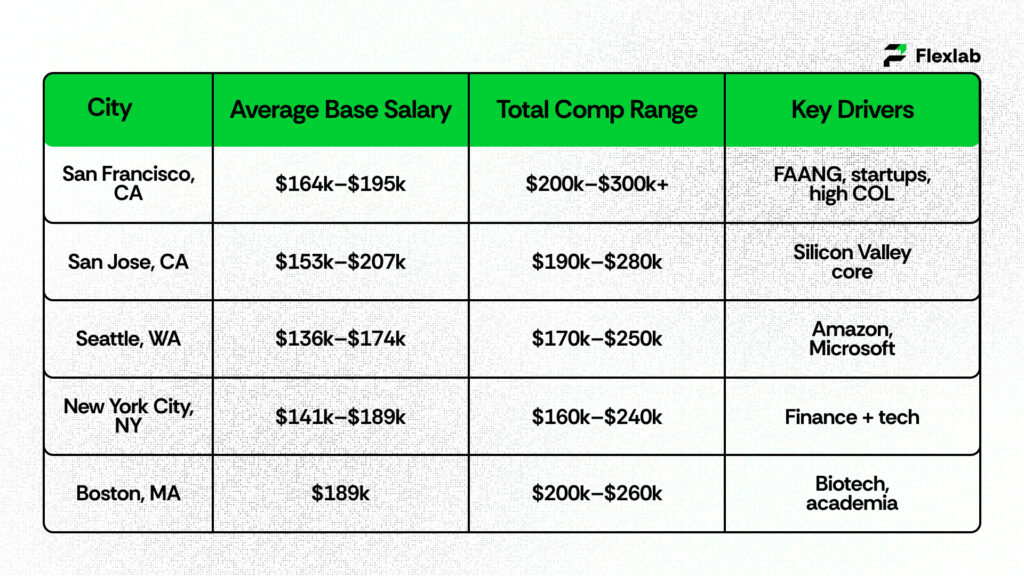
AI developer and AI engineer salaries in the US vary significantly by location, influenced by tech hubs, cost of living, and company density. For instance, the top cities often pay 20–50% above the national averages of $140k–$185k.
Top-Paying Cities (2026 Estimates)
Mid-Tier and Emerging Hubs
| City | Average Base Salary | Total Comp Range | Notes |
| Austin, TX | $130k–$139k | $150k–$200k | Lower taxes, rising AI |
| Los Angeles, CA | $158k–$190k | $180k–$240k | Entertainment AI |
| Chicago, IL | $106k | $130k–$170k | Enterprise focus |
| Washington, DC | $192k | $210k–$270k | GovTech, policy |
National remote averages sit around $150k total compensation, providing flexibility without coastal premiums. This option is ideal for balancing a strong lifestyle with competitive pay. Therefore, specializing in LLMs or MLOps can help you reach upper salary ranges anywhere.
AI Engineer Salaries in 2026: Global Country Comparison
AI engineer salaries in 2026 reflect intense global demand, with stark regional differences driven by tech ecosystems, living costs, and talent availability. The US leads premiums at 3–10x emerging markets, making cross-border hiring strategic for companies like Flexlab scaling AI/blockchain teams.
Global Overview Table (Annual USD)
| Region/Country | Junior | Mid-Level | Senior/Lead | Key Notes |
| USA | $95k–$140k | $150k–$220k | $220k–$350k+ | SF/NYC peaks; equity heavy |
| Canada | $80k–$110k | $110k–$150k | $150k–$200k | Toronto/Vancouver hubs |
| Australia | $90k–$120k | $120k–$160k | $160k–$220k | Sydney/Melbourne strong |
| UK | $55k–$80k | $70k–$110k | $110k–$160k | London £60k–£100k avg |
| Germany | $50k–$75k | $65k–$100k | $100k–$140k | Berlin/Munich €70k+ |
| Switzerland | $100k–$130k | $130k–$170k | $170k–$220k+ | Zurich tops Europe |
| Poland | $30k–$45k | $45k–$65k | $65k–$90k | Eastern European leader |
| Ukraine | $25k–$35k | $35k–$50k | $50k–$70k | Remote outsourcing favorite |
| Singapore | $80k–$110k | $110k–$150k | $150k–$200k | Asia’s pay king |
| Japan | $45k–$65k | $60k–$90k | $90k–$130k | Tokyo ¥8M–¥12M |
| India | $10k–$25k | $25k–$45k | $45k–$80k | Bangalore tops at ₹40L |
| China | $50k–$80k | $80k–$120k | $120k–$180k | Shanghai/Beijing high |
| Mexico | $25k–$40k | $40k–$65k | $65k–$100k | Nearshore US advantage |
| Brazil | $20k–$35k | $35k–$55k | $55k–$85k | São Paulo rising |
| UAE (Dubai) | $80k–$110k | $110k–$150k | $150k–$200k+ | Tax-free + expat perks |
| Saudi Arabia | $70k–$100k | $100k–$140k | $140k–$190k | Vision 2030 boom |
Regional Highlights
- North America: The US dominates with an average total compensation of $147k–$250k, while Canada trails closely, showing similar demand for skilled AI professionals
- Western Europe: Switzerland and the UK offer the highest pay (€100k+), whereas Germany and France provide solid opportunities with better work-life balance.
- Eastern Europe: 40–60% US savings with strong LLM/MLOps talent, while Poland/Ukraine is ideal for remote.
- Asia-Pacific: Singapore crushes ($115k+); India volume leader but low per-capita ($17k avg).
- Latin America: Mexico/Argentina offer $50k+ experienced at 1/3 US cost, which is perfect timezone overlap. Meanwhile, the UAE/Saudi hit $100k+ tax-free, fueled by AI diversification investments
Factors Raising AI Engineer Salaries
AI engineering commands premium pay that varies sharply based on expertise and context. However, beyond location, these key factors drive higher salaries for AI engineers in 2026.
Specialization Matters: Experts in deep learning, NLP, computer vision, generative AI, or reinforcement learning earn 20–40% more than general ML practitioners. Furthermore, mastering niches such as LLMs, RAG systems, or AI agents can unlock top compensation brackets of $220k–$350k total.
Academic Background Can Boost Pay: Master’s or PhDs in AI, computer science, or related fields open research-intensive roles at labs and startups, lifting offers 15–30% over bachelor’s alone. Furthermore, pair with AWS ML or Google certifications for maximum impact.
Industry Plays a Huge Role: Tech giants lead, but finance (AI in fraud detection), healthcare (diagnostics), defense/autonomous systems, and biotech pay equally well due to mission-critical AI deployments and regulatory demands.
Project Maturity Makes a Difference: Engineers who deliver production MLOps pipelines, scalable deployments, and revenue-driving systems often outearn research-focused roles. Moreover, quantifying business wins—such as “reduced inference costs 40%”—on resumes can lead to bigger salary jumps.
Ethical AI is in Demand: Amid rising scrutiny on bias, fairness, explainability, and regulations such as the EU AI Act, responsible AI specialists who build auditable, robust systems often earn $20k–$50k premiums across industries.
How to Become an AI Engineer (Simple Steps)
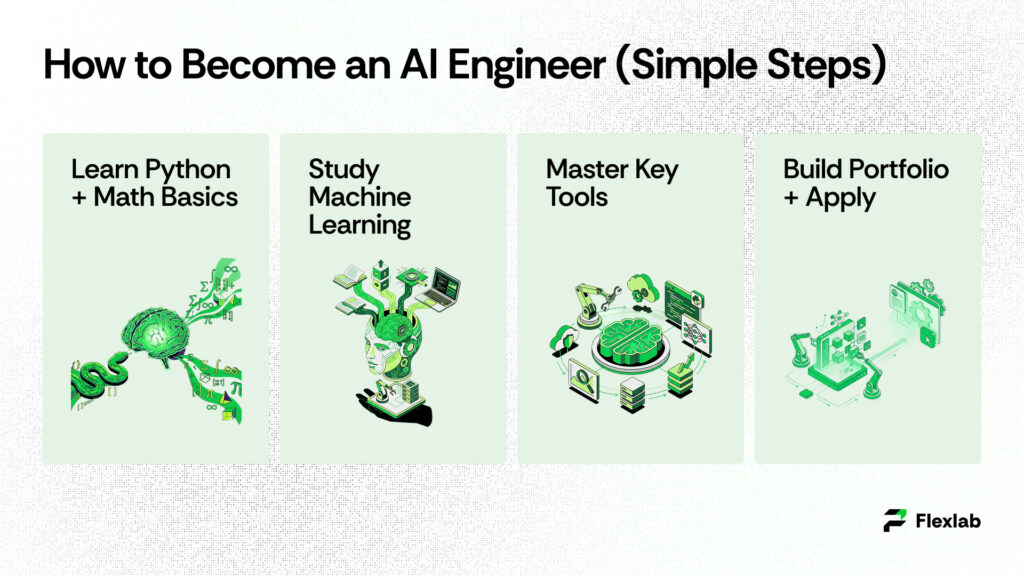
Here are the simple steps to become an AI developer:
- Learn Python + Math Basics: Master Python and other programming skills, as well as linear algebra, statistics, and calculus (free resources: Khan Academy, freeCodeCamp). This stage takes 2–3 months.
- Study Machine Learning: Begin with Andrew Ng’s Coursera ML course, then move to fast.ai for deep learning with PyTorch. Build projects such as image classifiers over 3–4 months.
- Master Key Tools: Learn TensorFlow or PyTorch, scikit-learn, Pandas, SQL, Docker, and cloud platforms (AWS/GCP free tiers). Additionally, practice on Kaggle datasets. This stage takes 2–3 months.
- Build Portfolio + Apply: Create 3 GitHub projects (chatbot, RAG app, prediction model). Get AWS ML cert. Apply for AI engineering jobs for entry-level roles ($95k-$140k). Meanwhile, network on LinkedIn.
Timeline: 8–12 months from zero to your first job. To reach $200k+ roles, focus on production skills such as MLOps and LLMs. In fact, you can start by completing one project this week!
Also Read: How to Become a Blockchain Developer?
Tools and Technologies Must Be Known by AI Engineering
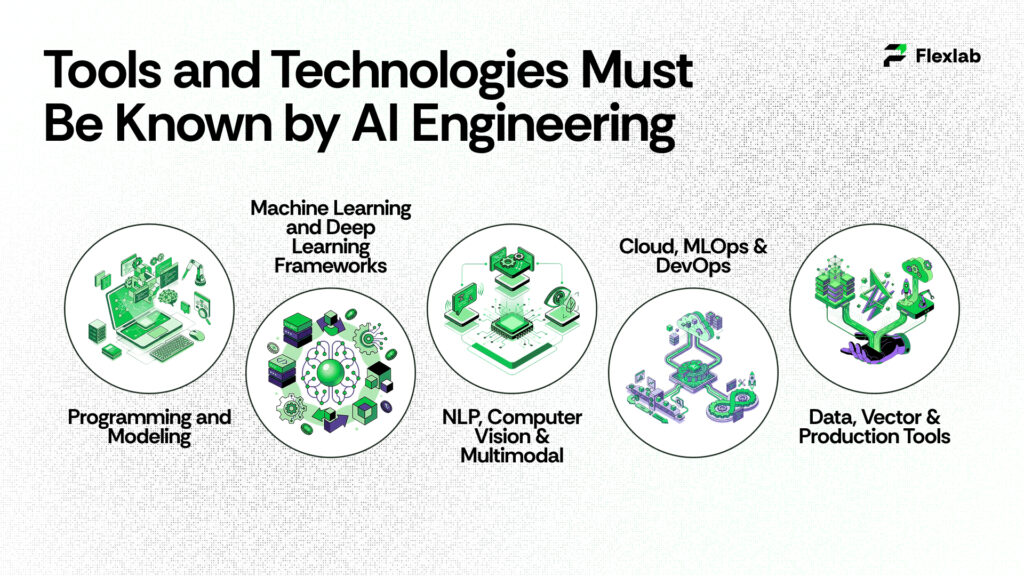
AI engineers rely on a dynamic, expansive tech stack that evolves rapidly. Mastering these tools accelerates workflows, production deployment, and AI engineer salary potential (often +20–30% for multi-tool experts). Below are essential categories with high-impact additions for 2026 roles.
-
Programming and Modeling
Python dominates as the universal AI language for its libraries and simplicity. Moreover, add Rust for high-performance inference engines, Julia for numerical computing speed, alongside R, C++, and Java for enterprise systems and low-latency apps.
-
Machine Learning and Deep Learning Frameworks
Core tools like TensorFlow, PyTorch, Keras, and scikit-learn handle model building/training. Additionally, level up with JAX for accelerated research, Hugging Face Transformers for LLMs, Ray for distributed training, and ONNX for cross-framework model export.
-
NLP, Computer Vision & Multimodal
Hugging Face Transformers and spaCy excel in language, while OpenCV leads vision tasks. Additionally, you can expand to LangChain or LlamaIndex for agentic/RAG pipelines, Diffusers for generative image and video, MediaPipe for real-time edge CV, and CLIP for multimodal AI embeddings.
-
Cloud, MLOps & DevOps
Scale with AWS SageMaker, Azure ML, and GCP Vertex AI. Similarly, essential DevOps services include Docker, Kubernetes, plus MLflow for experiment tracking, Kubeflow for K8s ML pipelines, Weights & Biases for monitoring, and Terraform for infra-as-code.
-
Data, Vector & Production Tools
For data preparation, use Pandas or Polars, and add Pinecone for data infrastructure, as well as Weaviate or FAISS for vector search and RAG. Meanwhile, Apache Kafka handles real-time streams, while TensorRT optimizes GPU inference for edge deployment.
Conclusion: Launch Your High-Paying AI Engineering Career in 2026
In a nutshell, AI engineering stands at the forefront of a $19.9 trillion global opportunity by 2030. They deliver salaries from $95k entry-level to $350k+ for senior specialists in hot niches like LLMs, MLOps, and AI agents. For instance, US hubs like San Francisco ($200k–$300k) lead globally, but smart hiring taps Eastern Europe/LATAM for 50–70% savings without sacrificing quality.
Are you ready to build your project? Contact us now and visit our LinkedIn page. Discover more helpful insights, such as 10 Day Trading Strategies, Best AI Tools in 2026, What Is Marketing Automation, and 22 Best AI Marketing Tools.
FAQs
Q1: Are AI engineers highly paid?
AI engineers rank among the highest-paid tech professionals in the USA, with median salaries exceeding $145,000 annually, well above the national average. Demand for their expertise in machine learning and data systems drives premium compensation, often including bonuses and equity.
Q2: How much do AI engineers get paid?
Average AI engineer salaries in the US range from $122,000 to $153,000 base pay, with total compensation often reaching $160,000+, including bonuses. Factors such as location (e.g., San Francisco premiums), experience, and company size significantly influence earnings.
Q3: What is the salary of an entry-level AI engineer?
Entry-level AI engineers in the USA earn $70,000–$120,000 annually, starting around $85,000 median for those with relevant degrees or certifications. Salaries rise quickly with 1–2 years’ experience, hitting $130,000+ in tech hubs like California or New York.