How AI Voice Agents Streamline Wait Times and Support Efficiency
AI Automation Agency | AI Business Ideas | AI Automation Tools
In today’s fast-paced, always-connected world, customers expect quick answers. Whether it’s checking an order, resetting a password, or fixing a billing issue, nobody has the patience to sit on hold anymore. Waiting isn’t just frustrating; it can cost businesses customers and sales. That’s why many organizations are turning to AI voice agents and other AI-powered voice assistants to provide callers with instant responses and enhance user experiences.
That’s where AI-driven voice solutions step in, the next big shift in how companies connect with their customers. Unlike traditional call centers that depend on agent availability and clunky menu systems, voice automation systems can respond instantly, handle multiple calls simultaneously, and deliver accurate, personalized assistance around the clock.
The impact is real. Customers no longer have to wait on hold, with most inquiries answered instantly. Issues get resolved faster across every touchpoint, creating smoother and more efficient interactions. Most importantly, customers feel heard and helped immediately, leaving them more satisfied and loyal to the brand. In this blog post, we’ll take a closer look at how AI-driven voice technology and modern AI systems are transforming customer service and why adopting them now gives companies a competitive edge.
Why Speed and Efficiency Matter More Than Ever in Customer Service
Today’s customers have more choices than ever, and have much less patience. Studies show that over 60% of consumers switch brands after just one poor service experience. Long wait times are often the first reason they walk away. Traditional call centers can only scale by adding more agents, which quickly becomes costly and difficult to manage. Interactive voice response systems were designed to help, but most IVR menus still frustrate callers who want natural answers instead of button presses.
Intelligent voice bots change the game. They can handle thousands of calls at once, provide consistent and accurate responses, and never leave customers waiting on hold. As more companies focus on speed and seamless service, businesses that adopt AI voice assistant technology now are the ones staying competitive, keeping customers satisfied, and improving their bottom line through smarter, faster support.
The Current State of Customer Service Wait Times
Let’s be honest, no one enjoys being put on hold. Whether you’re calling your bank, an airline, or a service provider, hearing “your call is important to us” only makes the wait more frustrating. Even with all the new AI automation tools available, long wait times remain one of the biggest challenges for both customers and businesses.
-
Traditional Call Center Challenges and Bottlenecks
Traditional call centers face significant limitations that make delivering quick responses challenging. When call volumes spike during peak hours, agents get overwhelmed. Complicated routing systems force customers through endless menus before they finally reach the right person. When demand increases, staffing shortages worsen the situation. The result is long queues, more abandoned calls, and unhappy customers. Intelligent virtual assistant solutions are designed to address these pain points.
For most companies, the problem isn’t a lack of effort; it’s the limits of the traditional model. No matter how talented your team is, humans can only handle one call at a time. That’s why modern AI voice solutions are transforming how businesses operate, enabling companies to scale customer service without increasing costs.
-
The True Cost of Long Wait Times on Business
Long wait times don’t just frustrate customers; they also harm your business. Every extra minute someone spends on hold increases the risk they’ll hang up and move on to a competitor. Studies show that even short delays can lower satisfaction scores and damage brand loyalty. Many companies are now turning to AI chatbots and conversational automation systems to handle simpler questions, allowing human agents to focus on what matters most: solving complex issues.
The financial impact is real. Abandoned calls mean lost sales and missed opportunities, and poor support experiences can hurt your reputation fast, especially in today’s social media-driven world. One negative online experience can reach thousands of people in minutes. This is where automated workflows help, streamlining customer interactions and ensuring that each query is handled efficiently from start to end.
-
Industry Standards and Customer Expectations Today
Customer expectations have completely changed. People expect support to be available anytime, anywhere, not just during business hours. They expect an immediate response when they reach out, even if it takes a little longer to resolve their issue. With the help of intelligent call routing, AI systems can instantly direct customers to the right resource, making slow service a thing of the past.
The average acceptable wait time across industries continues to shrink. A few years ago, customers might have waited five minutes without complaint. Today, they expect help in seconds. As instant communication becomes the standard, patience for waiting is disappearing fast. To stay competitive, more businesses are integrating conversational AI chatbot technology that provides round-the-clock, real-time support for their customers.
Understanding AI Voice Agent Technology
AI voice agents are transforming the way businesses handle customer interactions. They combine advanced speech technology, automatic speech recognition, and machine learning to create conversations that feel natural, efficient, and human-like. With this level of intelligence, callers can converse naturally, and the system understands, processes, and responds just as a real agent would.
-
How AI Voice Agents Work
When a customer calls, the AI voice agent instantly answers and responds as a person would. It utilizes real-time data to understand the caller’s intent, search for the relevant information, and respond within seconds. And if a situation requires a human touch, it seamlessly transfers the conversation, sharing the full context, so customers never have to repeat themselves.
-
What Makes AI Voice Agents Different from Traditional Call Centers
Unlike old call center systems that rely on scripts or long IVR menus, today’s intelligent voice bots can actually listen, learn, and adapt. They understand natural speech, recognize intent, and personalize responses to meet the needs of each caller. Over time, these systems become even smarter, learning from every interaction to continuously improve the experience.
Top Benefits of Using AI Voice Agents to Improve Customer Experience
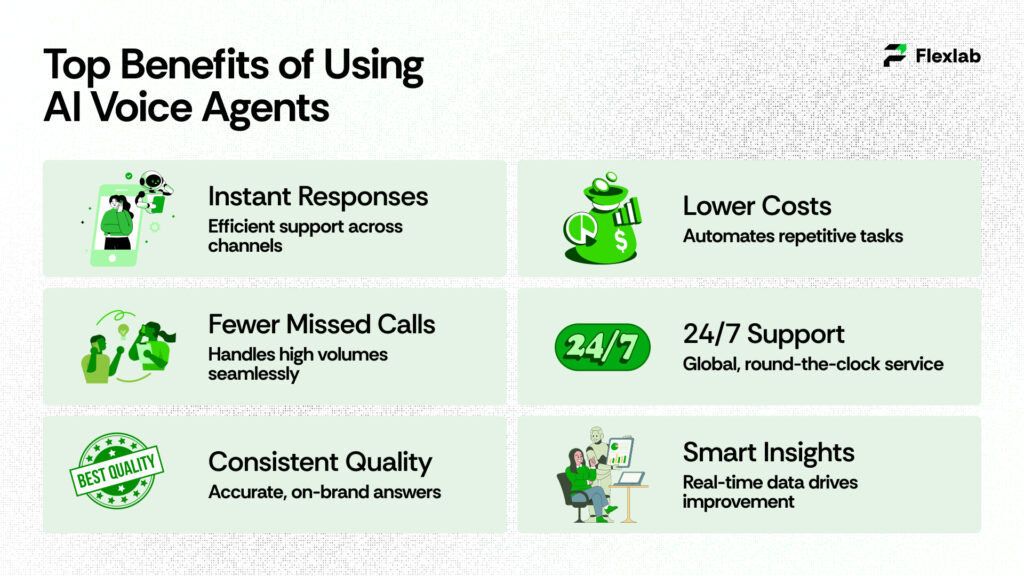
AI voice agents don’t just make service faster; they make it smarter. Businesses that integrate them often see measurable improvements in both performance and customer satisfaction. Let’s break down some of the biggest advantages of using AI automation in customer support.
1. Shorter Wait Times and Faster Responses
The most obvious benefit is speed. AI call automation answers instantly, so customers never have to sit on hold. With advanced interactive voice response systems, calls are handled in seconds, freeing your team from repetitive tasks and reducing stress during peak hours.
2. Fewer Missed Calls and Abandoned Interactions
When customers hang up before reaching an agent, businesses lose valuable opportunities. AI-powered voice agents ensure every call gets answered. They can manage thousands of interactions at once, dramatically reducing abandonment rates and enhancing customer satisfaction.
3. Consistent, High-Quality Customer Experiences
AI never takes days off, but human agents can. By using artificial intelligence (AI) to guide every conversation, you can have reliable and professional interactions every time. The system retrieves answers from verified and automatically updated sources, maintaining a consistent tone and aligned with your brand’s voice.
4. Lower Operational Costs and Greater Efficiency
AI reduces repetitive tasks and automates everyday workflows, saving time and cutting costs. This means your human agents can focus on complex or high-value cases instead. By using AI-driven voice solutions strategically, businesses can enhance productivity without increasing headcount.
5. 24/7 Availability and Global Scalability
Your customers expect help at any time, anywhere. With AI-powered voice assistants, your business can provide round-the-clock support without requiring additional staff. These systems handle global traffic smoothly, adjusting for different time zones and languages while maintaining quality service.
6. Smarter Insights Through Real-Time Data
Every customer interaction becomes a data source. AI systems capture patterns and feedback in real-time data, helping companies refine services, detect common issues, and even predict customer needs before they arise. This ongoing learning makes support smarter over time.
The Immediate Impact of AI Voice Agents on Customer Wait Times
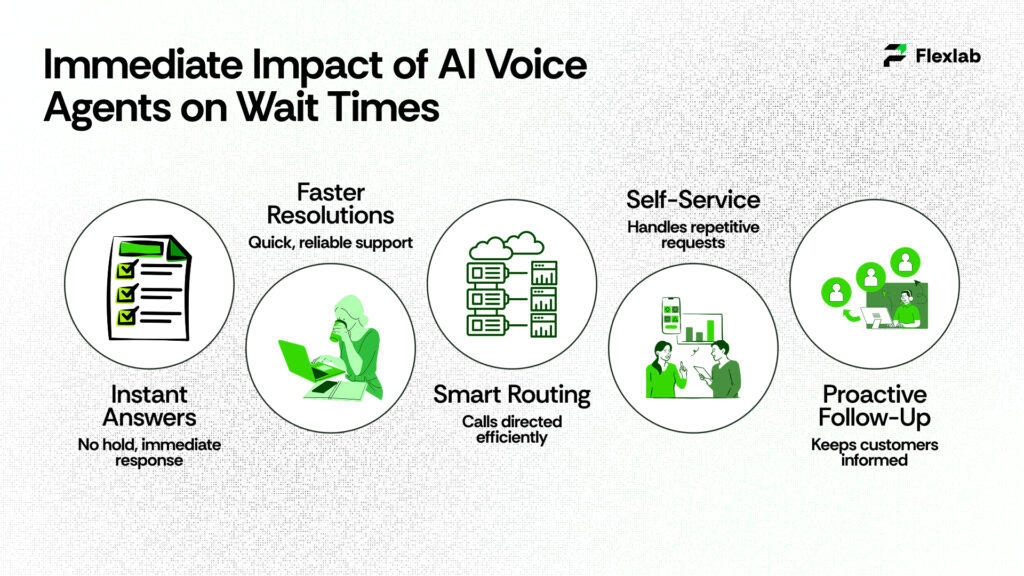
From day one, companies implementing voice automation systems experience a decrease in wait times and faster resolution times. When calls are answered instantly and handled efficiently, it builds immediate trust between the brand and the customer.
With AI managing the initial contact, customers get real-time answers while sensitive transactions remain protected. This combination of speed and security creates a stronger foundation for loyalty and brand confidence.
Instant Call Answering and First Response
When a call comes in, the AI system responds immediately. There is no waiting, no hold music, and no “please stay on the line” messages. That instant response matters because it sets the tone for the rest of the experience. Customers feel valued when they are heard right away.
Modern AI platforms often include call transcription features that record and analyze every interaction. This helps businesses maintain accurate records, train staff more effectively, and identify common customer concerns that can be solved automatically in the future.
Smarter Call Routing and Prioritization
Traditional routing systems frequently waste time by routing customers incorrectly. In contrast, AI voice agents use advanced automation to understand intent and context. Consequently, calls are directed to the most suitable department according to urgency, issue type, and past interactions.
This intelligent routing saves time for both customers and support teams. It reduces frustration, lowers abandonment rates, and keeps high-priority calls at the top of the queue. The result is a smoother and more personalized experience.
Reducing Call Volume Through Self-Service
AI voice agents are great at handling repetitive requests that would normally take up your support team’s time. With built-in knowledge bases and conversational logic, they can resolve most issues before a human has to get involved.
They also employ techniques similar to cold calling techniques in reverse, reaching out proactively to follow up with customers or provide updates before they even ask. This proactive service makes customers feel remembered and supported, while keeping call volumes manageable.
AI Voice Agents Enhance Response Quality and Accuracy
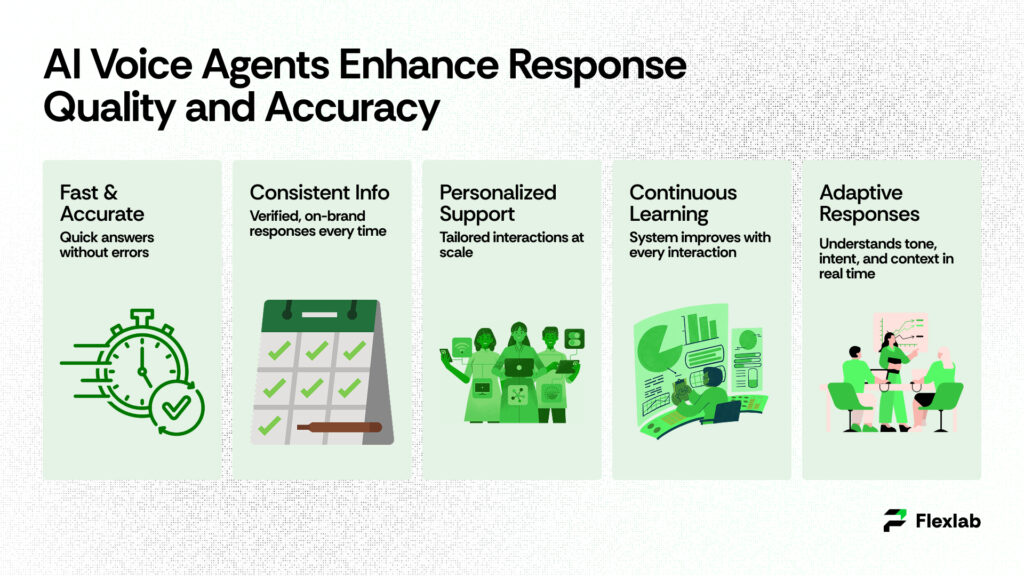
Speed is essential, but accuracy defines real service quality. There is nothing more frustrating for a customer than receiving a fast answer that turns out to be incorrect. This is where modern AI chatbots make a real difference. They deliver responses that are not only quick but also accurate and consistent across every channel.
Because the technology continuously learns from each conversation, your business can count on more reliable outcomes over time. The result is an experience that feels smooth and dependable, even as call volumes increase.
Consistent and Reliable Information
Unlike human agents who might forget updates or misinterpret company policies, AI voice agents pull their answers directly from verified sources. Every reply stays consistent, accurate, and on brand.
These systems also utilize AI workflows that keep data current across all platforms. That means when policies change, pricing updates, or promotions go live, your voice agent is instantly notified. This ensures that customers always get the latest information, reducing confusion and fostering trust.
Personalized Conversations at Scale
AI voice agents are not just fast; they are smart enough to make every customer feel recognized and valued. With access to historical data and preferences, they can tailor their responses to the caller’s identity and purpose. It feels human, despite being powered by advanced technology.
At the same time, AI-powered voice assistants make it possible to scale this personal touch. Whether it is one caller or one thousand, each person receives relevant, customized support that matches their specific needs.
Learning and Improving Over Time
The most exciting aspect of AI-driven support is that it continually improves. Every interaction contributes to the system’s knowledge, enabling it to understand what customers want and respond more effectively.
Using automatic speech recognition, AI can identify tone, intent, and key phrases in real time, then adjust its approach instantly. The longer it runs, the smarter it becomes, which means your customer service only improves with time.
Best Practices for Implementing AI Voice Agents
Adopting AI voice agents is more than adding new tech. It’s transforming the way your business connects with customers. With the right setup, you can make the transition easy and rewarding. These strategies will help ensure a smooth rollout and long-term success with your AI automation.
1. Plan and Integrate with Your Existing Systems
Before you begin, review your current customer service process. Identify where most delays occur during call routing, data lookup, or wait times. Once you know your weak spots, you can integrate AI more strategically.
When you connect your voice agent to your CRM, helpdesk, and knowledge base, it gains real-time access to customer data. This means it can provide accurate and personalized responses right away. And in most cases, businesses notice a boost in efficiency almost instantly.
2. Start Small and Scale Gradually
The best way to implement AI voice agents is by starting small. Launch it for high-volume, low-risk tasks such as order tracking or password resets first. Once performance stabilizes, expand into more complex calls.
This gradual rollout builds team confidence, gives you time to measure results, and helps customers adjust comfortably. The technology will continue to improve as your business becomes more proficient in using it effectively. A carefully phased approach makes success sustainable rather than rushed.
Using intelligent call routing ensures that when a call does need human attention, it reaches the right person fast. This balance between automation and empathy keeps the human touch alive while optimizing for speed.
3. Train Your Team and Monitor Performance
Your team is still central to your customer experience. Train them to collaborate with AI rather than compete with it. For example, they can focus on cases that require human judgment or emotion while the system handles repetitive requests.
Track key metrics as resolution time, satisfaction rates, and transfer frequency. These insights help you fine-tune the system and identify areas where your intelligent virtual assistant can improve. Monitoring ensures that your AI evolves with your business needs.
4. Overcome Challenges with a Balanced Approach
Like any major technology shift, adopting AI voice agents comes with challenges. You may face technical setup issues or initial customer hesitation. The solution is transparency. Let people know that automation isn’t replacing humans, it’s empowering them to provide faster and more consistent support.
Combining advanced AI systems with human empathy ensures that you deliver efficient, meaningful, and lasting customer relationships. When people feel heard and valued, loyalty follows naturally.
AI Voice Agent Case Studies: Real-World Success Stories
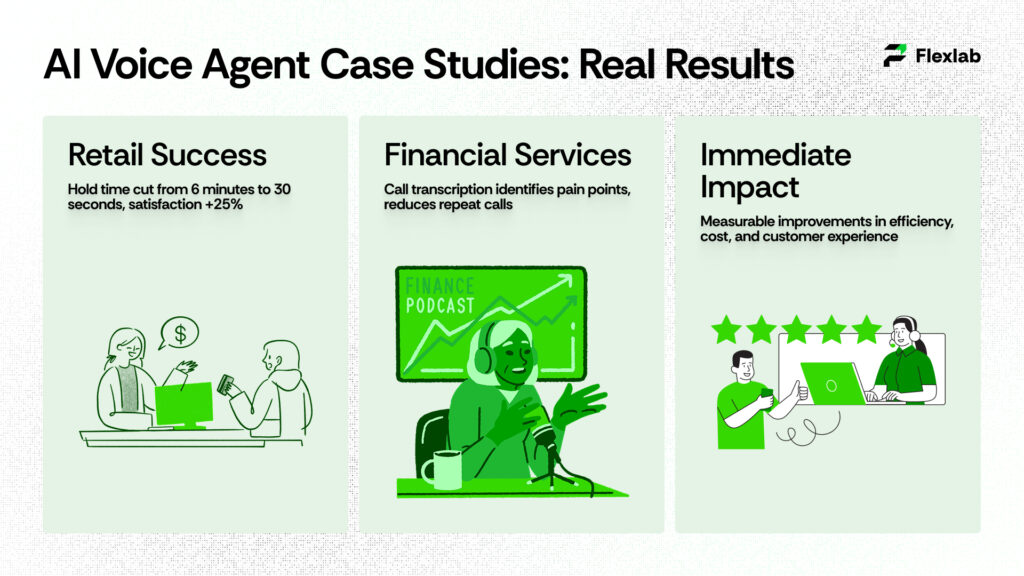
AI voice technology is moving from theory to tangible impact across industries. Businesses are no longer just experimenting; they’re transforming customer engagement, operations, and decision-making through intelligent automation. The following examples highlight how companies are achieving real, measurable results with AI-driven voice solutions.
-
Retail Industry: Faster Service and Happier Customers
A leading retail brand implemented custom AI agents to manage order tracking and product inquiries. Within just two weeks, their average hold time dropped from six minutes to under thirty seconds. Customer satisfaction scores increased by 25 percent, and operational costs declined significantly.
This quick transformation proved that AI can deliver measurable value almost immediately, even in large-scale customer operations.
-
Financial Services: Smarter Insights Through Automation
A financial services provider adopted call transcription to capture and analyze every customer conversation. The system identified recurring pain points, enabling the company to train agents more efficiently and enhance quality assurance.
By spotting issues early and making data-driven improvements, they reduced repeat calls and delivered faster, more confident resolutions.
The Future of AI Voice Agents
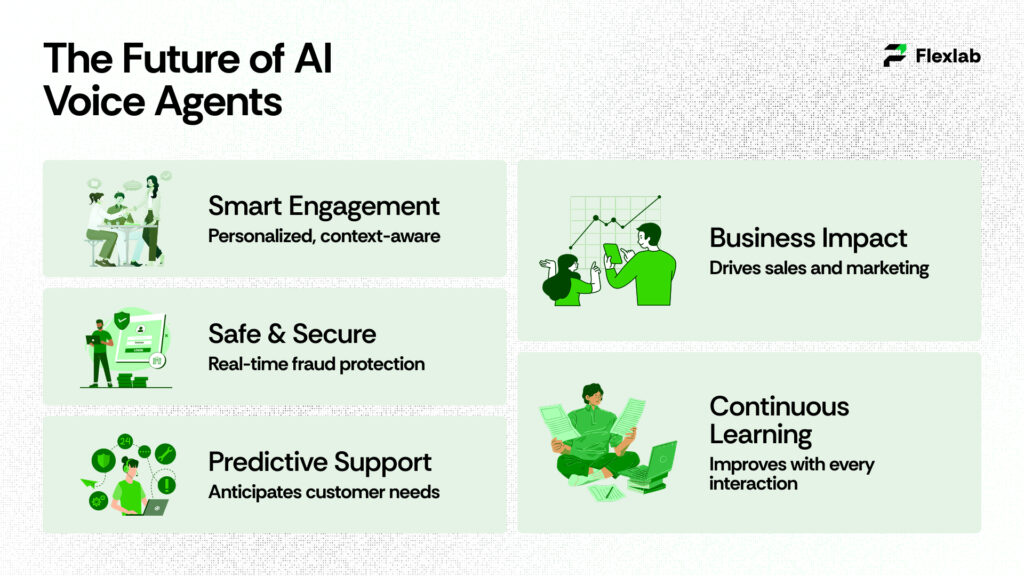
AI voice agents are entering a new era, one defined not just by how fast they respond, but by how intelligently they engage. From personalized interactions to context-aware understanding, these systems are evolving into trusted digital partners that enhance every customer experience. The future of voice isn’t robotic; it’s responsive, predictive, and deeply human in the way it connects people and technology.
Beyond Speed: Smarter, Safer Interactions
The next evolution of voice AI is not just about faster service. With AI fraud detection becoming a core capability, businesses will be able to protect customers in real time while keeping support fast and effortless.
Future systems will identify suspicious patterns during calls, ensuring transactions remain secure while maintaining a seamless customer experience.
Predictive Conversations and Proactive Help
Conversational AI chatbot technology is ready to transition from reactive to predictive. Imagine your system anticipating why a customer is calling and preparing the solution before they even ask.
As artificial intelligence tools for business continue to advance rapidly, AI will not only answer questions; it will guide sales, forecast demand, and personalize marketing at scale.
Looking Ahead: A Smarter Customer Experience
In turn, this evolution will build truly intelligent ecosystems that learn and improve with every interaction. Moreover, businesses embracing AI now will shape the future of customer engagement.
Ready to Transform Your Customer Service with AI Voice Agents?
At Flexlab, we design intelligent AI voice agent solutions that help companies eliminate wait times, boost efficiency, and deliver faster, smarter support around the clock. Our AI-driven technology provides customers with instant answers, freeing your team to focus on high-value interactions.
Ready to Grow Your Business?
📞 Book a FREE Consultation Call: +1 (416) 477-9616
📧 Email us: info@flexlab.io
Explore our services to see what’s possible. Take a look at our portfolio to discover how we’ve helped to lead brands in enhancing their customer experience with AI-driven automation. Contact us to start building your own intelligent voice solution today.
If you’d like to learn more about how AI is transforming the customer experience, check out these insights from our blog posts.
So stay connected with us on LinkedIn for the latest updates and innovations in AI, automation, and customer experience technology.
Closing Insights: The Growing Power of AI Voice Agents
AI voice agents are the biggest leaps forward in modern customer service. They solve one of the most frustrating issues for both businesses and customers, long wait times, while improving the quality of every interaction. By delivering instant, accurate, and personalized support 24/7, they remove the old barriers that once caused delays, stress, and lost opportunities.
These systems go beyond simple automation. With intelligent call routing, smart self-service, and seamless escalation to live agents when needed, AI systems make support faster, smoother, and more reliable. Customers get the help they require immediately, and teams can focus on meaningful conversations that drive loyalty.
Implementing this technology requires thoughtful planning, strong integration with your existing tools, and consistent performance tracking. When done right, the results are dramatic: higher satisfaction, lower costs, and stronger competitive positioning.
As artificial intelligence (AI) continues to advance, AI voice agents will only improve, learning from every call and adapting to every customer’s needs. The future of customer service is not just faster, it’s smarter, more human, and more connected than ever before.
FAQs
1. What types of businesses benefit most from using AI-powered voice assistants?
Industries such as e-commerce, banking, healthcare, logistics, and telecommunications often have the most significant impact on the environment. However, any business that handles a high volume of routine customer inquiries can benefit from AI-powered voice assistants. They reduce repetitive work for staff, improve service availability, and help smaller teams deliver enterprise-level support.
2. How accurate are AI systems with different accents and speech patterns?
Today’s voice AI platforms use advanced language models trained on millions of voice samples from around the world. That means they understand diverse accents, speech speeds, and phrasing with impressive accuracy, often above 95 percent. For best results, most companies run pilot programs using their own customer audio to fine-tune the system.
3. How do AI voice agents handle customer emotions or frustration?
Modern AI voice agents use emotion detection and sentiment analysis to understand tone, pace, and word choice. When a customer sounds frustrated or upset, the system adjusts its responses to be calmer and more empathetic. If the issue requires a human touch, it can instantly transfer the call to a live agent with full context, ensuring a smoother and more supportive experience.