Cutting-Edge AI Applications You Can Start Using Today
AI Marketing Tools | AI Voice Agents | AI Business Ideas
AI applications have moved beyond experiments once limited to tech giants. Today, they power faster workflows, sharper decisions, and a real competitive advantage for businesses and individuals. As 2026 accelerates digital adoption, organizations shift from debating AI to executing it with speed and purpose.
AI applications are intelligent systems that analyze data, automate decisions, and continuously improve performance, helping businesses operate faster, smarter, and more efficiently.
Some of the most advanced AI applications today include multimodal AI, which can process and integrate multiple data types such as text, images, and audio, to deliver richer insights and smarter decisions. Recent industry studies reveal that more than 65 percent of companies using AI report measurable improvements within the first six months.
This guide breaks down innovative AI applications you can implement today. It focuses on real use cases, clear benefits, potential risks, and practical steps. Ultimately, it turns curiosity into confident action.
How AI Applications Work in Real Life
AI systems turn data into actionable insights. They learn and improve over time using machine learning, NLP, and predictive modeling. Businesses replace manual estimation with data-driven decisions. AI systems track operations, customer behavior, and performance metrics.
A retail company used AI systems to flag slow-moving products and adjust pricing, boosting revenue by 12% in weeks. Scalable and efficient, AI systems handle thousands of decisions at once, far beyond manual capabilities, making them essential for modern businesses.
Top AI Applications and Real-World Use Cases
| AI Application | Primary Function | Key Benefit | Real-World Example |
| Autonomous AI Agents | Streamline complex workflows | Reduces manual oversight, saves time | A financial firm uses autonomous AI agents to monitor global stock movements and alert analysts only when unusual activity occurs |
| Conversational AI Tools | Customer engagement | Faster, personalized responses | A mid-size e-commerce store deployed conversational AI tools to guide visitors through purchases, boosting conversions by 18% |
| Predictive AI | Forecast trends | Smarter marketing and operational decisions | A subscription-based company leverages predictive AI to identify high-risk churn customers, reducing churn by 22% |
| Generative AI | Content creation | Saves hours, scales content production | A SaaS company used generative AI to produce weekly blogs and social posts tailored to different customer segments, increasing engagement by 35% |
| Smart Manufacturing AI | Process optimization | Reduces downtime, improves quality | A manufacturing plant uses smart manufacturing AI to detect defects on the production line instantly, cutting rework costs by 30% |
Key Benefits of Best AI Applications
The best AI applications deliver value quickly when businesses implement them with crystal clear objectives. While tools and platforms vary, the benefits remain consistent across industries.
-
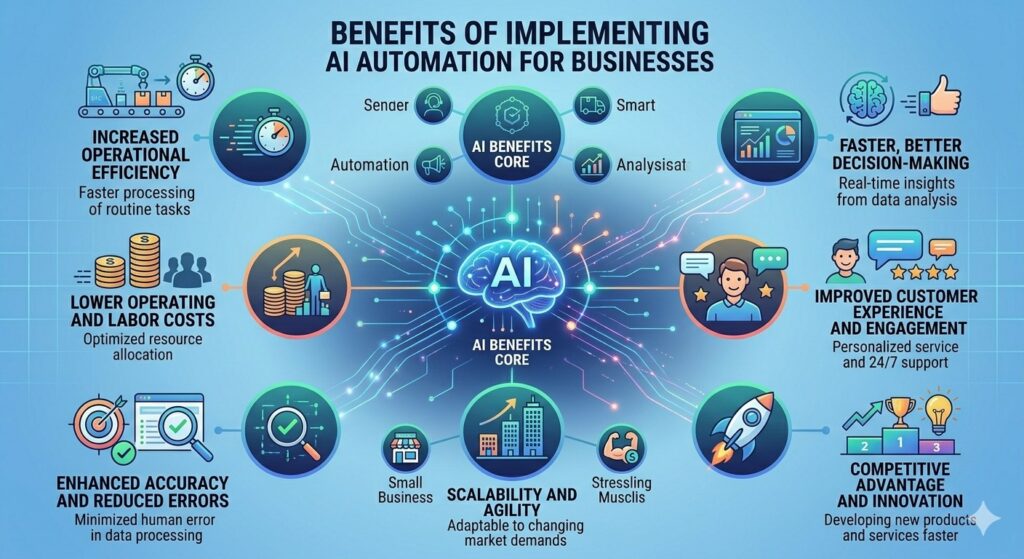
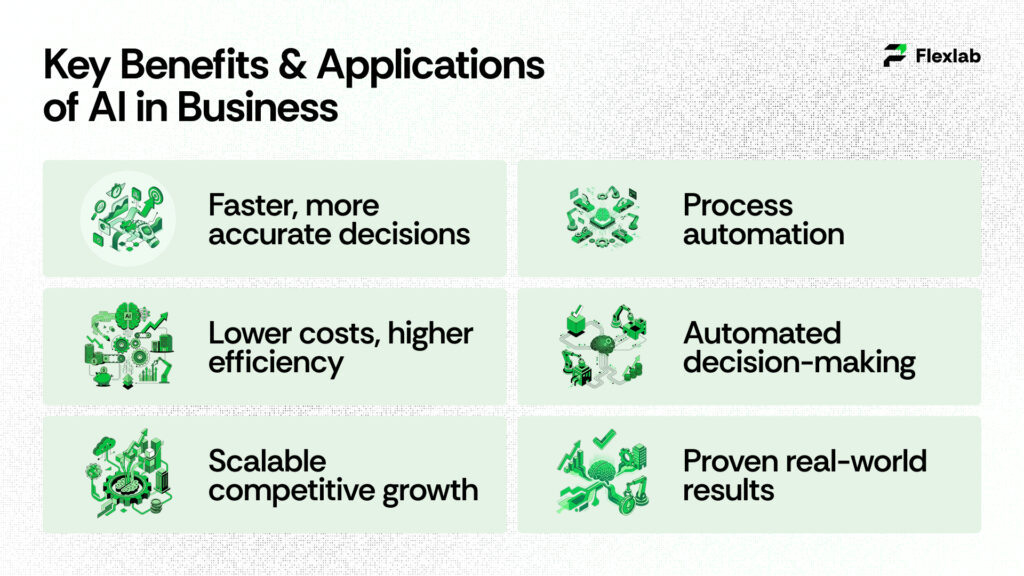
Faster Decisions and Better Accuracy
AI analyzes large datasets in seconds. As a result, leaders receive insights faster and with fewer errors. Studies show that organizations using AI-driven insights improve decision accuracy by nearly 30 percent compared to manual analysis.
-
Lower Costs and Higher Efficiency
AI reduces reliance on repetitive manual tasks. This leads to fewer mistakes and lower operational costs. For instance, companies that apply AI to routine workflows often notice cost reductions of up to 25 percent within the first year.
-
Scalable Growth and Competitive Advantage
AI grows with your business. Whether you serve hundreds or millions of users, AI systems adapt without requiring the same increase in staff. Therefore, organizations using AI scale faster while maintaining consistent quality and performance.
Together, these benefits explain why AI adoption has accelerated across industries. Consequently, businesses that delay implementation often struggle to keep pace with more agile competitors.
Best AI Applications for Business Use
Today’s organizations rely on the best AI tools for business to reduce costs, simplify operations, and improve decision quality while connecting data, workflows, and teams into a single intelligent system.
Businesses that adopt AI early often gain an advantage because they act faster and adapt more easily. In fact, industry reports indicate that companies utilizing AI-driven operations achieve up to 30 percent higher efficiency within the first year.
1. Business Process Automation
Many companies start their AI journey with business process automation. This approach replaces repetitive manual tasks with intelligent workflows that run continuously and accurately. For example, a logistics company automated invoice processing and shipment updates using AI. As a result, the company reduced processing time by 40 percent and significantly decreased human errors. Employees then focused on higher-value tasks instead of routine administration.
2. Automated Decision-Making
Another powerful use case involves automated decision-making. AI evaluates large volumes of data and instantly recommends actions. This eliminates delays from manual approvals and slow analysis. A retail chain applied automated decision systems to inventory planning. Consequently, stock shortages decreased and excess inventory dropped by 18 percent. These improvements directly increased profitability without adding operational complexity.
3. Real-World Use Case
Consider a medium-sized manufacturing firm struggling with production delays. After implementing AI-driven workflow automation, the company gained real-time visibility into operations. Bottlenecks became easier to identify. Within six months, on-time delivery improved by 22 percent, and customer satisfaction increased. This clearly highlights that when businesses choose the right AI applications, noticeable results appear quickly and compound over time.
Autonomous AI Agents in Action
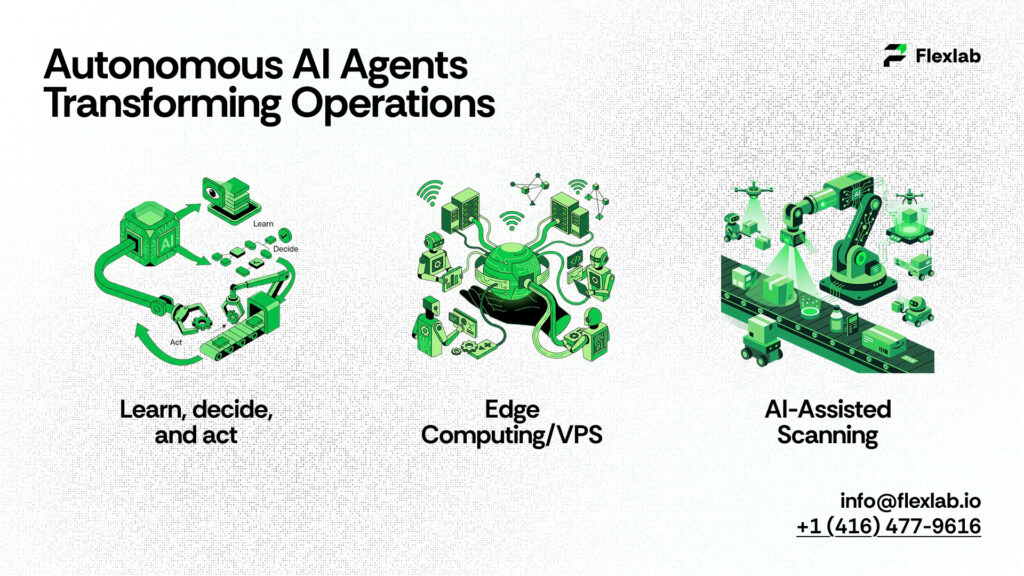
Autonomous AI agents are changing how businesses handle complex workflows. Unlike standard software, these AI systems can monitor multiple processes, make decisions, and take action with minimal human oversight. Consequently, the result is faster, smarter, and more accurate operations.
Organizations adopting autonomous AI agents report substantial efficiency gains. For example, a financial services firm deployed autonomous AI agents to track global market trends and detect unusual activity. The system alerted analysts only when anomalies appeared. reducing data review time by 50 percent, while freeing them to focus on strategy and decision-making.
How Autonomous Systems Work
These AI agents combine data analysis, predictive modeling, and automated execution using advanced AI techniques that allow systems to learn from patterns, adapt in real time, and improve decision accuracy over time.
They continuously learn from new inputs, improving over time. Instead of merely alerting humans to potential issues, they can act on rules or models directly, such as rebalancing a stock portfolio or adjusting production schedules.
Managing Complex Workflows
At the same time, businesses benefit when AI agents handle interdependent tasks across different systems. For instance, in logistics, autonomous agents can coordinate warehouse operations, shipping, and inventory management simultaneously. This integration reduces delays and minimizes errors that often occur when tasks are handled manually.
Real-World Use Case
A global e-commerce company implemented autonomous AI agents to oversee supply chain operations. Autonomous AI agents automatically flagged delayed shipments, rerouted packages, and optimized delivery priorities. Within three months, the company reduced late deliveries by 30 percent and improved overall customer satisfaction scores. This example shows why autonomous AI agents are no longer optional. They are essential for scaling operations efficiently while maintaining quality and accuracy.
AI in Marketing and Customer Growth
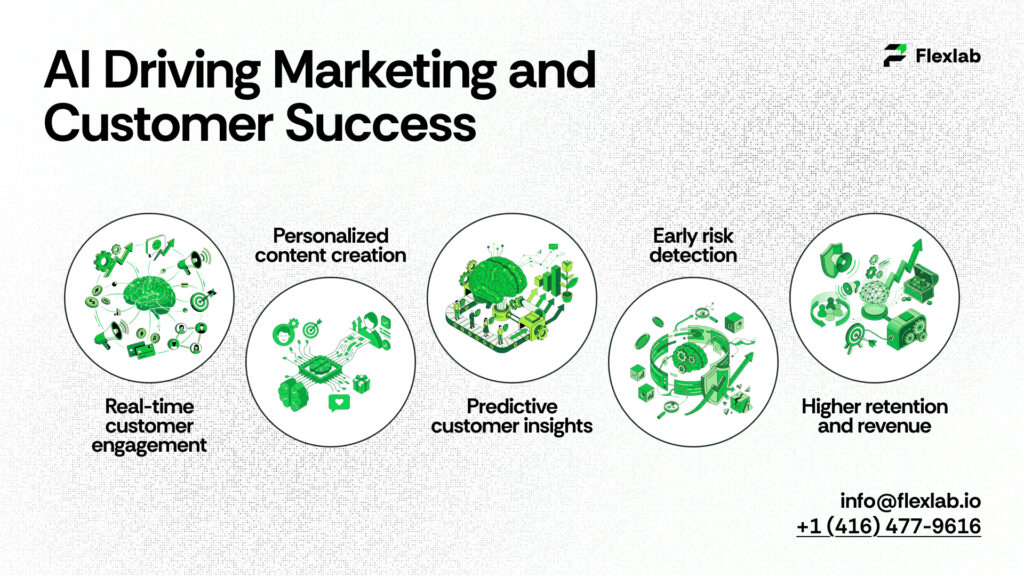
AI is transforming marketing from a reactive function into a proactive growth engine. Businesses now utilize AI in marketing to understand customer behavior, personalize experiences, and predict outcomes more accurately than ever before.
Recent studies show that companies integrating AI into marketing experience 20–30 percent higher campaign effectiveness compared to traditional methods. By analyzing data from multiple touchpoints, AI helps marketers deliver the right message to the right audience at the right time.
Conversational AI Tool
Conversational AI tools enable real-time customer interactions across websites, apps, and messaging platforms. These systems can answer questions, recommend products, and even complete transactions without human intervention.
For example, an average-sized online retailer implemented a conversational AI chatbot that interpreted visitor intent and guided users through the buying process. Therefore, conversion rates increased by 18 percent, while customer support costs declined by 25 percent.
Generative AI for Content
Generative AI automates content creation, from social media posts to blogs and ad copy. It learns a brand’s voice and adapts messaging to various audiences. As a result, marketing teams can save significant manual working hours.
Real-World Use Case
A subscription service applied predictive modeling to identify users likely to discontinue. Then, using AI-generated personalized retention messages, the company reduced turnover by 22 percent, thereby proving AI’s tangible impact on revenue growth.
Predictive Insights With AI
Companies leveraging predictive AI can forecast customer behavior, identify risks, and respond proactively rather than reactively. Meanwhile, market data suggests that organizations using predictive AI reduce operational costs by 15–20 percent while also improving decision-making speed. Thus, it makes predictive insights a critical advantage in competitive markets.
Predictive Analytics in Business
Predictive analytics in business utilizes historical and real-time data to identify patterns and forecast future outcomes. As an illustration, a subscription-based company applied predictive models to predict which customers were likely to cancel their plans. This insight enabled personalized retention campaigns, and accordingly, turnover dropped by 22 percent.
Anomaly Detection
Anomaly detection is another predictive technique that identifies unusual behavior or errors before they worsen. A global retailer used AI-driven anomaly detection to monitor transactions and spot potential fraud. The system flagged suspicious activity instantly. Hence, it reduces financial losses by 40 percent.
Real-World Use Case
A logistics company integrated predictive AI into its delivery operations. By analyzing weather forecasts, traffic patterns, and historical delivery times, the system automatically optimized routes. Thus, it reduced fuel costs by 18 percent and improved on-time deliveries, demonstrating how predictive insights can transform operational efficiency.
Security and AI in Fraud Detection
As digital transactions increase, businesses face growing risks from cyberattacks and financial fraud. AI in fraud detection enables organizations to identify suspicious activity in real-time, reducing losses and protecting sensitive data.
Research shows that companies implementing AI-driven fraud detection experience up to 40 percent fewer fraudulent transactions compared to traditional methods. It continuously learns from new patterns, staying ahead of evolving threats.
AI and Robotics in Security
AI and robotics collaborate to create layered protection. It analyzes vast amounts of data to spot irregularities, while robotic systems can automate responses, such as freezing accounts or flagging suspicious activity. For instance, a global bank monitors transactions with AI and robotics, cutting fraud losses by 35% in a year.
AI Engineering for Risk Management
AI engineering ensures that models are scalable, resilient, and explainable. Engineers design algorithms capable of detecting threats across multiple platforms, including web, mobile, and IoT devices.
A leading insurance company applied AI engineering principles to claims processing. The system analyzed claims and behavioral patterns, flagging high-risk cases with 90 percent accuracy, enabling faster review and fraud prevention.
AI in Smart Manufacturing and Edge AI
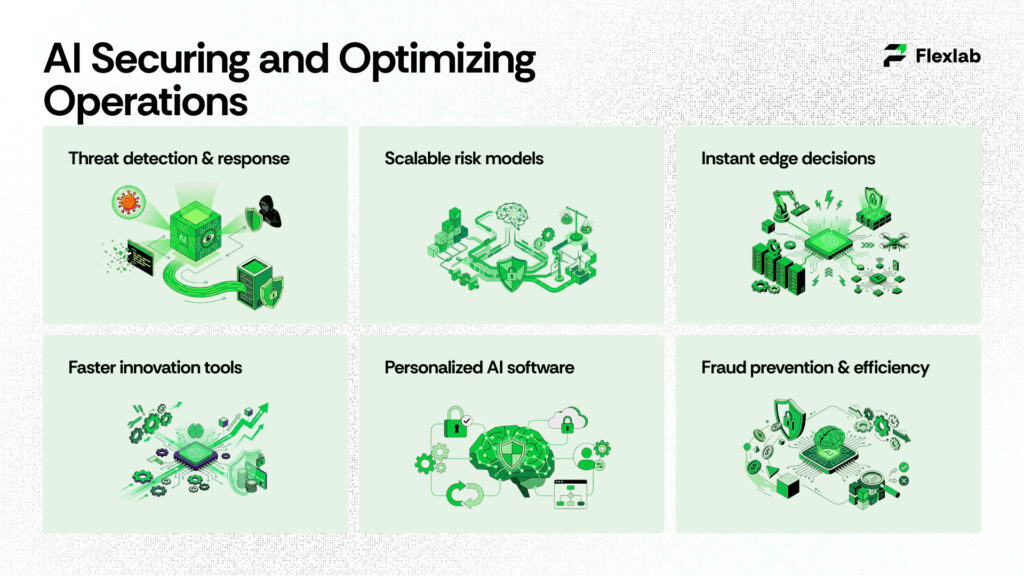
The manufacturing sector is rapidly evolving with the emergence of AI. Smart manufacturing leverages AI-driven systems and robotics to optimize production, reduce waste, and ultimately improve quality. Furthermore, by combining predictive analytics, sensors, and automation, companies gain real-time visibility and control over operations. Industry research indicates that factories implementing AI-driven manufacturing systems achieve up to 25 percent higher productivity and 30 percent lower operational cost, thereby highlighting the tangible impact of AI.
Edge AI for Real-Time Decisions
Edge AI processes data locally on machines instead of sending it to the cloud. This reduces latency and enables systems to make real-time decisions, which is crucial for industries where seconds matter. For instance, a car assembly plant implemented edge AI to inspect products on the production line. Edge AI systems detected defective parts immediately, preventing costly rework and saving thousands of dollars in production losses.
Real-World Use Case
A global electronics manufacturer integrated smart manufacturing with edge AI. The system monitored equipment health, predicted failures, and automatically adjusted workflows. Within six months, downtime decreased by 20 percent, efficiency improved, and product quality became more consistent. Therefore, combining smart manufacturing with edge AI provides both operational and financial benefits while enhancing production reliability.
AI Developer Tools and Software Development
Innovation in AI depends on the tools developers are using. AI developer tools help engineers test, build, and deploy efficient intelligent systems, while AI software development enables companies to create solutions that learn, adapt, and deliver personalized experiences.
AI Developer Tools for Faster Innovation
Modern AI developer tools include model training platforms, analytics dashboards, and low-code AI frameworks. These tools allow teams to experiment, iterate, and scale applications without starting from scratch.
For example, a robotics startup leveraged AI developer tools to design predictive maintenance models for factory equipment. This reduced downtime by 20 percent, allowing the company to scale production efficiently.
AI Software Development for Personalized Experiences
AI software development enables companies to deliver customized solutions. From fitness apps that adjust workouts in real time to financial apps providing personalized budgeting advice, these systems anticipate user needs and adapt accordingly.
A leading fitness app implements AI algorithms to develop exercise plans based on user progress and recovery metrics. Engagement increased by 30 percent, demonstrating how intelligent software enhances user experiences.
Consumer-Facing AI Applications and Smart Home Devices
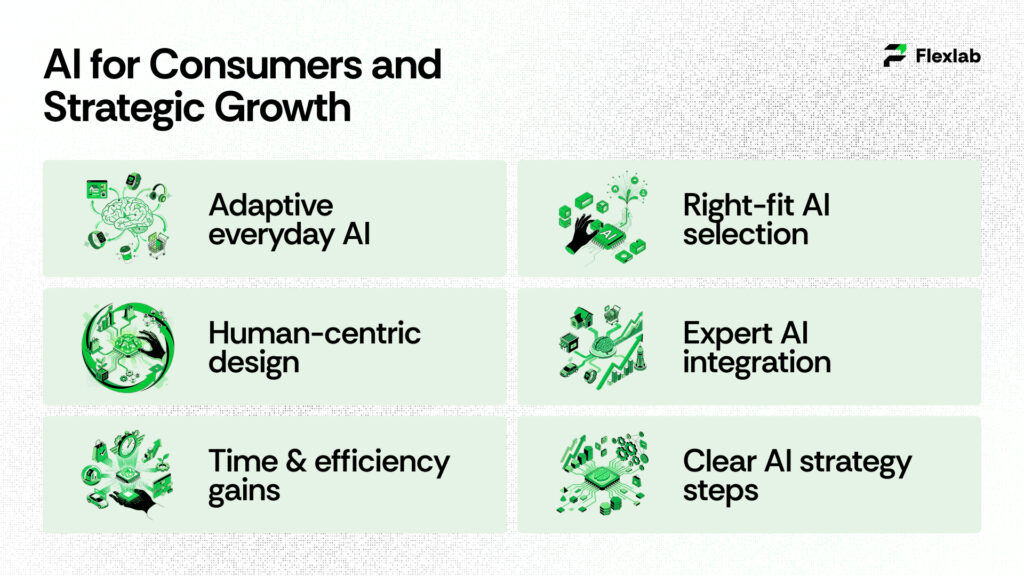
AI now operates beyond offices and factories. Smart home devices and consumer-facing applications transform daily life, making homes safer, more efficient, and more convenient. From intelligent thermostats to AI-powered security cameras, these tools adapt to user behavior and preferences.
Recent studies show that households using AI-powered smart devices report up to 25 percent lower energy consumption while enjoying improved comfort and convenience.
-
AI-Powered Software for Everyday Life
AI software development allows companies to create apps that learn from user behavior, and anticipate needs while delivering personalized experiences. For example, it includes fitness trackers, health monitoring apps, and personal finance tools.
-
AI Developers Designing Human-Centric Tools
AI developers focus on creating intuitive systems, such as voice assistants, smart appliances, and recommendation engines that anticipate user needs without being intrusive.
For instance, a voice-enabled kitchen assistant suggests recipes based on dietary preferences and available ingredients. Families reported a 20 percent reduction in meal preparation time, highlighting the practical impact of AI on daily life.
Getting Started With AI Strategy and Consulting Services
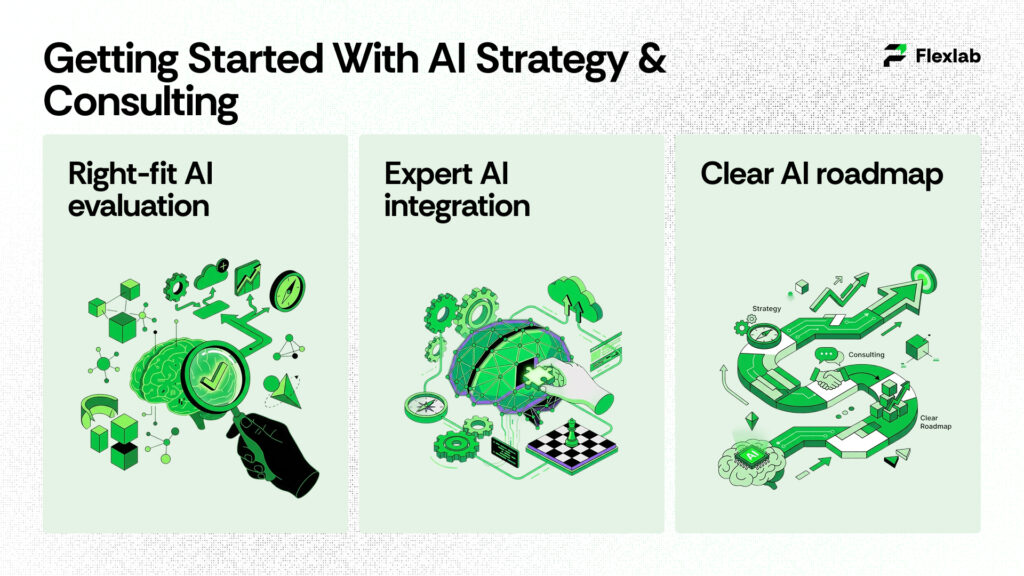
Implementing AI successfully begins with a clear strategy. AI strategy consulting helps businesses identify the right applications, align them with objectives, and maximize ROI.
Proper guidance ensures that businesses adopt AI effectively, deliver measurable results, and avoid wasted resources. Recent studies indicate that organizations with a structured AI strategy are 2.5 times more likely to achieve ROI within the first year compared to ad hoc implementations.
Evaluating AI Systems for Your Needs
Selecting the right AI systems requires understanding workflows, data availability, and the problems you aim to solve. Systems can range from predictive analytics platforms to AI-powered customer service solutions.
For example, a retail chain implemented AI systems to optimize inventory and supply chain management. Accurate demand forecasts reduced overstock by 20 percent and improved order fulfillment efficiency.
Partnering With an AI Automation Agency
Working with an AI automation agency ensures smooth integration of AI tools into existing workflows. Agencies provide expertise, select the right software, and customize solutions for specific business needs.
A mid-sized e-commerce company collaborated with an AI automation agency to implement automated customer support and personalized recommendations. Within six months, response times improved by 30 percent, and conversion rates grew by 15 percent.
Key Steps to Start Your AI Strategy
- First, assess needs by identifying processes that benefit most from AI.
- Next, select tools by evaluating AI systems aligned with business goals.
- Then, pilot and scale by starting small, measuring results, and expanding deployment gradually.
- Finally, monitor and optimize by continuously refining AI performance using analytics.
By following these steps, businesses can implement AI efficiently, achieving operational excellence and competitive advantage.
Supercharge Your Business with AI Applications at Flexlab
At Flexlab, we empower businesses to implement cutting-edge AI applications that automate workflows. In doing so, we deliver measurable results while saving valuable time. Whether you want to streamline operations, enhance customer experiences, or make smarter, data-driven decisions, our team guides you every step of the way. Don’t wait to unlock your business’s full potential.
Explore our portfolio to see real-world transformations, or learn more about our tailored services that fit your unique needs. Stay updated on AI innovations by visiting our blog, and connect with us on LinkedIn to follow our latest insights. Don’t just implement AI, partner with Flexlab, and contact us to turn innovation into action and discover how intelligent solutions can elevate every aspect of your business. Discover related blogs for practical AI insights.
- How AI Voice Assistants Improve Customer Service Efficiency
- How to Build Custom AI Agents for Your Business Operations?
- How to Use AI in Digital Marketing to Drive Better Conversions?
Conclusion: Embrace AI Applications Today
AI is a practical, transformative tool for smarter decisions, greater efficiency, and competitive advantage. By adopting AI applications, organizations streamline operations, enhance customer experiences, and reduce risks with predictive analytics, autonomous agents, and intelligent automation. Success depends on identifying high-impact processes, choosing the right tools with expert guidance, and piloting before scaling. Combining AI insights with human judgment and scalable systems turns innovation into measurable results and secures long-term growth in an AI-driven world.
Ready to Automate Your Business Workflows with AI?
📞 Book a FREE Consultation Call: +1 (416) 477-9616
📧 Email Us: info@flexlab.io
FAQ’s
1: What are the best AI tools for businesses to boost productivity?
The best AI tools for business include workflow automation platforms, predictive analytics software, AI-powered customer support, and intelligent scheduling tools. These applications streamline repetitive tasks, reduce human error, and provide actionable insights, helping teams focus on strategic work. Even small businesses can leverage cloud-based AI solutions to gain a competitive edge without large upfront investments, while larger organizations can scale them for enterprise-wide efficiency.
2: How do AI voice agents improve customer support and engagement?
AI voice agents handle real-time, hands-free interactions, answering routine queries, guiding customers through processes, and resolving simple issues instantly. They reduce wait times, improve first-call resolution rates, and allow human agents to focus on complex or high-value cases. Businesses in sectors like e-commerce, telecom, and banking report higher customer satisfaction, faster response times, and lower operational costs after integrating these systems.
3: How is generative AI transforming content marketing strategies?
Generative AI automatically produces blogs, social media content, ad copy, and emails while adapting to brand tone and audience preferences. It enables marketers to maintain consistency across channels, increase output, and quickly test content variations. Companies using generative AI report faster content creation, higher engagement, and improved campaign ROI, turning content marketing into a scalable, data-driven growth engine.