Key Advantages of AI in Supply Chain Management
AI in Marketing | Enterprise AI Solutions | AI Applications
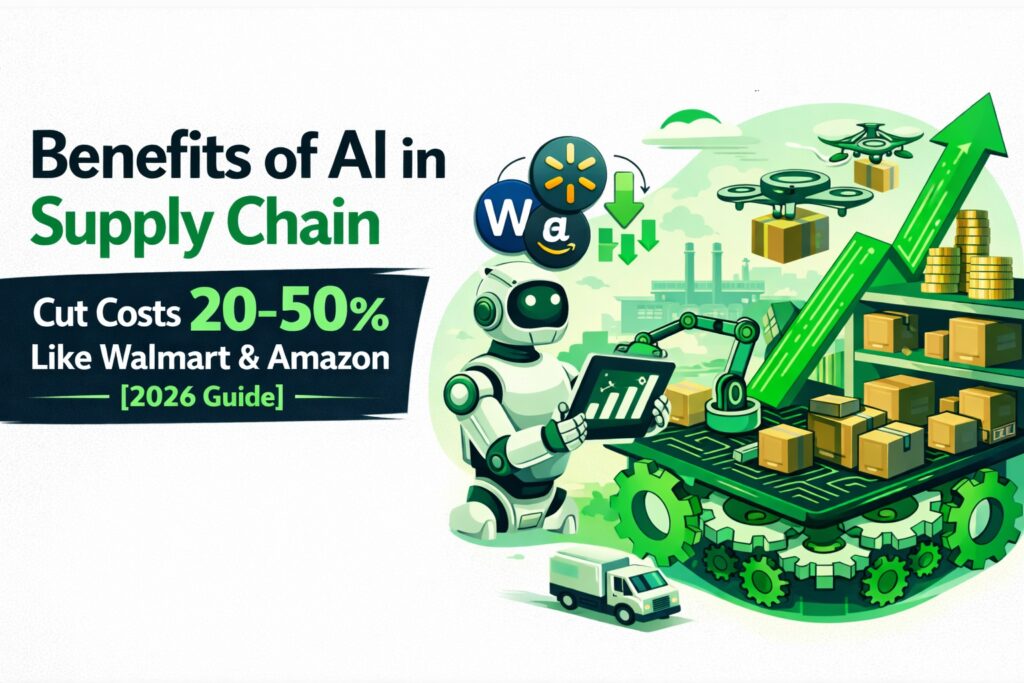
What are the benefits of AI in the supply chain? AI is slashing supply chain costs by 20-50%. Walmart keeps 98%of its shelves stocked, UPS saves $400Mannuallyy on fuel, and Amazon delivers Prime in hours. But your supply chain operations? Stockouts are bleeding $1.2M, data silos are killing forecasts, and manual chaos is wasting millions.
This guide reveals exactly how AI delivers these results, from AI demand forecasting accuracy to predictive maintenance and the hidden challenges tripping up 87% of implementations. Most importantly, discover Flexlab’s 30-Day AI Blueprint that turns your messy enterprise resource planning ERP system data into Amazon-level efficiency without $2M setups or 12-month delays.
Ready to unlock 28% cost savings like your competitors? Let’s dive in.
What is AI in Supply Chain?
Businesses nowadays leverage AI to handle and optimize supply chain tasks, such as monitoring product quality, balancing the right amount of inventory stocks, and finding the best delivery routes via transportation management systems with more efficiency than traditional or old software.
Artificial Intelligence (AI) is a general term for applications that act like smart humans and do complex tasks. It is a big part of machine learning (ML), where systems learn from consuming tons of data instead of following step-by-step instructions. This lets AI beat regular supply chain management software at things like deciphering information from videos, understanding speech or text, guessing future markets with predictive modeling, deciding in tricky situations, and finding hidden info in huge data piles.
These skills help fix and speed up workflow in supply chains everywhere. For instance, supply chain systems powered by ML algorithms can spot patterns in data that people miss, so it forecasts what customers demand more accurately. Hence, it leads to more economically efficient inventory management without any waste. Moreover, AI in transportation also checks traffic and weather to suggest faster routes, cutting delays. It watches work areas to catch bad quality checks or safety problems using Internet of Things devices. And new ideas like generative AI in supply chain and autonomous AI agents keep popping up as people test AI more.
The Importance of AI in Modern Supply Chain Management
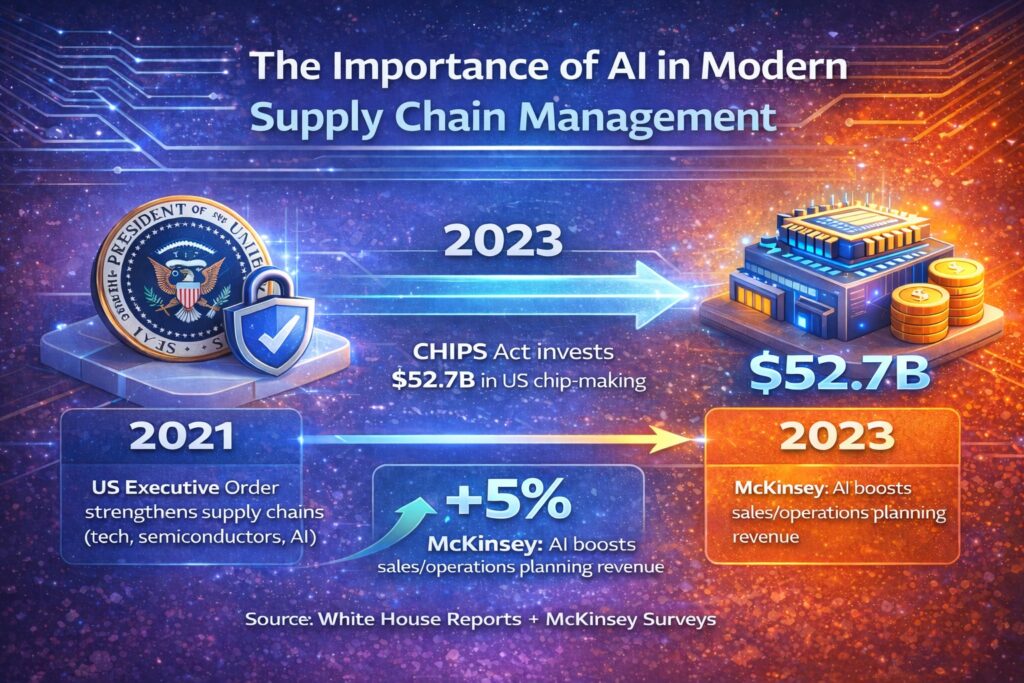
Supply chains, especially in the US, have faced more attention lately due to disruptions and risks.
In 2021, the US President signed an Executive Order to strengthen key supply chains, like tech, semiconductors, and AI. The goal was to make America’s supply chains tougher against problems like foreign threats, cyberattacks, and climate issues, while keeping AI tech competitive and safe via a resilient supply chain.
By 2023, a White House progress report showed real steps forward. The CHIPS and Science Act poured $52.7 billion into US chip-making, which powers AI. They also boosted training and research to spark AI innovation.
A new Executive Order focused on safe, reliable AI. Additionally, partnerships like the Indo-Pacific Economic Framework built stronger global chains for digital products, cutting risks in raw materials and boosting US leadership in AI.
These moves not only fix weak spots but also drive AI-powered progress while protecting the technology behind the AI boom. Moreover, recent McKinsey surveys confirm the payoff. In fact, most companies report that AI has boosted sales and operations planning revenue by over 5%. As a result, businesses are increasingly prioritizing AI investments to stay competitive.
Why use AI in Supply Chains?
AI offers companies a great chance to simplify operations and beat competitors in supply chains. It helps businesses predict customer demand accurately, spot risks early via supply chain analytics, and make smart choices based on data, which saves money and boosts supply chain efficiency.
Moreover, AI also takes over routine jobs like managing stock levels, finding the best delivery routes, and picking suppliers. This lets workers focus on big-picture supply chain strategies instead of daily chores.
In short, achieving this level of precision and efficiency in today’s fast-moving supply chains without AI would be nearly impossible.
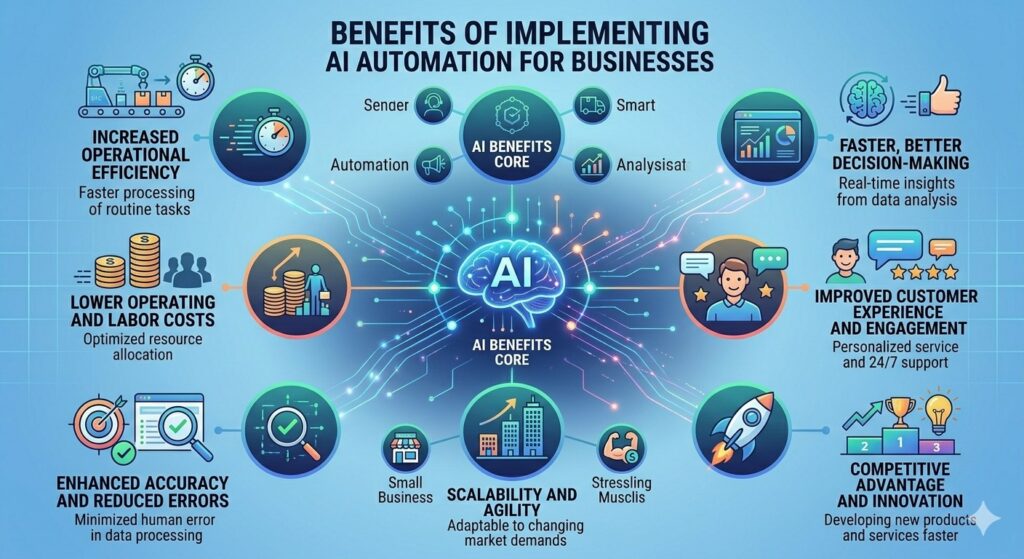
Top 8 Benefits of AI in Supply Chain
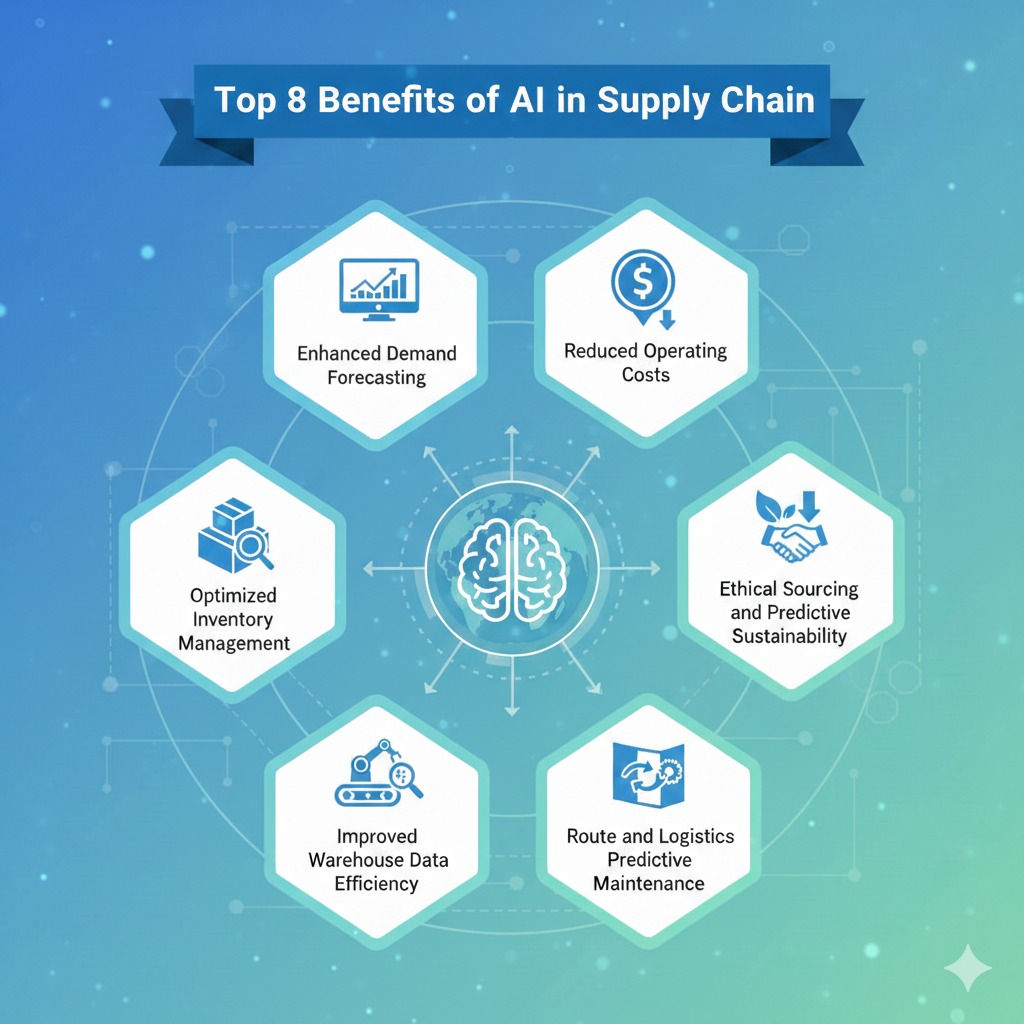
The future of supply chain worked well with AI technology, where no manual intervention is required. Let’s read some of the potential benefits of AI in supply chain management.
- Enhanced Demand Forecasting
- Optimized Inventory Management
- Improved Warehouse Efficiency
- Real-Time Data Analysis
- Reduced Operating Costs
- Ethical Sourcing and Sustainability
- Route and Logistics Optimization
- Quality Control and Predictive Maintenance
1. Enhanced Demand Forecasting
AI systems ingest vast datasets, such as past sales, weather patterns, social media sentiment, economic indicators, and even geopolitical events, to accurately forecast customer demand. In contrast, traditional methods depend on human estimates or basic spreadsheets. Thus, this approach often misses 20-50% of real needs, whereas AI machine learning improves accuracy by 30-50% over time as they learn from new data.
For example, retailers like Walmart use AI to forecast seasonal spikes, avoiding overstock during slow periods or shortages during peaks. Hence, it directly accelerates profits and customer satisfaction.
2. Optimized Inventory Management
AI optimizes inventory management. This can be done by analyzing sales data, supply chain dynamics, and external variables that maintain ideal stock levels. In this way, businesses strike a delicate balance between having enough stock to meet demand and avoiding excessive stock that incurs holding costs using supply chain tools. Moreover, AI systems automatically reorder stock when stock levels fall below a predefined threshold.
Therefore, it ensures a smooth replenishment without human intervention. It automates reorder points and knows when to order and how much, so you save big on storage fees and never run out of products. For instance, companies like Amazon that integrate AI with robotics, where AI signals restocking in seconds after detecting low shelves. Hence, it ensures products move efficiently, minimizes obsolescence, boosts cash flow, and ROI on storage assets without human delays.
3. Warehouse Efficiency
AI makes warehouses work better and faster. AI coordinates, organizes, and manages autonomous robots, automated guided vehicles AGVs, and smart picking systems to streamline receiving, storage, order fulfillment, and shipping. It helps in organizing shelves and warehouse layouts smartly. Machine learning looks at how much stuff moves through each aisle. It then suggests the best floor plans to grab items quicker, from unloading trucks, to storage racks, to packing, and out the door.
AI also maps the fastest paths for workers and robots to move goods around. This speeds up orders and cuts walking time. Plus, it checks demand clues from sales, marketing, and factories. This forecasts needs perfectly, balancing stock levels so warehouses don’t waste space or run empty.
For example, companies like Logiwa leverage AI in their warehouse and inventory management software to improve efficiency, accuracy, and decision-making capabilities. An AI system leads to a significant reduction in cost and enhances operational efficiency in warehouse operations.
4. Real-Time Data Analysis
AI systems improve real-time tracking that allows for better inventory management and the movements of goods and products. There are IoT sensors combined with AI that provide end-to-end tracking from suppliers to customers. Thus, it highlights issues such as temperature fluctuation for perishables or delays at ports instantly. Dashboards alert managers to anomalies, improving transparency and collaboration across partners. In practice, this helped companies during COVID disruptions by rerouting shipments proactively, reducing late deliveries from 25% to under 5%.
Furthermore, AI-powered supply chain systems improve logistics efficiency while optimizing delivery routes based on real-time data and AI predictive analytics. Thus, this approach improves resource allocation and faster delivery times.
5. Reduced Operating Costs
AI slashes supply chain operating costs by automating repetitive tasks via supply chain automation, boosting machinery performance, and cutting human errors for smoother operations. It perfects documentation accuracy, predicts equipment breakdowns early, and optimizes transportation routes by factoring in traffic, weather, and other conditions, suggesting faster alternatives that can trim logistics expenses by up to 30%.
For example, Uber Freight uses algorithms to minimize empty truck miles through smart routing, while early AI adopters report 15% overall logistics savings, proving a massive impact across entire networks.
6. Ethical Sourcing and Sustainability
How can AI enhance sustainability in supply chains? AI checks supplier info against green standards, like fair labor, pollution levels, water use, and avoiding conflict minerals. Blockchain proves where materials really come from. It tests eco-friendly options, like low-carbon suppliers, to cut company emissions by 10-20%.
AI Tools like Oracle spot bad suppliers instantly, helping follow rules such as Europe’s CSRD or US SEC laws. Businesses get “green” badges faster, cut waste with reusable packaging, and attract planet-friendly buyers. Sustainability becomes a money-saver and an edge over rivals, with generative AI in the supply chain simulating eco-scenarios for better decisions.
7. Route and Logistics Optimization
By processing live data on traffic, weather, fuel prices, vehicle capacity, and delivery windows, AI in transportation calculates the most efficient routes, sometimes rerouting mid-trip to avoid jams. This cuts transportation costs by 10-20%, reduces fuel use by 15%, and shortens delivery times by 18% on average. US logistics firms like UPS save millions yearly with tools like ORION, which optimizes 55,000 drivers’ paths daily, lowering miles driven and carbon emissions through transportation management systems TMS software.
8. Quality Control and Predictive Maintenance
Computer vision AI inspects products via cameras for defects at high speeds, catching issues humans miss, while predictive analytics forecasts equipment breakdowns using vibration and usage data from Internet of Things IoT devices. This drops defect rates by 40% and maintenance costs by 25%, extending machine life. Food manufacturers apply it to ensure compliance, avoiding recalls that cost millions. Food and pharma sectors use it for zero-defect compliance, while Oracle integrates it with ERP for automated holds/releases, preventing multimillion-dollar losses.
Challenges and Considerations in Implementing AI
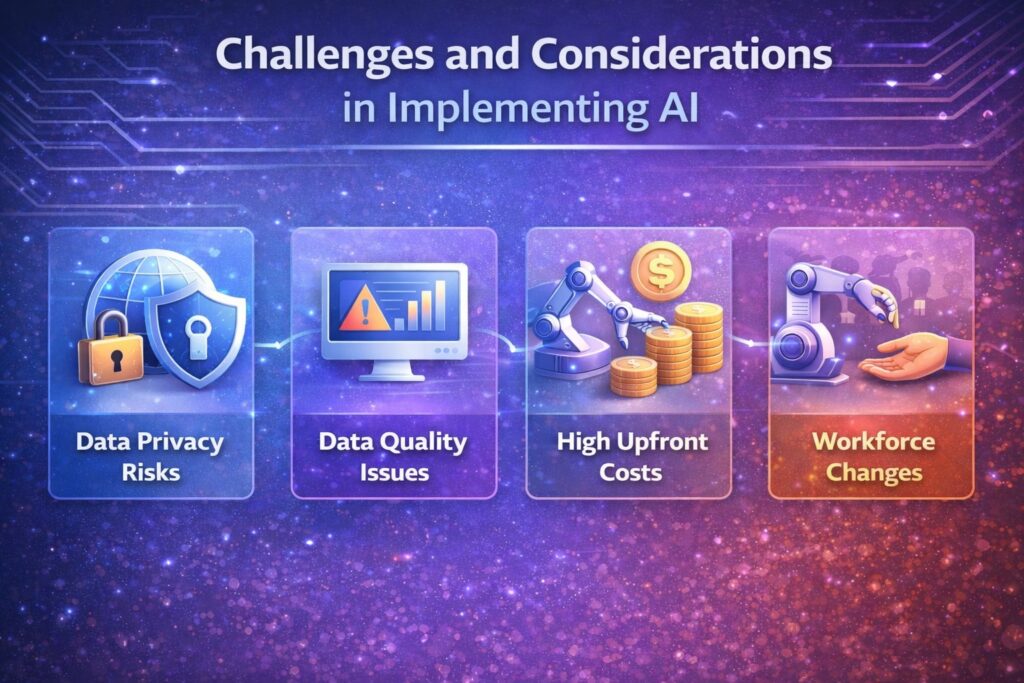
AI boosts supply chains significantly, but it also comes with real hurdles, especially for companies not ready for the switch.
-
Data Privacy Risk
Data privacy and security are the main concerns, as AI systems require vast amounts of sensitive data from suppliers, customers, and shipments, raising significant security concerns. To ensure security, businesses should comply with global regulations, such as the GDPR and the CCPA. This approach protects info and avoids fines.
For instance, EU companies face the strict EU AI Act, which demands strict data privacy, where small firms often struggle with these rules.
-
Data Quality Issues
AI algorithms work as they are trained. Therefore, companies must ensure that their data is accurate, relevant, and continuously updated to avoid erroneous predictions. Data security is a key challenge when it comes to AI adoption in industries. AI only works well with up-to-date data. Bad or messy info leads to wrong forecasts, like overstocking or missed delays.
Global supply chains make it worse: pulling data from suppliers in different countries, time zones, and formats creates integration headaches and errors.
-
High Upfront Costs
Implementing any new technology comes with upfront costs. Companies should carefully evaluate the potential benefits and ROI before investing in AI. Here are some key costs to consider:
- Hiring AI experts to build and fix systems
- Upgrading servers, cloud storage, and software
- Running heavy AI models that eat power and money
However, smart firms weigh ROI first, knowing long-term savings (like 20-40% cost cuts) beat the initial hit.
-
Workforce Changes
AI impacts the workforce significantly by automating routine tasks like inventory checks and route planning, which reduces manual labor but creates an urgent need for reskilling and upskilling programs. Companies must strike a careful balance between rapid technological advancement and preserving their existing talent pool. Therefore, ensure employees don’t just survive but thrive alongside intelligent systems.
Real World Application in Supply Chain Management
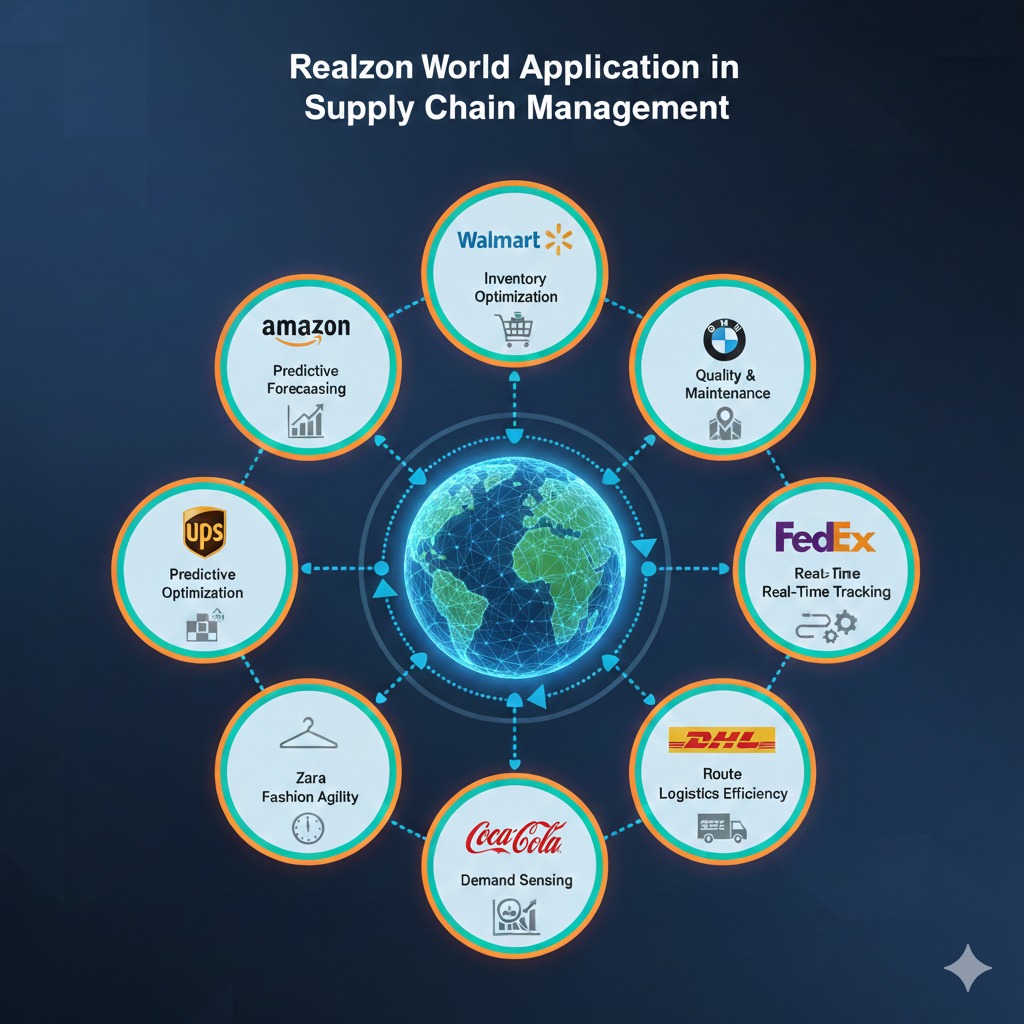
AI powers real-world supply chain wins at giants like Amazon and Walmart, cutting costs 20-50% via smarter forecasting and automation. Research highlights cases from UPS to Zara, proving massive ROI in efficiency and resilience.
Amazon: Predictive Forecasting
Amazon’s AI crunches sales, weather, and trends to stock warehouses perfectly. It auto-reorders 400M+ products, slashing stockouts 25% and saving billions on excess inventory, thus key to Prime’s fast delivery.
Walmart: Inventory Optimization
Walmart uses ML to adjust stock in real time across 10K+ stores based on local demand and delays. As a result, it reduced overstock 10–20% while boosting shelf availability to 98%, freeing $1B+ in tied-up cash yearly.
UPS: Route Optimization
UPS’s ORION AI plans 55K drivers’ routes daily, factoring in traffic and weather. As a result, it cuts 100M miles yearly, saves $400M in fuel, and speeds deliveries by 18%—thereby handling 20M+ packages seamlessly.
DHL: Logistics Efficiency
DHL’s AI optimizes global routes and warehouses while predicting disruptions. As a result, on-time rates improved 15%, fuel use dropped 10%, and real-time analytics now manage 1B+ shipments annually.
Zara: Fast Fashion Agility
Zara’s ML analyzes store/online sales to tweak inventory per location. Cuts markdowns 20%, sells out trends faster, thus turning 2-week design-to-shelf vs. industry’s 6 months.
Coca-Cola: Demand Sensing
Coca-Cola’s AI blends POS, weather, social data for local forecasts. Reduced stockouts/overstocks 30%, optimized bottling/transport for 200+ countries.
FedEx: Real-Time Tracking
FedEx Surround AI tracks fleets and predicts delays. Consequently, it reroutes critical shipments, reducing late deliveries by 20% across the global network.
BMW: Quality & Maintenance
BMW’s computer vision inspects parts on production lines, while AI predicts machine failures. As a result, defects drop 40%, and downtime falls 50% in factories.
Therefore, these apps show AI’s edge: 50% better forecasts, 65% fewer stockouts, and scalable globally.
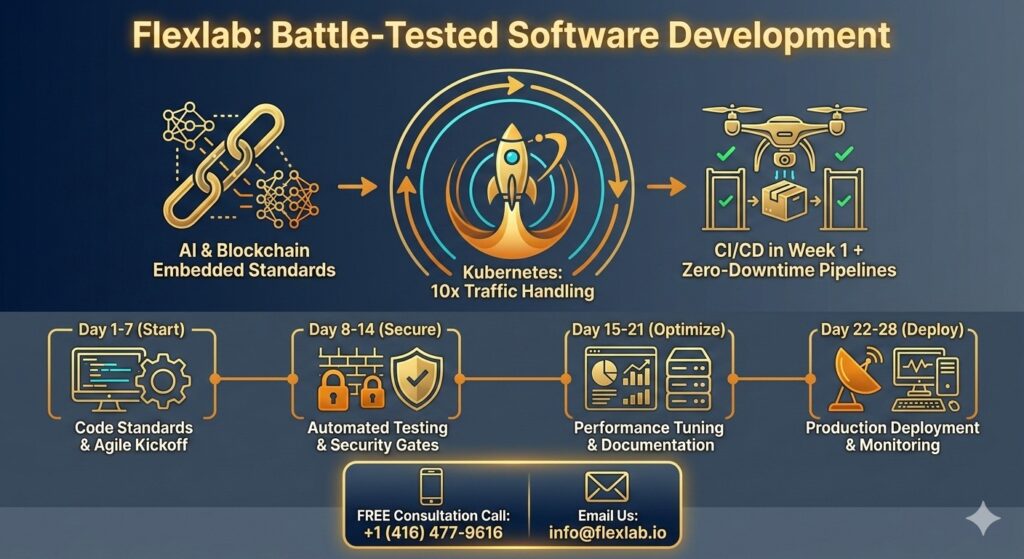
Flexlab’s Perfect Solution: AI Supply Chain Blueprint – Built in 30 Days or FREE
You’ve seen the wins; Walmart’s 98% stocked shelves, UPS’s $400M fuel savings, Amazon’s zero stockouts. Flexlab makes this YOUR reality with a custom AI Supply Chain Blueprint that transforms your messy ERP data into enterprise-grade supply chain automation in 30 days, or it’s FREE.
Check our blockchain and AI blog page and discover AI Automation Agency in Toronto, Agentic AI vs Generative AI, Marketing Automation, Automation Testing, and Benefits of AI in FinTech for Businesses.
Conclusion: Ai in Supply Chain Management
AI isn’t a “nice-to-have”; it’s table stakes for 2026 survival. Walmart’s 98% stocked shelves, UPS’s $400M fuel savings, and Amazon’s zero-stockout warehouses prove 20-50% efficiency gains are real and replicable. You’ve seen the benefits (65% fewer stockouts, 30% faster routes), government mandates (CHIPS Act, EU AI Act), and challenges (data silos, $500K costs, reskilling).
The gap? Execution. 87% of companies stall on implementation—you won’t.
Flexlab bridges it with your 30-Day AI Supply Chain Blueprint. Contact us now and visit our LinkedIn page to see real client feedback.
Ready to Cut Supply Chain Costs 28%?
📞 Book a FREE Consultation Call: +1 (416) 477-9616
📧 Email Us: info@flexlab.io
How do supply chains benefit from using generative AI?
Generative AI creates optimized replenishment plans, simulates what-if scenarios, and auto-generates supplier contracts from performance data boosting resilience 20-30% and cutting inventory costs via real-time demand signals. It also enhances risk mitigation by modeling disruptions proactively.
Is AI going to replace supply chain management?
No, AI evolves jobs, not eliminates them. Routine tasks (45% of roles) automate, creating new ones like AI governance, robot orchestration, and exception management. Amazon reskilled 700K+ workers into higher-paying AI-adjacent roles; supply chains gain job upgrades with less burnout.
How has artificial intelligence (AI) impacted supply chain management?
AI delivers 15-40% cost cuts, 50% better forecasts, 65% stockout reduction, seen in Amazon (zero-stockout warehouses), UPS ($400M fuel savings). 2026 trend: Agentic AI automates end-to-end planning; resilience jumps 30% via disruption modeling.