


AI automation in 2026 is not just a trend. It’s the engine empowering businesses to cut costs by up to 50%, boost efficiency 24/7, and outpace competitors with intelligent, adaptive workflows. Agentic AI handles complex decisions, while generative tools craft personalized customer experiences.
Do you want to boost productivity and grow your business? This guide covers everything you need: proven benefits, real-world case studies like Amazon’s 20% fulfillment savings, emerging trends, and strategies to measure ROI while overcoming common challenges.
AI automation uses advanced technology to handle tasks seamlessly and processes data by programming computer systems to review data, recognize patterns, and make decisions accordingly. It streamlines repetitive or time-consuming tasks that require human effort. From simple data entry and customer invoicing to complex inventory management and dynamic pricing, everything can be managed by AI agents, allowing people to spend more time on valuable work.
However, computers are not capable of doing abstract reasoning or making moral judgments; here comes Agentic workflows powered by the best autonomous AI agents. It is a technology that can be trained to mimic human decision-making and take autonomous actions. In contrast to traditional automation, which streamlines a fixed set of rules that perform repetitive tasks. But AI agent orchestration enables systems to evolve and improve efficiently. In short, Agentic AI improves over time through reinforcement learning or human-in-the-loop (HITL) retraining. It learns from experience and adjusts its actions to deliver tangible results.
Moreover, AI automation leverages both machine learning and natural language processing (NLP). This is because it enables them to understand and respond to human language. It also evaluates large datasets and makes intelligent decisions. Machine learning (ML) allows AI to analyze datasets and then recognize and predict patterns. This way, it can make decisions based on historical data.
Additionally, the introduction of large language models (LLMs) has greatly enhanced these techniques. Businesses can unlock more opportunities by incorporating generative AI. They use AI systems to create content and engage in natural conversation with humans, rather than only predicting and analyzing data.
A real‑world example of an AI agent vs chatbot in action is when a customer asks a question of a virtual agent on a company’s website. With a traditional chatbot, the customer would receive a preprogrammed response, but an AI automation model delivers a more comprehensive resolution. Since this model functions as an AI agent trained to analyze language and understand the issue, it can respond with a more relevant and tailored solution.
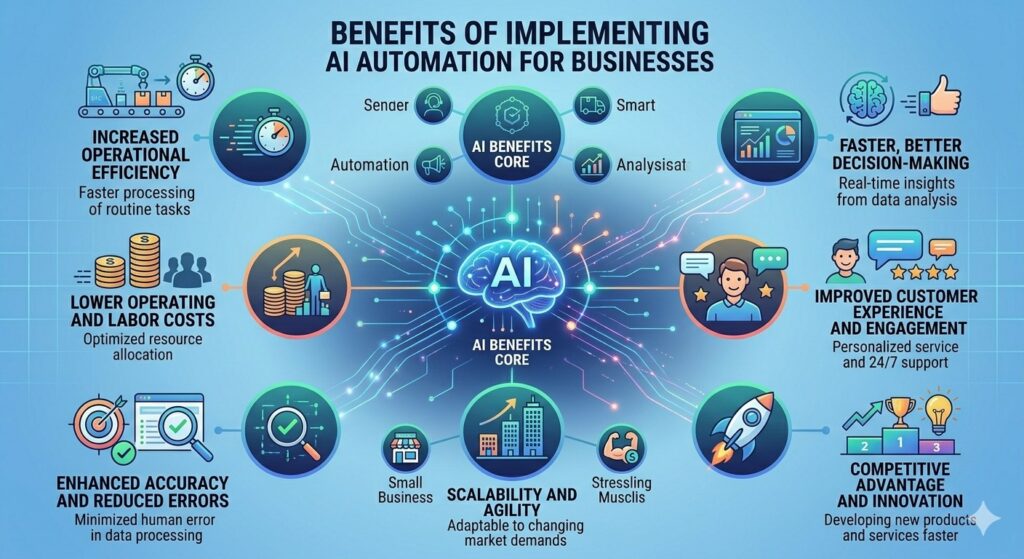
Implementing AI automation tools provides significant benefits in businesses. It makes up to 50% faster operational cycle times, saves costs, and enhances decision-making. Hence, businesses that adopt AI-driven workflows get tangible results. Let’s read each benefit in detail.
AI automation in 2026 streamlines repetitive, rule-based tasks such as data entry, invoice processing, and report generation. As a result, it frees up employees to focus more on strategy and innovation. Additionally, it reduces bottlenecks, cuts cycle times, and enables 24/7 processing without human intervention.
Organizations cut labor costs via cognitive robotic process automation (RPA), optimizing resource allocation. As a result, it minimizes errors that lead to rework or delays. Research shows AI-driven automation can significantly reduce operational costs, especially in areas such as HR, supply chain, and customer service.
AI systems examine vast amounts of data in real time, surfacing trends, anomalies, and actionable insights more quickly than manual analysis. As a result, this supports more accurate demand forecasting, inventory management, and risk assessment. It leads to smarter strategic decisions.
AI assistants, chatbots, and recommendation engines deliver fast, personalized responses, enhancing customer journey automation across websites and messaging channels. As a result, these tools reduce response times, increase resolution rates, and foster more consistent and satisfying experiences across touchpoints.
AI systems significantly cut human errors in data processing, compliance checks, and quality control via intelligent document processing. Automation improves operational precision and reduces costly errors in roles such as document verification, order processing, and financial reporting.
Multi-agent systems handle fluctuating workloads and scale operations without the immediate need for new hires. Whether handling seasonal spikes, expanding into new markets, or experimenting with new campaigns, AI-driven workflows adapt rapidly and maintain consistency.
Companies that implement AI agent frameworks get advantages in speed, personalization, and service quality. By automating routine work, teams can spend more time on innovation, experimentation, and strategic planning that sets the brand in the market.
AI automation 2026 in businesses boosts productivity by managing repetitive tasks, augmenting employee capabilities, and providing actionable insights through data analysis. Let’s read some of the key use cases of AI:
AI-powered chatbots and virtual assistants resolve customer queries 24/7, providing accurate solutions via websites, apps, and messaging platforms. Moreover, they answer FAQs, guide users through processes, and escalate complex issues to human agents. As a result, it cuts response time, improves service availability, and boosts productivity.
Businesses leverage AI automation to personalize outreach through AI visibility monitoring, score leads, and recommend products based on behavior and preferences. Additionally, AI tools optimize ad targeting, content generation, and campaign performance. As a result, it helps teams to run seamlessly and build scalable marketing campaigns.
AI systems extract, clean, and examine data from invoices, forms, emails, and databases. It turns raw data into structured reports. Hence, it speeds up financial close cycles, reduces manual errors, and enables faster decision-making.
AI in the supply chain forecasts demand, monitors inventory levels, and uses AI in predictive maintenance to anticipate disruptions. It automatically adjusts purchase orders and replenishment schedules. As a consequence, it helps businesses to avoid stockouts and overstock while improving delivery reliability.
AI automation helps in recruitment by screening resumes, scheduling interviews, and answering candidate questions. Additionally, it assists in the onboarding workflow while guiding new hires through forms, training, and system setup. Thus, it reduces time-to-productivity.
AI tools can read, classify, and extract key information from contracts, emails, and other documents. Then, it highlights deadlines, risks, or non-standard clauses. In this way, it reduces manual review time and improves compliance in legal, procurement, and finance functions.
AI automation in 2026 analyzes network traffic, user behavior, and system logs to detect anomalies that can signal fraud and security threats. It can trigger alerts or automated responses. Hence, it helps security teams respond so quickly and with fewer false positives.
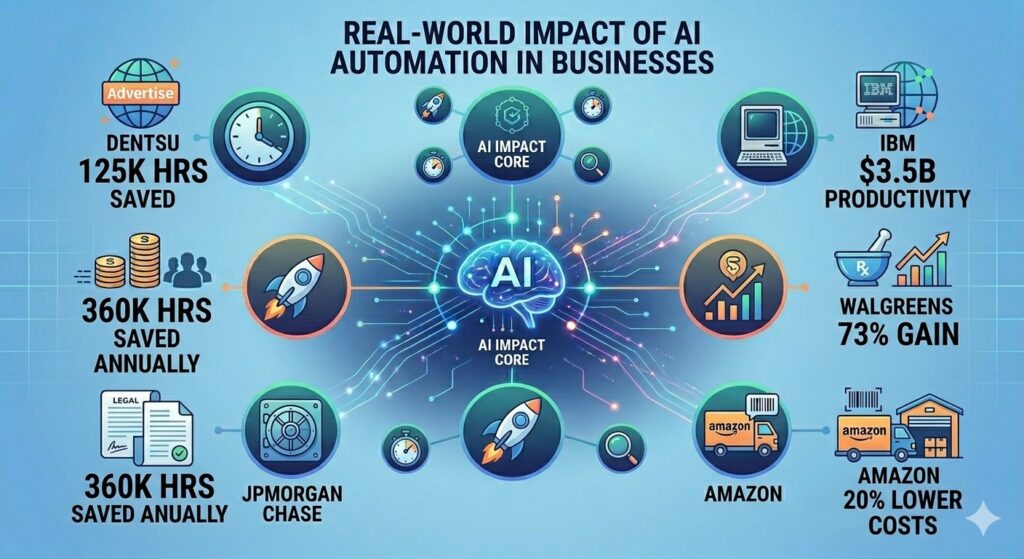
These case studies showcase how leading companies have harnessed AI automation services to achieve significant efficiency gains, cost savings, and enhanced performance. Let’s have a look at some of the impact.
The global marketing and advertising company deployed 60 software robots within 30 days. As a result, it saved over 125,000 hours through automated data extraction and migration tasks.
IBM implemented AI technology across all sectors, including IT and human resource management. As a consequence, they achieved $3.5 billion in productivity improvements.
Walgreens integrated RPA technology to their HR functions and saw a massive increase of around 73% in administrative performance efficiency in its services department.
Amazon leverages AI‑driven robots and machine‑learning systems to route inventory, optimize packing, and schedule deliveries in its fulfillment centers. This approach has reduced fulfillment cost by around 20% while increasing order processing.
JPMorgan deployed an AI‑based system called COiN to analyze thousands of legal and financial contracts, extracting key clauses and dates that previously required large teams of lawyers. The automation saves an estimated 360,000 hours of work per year.
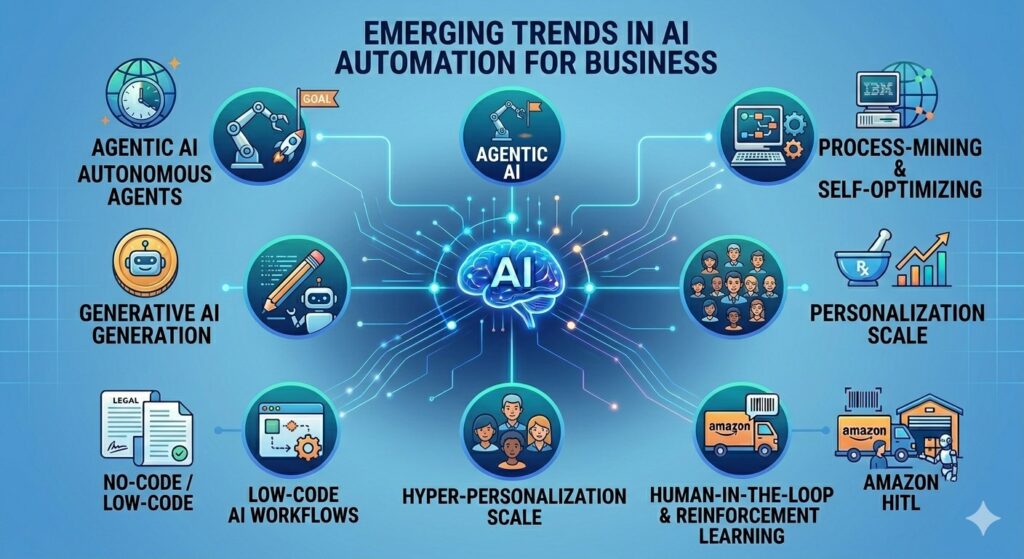
AI automation in 2026 is rapidly evolving from simple rule-based bots into new intelligent, adaptive, and customer-centric systems. These emerging trends are building blocks for how businesses design workflow, customer interaction, and compete in 2026 and beyond.
Unlike rule‑based automation, which follows a fixed set of instructions, businesses are now using AI agents that can plan, reason, and execute multi‑step tasks on their own. These agents manage and streamline workflows such as order fulfillment and incident resolution while reducing the need for human intervention. For example, C3 AI Agentic Process Automation wraps AI business ideas and processes like order‑to‑cash, customer service, invoice processing, and supplier onboarding into intelligent workflows. This allows complex workflows to run seamlessly with minimal human oversight while maintaining transparency and auditability.
Generative AI is integrated into automation platforms so systems can create emails, reports, social posts, and code snippets on the fly. This enables companies to automate data handling and generate content, personalize, and communicate with customers at scale.
Many companies are combining automation with human feedback loops, where AI learns from corrections and approvals to improve its outputs over time. Reinforcement learning helps models refine their actions, such as routing customer tickets or suggesting next‑best offers, based on real‑world results.
More business teams are developing AI-driven automation without coding while using visual tools that connect apps, data sources, and AI models with drag-and-drop workflows. This trend makes automation accessible, so marketing, sales, HR, and support teams implement their own AI-powered processes.
AI automation allows hyper-personalized experiences across channels by analyzing behavior, preferences, and context in real time. Businesses leverage these systems to tailor product recommendations, pricing, content, and support. Hence, it makes generic mass-marketing feel increasingly outdated.
AI tools scan existing business processes (e.g., order‑to‑cash, hire‑to‑retire) to discover inefficiencies and bottlenecks automatically. Then they suggest or even deploy automated fixes, gradually turning historical workflows into self‑optimizing, AI‑driven operations.
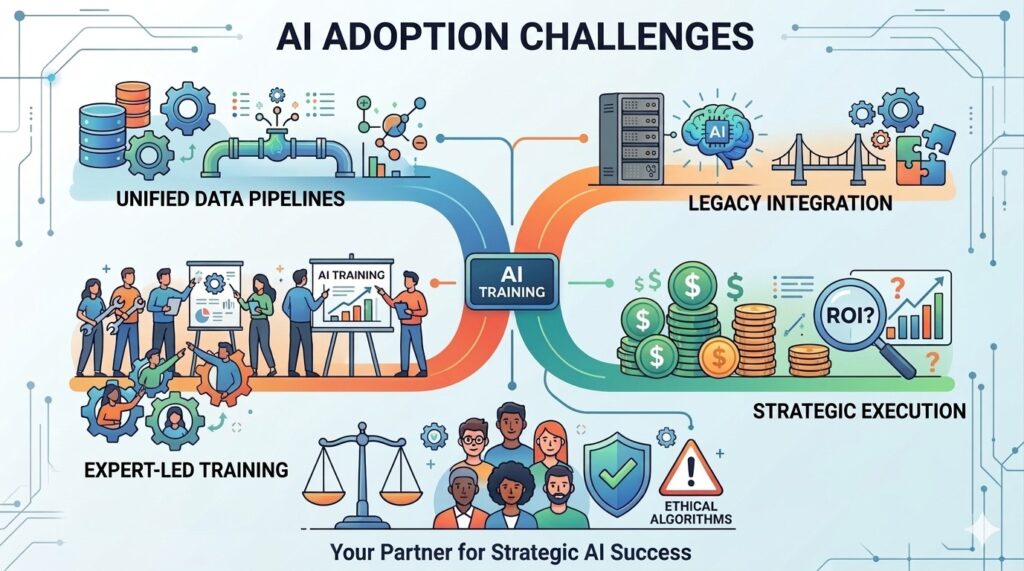
While the benefits of AI automation are clear, many organizations face challenges when getting started. However, with the right strategies, AI challenges can be resolved, resulting in successful outcomes. Here are some of the most common challenges:
AI systems depend on accurate, high-quality, and well-structured data to learn patterns, generate predictions, and automate decision-making. However, many companies have fragmented data sources, inconsistent formats, and missing or outdated records. As a result, AI models will produce misleading and inaccurate outcomes. This reduces the performance and reliability of automated workflows.
Many organizations have legacy infrastructure, such as CRM, core operational, and ERP software systems, that were not designed to support modern AI and APIs. Therefore, connecting AI automation to these systems can be complex, time-consuming, and prone to errors or performance bottlenecks.
There is a shortage of skilled professionals who are capable of building and managing AI systems. AI automation projects require expertise in machine learning, data engineering, data science, and software development. Moreover, employees may also resist automation due to fear of job loss or lack of trust in AI‑driven decisions, making adoption and change management a major hurdle.
When building, testing, and deploying AI workflows, businesses need upfront investment in tools, licenses, infrastructure, and training. It is difficult to demonstrate clear, measurable ROI in the early stages, especially when the benefits are spread across efficiency, quality, and customer experience
AI models can reflect and amplify biases present in training data. Thus, it leads to unfair or discriminatory outcomes in areas like hiring, pricing, and credit scoring. Moreover, ensuring fairness, transparency, and ethical use of AI automation is now a critical compliance and reputational issue.
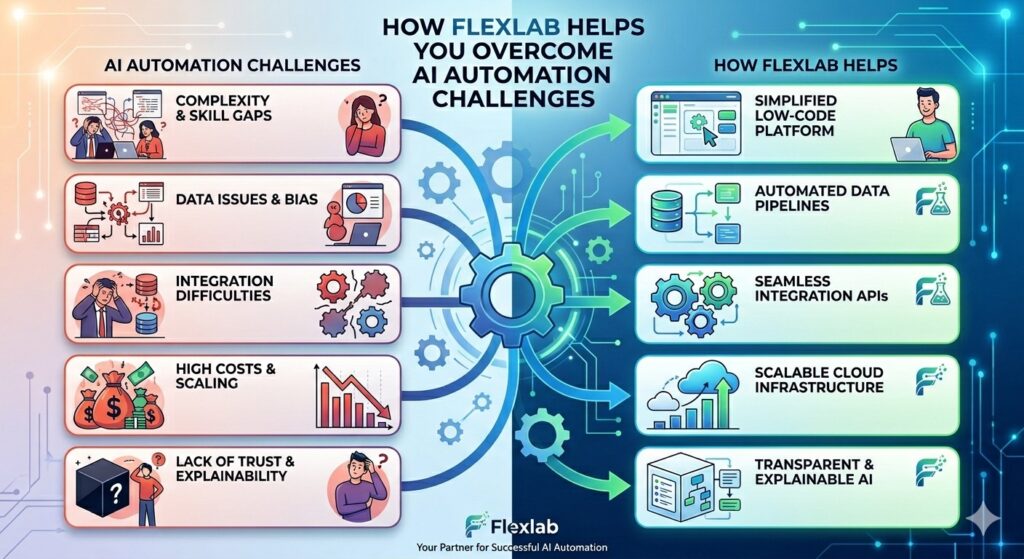
AI automation in 2026 may seem complex and intimidating at first, but with the right strategy and approach, it can be handled in a structured, manageable way. As an AI automation agency, Flexlab helps businesses turn these challenges into advantages with a partner‑led, end‑to‑end approach. We specialize in AI in fintech, AI automation in healthcare, and more, while integrating multi-agent systems with legacy ERP systems.
Is your data fragmented, are your systems legacy‑heavy, or does your team lack AI expertise? Don’t worry. We design, build, and implement AI workflows that are clean, compliant, and built for real‑world ROI.
We simplify data integration, modernize legacy stacks, and embed explainable AI into your workflows so you get reliable automation without sacrificing trust or transparency. Additionally, we guide you through change management, upskilling, and governance to help your organization embrace AI.
If you’re ready to move beyond AI pilot projects and deploy automation that scales, contact us today and visit our GBP profile to transform challenges into measurable business outcomes.
Furthermore, explore our Blockchain and AI blog page and discover the Best AI Automation Agency in Toronto, Role of AI Predictive Analytics, AI in Marketing, Enterprise AI Solutions, and How to Choose the Right AI Automation Agency in Toronto.
In 2026, AI automation stands as a transformative force for businesses, driving efficiency, innovation, and competitive edge through agentic AI implementation, generative tools, and scalable workflows. From Dentsu’s 125,000 hours saved to Amazon’s 20% cost reductions, real-world successes prove its impact, while emerging trends like no-code platforms and edge AI promise even greater agility.
The key? Strategic implementation that overcomes hurdles and unlocks value. At Flexlab, we’re here to guide you every step of the way to seamless integration to ethical, high-ROI automation.
AI business automation uses machine learning and NLP to perform and optimize business tasks, such as customer service, invoicing, HR, and supply chain workflows, with minimal human effort. It learns from data, handles unstructured inputs, and makes smarter decisions than fixed rule automation. The result is faster operations, fewer errors, and more time for strategic work.
You can earn by building and selling custom AI workflows for SMEs, such as email bots, lead qualifier systems, or invoice processing, often as one time or recurring services. Another way is offering AI powered freelance work like content, SEO, or design, typically charging $20–$150+ per hour.
Big 4 AI automation refers to how Deloitte, PwC, EY, and KPMG use AI and automation in audit, tax, compliance, and back office workflows. It means chatbots, analytics engines, and agentic systems that cut manual work and improve consistency. This lets consultants focus on advisory instead of routine tasks.
Blockchain Development Agency | Smart Contract Audit Services | White Label Crypto Exchange
Do you know why we need white-label services? Agencies want it to double revenue overnight without investing a single penny. They won’t hire any developers, SEO experts, or marketers. With the help of these services, you can rebrand premium solutions as your own.
In fact, 78% of digital agencies using these partnerships report 2x growth within a year, while 65% cut operational costs by 40%, according to industry benchmarks. Sound interesting? Let’s dive into this guide that reveals real-world examples, use cases, and expert tips to find the right provider and scale your business smartly.
White-label services allow one company to create products or services that another company rebrands and sells as their own product under their brand name without showing the real maker.
Let me explain with an example. The digital agency would hire a white-label marketing agency to execute projects across email marketing, digital marketing, content creation, and social media management. Then they rebrand them under their name and resell them. Instead of doing it in-house, they hire a white-label agency to handle all the projects.
In this way, companies offer a wide range of services without developing them from scratch. This approach is common across many industries, including software houses and consumer goods companies.
Furthermore, these providers manage production and support. On the other hand, the company focuses on marketing customer relationships. This setup benefits both parties and allows each party to specialize in its core expertise.
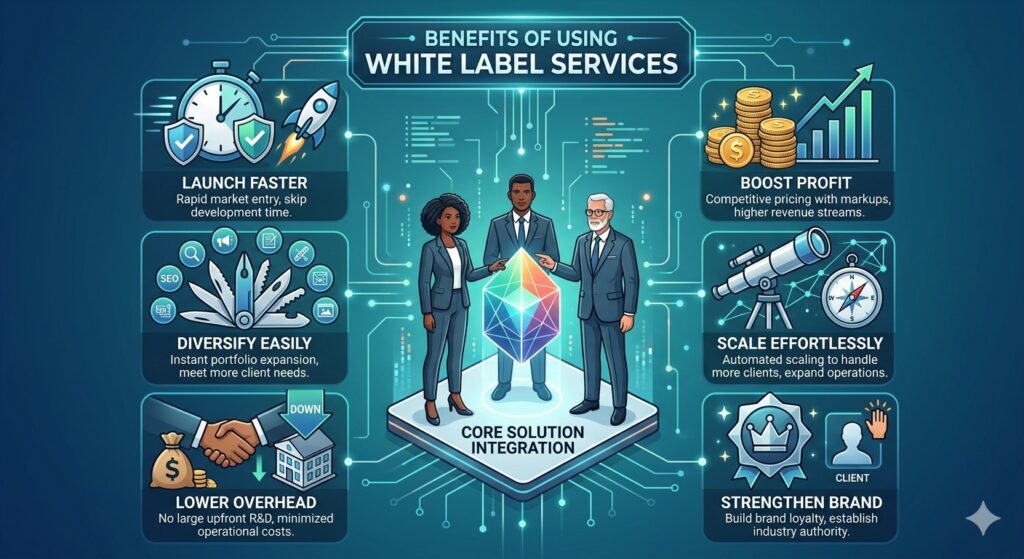 You have numerous advantages when leveraging these services, whether for small or larger enterprises. One of the key benefits is the ability to expand your services and products at zero development cost. Businesses can bring new products by partnering with them and fulfill the demands of customers effectively.
For instance, a digital marketing agency without in-house web development expertise can team up with a white-label web development services provider to bundle custom websites into its offerings. This lets them deliver greater value to clients.
Another major perk is faster time-to-market. These solutions come ready-made and customizable, so you launch new offerings weeks or months ahead of building them in-house. It’s perfect for staying ahead in competitive tech landscapes like blockchain development services.
You also gain access to expert talent and cutting-edge tech without the hassle of recruitment or training. Providers handle the heavy lifting with specialized teams, ensuring high-quality results that boost your agency’s reputation.
Plus, these services offer scalability on demand. Ramp up or down based on client needs without fixed overheads, keeping your operations lean and profitable. Thus, you don’t need full-time hires or building a dev team from scratch. Check out our white-label services at Flexlab and visit our LinkedIn to discover how we empower agencies to scale smarter.
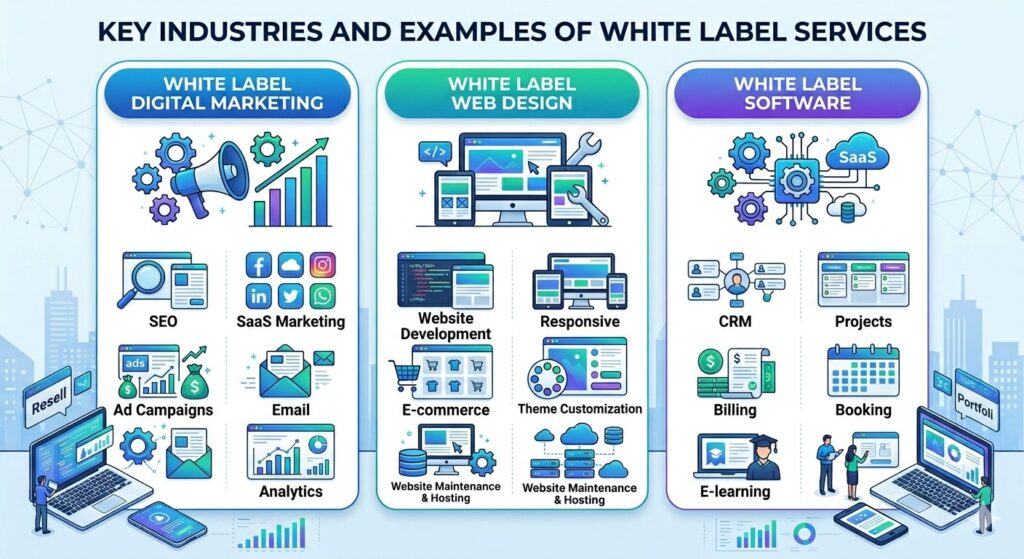
These services span countless industries, unlocking rapid growth for agencies and brands alike. Explore the top sectors where they deliver maximum impact.
SEO Services
Search Engine Optimization (SEO) drives online visibility for businesses. White label content marketing and SEO let agencies deliver expert keyword research, on-page optimization, and link-building under their brand, expanding services without hiring specialists.
PPC Advertising
Pay-Per-Click (PPC) demands precision for ROI. Agencies use PPC service to run Google Ads and Meta campaigns seamlessly, boosting client results and agency credibility with minimal overhead.
Social Media Management
Handling social platforms requires consistent effort. White label social media management services manage content calendars, analytics, and community engagement, enabling agencies to offer full-service packages. Studies show 70% of U.S. small businesses credit social media for brand growth.
Email Marketing
Email campaigns nurture leads and drive conversions effectively. White label email marketing platforms handle automation, segmentation, and A/B testing, allowing agencies to deliver personalized sequences under their branding without building tech stacks.
Website Development
Custom websites boost client presence online. Agencies partner with white label web design providers for WordPress, Shopify, or custom builds, offering fully branded sites from concept to launch without in-house developers.
UI/UX Design
Because user experience defines conversion rates, they focus on creating intuitive interfaces and mobile-responsive designs. As a result, agencies can deliver polished digital experiences that not only retain users but also enhance brand perception.
SaaS Platforms
White label SaaS scales effortlessly for teams. It resellers rebrand tools like CRM or automation platforms (e.g., HubSpot alternatives), letting businesses present enterprise-grade software as proprietary.
Mobile Apps
Custom app development can be resource-intensive. However, their pre-built apps for e-commerce or productivity allow quick rebranding and launch. Consequently, businesses can deliver polished user experiences without having to code from scratch, saving both time and resources.
E-commerce Systems
Online retail thrives on reliable platforms. White label solutions like Shopify clones provide customizable storefronts with payment gateways and inventory tools, helping agencies launch client stores rapidly.
Food Products
Grocers like Trader Joe’s source private-label snacks and meals from manufacturers. This offers unique, affordable items exclusive to their shelves, cutting costs while building customer loyalty. If you are confused between white label vs private label, then let me explain in a nutshell: white label products are pre-made by one manufacturer and sold to multiple companies, while private label products are custom-made, exclusive items manufactured for one retailer.
Health and Beauty
Skincare brands partner with service provider labs for creams and serums. Smaller players compete with giants by rebranding high-quality formulas, focusing on marketing over production.
These services empower businesses to diversify offerings, enhance client value, and drive profits efficiently, all while outsourcing the heavy lifting.
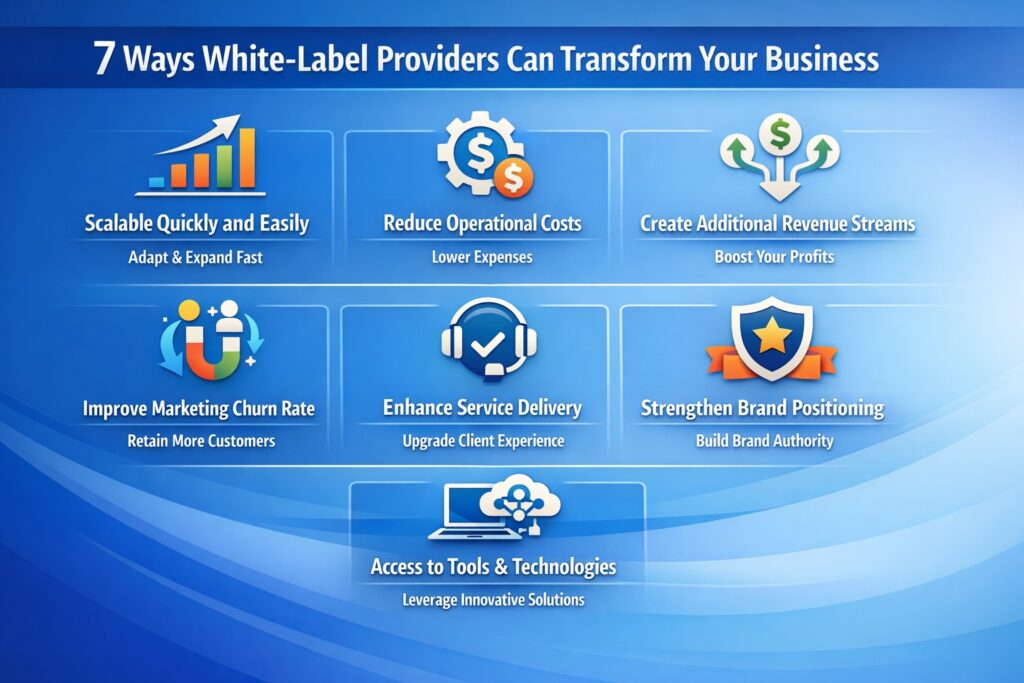
They act as force multipliers for agencies, delivering specialized expertise that accelerates growth without the typical headaches of expansion. Here’s how they transform operations across seven key areas.
As the demand for digital services increases in the market, businesses want a broader range of services. To remain competitive in the market, companies need to offer more services instead of just providing traditional services. For instance, if you run a digital marketing agency, you can only sell a few services, such as SEO, web design, and pay-per-click.
Whereas customers demand a full suite of digital marketing services so that they get the desired results. Here comes the white-label service provider who offers a comprehensive suite of digital services that fulfill the requirements of the client. In this way, businesses scale their service portfolio without investing in hiring new resources.
Due to increasing inflation and a weak economy, business owners seek ways to reduce their operational costs. Running a successful company requires a huge amount of investment in technology and other important assets. Most companies reinvest the set profit margin to grow their business. The service provider can help you here. They provided a pay-as-you-go model without asking for a big upfront payment, which really helps businesses. They have economies of scale that allow them to sell the service at a lower cost than digital agencies.
Moreover, some providers won’t ask for long-term contracts. These providers bear the cost of tools and technologies. In this way, businesses do not incur high costs on new technologies.
Businesses are finding new ways to generate revenue to stay competitive, as it is difficult to rely on traditional revenue resources. However, creating an additional revenue stream is quite challenging, but a full-service provider helps you in this regard. They can provide an opportunity to businesses so that they start generating revenue from new services and products.
Moreover, comprehensive providers have additional resources and training that can help businesses to sell their services more effectively. Thus, businesses can accelerate their new revenue streams without compromising the quality of existing services.
Churn rate is the percentage of customers who cancel their services within a certain period of time. This is a common and major issue in online business. According to the study by Recurly Research, the business experience of B2C subscription is higher customer churn rates as compared to B2B businesses. Moreover, it increases upto 20% for digital marketing agencies.
Customers cancel services for various reasons, but poor quality or performance often plays a key role. Businesses that fail to proactively address client needs risk high churn rates. Experienced service providers bring portfolios of hundreds or thousands of projects. Their proven strategies help agencies retain clients and lower marketing churn.
Market trends are constantly evolving, so businesses need to keep up to date to stay relevant in the market. This approach is quite challenging, especially for small business who donot invest in new services. Moreover, this is even more difficult for digital marketing agencies.
For instance, digital marketing platforms such as Google and Facebook are continuously changing their algorithms. This impacts the services offered by agencies. For example, Google’s recent helpful update requires agencies to create more helpful and useful content for their client to rank on search results. As a result, businesses must update their service delivery and remain relevant to give tangible results to their customer.
The service provider enhances service delivery and scales online businesses. Best white label marketing agency has the resources and expertise to keep up with the latest changes in the industry. This way allows them to provide the best services to the clients.
Markets today overflow with competition. There are thousands of businesses chasing the same clients, with new entrants appearing constantly.
In this crowded space, a strong brand sets you apart and drives client attraction and loyalty. Unfortunately, small or mid-sized firms often lack the resources or know-how to craft one effectively. That’s where a white-label company can help. They solve this by delivering top-tier, rebranded services that elevate your market presence. You stand out from rivals, build instant recognition, pull in fresh clients, and hold onto current ones.
Businesses must require access to numerous tools and technologies to run smoothly. For instance, if you want to track a record of website visitors, manage social media, and build marketing campaigns.
These solutions often come with steep costs through monthly subscriptions that accumulate quickly, making them difficult for small businesses to afford. However, get regulatory compliance tools, AI analytics, and more without subscriptions piling up.
Moreover, AI and machine learning have surged in digital marketing importance. They power hyper-personalized, targeted campaigns that boost lead generation.
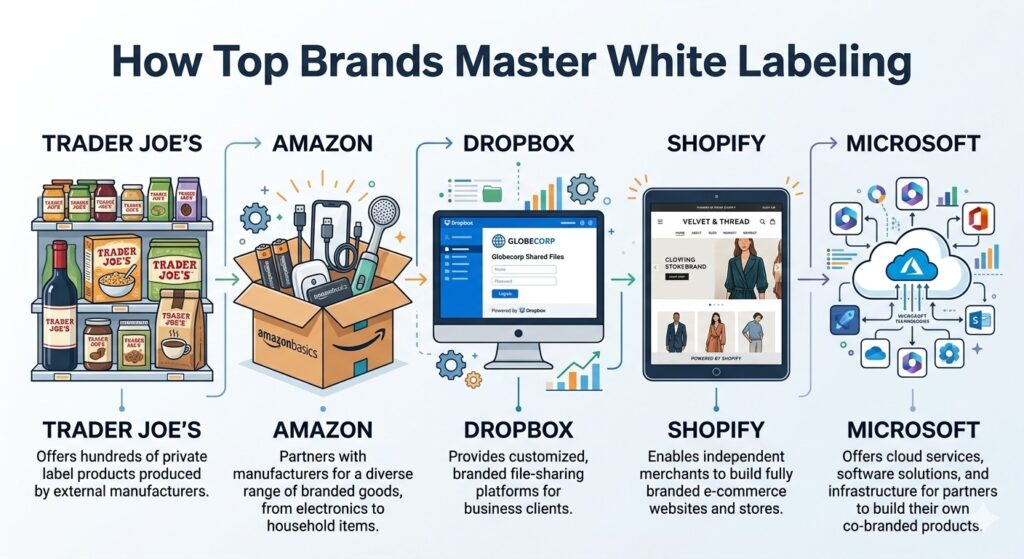
Leading companies across retail, tech, and e-commerce have harnessed white labeling to boost margins, enhance branding, and scale efficiently. Here are standout examples showcasing tangible benefits.
This iconic U.S. grocery chain sources private-label snacks, frozen meals, and beverages from manufacturers, selling them exclusively in-store. The strategy delivers unique, affordable products that drive customer loyalty and fuel the brand’s cult following.
The e-commerce giant offers private-label lines like AmazonBasics (electronics), Amazon Essentials (clothing), and Amazon Elements (health goods). So, leveraging customer data, Amazon identifies trends to launch targeted brands, capturing higher profits on everyday essentials.
Dropbox provides businesses with a white-labeled cloud storage solution for seamless branding and workflow integration. Companies rebrand the platform as their own, ensuring a consistent user experience while tapping Dropbox’s robust infrastructure.
With Shopify Plus, enterprises can fully customize their e-commerce stores using their own branding, domains, and advanced features, including unlimited bandwidth and multilingual support. As a result, businesses can deliver personalized shopping experiences, which in turn accelerate growth and enhance brand visibility. Moreover, these tools empower brands to adapt quickly to evolving customer needs, ensuring a competitive edge in the market.
Microsoft 365 lets organizations apply custom branding to the Office suite, including Word, Excel, and PowerPoint, with custom branding. It includes enterprise-grade security and compliance, enabling secure, familiar tools that streamline operations at scale.
Selecting the right partner is crucial for aligning with your business objectives and ensuring long-term success. Therefore, focus on these key factors to make an informed decision.
First, prioritize partners whose white label products or services match your quality benchmarks. For example, request samples or demos upfront, then rigorously test them to confirm consistent reliability before finalizing any agreement.
Additionally, choose partners with strong client testimonials and a solid history of performance. To do this, research reviews from other businesses to gauge their dependability, support quality, and delivery track record.
Next, seek partners whose values, target audience, and offerings complement your brand. As a result, this alignment ensures smooth integration and enhances your ability to upsell without disrupting customer experience.
Moreover, compare pricing structures across options to protect your profit margins. Importantly, verify that costs are reasonable, scalable, and allow you to maintain competitive pricing in your market.
Finally, scrutinize agreements for fairness, focusing on exclusivity clauses, minimum orders, and payment schedules. In short, negotiate terms that support your flexibility and growth without hidden risks.
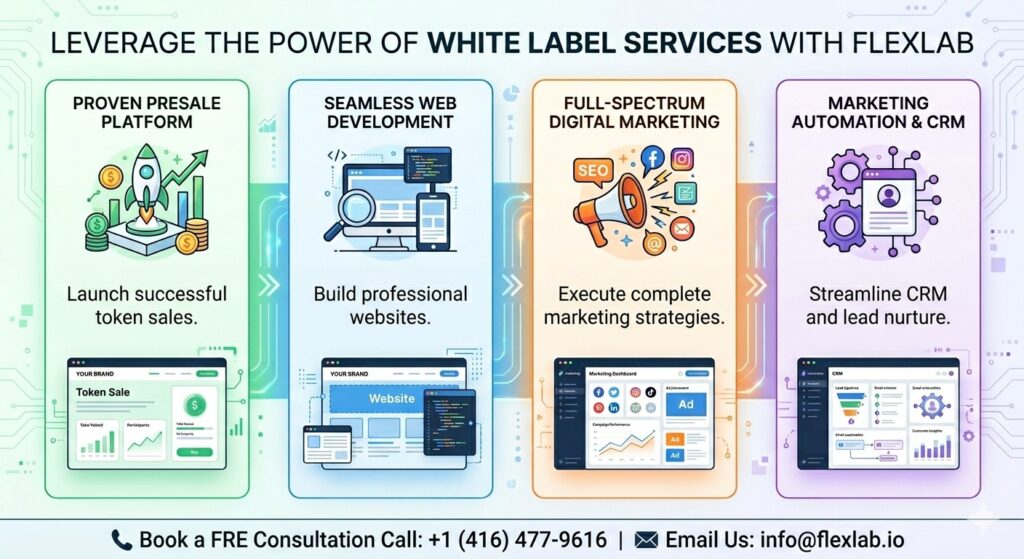
Flexlab empowers digital agencies and businesses to scale effortlessly through our comprehensive solutions. Partner with us to rebrand premium white label IT support services like web development, SEO, PPC, and marketing automation as your own, delivering exceptional value without building internal teams.
Flexlab offers a ready-to-use presale platform you can fully brand as your own. It supports token launches on EVM and Solana chains with crypto wallet development, accepts fiat and crypto payments, includes KYC checks, staking, vesting schedules, and investor dashboards, all set up in days for easy, compliant fundraising.
Offer custom WordPress, Shopify, or enterprise websites under your own branding. In addition, our expert developers handle everything from design to launch, ensuring fast turnarounds and pixel-perfect results. As a result, you can impress your clients with high-quality websites that truly stand out.
Expand your toolkit with digital marketing services including SEO, PPC campaigns, social media management, and content creation. Flexlab’s proven strategies drive measurable ROI, helping you win bigger contracts and retain clients longer.
White label marketing automation lets you resell customizable SaaS platforms for email funnels, lead nurturing, and analytics dashboards. Integrate seamlessly with your services, positioning your agency as a one-stop growth partner.
White label services transform how agencies and businesses scale by offering premium capabilities under your brand without the costs of in-house teams. From digital marketing and white-label software solutions to consumer goods, these partnerships drive revenue growth, client satisfaction, and competitive edges, as proven by leaders like Trader Joe’s, Amazon, and innovative agencies worldwide.
Contact us now and visit our AI and Blockchain Blog page and discover more helpful insights and guides on the Best AI Automation Agency in Toronto, Day Trading Strategies, What Is Marketing Automation, AI Strategy Consulting, and 22 Best AI Marketing Tools to Transform Your Business.
White labeling is entirely legal when conducted with proper contracts, intellectual property permissions, and compliance to regulations. It differs fundamentally from counterfeiting, as it involves authorized rebranding of products or services from third-party providers who explicitly allow resale under your brand.
White labeling drawbacks include limited product differentiation since items often mirror competitors', restricted customization possibilities, and less control over quality or production. Businesses also risk over-reliance on third-party suppliers, supply chain disruptions, and squeezed margins from price-based competition.
White labeling delivers strong profit potential, boasting gross margins of 40-70% thanks to reduced production and development expenses. Agencies often start with 30-50% margins, which climb to 60-75% at scale, enabling owners to earn $150K-$350K+ annually within three years.
What is big data, and why do we need modern solutions? Every day, businesses generate 2.5 quintillion bytes of information, from customer clicks and IoT sensors to financial transactions and social feeds. These solutions are the powerful technologies that capture this overwhelming volume, process it at lightning speed, and transform chaos into actionable insights that drive revenue, cut costs, and crush competition.
Whether you’re fighting fraud in finance, personalizing retail experiences, predicting hospital patient outcomes, or optimizing manufacturing lines, it bridges the gap between raw information overload and strategic advantage. Do you want to learn more? Let’s dive into detailed insights below.
It refers to massive, complex, and rapidly growing large-scale information that cannot be easily managed and analyzed with traditional database systems. It encompasses both structured information (e.g., a list of financial transactions or an inventory ledger) and unstructured information (e.g., social media posts or videos). Additionally, it includes mixed records, such as those used to train large language models. Moreover, these records may include anything, from a work of Shakespeare to a company’s budget spreadsheet for the last 10 years.
However, managing and extracting information requires advanced technologies that conventional processing methods cannot handle at the scale, speed, and complexity involved. Businesses can analyze patterns, detect anomalies, and make more precise forecasts with the right technologies. Hence, it will help refine strategies, reduce operational inefficiencies, and improve customer experience.
For instance, big data tools like data lakes ingest, process, and store structured, unstructured, and semi-structured information in its native format. It is essential for handling its large volume, variety, and velocity while supporting advanced AI predictive analytics, machine learning techniques, and AI and advanced integration systems.
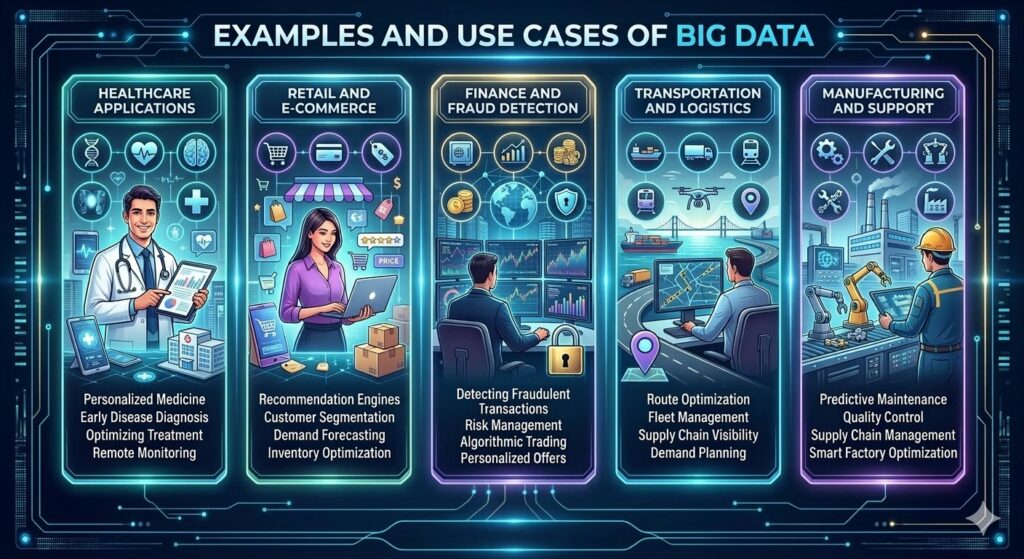
It empowers transformation across many industries, including;
The healthcare industry leverages it and NLP to analyze unstructured information, such as clinical notes and lab results, to accelerate drug development and enable personalized treatments. Moreover, hospitals use it to predict patient outcomes and track epidemics.
Retailers also use it to analyze purchase history and browsing patterns to deliver hyper-personalized recommendations, market segmentation, and optimize inventory. For instance, Amazon and Walmart leverage it. Hence, it boosts sales through dynamic pricing and customer segmentation.
It is vital in financial services for fraud detection and risk management. Banks monitor transaction patterns in real-time against historical records to identify fraud instantly. As a result, it reduces losses. It also enables risk assessment and the development of tailored financial products.
Companies optimize routes using traffic patterns, GPS, and demand forecasting to improve efficiency in last-mile delivery and fleet management. Uber uses it for surge pricing and predictive maintenance.
IoT sensors enable predictive maintenance, energy optimization, and supply chain optimization using satellite and geospatial records. This minimizes downtime and supports sustainability tracking.
In agriculture, sensors and satellites guide crop yields; sports analytics enhance performance; and governments improve public services, such as traffic management. Google’s ecosystem has a broad impact across search, ads, and maps.
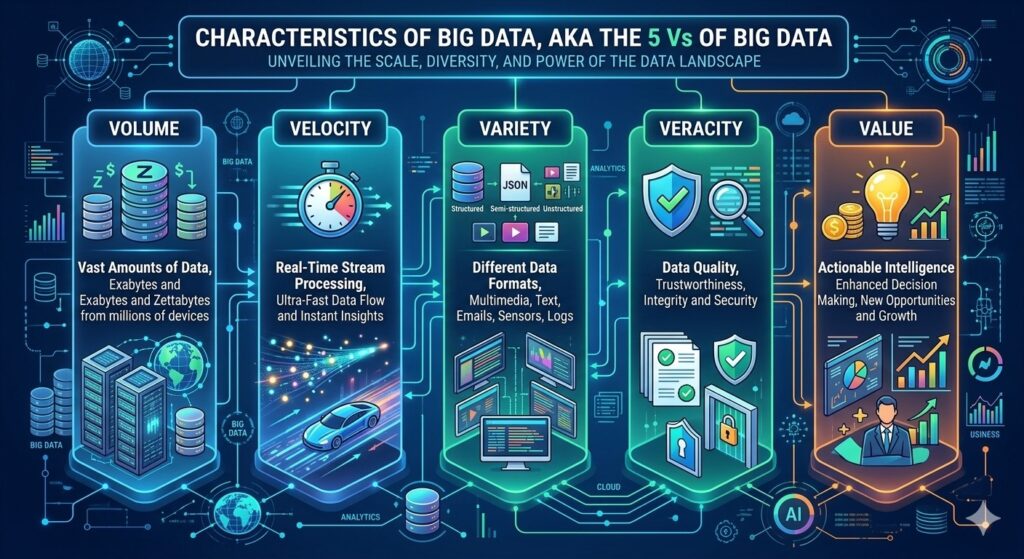
It describes the core characteristics that differentiate advanced analytics from traditional records and explains what it takes to manage it effectively. Here are the 5 V’s;
It is “big” because of the large amount of information generated every second from web applications, IoT devices, transaction systems, and more. As a result, traditional storage and processing tools often struggle at this scale, making it difficult for organizations to capture and retain what they need.
Fortunately, modern platforms, especially cloud-based storage and distributed systems, now help store, process, and protect these rapidly growing datasets so that important information isn’t lost.
Velocity is the speed at which information is created, collected, and processed into a system, and it is extremely high in these scenarios. It arrives continuously and quickly at millisecond speeds, from real-time social feeds to streaming sensor streams or high-frequency trading records.
To keep up, organizations rely on stream-processing frameworks and in-memory technologies to ingest, analyze, and respond to data in near-real time. As a result, it enables faster, advanced decision-making.
Variety captures the wide range of formats that advanced analytics can take. Beyond traditional structured tables, it includes unstructured information such as text, audio, images, and video, as well as semi-structured formats such as JSON or XML that have some organization but no fixed schema.
However, handling this mix requires flexible architectures, such as NoSQL databases, data lakes, and schema-on-read approaches, that can store, combine, and analyze multiple types in a single environment.
Veracity refers to how trustworthy, accurate, and consistent the data is. Because it comes from many different sources and at high speed, it often contains duplicates, inconsistencies, missing values, or outright errors that can distort insights.
Organizations, therefore, need robust quality practices, including cleaning, validation, and verification, to filter out noise and ensure analytics and models are built on reliable data.
Value is the business impact organizations can extract from information. When managed and analyzed effectively, it can improve operations, enhance customer experiences, uncover new revenue streams via predictive modeling, and reveal emerging risks or opportunities.
Furthermore, using advanced analytics, machine learning, and AI, companies turn raw, complex information into actionable insights that drive smarter strategies and measurable outcomes.
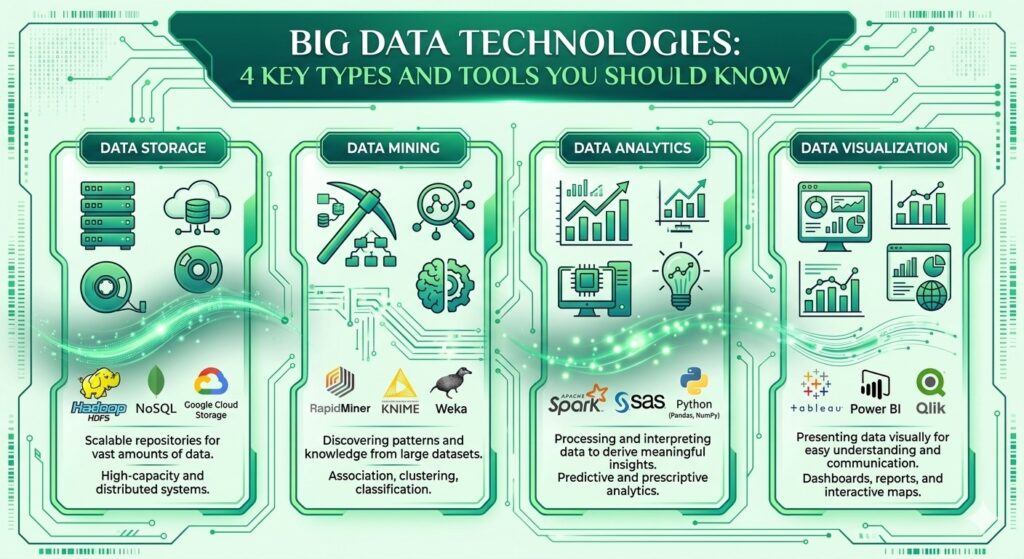
These technologies are usually grouped into four core categories:
Each category includes specialized tools that help you capture, manage, and turn large, complex large-scale information into insights that drive decisions. Let’s read about types of big data in detail:
These technologies are designed to fetch, store, and manage large volumes of structured and unstructured data. For instance, they provide scalable infrastructure that keeps information accessible and seamlessly integrated with other systems. Popular tools for data storage include Apache Hadoop and MongoDB, which excel in handling massive datasets.
Apache Hadoop is an open-source framework for storing and processing it across clusters of commodity hardware. Moreover, its distributed architecture enables parallel processing, along with faster handling of very large datasets and support for multiple formats. As a result, it’s known for its fault tolerance, scalability, and suitability for both batch processing and long-term storage.
MongoDB is a popular NoSQL database built to handle large volumes of semi-structured or unstructured data. Specifically, it stores information in flexible, JSON-like documents grouped into collections, which makes it easy to evolve schemas over time. Because it scales horizontally and handles varied data types, MongoDB is widely used for high-velocity applications, content platforms, and real-time analytics backends.
It focuses on extracting useful patterns, correlations, and trends from raw data. For example, these technologies help turn both structured and unstructured data into actionable information. Key tools used for mining include RapidMiner and Presto, which streamline complex analysis processes.
RapidMiner is a data mining and machine learning platform for building end-to-end predictive models. Specifically, it supports data preparation, feature data engineering, model training, and evaluation in a single environment, along with low-code workflows. As a result, organizations use it to operationalize advanced analytics and AI automation across use cases like churn prediction, scoring, and risk analysis.
Presto is an open-source, distributed SQL query engine created to run interactive analytics on very large datasets. Moreover, it can query data where it lives across data lakes, warehouses, and other systems, while joining multiple sources in one statement. Therefore, this makes it well-suited for ad hoc exploration and fast analytics without heavy data movement.
Big data analytics tools, such as Apache Spark and Splunk, clean, transform, and model data to support business decisions. For instance, after mining and preparing the data, these technologies enable advanced queries, algorithms, and predictive analytics at scale.
Apache Spark is a widely used big data analytics engine known for its speed and in-memory processing. Unlike traditional MapReduce, Spark keeps data in RAM when possible, which makes iterative workloads and complex analytics significantly faster. Moreover, it supports batch processing, streaming, machine learning, and graph processing through a unified framework.
Splunk specializes in analyzing machine-generated data such as logs, metrics, and event streams. Specifically, it ingests large volumes of data, indexes it, and provides search, dashboards, alerts, and reports. As a result, with built-in support for advanced analytics and AI, Splunk helps teams detect anomalies, troubleshoot systems, and derive operational insights in near real time.
These technologies turn large, complex datasets into charts, dashboards, and stories that stakeholders can quickly understand. For example, they are essential for communicating insights and driving action. Some key tools include Tableau and Looker, which make complex data accessible to all.
Tableau is a leading visualization platform with a drag-and-drop interface that makes it easy to build dashboards and a wide range of chart types: bar, line, box plots, maps, Gantt charts, and more. Moreover, it connects to many data sources and supports secure sharing, thus enabling teams to explore data interactively and align around shared metrics.
Looker is a modern business intelligence (BI) tool that sits on top of your warehouse and helps define consistent metrics while delivering interactive visualizations. Specifically, using a semantic modeling layer, teams can build reusable definitions and then create dashboards and reports for use cases like monitoring brand engagement, product performance, or customer behavior over time.
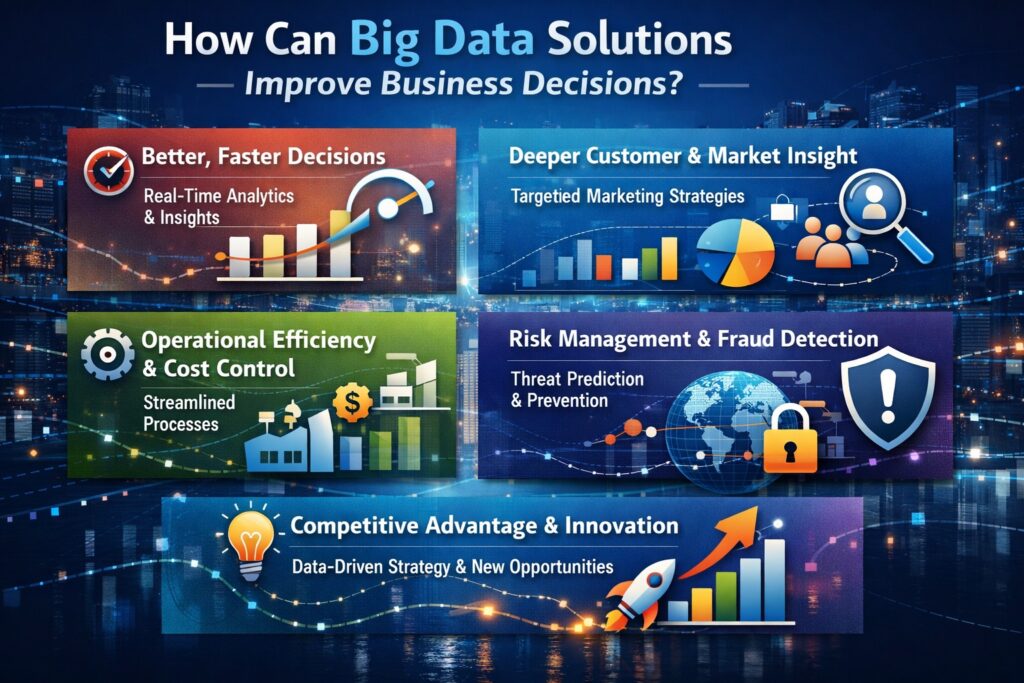
It improves business decisions by replacing intuition and guesswork with evidence-based, real-time insights drawn from large, diverse datasets. Let’s have a look at big data pros and cons:
Platforms aggregate data from many sources and analyze it in real time, so leaders can react quickly to changing customer behavior and market conditions. Moreover, this reduces uncertainty and enables faster, more confident choices grounded in facts rather than opinions.
Analytics on customer interactions, transactions, and feedback reveals patterns in preferences, churn drivers, and demand trends. As a result, businesses use these insights to refine products, personalize experiences, and spot new opportunities or underserved segments.
Examining process data across operations and supply chains, it highlights bottlenecks, waste, and automation opportunities. Organizations that adopt real-time analytics report faster decision speed and lower operational costs through optimized workflows and resource allocation.
It monitors transactions and events at scale to detect anomalies that indicate fraud, failures, or emerging risks. For instance, predictive models help forecast issues before they escalate, allowing proactive interventions instead of reactive firefighting.
Data-driven decision-making uncovers hidden patterns and trends that competitors may miss, enabling better product-market fit and smarter strategies. Firms with strong data cultures make decisions faster, innovate more effectively, and are significantly more likely to acquire and retain customers.
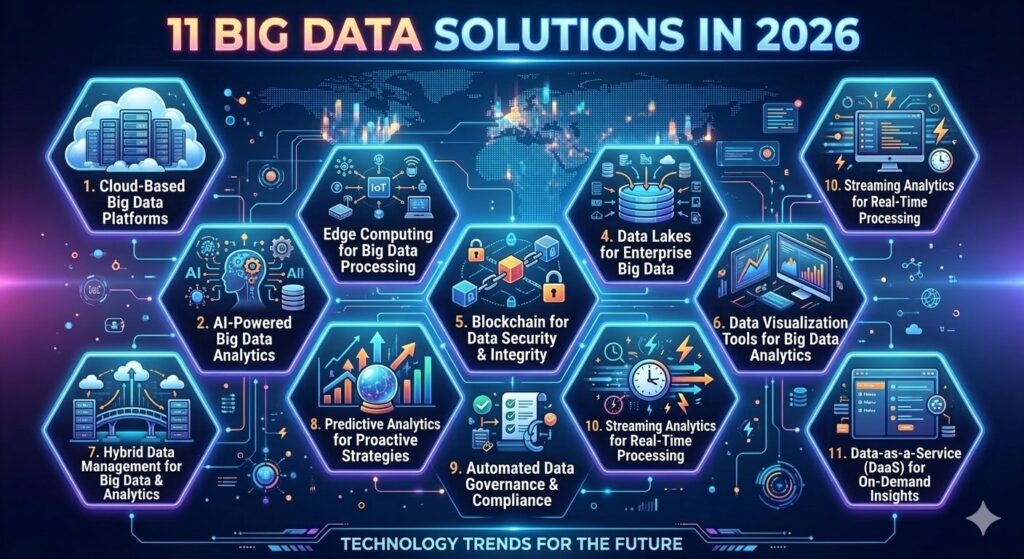
These solutions help organizations collect, process, and analyze massive, fast-changing datasets so they can improve efficiency, reduce risk, and unlock new growth opportunities. As reliance on analytics increases, choosing the right mix of technologies becomes critical for accuracy, scalability, and long-term value.
Cloud-native platforms provide elastic storage and compute so teams can scale up for heavy workloads and scale down to control costs. For instance, they reduce dependence on on-premises hardware, simplify maintenance, and offer built-in tools for security, monitoring, and analytics. Common use cases include real-time transaction analysis, secure storage of sensitive records, and large-scale risk modeling across global operations.
AI and machine learning enhance big data analytics by automatically detecting patterns, predicting outcomes, and handling unstructured data at scale. Specifically, organizations apply AI to spot fraud, personalize customer journeys, score leads, and automate complex decision workflows. Over time, models learn from new data, thus improving prediction accuracy and making insights more reliable for strategic planning.
Edge computing processes data close to where it’s generated; on devices, gateways, or local nodes, rather than sending everything to a central cloud. This approach reduces latency, bandwidth usage, and dependence on always-on connectivity. Therefore, industries like manufacturing, logistics, and healthcare use edge analytics to monitor equipment health, optimize routing, and react instantly to critical events such as anomalies in patient vitals or production lines.
Data lakes serve as centralized repositories that store structured, semi-structured, and unstructured data in its raw form. Moreover, this flexible model supports advanced analytics, AI/ML experimentation, regulatory reporting, and cross-team collaboration on shared datasets. By decoupling storage from compute, data lakes let organizations scale cost-effectively while keeping a single source of truth for diverse data types.
Blockchain-based solutions create tamper-resistant ledgers that strengthen trust in critical data and transactions. For example, they are used to track product provenance, secure patient records, and record financial events in an auditable, transparent way. As a result, immutable logs and cryptographic verification help reduce fraud, support compliance, and simplify cross-organizational data sharing without sacrificing security.
Data visualization tools turn complex datasets into intuitive dashboards, charts, and interactive reports. In addition, they enable business and technical teams to monitor KPIs, explore trends, and spot anomalies without deep coding skills. Real-time data processing and self-service visualizations further improve communication across departments and help leadership respond faster to shifts in performance, demand, or risk.
Hybrid data architectures combine on-premises and cloud environments so organizations can balance control, compliance, and scalability. Meanwhile, sensitive or regulated data can remain on-site, while anonymized or aggregated data is analyzed in the cloud using advanced analytics services. This approach supports regional compliance rules, optimizes infrastructure spend, and gives enterprises flexibility as their data driven strategy evolves.
Predictive analytics utilizes historical and real-time facts, statistical models, and machine learning to forecast future events and behaviors. As a result, businesses implement these solutions for demand forecasting, churn prediction, risk scoring, pricing optimization, and capacity planning. Hence, by anticipating trends and disruptions early, organizations can adjust strategies proactively. Ultimately, this approach reduces waste and allocates resources more effectively.
Automated data governance tools continuously classify data, enforce access policies, and track how information is used across systems. Moreover, they help organizations meet regulatory requirements, reduce manual audit overhead, and lower the risk of non-compliance. Key features, like policy-based access control, lineage tracking, and automated reporting, therefore improve transparency and strengthen internal controls.
Streaming analytics platforms analyze facts as they’re generated, which enables real-time detection of anomalies, threats, and opportunities. For instance, they are widely used in fraud detection, cybersecurity monitoring, network operations, and real-time customer experience optimization. Consequently, processing events in motion allows businesses to trigger immediate actions, such as blocking suspicious transactions, rerouting deliveries, or updating recommendations.
These solutions deliver curated, ready-to-use datasets via APIs or subscriptions, without requiring heavy internal infrastructure. Organizations augment their own information with external market, financial, location, or behavioral data to improve models and reporting. Therefore, this model lets teams focus on insight generation and smart decision-making, while the provider handles data collection, cleaning, and delivery at scale.
Even though the advantages of data-driven decision-making are well known, many organizations still struggle to put it into practice consistently. Let’s read the challenges below:
Working with biased or partial data is like trying to assess a landscape through a fogged lens; it distorts reality and leads to flawed conclusions. Teams must learn to detect and correct bias, fill data gaps, and use the right tools and processes to ensure their analysis is as complete and accurate as possible.
Having large volumes of data does not automatically translate into better decisions. Many organizations lack the analytical skills, frameworks, or context needed to turn raw numbers into clear, actionable insights that leaders can trust.
New platforms and processes often have to coexist with legacy applications and siloed systems. When data integration is complex or incomplete, it becomes hard to create a unified data view, slowing or blocking the adoption of truly data-driven practices.
Moving from gut-driven to large-scale decisions requires a cultural shift. Established habits, organizational silos, and fear of transparency can all create pushback, making it difficult to embed data into everyday decision-making.

Flexlab transforms the given challenges into competitive advantages through end-to-end AI and blockchain expertise. Our services deploy scalable data lakes, cloud-native platforms, and real-time streaming analytics tailored to your industry.
Are you looking for healthcare NLP for clinical insights, retail personalization engines, or manufacturing IoT predictive maintenance? Everything is covered here in Flexlab. Our team handles everything from Hadoop/Spark cluster optimization and automated governance to custom Tableau/Looker dashboards, so you overcome data silos, bias issues, and integration hurdles while unlocking faster decisions, fraud detection, and revenue growth through production-ready solutions.
It transforms massive datasets into actionable insights that drive smarter decisions across healthcare, retail, finance, and logistics. The right cloud platforms, AI analytics, and streaming solutions overcome silos and bias to deliver real-time fraud detection, personalization, and predictive power.
Organizations mastering it to see 30%+ revenue growth and major cost savings. Flexlab deploys production-ready solutions, from Spark clusters to automated governance, that deliver ROI in weeks.
Contact us today for your free consultation and discover exactly how to operationalize everything you’ve learned here. Visit our AI and blockchain blog and discover new helpful insights on the Benefits of AI in Supply Chain, The Role of AI Predictive Analytics, Is AI in Marketing Worth the Investment for Small Businesses, and What are Enterprise AI Solutions.
These solutions are integrated technologies and platforms, like cloud data lakes, AI analytics engines, streaming processors, and NoSQL databases, that manage massive, diverse datasets at high speed to deliver actionable business insights, improve decision-making, and drive efficiency across industries.
Key tools include Apache Hadoop/Spark for processing, MongoDB/Cassandra for NoSQL storage, Kafka/Flink for streaming, BigQuery/Snowflake for analytics warehouses, and Tableau/Power BI for visualization.
Collect diverse sources into unified platforms, apply AI/ML for pattern detection/prediction, visualize insights via dashboards, and act on real-time alerts. Hence, this approach enables fraud detection, demand forecasting, personalization, and risk mitigation with evidence-based speed.

Smart Contract Security Best Practices | Blockchain Development Services | Smart Contract Development
Software development best practices separate struggling Agile teams from market leaders. In fact, code quality, security gaps, and unscalable architecture kill 70% of software projects before they reach profitability. Ultimately, the difference comes down to proven standards executed with precision.
This guide delivers 12 battle-tested software development best practices that top Agile teams use to build enterprise-grade AI in software development, blockchain, and Web3 applications. Moreover, from software requirements specification to production monitoring, you’ll get step-by-step implementation, tools, and real-world examples that are tailored for modern development challenges.
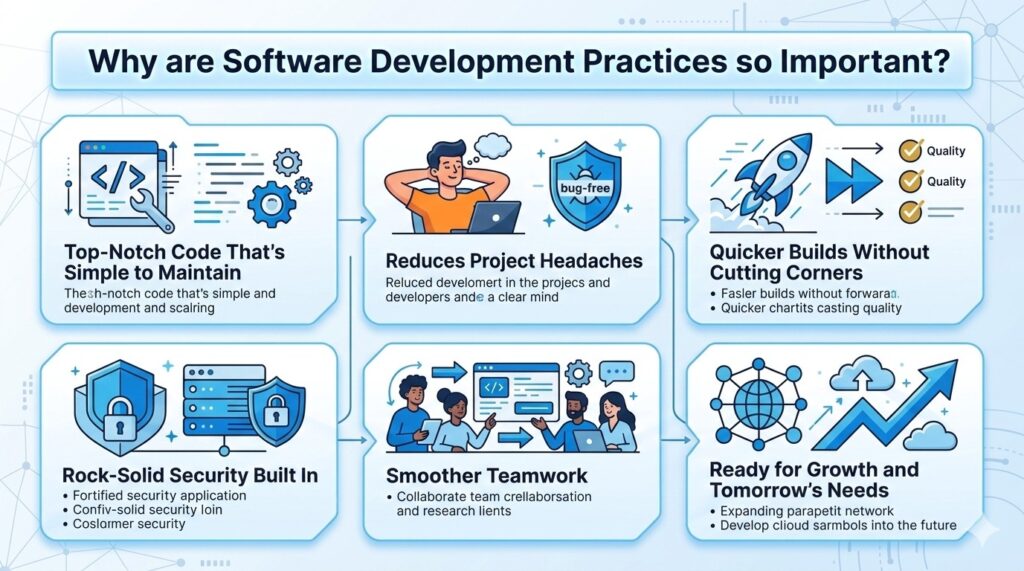
A great software product succeeds because of how it’s made. Industry best practices and software design principles lay a strong foundation not only for solid tech but also for real business wins, such as faster growth and loyal users.
Here’s why your cross-functional teams need them:
The quality code is clean, consistent, and easy to work with. Following standards, including regular code review, modular designs, and uniform coding conventions. This approach will make code readable and maintainable; hence, lead to fewer glitches and hassle-free updates. For instance, tools like ESLint keep everything tidy.
Every software project faces some risks, delays, security holes, or extra costs. Structured approaches, including smart planning, regular check-ins with stakeholders, and non-stop testing, catch problems early via test-driven development (TDD) principles. No more small issues turning into disasters.
Speed counts, but quality first. Agile software development, CI/CD pipeline (like GitHub Actions), automated tests, and DevOps services cut busywork and speed things up. For example, test every change automatically for rapid releases.
Make security part of the process from the start, rather than treating it as an afterthought. For example, use secure coding standards such as OWASP guidelines, perform routine vulnerability scans with tools like Snyk, and implement quick fixes whenever issues appear. As a result, your application stays protected while also strengthening user trust, which is especially important for blockchain or AI projects.
Software thrives on collaboration. Therefore, Agile methodologies, clear chats (Slack), and version control systems like Git keep teams synced. As a result, teams achieve smarter designs, less confusion, and on-time launches.
Following principles such as modular design, clean APIs (REST/ GraphQL), and cloud-native development ensures your software can handle future growth without any expensive costs. For instance, Netflix manages huge traffic without expensive overhauls. It is perfect for evolving tech like Web3.
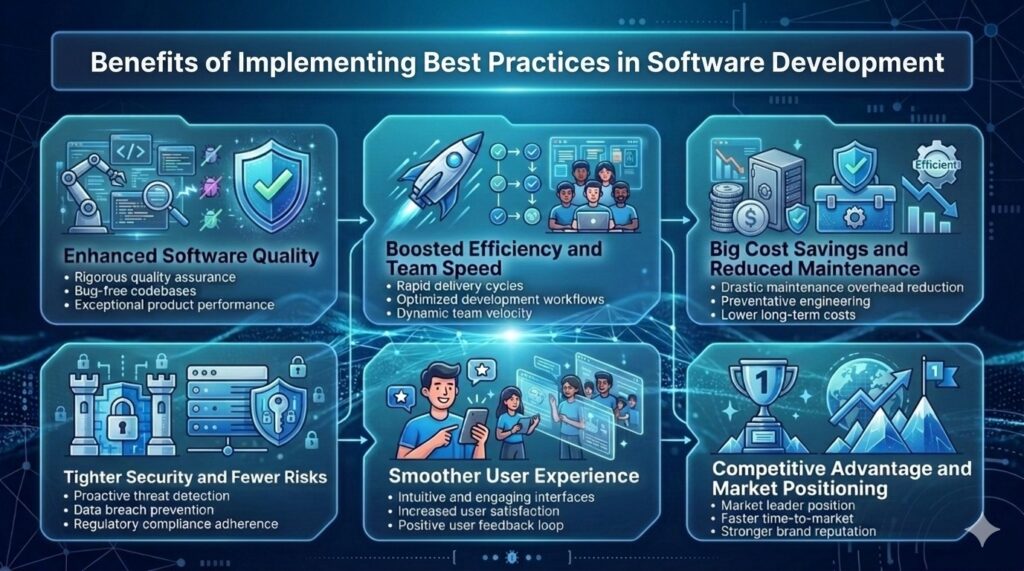
Here are the best practices that go beyond better processes. Furthermore, these benefits shape the software development lifecycle, fortify the end product’s market viability, and strengthen business results.
First, implementing software development best practices delivers big cost savings by catching issues early through proactive planning and automated testing, thus eliminating expensive post-launch fixes. Additionally, modular designs enable simple updates without system rewrites, while predictable processes cut overtime and contractor costs over time.
Moreover, teams create smoother user experiences with intuitive applications built on user-centered design, WCAG accessibility standards, and performance optimization that work flawlessly across devices. As a result, satisfied users generate positive reviews, reduce support tickets, and fuel organic growth through word-of-mouth.
Finally, these practices provide a competitive advantage through scalable cloud-native architecture, cutting-edge security, and rapid delivery cycles. In fact, this positions your team as innovation leaders with future-proof software that handles enterprise growth effortlessly, while competitors struggle with legacy systems, ultimately delivering clear market differentiation and accelerated revenue growth.
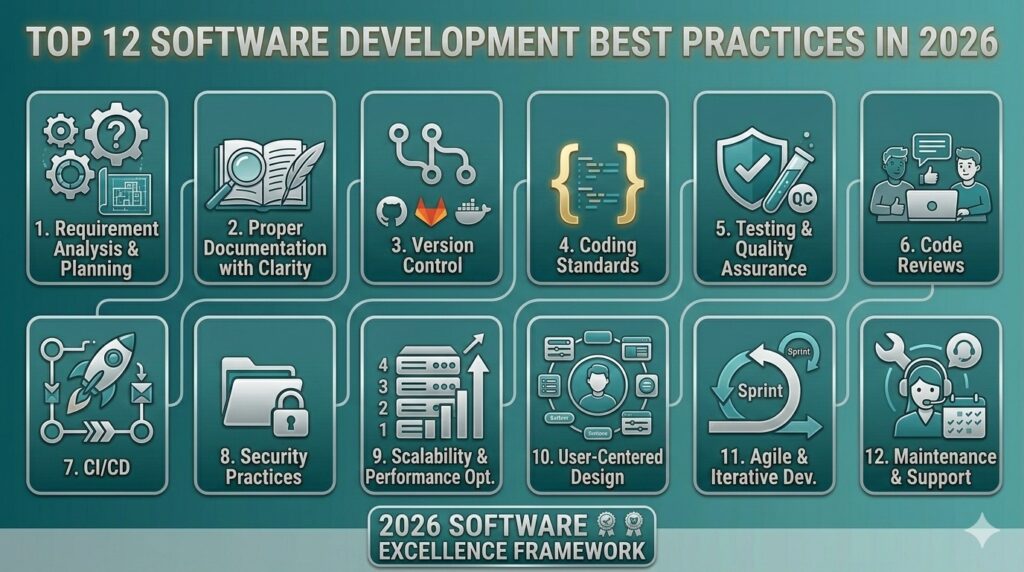
These 12 practices form the backbone of professional software development. Moreover, each includes step-by-step implementation, examples, and tools tailored for modern teams working on AI, blockchain, or enterprise applications.
When you start a project without a clear requirement, it leads to confusion and wastes your efforts. Therefore, you need to thoroughly analyze the requirements so that the project’s goal is well aligned with the client’s expectations and user needs. Create an effective plan with a clear roadmap, mitigate risks, and deliver the project on time. This approach is significant in spotting potential challenges early on.
How To Do:
Tools You May Use: Jira, Confluence, Miro, Notion
Example: For a blockchain wallet, define “users must recover wallet with 12-word seed” before development starts
Documentation is the most crucial aspect of software development best practices. Moreover, it provides clear knowledge for current and future teams, making onboarding and knowledge transfer easier. In addition, clear and concise documentation serves as a guide for software maintenance and preserves core functionalities and specifications.
How to do it:
Tools you Can Use: Swagger, MkDocs, Docusaurus, GitHub Wikis
Example: Auto-generate ABI docs from Solidity contracts, so that auditors can understand interfaces instantly.
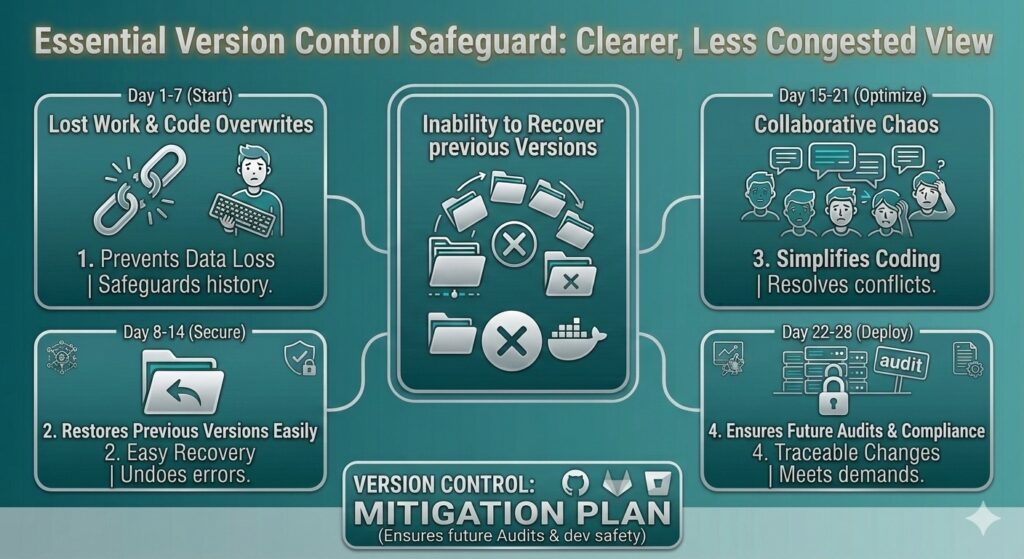
Version control is a tool within software development principles that safeguards the codebase system. It allows multiple developers work simultaneously with a safety net while recovering previous code versions. In short, this is the only way to develop collaboratively, track progress, roll back changes on code, and is crucial for future audits.
How to do it:
Tools: GitHub, GitLab, Bitbucket
Example: AI teams keep model versions as separate branches (v1-gpt4 vs v2-llama3)
Coding standards maintain consistency and readability within the software development process. Furthermore, they guide developers to write uniform code, facilitating easier maintenance and updates. In addition, adherence to these standards reduces complexity, making software stable and secure against vulnerabilities.
How to do it:
Tools: ESLint, Prettier, SonarQube
Example: Blockchain contracts use consistent naming, for example, onlyOwner and safeTransfer.
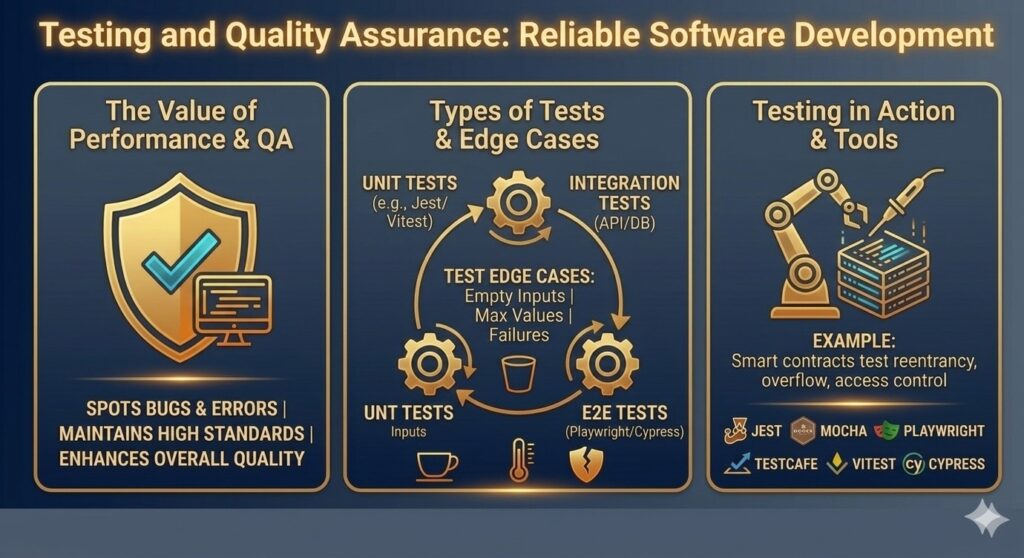
Software performance testing is a non-negotiable software development practice that spots bugs and errors before they affect any user. Moreover, quality assurance (QA) sets high standards throughout the development process and maintains the reliability of the final product to meet requirements. As a result, regular QA promptly addresses issues and enhances the software’s overall quality.
How to do it:
Tools: Jest, Mocha, Playwright, TestCafe
Example: Smart contracts test reentrancy, overflow, and access control
Code review is essential for an error-free software development process. Team members review each other’s work, spot bugs, suggest new ways, and teach better tricks. Hence, it fosters the culture of sharing knowledge and continuous learning. Moreover, reviews not only spot mistakes early but also ensure the code aligns well with established standards and best practices.
How to do it:
Tools: GitHub PRs, GitLab Merge Requests
Example: Senior dev reviews junior’s blockchain access control logic
Continuous integration and continuous deployment (CI/CD) serve as the automated backbone of modern software engineering while transforming the delivery lifecycle into a streamlined, high-speed pipeline. CI/CD ensures that every update is tested and deployed with consistent reliability, thereby effectively eliminating the risks associated with manual intervention. As a result, teams can release more robust applications and remain highly responsive to evolving market demands.
How to do it:
Commit → Lint → Test → Security Scan → Deploy Staging → Manual Approval → Production
Tools: GitHub Actions, Jenkins, GitLab CI, CircleCI
Example: Deploy smart contracts to testnets automatically after Slither passes
It is essential to integrate robust security practices from the outset to mitigate cyber threats. Therefore, developers must prioritize secure coding, encryption, and regular security audits. As a result, this proactive approach maintains integrity throughout the software development lifecycle.
How to do it:
Tools: Snyk, OWASP ZAP, GitHub CodeQL
Blockchain: Slither, Mythril, Hardhat security plugins
Example: Never trust user input; therefore, sanitize everything.
Designing for scalability means building apps that handle growth smoothly without slowing down. Furthermore, strategic planning and regular performance checks keep applications fast and responsive as user numbers increase. As a result, scalable apps deliver better experiences while staying cost-effective to maintain during expansion.
How to do it:
Tools: New Relic, DataDog, Lighthouse
Example: Paginate blockchain transaction history
Another best practice is to adopt a user-centered design approach so that it aligns well with the final product and meet expectation with the users’ needs. This approach includes an interactive design process, in which user feedback is consistently compiled, evaluated, and integrated into ongoing improvements. Furthermore, by prioritizing the user experience, organizations can enhance satisfaction, foster loyalty, and improve retention. In short, it’s a key factor in the long-term success of any application.
How to do it:
Tools: Figma, UserTesting, Hotjar
Example: Crypto wallet shows gas fees clearly before transactions
Agile development and iterative methodologies prioritize flexibility and the ability to respond quickly to change, which are critical in today’s fast-evolving market landscape. Furthermore, by organizing work into short, focused sprints and fostering strong collaboration among cross-functional teams, these approaches support continuous feedback, rapid adaptation, and ongoing enhancement. As a result, frequent iterative releases ensure that users receive timely updates, helping the software remain current, competitive, and aligned with evolving needs.
How to do it:
Tools: Jira, Trello, Azure DevOps
Example: AI model improvements deployed iteratively
To keep ongoing maintenance and support of software development, maintain reliability and durability. They include troubleshooting and fixing issues as well as updating the software to meet current standards and the latest technologies. Moreover, proactive maintenance prevents issues early before they occur. This approach will address issues promptly.
How to do it:
Tools: Sentry, PagerDuty, feature flags (LaunchDarkly)
Example: As a result, Hotfix critical blockchain vulnerabilities within 24 hours
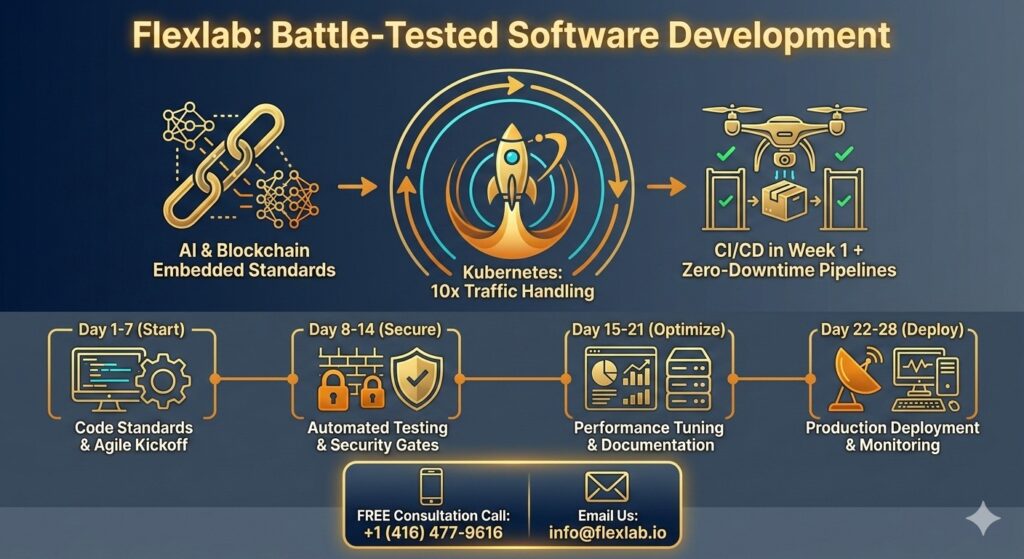
We don’t chase trends; instead, we ship software that scales to millions. Moreover, forget generic “best practices.” Flexlab is a leading custom software development company whose AI and blockchain specialists embed 12 proven standards directly into your codebase.
We focus on real projects instead of just slides; for example, we’ve already audited over 50 smart contracts. Moreover, our approach combines speed and security, with CI/CD pipelines up and running by Week 1. In addition, DevSecOps is built right in, running OWASP ZAP scans from the very first commit. Finally, everything is growth-ready, using Kubernetes clusters that handle 10x more traffic without a hitch.
Visit our AI and blockchain blog page, and also discover insightful details on the Benefits of AI in Supply Chain, Public Key Vs Private Key, AI in Marketing, Enterprise AI Solutions, and learn how Flexlab helps Toronto Businesses Scale Faster With AI Automation.
The 12 software development best practices above represent the exact standards that distinguish profitable tech companies from struggling ones. But here’s the reality: most teams never move beyond theory because they lack the systems, automation, and expertise to execute at scale.
Implementing these shifts isn’t just about writing better code; rather, it’s about building a culture of excellence that future-proofs your business against rapid changes in AI, Blockchain, and Web3. Additionally, contact us now and visit our LinkedIn page to transform your development process with our software development services.
The five pillars of software development are requirements and planning, design and architecture, development, testing, and deployment with maintenance. Moreover, these stages ensure that software is properly planned, built, verified, and maintained. In addition, each pillar supports quality, functionality, and long-term sustainability. Together, they create a structured framework for successful software delivery.
Successful software engineering involves writing clean, maintainable code and following coding standards. It requires strong teamwork, proper documentation, and thorough testing. Security, scalability, and performance must be considered from the beginning. Continuous learning and improvement also contribute to long-term success.
SDLC best practices include clear requirement gathering, iterative development, and continuous testing. Furthermore, they emphasize version control, code reviews, and risk management throughout the lifecycle. In addition, automation through CI/CD improves efficiency and reduces errors. Finally, continuous feedback ensures ongoing improvement and adaptability.

Hiring a blockchain development agency is becoming essential for businesses looking to innovate with blockchain technology. Blockchain development services are no longer optional for businesses looking to innovate, and in fact, they’re becoming essential. Research shows that over 60% of blockchain projects fail due to overlooked security, compliance, or timeline issues. According to Gartner research, poor planning and lack of expertise are major causes of blockchain project failures. which in turn can cost companies millions in lost revenue and delayed launches.
That’s why working with a specialized blockchain development agency gives you a ready team and proven processes that help reduce these risks. For example, whether you’re building DeFi platforms, tracking supply chains, or launching tokenized assets, an experienced agency ensures faster deployment, fewer surprises, and smooth integration with your existing systems.
By the end of this article, you’ll see exactly why hiring a blockchain development agency is often the smartest move, the benefits you can expect, and how to pick the right partner for your next blockchain project in 2026, so that you can avoid costly mistakes and accelerate results.

A blockchain development agency is a specialized team that helps businesses design, build, and support digital products on blockchain networks. For example, many companies struggle with delays or security issues when developing in-house. Therefore, agencies provide ready-made expertise, tested processes, and guidance so projects launch faster and run smoothly. In fact, studies show that over 70% of blockchain projects experience setbacks without professional support.
A professional agency provides end-to-end blockchain development. Key services include:
As a result, businesses can launch faster, reduce errors, and ensure smoother operations.
Unlike freelancers or in-house teams, a blockchain development agency offers multi-disciplinary expertise under one roof.
Businesses across DeFi platforms and enterprise blockchain solutions rely on agencies for several reasons:
Therefore, agencies enable companies to accelerate innovation and achieve better ROI than building in-house or hiring freelancers.
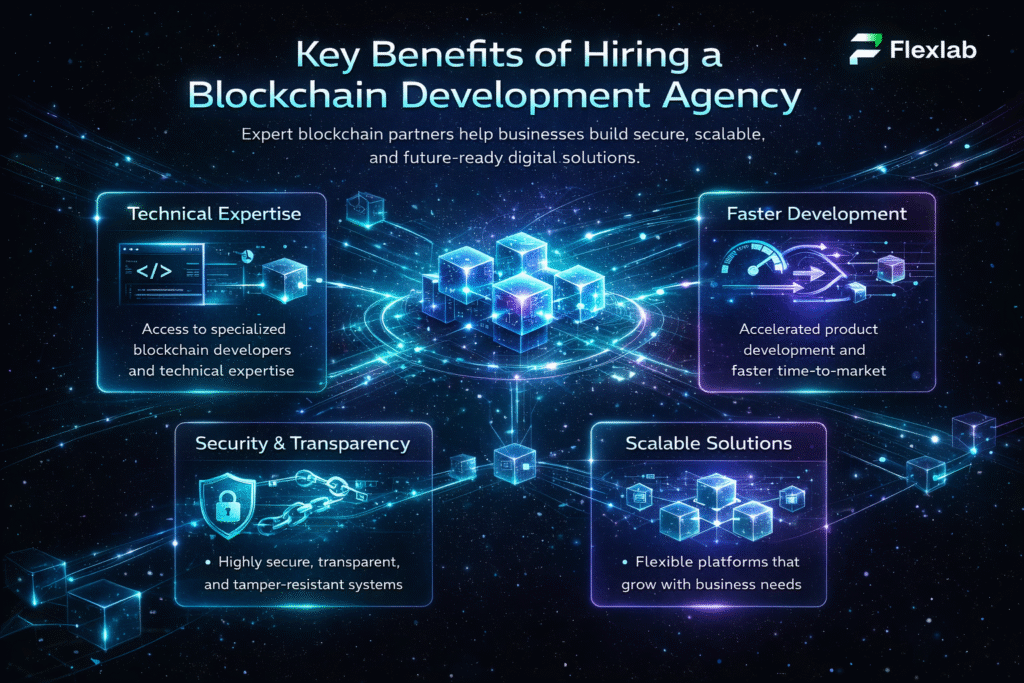
Hiring a blockchain development agency can significantly reduce the complexity of launching and managing Web3 applications and blockchain-based products. However, many businesses still try to build internal teams, which often leads to delays, higher costs, and technical challenges.
According to a Deloitte blockchain survey, nearly 39% of companies struggle to find skilled blockchain professionals, which slows innovation and project delivery. Because of this, organizations increasingly rely on specialized agencies that bring proven experience, secure development practices, and faster deployment cycles. Below are some of the most important benefits businesses gain when working with an experienced blockchain partner.
One of the biggest advantages of working with an agency is access to experienced professionals who understand blockchain development from architecture to deployment. Instead of hiring multiple specialists individually, companies gain access to a ready team of engineers, security experts, and solution architects. As a result, projects move faster while maintaining high technical standards.
More importantly, security is critical in blockchain systems, especially when smart contracts handle financial transactions or digital assets. Therefore, agencies prioritize blockchain security from the earliest stages of development.
They conduct code reviews, automated testing, vulnerability checks, and a complete blockchain audit before launch. In fact, security audits can reduce contract vulnerabilities by up to 60%, according to multiple blockchain research reports.
Another key benefit is the ability to validate ideas through proof of concept quickly. Instead of spending months building a full system, agencies help businesses test feasibility early. For example, companies can validate user demand, evaluate performance, and refine technical architecture before scaling the solution. Consequently, organizations reduce development risks and save significant time and budget.
Meanwhile, modern businesses rarely build blockchain products in isolation. Instead, they often integrate them with payment systems, CRMs, analytics platforms, and internal databases. A professional agency provides flawless blockchain integration services to ensure smooth communication between blockchain networks and traditional infrastructure, enabling businesses to adopt blockchain without disrupting existing operations.
Many organizations prefer cloud-based solutions because they reduce infrastructure costs and simplify maintenance. Therefore, agencies often implement blockchain-as-a-service, allowing companies to deploy and manage blockchain environments without maintaining complex hardware. This approach provides scalability, faster updates, and simplified network management, making it ideal for growing startups and similar enterprises.
Every organization has unique goals, whether they involve digital identity, financial transactions, or supply chain transparency. Because of this, agencies design custom blockchain solutions tailored to specific industries and workflows. Ultimately, these tailored systems deliver better efficiency, improved transparency, and a stronger competitive advantage.
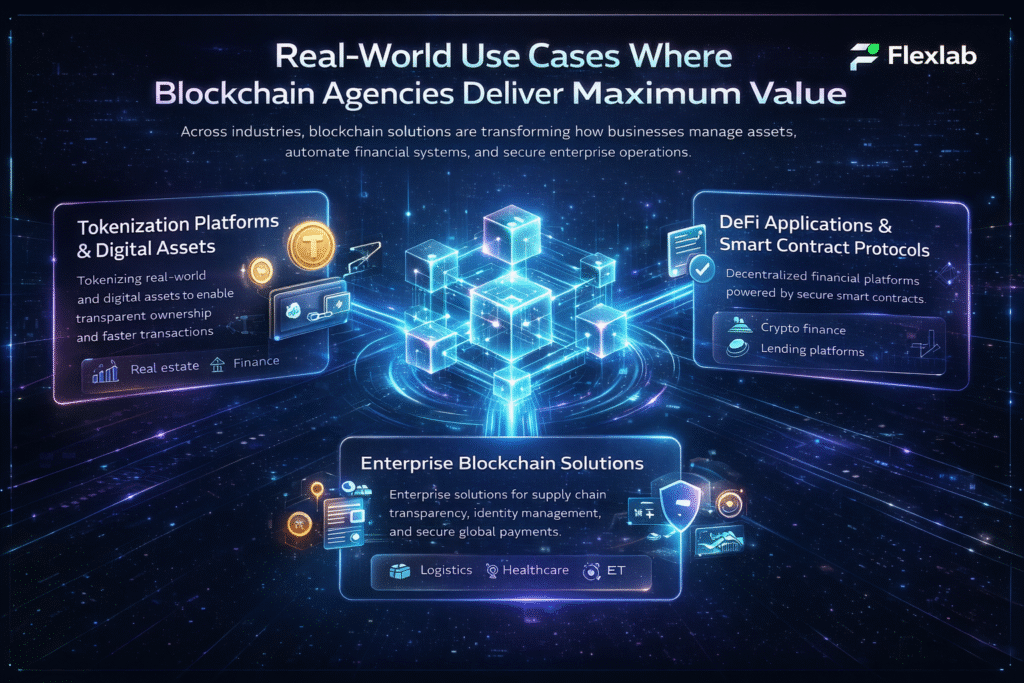
Understanding the benefits is helpful; however, many business leaders still ask a practical question: what are the real use cases of blockchain and where does it create value in the real world?
Across industries, organizations are already using blockchain to improve transparency, automate trust, and build entirely new digital ecosystems. Because of this shift, many companies now collaborate with blockchain development agencies to design solutions that solve real operational problems rather than experimental ones. Below are several areas where these agencies consistently deliver measurable impact.
Tokenization is transforming how businesses represent and transfer value. Instead of relying on traditional ownership systems, companies can convert physical or digital assets into blockchain-based tokens. As a result, transactions become faster, transparent, and easier to verify. For example, real estate firms are exploring tokenized property ownership, while financial institutions are experimenting with tokenized investment products. A blockchain development company helps organizations build the underlying platforms that securely manage these digital assets.
In addition, these platforms often include smart contract automation, wallet integration, and compliance features. Because of this infrastructure, businesses can manage digital assets more efficiently and with greater trust.
Decentralized finance (DeFi) is another area where blockchain for financial services is transforming traditional financial infrastructure. Instead of relying on traditional financial intermediaries, DeFi platforms use smart contracts to automate lending, trading, and asset management.
However, building these systems requires strong technical knowledge and careful security practices. For that reason, companies frequently work with a blockchain application development company when launching DeFi platforms or decentralized protocols.
With the right architecture in place, organizations can create financial ecosystems that operate continuously, process transactions transparently, and reduce operational friction.
Beyond crypto and finance, blockchain is also gaining traction in enterprise sectors such as supply chains, identity systems, and blockchain for healthcare. Many organizations are implementing distributed ledger systems, including private blockchain, to improve supply chain visibility, digital identity verification, and cross-border payment processes.
For instance, supply chain platforms can track products from manufacturing to delivery, ensuring authenticity and reducing fraud. Similarly, blockchain-based identity systems allow individuals and businesses to verify credentials without relying on centralized databases.
To implement these solutions successfully, companies often collaborate with experienced blockchain software development services providers who understand enterprise integration requirements. As a result, businesses can modernize critical systems while maintaining security and scalability.
After exploring real-world use cases, many businesses face another important decision: who should actually build the solution? Some organizations hire internal developers, while others rely on freelancers for short-term projects. However, many companies now prefer working with a blockchain development firm because it combines expertise, structured processes, and long-term support. To better understand the differences, let’s compare these three approaches.
Building blockchain platforms requires specialized skills, including smart contract development, security auditing, and distributed architecture design. Because of this complexity, development speed often depends on the team’s experience.
However, freelancers can sometimes start quickly, but their expertise can vary by individual developer. Similarly, in-house teams need time to hire, onboard, and train before they can deliver complex blockchain projects. By contrast, a blockchain development firm typically includes multiple specialists working together. As a result, projects move faster while maintaining strong technical quality.
More importantly, security is one of the most critical aspects of blockchain systems. A single vulnerability in a smart contract can expose financial assets or sensitive data. Freelancers may not always follow formal auditing practices, especially on smaller projects. Likewise, internal teams might lack deep experience with blockchain security frameworks.
Professional agencies, on the other hand, usually follow structured testing processes. In addition, they perform smart contract audits and security reviews before deployment. As a result, businesses gain greater confidence in the reliability of their blockchain solutions.
At first glance, freelancers may seem to be the most affordable option. However, projects often require multiple skill sets such as blockchain architecture, backend integration, and security testing. When several freelancers are involved, coordination becomes challenging. Building an internal team can also be expensive due to salaries, training, and infrastructure costs. Furthermore, scaling the team for larger projects may take significant time.
Therefore, working with a specialized agency often provides a more balanced approach. Businesses can access a full team of experts while maintaining predictable project costs. As a result, organizations can scale development more efficiently without managing a large internal department.
| Factor | Blockchain Agency | In-House Team | Freelancers |
| Speed to Market | Fast | Slow | Medium |
| Expertise | Multi-specialist team | Limited to hires | Variable |
| Security Practices | Mature processes | Depends on the team | Often inconsistent |
| Cost Structure | Project-based | High fixed cost | Hourly |
| Scalability | Easy to scale | Difficult | Limited |
| Post-Launch Support | Long-term support available | Internal maintenance | Rare |
This comparison shows why many businesses ultimately choose experienced partners when building blockchain platforms. By combining technical expertise, structured processes, and long-term support, agencies often deliver more reliable results than fragmented development approaches.
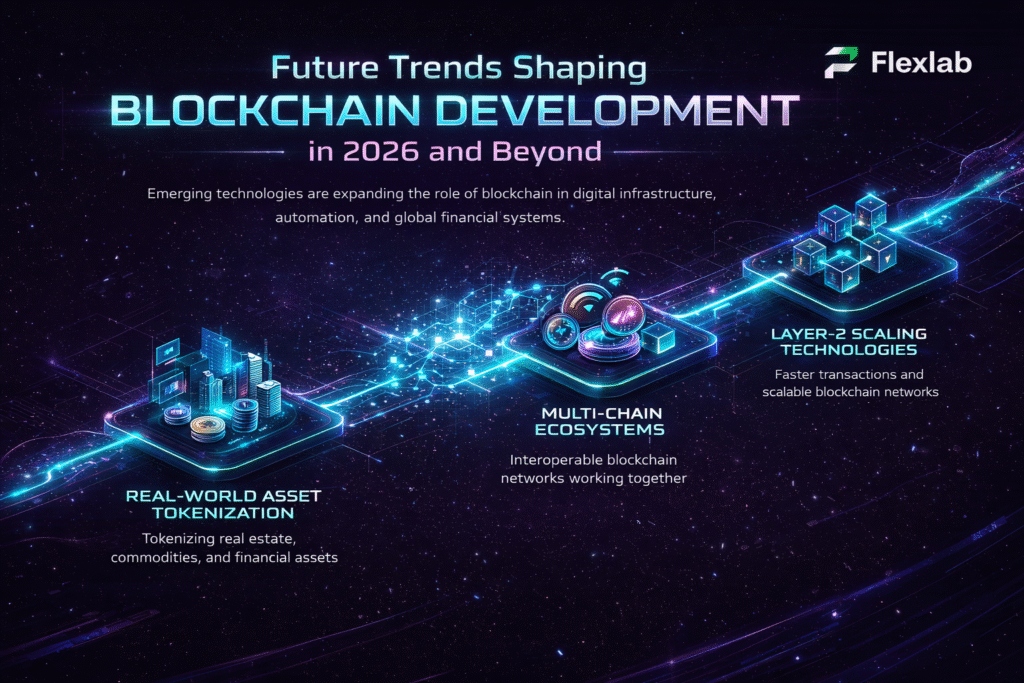
Blockchain technology continues to evolve beyond its early association with cryptocurrencies. Today, many organizations are exploring how distributed systems can support secure digital infrastructure, transparent transactions, and automated processes, highlighting the growing importance of blockchain in modern enterprise technology. Because of this shift, businesses are increasingly working with providers offering blockchain development services to build platforms that can adapt to future technological demands.
One major trend is the growing interest in tokenizing real-world assets, including real estate, financial instruments, and digital collectibles. At the same time, companies are adopting multi-chain ecosystems and Layer-2 scaling solutions to improve scalability and transaction efficiency. In addition, the integration of artificial intelligence with blockchain is opening new possibilities for automated decision-making and smarter data management.
As these innovations continue to mature, blockchain is expected to play a much larger role in enterprise technology. Therefore, organizations that begin exploring these capabilities today will be better positioned to build secure, scalable, and future-ready digital systems.
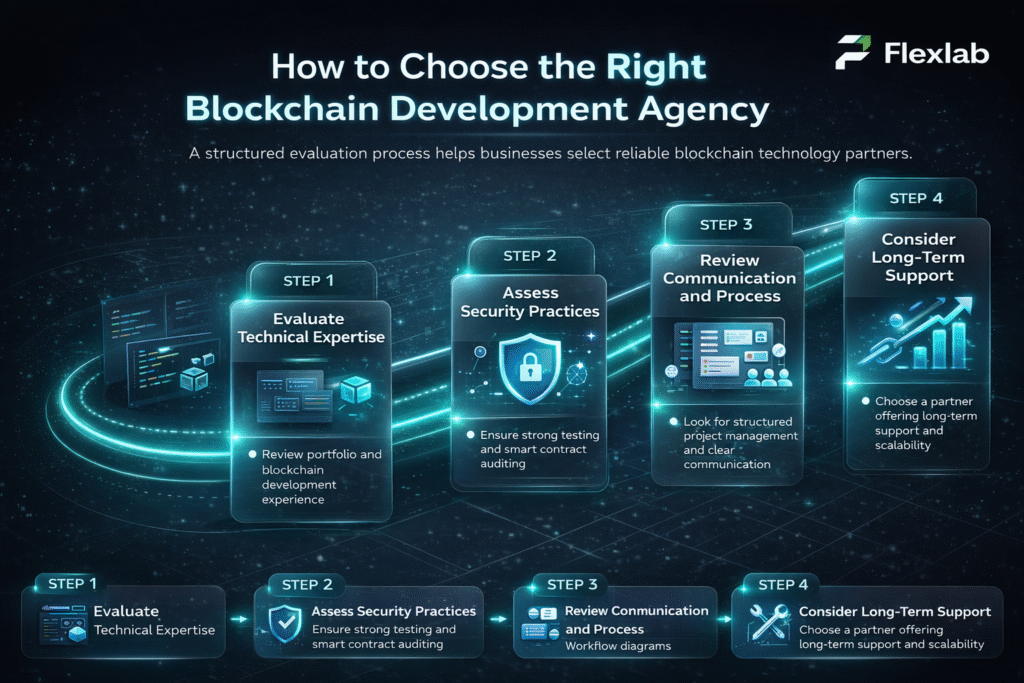
Selecting the right partner for a blockchain project requires careful evaluation. Since blockchain platforms often manage sensitive data and financial transactions, businesses should focus on expertise, security practices, and long-term support before making a decision. The following steps can help organizations choose a reliable development partner.
First, review the agency’s portfolio and past blockchain projects. An experienced team should demonstrate strong knowledge of smart contracts, decentralized architecture, and enterprise integration. Working with a proven blockchain development solutions provider often ensures that the platform is built using reliable frameworks and best practices.
Next, examine the agency’s approach to security. Blockchain systems require careful testing, smart contract auditing, and secure coding standards. Agencies that follow structured development processes and transparent testing procedures can significantly reduce technical risks.
Clear communication is essential for complex technology projects. Therefore, businesses should ensure the agency provides regular updates, structured development timelines, and collaborative project management tools.
Finally, think beyond the initial launch. Companies continuously evolve blockchain platforms as their needs grow. Choosing a partner that offers ongoing maintenance, updates, and technical support can help ensure the platform remains reliable in the long run.
Building a successful blockchain platform requires deep technical expertise, strategic architecture, and flawless execution. At Flexlab, ambitious businesses gain access to powerful blockchain development services engineered for security, scalability, and high-performance digital ecosystems. From advanced smart contract systems to enterprise-grade blockchain platforms, the Flexlab team transforms bold concepts into production-ready decentralized solutions built for long-term growth.
Speak directly with blockchain specialists at Flexlab and receive expert insights, technical guidance, and strategic recommendations for your project.
Explore real project implementations in the portfolio, discover the full range of services, and read expert insights on the Blog. Many innovators and technology leaders also stay connected with the latest blockchain advancements through LinkedIn.
When you’re ready to move from idea to execution, start the conversation and contact us to build a secure, scalable, and future-ready blockchain platform with Flexlab.
Read more:
Blockchain is rapidly evolving from an emerging concept into a practical foundation for modern digital systems. As businesses seek stronger security, transparency, and automation, the demand for reliable blockchain development services continues to grow. Throughout this guide, we explored how specialized agencies accelerate development, strengthen security practices, and deliver scalable blockchain solutions across multiple industries.
At the same time, successful adoption requires more than just understanding the technology. Organizations must evaluate expertise, long-term scalability, and strategic implementation before launching blockchain initiatives. Therefore, businesses that invest in the right development approach today are more likely to build secure, efficient, and future-ready digital platforms.
Ultimately, blockchain is reshaping how digital ecosystems operate, and companies that act early gain a meaningful competitive advantage. With the right strategy and experienced development support, organizations can unlock new opportunities, streamline operations, and move confidently toward the next generation of decentralized innovation.
For many businesses, hiring a blockchain development agency is often more practical than building an in-house team. Blockchain projects require specialized skills such as smart contract development, security auditing, and decentralized architecture design. Building a full internal team with this expertise can take time and significant investment. Therefore, companies frequently choose agencies to access experienced professionals and accelerate project development.
The cost of blockchain development can vary widely depending on the complexity of the project. A small proof-of-concept may cost a few thousand dollars, while a full enterprise blockchain platform can require a much larger investment. Factors such as network selection, smart contract complexity, security audits, and integrations also influence pricing. Careful planning and a clear project scope help businesses estimate development costs more accurately.
Not every project requires a large blockchain development team, but specialized expertise is usually necessary for building secure and reliable solutions. Blockchain systems involve distributed networks, cryptographic security, and smart contracts, which require technical knowledge beyond traditional software development. Experienced developers ensure that the system functions correctly and remains secure. As a result, businesses often rely on professional developers to implement blockchain platforms effectively.

The best programming languages for blockchain are infrastructure decisions that directly impact security, scalability, compliance, and long-term viability. Blockchain has evolved far beyond early crypto experiments. With over 420 million global users and billions of dollars secured daily across decentralized systems, blockchain development now underpins financial platforms, enterprise systems, tokenized assets, and AI-driven applications worldwide.
What many founders and technical teams underestimate is this: the programming language you choose determines not only how your product performs today, but how resilient it remains five years from now.
In this guide, we break down the 10 best programming languages for blockchain development in 2026, where each one excels, and how to select the right stack based on real-world technical and business priorities, not industry hype.
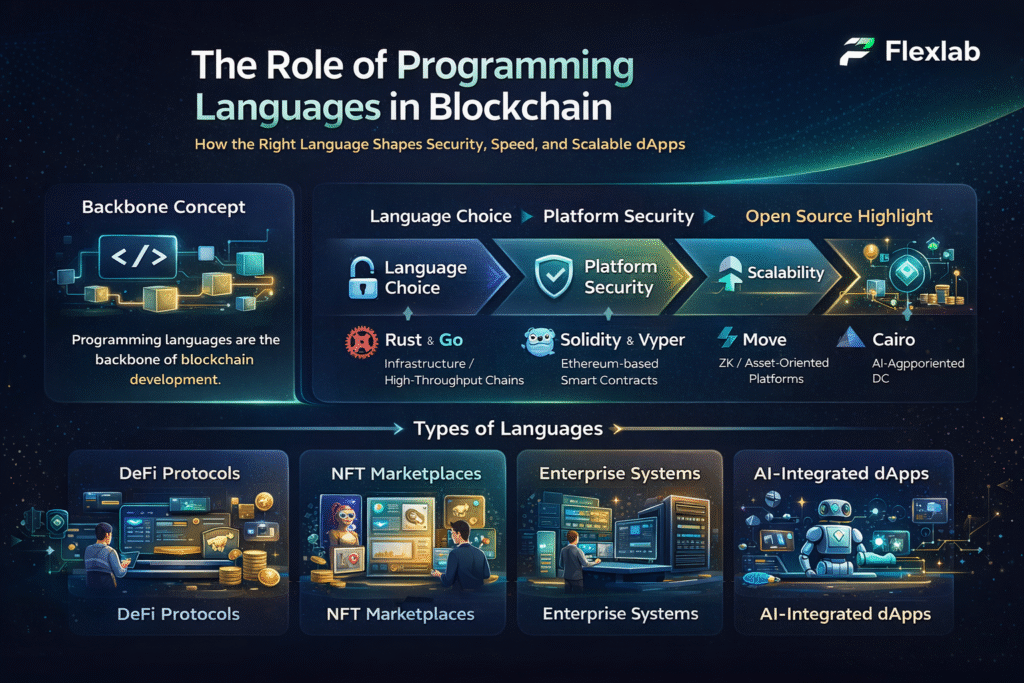
Programming languages are the backbone of blockchain development. In fact, most modern blockchain platforms rely on open source programming languages, which promote transparency, peer review, and continuous security improvements. As a result, they do far more than just run code; they ultimately determine how secure, scalable, and efficient your network will be.
As more organizations adopt decentralized systems across finance, supply chains, gaming, and AI-driven applications, choosing the right language becomes a strategic decision rather than a technical formality.
Selecting a language early shapes how confidently users interact with your platform, how efficiently your team builds solutions, and how quickly your ecosystem adapts to new challenges. For this reason, programming languages play a foundational role in blockchain networking and are essential for any serious developer or organization entering the space.
A programming language in blockchain is a set of instructions that allows developers to create, control, and automate transactions, smart contracts, and decentralized applications (dApps) that operate across distributed networks without centralized control. In practice, these decentralized applications dApps form the foundation of modern blockchain platforms, powering everything from DeFi protocols to enterprise systems.
These languages go beyond general-purpose coding; they interact directly with blockchain networks, implement complex consensus mechanisms, and ensure transaction integrity.
By choosing the right language, developers can reduce errors, prevent vulnerabilities, and accelerate deployment. Therefore, knowing what a blockchain programming language is and how it functions lays the foundation for building robust platforms.
Your choice of language directly affects platform security, speed, and maintainability. Some languages are inherently safer and reduce common vulnerabilities, while others offer faster execution but require more careful auditing.
For instance, developers working on smart contract development rely on specific languages that prevent critical mistakes and make audits simpler. Moreover, performance efficiency and developer tooling depend heavily on the language, impacting scalability, adoption, and long-term ROI.
Ultimately, selecting the right language early prevents costly migrations and ensures your platform remains competitive and trustworthy.
Blockchain uses a mix of general-purpose and specialized languages. For example:
Each type has its role, advantages, and support within its ecosystem. Understanding these categories helps developers choose the right tool for the project’s goals, whether building enterprise blockchain solutions, dApps, or decentralized finance platforms.
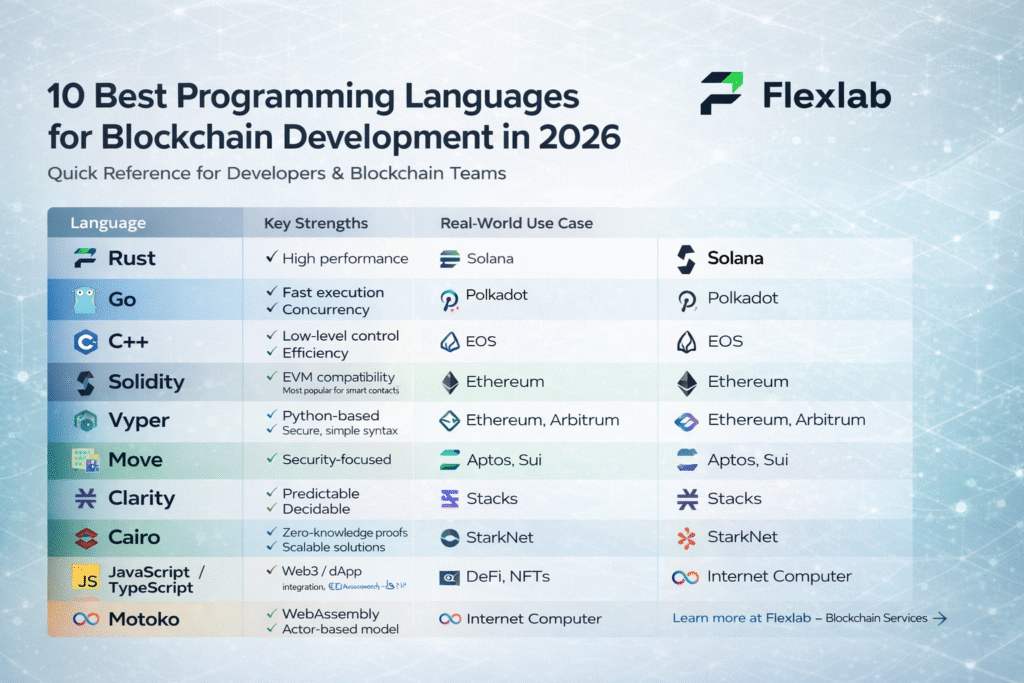
The blockchain landscape is evolving rapidly, and the programming language you choose defines not just how your code runs, but how secure, scalable, and future-proof your platform will be. In 2026, developers must consider throughput, formal verification, integration capabilities across multiple chains, and the strength of the surrounding blockchain ecosystem that supports long-term growth.
Below, we break down the 10 best programming languages for blockchain development, highlighting where each shines, its practical use cases, and why it’s worth learning today.
Rust is ideal for high-performance Layer 1 blockchain networks such as Solana and Polkadot. First and foremost, its memory safety and zero-cost abstractions allow developers to achieve near-metal speed without common segmentation faults.
Beyond performance, Rust’s ecosystem supports ZK-friendly applications, making it especially valuable for developers who prioritize speed and security. As such, enterprises and DeFi projects increasingly choose Rust for mission-critical blockchain infrastructure.
Solidity remains the backbone of Ethereum, Polygon, and Arbitrum smart contracts, operating within the Ethereum Virtual Machine (EVM) that standardizes execution across compatible chains. Its market dominance ensures a massive ecosystem of dApps, developer tools, and libraries.
Moreover, because over 65% of Total Value Locked (TVL) sits on EVM chains, learning Solidity immediately opens access to the largest liquidity pools. Therefore, any blockchain developer serious about DeFi or NFT projects should prioritize Solidity for robust smart contract development.
Move powers Aptos and Sui with a resource-oriented approach. Tokens are treated as objects that cannot be duplicated or accidentally deleted, which adds a layer of security previously unavailable in blockchain programming.
At the same time, Move simplifies asset tokenization, making it ideal for projects handling digital assets or NFT marketplaces. This advantage enables developers to build safer, future-ready blockchain applications.
Go is widely used in Hyperledger Fabric, Cosmos, and Ethereum Geth nodes. First, its concurrency model ensures efficient network operations, while its simplicity allows teams to maintain and scale infrastructure with fewer errors. Moreover, Go’s clean syntax accelerates onboarding, which is why enterprise blockchain projects often prefer it for foundational protocols.
Cairo powers StarkNet, enabling developers to leverage Zero-Knowledge proofs for Ethereum Layer 2 solutions. First, it allows scalability without compromising security. Moreover, Cairo is increasingly used for DeFi and NFT platforms aiming to reduce transaction costs while maintaining auditability. Therefore, learning Cairo prepares developers for the next generation of scaling solutions.
Vyper is a Pythonic smart contract language optimized for safety. By intentionally removing complex features such as recursion, it allows auditors and developers to reduce bugs and prevent exploits. Consequently, it’s ideal for security-critical applications such as stablecoins, insurance protocols, or high-value DeFi contracts.
Clarity, used on Stacks (Bitcoin L2), is an interpreted language. First, it allows developers to see exactly what code executes on-chain, eliminating compiler surprises. Moreover, Clarity’s predictability is attractive for projects emphasizing transparency and formal verification. Therefore, it’s suited for applications where code correctness is mission-critical.
JS/TS powers front-end dApps, wallet integration, and smart contract interaction. Even if your protocol runs on Rust or Solidity, the user experience ultimately depends on modern JavaScript frameworks such as Ethers.js, Web3.js, and React-based tooling to connect users with blockchain networks. In addition, TypeScript introduces static typing, which enhances maintainability and reduces runtime errors. As a result, JS/TS plays a critical role in blockchain app development, enabling teams to build secure, interactive, and scalable decentralized platforms.
C++ remains a critical language for Bitcoin Core, EOS, and Ripple. First, its low-level control ensures extreme resource management and high-performance execution. Moreover, developers who need precise CPU and memory handling often choose C++ for protocol-level optimizations, especially when minimizing performance risks, such as CPU throttling under heavy transaction loads. Therefore, for legacy blockchain projects or performance-critical systems, C++ remains a relevant language.
Motoko powers DFINITY’s Internet Computer, built around “canisters” for native persistence without traditional databases. First, its design allows developers to deploy scalable, stateful applications with less overhead. Moreover, Motoko is uniquely suited for decentralized internet projects, making it ideal for forward-looking Web3 platforms.
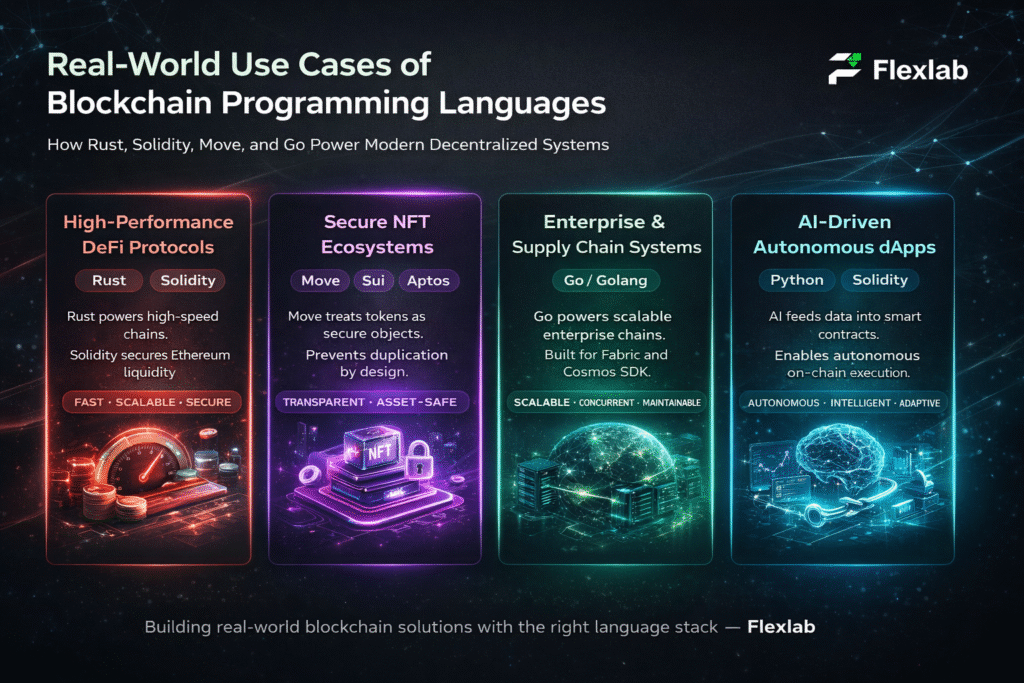
Blockchain programming languages aren’t just theoretical tools; they power real-world platforms shaping finance, gaming, supply chains, identity management, and enterprise systems. In practice, understanding how these languages are applied today helps developers and organizations make informed choices and avoid costly mistakes.
Several high-performance DeFi platforms rely on Rust for infrastructure and Solidity for smart contracts. For instance, Solana-based lending protocols achieve sub-second transaction finality thanks to Rust’s speed, while Ethereum DeFi platforms like Uniswap rely on Solidity for secure liquidity pools. Consequently, developers combining these languages can build systems that are fast, scalable, and secure, reducing operational risk.
Emerging NFT marketplaces on Sui and Aptos are using Move to enable asset-oriented programming. Tokens are treated as indivisible objects, preventing accidental duplication or deletion. Moreover, this approach simplifies asset tokenization, making it easier for developers to create secure digital collectibles, gaming assets, or fractionalized ownership models. Therefore, Move adoption is driving the development of safer, more transparent NFT ecosystems.
Many enterprise blockchain initiatives, such as supply chain tracking, logistics, and interbank settlement, rely on Go/Golang. Hyperledger Fabric and Cosmos SDK projects illustrate how Go supports scalable, concurrent operations with minimal developer overhead.
Moreover, enterprises using Go often integrate blockchain systems with modern cloud development environments, benefiting from robust documentation, auditability, and long-term maintainability. Consequently, Go remains the top choice for companies implementing custom blockchain solutions at scale.
Some cutting-edge decentralized applications integrate machine learning solutions directly with smart contracts. For example, predictive analytics for DeFi risk assessment or automated NFT pricing models use Python or Mojo to feed AI decisions into Solidity contracts. This creates autonomous systems where AI agents transact on-chain, highlighting the growing synergy between blockchain and AI-powered solutions. Therefore, developers focusing on AI-integrated dApps gain a competitive edge.
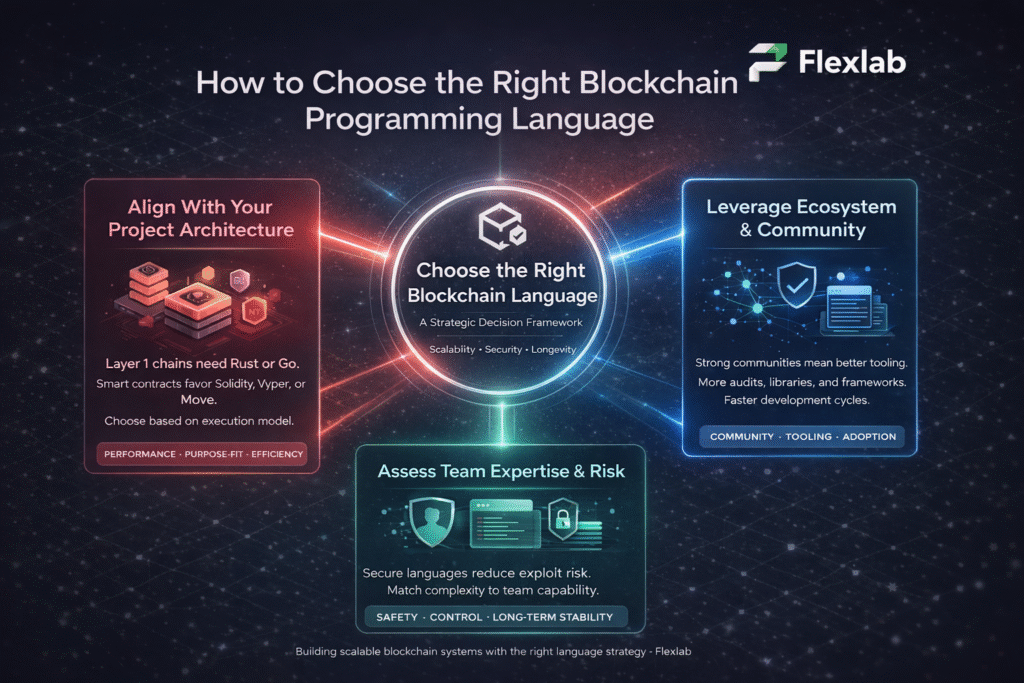
Choosing the right programming language is more than a technical decision; it directly impacts your project’s scalability, security, and long-term success. As a blockchain developer, understanding which language aligns with your project type, ecosystem, and team skills can save months of rework and costly errors.
First, identify whether you’re building a DeFi protocol, NFT marketplace, or enterprise blockchain solution. Rust or Go works best for high-performance Layer 1 chains and enterprise-grade networks, whereas Solidity, Vyper, or Move are ideal for smart contracts and asset tokenization. Moreover, choosing the right language ensures your team can leverage the existing ecosystem and tooling, avoiding unnecessary friction during development.
Next, evaluate the ecosystem surrounding a language. A vibrant community means more libraries, frameworks, tutorials, and audit tools. For example, Ethereum’s Solidity community offers extensive documentation and audited contracts, while Rust is gaining adoption in the Solana and Polkadot ecosystems. Consequently, languages with strong community backing accelerate development and reduce the risk of hidden vulnerabilities.
Finally, assess your team’s skill set and the security requirements of your platform. Languages such as Vyper or Clarity provide safer, auditable environments but may have a steeper learning curve. Conversely, JavaScript and TypeScript enable rapid dApp development but may require additional safeguards when interacting with critical smart contracts. Therefore, balancing speed, safety, and team proficiency is key to long-term success.

Choosing the Best Programming Languages is only the first step. What separates successful blockchain products from failed experiments is execution, secure architecture, optimized performance, and production-ready deployment.
At Flexlab, we design and launch high-performance blockchain systems built to scale. From Ethereum smart contracts and advanced Solana development to enterprise-grade private blockchain infrastructure, every solution is engineered for security, speed, and long-term growth. We don’t experiment with your product. We architect it for resilience, audit it for security, and deploy it for real-world adoption.
Explore our full capabilities on our services page, review successful deployments in our portfolio, or connect directly through contact us. For deeper insights into blockchain and emerging technologies, visit our Blog or follow us on LinkedIn to stay updated on emerging technologies.
Read more:
The Best Programming Languages for blockchain development aren’t defined by hype, but by fit. Rust and Go strengthen core infrastructure, Solidity and Move power smart contracts, and JavaScript connects blockchain logic to real users.
That said, performance alone isn’t enough. Instead, security, ecosystem maturity, developer support, and long-term scalability should guide your decision. A strong community means better tooling, faster debugging, and more reliable audits. Likewise, aligning your language choice with your team’s expertise reduces development risks and technical debt.
Ultimately, the right choice depends on your project goals and growth strategy. Choose wisely, prioritize security from day one, and build with a stack that supports innovation, stability, and sustainable success in the evolving blockchain landscape.
For most beginners, Solidity or JavaScript is the easiest place to start. Solidity is widely used for Ethereum smart contracts, and it has strong documentation and community support. Meanwhile, JavaScript helps developers connect smart contracts to front-end applications. If you already know Python, Vyper can also feel familiar and approachable.
In 2026, Solidity and Rust remain highly in demand. Solidity dominates Ethereum-based projects and DeFi platforms, while Rust powers high-performance chains like Solana and Polkadot. Demand often depends on the ecosystem you're targeting, but developers skilled in these two languages consistently see strong job and freelance opportunities.
Yes, in most cases, you’ll need more than one language. For example, you might use Solidity for smart contracts, JavaScript for front-end integration, and Go or Rust for infrastructure work. Blockchain development is layered, so understanding how different components interact gives you a serious competitive edge.





One Response
Your point of view caught my eye and was very interesting. Thanks. I have a question for you.