
What are Generative AI Applications? A 2025 Beginner’s Guide

What Are Generative AI Applications? A Beginner’s Guide

What Are Generative AI Applications and How Do They Work?

Smart Contracts | AI and Blockchain | AI Voice Agents

Let’s start from the beginning. When someone refers to artificial intelligence (AI), they typically mean systems designed to predict outcomes. For instance, given an image, decide whether it has a dog or a cat; given a loan applicant’s data, decide whether he will pay or not. However, there is another significant aspect of AI: one that doesn’t just classify or predict, but also helps with the creation of new content for consumers. That is the realm of generative AI. Generative AI generally refers to algorithms or computer systems capable of generating new content, such as images, text, music, etc. Generative AI models are trained on large volumes of existing data, learn the pattern, and then generate something entirely new of a similar kind.

In this blog, we will discover what Generative AI applications are, agentic AI vs. generative AI, use cases, and examples of generative AI

How Does it Work? In Simple Terms

How does generative AI work? You don’t need to be an expert to get the gist of how generative AI applications work. However, here is the analogy.

  • A model is given a vast collection of information, including numerous articles, numerous pictures of bags, or lots of music tracks.
  • With the help of AI data analysis, it tends to find the pattern, how words are arranged, and how they follow each other. It identifies how pixels in a picture are related to each other, and how chords follow in musical melody.
  • Once it is trained, you give it a ‘prompt’ or input- maybe a short text, for example, ‘draw a red bag in a minimalist room, and it uses what it learned to generate something new consistent with the pattern.

In more technical terms, large ‘foundation models’ such as large language models (LLMs) are trained on massive datasets and can then be adapted to many tasks with relatively little extra training. Some examples of these models that derive from deep learning techniques include Generative Adversarial Networks (GANs) and Variational Autoencoders (VAEs). These models are revolutionizing various industries by enabling novel innovations. 

So, from a beginner’s point of view, the system learns from what humans have made and then creates something in the same pattern. That’s the basic essence of generative AI. 

Why is Generative AI Useful?

Benefits of using AI technology

Here are some of the main reasons why this smart technology has gained traction recently.

  • Content Creation: Generative AI applications can help speed up creative work by creating drafts of texts, images, and even videos or music. 
  • Personalization: Generative AI allows content and services to be unique and tailored to users’ individual goals more easily. 
  • Innovation: It can help people explore new ideas, designs, or formats that might not easily come up through manual effort. 
  • Automation: Repetitive or tedious manual tasks, such as creating multiple variants of a picture and writing variants of marketing content, can be offloaded with generative AI. 
  • Data Augmentation: Generative AI can help with data augmentation and simulations. In fields like healthcare and manufacturing, geerative AI models can generate synthetic data to simulate scenarios or train other systems. 

In short, generative AI is useful for many reasons because it changes what AI-assisted humans look like – not just categorizing or analyzing, but generating. 

Top Applications of Generative AI

Common uses of generative AI

Generative AI is revolutionizing various industries by creating designs, content, and smart solutions. From enhancing productivity to improving creativity, its potential applications are vast and varied. Below are some of the major areas where generative AI is being applied. 

  • Generative AI in Healthcare
  • Generative AI in Cybersecurity
  • Generative AI in Virtual Assistants
  • Generative AI in Finance
  • Generative AI in Content Creation

Generative AI in Healthcare

Generative AI in healthcare is transforming the industry through drug discovery, personalized medicine, and medical imaging. It analysis of patient records helps bring customized treatment plans, therefore, increasing successful outcomes for patients. For instance, several companies are utilizing AI to create treatments tailored to individual patient profiles, taking into account their family and genetic history. 

Additionally, tools such as Insilico Medicine utilize generative AI to generate synthetic patient data, enabling the training of machine learning models without compromising patient privacy. Generative AI also helps with the early detection of diseases. For example, there are apps like SkinVision that use AI systems to analyze and examine images of the skin to help with diagnosis and detect early signs of skin cancer. 

AI Applications in Cybersecurity

Generative AI is revolutionizing cyber risk management by improving threat detection and automating incident response. It is redefining cybersecurity by proactively recognizing threats, simulating attack scenarios, and strengthening incident response capabilities. 

Generative AI helps analyze large datasets to recognize normal behavior within a network. For instance, it can detect an unusual spike in traffic that may demonstrate unauthorized access or a malware attack. Furthermore, advanced phishing attacks can also be encountered through generative AI, which utilizes natural language processing (NLP). It works by analyzing the content of emails and social media interactions in order to look for slight anomalies of unusual or false activities. 

In addition to this, generative AI also plays an important role in incident analysis and prioritization. Generative AI models can automatically analyze security incidents in real time. These models then prioritize incidents based on severity, enabling security teams to respond quickly and effectively.

The Role of AI in Virtual Assistants

Virtual assistants or AI-powered chatbots utilize generative models to provide a more human-like interaction with customers in customer service fields, effectively answering queries and resolving consumer issues. For example, Erica is a virtual financial assistant at the Bank of America that can assist up to 25 million users in managing their accounts, paying bills, and getting spending insights into their transactions. It helps make banking more accessible and efficient for users. Amazon’s Alexa uses conversational AI to deliver personalized product recommendations based on consumer preferences and past purchases, making shopping a fun experience for millions of customers. Another example of generative AI in virtual assistants is Duolingo. It employs a virtual assistant to tailor language lessons according to the user’s progress. Moreover, it provides real-time feedback and delivers gamified learning challenges to enhance the learning experience. 

How AI Is Used in Finance

Generative AI is revolutionizing the finance industry by enhancing fraud detection and risk mitigation. It helps create customized investment plans and improve risk management in the finance sector. One major application is automated report creation. AI generates real-time financial summaries, investment insights, and market trend briefs with high accuracy. In wealth management, advisors use generative AI to create personalized portfolio strategies, scenario analyses, and communication drafts for clients. It helps streamline workflows while significantly improving customer experience. Another use case is synthetic data generation, which allows companies to train models without exposing sensitive data, speeding up generative AI adoption across compliance-heavy environments. 

In addition to this, generative AI strengthens and supports regulatory teams by drafting compliance documents, analyzing policy advancements, and summarizing complex regulations. 

AI in Content Creation

Generative AI in content creation is redefining content creation across various industries. From images and text to music and videos, AI-driven systems streamline workflows, enhance creativity, and boost productivity while maintaining scalability and consistency. Writers and marketers can draft scripts, articles, and posts in minutes, allowing them to focus on ideas rather than time-consuming first drafts. Generative AI also tailors content to specific audiences by analyzing tone and user preferences.

A well-known example is Netflix, where AI algorithms analyze viewing habits, likes, and preferences to provide personalized recommendations. This personalization drives nearly 80% of the content streamed on the platform. Sephora uses a similar approach through its augmented reality tool, Virtual Artist, which lets users try makeup products virtually, enhancing the shopping experience with more interactive engagement.

Generative AI also supports writers by creating blog drafts, headings, and SEO metadata. These autonomous systems help overcome writer’s block, reduce effort, and ensure consistent, high-quality content with greater ease.

Things to Keep in Mind While Using Generative AI
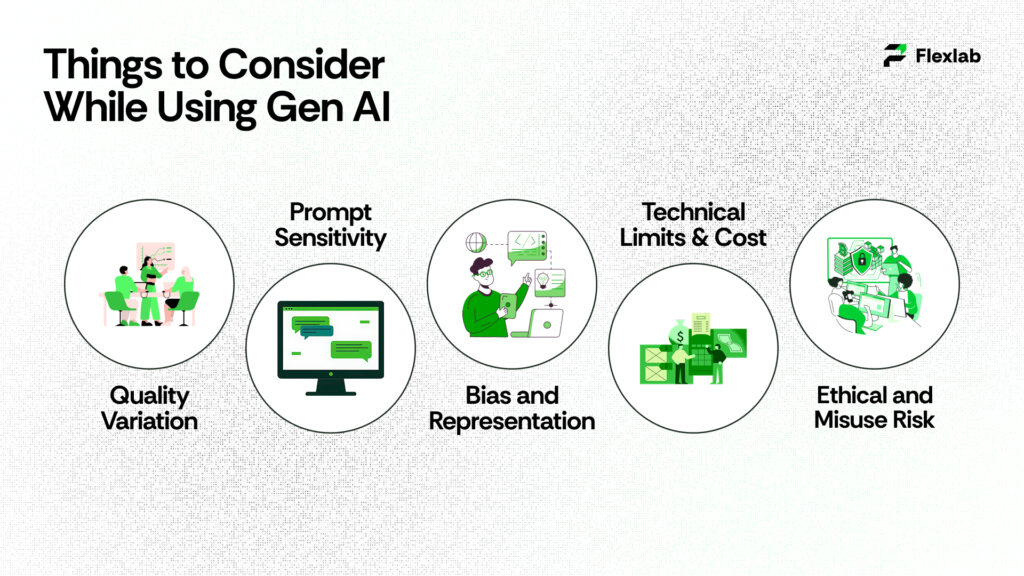
Important considerations when using AI tools

While the potential is significant and exciting, it is better to stay grounded. Here are some important caveats and considerations to keep in mind to make the best use of Generative AI applications. 

  • Quality May Vary: The output you get from generative AI may vary in terms of quality. They are not always perfect. It may make mistakes, be inconsistent, or produce something unexpected.
  • Prompt Sensitivity: The content or output you receive depends heavily on how the user explains the prompt. The more precise, the better the outputs. 
  • Bias and Representation: Since the generative models learn from human-made data, they can also inherit biases present in the data. Therefore, the use of these systems demands careful consideration. 
  • Technical Limits and Cost: Training and running such huge models can be expensive, and using them wisely with responsibility requires knowledge and skills. 
  • Ethical and Misuse Risk: Generative AI can easily be used to create misleading content, such as deepfakes or fake news. Also, it can be used in ways that can raise security and privacy concerns. Therefore, taking such sensitive things into account is really important. 

Keeping these in mind helps you approach generative AI with caution and curiosity. 

How to Start Using Generative AI as a Beginner?

Beginner guide to getting started with AI

If you are just starting out and wondering how you can experiment with generative AI, here are some simple yet effective steps;

  1. Pick a domain you want to work on. You could write blogs, make graphics, or teach.
  2. Find a tool. There are plenty of generative AI tools for different purposes that you can try. 
  3. Craft a good prompt. Be specific about what you want, such as style, tone, or constraints, etc. 
  4. Generate and review the content. After the output is created, edit and refine it. 
  5. Consider ethical implications, especially if you are publishing or sharing the output. Do take care of credit, accuracy, and originality. 

By using this approach, you can get the benefit of generative AI even without being an expert in machine learning. 

Concluding Keyphrases on Applications of Generative AI

Generative AI is transforming how we think, create, and solve problems these days. Its unique abilities to produce text, images, and ideas open new opportunities and possibilities across work, art, and everyday life. As these technologies grow more capable and advanced, they are becoming powerful partners with humans that help us move faster, discover new opportunities, explore new directions, and minimize the limits of traditional workflows. Yet the real significance of generative AI lies in how users choose to use it– with intention, creativity, and awareness. When human judgment meets AI advancements, the result comes out to be more efficient and imaginative way of working.

By developing and deploying AI technologies with the right safety and ethical measures, we can create systems that promote fairness and protect users. Generative AI is not the future of innovation on its own. However, it is becoming an essential part of how we shape our future.

Looking for a Trusted Generative AI Development Company?

Get Reliable AI development services with Flexlab

Unlock the power of generative AI with Flexlab, where innovation, engineering, and strategy come together to drive real and measurable results. Our team of skilled developers develops tailored AI solutions for industries like finance, healthcare, retail, and logistics, helping them cut operational costs with increased workflow efficiency through automation and intelligent content creation. From custom AI models to end-to-end deployment, Flexlab turns complex data into smarter decisions, faster processes, and new revenue opportunities. 

Ready to Grow Your Business?

📞 Book a FREE Consultation Call: +1 (201) 347-8591
📧 Email us: info@flexlab.io

Discover real-world success stories in our portfolio, explore our solutions, and start your AI solution development journey today. Contact us or have a look at our services. See firsthand what our clients say about us and how we’ve transformed their generative AI vision into measurable success.

To have more detailed insights into different topics, explore our blog page for more blogs like public vs private blockchain, benefits of using white label crypto exchanges for startups, and what is multimodal AI? 

FAQs

1. What is the most common use of Generative AI?

The most common use of generative AI is creating and improving content, such as text, images, and code, based on simple user prompts. It’s widely used in writing assistance, marketing content, design, and customer support to save time and boost productivity.

2. What is the most used generative AI tool?

The choice of the right tool depends on what you need: writing, designing, coding, or industry-specific solutions. There is no single best generative AI tool, but leading options like OpenAI’s ChatGPT, Google Gemini, and Adobe Photoshop dominate their fields for text, multimodal tasks, and image generation.

3. What are the seven main types of AI?

The seven main types of AI are reactive machines, limited memory AI, theory-of-mind AI, self-aware AI, narrow AI, general AI, and superintelligent AI. These types range from simple rule-based systems to advanced forms that could one day think, learn, and reason like— or even beyond—humans.


One Response

Leave a Reply

Your email address will not be published. Required fields are marked *

22 Best AI Marketing Tools to Boost Performance in 2026

Generative AIMultimodal AI | Digital Transformation Strategy with AI and Blockchain

Why is everyone looking for the best AI marketing tools? Why do we need to leverage AI marketing tools in our business? Here’s the answer: The marketing landscape has fundamentally transformed. Artificial intelligence has become a core marketing tool in over 71% of businesses, and over 84% of marketers in the UK are using AI to speed up, manage, or optimize their work every day. This isn’t just a trend; it’s the new baseline for competitive advantage.

The global market share for AI in marketing is forecasted to soar to USD 47 billion by 2025, with a remarkable leap to USD 107 billion predicted by 2028. More telling, 60% of nearly 1,900 predominantly U.S.-based respondents said their teams were piloting or scaling AI, up from 42% in 2023.

Perhaps most encouraging for marketers: 69% of marketers aren’t worried about AI replacing their jobs; they understand that AI isn’t replacing their job, but rather empowering them to do more within it.

What are AI Marketing Tools?

AI marketing tools are advanced marketing automation platforms integrated with large language models, existing marketing workflows, or using the Model Context Protocol MCP. It helps marketers automate their internal workflow through marketing automation. With the help of these AI tools for marketing, you can either innovate something new, like AI-powered chatbots for customer service or conversational AI, or take your AI automation skills to the next level without needing to be an AI Engineer.

What Makes AI Marketing Tools Essential in 2026?

AI marketing tools leverage artificial intelligence, machine learning, and automation to transform how teams brainstorm, produce, and deploy campaigns. According to recent research, these AI marketing software deliver measurable results through predictive modeling and business intelligence:

  • 8.6% sales productivity gains, 8.5% customer satisfaction increases, and 10.8% marketing overhead reductions
  • 22% higher ROI for AI-driven marketing campaigns versus traditional methods
  • 47% better click-through rates from AI-generated ad creatives

The technology has moved beyond experimental pilots. 74% said AI was critically or very important to next year’s marketing agenda, making this the perfect time to build your AI-powered marketing stack with customized marketing solutions.

22 Best AI Marketing Tools to Grow Your Business in 2026

Here are the best AI marketing tools that stay competitive in the AI market. Let’s read each tool below:

  • Gumloop (AI automation tool)
  • Zaiper (AI automation tool)
  • Notion AI (content generation tool)
  • Surfer SEO (SEO optimization tool)
  • Jasper (AI writing tool)
  • Seventh Sense (email optimization tool)
  • ActiveCampaign (marketing automation tool)
  • HoppyCopy (email copywriting tool)
  • Grammarly (writing enhancement tool)
  • WriteSonic (content generation tool)
  • Adcreative.ai (ad creative tool)
  • Albert.ai (ad optimization tool)
  • Synthesia (video generation tool)
  • Sora (video generation tool)
  • Runway (video editing tool)
  • Veed.io (video editing tool)
  • Descript (audio/video editing tool)
  • ElevenLabs (voice generation tool)
  • UnifyGTM (GTM automation tool)
  • Aampe (personalization tool)
  • Movable Ink (dynamic content tool)
  • OfferFit (offer optimization tool)

1. Gumloop

Gumloop AI automation tool for marketing workflows

Gumpoo is a popular AI automation tool that merges workflow automation with integrated large language models. It provides built-in access to premium AI models without requiring API keys. This tool is ideal for marketing teams that build AI-powered workflows without coding for customer relationship management (CRM). Along with pre-built LLM access, it has more features, including web scraping, continuous AI agents, and MCP integration supporting social media automation. Teams at Webflow, Instacart, and Shopify use this AI marketing tool.

Moreover, it has a modern, user-friendly interface for a smoother AI workflow. One of the standout qualities of this platform is to set on automation, which continuously runs and acts on new real data. This tool is best for sales, research, and admin tasks in content management.

2. Zaiper

Zaiper is a top AI automation platform that connects over 8,000 applications. It enables marketers to build custom workflows that automatically take actions across multiple systems. Marketers create “Zaps” with Copilot AI for natural language setup, such as routing leads from forms to HubSpot/Slack, as well as autonomous Agents for tasks like content management, product development, and AI chatbots for customer service

Over 3 million businesses leverage this platform to scale multichannel campaigns, achieving a 25% ROI. Moreover, users access 500+ AI apps without code, supporting models such as GPT-4o mini or custom APIs for image/audio analysis and Python scripting via Code by Zapier.

Unlike Gumloop’s focus on built-in LLMs, web scraping, and continuous agents for Shopify/Webflow teams, Zapier’s vast ecosystem and enterprise features suit broader marketing stacks. Zaiper is available for the free tier; however, for unlimited AI, you need to go with the Pro package. It is an ideal tool for blockchain and AI marketing automation. Also read the top 10 AI automation tools that drive sales and grow your business.

3. Notion AI

Notion AI is one of the best AI tools for marketing. It is an AI assistant built into the Notion productivity platform. It uses large language models to help users write, edit, summarize, and organize information in their workspace.

For $8–10 per member per month, users get unlimited access to strong features. It can generate content such as blog posts, emails, meeting notes, and social media posts. It also offers smart editing tools that fix grammar, change tone, translate text, or adjust length. The summarization feature extracts key points and action items from long documents. Its workspace Q&A lets you ask questions like “What did we decide in last week’s meeting?” and get answers by searching all pages and databases.

The AI can also fill databases, brainstorm ideas, and adjust tone with one click. It needs an internet connection, and its output still requires human review. Even so, Notion AI’s smooth integration makes it valuable for marketers, content creators, project managers, and teams who work in Notion often.

4. Surfer SEO

Surfer SEO AI optimization tool for content marketing

Surfer SEO is a content optimization tool that helps marketers and creators rank higher in search results. Specifically, it evaluates top-performing content and gives data-driven recommendations to structure and optimize articles. To do this, the tool analyzes top search results for your keyword, identifying patterns in keyword density, headers, article length, readability, and image usage. Then, it generates an actionable “Content Score” that updates content in real time. As a result, marketers can improve search visibility and produce content that better aligns with audience expectations and SEO best practices.

The platform features a built-in text editor (SERP Editor) where you can write directly while watching your optimization score improve from 0 to 100, or you can use the browser extension to optimize content in Google Docs, WordPress, or other platforms. Surfer SEO integrates with popular tools like Jasper AI for AI-assisted writing, Google Search Console for performance tracking, and WordPress for direct publishing, making it a central hub for SEO content workflows. Trusted by major brands including FedEx, Shopify, Quantas, and Viacom. The platform costs approximately $89 to $239/month, depending on the plan and features.

5. Jasper

Jasper is an AI-powered writing and marketing platform that simplifies content creation and automates workflow. It helps the marketing team to create content faster and more consistently across channels such as blogs, ads, emails, and social posts. This platform uses large language models like OpenAI, Anthropic, Google, and Cohere, and layers them with your brand guidelines so that they match your brand tone, style, and messaging. 

Jasper offers 50+ specialized templates for different content types (AIDA framework, PAS formula, product descriptions, blog post outlines, SEO meta descriptions). It supports over 25 languages and includes features like “Brand Voice” customization ensures consistency for a personalized customer experience, where you can upload writing samples to train the AI to match your company’s specific tone and style, ensuring consistency across all generated content.

6. Seventh Sense

Seventh Sense is an AI email-marketing optimization platform that uses HubSpot or Marketo to determine the ideal time to email each customer and drive engagement. This platform leverages machine learning to analyze customers’ past behavior and evaluate the tracking record of a client when they open an email, click links, and engage with content. Seven Sense predicts the optimal send time based on insights, driving engagement, and improving email deliverability through email marketing optimization strategies.

Moreover, this AI tool leverages AI to assess customers’ engagement and adjust email frequency. It ensures subscribers receive the right number of emails without feeling overwhelmed.

7. ActiveCampaign

ActiveCampaign AI-powered marketing automation platform

ActiveCampaign is a leading AI-powered marketing automation and customer experience platform that orchestrates personalized email, SMS, site messaging, and CRM workflows across channels. Launched in 2003 and serving over 180,000 businesses, its 2025 “Active Intelligence” upgrade integrates system-wide AI agents, such as Brand Kit for on-brand content generation, Suggested Segments for high-value targeting, and AI Automation for 1:1 personalized journeys, drawing from billions of data points to build, adapt, and optimize cross-channel campaigns autonomously. 

Moreover, its key features include predictive send-time optimization (similar to Seventh Sense), smart audience segmentation, campaign calendars, reporting copilots, and 950+ integrations (e.g., Wix, Shopify) via MCP and Agent-to-Agent tech, enabling marketers to set goals and let AI handle execution for higher engagement and ROI without great technical skills. It’s perfect for scaling your blockchain/AI content funnels. Pricing starts free (limited contacts), with paid plans from $29/month, scaling by audience size.

8. HoppyCopy

HoppyCopy specializes in AI-driven email marketing. Specifically, it offers 60+ templates for newsletters, drip sequences, and promotional copy that adapts to your brand voice. Additionally, it includes spam testers, A/B subject line generators, and competitor email insights for up to 50 brands. Moreover, visual workflow builders let users automate sends without coding.

As a result, it is ideal for boosting open rates in SEO and content funnels. Furthermore, pricing starts at $29/month with free trials, and it integrates with ESPs like Mailchimp.

Finally, users report 40% higher opens through personalization, while the blog highlights sequence generation tailored to tone and audience for rapid campaigns.

9. Grammarly

Grammarly’s AI suite goes beyond basic proofreading with tone detection (e.g., confident, friendly), full-sentence rewrites for clarity/conciseness, plagiarism scans, and brand kits that enforce terminology across docs, emails, and ads. Marketers use it for polishing pitch decks, social copy, and client reports, with integrations in Google Workspace and real-time collaboration boosting team output by 35%. Business plans from $15/user/month include analytics on engagement impact; 30M+ daily users; blog praises real-time error detection, drafts, and AI-flagging for professional content.​

10. Writesonic

WriteSonic AI content generation tool for marketers

Writesonic leverages GPT models for long-form SEO blogs, ad copy, and chatbot scripts, featuring Botsonic for custom AI agents, Photosonic for images, and an SEO checker that audits against top SERPs. Its workflow builder chains generations (e.g., outline → draft → optimize), supporting 25+ languages and enterprise fact-checking for blockchain/AI content scaling. Free tier available; Pro at $20/month; powers 5M+ pieces of content monthly with built-in plagiarism tools; blog highlights 100+ templates, keyword analysis, and tone adjustments for search-aligned copy.​

11. AdCreative.ai

AdCreative.ai scans your site URL to automatically generate ad variants, including banners, videos, and text. For example, it tailors ads for Meta, Google, and TikTok using a high-conversion database. Creative Scoring predicts performance with 90% accuracy, while Competitor Insights reveals rivals’ top-performing ads. Moreover, Product Video Shoot turns photos into UGC-style videos, perfect for e-commerce without designers.

As a result, users can boost CTRs up to 14x. Plans start at $21/month for 10 downloads, with unlimited generations available. Notably, G2 ranked it the 3rd fastest-growing product in 2023–2024. Finally, the blog calls it essential for quick creatives, copywriting, and competitor analysis.

12. Albert.ai

Albert AI marketing ad optimization platform

Albert.ai works as an autonomous ad engine that analyzes campaign data across channels. It uses reinforcement learning to test and shift budgets, audiences, and creatives in real time. The tool manages micro-segmentation, bid changes, and creative optimization without human bias. Many CPG brands report 2–3x ROI gains because it responds to customer experience signals quickly.

It offers enterprise pricing based on custom quotes. The platform deploys within a few weeks and is owned by Zoomd, which boosts its cross-platform strength. The company notes that Albert.ai can run over 1,000 real-time optimizations to improve ROAS and reduce CPA.

13. Synthesia

Synthesia AI video generation tool for marketing

Synthesia lets you type scripts for AI avatars that deliver videos in 140+ languages and accents. For example, it includes lip-sync, gestures, and custom backgrounds. Additionally, it is ideal for personalized sales demos or multilingual training. Teams can upload faces for branded presenters, edit via text, and export for LMS or social platforms.

As a result, video production is reduced from days to minutes. Furthermore, pricing starts at $22/month, with 50+ avatars available. Notably, 50% of Fortune 100 companies use it for compliance videos. Finally, the blog highlights no-equipment pro videos with over 230 avatars.

14. Sora

OpenAI’s Sora generates up to 60-second 1080p videos from text prompts, mastering physics (e.g., flowing water, crowds), emotions, and multi-shot continuity, plus image-to-video extension. Marketers use it for dynamic ads/simulations, though access is limited to pros via API for high-fidelity storytelling without actors/sets. API pricing ~$0.05/second; excels at 20s clips; safety filters prevent misuse; blog touts text-to-live-action for ads/b-roll without production teams.​

15. Runway

Runway’s Gen-3 Alpha creates and edits videos from text or images. For instance, it offers Motion Brush to animate parts, Act-One for lip-syncing, and style transfer for cinematic effects. Additionally, it supports inpainting, camera controls, and 4K upscaling, enabling fast prototyping of social reels or product visuals. As a result, marketers and creators can produce polished content for AI or blockchain campaigns quickly.

Furthermore, it offers a free tier, with Pro at $12/month, and integrates with Adobe. Notably, it also powers Hollywood VFX pipelines. Finally, the blog highlights text-to-video features and effects for marketing and film projects.

16. Veed.io

Veed.io AI video editing tool for marketers

Veed.io’s browser editor auto-transcribes videos, removes “ums”/silences, fixes eye contact, voice cloning, and adds subtitles/translations—one-click Magic Cut trims to highlights. Teams collaborate with brand kits/templates, host embeds, and scale for social/ads, slashing edit time 60% for non-experts. Free plan; Pro $29/month; 4M users; Fortune 500 testimonials for speed; blog notes subtitles/dubbing for global reach without downloads.​

17. Descript

Descript transforms editing by treating video like text. Users can edit transcripts to cut footage easily. Additionally, Overdub creates AI voices for filler-free narration. Meanwhile, Studio Sound cleans audio, and Underlord co-pilot suggests clips and scripts.

As a result, podcasters and marketers can turn long-form content into shorts, while automatically adding B-roll and captions for polished YouTube or LinkedIn videos.

Pricing starts at $12/month for Creators, with enterprise options available. Over 1M creators use Descript for 10x faster workflows. The blog highlights transcript editing and voice cloning for beginners.

18. ElevenLabs

ElevenLabs’ voice AI clones any accent/speaker from a 30-second audio, generating expressive TTS for 29 languages with emotion control (e.g., excited narration). It powers audiobooks, video dubs, and game characters, with a low-latency API for real-time apps, key for multilingual crypto explainers or personalized voiceovers. Free 10k chars/month; $5 for 100k; 1B+ characters generated; blog praises 1000+ voices and dubbing for cost savings up to 50%.​

19. UnifyGTM

UnifyGTM AI go-to-market automation tool

UnifyGTM is an AI-powered go-to-market platform that automates sales prospecting and engagement. It combines more than 10 intent data sources with AI agents for account research and personalized messaging. The platform also uses custom workflows, called “Plays,” to handle enrichment, sequencing, and multi-touch outreach.

Additionally, it pulls data from CRMs and public sources into dashboards showing pipeline insights, email deliverability, and buyer signals. As a result, revenue teams can scale personalized campaigns without manual effort. Furthermore, the tool works well for B2B blockchain and AI lead generation.

Pricing is custom and starts at around $500 per month. Many users say it boosts creativity and conversions through timely targeting.

20. Aampe

Aampe delivers AI-driven, customer-centric personalization for app, email, and SMS marketing. Specifically, it uses multi-armed bandits to run thousands of simultaneous A/B/n tests on content, timing, and frequency.

As a result, marketers can optimize one-to-one experiences without relying on rigid templates. Additionally, it connects to CDPs and CPaaS for event tracking, propensity scoring, and engagement insights per user.

Moreover, the platform balances exploration and exploitation to improve retention and ROI. Consequently, marketers can scale campaigns across channels effortlessly. For example, it integrates with Braze and Salesforce.

Finally, enterprise pricing is custom, and the tool excels at reducing churn through optimal messaging cadence.

21. Movable Ink

Movable Ink’s Autonomous Marketing platform uses AI agents for agentic campaigns that self-adapt content, subject lines, send times, and frequency across email/mobile/web, incorporating marketer-defined guardrails, brand assets, and goals. It enables post-send updates, no-code builders, and AI decisioning synced to data systems for dynamic personalization (e.g., live product feeds), shifting execution from manual calendars to strategy focus. Trusted by enterprises; June 2025 launch highlighted 3-step workflows. Custom enterprise pricing delivers higher opens/conversions via real-time relevance.​​

22. OfferFit

OfferFit is an autonomous ML platform that replaces A/B testing with continuous experimentation to optimize offers, incentives, timing, and channels for each customer, detecting behavior shifts for 10-20%+ revenue uplift and cost reductions. It acts as a decision layer between data/automation tools (Braze, Salesforce), generating tailored recommendations via AI while providing performance reports. Used by Brinks Home for profit-maximizing offers; integrates seamlessly for omnichannel. Custom pricing; ideal for retention/upsell in competitive markets like crypto services.

Ready to Transform Your Marketing with These AI Tools? 

Flexlab builds custom AI marketing stacks tailored for blockchain and SEO campaigns. 

Unlock 22% higher ROI and 47% better CTRs with proven AI marketing. Flexlab’s experts integrate tools like Jasper, UnifyGTM, and Zapier into your workflows. 

What are you waiting for? 

📞 Book a FREE Consultation Call: +1 (201) 347-8591

📧 Email us: info@flexlab.io

The Future of AI Marketing: What’s Next?

AI marketing tools will drive 50%+ efficiency gains by 2028 through agentic systems and ethical data strategies.

  • Agentic AI Adoption

In the future, marketers will move beyond experimenting with agentic AI to full-scale adoption. Consequently, these autonomous systems will handle increasingly complex tasks, including campaign management and customer journey optimization.

  • Privacy-First Marketing

As third-party cookies disappear, AI-powered first-party data strategies become essential. Tools that help capture and activate customer data ethically will dominate.

  • Democratization of Advanced Capabilities

A local retailer can now deploy Amazon Personalize for under $200, while autonomous advertising platforms optimize campaigns with the same sophistication as global brands. This levels the competitive playing field.

  • Human-AI Collaboration

Sam Altman, CEO of OpenAI: “95% of what marketers use agencies, strategists, and creative professionals for today will easily, nearly instantly, and at almost no cost be handled by AI”. However, this doesn’t mean job losses; it means marketers will focus on strategy, creativity, and authentic human connection.

Conclusion: Building Your AI Marketing Stack

The AI marketing revolution isn’t coming; it’s already here. 97% of marketing leaders say AI proficiency is vital for proper job performance, making this a mandatory skillset rather than an optional enhancement.

The best AI marketing tools covered in this guide represent the top available solutions for 2026, each addressing specific marketing challenges. Start by identifying your top three pain points, then experiment with the tools that address those specific needs.

Don’t just read about 2026 AI dominance; build it. Partner with Flexlab, your blockchain development nd AI marketing automation agency, to deploy agentic systems that deliver 50%+ efficiency gains. Contact us now for your custom roadmap and check our LinkedIn for real results. You’ll also love our blockchain and AI blog with insights on Generative AI, Multimodal AI, Digital Transformation Strategy with AI and Blockchain, AI-Powered Chatbots in Healthcare Services, and Trusted Execution Environment for AI & Blockchain.

FAQs

Q1: How can you use AI for marketing?
AI powers marketing via content generation (Jasper, Surfer SEO), email optimization (Seventh Sense), personalization (UnifyGTM, OfferFit), and automation (Zapier, ActiveCampaign) for SEO/blockchain campaigns.​

Q2: Is ChatGPT good at marketing?
ChatGPT excels at ad copy, emails, and social posts but pairs best with tools like Jasper for brand voice and human strategy oversight.​

Q3: Can you make money with AI marketing?
Yes, monetize AI marketing through freelancing SEO content, affiliate tools, or agency services using agentic AI for 20-50% efficiency gains.

Common Challenges in Smart Contract Development for Beginners

Blockchain Trends | Private Blockchain Development | Blockchain Database

Curious to learn about how smart contract development automates agreements, eliminates slow approvals, and removes costly intermediaries, boosting efficiency and trust in business operations.

In 2025, over $15 billion is locked in decentralized finance (DeFi) platforms, while applications such as non-fungible tokens (NFTs) and asset tokenization are transforming industries. Yet many organizations still rely on inefficient, manual processes that drain resources and slow growth.

This beginner-friendly guide covers what smart contracts are and how they operate. Moreover, it explains how smart contract development helps enterprises reduce costs, enhance security, and scale applications in DeFi, NFTs, and automated business operations across the digital economy.

Understanding Smart Contracts:  Automating Blockchain Transactions

A smart contract is a self-executing program stored on a blockchain that automates agreements and transactions once pre-defined conditions are met. Think of it as a vending machine: you insert a coin, it verifies payment, and delivers your product,  no human intervention required. Similarly, smart contracts verify, execute, and record transactions automatically, ensuring accuracy, trust, and efficiency.

Key Business Advantages of Smart Contracts

  • Transparency: All actions are recorded on the blockchain, making auditing and tracking effortless.
  • Immutability: Once deployed, contracts cannot be altered, guaranteeing integrity and reducing disputes.
  • Automation: Manual approvals and intermediaries are eliminated, streamlining workflows and lowering costs.
  • Security: Advanced cryptographic protocols protect digital assets and sensitive information.
  • Scalability: Businesses can integrate smart contracts into existing systems and seamlessly expand operations.

Consequently, a DeFi lending platform can automatically execute loans and repayments, while NFT marketplaces enforce ownership transfers and royalties without manual intervention.

Why Smart Contracts Are Critical for Businesses 

In today’s fast-paced digital economy, inefficiencies, delays, and reliance on intermediaries can cost businesses time, money, and trust. By leveraging smart contract development in decentralized finance (DeFi) and other blockchain applications, companies can overcome these obstacles. As a result, they can execute agreements, manage assets, and automate processes securely and efficiently.

Top advantages for enterprises include:

  • Trustless Operations: Code enforces agreements automatically, reducing human error and ensuring reliability.
  • Cost Reduction: Avoid fees paid to banks, lawyers, or brokers by automating transactions and approvals.
  • Automation & Speed: Transactions execute instantly when pre-defined conditions are met, accelerating workflows and improving service delivery.
  • Auditability: Every action is recorded on the blockchain, providing a verifiable, tamper-proof trail for compliance and reporting. As a result, organizations can maintain transparency and meet regulatory requirements with confidence.
  • Global Reach: Operate seamlessly across borders, interacting with clients, vendors, and partners without intermediaries.

Accordingly, a DeFi platform can automate lending, borrowing, and token swaps, while NFT marketplaces automatically enforce ownership transfers and royalties, without manual intervention.

The Smart Contract Development Lifecycle (SCDLC) 

Implementing smart contracts successfully requires a structured approach to ensure security, efficiency, and alignment with business objectives. 

Table illustrating the stages of a smart contract development lifecycle

1. Requirements & Architecture 

Define the contract’s purpose, IF/THEN conditions, blockchain platform (Ethereum, Solana, Polygon), and plan for upgrades with proxy patterns.

2. Coding & Initial Development 

Ensure smart contract security by writing robust Solidity or Rust code and applying cryptographic techniques. Additionally, follow modular design principles to make your contracts maintainable and reusable. Finally, leverage audited libraries such as OpenZeppelin to enhance security and reliability.

3. Rigorous Testing 

Ensure thorough testing by conducting unit and integration tests. Additionally, simulate high loads and edge cases to identify potential weaknesses. Finally, verify interactions with wallets and APIs to confirm seamless functionality and reliability.

4. Security Audits 

It is essential to engage professional security audits to identify potential vulnerabilities. For example, audits can uncover issues such as reentrancy attacks, access control flaws, and integer overflows, helping ensure the safety and reliability of smart contracts.

5. Deployment & Maintenance 

Deploy smart contracts using deployment tools like Hardhat, Truffle, and MetaMask on testnets before moving to the mainnet. Additionally, continuously monitor contracts to ensure they perform as expected and remain secure.

Ultimately, following this lifecycle ensures that smart contract platforms deliver secure, efficient, and scalable solutions, providing businesses with reliable automation and reducing operational risk.

Tools That Simplify Smart Contract Development 

Icons representing tools used for building and testing smart contracts

Implementing smart contract development efficiently requires the right set of tools. These tools streamline coding, testing, deployment, and security, allowing businesses to focus on strategy while ensuring contracts perform flawlessly.

1. Remix IDE 

Remix IDE is a browser-based, beginner-friendly environment ideal for writing, testing, and deploying digital contracts.
Moreover, it allows users to experiment with Solidity code without a complex setup. As a result, businesses exploring blockchain technology can accelerate prototyping and streamline early-stage development. Overall, Remix simplifies initial experimentation and reduces the barrier to adopting smart contract development.

2. Hardhat & Truffle

Hardhat and Truffle are robust frameworks that support local blockchain testing, automated deployment, and smart contract compilation. Hardhat’s plugin ecosystem and debugging tools allow developers to simulate real-world conditions, while Truffle’s suite simplifies contract migration and integration testing. Together, these frameworks ensure that contracts are production-ready and compatible with blockchain networks.

3. MetaMask 

MetaMask is a widely used crypto wallet that connects smart contracts to end users. In addition, it enables secure transaction signing and allows developers to test smart contracts within real-world workflows. Furthermore, its multi-chain support makes it ideal for DeFi platforms and NFT applications. As a result, MetaMask plays a critical role in bridging blockchain technology with practical user experiences.

4. Ganache 

Ganache provides a simulated private blockchain environment. It allows developers to test contracts safely before public deployment. It supports transaction simulation, account management, and state inspection, minimizing risk when scaling operations.

5. OpenZeppelin 

OpenZeppelin provides pre-audited, reusable libraries for tokens, governance, access control, and upgradable contracts. By leveraging these libraries, businesses can enhance smart contract security and ensure compliance with industry standards.

In short, these tools simplify smart contract development, minimize potential errors, and save time. Consequently, businesses can focus on strategic growth while ensuring that all technical aspects—from coding to deployment—remain secure, scalable, and reliable.

Essential Smart Contract Security Practices for Businesses 

In today’s digital landscape, smart contract security is not optional. Even minor vulnerabilities can result in catastrophic financial losses and reputational damage. Businesses must adopt proven strategies to protect digital assets, DeFi platforms, and NFT operations.

Key Vulnerabilities to Watch 

  • Reentrancy Attacks: External contracts repeatedly call a function to drain funds before the transaction completes.
  • Integer Overflow & Underflow: Numeric values exceeding storage limits can cause unexpected behavior.
  • Unauthorized Access / Role Mismanagement: Weak access controls can allow unauthorized users to execute sensitive functions.

Best Practices for Robust Security 

  • Use Proven Libraries: Leverage OpenZeppelin and other audited code libraries for tokens, governance, and upgradable contracts.
  • Keep Contracts Simple & Modular: Reduces complexity and minimizes error opportunities.
  • Conduct Comprehensive Security Audits: Hire professional auditors to identify vulnerabilities before deployment.
  • Integrate Cryptographic Protocols: Ensure all contracts and assets are encrypted and tamper-proof.
  • Regularly Test in Safe Environments: Use Ganache, local testnets, and sandbox platforms to simulate potential attack scenarios.

Ultimately, following these security practices protects funds, builds trust, ensures compliance, and keeps operations secure, transparent, and resilient.

Real-World Applications for Your Business 

Real-World Applications for Businesses

Smart contract development is a practical tool that can transform your business operations. By leveraging digital contracts, companies can automate complex workflows, enhance transparency, and reduce operational risks. Let’s explore how different applications can immediately benefit your enterprise.

1. Decentralized Finance (DeFi) 

Through DeFi platforms, businesses can automate lending, borrowing, and trading processes without intermediaries. Consequently, this reduces operational costs, accelerates transactions, and improves accuracy. Examples include yield farming, stablecoins, token swaps, and other digital contract-based solutions. By integrating cryptographic protocols and secure blockchain networks, enterprises can achieve trustless operations while maintaining compliance and security.

2. Non-Fungible Tokens (NFTs) 

NFTs provide verifiable digital ownership for assets such as art, collectibles, or in-game items. By using smart contract platforms, businesses can issue digital assets that are unique, traceable, and tamper-proof. This not only creates new revenue streams but also strengthens engagement with customers, gamers, and content creators by offering verifiable ownership and royalties.

3. Asset Tokenization 

Asset tokenization allows companies to represent real-world assets such as real estate, stocks, commodities, or intellectual property as tradable on-chain tokens. Consequently, this enhances liquidity, enables fractional ownership, and simplifies compliance. Furthermore, tokenized assets can be seamlessly integrated into blockchain platforms, opening avenues for innovative investment models and global access.

4. Supply Chain & Identity Management 

Smart contracts enable transparent tracking of goods and verification of credentials. Consequently, businesses can monitor every step in the supply chain, ensuring authenticity, reducing fraud, and minimizing disputes. Similarly, in identity management, crypto wallets and cryptographic techniques provide secure credential verification, streamline access management, and automate compliance processes. As a result, these technologies enhance both operational efficiency and trust.

Enterprise-Scale Smart Contract Solutions 

Architecture diagram showing enterprise blockchain infrastructure

For businesses seeking to leverage smart contract development at scale, simply deploying contracts is not enough. Advanced solutions are essential to ensure seamless integration, robust security, and operational efficiency across multiple platforms. By implementing these strategies, enterprises can fully harness the potential of blockchain technology while minimizing risk and increasing transparency.

1. Cross-Chain Compatibility for Multi-Platform Blockchain Networks 

Modern enterprises often use multiple blockchain platforms, each serving different purposes. Consequently, cross-chain compatibility allows smart contracts to communicate and operate across these diverse networks. This ensures data consistency, reduces manual reconciliation, and provides businesses with flexibility to optimize workflows across platforms.

2. AI-Assisted Integration Testing and Smart Contract Security 

Integration testing is essential to ensure that your contracts interact correctly with other systems, wallets, or APIs. By using AI-assisted testing tools, this process is enhanced, as they can automatically detect potential issues, simulate various scenarios, and optimize smart contract security. As a result, businesses can identify and prevent vulnerabilities—such as reentrancy attacks, access control flaws, or logic errors—before going live.

3. Enterprise-Grade Private Blockchain Environments 

For sensitive data or regulated industries, private blockchain networks offer controlled access, ensuring confidentiality and compliance. Companies can deploy digital contracts in these environments to manage internal processes, supply chains, or asset tokenization projects, all while maintaining the benefits of blockchain immutability and transparency.

4. Automated Application Binary Interface (ABI) Monitoring

The application binary interface (ABI) is critical for smart contract interaction with external systems. Automated ABI monitoring allows businesses to track contract interactions, detect anomalies, and optimize performance. Consequently, it ensures that digital assets are managed efficiently, reduces operational errors, and supports smooth integrations with crypto wallets and other blockchain-enabled applications.

The Future of Smart Contract Development in 2026 and Beyond

Illustration representing future blockchain and smart contract innovation

Looking ahead, smart contract development is set to transform not just the tech industry but every sector that relies on secure, transparent, and automated transactions. Businesses that stay ahead of these emerging trends will gain a significant competitive advantage in the rapidly evolving world of blockchain technology.

1. Layer-2 Scaling Solutions 

To address high network fees and slow transaction speeds, Layer-2 solutions such as Arbitrum, Optimism, and zkSync are becoming increasingly popular. By building on top of existing blockchain networks, these technologies enable smart contracts to execute more quickly and cost-effectively. As a result, decentralized finance (DeFi) platforms and other enterprise applications become more accessible and efficient for users.

2. AI-Enhanced Contract Creation and Auditing 

Artificial intelligence is to play a pivotal role in smart contract development. AI can assist in automatically generating code, performing rigorous security audits, and detecting potential vulnerabilities before deployment. This not only reduces human error but also accelerates the deployment tools process, ensuring digital contracts are safe and efficient.

3. Broader Industry Adoption 

While finance has been an early adopter, industries such as healthcare, logistics, gaming, and real estate are increasingly integrating smart contracts. From automating insurance claims to managing supply chain data or securing digital assets, smart contract platforms are becoming central to enterprise innovation.

4. Enhanced Asset Tokenization 

The tokenization of real-world assets, including real estate, commodities, and intellectual property, is set to expand significantly. By converting these assets into tradable digital assets, businesses can improve liquidity, enhance transparency, and create new revenue streams, all powered by smart contracts and cryptographic protocols.

5. Cross-Chain and Interoperable Ecosystems

Since blockchain networks multiply, cross-chain compatibility will become increasingly important. Businesses will benefit from interoperable smart contracts that can operate across multiple platforms, seamlessly connecting crypto wallets, decentralized apps, and enterprise systems.

In short, embracing these future trends helps your enterprise stay ahead in 2026 and beyond. By leveraging Layer-2 scaling, AI-assisted auditing, widespread industry adoption, enhanced asset tokenization, and cross-chain interoperability, companies can fully unlock the potential of smart contract development. As a result, they gain greater efficiency, stronger security, and new business opportunities.

Accelerate Your Business with Flexlab’s Smart Contract Development

Flexlab platform interface for enterprise blockchain development

Your smart contract partner can determine whether your project scales or stalls. Flexlab delivers secure, high-performance, enterprise-grade blockchain solutions that accelerate growth, automate workflows, and keep you ahead of the competition. From DeFi to NFTs, we build systems that work flawlessly from day one.

Ready to Grow Your Business?

📞 Book a FREE Consultation Call: +1 (201) 347-8591
📧 Email us: info@flexlab.io

Our team brings deep expertise in blockchain architecture, Web3 automation, and end-to-end decentralized development. We handle validation, audits, optimization, and post-launch support, so you can innovate boldly without worrying about the technical details.

Discover how we transform ideas into real blockchain products through our portfolio. Explore the AI, blockchain, and automation solutions on our services page. Move forward with a secure, scalable implementation by reaching out and contact us. Stay informed with expert insights, practical frameworks, and industry trends on our blog. Follow us for updates and behind-the-scenes innovation on LinkedIn. Transform your operations, eliminate inefficiencies, and unlock new revenue opportunities. For deeper learning, here are a few recommended reads:

Final Thoughts on Smart Contract Development 

In conclusion, smart contract development is revolutionizing the way businesses operate by enabling secure, automated, and transparent transactions. From digital contracts to decentralized finance (DeFi) and asset tokenization, these innovations help reduce costs, minimize risks, and unlock new growth opportunities. By partnering with experts and leveraging blockchain platforms, companies can confidently implement smart contracts. As a result, they drive efficiency, build trust, and create long-term value in the digital economy.

FAQs

1: How do smart contracts interact with real-world data? 

Smart contracts rely on oracles, which are trusted data providers, to fetch information from the real world, such as prices, weather, or delivery confirmations. These oracles feed the data into the blockchain, allowing smart contracts to execute automatically based on real-world events. As a result, even complex workflows—like DeFi transactions or NFT marketplaces—can run with greater automation and accuracy.

2: Can smart contracts be upgraded after deployment? 

Yes, but with careful planning. Smart contracts are immutable by default, meaning their code cannot be changed after deployment. To allow upgrades, developers use proxy patterns or modular architectures, which let them update the contract’s logic without changing its blockchain address. This ensures flexibility, security, and long-term scalability for enterprise applications.

3: What industries can benefit most from smart contract development? 

Smart contracts are widely applicable beyond finance. Industries such as supply chain, real estate, healthcare, gaming, and insurance can benefit from automated, secure, and transparent workflows. For example, supply chain companies can track goods and verify authenticity, real estate businesses can automate property sales and rentals, and healthcare providers can securely manage patient records and consent. These solutions reduce costs, prevent fraud, and improve operational efficiency.

How to Invest in Cryptocurrency Safely and Smartly

Post-Quantum CryptographyCrypto WalletsCybersecurity Risk Assessment  

Buying your first cryptocurrency can feel exciting and overwhelming. If you are searching for how to invest in cryptocurrency for beginners, you are not alone. A recent survey shows that 64 percent of new investors fear losing money due to a lack of understanding of how cryptocurrency works. Additionally, over 46 percent admitted that early investment decisions were influenced more by hype than by careful research.

Social media moves fast, prices move even quicker, and bold promises can push beginners into impulsive mistakes. Fortunately, cryptocurrency becomes much easier to navigate when you slow down, learn the basics, and follow a structured approach. The goal is not to get rich overnight, but to protect your money while gaining a solid understanding of digital assets.

Globally, more than 300 million people hold cryptocurrency, but many beginners still lose money early due to a lack of knowledge. Understanding the basics early helps you make more confident decisions.

This guide will provide a clear, structured plan for beginners to invest safely. You will learn:

  • What cryptocurrency is and how it works
  • The main risks involved and how to reduce them
  • How to create a smart investing plan
  • How to choose secure tools such as exchanges and wallets
  • How to store your assets safely using different types of crypto wallets
  • How to build long-term crypto investing strategies
  • Whether cryptocurrency is a good investment for beginners
  • How to understand the crypto ecosystem using a simple Crypto Periodic Table

Understand Crypto Basics and Security Overview

Before spending a single dollar, understand what you are actually investing in. Most beginners skip this step, then panic the moment the price drops or a headline goes viral. Learning about the basics can save you from stress and regret. Start with three basic questions: 

  • What is cryptocurrency?
  • What types exist? And 
  • What can go wrong? 

Once you can answer those in your own words, then you are ready to think about your first small investment.

What Cryptocurrency is and How it Works 

Cryptocurrency is digital money powered by blockchain networks. It records transactions on a transparent, decentralized system.

You can think of a blockchain as a public ledger. Whenever someone sends or receives crypto, a new entry is added to the ledger. Moreover, its copies are stored on numerous computers worldwide. Because of this, everyone can easily see it, making it hard to cheat. Additionally, there isn’t any central bank that controls the ledger. Consequently, if you send crypto to the wrong address, it is usually gone, and no customer service helpline can undo the mistake.

Furthermore, prices also fluctuate significantly. A coin that is worth $100 today can be worth $60 or $150 tomorrow. Most cryptocurrencies lack government-backed insurance. 

Core Building Blocks

  • Blockchain and Security

A blockchain is a digital ledger where transactions cannot be easily altered or tampered with. This level of security comes from cryptography techniques, which not only protect data but also verify ownership.

  • Smart Contracts

Many cryptocurrencies use smart contracts, which are self-executing digital agreements. Consequently, they operate automatically, thereby eliminating the need for banks or middlemen.

  • Peer-to-Peer Payments

Crypto enables peer-to-peer payments, which means money is transferred directly between individuals without the need for a bank or intermediaries. Consequently, transactions can be faster and more efficient.

  • Digital Payment and Global Access

Cryptocurrency can serve as a digital payment method, thereby providing access to global financial systems for individuals who might otherwise face traditional restrictions. Furthermore, understanding these basics helps beginners start with clarity instead of confusion.

Types of Crypto Beginners Should Know

Although thousands of digital assets exist, most fall into a few main categories. Understanding these categories helps clarify how different crypto assets function and where their risks may lie.

Coins: Coins are cryptocurrencies that operate on their own independent blockchains.

Examples include Bitcoin and Ethereum. They are commonly used as:

  • Digital money
  • A store of value
  • The foundational layer for building other blockchain-based applications

Because coins rely on their own networks, they often have stronger infrastructure, broader adoption, and more proven security compared to smaller assets.

Tokens: Tokens are digital assets built on existing blockchains rather than having their own networks.
For example, many tokens exist on the Ethereum blockchain. Tokens can serve various purposes, such as:

  • Providing access to a decentralized application
  • Representing governance rights in a protocol
  • Acting as utility points for gaming, finance, or digital services

Tokens tend to be more experimental and carry a higher risk, because they depend on the strength and legitimacy of their own project.

Stablecoins: Designed to maintain a relatively stable value, generally connected in value to a standard currency, such as the US dollar.
Examples include USDT and USDC. Stablecoins are useful for:

  • Storing value without high volatility
  • Moving funds quickly across crypto platforms
  • Providing liquidity in trading and decentralized finance

Although they are mainly less volatile, stablecoins still carry risks related to regulation, transparency of reserves, and the stability of the issuing entity. These coins usually provide stronger infrastructure and wider adoption. In contrast, new or small tokens can be far more volatile, may have limited oversight, and are more vulnerable to fraud or sudden collapse.

Safe Tools & Security Steps for Beginners

Ensuring digital safety is essential for beginners. This includes using strong passwords, enabling two-factor authentication, keeping recovery phrases offline, and carefully choosing trusted wallets and exchanges. Additionally, prioritizing digital safety not only helps protect your assets but also reduces the risk of scams, hacks, and other online threats.

Safe & Smart Crypto Tools for Beginners

1. Pick a Trusted Crypto Exchange & Create a Secure Account

A crypto exchange is a platform where you can buy and sell digital assets using regular money.

Choose exchanges that have:
• A long track record
• Strong security features
• Clear company information
• High trading volume
• Two-factor authentication

Additionally, use a strong, unique password and enable two-factor authentication through an app. Avoid logging in on public devices. Regulated exchanges also offer investments such as exchange-traded products and exchange-traded funds, providing beginners with alternative exposure without requiring them to manage private keys directly.

2. Understand Wallets & Storage Options

A wallet does not store coins. It stores your private keys, which control access to your funds. Here are the main types of crypto wallets:

  • Hot Wallets: App-based or online wallets. Good for small amounts and daily use.
  • Hardware Wallets: Offline physical devices. Best for large, long-term storage.
  • Paper Wallets: Printed keys stored offline. Less common but highly secure when managed properly.

Most beginners start with a trusted app or exchange wallet, then move to hardware wallets as their holdings increase.

3. Protect Your Keys, Passwords, & Recovery Phrases

Your recovery phrase is the master key to your wallet. If you lose it, you may lose access to your crypto forever. Follow these golden rules to protect against any kind of scam.

  • Never share your private keys
  • Write your recovery phrase on paper
  • Keep copies in two secure locations
  • Avoid storing it digitally
  • Double-check URLs before logging in

4. Avoid Early Mining Attempts

Mining requires specialized technical skills and hardware; therefore, it is less ideal for beginners.

5. Advanced Features for Beginners

Platforms may offer tools such as smart contracts, contracts for differences, peer-to-peer payments, and digital payment capabilities. Beginners should master basic investment principles before engaging with these advanced features.

Crypto Investing Strategies for Beginners

When starting, beginners should focus on proven crypto investing strategies to grow their holdings safely and manage risk effectively.

Crypto Investing Strategies for Beginners

1. Long-Term Holding (HODL)

This is the “buy it and forget about it” strategy. Essentially, you pick strong, well-established cryptocurrencies and hold them for years, while ignoring short-term ups and downs. Therefore, it’s ideal for individuals who prefer not to trade daily and who believe the market will grow over time.

2. Dollar-Cost Averaging (DCA)

Invest a fixed amount on a schedule, such as weekly or monthly. It reduces timing risk and promotes discipline. This strategy supports dollar cost averaging, one of the safest techniques for beginners.

3. Diversify Your Crypto Portfolio

Practicing good portfolio management helps beginners strike a balance between risk and reward. By consistently keeping track of the coins, tokens, and stablecoins you hold, and by regularly reviewing your allocations, you can make more informed decisions while adjusting your strategy as the market evolves. Ultimately, this approach improves your chances of long-term success. A healthy crypto portfolio may include:

  • Major coins
  • A few reliable tokens
  • Stablecoins
  • Optional crypto index funds if available

4. Use Simpler Investment Products

Beginners can also explore contract for differences (CFDs), which allow them to speculate on cryptocurrency price movements without owning the underlying assets. However, this approach can provide flexibility and leverage, and at the same time, it carries a higher risk and should be used cautiously by new investors.

5. Avoid Emotional Decisions

Stick to your plan, and stay disciplined, while avoiding hype-driven choices. In conclusion, clear and consistent strategies not only reduce risk but also support long-term success.

Is Cryptocurrency a Good Investment for Beginners?

Cryptocurrency can be an exciting addition to your investment portfolio when you approach it responsibly. With that in mind, the right mindset and strategy allow beginners to confidently and safely enter this digital world.

Is Cryptocurrency a Good Investment for Beginners

  • Start Small & Learn

Think of crypto like an experiment at first. Begin with only what you can afford to lose without affecting your daily life. Start with amounts that feel comfortable while you learn how the market behaves.

  • Focus on Strong Coins

For beginners, it’s best to stick with well-known cryptocurrencies.

  • Bitcoin (BTC): The original and most widely accepted crypto
  • Ethereum (ETH): It is known for smart contracts and decentralized apps
  • Stablecoins: These are tied to traditional currencies and are much less volatile

These options give beginners a reliable starting point. Additionally, some beginners prefer exposure through exchange-traded products, which allow you to invest in cryptocurrencies without directly holding the assets yourself. For example, these products track the price of coins like Bitcoin or Ethereum, making them easier to manage for those who want a simplified and regulated way to participate in the market.

  • Understand Cryptocurrency Mining

Cryptocurrency mining can sound exciting, but it’s not usually the best starting point for beginners. Here’s why:

  • Mining requires expensive hardware that can cost thousands of dollars.
  • Electricity costs can easily outweigh the coins you earn.
  • It isn’t very easy, requiring setup, maintenance, and constant monitoring.

For most beginners, buying small amounts on a regular schedule (like weekly or monthly) is a much simpler and safer way to get started.

  • Follow KYC Requirements

Most reputable exchanges require Know Your Customer (KYC) verification, which means providing identification to confirm your identity. As a result, this process helps enhance security and prevent fraud.
This step might feel like a struggle, but it:

  • Improves the reliability of the platform
  • Helps reduce fraud
  • Ensures regulatory protection for users

Think of it as a small safety measure that keeps your money and crypto secure.

  • Use Safe Storage

For beginners, the safest approach is usually a simple, trusted wallet:

  • A mobile wallet app is easy to use and convenient for daily access.
  • Many beginners also keep small amounts in a reputable exchange wallet.

At this stage, the key is security and simplicity, not complex storage setups.

Benefits of Investing in Cryptocurrency

  • Accessibility: Open to anyone with internet access
  • Potential Growth: Historical appreciation of major coins
  • Transparency: Blockchain ensures verifiable transactions
  • Diversification: Adds a layer to traditional portfolios
  • Innovation Exposure: DeFi and smart contracts introduce new opportunities

Risks of Investing in Cryptocurrency

  • High Volatility: Prices can fluctuate dramatically
  • Security Threats: Scams, phishing, and hacks are common
  • Regulatory Changes: Cryptocurrency regulations can impact access and legality
  • Lack of Insurance: Wallets are not covered by the government
  • Emotional Decisions: Fear of missing out (FOMO) can lead to impulsive mistakes

Overall, a careful approach, patience, and knowledge effectively balance these benefits and risks.

The Future of Cryptocurrency

The cryptocurrency landscape is evolving rapidly. Looking ahead, beginners should be aware of trends and potential developments to make informed decisions.

The Future of Cryptocurrency

Increasing Adoption

More companies, payment platforms, and even governments are starting to accept or regulate cryptocurrencies. For instance, Bitcoin is gaining a mainstream payment option in several regions.

Technological Innovation

Additionally, advancements in smart contracts, Layer-2 scaling solutions, and decentralized applications (dApps) will continue to expand cryptocurrency’s capabilities and usability.

Regulation and Security Improvements

Governments and institutions are implementing clearer rules and improved security measures. Consequently, this will make crypto markets safer for beginners over time.

Long-Term Investment Outlook

Ultimately, patient and informed investors who diversify their portfolios and follow disciplined strategies are more likely to benefit from the long-term growth of cryptocurrency. Moreover, staying consistent and avoiding impulsive decisions can further improve their outcomes.

The Crypto Periodic Table: Visualizing the Ecosystem

Understanding the crypto world can feel overwhelming because there are thousands of coins and tokens. Fortunately, the Crypto Periodic Table serves as a handy reference, enabling beginners to see how different assets fit together at a glance. It’s an excellent tool for organizing your learning and simplifying decision-making.

shows The Crypto Periodic Table

Core Money
BTC, BCH, LTC: These are the foundational coins of the crypto world, serving as digital money and a store of value.

Layer-1 Chains
ETH, ADA, SOL: These blockchains host applications, smart contracts, and tokens, forming the infrastructure of the crypto ecosystem.

Layer-2 and Scaling Solutions
ARB, OPT, ZK-Rollups: These solutions enable transactions to move faster and more cost-effectively, thereby improving the user experience on busy networks.

Stablecoins
USDC, USDT, DAI: Stablecoins are typically indexed to traditional currencies like the US dollar, therefore providing a more stable option for beginners who want to navigate a volatile market.

DeFi and Lending Platforms

Platforms like AAVE, COMPOUND, and various lending pools enable decentralized finance users to lend, borrow, and earn interest without relying on traditional banks. As a result, they allow for more dynamic interaction with crypto assets.

Crypto Index Funds

Beginners can also explore crypto index funds to gain diversified exposure. Specifically, these funds track a selection of cryptocurrencies, which makes it easier to manage a balanced portfolio without having to handle multiple individual assets.

Infrastructure and Oracles
CHAINLINK, THEGRAPH, ORACLES: These provide essential data and connectivity, powering smart contracts and other blockchain applications.

Wallets
For instance, exchanging hot wallets, hardware wallets (Ledger/Trezor), and mobile wallets allows beginners to store crypto securely, while also matching different security and accessibility needs.

By using this visual framework, beginners can quickly grasp the crypto ecosystem. Moreover, they can understand how different asset types fit together, which in turn makes investment decisions easier and more informed.

Real-World Use Cases of Cryptocurrency

Real-World Use Cases of Cryptocurrency

To fully understand crypto, it’s helpful to see how it’s applied in the real world. For beginners, these use cases highlight the practical value of digital assets beyond investing.

  • Peer-to-Peer Payments

Cryptocurrencies enable direct transactions between individuals without the need for intermediaries. For instance, sending money across countries can be faster and cheaper than traditional methods.

  • Global Digital Payments

Digital currencies not only allow global payments but also reduce reliance on banks, thereby making international transactions seamless.

  • Decentralized Finance (DeFi)

Additionally, DeFi platforms let users lend, borrow, and earn interest without traditional banks, opening new financial opportunities.

  • NFTs and Gaming

Cryptocurrencies not only power digital collectibles (NFTs) but also support blockchain-based games, thereby providing new ways for creators and players to interact and monetize content.

Finally, these use cases give beginners practical examples of how crypto functions in everyday life, helping to connect theory with reality.

Track and Manage Your Crypto Securely with Flexlab

Track and Manage Your Crypto Securely with Flexlab

Flexlab’s all-in-one portfolio solutions enable both beginners and experienced investors alike to organize their crypto portfolios, monitor performance, and implement crypto investing strategies safely and efficiently. Are you excited to grow your crypto portfolio? Start today with Flexlab

 Ready to Grow Your Business?

📞 Book a FREE Consultation Call: +1 (201) 347-8591

📧 Email us: info@flexlab.io

Let’s discuss how our solutions can help you track, manage, and grow your investments securely. Additionally, explore our services, see our portfolio, or contact us directly. Moreover, stay connected and follow us on LinkedIn for the latest updates. With FlexLab, beginners can confidently manage their crypto, stay informed, and grow their investments safely. Finally, read our latest blog posts for expert insights and thoughtful perspectives on the future of care.

Final Thoughts on How to Safely Invest in Cryptocurrency for Beginners

Investing in cryptocurrency for beginners can be exciting, but knowledge, patience, and a clear plan are essential. Approach crypto with a clear plan and a steady learning mindset. By understanding the basics, following strategies such as  HODL or DCA, and staying informed about regulations and trends, you can safely navigate this digital financial world. Ultimately, cryptocurrency is not just an investment; it’s a learning journey. Start safely, stay informed, and explore the opportunities gradually.

What are the best cryptocurrencies for beginners?

Beginners usually start with well-known, established cryptocurrencies because they have stronger reputations and clearer use cases. Bitcoin and Ethereum are often considered the easiest entry points due to their history and widespread support. Stablecoins can also help beginners understand how value stability works in crypto. Starting with trusted options gives newcomers a safer foundation as they learn the basics.

How much money should a beginner invest in cryptocurrency?

Most beginners start small to keep their risk low while they learn how crypto markets behave. Investing only what you can afford to lose helps you stay comfortable and avoid emotional decisions. As your confidence grows, you can slowly increase your investment based on your goals and risk tolerance. Taking a gradual approach makes learning smoother and much less stressful overall.

How do beginners avoid scams in cryptocurrency?

Beginners can avoid scams by sticking with reputable platforms and by never trusting offers that promise guaranteed profits. Typically, scammers use urgency, pressure, or fake endorsements to trick new investors into rushing decisions. Therefore, taking a moment to research a project or exchange can prevent costly mistakes and protect your money. In addition, learning to slow down and verify information is one of the strongest defenses a beginner can have.

How Does a Crypto Trading Bot Actually Trade for You?

Hot Wallet vs Cold WalletWhite Label Crypto Exchange | Crypto Wallets

What is a crypto trading bot? Do AI crypto trading bots work? Yes, they can work by automating trades and executing strategies that work 24/7, which is a faster approach than human trading. However, they are not foolproof and require careful setup, monitoring, and realistic expectations.

In one 90‑day independent test of 26 AI bots, the top three strategies were profitable with strong win rates and controlled drawdowns, while many others underperformed or lost money.​

AI trading bot performance analysis explained a case study of a conservative BTC/USDT AI‑optimized DCA bot showed a 12.8% return over 30 days with a 100% win rate across 36 closed trades, but this was in a specific market period and with cautious settings. Isn’t this amazing? Let’s learn detailed insights about crypto trading bots, how they work, and explore top crypto trading platforms.

What is an AI Crypto Trading Bot?

Do you want to analyze real-time price movement, historical data, and market sentiment that make sharper trades? Don’t hassle more. Here comes the AI crypto trading bot that makes your trading faster, reliable, and result-driven.

An AI crypto trading bot is an advanced software tool for crypto trading that utilizes artificial intelligence and machine learning to automate decision-making. In contrast with traditional bots that follow fixed rules and a backtested script. These trading bots connect to your crypto exchange account via cryptographic keys (API keys), operating 24/7 to collect data. These bots can analyze market data through efficient data processing, identify patterns, and execute trades with the help of mathematical algorithms, machine learning models, and AI. These seamless trades do not require human intervention. 

Trading bots software never misses a market opportunity, and they react swiftly to price changes. They are designed to reduce the need for constant market monitoring. This helps traders stay active in volatile cryptocurrency markets. In simple terms, these bots help you remain competitive in the fast-paced world of crypto trading. They offer valuable benefits for both new users and experienced traders.

Why are Crypto Traders Turning to AI Bots?

Why are Crypto Traders Turning to AI Bots

Here are some factors to consider to gain insight into the awareness of AI trading bots. Have a glance at the benefits of cryptocurrency trading with AI:

  1. 24/7 Automated Trading Operations: The cryptocurrency market never closes, and bots are working around the clock. These bots continuously monitor the cryptocurrency market and execute trades without interruption. It means no downtime and no missed windows. 
  2. Logical Trading Over Emotion Decision: Another benefit of AI bots is to eliminate human greed from trading decisions and prevent impulsive action, such as panic selling or FOMO buying. They consistently follow pre-programmed crypto strategies and adhere to them without being greedy.
  3. Smarter Risk Management: AI bots are designed to automatically trigger stop-loss orders, protect your capital with take-profit settings, and rebalance portfolios. It helps in mitigating risk and reducing losses during market downturns through strategic portfolio management.
  4. Test and Well-Optimized: Backtesting tools provide you with past market historical data and let you be aware to simulate your trading strategies accordingly. It will save your real money putting on the line and enable you to make wise decisions. Some AI bots also have built-in backtesting module features.
  5. Fastest Speed and Efficiency: AI trading bots analyze data and execute trades in milliseconds. They capture market opportunities so quickly that a human trader might miss. Moreover, they can monitor the abundance of trading pairs simultaneously, which is far beyond a human capacity with advanced application monitoring tools.

Types of Crypto Trading Bot

  • Grid trading bots
    Place a series of buy and sell orders within a price range, buying lower and selling higher as the market moves sideways. These are popular on platforms like Pionex, Bitsgap, and 3Commas for range‑bound markets.
  • DCA (Dollar‑Cost Averaging) bots
    Invest fixed amounts at regular intervals, smoothing out volatility over time. Traders use DCA bots to build long‑term positions in assets like Bitcoin or Ethereum without trying to time the market.
  • Trend‑following bots
    Use indicators such as moving averages or RSI to detect uptrends and downtrends, then open long or short positions accordingly. They work best in strong trending markets and can struggle when price chops sideways.
  • Arbitrage and market‑making bots
    Arbitrage bots try to profit from small price differences across exchanges or markets, while market‑making bots quote both buy and sell orders to earn the spread. These usually require more capital, tighter risk controls, and deeper technical expertise.
  • AI‑driven and signal‑based bots
    Use machine learning models or external trading signals to adjust strategies in real time. Instead of fixed rules, they can adapt to changing volatility, volume, and correlations, but they are more complex to test, explain, and monitor.

How Do Crypto Trading Bots Work?

Diagram showing how a trading bot executes cryptocurrency trades

Crypto trading bots are software programs that connect to your exchange account and place trades for you automatically. They follow a set of rules or strategies you define, like when to buy, when to sell, and how much to risk on each trade. The goal is to remove emotion, react faster than humans, and keep your strategy running 24/7 in the crypto market.

Step 1: Connect to the Exchange

  • You create API keys in your exchange account and plug them into the bot.
  • These keys let the bot read your balance protected by robust network security, see prices, and place orders without needing your login password.
  • You can usually choose permissions , such as “trade only” and disable withdrawals for extra safety. For unused funds, pair this with a cold storage crypto wallet.

Step 2: Gather Market Data

  • The bot constantly pulls live data like prices, trading volume, and order book depth.
  • It may also use indicators such as moving averages, RSI, or Bollinger Bands to understand trends and momentum.
  • This data stream is the input the bot uses to decide what to do next.

Step 3: Apply the Trading Strategy

  • Inside the bot, you configure simple rules or a full strategy, for example: “If Bitcoin drops 5% in an hour, buy,” or “If price breaks above resistance, open a long.”
  • Common strategies include grid trading, dollar‑cost averaging, trend‑following, arbitrage, and scalping. Also read some crypto trading tips for beginners.
  • The bot checks your rules against the live market data every few seconds (or faster) to see if conditions are met.

Step 4: Place and Manage Orders

  • When conditions match your rules, the bot automatically executes each crypto transactions (buy or sell order) on the exchange.
  • It can also set stop‑loss and take‑profit levels to manage risk and lock in gains without you watching the screen.
  • After orders fill, the bot tracks open positions, updates balances, and gets ready for the next signal.

Step 5: Risk, Security, and Tuning

  • You control how much of your balance each trade can use and how big a loss you are willing to tolerate while staying mindful of cryptocurrency regulation.
  • You monitor performance and tweak settings over time, turning off strategies that don’t work and refining the ones that do.
  • Good practice is to start with small amounts or paper trading, then scale up once you’re confident the bot behaves as expected.

5 Best Crypto Trading Bot Platforms for 2026

Comparison of the top 5 automated trading platforms in 2026

If you’re new to cryptocurrency for beginner and eager to learn about the best AI crypto trading bot, then you’re in the right place. Let’s explore the top automated trading platforms below;

  1. Cryptohopper
  2. Coinrule
  3. Bitsgap
  4. 3Commas
  5. Pionex

1. Cryptohopper

Cryptohopper is a cloud-based crypto trading bot platform that stands out for its versatility and rich feature set. It supports automated trading bots across many exchanges, including Binance, Coinbase Pro, Kraken, and KuCoin. You don’t need to run any software manually. One standout feature is its strategy marketplace, a hub where traders can buy, sell, or download free strategies and bot templates. This setup lets you use community-created strategies or hire expert signallers to guide your bots.

Furthermore, this trading bot also provides a drag-and-drop strategy builder that needs no coding. It includes backtesting and paper trading modes, allowing you to test your ideas safely.

2. Coinrule

Coinrule is a user-friendly crypto trading automation tool that enables traders to create and deploy trading rules without requiring any coding. It has a user-friendly interface that allows you to develop strategies by selecting simple triggers and actions. For instance, if Bitcoin drops 10% in 1 hour, then buy X amount through the drop-down menu. This approach makes algorithmic trading accessible and convenient to everyone while lowering the barrier of entry.

Coinrule offers 250 ready-made strategy templates, which you can copy or customize easily for either basic stop-loss or complex momentum strateg

ies. This is best for quick learners or crypto trading for beginners. It supports exchanges such as Binance, Coinbase Pro, Kraken, KuCoin, and more, connected securely via API keys.

3. Bitsgap

Bitsgap is a comprehensive crypto trading bot, also known as a one-stop trading hub where you can connect 15+ exchanges. It also manages your entire crypto portfolio and trades from a single interface. It is well known for its Grid trading bot and DCA bot. In a grid trading bot, you can excel at buying low price while selling high price within a price range. Dollar-Cost Averaging DCA bots work well for gradually building positions. 

Moreover, it provides algorithmic tools for crypto arbitrage opportunities across exchanges. Bitsgap’s interface has a powerful charting terminal where you can manually trade with advanced order types or easily monitor your bots in real time. Furthermore, it has rich features such as technical indicators, Trailing Up/Down features for grids, and Smart Orders (e.g., simultaneous stop-loss and take-profit).

4. 3Commas

3Commas is the most well-known and globally used crypto trading platform due to its rich functionality and large community. It supports 20+ exchanges, including Binance, Kraken, Coinbase, KuCoin, and many others. Now you can manage all your exchange accounts in one place. It offers a variety of automated bots such as DCA Bot, Grid Bot and Option Bot. DCA bot helps you to implement dollar-cost-averaging strategies to buy or sell in portions. Grid bot is good for range trading, and the Option bot works for derivative trading on certain exchanges.

The standout quality of 3Commas is to provide the blend of manual and automated trading tools. Moreover, its SmartTrade terminal features allow you to trade, simultaneously take-profit and stop-loss, trail stops, and other advanced order combinations. It also essentially gives you superpowers even for manual trades.

5. Poinex

Pionex is a crypto exchange and automated trading platform known for its built-in, free trading bots. It removes the need to connect external APIs or use paid bot services. This makes it beginner-friendly while still powerful enough for active traders.

The platform supports hundreds of cryptocurrencies and offers spot, margin, and futures markets. You can deploy bots across different trading environments and use leverage if desired. Pionex provides about 16 bot types, including Grid, DCA, Infinity Grid, and futures grid bots. These help you profit from market volatility, accumulate positions over time, or run leveraged strategies automatically.

Its fee structure is competitive. Spot trading fees are around 0.05%, and futures maker fees are even lower, cheaper than many popular exchanges.

The Future of Crypto Trading Bot

Illustration representing the future trends of crypto trading technology

  • More AI and automation
    Bots will increasingly rely on AI agents that learn from historical and live data, auto‑optimize parameters, and switch strategies based on conditions like volatility or liquidity. This will make institutional‑style automation more accessible to regular traders.
  • Closer integration with regulations and compliance
    As cryptocurrency regulations tighten, serious bot platforms will include compliance features. These include KYC/AML support, audit trails, tax reporting exports, and client fund controls. Such features help bots evolve from “retail hobby tools” into regulated financial products.
  • Stronger security and risk management
    Future bots will emphasize secure key storage, granular API permissions, and builtin risk dashboards with clear drawdown limits, max position sizes, and circuit breakers. Expect safer defaults so beginners do not accidentally over‑leverage or expose their entire portfolio, incorporating enterprise risk management from the start.
  • Cross‑platform and DeFi expansion
    Bots will work across centralized exchanges, DEXs, and even on‑chain lending or perp protocols, routing orders to wherever pricing and fees are best. This cross‑venue routing turns bots into full “execution agents” rather than simple exchange‑bound scripts.
  • No‑code and plug‑and‑play ecosystems
    Strategy marketplaces, drag‑and‑drop builders, and template libraries will keep growing, making it normal to launch, test, and share bots without writing code. Traders will pick from pre‑built playbooks, then customize risk and time horizon instead of building from scratch, often starting with mvp development to validate ideas quickly.

How Flexlab Can Help in Using a Crypto Trading Bot?

How Flexlab platform assisting with automated trading setup

FlexLab is a company that specializes in blockchain development and AI automation, and it can help with creating or running an AI crypto trading bot by providing the technical foundation needed to build such a system. Instead of starting from scratch, FlexLab offers ready-made, customizable trading or exchange platforms that save time, reduce costs, and handle complex parts like security, backend setup, liquidity, and integrations. Because they also work with AI automation, they can help incorporate features like real-time market analysis, pattern detection, and automated trade execution, all of which are essential for a modern AI-driven trading bot.

With FlexLab’s tools, you can build a bot that trades 24/7 and reacts quickly to market changes. It also helps you avoid emotional decisions. However, no AI trading bot can guarantee profits. Their tools make development easier and safer, but you still need careful monitoring and solid risk management.

Final Verdict on Crypto Trading Bot

Crypto trading bots, powered by AI, empower traders to automate strategies, operate 24/7, and execute with precision that surpasses manual efforts in speed and discipline. Platforms like Cryptohopper, 3Commas, and Pionex deliver proven tools for grid, DCA, and trend-following approaches, while innovations from partners like Flexlab streamline secure, custom development for real-world gains. Contact us now or explore our LinkedIn to see real feedback from clients.

You can also visit our blockchain and AI blog page to read more helpful insights regarding blockchain and AI and blockchain application development, AI automation agency, public and private keys, public vs private blockchain, and many more.

Ready to Automate Your Crypto Profits 24/7?

Don’t miss market opportunities – supercharge your trades with a custom AI bot from Flexlab.

📞 Book a FREE Consultation Call: +1 (201) 347-8591

📧 Email us: info@flexlab.io

Do crypto trading bots work?

Yes, AI crypto trading bots work effectively by automating 24/7 trades, leveraging machine learning for pattern recognition, and outperforming manual trading by 10-40% in consistency when properly configured with backtesting and risk controls.

Which bot is best for crypto trading?

Cryptohopper stands out as the best overall for 2025 due to its versatile features, strategy marketplace, multi-exchange support, and user-friendly no-code tools, ideal for beginners and pros alike.

Can you make $100 a day with crypto?

Possible but not guaranteed, it depends on capital (e.g., $10K+ at 1% daily return), market conditions, strategy, and risk management; bots like grid or DCA can yield 15-50% APR in tests, but volatility often leads to losses without oversight.

10 Common Pitfalls to Watch Out For in Crypto Transactions

Crypto Wallets | White Label Crypto Exchange | Blockchain Audit

Crypto transactions are permanent, fast, and unforgiving. Unlike traditional banking, where you can call customer support to reverse a mistake, crypto transactions cannot be reversed once confirmed due to blockchain immutability. Over $12.4 billion vanished from beginner wallets in 2024 alone, with $2.17 billion lost in just the first half of 2025. Most of these losses were completely preventable if people had avoided basic transaction mistakes. 

Whether you’re just learning about ways to invest in crypto or you’re an experienced trader, understanding these errors is crucial for protecting your digital assets. Here are the top 10 errors that cost crypto users the most money. Let’s read below.

1. Sending Crypto to the Wrong Address

Sending Crypto to the Wrong Address

This is the nightmare scenario that haunts the user. You copy an address, paste it, hit send, and then realize you sent thousands of dollars to the wrong place. Sending crypto to the wrong address typically results in permanent loss, as blockchain transactions are irreversible.

What makes this worse is that crypto addresses are long strings of random-looking characters. One wrong character and your money is gone forever. A single wrong character in the recipient’s wallet address can send funds into the void, or worse, into a stranger’s wallet.

Even more frightening is address poisoning, where hackers place look-alike addresses in your transaction history. Address-poisoning swaps a look-alike address into your clipboard. You think you’re copying your friend’s address from a recent transaction, but you’re actually copying a scammer’s address that looks almost identical. This is a critical part of security measures that every trader must understand.

A real-world example shows how costly this can be. A single copy-paste mistake where a crypto trader loses $26 million in Renzo Restaked ETH. That’s not a typo, twenty-six million dollars gone because of one careless moment. This highlights why a proper risk management process should be your top priority when performing any transfers.

How to Avoid this:

  • Always send a small test transaction first before sending large amounts
  • Verify the full address character by character, not just the first and last few
  • Never copy addresses from transaction history; always get them directly from the recipient
  • Use QR codes when possible to avoid typing errors
  • Double and triple-check before hitting send; your money depends on it
  • Consider using a crypto portfolio tracker to monitor all your movements and addresses

2. Choosing the Wrong Blockchain Network

New to crypto? This mistake trips up cryptocurrency for beginners constantly and can be just as devastating as sending to the wrong address.

Many cryptocurrencies like USDT, USDC, and ETH exist on multiple blockchains, including Ethereum, Binance Smart Chain, Polygon, Arbitrum, and others. Sending Tether USDT over Ethereum instead of Tron is a classic mistake, and choosing the wrong network can result in permanent loss.

Each blockchain operates independently, meaning assets sent to an incorrect network will not automatically appear where you expect them to be. Your crypto doesn’t disappear; it just becomes trapped on the wrong blockchain, where your digital wallets can’t see it. Understanding blockchain technology is essential here, as each decentralized network operates with its own rules and infrastructure.

If you send cryptocurrency to the wrong network, your funds don’t disappear; they become inaccessible on the intended network. For example, if you send USDT as an ERC-20 token to a BEP-20 address on Binance Smart Chain, the tokens land on Binance Smart Chain but won’t show up in your Ethereum wallet.

Recovery is sometimes possible but complicated. You need to export your cryptographic keys and import them into a wallet that supports the blockchain where your funds ended up. However, many exchanges won’t help you recover funds sent on unsupported networks. 

How to Avoid this:

  • Confirm that both sender and receiver support the same network before transacting
  • Read exchange deposit instructions carefully; they always specify which network to use
  • When withdrawing, match the network selection to where you’re sending
  • Send a tiny test amount first on the correct network
  • Never rush, network mistakes are one of the costliest errors you can make

3. Storing Your Seed Phrase Digitally

Storing Your Seed Phrase Digitally

Your seed phrase is the master key to your entire portfolio. Seed phrase exploits and front-end compromises were the primary attack methods in the first half of 2025, accounting for over 80% of losses. Yet people still make the common mistake of storing their seed phrases digitally. Proper management of public and private keys is a cornerstone of protection in the crypto ecosystem.

Taking screenshots, saving in cloud drives, or writing seed phrases in notes apps is a common mistake. Some users think they’re being smart by taking a photo of their seed phrase and storing it in Google Photos or iCloud. That’s basically handing hackers the keys to your vault.

A victum recently lost $100,000 when their photographed seed phrase got compromised through phishing. Malware can scan your devices for text files containing common seed phrase words. Cloud storage gets hacked. Your phone can be stolen. Digital storage of seed phrases is asking for trouble.

Even browser extensions can be traps. A malicious Chrome extension called “Safery: Ethereum Wallet” ranked as the fourth result for “Ethereum wallet” on the Chrome Web Store and was designed to steal seed phrases by encoding them into micro-transactions on the Sui blockchain. It looked completely legitimate with clean branding and fake five-star reviews. Want to learn more? Read about the malicious chrome extension exfiltrates seed phrases.

  How to Avoid this:

  • Write your seed phrase on paper or engrave it on metal, never digitally
  • Store physical backups in multiple secure locations, like safes or bank deposit boxes
  • Never enter your seed phrase on any website or in any app except when recovering your actual wallet
  • No legitimate service will ever ask for your seed phrase
  • Consider metal backup solutions that survive fire and water damage
  • Implement these protections as part of your overall crypto trading strategies

Ready to Bulletproof Your Crypto Security Today?

Don’t let these mistakes cost you millions—secure your transactions with expert help from Flexlab.

📞 Book a FREE Consultation Call: +1 (201) 347-8591
📧 Email us: info@flexlab.io

4. Not Testing Transactions First

Sending large amounts in one transaction without testing is gambling with your money. Professional traders with a solid plan know this; beginners learn it the hard way. A test transaction means sending a tiny amount first, like $10 or $20, to verify everything works before sending the full amount.

Always send a test amount to ensure the address works and is correct, and once confirmed, proceed with the full amount. Yes, you pay transaction fees twice. Yes, it takes a few extra minutes. But that small cost and time investment can save you from a big loss. This is essential advice that can save your entire portfolio.

Test crypto transactions catch multiple types of errors. They verify the address is correct, confirm the network matches, ensure the receiving wallet can accept that token, and prove the funds actually arrive where you expect. If something’s wrong, you lose $20 instead of $20,000.

This is especially important when:

  • Sending to a new address for the first time
  • Using a new exchange or wallet
  • Transferring between different blockchains
  • Moving significant amounts of money
  • Dealing with any unfamiliar process
  • Managing your holdings across multiple platforms

How to Avoid this:

  • Always test with a small amount first when sending to new addresses
  • Wait for full confirmation before sending the main amount
  • Keep records of successful test transactions for future reference
  • Budget for the extra fees, it’s cheap insurance
  • Never skip this step just to save a few dollars in fees
  • Use AI automation tools or tracking software to log all test movements

5. Forgetting About Transaction Fees

Forgetting About Transaction Fees

Transaction fees, known as gas fees, fluctuate dramatically from pennies to hundreds of dollars, driven by network congestion and timing. During Ethereum peak periods, a single transaction can cost $50–$100 or even more. Understanding fee structures is crucial when figuring out how to trade cryptocurrency profitably.

Underpaying gas fees can leave your transaction stuck or pending indefinitely. Your transaction sits in limbo, not confirmed but not canceled either. Meanwhile, your funds are essentially frozen, and you can’t use them.

The bigger problem hits small portfolio holders. If you’re trying to move $200 worth of cryptocurrency and the fee is $75, you just lost over one-third of your money to fees. This happens constantly with Ethereum-based tokens. A Paxful user mistakenly set a $500,000 transaction fee for a Bitcoin transfer, significantly exceeding standard fees, and because mining fees are automatically distributed to miners, recovering the funds was nearly impossible.

Different blockchains have vastly different fee structures. Bitcoin and Ethereum tend to have higher fees, especially during busy times. Networks like Polygon, Arbitrum, Solana, and Binance Smart Chain usually have much lower fees, often just pennies per transaction. This impacts which might be the best cryptocurrencies to invest in for frequent transfers.

How to Avoid this:

  • Check current network fees before making transactions
  • Use the fee estimation tools available in most wallets
  • For Ethereum, check sites like Etherscan Gas Tracker to see current rates
  • Consider timing, fees are often lower during weekends and off-peak hours
  • Make sure you have enough of the network’s native token to cover fees
  • For small amounts, use low-fee networks when possible
  • Factor fees into your management approach and overall strategy

6. Ignoring Memo/Tag Requirements

Some cryptocurrencies require a memo, destination tag, or payment ID in addition to the wallet address. This is common with coins like XRP (Ripple), Stellar (XLM), EOS, and Binance Chain (BEP-2) tokens. Some networks, such as XRP, Stellar, and Binance Smart Chain, require an additional memo or destination tag to ensure funds are routed correctly, and failure to include it may result in lost funds.

Think of it like this: the wallet address is the bank, and the memo is the account number within that bank. Exchanges and custodial services use one address for many users, and they identify who owns what through these memos or tags. Send without the correct memo, and your funds arrive at the exchange, but they have no way to credit your account.

This is particularly frustrating because the funds aren’t lost in the technical sense; they arrived at the destination. But without the proper memo, the receiving platform can’t identify whose funds they are. Some exchanges will help you recover, but it often requires contacting support, proving ownership, and waiting days or weeks. For cases where a unique deposit memo or tag is required but was submitted incorrectly or was missing, you might be asked to make another minimum deposit from the same address with the correct memo/tag included so they can verify you are the owner. Some platforms charge recovery fees or won’t help at all.

How to Avoid this:

  • Always check if the cryptocurrency requires a memo, tag, or payment ID
  • Read the deposit instructions carefully on exchanges
  • Copy and paste the memo exactly as provided; don’t type it manually
  • Verify both the address and the memo before confirming
  • If unsure, contact support before sending rather than after
  • Track memo requirements in your portfolio software for different exchanges

7. Using Public Wi-Fi for Transactions

Using Public Wi-Fi for Transactions

Performing transfers on public Wi-Fi at coffee shops, airports, or hotels is extremely risky. Public networks are hunting grounds for hackers using tools to intercept data. Public Wi-Fi networks can be exploited by hackers, so avoid making any crypto transactions on them, and if you must access an exchange or wallet, use a VPN to encrypt your connection.

Hackers on the same public network can potentially see your transaction details, steal login credentials, or inject malicious code into your connection. Man-in-the-middle attacks let them intercept communication between you and the exchange or wallet you’re using. This vulnerability in the ecosystem has cost countless users their investments.

Even worse, some “public Wi-Fi” networks are actually fake hotspots set up by scammers specifically to steal cryptocurrency. They name them things like “Coffee Shop Guest WiFi” or “Airport Free WiFi” and wait for victims to connect. Once you’re on their network, they can see everything you do, including accessing your wallets.

How to Avoid this:

  • Never perform transfers on public Wi-Fi
  • If you absolutely must, use a reputable VPN service to encrypt your connection
  • Use your phone’s mobile data instead; it’s much more secure
  • Wait until you’re on a trusted private network
  • Consider using a separate device only for cryptocurrency that never connects to public networks
  • Essential protections for safeguarding your investments

8. Not Verifying Smart Contract Addresses

When interacting with DeFi protocols, swapping tokens on decentralized exchanges, or adding tokens to your wallet, you often need to input smart contract addresses. Using the wrong contract address can send your funds to a scam token or drain your wallet completely. Understanding smart contracts is part of both fundamental vs technical analysis in the ecosystem.

Scammers create fake tokens with names identical to popular cryptocurrencies. They might call it “Ethereum” or “USDT,” but it’s actually a worthless scam token. If you add the wrong contract address to your wallet and then try to send or swap, you could lose everything. This is especially important when evaluating which assets to purchase.

Phishing websites are everywhere in the space. They look exactly like popular DEXes or token websites, but with slightly different URLs. Once you connect your wallet and approve transactions, they drain your funds. Some sophisticated scammers even create fake initial coin offering (ICO) websites to steal funds from investors.

How to Avoid this:

  • Always get contract addresses from official sources like the project’s official website
  • Verify URLs carefully, scam sites use look-alike domains
  • Check contract addresses on block explorers like Etherscan
  • Be suspicious of contracts shared in Telegram groups or Discord
  • Use token lists from reputable sources in DEX interfaces
  • Never connect your wallet to suspicious sites
  • Consider consulting a custom software development firm if you’re launching your own token to ensure proper implementation

9. Approving Unlimited Token Allowances

When using decentralized exchanges and DeFi protocols, you need to approve them to spend your tokens. Many platforms default to requesting “unlimited” approval, meaning they can spend unlimited amounts of that token from your wallet forever. Infinite allowances to sketchy routers or blind-signing typed data let drainers empty wallets.

While this is convenient because you only approve once, it’s also dangerous. If that protocol gets hacked or turns out to be malicious, they can drain every token you gave unlimited approval to. This has happened countless times in the decentralized ecosystem.

Users should prefer exact-amount approvals and review and revoke approvals monthly. You can check what approvals you’ve given using tools like Revoke cash or Unrekt. You might be shocked to see dozens of old approvals from protocols you used years ago. Some traders use the best crypto AI trading bots that manage these approvals automatically as part of their toolkit.

How to Avoid this:

  • Never approve unlimited spending unless necessary
  • Set approval amounts to exactly what you need for that specific transaction
  • Regularly review and revoke old approvals
  • Be especially careful with new or unaudited protocols
  • Use approval management tools to see who has access to your wallet
  • Implement this as a core protection in your overall approach

10. Not Keeping Transaction Records

Failing to keep detailed records of your transfers causes massive problems, especially at tax time. Starting January 1st, 2025, the IRS requires wallet-based cost tracking, meaning transaction records need to match disposals exactly. Understanding cryptocurrency regulation is crucial for compliance.

Every movement is a taxable event in the United States. Selling, swapping, spending, or even moving between your own wallets can trigger tax obligations. Without proper records, you can’t accurately calculate what you owe using methods like the FIFO method first in first out. That leads to either overpaying taxes or underpaying and risking audits, penalties, and interest.

All exchanges will have to report their gains and losses to the IRS on Form 1099-DA starting in 2025. The IRS is getting much more sophisticated at tracking cryptocurrency. They’re not messing around with regulatory compliance.

But tax compliance isn’t the only reason to keep records. If you need to dispute a transfer, prove ownership, or recover funds, detailed records are essential. They’re also crucial for understanding your own performance and portfolio management. Good tracking software becomes invaluable here, especially when you’re trying to understand profitability consistently.

How to Avoid this:

  • Use tax software like CoinTracker, Koinly, or CryptoTraxer to automatically track movements
  • Export transaction histories from exchanges regularly
  • Keep records of wallet addresses you own
  • Document the date, amount, price, and purpose of each transfer
  • Store records securely for at least 7 years
  • Don’t wait until tax season to organize everything
  • Tracking software can automate much of this process
  • Understand regulations in your jurisdiction

Extra Tips for Safe Crypto Transactions

Beyond these top 10 mistakes, here are additional best practices that combine analysis methods with practical crypto trading tips:

  • Use Address Whitelisting: Many exchanges let you whitelist addresses, meaning only pre-approved addresses can receive withdrawals. This prevents mistakes and adds protection even if someone hacks your account.
  • Enable All Security Features: Two-factor authentication, withdrawal confirmations via email, anti-phishing codes, and all other features should be turned on. Every layer helps protect your holdings.
  • Stay Calm and Focused: Many mistakes happen when people are rushed, distracted, or emotional. The FOMO fear of missing out can lead to rushed decisions and costly errors. Take your time with every transfer. There’s no undo button. This is especially important when dealing with the volatility of cryptocurrency.
  • Educate Yourself Continuously: The space evolves constantly. New scams, new protocols, new risks. Stay informed through reputable sources and learn from others’ mistakes. Whether you’re learning fundamentals or perfecting your approach, education is ongoing.
  • Consider Using Automation Wisely: Some traders use bots or other tools to manage their portfolios. While these can be helpful, always maintain control over your private keys and never give unlimited access to any automated system.
  • Understand Blockchain Finality: Once a transaction is confirmed on the blockchain, it’s permanent and unchangeable, and no central authority, like a bank or support desk, can change, delete, or recall a transaction. This is a fundamental principle of the technology and decentralized structure. This isn’t like traditional finance, where chargebacks exist. You’re responsible for getting it right the first time.
  • Diversify Your Approach: Don’t put all your eggs in one basket. When researching which assets to purchase, consider multiple projects and use both analytical methods. Your protection plan should include portfolio diversification.

The Bottom Line About Crypto Transactions

Crypto transactions offer incredible power but demand unwavering vigilance. Avoiding these top 10 mistakes safeguards your assets from billions in preventable losses. Mastering test transactions, secure key storage, and network verification turns risks into routine safety, empowering confident trading in this decentralized world.

How Flexlab Helps Your Crypto Security

How Flexlab Helps Your Crypto Security

Flexlab delivers tailored cybersecurity solutions for crypto users, including automated key management to prevent seed phrase leaks and address poisoning. Custom AI tools monitor transactions in real-time, flag wrong networks or unlimited approvals, and enforce whitelisting for seamless security. Partner with Flexlab for expert audits, recovery strategies, and compliance tracking, ensuring your portfolio thrives without the pitfalls.

Ready to explore more? Contact us now and check out our LinkedIn to see our projects. You can also glance at our insightful AI and blockchain blogs, including;

FAQs

Q1: What are crypto transactions?

Crypto transactions are digital asset transfers recorded on a blockchain, involving the sender, receiver, amount, and a digital signature to verify authenticity. They occur on decentralized networks, eliminating the need for a central authority, thereby ensuring peer-to-peer trust and security.

Q2: Can I withdraw crypto directly to my bank?

You cannot withdraw cryptocurrency directly to a bank account. Instead, you first need to sell or convert your crypto into fiat currency through a cryptocurrency exchange or broker. After conversion, you can transfer the fiat money to your linked bank account. Direct crypto-to-bank transfers are not supported because banks operate with fiat funds, not crypto.

Q3: How can I see crypto transactions?

You can view crypto transactions using your wallet’s transaction history or public blockchain explorers. Blockchain explorers are websites that display all transactions on a blockchain, showing details like transaction amount, sender and receiver addresses, and the transaction’s status. These tools help verify and trace transactions transparently on chains like Bitcoin or Ethereum blockchain technology.

Hot Wallet vs Cold Wallet: How to Pick the Right One

Public vs Private Blockchain | White Label Crypto ExchangeWeb3 Technology

Are you worried about choosing the wrong crypto wallet and unsure whether a hot wallet vs cold wallet is best for keeping your digital assets safe? If you hold any cryptocurrency, you already play a major role in your own security. A crypto wallet is the tool that gives you control by storing the keys that prove you own the blockchain coins.

Most people quickly encounter the choice between hot wallet vs cold wallet, and this distinction shapes everything from convenience to long-term security. For example, hot wallets provide fast access to your funds, DeFi platforms, and NFTs. In contrast, cold wallets keep your keys offline, therefore offering stronger protection.

With millions now using crypto and billions already lost to hacks, therefore, this decision matters more than ever. This guide explains how each wallet works, how keys protect your assets, how to pick the one that fits your habits, and which setup will matter most in 2026.

What Are Crypto Wallets and How Do They Work

A crypto wallet is more than a place to hold digital assets. It is a secure form of digital wallets powered by blockchain technology. It manages public keys and private keys, which act as proof of ownership. 

Understanding what are crypto wallets is essential because these tools allow users to send, receive, and control their cryptocurrency without relying on a bank or central authority.

Cryptographic hashes play a crucial role because they create tamper-resistant digital signatures that secure transactions. Consequently, wallets rely on these hashes to validate ownership, ensuring that crypto transactions remain safe and verifiable across global blockchain networks.

  • Public & Private Keys: The Invisible Locks Protecting Your Crypto

Comparison between public and private keys

To understand hot and cold wallets, you must first know how public and private keys work. These two elements function as a digital lock-and-key system that keeps crypto secure on the blockchain.

Public Key
A public key is similar to a bank account number. Specifically, it is safe to share, as it is used to receive cryptocurrency and helps generate the wallet address. In other words, it identifies a wallet on the blockchain without exposing any security details.

Private Key
A private key is like a highly sensitive PIN. Therefore, it must never be shared, because it provides complete control over your funds. Additionally, it is used to sign and authorize transactions, and consequently, anyone who gains access to it can move the crypto.

There is no customer support, no fraud reversal, and no undo button if a private key is compromised. As a result, selecting the right wallet becomes a critical security decision. Moreover, since the primary purpose of wallets is to store and protect the private key, they must also enable transactions securely and efficiently.

  • How Wallets Keep Your Crypto Safe Or Put It At Risk

Crypto wallets protect private keys in different ways. Specifically, hot wallets store keys on devices like phones, laptops, or browser extensions. While they provide fast access when online, they are also more exposed to malware, phishing, and other cybersecurity threats.

Cold wallets store keys offline in a hardware device. As a result, they reduce online threats and offer stronger protection for long-term storage. Although they require extra steps to use, they still provide greater security. Therefore, understanding this balance between convenience and safety is essential for safeguarding crypto assets.

  • Types of Crypto Wallets

Crypto wallets come in two main types, each storing and protecting keys differently:

  1. Hot Wallets: Online and connected to the internet. Often available as mobile apps or browser extensions.
  2. Cold Wallets: Offline, usually hardware devices. Offer stronger protection for long-term storage.

Both types interact with the blockchain technology network, yet they differ in terms of security and convenience. Therefore, the key question for any crypto user is simple: Which wallet is best for keeping crypto safe—hot wallet vs cold wallet?

What Are Hot Wallets and How They Fit into Daily Crypto Life

Diagram shows about what is hot wallet

Hot wallets are decentralized applications connected to the internet. They are ideal for users who require quick access to funds or frequently interact with NFT marketplaces, decentralized finance (DeFi), or web3 platforms.

Think of a hot wallet like the wallet you carry every day, ready whenever it’s needed.

How Hot Wallets Work

Hot wallets store private keys in software on a browser, desktop, or mobile device. Being online lets users send, receive, and manage crypto instantly.

When a transaction is made:

  • The private key signs the transaction, proving ownership.
  • The wallet broadcasts it to the blockchain network.
  • Blockchain nodes verify it using cryptographic rules.
  • Once approved, the transaction is added to the blockchain.

Therefore, this online connectivity makes hot wallets extremely convenient. They enable quick token swaps, staking, NFT trading, and seamless interaction with Web3 platforms, all without requiring device switching or waiting for manual approvals.

Types of Hot Wallets

Hot wallets come in different forms, each offering varying levels of convenience and security.

1. Mobile Wallets

Apps like MetaMask Mobile or Trust Wallet run on smartphones. They provide quick access to crypto, staking, DeFi apps, and NFT marketplaces on the go. They are user-friendly but depend on the security of the mobile device.

2. Desktop Wallets 

Software such as Electrum or Exodus runs on computers. Desktop wallets offer advanced features, including portfolio tracking and exchange integration. Their security relies on the computer’s protections.

3. Web/Browser Wallets 

Browser extensions, such as MetaMask, or exchange-based web wallets, connect directly to decentralized applications and blockchain services. While they are convenient, they are also more exposed to phishing and browser attacks.

Top Benefits of Hot Wallets

Hot wallets are built for convenience and fast crypto management, making them ideal for everyday users. Key advantages include:

  • Instant Access to Funds: Send, receive, or swap crypto immediately, perfect for traders and active users.
  • Beginner-Friendly Setup: Easy to install and simple to use, making them great for newcomers.
  • Seamless DeFi & NFT Integration: Connect quickly to staking platforms, DEXs, token swaps, and NFT marketplaces.
  • Low or Zero Cost: Most hot wallets are free, making them ideal for managing small to medium-sized crypto amounts.
  • Highly Portable: Mobile wallets like MetaMask and Trust Wallet allow management anywhere, at home, or on the go.
  • Supports Multi-Token Portfolios: Store and manage coins and tokens from multiple blockchains in one place.

Major Risks of Hot Wallets

Hot wallets offer convenience, but they carry significant security risks:

  • Hacking Vulnerability: Private keys on internet-connected devices can be targeted by hackers.
  • Dependence on Device Security: Malware, viruses, or lost/stolen devices can compromise crypto.
  • Exchange-Related Risks: Exchange-based wallets face risks such as platform hacks, withdrawal freezes, or insolvency.
  • Phishing & Social Engineering: Scammers use fake sites, wallet pop-ups, and emails to steal seed phrases or login details.

Essential Security Tips for Protection

Enhance crypto safety with these tools:

  • Identity Protection PINs can add a personal layer of security to prevent unauthorized access.
  • Two-Factor Authentication (2FA) strengthens login security with an extra verification step.
  • Multi-Party Computation (MPC) Wallets distribute key control across multiple parties for sensitive transactions.

However, these measures don’t eliminate all risks, but they significantly reduce exposure to common attacks.

Cold Wallets: Offline Security for Long-Term Storage

What are cold wallets

Cold wallets store private keys offline, providing maximum safety. Transactions can even use quick response code signing to simplify offline operations.

How Cold Wallets Work

A cold wallet stores private keys within a physical device, such as a USB-style hardware wallet. When a transaction is made, it is first prepared on a computer or phone, and then signed offline by the cold wallet. Importantly, the private keys never leave the device. Finally, once signed, the transaction is broadcast to the blockchain.

Types of Cold Wallets

Cold wallets come in several forms, each offering strong offline protection:

1. Hardware Wallets 

Devices like Ledger Nano X or Trezor store private keys offline. Transactions are signed on the device, so keys never touch the internet. They are highly secure, portable, and considered the gold standard for serious investors.

2. Paper Wallets 

A physical printout of public and private keys can serve as a secure option. Although it is immune to online threats, it is still vulnerable to loss, theft, or damage. Therefore, it is best used as a backup or secondary storage method.

3. Air-Gapped Devices 

Offline computers or USB devices are used solely to sign transactions without requiring an internet connection. Extremely secure but requires technical knowledge.

Top Benefits of Cold Wallets

  • Cold wallets keep private keys offline, offering the highest level of protection. They are ideal for long-term investors and high-value portfolios.
  • Maximum Offline Security: Keys never touch the internet, protecting against hacking, malware, spyware, and phishing.
  • Perfect for Long-Term Storage: Safely hold crypto for months or years without online risk.
  • Full Self-Custody: Maintain complete control, no exchanges, third-party risks, or centralized dependence.
  • Multi-Signature & MPC Security: Advanced wallets allow multiple devices or parties to approve transactions for extra security.
  • Peace of Mind: Offline keys provide serious investors with confidence that their assets are safe.

Main Risks of Cold Wallets

Meanwhile, cold wallets are highly secure, but they have limitations that affect convenience, usability, and cost:

  • Higher Upfront Cost: Hardware wallets require an initial investment, unlike free hot wallets, which may not suit casual users.
  • Less Convenient for Daily Transactions: Transactions require connecting the device, confirming actions, and following multiple steps. Quick swaps or routine transfers are slower.
  • Physical Damage or Loss: Cold wallets can be damaged by fire, water, impact, or misplacement. Moreover, losing the device without a properly stored seed phrase means that your funds become permanently inaccessible.
  • Technical Setup Required: New users may struggle with seed phrases, wallet restoration, passphrases, and security steps. Mistakes during setup can result in loss of access.

Highly Recommended Security Tips

To strengthen protection, cold wallet users should employ multiple layers of cybersecurity when managing long-term assets. Protect a cold wallet with these steps:

  • Secure Backup: Store seed phrases in a fireproof safe or use distributed storage.
  • Enable Passphrase Protection: Adds an extra layer of security to the wallet.
  • Use Hot Wallets for Daily Use: Keep long-term assets offline and small amounts in a hot wallet for everyday use.

This approach combines convenience with maximum security.

Hot Wallet vs Cold Wallet: The Ultimate 2026 Comparison

Key Difference with cold wallet vs hot wallet

The differences between a cold wallet vs hot wallet become clearer when you compare their security, convenience, and use cases. All wallets are not the same. Hot wallets prioritize speed and convenience, perfect for daily transactions and active trading. Cold wallets focus on security, keeping assets offline for long-term protection. Understanding their strengths and trade-offs helps protect investments while staying flexible in a fast-moving crypto market.

Feature Hot Wallet Cold Wallet
Connectivity Online Offline
Security Level Moderate; vulnerable to cybersecurity threats Very high; immune to online hacking
Accessibility Instant access; ideal for trading and daily use Slower access; best for long-term storage
Best For Frequent transactions, DeFi, NFT marketplaces Large holdings, long-term investors, cold storage cryptocurrency
Cost Usually free or minimal fees Paid hardware wallets; paper wallets are free but less convenient
Private Key Storage Stored online; risks if device/exchange compromised Stored offline; keys never touch the internet
Integration Works seamlessly with dApps, exchanges, and DeFi platforms Can integrate via QR code or wallet connect, but less convenient
Recovery & Backup Easy; depends on app/exchange backup Requires careful storage of seed phrases or backup devices
Risk Level High for large amounts Very low for long-term security
Recommended Use Day-to-day trading and interactions Long-term holding, cold wallet storage, and maximum security

A simple rule to remember is that if you engage in frequent trading or NFT/DeFi interactions, a hot wallet is more suitable. In contrast, larger, long-term holdings should use a cold wallet for maximum security and peace of mind.

Choosing the Right Wallet Strategy for 2026

Choosing the Right Wallet Strategy for 2026

Selecting the right wallet is about more than convenience or security; in fact, it also depends on your habits, as well as your risk tolerance and overall crypto goals. Many users adopt a hybrid approach, combining a hot wallet vs cold wallet for the best of both worlds.

  • Hot Wallet for Everyday Transactions

A hot wallet acts like your digital pocket money, always online for instant access. Use it for:

  • Daily trading or small crypto spending
  • Participating in NFT drops or marketplaces
  • Quick interaction with DeFi protocols
  • Managing multiple types of tokens without offline devices

For added security, hot wallets are convenient; however, they also expose your keys to cybersecurity risks. Therefore, it is important to enable strong protections, such as PINs and two-factor authentication (2FA).

  • Cold Wallet for Long-Term Savings

A cold wallet works like a digital safe. It keeps keys offline, protecting assets from hackers and malware. Use it for:

  • Large crypto holdings
  • Long-term investments
  • Protecting assets from online threats
  • Advanced security (multi-party computation or passphrases)

Cold wallets may feel slower, but they provide peace of mind. Hardware devices or QR-code signing can simplify offline transactions.

  • The Hybrid Wallet Approach

Combine both strategies:

  • Keep a hot wallet for small, daily transactions
  • Store most assets in a cold wallet for long-term security

For example, 10% of crypto is in a hot wallet for trading, 90% in cold storage for protection. This approach strikes a balance between speed, convenience, and security.

  • How to Stay Safe with Any Wallet

Your crypto is only as secure as the habits you practice. Follow strong security protocols by protecting private keys and seed phrases, enabling PINs, biometric authentication, and two-factor authentication (2FA). To enhance security, use offline methods for cold wallet transactions, and always double-check URLs when connecting hot wallets to dApps or Web3 platforms. Additionally, keep your devices updated and consider multi-party computation wallets for extra protection. By regularly reviewing your setup and following best practices, you can ensure that your funds remain safe and accessible.

Flexlab Wallet Solutions: Safeguard Your Crypto in 2026

Flexlab Wallet Solutions: Safeguard Your Crypto in 2026

From managing a few tokens to handling millions in crypto, Flexlab provides custom wallet solutions that protect your assets and streamline digital operations. By using advanced security features, such as multi-signature wallets, MPC, cold storage, and biometric authentication, your crypto stays safe. At the same time, it remains ready for DeFi platforms, NFT marketplaces, and multichain ecosystems. Get started with Flexlab today to safeguard your crypto assets and future-proof your investments.

Ready to Grow Your Business?

📞 Book a FREE Consultation Call: +1 (201) 347-8591
📧 Email us: info@flexlab.io

Explore our proven expertise through our portfolio. To inspect real-world projects where we implemented secure crypto solutions, dive deeper into our services. To experience how we custom-build wallets for DeFi platforms, NFT marketplaces, and multichain ecosystems.  Check out our blog to gain expert insights and strategies to protect and grow your crypto assets. Connect with us on LinkedIn to stay updated with industry trends, success stories, and professional insights. Elevate your digital strategy. Contact us to explore custom-built solutions designed to scale your business.

Recommended Reads from Flexlab Blog:

Closing Insights: Hot Wallet vs Cold Wallet

Hot wallets provide speed and convenience for daily cryptocurrency activities, such as trading, DeFi, and NFT interactions. On the other hand, cold wallets offer maximum security, making them ideal for long-term storage and high-value holdings. The most effective approach is a hybrid system, utilizing a hot wallet for everyday transactions and a cold wallet to safeguard the majority of your funds. This way, your crypto stays secure, easy to access, and prepared for whatever the future holds in 2026.

FAQs

Q1: How to set up a crypto wallet?

Setting up a crypto wallet is simple and depends on the type you choose. For a hot wallet, you can download an app like MetaMask, Trust Wallet, or Coinbase Wallet, create an account, and make sure you securely save your seed phrase. For a cold wallet, you set up a device like Ledger or Trezor, write down the seed phrase, and store it offline. Then you can safely transfer crypto from exchanges or hot wallets for long-term storage.

Q2: Can I recover crypto if I lose my hardware wallet?

Yes, recovery is possible if you have securely backed up your seed phrase. Hardware wallets such as Ledger or Trezor generate a recovery phrase during setup, which allows you to restore funds on a new device. Never store this phrase online or in cloud storage. Keeping it offline ensures your crypto remains safe even if the device is lost or damaged.

Q3: What is a wallet address?

A wallet address is a unique string of letters and numbers that you use to receive your cryptocurrency. It is generated from your public key and, therefore, is safe to share with others when someone wants to send you crypto. However, your private key must always remain secret, because it gives full access to your funds. Think of it like your bank account number in the blockchain world.