
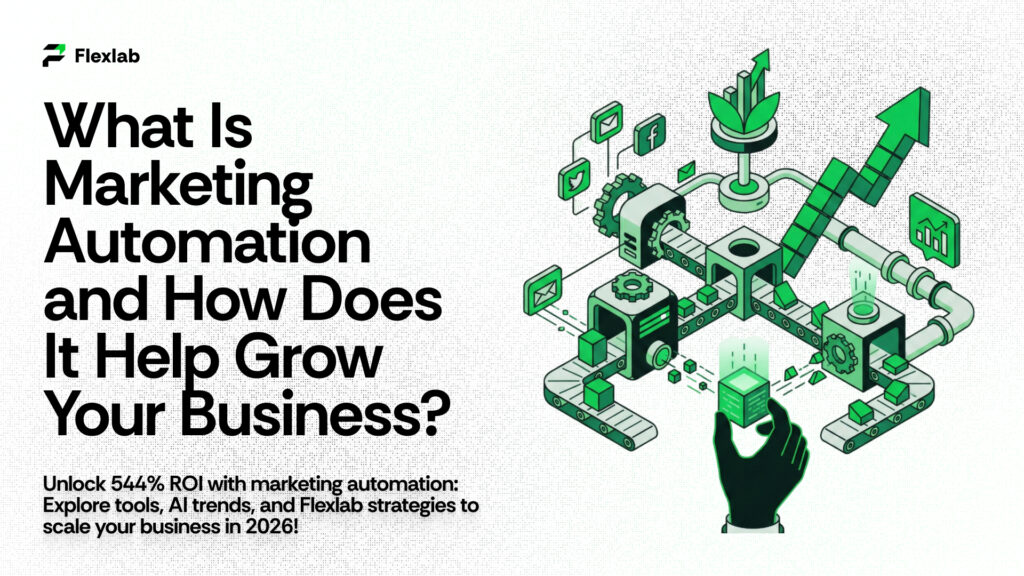
What Is Marketing Automation in Digital Marketing
AI in Digital Marketing | AI in Fraud Detection | AI Marketing Tools
Marketing automation has become essential for businesses aiming to scale efficiently. The global marketing automation market hit $6.65 billion in 2024 and is projected to reach $15.58 billion by 2030, growing at a 15.3% CAGR. It is driven by demand for AI automation tools and email automation.
With 83% of large-budget companies using it and an average 544% ROI ($5.44 per $1 spent), it’s clear why 70% of leaders plan to invest more in 2026.
This blog breaks down marketing automation software, as well as the benefits of marketing automation, top marketing automation tools, AI in marketing trends, and how to build your marketing automation strategy. Moreover, it’s perfect for B2B marketing strategies or B2C marketing automation.
What is Marketing Automation?
Marketing automation uses marketing automation software and automation technology to handle everyday digital marketing tasks across different channels, helping automate repetitive tasks like emails and follow-ups.
It helps companies streamline their marketing automation strategy. It also lets them personalize content and experiences for customers at every stage of their journey. This makes it a key part of both B2C marketing automation and B2B marketing strategies.
Today’s marketing campaigns rely more on automated tech, boosted by know-how from the marketing team.

According to 2025 marketing automation statistics and surveys:
- Email marketing (63%), social media management (50%), and paid ads (40%) rank as the top areas where marketers utilize marketing automation.
- SMS marketing, personalized content automation (77%), and web personalization show the strongest year-over-year growth in adoption.
- Targeting audiences remains the leading AI application in marketing automation at around 45%, while personalization sees up to 77% usage, and data quality improvements follow closely.
Moreover, automation isn’t new, but advances in artificial intelligence (AI), natural language processing (NLP), and machine learning (ML) add powerful new features. Companies build these into their marketing workflows to get even better results.
In short, marketing automation brings real benefits. It boosts lead generation, creates great customer experiences through digital channels, and frees up staff for bigger tasks. When done correctly, it reduces costs, boosts marketing ROI, and enhances the company’s bottom line.
How Does Marketing Automation Work?
You need to gather customer data from emails, visiting their website, using the app, social media, and more. This way, you get a comprehensive view of each customer.
Here comes the software that handles the rest. It sorts customers into groups fast and at scale. It creates personalized messages according to their profiles. With the help of a few clicks, you can send tailored content across different platforms, including email, mobile, social, web, and other channels. This delivers custom experiences, whether you have 100 or 100 million customers.
For instance, imagine a marketer running a webinar to represent your product. Here is the step-by-step guide on how automation makes it smooth:
- Invitation Email: Send an automated invite to new leads via email automation.
- Form Submission: When leads RSVP via a form, the tool adds them to a special list.
- Nurture Campaign: The list gets a thank-you email right after the webinar. A few days later, they received a link to a related case study.
- Sales Handoff: If they download the case study, the system flags them as hot leads and alerts your sales team for follow-up. These folks are qualified and ready to buy.
Marketing Automation vs Manual Marketing
Let’s differentiate between marketing automation and manual marketing to get a better understanding of marketing automation. Marketing automation outperforms manual marketing in terms of efficiency and scale, while manual efforts excel in personalization and flexibility for smaller campaigns.
Key Comparison Table
| Aspect | Marketing Automation | Manual Marketing |
| Time Efficiency | Runs 24/7 with minimal oversight; automates emails, scoring, and workflows to save hours or days. | Requires hands-on work for every task, such as sending emails or tracking responses, and is prone to delays. |
| Scalability | Handles 100 to 100,000+ contacts effortlessly across channels without extra staff. | Struggles with large audiences; time-intensive and hard to expand. |
| Personalization | Data-driven and dynamic at scale using behavior, preferences, and AI for tailored messages. | Offers deep, one-to-one human touch ideal for niche or high-value relationships. |
| Consistency | Ensures uniform messaging, timely delivery, and real-time adjustments via rules. | Depends on team execution; risks inconsistencies but allows creative adaptability. |
| Analytics & ROI | Built-in dashboards for A/B testing, KPIs, and optimization; often boosts leads by 451%. | Relies on manual tracking; strong ROI in trust-building but resource-heavy. |
| Best For | High-volume campaigns like drip emails, retargeting, and lead nurturing. | B2B sales cycles, custom outreach, or quick market shifts needing human insight. |
Types of Marketing Automation

Marketing automation comes in several key types, each targeting specific parts of the customer journey to save time and boost results.
- Email Marketing
- Digital Advertising
- Customer Relationship Management
- Checkout Upsells
- Customer Experience
1. Email Marketing Automation
Email marketing automates email campaigns, including welcome series, newsletters, and abandoned cart reminders. In addition, this software segments lists based on behavior, sends personalized content at optimal times, and tracks opens and clicks, thereby nurturing leads automatically.
2. Digital Advertising Automation
This automation not only handles ad bidding, targeting, and optimization across Google Ads, Facebook, Instagram, and TikTok, but also utilizes AI to adjust budgets in real-time. Additionally, it can retarget website visitors and create dynamic ads based on user data, thereby improving ROI.
3. Customer Relationship Management (CRM) Automation
This Automation integrates with CRM systems such as HubSpot or Salesforce to lead scoring, trigger sales alerts, and sync data across teams. It automates follow-ups, deal progression, and customer segmentation. As a result, it turns marketing efforts into sales-ready opportunities.
4. Checkout Upsells Automation
This automation is common in e-commerce, and it specifically suggests add-ons or bundles right at checkout via tools like Klaviyo (cross-selling vs. upselling). Moreover, it analyzes cart contents, past purchases, and timing to display personalized upsells, thereby increasing the average order value without requiring extra work.
5. Customer Experience Automation
It focuses on omnichannel journeys, therefore personalizing interactions across email, SMS, web, apps, and in-store via platforms like Braze. In addition, it maps full customer paths while using AI for recommendations (virtual agent), and ensures consistent messaging, which in turn helps build loyalty.
Benefits of Marketing Automation
Why is marketing automation important? Do small businesses really need marketing automation? Here is your answer. Marketing automation delivers big wins by handling repetitive tasks, personalizing customer interactions, and driving measurable growth for businesses.
Saves Time and Resources
It automates routine work, like email sends, lead scoring, and follow-ups, freeing marketers to focus on strategy and creativity. Furthermore, teams handle more with less effort, cutting manual processes by up to 80% in many cases.
Boosts Lead Generation and Nurturing
Software tracks behaviors and scores leads automatically, thereby triggering personalized campaigns, turning cold prospects into hot ones faster. This also increases qualified leads by nurturing them through tailored content across channels.
Improves Personalization at Scale
Using customer data, it crafts relevant messages for emails, ads, and sites, whether for 100 or millions of users. Hence, this builds stronger connections, lifts audience engagement rates, and enhances customer loyalty.
Increases Revenue and ROI
Features like upsells (cross-selling vs upselling), retargeting, and A/B testing tools optimize campaigns in real-time, thereby raising conversion rates and average order values. As a result, businesses often see 451% more qualified leads and better bottom-line results.
Enhances Analytics and Insights
Dashboards provide clear metrics on opens, clicks, sales, and ROI, thereby enabling data-driven tweaks with marketing intelligence. Consequently, this creates a feedback loop for continuous improvement without guesswork.
Which Tools are Used for Marketing Automation?

Marketing automation tools include the best b2b marketing automation platforms that handle email automation, workflows, customer data, and multichannel campaigns efficiently.
- HubSpot
- ActiveCampaign
- Klaviyo
- Mailchimp
- Salesforce Pardot
- Omnisend
- Brevo
1. HubSpot
HubSpot is an all-in-one platform for mid-sized businesses. It offers CRM integration, email automation, lead scoring, and AI marketing analytics. Moreover, it excels in scalability with free training through HubSpot Academy and supports multi-step workflow automation across channels.
2. ActiveCampaign
ActiveCampaign shines for SMBs and e-commerce with AI automation tools, visual builders, and deep segmentation for email/SMS. In addition, users praise its predictive sending and ease of use for global teams, starting at $15/month.
3. Klaviyo
Klaviyo dominates e-commerce, especially Shopify stores, with real-time data syncing, behavioral flows, and predictive analytics. It boosts retention through cart recovery and A/B testing, with a free tier up to 250 contacts.
4. Mailchimp
Mailchimp is best for beginners and small businesses with drag-and-drop emails, basic automations, and multichannel support. It has a simple interface and a free plan that makes it ideal for startups, though advanced features need upgrades
5. Salesforce Pardot
Pardot targets B2B marketing strategies for enterprises with advanced lead scoring, dynamic content, and seamless Salesforce CRM ties. It handles complex nurturing and ROI reporting, but starts at higher prices around $1,250/month.
6. Omnisend
Omnisend focuses on e-commerce with email automation, SMS, and push notifications, including pre-built workflows for abandoned carts. Moreover, its generous free plan and strong support make it beginner-friendly for growth campaigns.
7. Brevo (Sendinblue)
Brevo offers affordable, all-in-one multichannel marketing automation solutions for SMBs, covering email, SMS, and ads from $25/month. Additionally, it stands out for ease and value, with solid G2 ratings around 4.5/5.
How AI is Revolutionizing Marketing Automation
Generative AI could boost marketing productivity by 5-15% of total spend, up to $463 billion annually worldwide, per McKinsey analysis. This tech supercharges automation by enabling hyper-personalization, rapid content creation, and predictive insights at scale.
More than 75% of CMOs say generative AI in marketing will transform marketing operations, according to IBM’s Institute for Business Value. Key insights for leaders include:
- Lead Enterprise Adoption: Marketers already use efficiency tools; gen AI amplifies creativity while cutting low-value manual work.
- Ease Content Overload: It generates endless variations, letting teams refine high-impact pieces instead of starting from scratch.
- Enable Hyper-Personalization: Personalizing copy for individuals now costs near zero, allowing granular campaigns that feel one-to-one.
For instance, gen AI customizes base content for specific users, acts as a strategy copilot for ideas, and uncovers hidden patterns in customer data faster than humans using AI marketing analytics. It fills data gaps like locations or preferences, while platforms embed it for drafting emails, social posts, and web copy. In short, it is turning automation into intelligent, always-on systems.
Best Practices of Marketing Automation
Follow these steps to set up winning workflows that deliver ROI without headaches.
- Clean and Segment Data First: Start with accurate customer lists divided by behavior (e.g., frequent buyers vs. browsers), location, or past purchases. Use tags like “engaged” or “VIP” for easy targeting. However, dirty data kills 70% of campaigns.
- Build Smart Triggers and Rules: Use “if-then” logic: If they click a link, send a nurture email; if no response in 48 hours, pause and re-engage later. Test one variable at a time (subject lines, send times) with A/B splits.
- Align Teams with Lead Scoring: Give points for actions (email open = 10 pts, demo request = 50 pts). When a lead hits 100, auto-notify sales. This shared system cuts unqualified leads by 50%.
- Track Everything and Optimize: Monitor opens, clicks, conversions, and revenue per campaign. Use multi-touch attribution to see what truly drives sales, not just vanity metrics. Comply with privacy laws like GDPR by adding easy opt-outs.
- Keep It Mobile-Friendly: 60% of emails are opened on phones. Short copy, big buttons, and fast-loading images ensure higher engagement.
Start small with one workflow, measure for 30 days, then scale. Tools like ActiveCampaign make drag-and-drop setup beginner-proof
What are the Marketing Automation Trends in 2026?

Marketing automation trends for 2026 point to deeper AI integration, privacy-focused personalization, and fully autonomous systems that make campaigns smarter and more human-like.
-
AI as Your Copilot Everywhere
By 2026, 78% of marketers plan to use AI for 25%+ of tasks, evolving from basic tools to “copilots” that build flows, suggest triggers, and personalize at scale. Furthermore, gen AI will auto-generate dynamic content for emails, ads, and landing pages in real-time, while predictive models forecast churn or buys to send proactive offers.
-
Autonomous Orchestration Takes Over
Think about a systems that plan, execute, and adjusts campaigns across different channels without constant oversight. AI agents will handle the full customer journey: sorting audiences, shifting money to what works, and using your own customer data. This makes campaigns start 25% faster than old methods and bring in more profit.
-
Privacy-First Personalization Wins
With cookies fading and stricter regulations like EU rules, zero- and first-party data (from quizzes, preferences) therefore becomes gold. Consequently, brands will deliver hyper-personal journeys with consent, while blending conversational AI chatbots and AR/VR for “phygital” experiences that feel intimate yet scale to millions.
-
Omnichannel and Full-Funnel Automation
Full-funnel tools sync CRM, MAPs, and ads for seamless journeys: top-of-funnel attribution via AI, multi-touch tracking, and mobile-first automation. Review management, social drips, and conversion APIs will unify data, cutting CAC while boosting loyalty.
Human-AI Hybrid Focus
Marketers shift from tactics to strategy. AI handles analysis and execution, freeing creatives for relationships. Furthermore, ethical AI fights deepfakes with authenticity tech (60% CMO adoption), and hybrid workflows combine human insight with machine speed for sustainable growth.
Start Building Your Marketing Automation Strategy with Flexlab

Flexlab is a leading custom blockchain development and AI automation agency, offering marketing automation services. Specifically, we provide a no-code platform tailored for AI and blockchain professionals like you, which lets you audit workflows, map customer journeys, and launch personalized campaigns in days, not months. Moreover, we’ve helped teams boost leads by 451% and cut costs by 30%; now, it’s your turn.
Take the first step now:
- Book a Free Strategy Audit: Spot gaps and get a custom roadmap in 24 hours.
- Visit Flexlab on LinkedIn: Connect with our experts and see client wins.
- Check our AI and Blockchain Blog for Proven Tips: Dive into 2025-2026 trends and case studies, including AI in Digital Marketing, AI in Fraud Detection, AI and Blockchain Application Development, and AI for Business Process Automation.
Ready to Automate Your Marketing Strategies?
📞 Book a FREE Consultation Call: +1 (416) 477-9616
📧 Email us: info@flexlab.io
Conclusion
Marketing automation is no longer optional; in fact, it’s the engine powering digital marketing success in 2025 and beyond. From email automation and lead scoring to AI-driven hyper-personalization and workflow automation, these tools therefore deliver the massive benefits of marketing automation, including time savings, higher ROI, and scalable growth.
Whether you’re a small business exploring marketing automation solutions or an enterprise refining B2B marketing strategies, start with clean data and smart triggers. Ready to find the right AI automation agency? Look no further—visit Flexlab today, contact us now for a free consultation call, and supercharge your workflows!
FAQs
Q1: What is CRM and marketing automation?
CRM (Customer Relationship Management) tracks customer interactions, sales pipelines, and service to build lasting relationships. Meanwhile, marketing automation uses software to handle repetitive tasks like emails and lead nurturing across channels. Together, they sync data for seamless lead handoffs from marketing to sales, thereby boosting efficiency.
Q2: What are examples of marketing automation?
Welcome email series for new sign-ups, abandoned cart reminders with discounts, and lead nurturing drips based on website behavior help engage customers. Additionally, post-purchase upsell SMS and webinar follow-ups send personalized resources to attendees, thereby recovering lost sales and guiding prospects to purchase.
Q3: How to start marketing automation?
Audit your current workflows and clean customer data first. Pick a tool like HubSpot or ActiveCampaign, segment audiences by behavior, and set simple triggers (e.g., “if opens email, send offer”). Test one campaign, track opens/conversions, then scale with A/B tests.














2 Responses
Thanks for your ideas. One thing I have noticed is the fact that banks and financial institutions know the spending practices of consumers and also understand that a lot of people max out and about their own credit cards around the holiday seasons. They wisely take advantage of that fact and begin flooding the inbox and also snail-mail box by using hundreds of Zero APR credit card offers shortly when the holiday season finishes. Knowing that for anyone who is like 98 of all American public, you’ll get at the possiblity to consolidate financial debt and move balances for 0 interest rate credit cards.