How AI and Blockchain Are Shaping the Future of the Internet
AI agents | AI automation tools | What are NFTs?
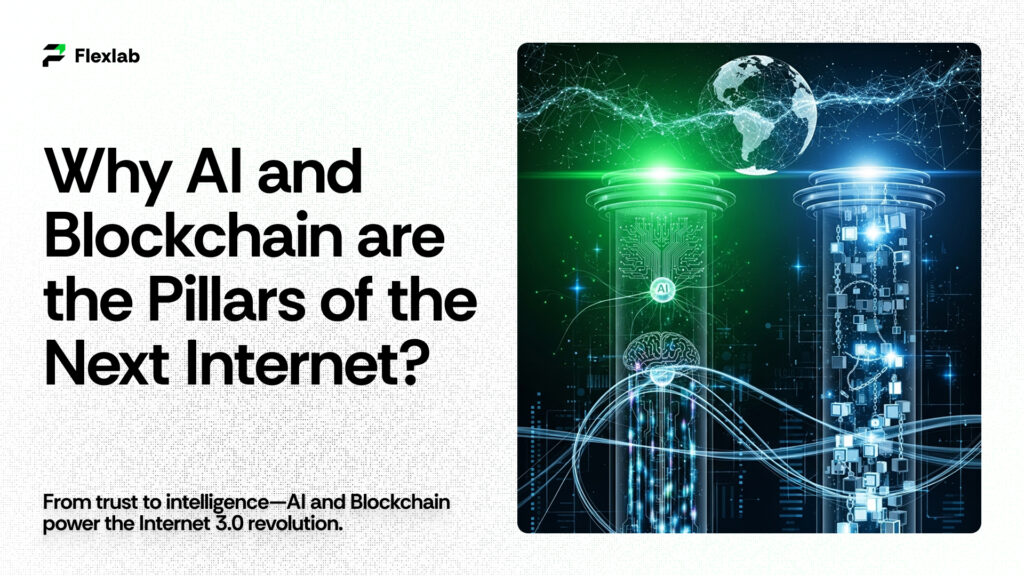
In recent years, the internet has shifted the way we think, connect, work, and live. In these digital times, two transformative technologies– Artificial Intelligence and Blockchain are emerging as pillars of innovation across companies. Together, they are not just improving the existing internet; they are also laying the foundation for the Next Internet or Web 3.0. Blockchain provides trust, transparency, immutability, and decentralization, whereas AI ensures automation, intelligence, and personalization. When AI and Blockchain are integrated, they come with the power to reshape how digital innovation operates– making it smart, reliable, and secure.
This blog will be your guide to why AI and blockchain are the pillars of the Next Internet, observing their individual and combined strengths, and the impact they will have on businesses and daily life.
Limitations of Today’s Internet
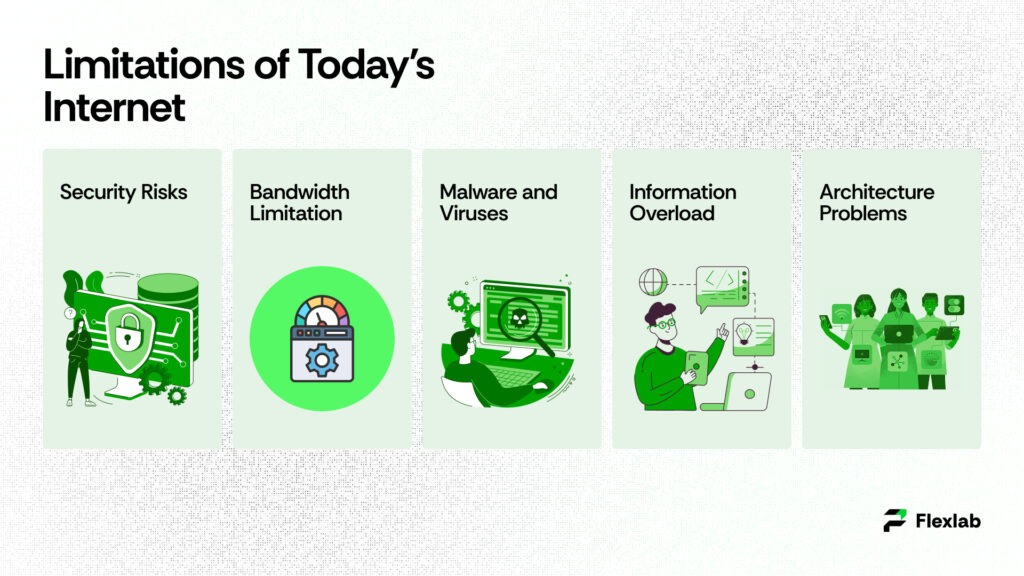
Before exploring how blockchain and AI will redefine the digital landscape, it is essential to acknowledge the challenges and limitations of today’s internet. Here are some of the areas where today’s internet falls short;
- Security Risks: In this constantly evolving digital landscape, cyber threats, identity theft, and data breaches are prevalent, highlighting the vulnerability of centralized systems.
- Bandwidth Limitation: Insufficient capacity in today’s network backbones can result in bottlenecks. It prevents the efficient handling of a large volume of data from voice and video.
- Malware and Viruses: cyber threats like malware and viruses can infect internet systems, resulting in data loss and unproductivity.
- Information overload: The vast volumes of data and content online make it challenging to filter out accurate information, leading to confusion and the spread of misinformation, including fake news.
- Architecture problems: Existing network architecture and topologies are not always efficient, especially when it comes to maintaining communication among multiple users.
The Role of AI in the Next Internet
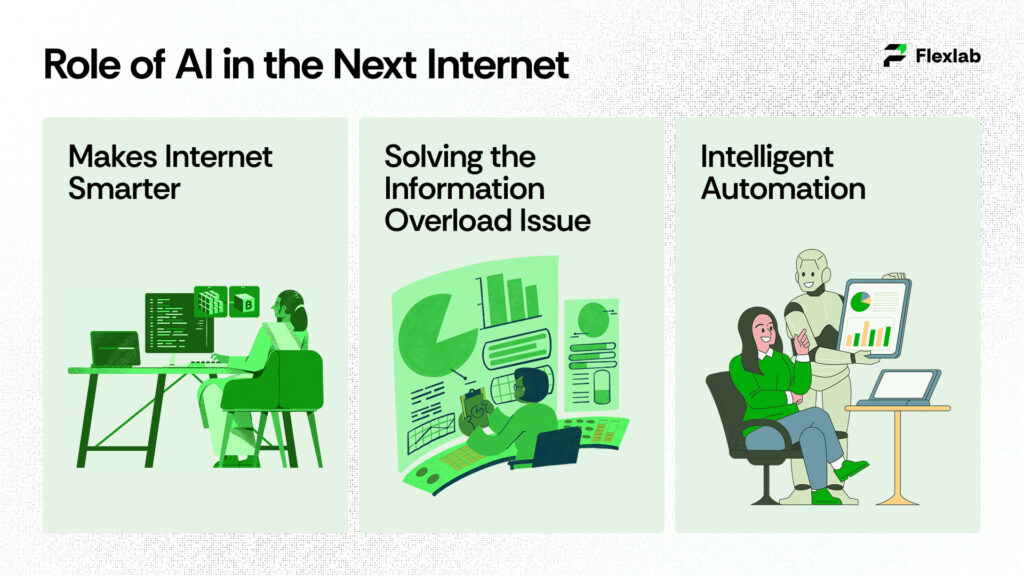
Artificial intelligence (AI) is basically the simulation of human intelligence in machines and technology. The key capabilities of AI technologies are;
- Machine Learning (ML) is referred to as an AI algorithm that learns and improves over time.
- Natural Language Processing (NLP) helps understand and interpret human language.
- Predictive analytics helps forecast results and outcomes based on data history.
Here is how AI plays a crucial role in the Next Internet.
-
Makes Internet Smarter
Artificial intelligence (AI) makes the internet smarter by using different AI techniques. AI has successfully enabled machines to collect data, analyze patterns, and make informed decisions. Moreover, this technology ensures that platforms deliver personalized and context-aware information. As a result, search engines can now provide users with far more relevant results. For example, Netflix’s search engine uses AI to recommend shows or movies based on viewers’ viewing history.
-
Solving the Information Overload Issues
Today’s internet tends to produce more data in a day than a person could consume in a lifetime. However, AI helps solve the problem of information overload by filtering, classifying, and processing large volumes of data. AI technology helps users consume meaningful and helpful data instead of being buried in the noise of information.
-
Intelligent Automation
AI helps bring automation to the next Internet. Companies can benefit from AI automation in different aspects, like customer support, supply chain logistics, and many more. For instance, in healthcare, AI helps keep patient records and assists doctors in diagnosing diseases. In the next internet, this intelligence and automation of AI systems will seamlessly integrate into platforms and services.
Role of Blockchain Technology in the Next Internet
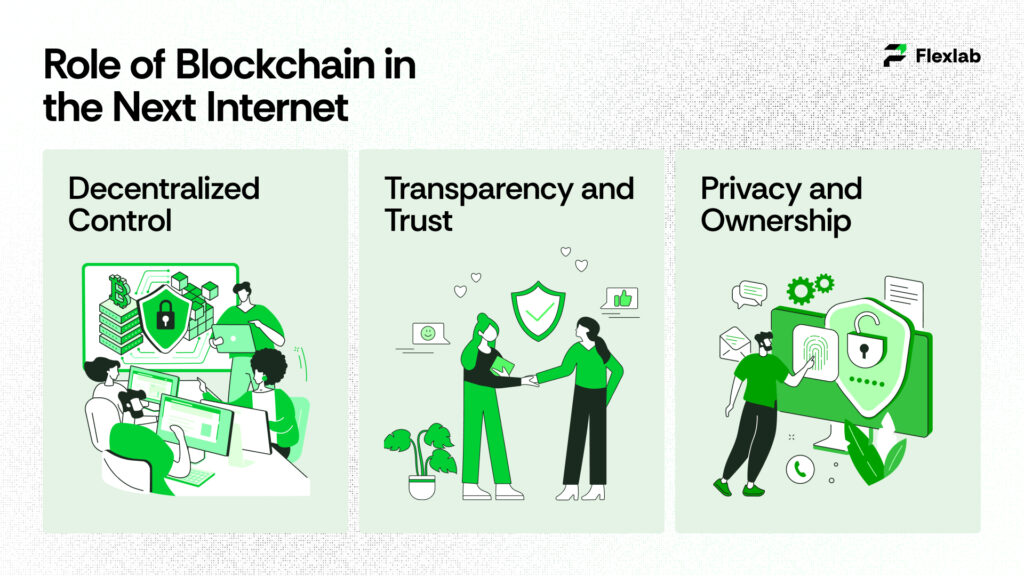
Blockchain is a distributed ledger technology that helps record data in a blockchain, making it immutable and tamper-proof. Each block is chronologically linked and encrypted, guaranteeing transparency and decentralization. The key features of blockchain technology are:
- Decentralization: No central authority or middleman controls the data, thereby reducing single points of failure.
- Immutability: The information stored on blockchain cannot be altered.
- Transparency: All transactions are visible to authorized owners.
Here is what role blockchain is playing in this era of the next internet.
-
Decentralized Control
Blockchain technology makes use of distributed ledgers; therefore, no single authority owns the system. As a result, it helps eliminate the dominance of large companies over internet services. For users, this also means greater fairness, enhanced autonomy, and true freedom.
-
Transparency and Trust
Blockchain provides verifiable authenticity because every transaction is recorded on an immutable ledger. Therefore, this provides trust among participants because the records cannot be altered or deleted.
-
Privacy and Ownership
Currently, user data is managed and controlled by tech giants and big corporations. However, blockchain is transforming this landscape by shifting power to individuals, thereby allowing users to own and control their data. Moreover, the decentralized structure of blockchain further eliminates the need for intermediaries, which in turn improves both privacy and security.
How are AI and Blockchain Shifting the Game?
Individually, both AI and blockchain are very impactful and transformative technologies. But their integration unlocks a major transformation, ensuring accurate and real-time data is used to make informed decisions. When combined, AI and blockchain address each other’s limitations and form the Pillars of the next internet.
- Auditability and Explainable AI
- Intelligence Meets Trust
- Enhanced Cybersecurity
- Automating Smart Contracts with AI
- Better Data for AI
- Token-Based Incentives for Data Contribution
- Real-time Decision Making
1. Auditability and Explainable AI
One of the biggest challenges that AI presents is its “Black Box” nature. Fortunately, blockchain helps address this issue by recording every transaction and AI data input on a tamper-proof log. As a result, this approach not only improves trust and transparency but also facilitates regulatory compliance and, ultimately, builds confidence in AI outcomes.
2. Intelligence Meets Trust
While AI can make powerful decisions, however, it often works in a black box. It means users cannot see how these AI-powered decisions are made. This raises concerns of bias, accountability, and fairness. Whereas blockchain provides transparency, it lacks scalability and the ability to process large datasets. AI and blockchain combined provide the best of both worlds. Blockchain makes AI auditable, trustworthy, and transparent. On the other hand, AI helps blockchain with scalability, intelligence, and automation.
3. Enhanced Cybersecurity
Blockchain and AI together help strengthen cybersecurity by integrating intelligent AI fraud detection with tamper-proof systems. Integrating AI in blockchain, systems can analyze unusual activity in real time, detecting cyber threats before they spread and cause harm. In addition to this, a blockchain developer can incorporate AI models into smart contracts and decentralized applications, ensuring data integrity while minimizing human error. Along with AI in fraud detection, blockchain technology ensures transparency and immutability, creating a dual layer of protection for networks.
4. Automating Smart Contracts with AI
AI and blockchain help transform automation by turning smart contracts more adaptive and intelligent. Through smart contract development, AI helps analyze data inputs and trigger smart contract execution based on pre-defined conditions. Additionally, AI integration helps improve accuracy, efficiency, and decision-making in blockchain-powered business operations. When it comes to dApp development, AI-powered contracts can self learn from transaction history, predict risks, and automate complex workflows.
5. Better Data for AI
AI thrives on data. However, access to secure, unbiased, and quality data remains a concern. That’s when blockchain comes into play. Through blockchain and IoT, real-time data from all the connected devices is securely stored on a decentralized ledger, guaranteeing immutability and accuracy. This transparent data serves as a strong and reliable foundation for machine learning and deep learning models. It helps improve the AI model’s ability to conduct predictive analysis and make informed decisions. Therefore, blockchain technology helps prevent data breaches and manipulation, while AI recognizes patterns and insights from these trustworthy datasets.
6. Token-Based Incentives for Data Contribution
AI and blockchain complement each other by introducing token-based incentives. In this way, the approach encourages customers to share their data with brands. Furthermore, blockchain technology ensures that this data sharing remains secure and safe. Through the tokenization of assets, customers are rewarded with digital, verifiable tokens in exchange for quality data sharing. With blockchain technology in business, decentralized platforms manage these token-based incentives, preventing fraud and ensuring accountability. Resultantly, it leads to a self-sustaining ecosystem where secure data fuels AI advancements, while clients gain tangible value for their contribution.
7. Real-Time Decision Making
Integration of AI and blockchain helps empower real-time decision-making by ensuring accuracy, transparency, and speed. For instance, blockchain technology provides supply chain transparency by recording every transaction and product movement on a decentralized, secure, and immutable ledger. AI then instantly processes and analyzes this data to detect risks or predict delays. As a result, this enables organizations to act and respond quickly, preventing disputes and fraudulent activities. Integrated with the Internet of Value, blockchain technology enables seamless digital asset and payment transfers in real time, further strengthening decision efficiency.
Real-World Use Cases of AI and Blockchain Integration
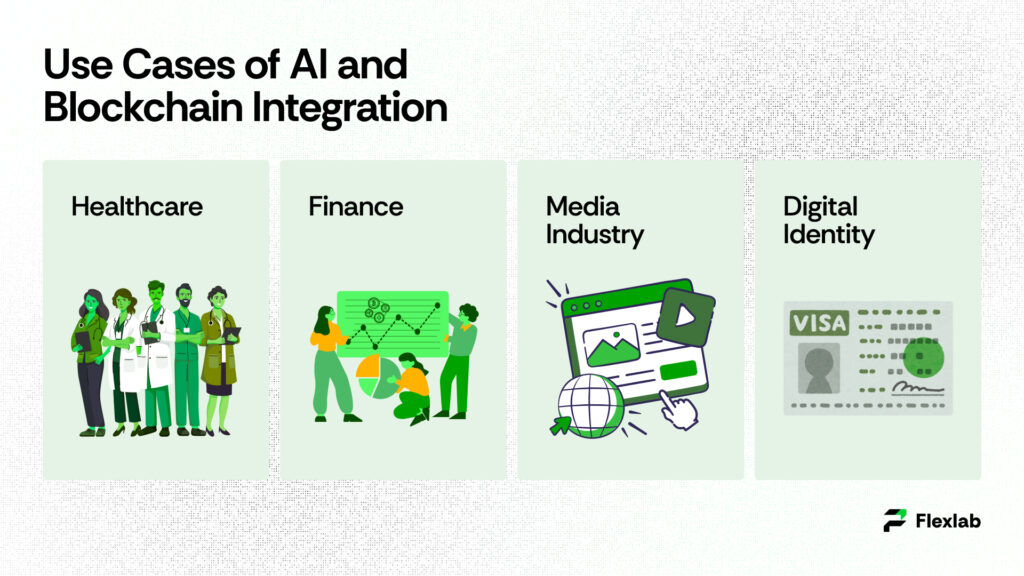
The integration of AI and blockchain makes a robust alliance that addresses issues of data security, transparency, and efficiency. Furthermore, it has made the combined market size of blockchain and AI technologies exceed USD 703 million by the year 2025, increasing with a CAGR of 25.3% from 2020 to 2025. Here is how this powerful combination of technologies is benefiting various industries.
- Healthcare
- Finance
- Media Industry
- Digital Identity
Healthcare
Artificial intelligence (AI) helps analyze and predict patient diagnoses. On the other hand, blockchain helps maintain transparent and secure patient records, ensuring they stay private yet easily shareable with authorized professionals. Combined, they deliver a secure, accurate, and transparent healthcare internet.
Finance
AI powers financial forecasting by helping detect cyber threats and vulnerabilities. Whereas, Blockchain technology enables fast and secure transactions even across borders. Together, they establish a financial ecosystem where transparency meets intelligence, minimizing costs and risks.
Media Industry
AI helps curate personalized entertainment. However, Blockchain enables the protection of intellectual property rights, ensuring that the artists get fair royalties. Their integration can redefine the content and media industries, such as music, gaming, art, etc.
Digital Identity
AI technology improves facial recognition and verification. On the contrary, blockchain ensures that identities cannot be forged and are stored securely through distributed ledger technology. AI-powered blockchain technology helps prevent identity theft while giving users control over their shared information.
The Next Internet: Web 3.0 and Beyond
The concept of the Next Internet, often referred to as Web 0.3, is rooted in intelligence, decentralization, and user empowerment. Web 1.0 refers to a static Internet of read-only websites, while Web 2.0 is the interactive Internet that includes social media apps, but is controlled by a centralized authority. Web 3.0 is the emerging era of the Internet, powered by AI and blockchain, where users have control over their data, decisions are intelligent, and services are decentralized. This modern phase of the internet is characterized by;
- User-Centric Approach: People have control of their data and choose how to use it.
- Transparent Interactions: Trustworthiness of blockchain eliminates the need for intermediaries.
- Smart Ecosystems: Blockchain-powered AI systems make platforms more adaptive, predictive, and consumer-friendly.
Closing Insights: The Internet Revolution by AI and Blockchain
The internet is on the verge of having a major transformation. The problems of Web 2.0– centralization, misuse of data, security concerns, and information overload- need more than small fixes. These problems demand a complete redesign of the internet architecture.
The powerful fusion of AI and blockchain offers a solution to all these concerns. AI brings intelligence and scalability, whereas blockchain adds trust and transparency. When integrated, they make up the foundation of Web 3.0, the Next Internet, which is smarter, fairer, and user-centric.
From healthcare to finance, and from the media industry to digital identities, this combined technology is already revolutionizing multiple sectors. Indeed, the vision is clear: the Next Internet will not only connect us but also empower us to take greater control of our digital lives.
With Flexlab, Get the Best of Both Worlds: AI and Blockchain
At Flexlab, we believe the companies that embrace the combined power of AI and blockchain hold the future. Our team of experts specializes in AI automation and custom blockchain development, thereby helping organizations build more secure, smarter, and future-ready solutions. Moreover, as one of the most trusted and cutting-edge software development companies, we take pride in delivering advanced AI and blockchain solutions to businesses across the globe. By combining intelligence with trust, we create systems that not only automate operations but also ensure data ownership, transparency, and resilience. From healthcare to finance to supply chain management, Flexlab delivers solutions tailored to your business needs. Explore our services and have a look at what our clients have to say about us.
To have detailed insights into topics like AI in digital marketing, AI and blockchain application development, and Web3 Technology, explore our blog page.
Ready to Launch Your Blockchain Project?
📞 Book a FREE Consultation Call: +1 (416) 477-9616
📧 Email us: info@flexlab.io
What is the relationship between AI and Blockchain?
AI and blockchain complement one another’s capabilities. Therefore, we can say that they are complementary technologies. They are not directly related, but they complement each other by combining AI’s ability to analyze and learn from data with blockchain’s secure and immutable data storage. They both improve each other’s abilities.
What technology will someday replace blockchain?
No single technology is fully set to replace blockchain. However, Directed Acyclic Graphs (DAGs) and Holochains are emerging as more scalable technologies. These technologies are designed to handle large volumes of data with minimal energy consumption. However, instead of replacement, they may coexist and evolve alongside blockchain technology.
Which language does blockchain use?
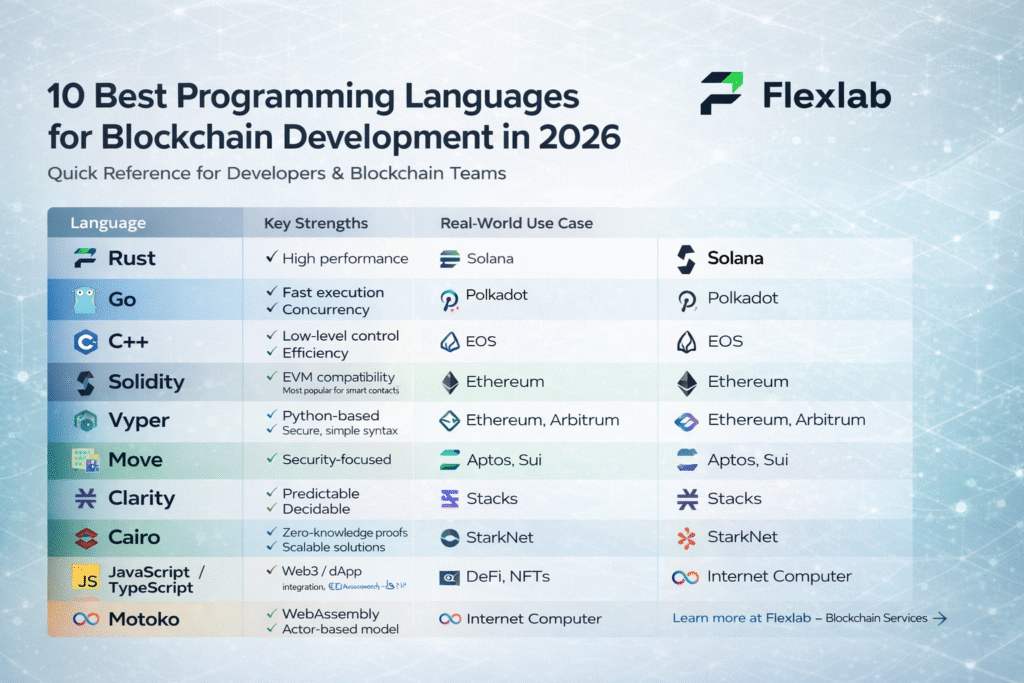
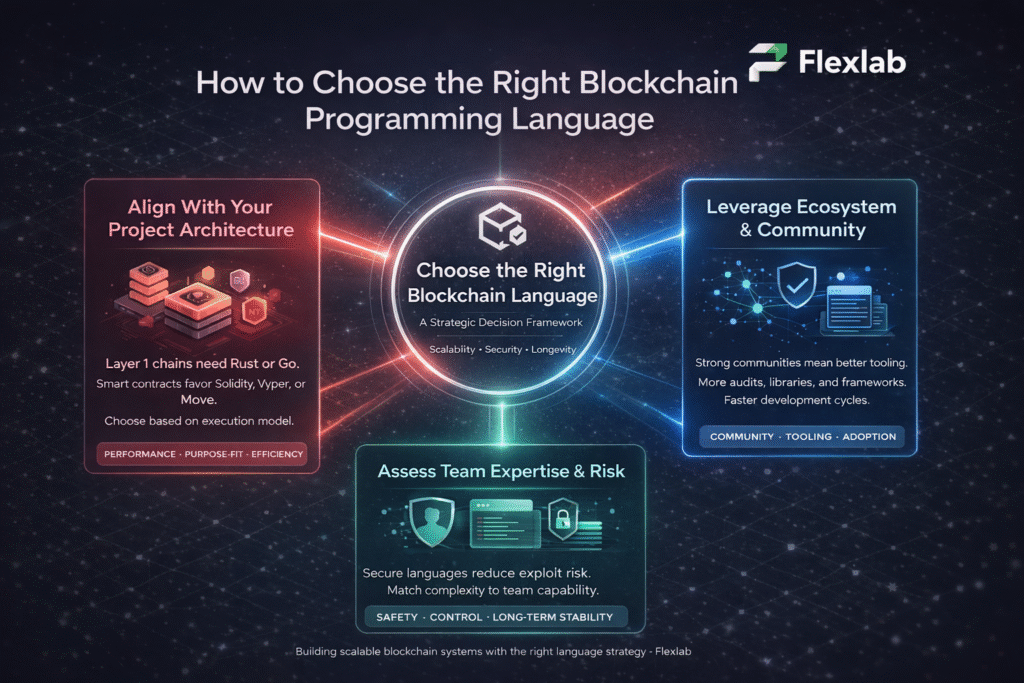
Blockchain developers utilize languages such as Solidity for smart contracts on Ethereum, as well as Go and Rust for blockchain platform development, and JavaScript or Python for dApp development. The choice of language depends on the blockchain network and application type.