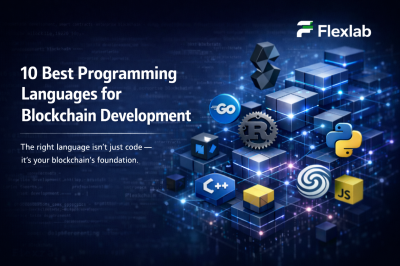
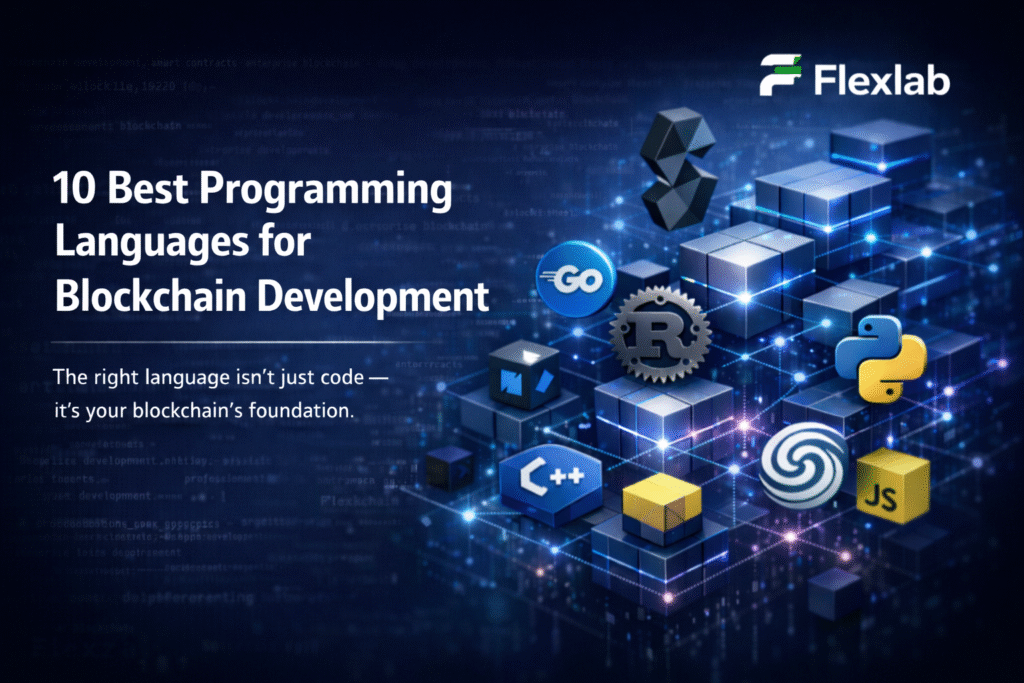
10 Best Programming Languages for Modern Blockchain Projects
Blockchain Trends | Enterprise Blockchain | Blockchain for Startups
The best programming languages for blockchain are infrastructure decisions that directly impact security, scalability, compliance, and long-term viability. Blockchain has evolved far beyond early crypto experiments. With over 420 million global users and billions of dollars secured daily across decentralized systems, blockchain development now underpins financial platforms, enterprise systems, tokenized assets, and AI-driven applications worldwide.
What many founders and technical teams underestimate is this: the programming language you choose determines not only how your product performs today, but how resilient it remains five years from now.
In this guide, we break down the 10 best programming languages for blockchain development in 2026, where each one excels, and how to select the right stack based on real-world technical and business priorities, not industry hype.
The Role of Programming Languages in Blockchain
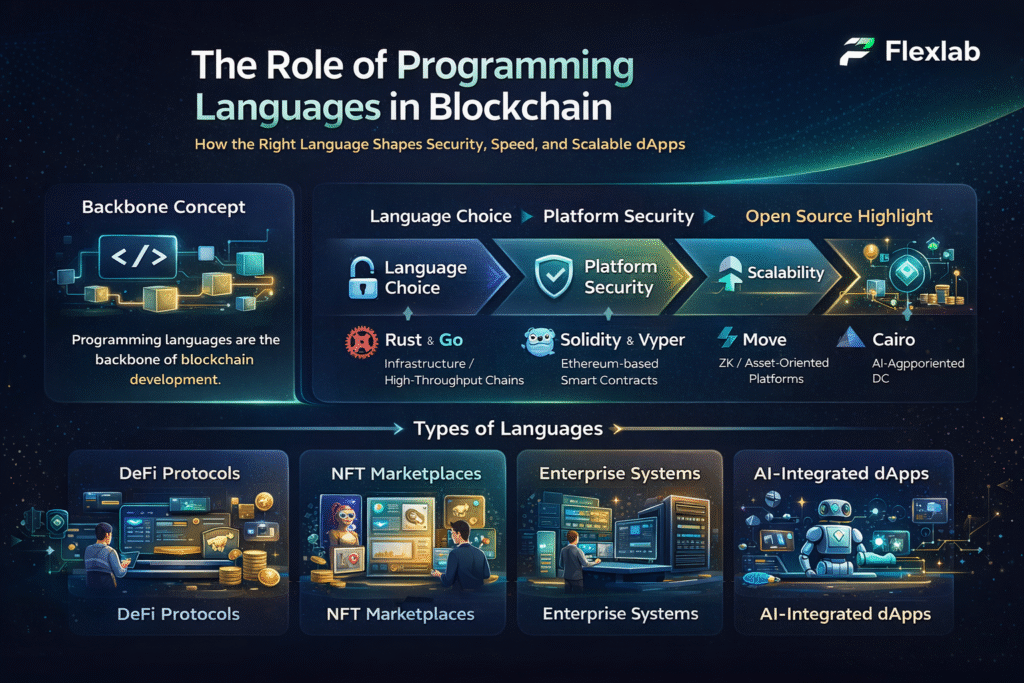
Programming languages are the backbone of blockchain development. In fact, most modern blockchain platforms rely on open source programming languages, which promote transparency, peer review, and continuous security improvements. As a result, they do far more than just run code; they ultimately determine how secure, scalable, and efficient your network will be.
As more organizations adopt decentralized systems across finance, supply chains, gaming, and AI-driven applications, choosing the right language becomes a strategic decision rather than a technical formality.
Selecting a language early shapes how confidently users interact with your platform, how efficiently your team builds solutions, and how quickly your ecosystem adapts to new challenges. For this reason, programming languages play a foundational role in blockchain networking and are essential for any serious developer or organization entering the space.
What is a Programming Language in Blockchain
A programming language in blockchain is a set of instructions that allows developers to create, control, and automate transactions, smart contracts, and decentralized applications (dApps) that operate across distributed networks without centralized control. In practice, these decentralized applications dApps form the foundation of modern blockchain platforms, powering everything from DeFi protocols to enterprise systems.
These languages go beyond general-purpose coding; they interact directly with blockchain networks, implement complex consensus mechanisms, and ensure transaction integrity.
By choosing the right language, developers can reduce errors, prevent vulnerabilities, and accelerate deployment. Therefore, knowing what a blockchain programming language is and how it functions lays the foundation for building robust platforms.
Why Programming Language Choice Matters in Blockchain
Your choice of language directly affects platform security, speed, and maintainability. Some languages are inherently safer and reduce common vulnerabilities, while others offer faster execution but require more careful auditing.
For instance, developers working on smart contract development rely on specific languages that prevent critical mistakes and make audits simpler. Moreover, performance efficiency and developer tooling depend heavily on the language, impacting scalability, adoption, and long-term ROI.
Ultimately, selecting the right language early prevents costly migrations and ensures your platform remains competitive and trustworthy.
Types of Programming Languages Used in Blockchain
Blockchain uses a mix of general-purpose and specialized languages. For example:
- Rust and Go for infrastructure and high-throughput protocols
- Solidity and Vyper for Ethereum-based smart contracts
- Move to Cairo for emerging ZK and asset-oriented platforms
Each type has its role, advantages, and support within its ecosystem. Understanding these categories helps developers choose the right tool for the project’s goals, whether building enterprise blockchain solutions, dApps, or decentralized finance platforms.
10 Best Programming Languages for Blockchain Development
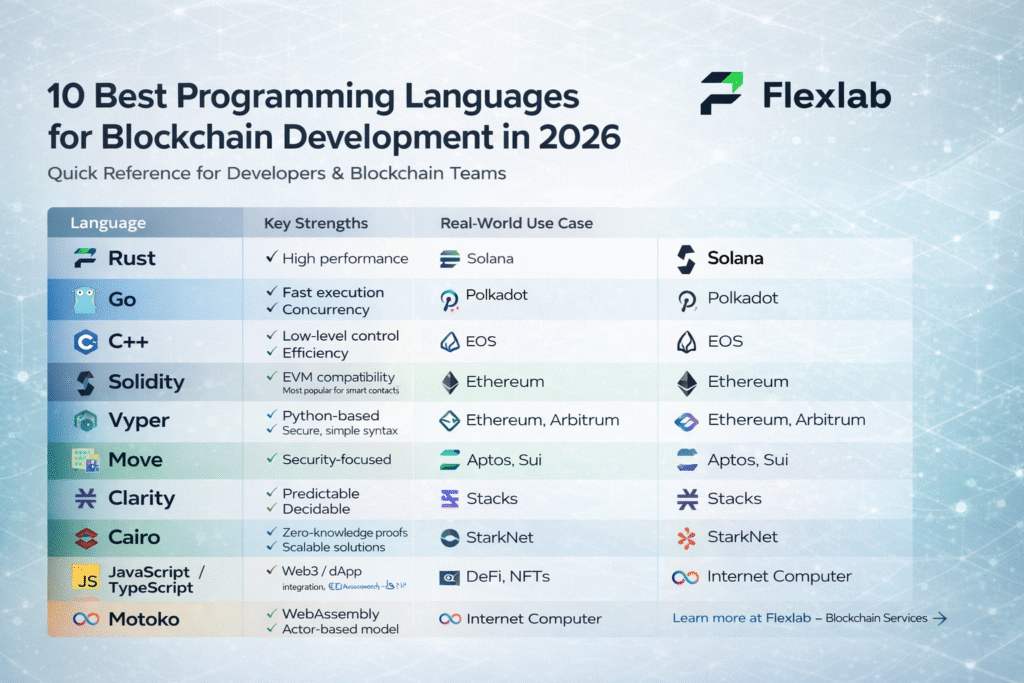
The blockchain landscape is evolving rapidly, and the programming language you choose defines not just how your code runs, but how secure, scalable, and future-proof your platform will be. In 2026, developers must consider throughput, formal verification, integration capabilities across multiple chains, and the strength of the surrounding blockchain ecosystem that supports long-term growth.
Below, we break down the 10 best programming languages for blockchain development, highlighting where each shines, its practical use cases, and why it’s worth learning today.
1. Rust: The Gold Standard for Throughput
Rust is ideal for high-performance Layer 1 blockchain networks such as Solana and Polkadot. First and foremost, its memory safety and zero-cost abstractions allow developers to achieve near-metal speed without common segmentation faults.
Beyond performance, Rust’s ecosystem supports ZK-friendly applications, making it especially valuable for developers who prioritize speed and security. As such, enterprises and DeFi projects increasingly choose Rust for mission-critical blockchain infrastructure.
2. Solidity: The Undisputed King of Liquidity
Solidity remains the backbone of Ethereum, Polygon, and Arbitrum smart contracts, operating within the Ethereum Virtual Machine (EVM) that standardizes execution across compatible chains. Its market dominance ensures a massive ecosystem of dApps, developer tools, and libraries.
Moreover, because over 65% of Total Value Locked (TVL) sits on EVM chains, learning Solidity immediately opens access to the largest liquidity pools. Therefore, any blockchain developer serious about DeFi or NFT projects should prioritize Solidity for robust smart contract development.
3. Move: The Asset-First Revolution
Move powers Aptos and Sui with a resource-oriented approach. Tokens are treated as objects that cannot be duplicated or accidentally deleted, which adds a layer of security previously unavailable in blockchain programming.
At the same time, Move simplifies asset tokenization, making it ideal for projects handling digital assets or NFT marketplaces. This advantage enables developers to build safer, future-ready blockchain applications.
4. Go / Golang: The Architect of Networks
Go is widely used in Hyperledger Fabric, Cosmos, and Ethereum Geth nodes. First, its concurrency model ensures efficient network operations, while its simplicity allows teams to maintain and scale infrastructure with fewer errors. Moreover, Go’s clean syntax accelerates onboarding, which is why enterprise blockchain projects often prefer it for foundational protocols.
5. Cairo: The ZK-Rollup Pioneer
Cairo powers StarkNet, enabling developers to leverage Zero-Knowledge proofs for Ethereum Layer 2 solutions. First, it allows scalability without compromising security. Moreover, Cairo is increasingly used for DeFi and NFT platforms aiming to reduce transaction costs while maintaining auditability. Therefore, learning Cairo prepares developers for the next generation of scaling solutions.
6. Vyper: Security by Simplification
Vyper is a Pythonic smart contract language optimized for safety. By intentionally removing complex features such as recursion, it allows auditors and developers to reduce bugs and prevent exploits. Consequently, it’s ideal for security-critical applications such as stablecoins, insurance protocols, or high-value DeFi contracts.
7. Clarity: The Decidable Logic
Clarity, used on Stacks (Bitcoin L2), is an interpreted language. First, it allows developers to see exactly what code executes on-chain, eliminating compiler surprises. Moreover, Clarity’s predictability is attractive for projects emphasizing transparency and formal verification. Therefore, it’s suited for applications where code correctness is mission-critical.
8. JavaScript / TypeScript: The Gateway to Web3
JS/TS powers front-end dApps, wallet integration, and smart contract interaction. Even if your protocol runs on Rust or Solidity, the user experience ultimately depends on modern JavaScript frameworks such as Ethers.js, Web3.js, and React-based tooling to connect users with blockchain networks. In addition, TypeScript introduces static typing, which enhances maintainability and reduces runtime errors. As a result, JS/TS plays a critical role in blockchain app development, enabling teams to build secure, interactive, and scalable decentralized platforms.
9. C++: The Legacy Powerhouse
C++ remains a critical language for Bitcoin Core, EOS, and Ripple. First, its low-level control ensures extreme resource management and high-performance execution. Moreover, developers who need precise CPU and memory handling often choose C++ for protocol-level optimizations, especially when minimizing performance risks, such as CPU throttling under heavy transaction loads. Therefore, for legacy blockchain projects or performance-critical systems, C++ remains a relevant language.
10. Motoko: The Internet Computer Specialist
Motoko powers DFINITY’s Internet Computer, built around “canisters” for native persistence without traditional databases. First, its design allows developers to deploy scalable, stateful applications with less overhead. Moreover, Motoko is uniquely suited for decentralized internet projects, making it ideal for forward-looking Web3 platforms.
Real-World Use Cases & Examples
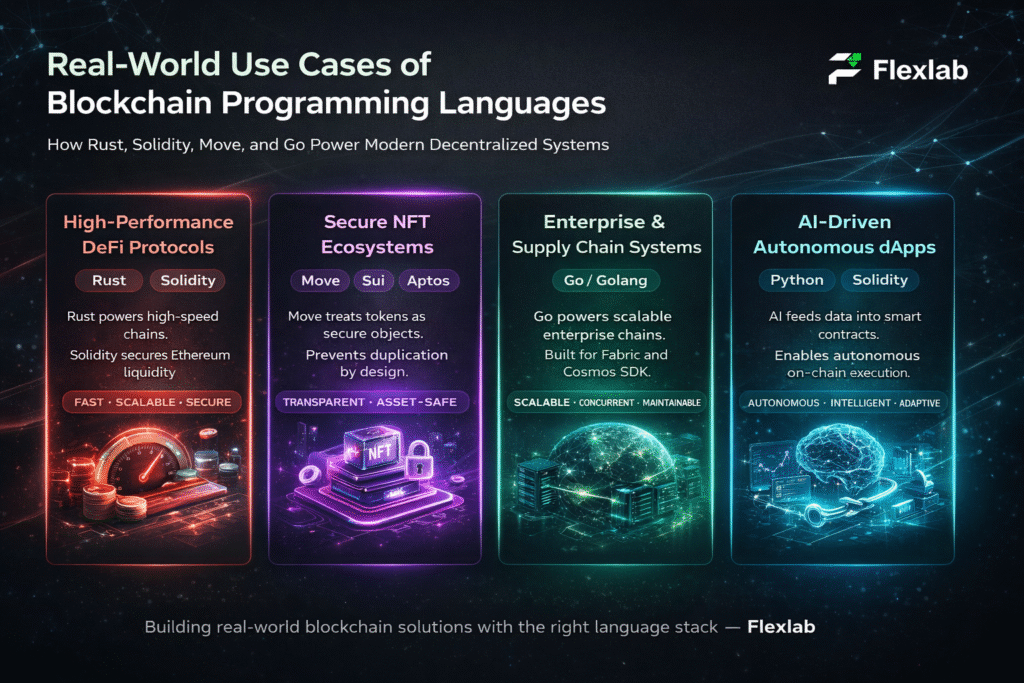
Blockchain programming languages aren’t just theoretical tools; they power real-world platforms shaping finance, gaming, supply chains, identity management, and enterprise systems. In practice, understanding how these languages are applied today helps developers and organizations make informed choices and avoid costly mistakes.
DeFi Protocols Leveraging Rust and Solidity
Several high-performance DeFi platforms rely on Rust for infrastructure and Solidity for smart contracts. For instance, Solana-based lending protocols achieve sub-second transaction finality thanks to Rust’s speed, while Ethereum DeFi platforms like Uniswap rely on Solidity for secure liquidity pools. Consequently, developers combining these languages can build systems that are fast, scalable, and secure, reducing operational risk.
NFT Marketplaces and Move Language Adoption
Emerging NFT marketplaces on Sui and Aptos are using Move to enable asset-oriented programming. Tokens are treated as indivisible objects, preventing accidental duplication or deletion. Moreover, this approach simplifies asset tokenization, making it easier for developers to create secure digital collectibles, gaming assets, or fractionalized ownership models. Therefore, Move adoption is driving the development of safer, more transparent NFT ecosystems.
Enterprise Blockchain Deployments Using Go
Many enterprise blockchain initiatives, such as supply chain tracking, logistics, and interbank settlement, rely on Go/Golang. Hyperledger Fabric and Cosmos SDK projects illustrate how Go supports scalable, concurrent operations with minimal developer overhead.
Moreover, enterprises using Go often integrate blockchain systems with modern cloud development environments, benefiting from robust documentation, auditability, and long-term maintainability. Consequently, Go remains the top choice for companies implementing custom blockchain solutions at scale.
AI and Machine Learning Integration in dApps
Some cutting-edge decentralized applications integrate machine learning solutions directly with smart contracts. For example, predictive analytics for DeFi risk assessment or automated NFT pricing models use Python or Mojo to feed AI decisions into Solidity contracts. This creates autonomous systems where AI agents transact on-chain, highlighting the growing synergy between blockchain and AI-powered solutions. Therefore, developers focusing on AI-integrated dApps gain a competitive edge.
Tips for Choosing the Right Blockchain Language
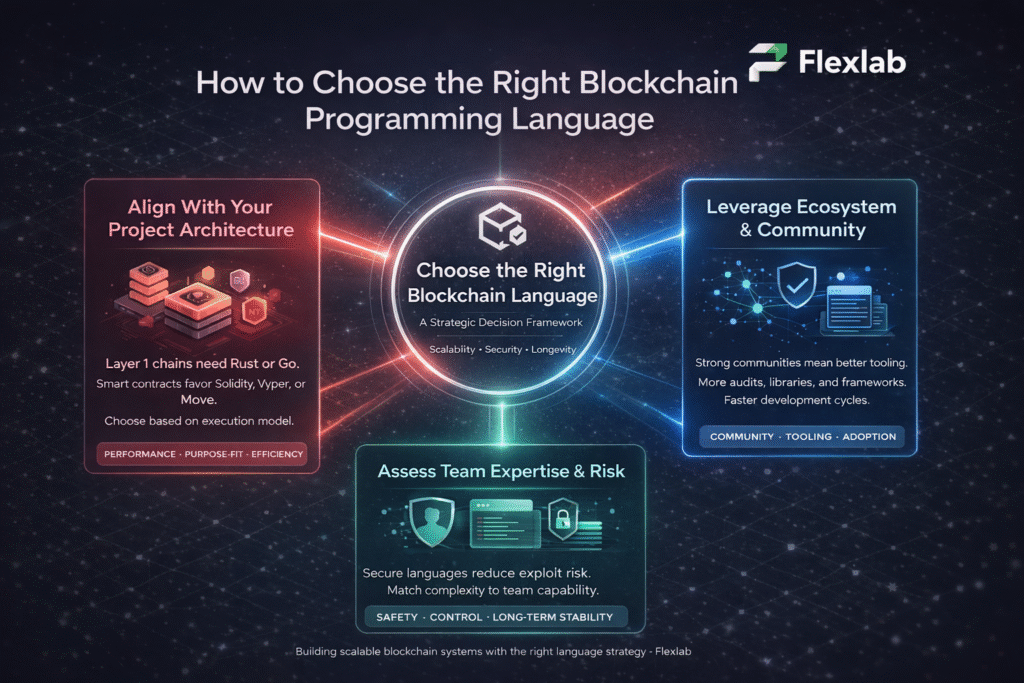
Choosing the right programming language is more than a technical decision; it directly impacts your project’s scalability, security, and long-term success. As a blockchain developer, understanding which language aligns with your project type, ecosystem, and team skills can save months of rework and costly errors.
-
Match Language to Your Project Type
First, identify whether you’re building a DeFi protocol, NFT marketplace, or enterprise blockchain solution. Rust or Go works best for high-performance Layer 1 chains and enterprise-grade networks, whereas Solidity, Vyper, or Move are ideal for smart contracts and asset tokenization. Moreover, choosing the right language ensures your team can leverage the existing ecosystem and tooling, avoiding unnecessary friction during development.
-
Consider Ecosystem and Community Support
Next, evaluate the ecosystem surrounding a language. A vibrant community means more libraries, frameworks, tutorials, and audit tools. For example, Ethereum’s Solidity community offers extensive documentation and audited contracts, while Rust is gaining adoption in the Solana and Polkadot ecosystems. Consequently, languages with strong community backing accelerate development and reduce the risk of hidden vulnerabilities.
-
Factor in Team Expertise and Security Needs
Finally, assess your team’s skill set and the security requirements of your platform. Languages such as Vyper or Clarity provide safer, auditable environments but may have a steeper learning curve. Conversely, JavaScript and TypeScript enable rapid dApp development but may require additional safeguards when interacting with critical smart contracts. Therefore, balancing speed, safety, and team proficiency is key to long-term success.
Flexlab – Turning the Best Programming Languages into Real Blockchain Solutions
Choosing the Best Programming Languages is only the first step. What separates successful blockchain products from failed experiments is execution, secure architecture, optimized performance, and production-ready deployment.
At Flexlab, we design and launch high-performance blockchain systems built to scale. From Ethereum smart contracts and advanced Solana development to enterprise-grade private blockchain infrastructure, every solution is engineered for security, speed, and long-term growth. We don’t experiment with your product. We architect it for resilience, audit it for security, and deploy it for real-world adoption.
Explore our full capabilities on our services page, review successful deployments in our portfolio, or connect directly through contact us. For deeper insights into blockchain and emerging technologies, visit our Blog or follow us on LinkedIn to stay updated on emerging technologies.
Read more:
- 2025 Guide to Blockchain Development: Tools, Trends & Strategies
- Beginner’s Guide: How to Choose the Right AI Development Company?
- Is Blockchain Database Right for Your Business? A Comprehensive Guide
Concluding Best Programming Languages for Blockchain Development
The Best Programming Languages for blockchain development aren’t defined by hype, but by fit. Rust and Go strengthen core infrastructure, Solidity and Move power smart contracts, and JavaScript connects blockchain logic to real users.
That said, performance alone isn’t enough. Instead, security, ecosystem maturity, developer support, and long-term scalability should guide your decision. A strong community means better tooling, faster debugging, and more reliable audits. Likewise, aligning your language choice with your team’s expertise reduces development risks and technical debt.
Ultimately, the right choice depends on your project goals and growth strategy. Choose wisely, prioritize security from day one, and build with a stack that supports innovation, stability, and sustainable success in the evolving blockchain landscape.
Ready to launch or scale your blockchain product?
📞 Book a FREE Consultation Call: +1 (416) 477-9616
📧 Email Us: info@flexlab.io
What is the easiest blockchain programming language to learn?
For most beginners, Solidity or JavaScript is the easiest place to start. Solidity is widely used for Ethereum smart contracts, and it has strong documentation and community support. Meanwhile, JavaScript helps developers connect smart contracts to front-end applications. If you already know Python, Vyper can also feel familiar and approachable.
Which blockchain programming language is most in demand in 2026?
In 2026, Solidity and Rust remain highly in demand. Solidity dominates Ethereum-based projects and DeFi platforms, while Rust powers high-performance chains like Solana and Polkadot. Demand often depends on the ecosystem you're targeting, but developers skilled in these two languages consistently see strong job and freelance opportunities.
Do I need to learn multiple languages for blockchain development?
Yes, in most cases, you’ll need more than one language. For example, you might use Solidity for smart contracts, JavaScript for front-end integration, and Go or Rust for infrastructure work. Blockchain development is layered, so understanding how different components interact gives you a serious competitive edge.