
How to Choose the Best AI Automation Agency in Toronto, CA?

How to Choose the Right AI Automation Agency in Toronto (Checklist for 2026)

How to Find the Best AI Automation Agency in Toronto (2026 Guide)

Automated Machine Learning | AI in FinTechAI Business Ideas

Choosing the right AI automation agency in Toronto can transform your business. In 2026, artificial intelligence and automation are core infrastructure that empowers growth, efficiency, and smarter decision-making. For Toronto companies, selecting the wrong agency can lead to wasted budgets, stalled initiatives, and automation systems that fail to scale.

This guide provides a practical, future-ready checklist to help you choose an AI automation agency in Toronto, avoid common pitfalls, and invest in AI solutions that deliver measurable, long-term value.

What’s at Stake for Toronto Businesses in 2026?
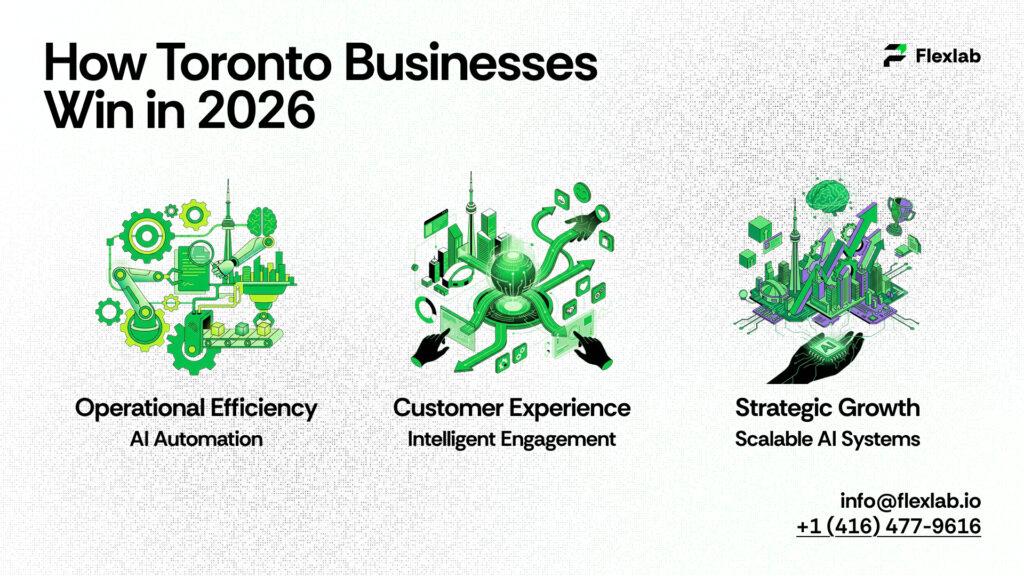
How Toronto Businesses Win in 2026

The adoption of artificial intelligence and automation is now a strategic differentiator. McKinsey reports that companies leveraging intelligent automation at scale see productivity improvements of 20–30% across core operations. As a result, for Toronto businesses competing with US-based and global companies, falling behind is not just risky, it is expensive and often irreversible.

Operational Efficiency

Automation reduces repetitive tasks, improves workflow accuracy, and speeds up internal processes. However, beyond time savings, it also enables teams to focus on higher-value work. As a result, organizations that delay adoption often face growing operational bottlenecks, higher error rates, and wasted labor hours. Over time, this inefficiency compounds, making it harder to scale operations or respond quickly to market changes.

Customer Experience

From conversational AI to AI voice agents, automation directly impacts how customers interact with your business. When implemented correctly, it enables faster responses, consistent service, and personalized interactions. On the other hand, poor automation leads to delays, errors, and frustration. Consequently, customer trust declines, retention drops, and competitors with smarter AI experiences gain a clear advantage.

Strategic Growth

Companies implementing enterprise AI solutions effectively position themselves for long-term, scalable growth. Not only does automation support expansion, but it also ensures systems remain adaptable as business needs evolve. Therefore, choosing the right AI automation agency becomes critical. The right partner builds flexible, future-ready systems that support innovation, new revenue streams, and sustained competitive advantage.

Learn more about Flexlab on LinkedIn for updates on AI adoption trends and real-world implementation insights.

Toronto’s AI Automation Market Is Evolving Fast
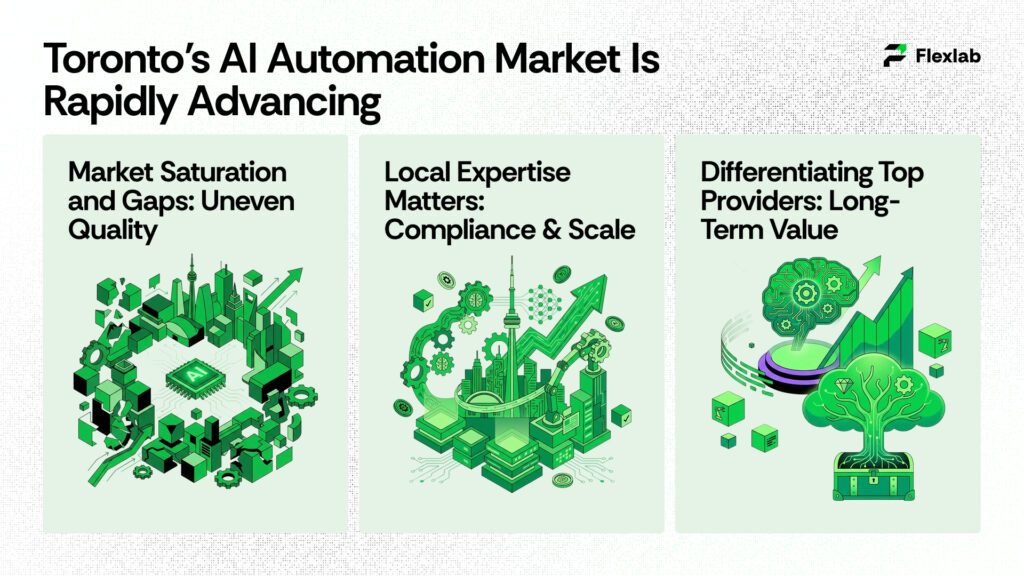
Toronto’s AI Automation Market Is Rapidly Advancing

Toronto has become a key North American AI hub. As investment and innovation continue to accelerate, the rapid growth of AI technologies, intelligent automation services, and AI software development companies has created an abundance of options. However, while choice has increased, quality and long-term reliability still vary significantly across providers.

Market Saturation and Gaps

On the surface, many agencies appear similar. However, when evaluated closely, clear gaps emerge. Some agencies focus only on AI models, others rely heavily on off-the-shelf AI automation tools, and only a small number successfully combine strategy, development, and scalability. As a result, many solutions fail once business complexity increases.

Local Expertise Matters

While technical skills are important, local expertise is equally critical. Agencies unfamiliar with Toronto regulations, data compliance standards, and enterprise procurement processes often deliver solutions that struggle to scale. Consequently, businesses face delays, rework, or compliance risks that could have been avoided with the right local partner.

Differentiating Top Providers

Ultimately, high-quality providers distinguish themselves through consistency and long-term value. They offer a balanced mix of AI automation services, strategic guidance, and ongoing optimization. Therefore, business process automation solutions are not only implemented successfully but also continuously refined to improve performance, efficiency, and ROI over time.

Discover our services to see how Flexlab drives scalable AI solutions that deliver measurable business impact.

What Businesses Need vs. What Agencies Pitch?
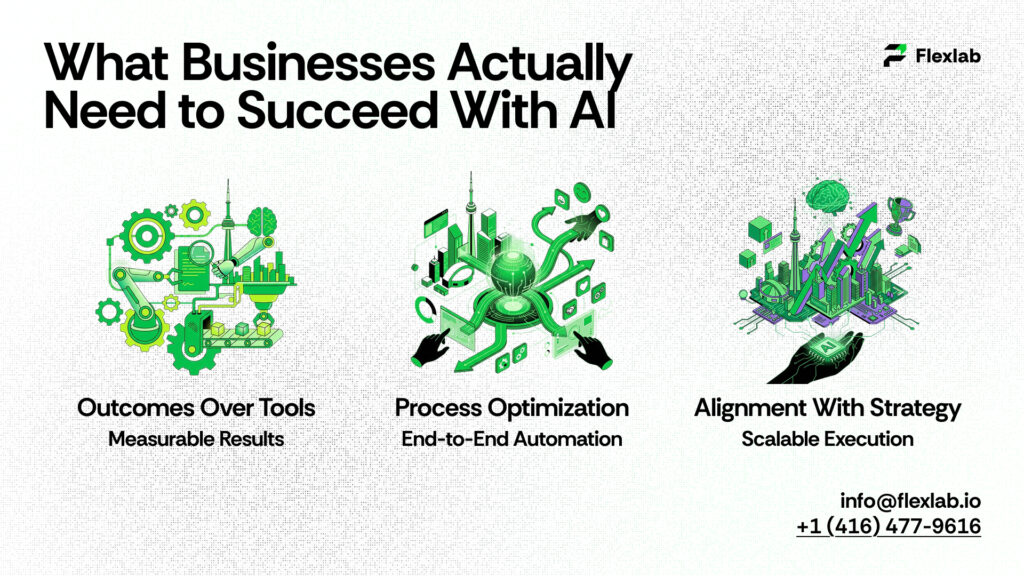
What Businesses Actually Need to Succeed With AI

Many agencies sell AI automation tools and flashy demos rather than real outcomes. However, businesses do not succeed with tools alone. Instead, they need AI workflow automation that is clearly aligned with business goals, measurable over time, and scalable as operations grow. In fact, Gartner reports that over 50% of AI projects fail, largely due to misalignment between strategy and execution, making agency selection even more critical.

Outcomes Over Tools

The right agency prioritizes solving real business problems rather than showcasing technology. While prebuilt AI agents may look impressive, they often fail to deliver lasting value. Therefore, agencies that focus on outcomes, efficiency gains, and ROI consistently outperform those that sell tools without context.

Process Optimization

AI workflow automation should enhance end-to-end processes, not just isolated tasks. When automation is applied holistically, teams work more efficiently, errors decrease, and insights improve. As a result, businesses gain sustainable improvements rather than short-term fixes.

Alignment With Strategy

AI strategy consulting ensures automation aligns with broader objectives, KPIs, and growth plans. Consequently, decision-makers gain clarity, measurable results, and confidence in long-term AI investments.

To deepen your understanding, check out our Blog for expert insights, practical AI trends, and proven best practices tailored specifically for Toronto businesses.

The 2026 AI Automation Agency Checklist
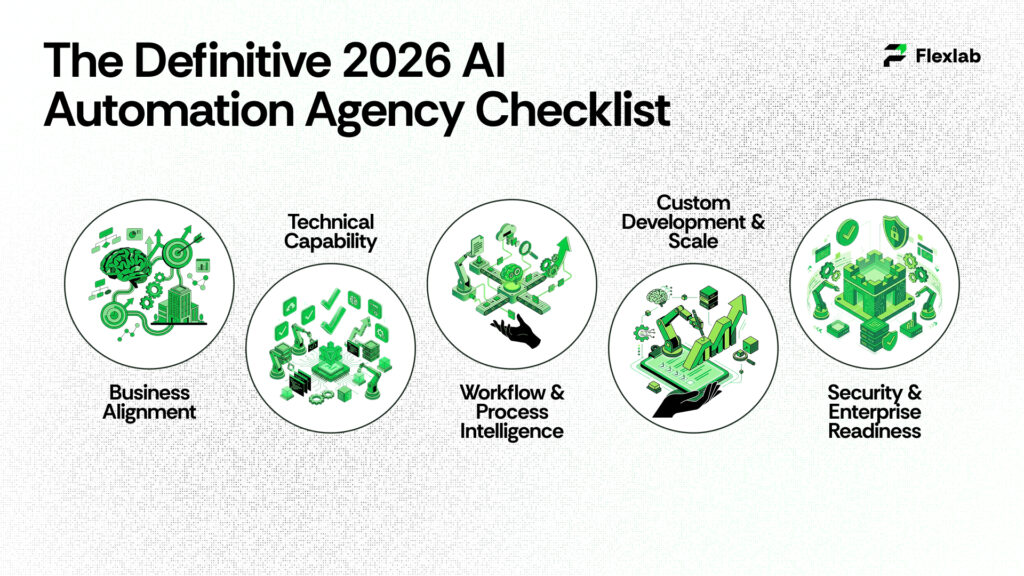
The Definitive 2026 AI Automation Agency Checklist

This checklist helps evaluate whether an agency can deliver long-term value rather than short-term experimentation. In 2026, successful AI adoption depends on strategy, execution, and scalability working together. Therefore, reviewing agencies through a structured checklist ensures you choose a partner capable of supporting both immediate needs and future growth.

Business Alignment

A strong agency begins with a product strategy that clearly understands KPIs, workflows, and operational priorities. Moreover, effective partners assess where automation will generate the highest impact. Projects may include MVP development for validation or full enterprise rollouts designed to support long-term transformation.

Technical Capability

Look for proven expertise in AI models, generative AI, and AI automation tools. However, technical depth alone is not enough. Strong agencies demonstrate sound judgment in selecting the right technologies based on the business context rather than simply implementing tools because they are trending.

Workflow and Process Intelligence

AI workflow automation must improve entire systems, not isolated tasks. As a result, agencies experienced in intelligent automation services focus on end-to-end process optimization. This approach reduces inefficiencies, removes barriers, and ensures automation delivers consistent, measurable results. For a deeper, practical understanding, you can also read How to Use AI for Business Process Automation in 2025 to explore real-world use cases and implementation strategies.

Custom Development and Scale

Custom software development and web app development allow automation systems to evolve alongside business growth. As operations expand, tailored solutions ensure flexibility, adaptability, and long-term performance without the need for costly rework or replacements.

Security and Enterprise Readiness

Enterprise AI solutions require secure infrastructure, governance, and reliability. Therefore, agencies should clearly explain their AI implementation practices, including data security, compliance standards, and system monitoring. This transparency builds trust and reduces operational risk.

Core Capabilities of a High-Performing AI Automation Agency

Capability Why It Matters Flexlab Advantage
AI Strategy Consulting Ensures automation aligns with business goals Flexlab provides end-to-end planning and roadmap creation
Custom AI Models Tailored solutions scale with business needs Flexlab develops models designed for enterprise requirements
Workflow Automation Streamlines processes and increases efficiency Flexlab integrates AI into full business workflows
Enterprise-Ready Systems Supports growth and complex operations Flexlab ensures security, compliance, and scalability
Post-Launch Support Maintains system performance and updates Flexlab offers ongoing optimization and support

After reviewing these capabilities, it becomes easier to identify agencies that focus on long-term success rather than quick wins. Ultimately, this checklist helps decision-makers compare options objectively, reduce risk, and confidently select an AI automation services built for sustainable growth in 2026 and beyond.

Step-by-Step Guide to Choosing the Right AI Automation Agency
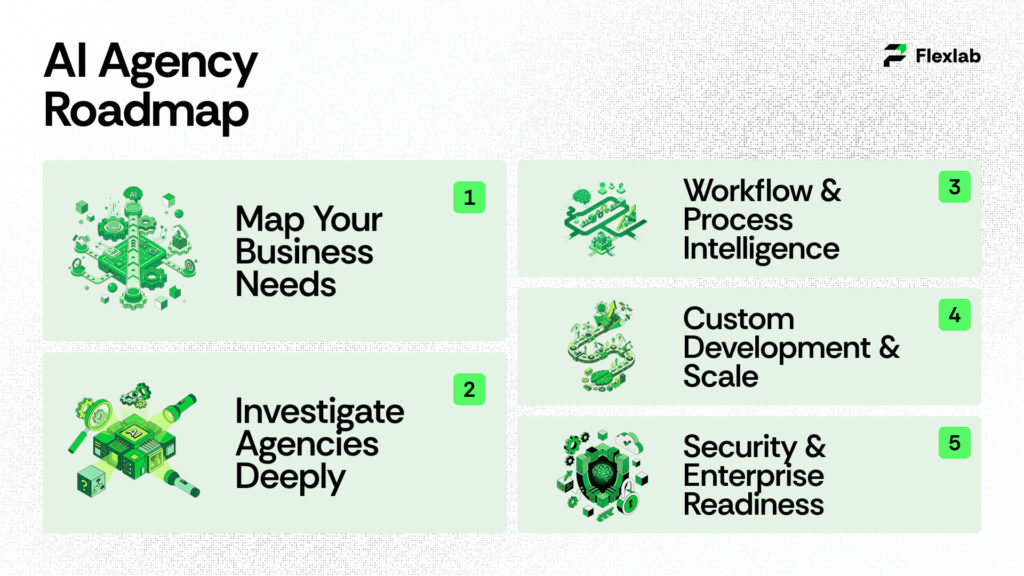
AI Agency Roadmap

Here’s a clear, practical roadmap for Toronto businesses looking to select the right AI automation agency in 2026. Rather than relying on sales pitches, this step-by-step approach helps decision-makers evaluate agencies logically, reduce risk, and ensure long-term value. Moreover, following a structured process makes it easier to compare providers objectively.

Step 1: Assess Your Business Needs

Before evaluating agencies, clearly map out which processes require AI workflow automation. For instance, identify goals such as reducing repetitive tasks, improving customer experience, or enabling predictive analytics. As a result, you enter discussions with clarity, making it easier to spot agencies that truly understand your challenges.

Step 2: Research Agencies Thoroughly

Next, research agencies with proven experience in enterprise AI solutions and AI development services. Look beyond websites and marketing claims. Instead, review case studies, client outcomes, and real-world implementations. For practical examples, explore Flexlab’s portfolio to see how scalable AI solutions are delivered in action.

Step 3: Evaluate Technical Capabilities

Once shortlisted, evaluate each agency’s technical depth. Ensure they can handle AI models, generative AI, and custom software development. 

If you’re comparing different AI approaches, reading Agentic AI vs Generative AI: Choosing the Right AI for Your Business can help clarify which technology best fits your use case.

Additionally, ask how they manage workflow integration and scalability. This step is crucial because poorly integrated systems often fail as complexity increases.

Step 4: Ask About Strategy and Support

A reliable partner goes beyond implementation. Therefore, confirm whether the agency provides AI strategy consulting and long-term support. Discuss post-launch optimization, performance monitoring, maintenance, and regular updates. Consequently, you avoid one-off projects and build systems designed to evolve.

Step 5:  Compare ROI and Costs

Rather than focusing only on upfront pricing, evaluate total business value. Consider efficiency gains, scalability, predictive analytics, and automation outcomes. While costs matter, long-term ROI also matters more. Referencing benchmark data enables you to make informed, confident decisions.

Step 6: Schedule a Consultation

Finally, book a consultation to discuss your specific requirements and challenges. This step reveals how well an agency understands your business. To explore a tailored automation roadmap, contact us and start building an AI automation plan designed for growth in 2026 and beyond.

Red Flags That Signal the Wrong AI Partner
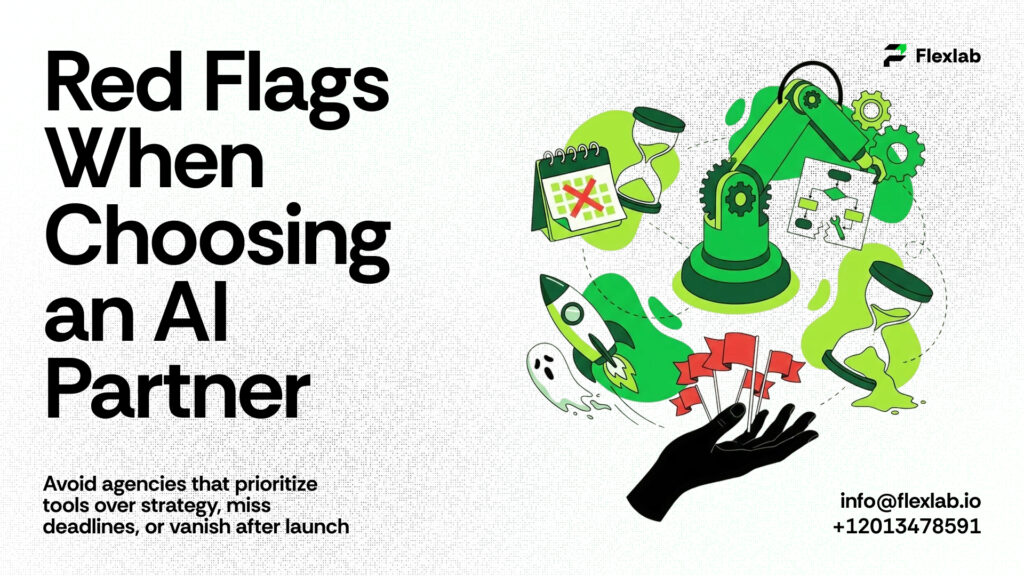
Red Flags When Choosing an AI Partner

Some warning signs consistently indicate a risky choice when selecting an AI automation agency. While many agencies promise innovation, not all are equipped to deliver sustainable value. Therefore, recognizing these red flags early can save businesses time, budget, and long-term frustration, especially as AI investments become more critical in 2026.

Tool-First Proposals

Agencies that prioritize prebuilt AI automation tools over strategy often struggle to deliver meaningful outcomes. While tools may accelerate demos, they rarely address unique business challenges. As a result, solutions lack flexibility and fail to scale as requirements evolve.

Vague Timelines

Unclear timelines, undefined deliverables, and ambiguous post-launch responsibilities signal high project risk. Moreover, without transparency, businesses are left guessing about progress, accountability, and results, which frequently leads to delays and budget overruns.

Lack of Support

Ongoing AI automation services, including optimization, monitoring, and retraining, are critical for long-term success. Agencies that disappear after deployment can leave clients stranded with outdated systems. Consequently, performance declines and ROI suffer over time.

Cost vs. Value in AI Automation Projects

Focusing only on cost often leads to higher long-term expenses. Instead, businesses should evaluate value holistically. Deloitte reports that organizations prioritizing long-term AI value see 2–3x higher ROI compared to cost-focused implementations. Therefore, understanding ROI drivers is essential when selecting the right partner.

Measuring ROI

When evaluating AI tools for business, consider more than immediate savings. Look at predictive analytics, efficiency gains, decision accuracy, and end-to-end process optimization. These factors collectively determine the true impact of automation.

Total Cost of Ownership

In addition to upfront pricing, include maintenance, scaling, security updates, and system enhancements. Although a higher initial investment may seem risky, it often delivers stronger long-term returns and operational stability.

AI Automation ROI Benchmarks for 2026

Benefit Potential Improvement (2026 Benchmark)
Productivity +20–30% (McKinsey)
Process Completion Speed +35% (Forrester)
Decision Accuracy +25% (PwC)
Cost Savings Over Time 2–3x higher ROI (Deloitte)

After reviewing these benchmarks, it becomes clear that the right AI partner delivers measurable, compounding value. Ultimately, avoiding red flags and focusing on long-term ROI enables businesses to make confident, future-proof AI investments.

Why Flexlab Is the Right AI Automation Agency in Toronto?
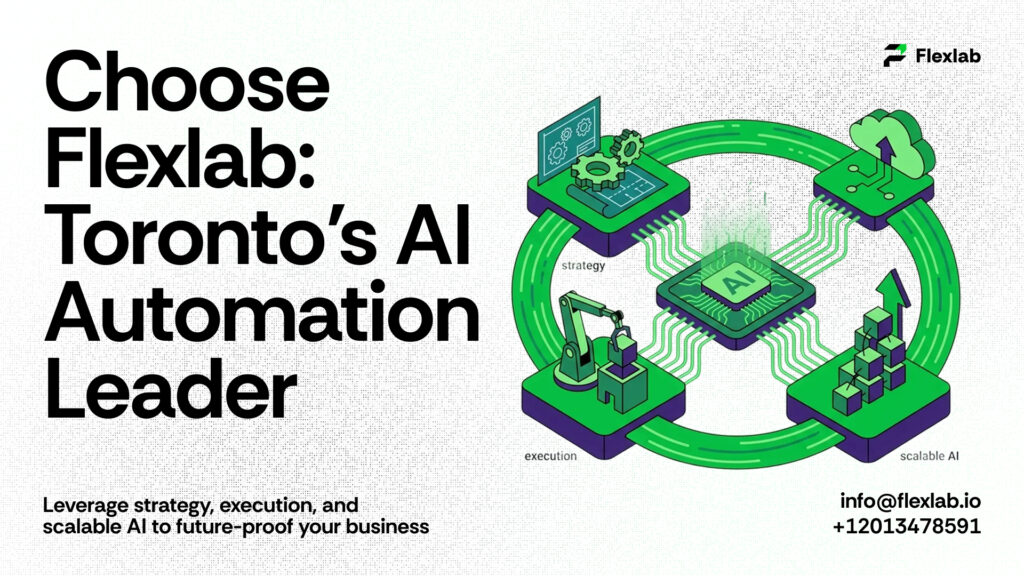
Choose Flexlab_ Toronto’s AI Automation Leader

Toronto businesses choose Flexlab because it combines strategic clarity, technical depth, and long-term partnership. While many agencies focus only on deployment, Flexlab operates as a full-service AI software development company, delivering US-based engineering standards along with deep local market expertise. As a result, businesses gain scalable, secure, and future-ready automation systems.

Strategy Meets Execution

Unlike agencies that stop at recommendations, Flexlab bridges AI strategy consulting with hands-on execution. Therefore, automation initiatives move seamlessly from planning to production without delays or misalignment. This integrated approach ensures every solution supports measurable business outcomes.

Proven Results Across Industries

From AI agents and AI voice agents to advanced intelligent automation services, Flexlab builds solutions that improve efficiency, reduce costs, and strengthen decision-making. 

To explore Flexlab’s broader capabilities, you can also read Why Flexlab Is Your Best Choice for AI and Blockchain Application Development for deeper insight into our approach to scalable, secure innovation.

Enterprise-Grade Security and Compliance

Flexlab delivers enterprise AI solutions with security, compliance, and IP ownership built in from the start. Consequently, organizations gain confidence knowing their automation systems meet enterprise requirements while remaining scalable and reliable.

A Long-Term AI Partner, Not Just a Vendor

Intelligent automation is a long-term investment. Therefore, Flexlab acts as a strategic partner, helping businesses adapt as AI technologies evolve. Future-proofed systems enable the seamless addition of new workflows without costly reimplementation.

Flexlab Build Scalable AI Automation for Your Business

Now that you understand what to look for in an AI partner, the next step is taking action. Whether you’re planning an MVP or scaling enterprise automation, Flexlab can help you move forward with confidence.

Ultimately, choosing the Best AI automation agency in Toronto determines how effectively your business competes in 2026 and beyond. With the right strategy, technology, and partner, AI becomes a growth engine, not a risk. Flexlab is built to deliver exactly that.

Final Thoughts on Choosing the Right AI Automation Agency in Toronto

Choosing the right AI automation agency in Toronto is not just a technical decision, but a strategic one. Therefore, by prioritizing alignment, scalability, ROI, and long-term support, businesses can avoid costly missteps. Ultimately, the right partner enables intelligent automation that evolves with your goals and delivers measurable value in 2026 and beyond.

Ready to Scale Your Business with AI Automation?

📞 Book a FREE Consultation Call: +1 (416) 477-9616
📧 Email Us: info@flexlab.io

How long does it take to see results after hiring an AI automation agency?

The timeline depends on the complexity of your workflows and the type of AI automation implemented. In many cases, businesses begin seeing efficiency improvements within 60 to 90 days after deployment. However, enterprise-level AI solutions may take longer due to integration and testing. A strategic rollout ensures sustainable, measurable results rather than rushed outcomes.

Can AI automation integrate with existing business systems?

Yes, modern AI automation is designed to integrate seamlessly with existing tools such as CRMs, ERPs, and internal platforms. A qualified AI automation agency evaluates your current infrastructure before implementation. As a result, automation enhances workflows without disrupting operations. Proper integration also ensures scalability as business needs evolve.

What industries benefit most from AI automation in Toronto?

AI automation delivers value across industries, including finance, healthcare, real estate, logistics, and SaaS. In Toronto’s competitive market, businesses with complex processes benefit the most. Automation improves accuracy, speeds decision-making, and reduces operational costs. Ultimately, any organization handling large volumes of data or repetitive workflows can gain a strong advantage.


Leave a Reply

Your email address will not be published. Required fields are marked *

Cutting-Edge AI Applications You Can Start Using Today

AI Marketing Tools | AI Voice Agents | AI Business Ideas

AI applications have moved beyond experiments once limited to tech giants. Today, they power faster workflows, sharper decisions, and a real competitive advantage for businesses and individuals. As 2026 accelerates digital adoption, organizations shift from debating AI to executing it with speed and purpose.

AI applications are intelligent systems that analyze data, automate decisions, and continuously improve performance, helping businesses operate faster, smarter, and more efficiently.

Some of the most advanced AI applications today include multimodal AI, which can process and integrate multiple data types such as text, images, and audio, to deliver richer insights and smarter decisions. Recent industry studies reveal that more than 65 percent of companies using AI report measurable improvements within the first six months.

This guide breaks down innovative AI applications you can implement today. It focuses on real use cases, clear benefits, potential risks, and practical steps. Ultimately, it turns curiosity into confident action.

How AI Applications Work in Real Life 

AI systems turn data into actionable insights. They learn and improve over time using machine learning, NLP, and predictive modeling. Businesses replace manual estimation with data-driven decisions. AI systems track operations, customer behavior, and performance metrics. 

A retail company used AI systems to flag slow-moving products and adjust pricing, boosting revenue by 12% in weeks. Scalable and efficient, AI systems handle thousands of decisions at once, far beyond manual capabilities, making them essential for modern businesses.

Top AI Applications and Real-World Use Cases

AI Application Primary Function Key Benefit Real-World Example
Autonomous AI Agents Streamline complex workflows Reduces manual oversight, saves time A financial firm uses autonomous AI agents to monitor global stock movements and alert analysts only when unusual activity occurs
Conversational AI Tools Customer engagement Faster, personalized responses A mid-size e-commerce store deployed conversational AI tools to guide visitors through purchases, boosting conversions by 18%
Predictive AI Forecast trends Smarter marketing and operational decisions A subscription-based company leverages predictive AI to identify high-risk churn customers, reducing churn by 22%
Generative AI Content creation Saves hours, scales content production A SaaS company used generative AI to produce weekly blogs and social posts tailored to different customer segments, increasing engagement by 35%
Smart Manufacturing AI Process optimization Reduces downtime, improves quality A manufacturing plant uses smart manufacturing AI to detect defects on the production line instantly, cutting rework costs by 30%

Key Benefits of Best AI Applications


The best AI applications deliver value quickly when businesses implement them with crystal clear objectives. While tools and platforms vary, the benefits remain consistent across industries.

Key Benefits & Applications of AI in Business

  • Faster Decisions and Better Accuracy

AI analyzes large datasets in seconds. As a result, leaders receive insights faster and with fewer errors. Studies show that organizations using AI-driven insights improve decision accuracy by nearly 30 percent compared to manual analysis.

  • Lower Costs and Higher Efficiency

AI reduces reliance on repetitive manual tasks. This leads to fewer mistakes and lower operational costs. For instance, companies that apply AI to routine workflows often notice cost reductions of up to 25 percent within the first year.

  • Scalable Growth and Competitive Advantage

AI grows with your business. Whether you serve hundreds or millions of users, AI systems adapt without requiring the same increase in staff. Therefore, organizations using AI scale faster while maintaining consistent quality and performance.

Together, these benefits explain why AI adoption has accelerated across industries. Consequently, businesses that delay implementation often struggle to keep pace with more agile competitors.

Best AI Applications for Business Use

Today’s organizations rely on the best AI tools for business to reduce costs, simplify operations, and improve decision quality while connecting data, workflows, and teams into a single intelligent system.

Businesses that adopt AI early often gain an advantage because they act faster and adapt more easily. In fact, industry reports indicate that companies utilizing AI-driven operations achieve up to 30 percent higher efficiency within the first year.

1. Business Process Automation

Many companies start their AI journey with business process automation. This approach replaces repetitive manual tasks with intelligent workflows that run continuously and accurately. For example, a logistics company automated invoice processing and shipment updates using AI. As a result, the company reduced processing time by 40 percent and significantly decreased human errors. Employees then focused on higher-value tasks instead of routine administration.

2. Automated Decision-Making

Another powerful use case involves automated decision-making. AI evaluates large volumes of data and instantly recommends actions. This eliminates delays from manual approvals and slow analysis. A retail chain applied automated decision systems to inventory planning. Consequently, stock shortages decreased and excess inventory dropped by 18 percent. These improvements directly increased profitability without adding operational complexity.

3. Real-World Use Case

Consider a medium-sized manufacturing firm struggling with production delays. After implementing AI-driven workflow automation, the company gained real-time visibility into operations. Bottlenecks became easier to identify. Within six months, on-time delivery improved by 22 percent, and customer satisfaction increased. This clearly highlights that when businesses choose the right AI applications, noticeable results appear quickly and compound over time.

Autonomous AI Agents in Action

Autonomous software agents improving business operations

Autonomous AI agents are changing how businesses handle complex workflows. Unlike standard software, these AI systems can monitor multiple processes, make decisions, and take action with minimal human oversight. Consequently, the result is faster, smarter, and more accurate operations.

Organizations adopting autonomous AI agents report substantial efficiency gains. For example, a financial services firm deployed autonomous AI agents to track global market trends and detect unusual activity. The system alerted analysts only when anomalies appeared. reducing data review time by 50 percent,  while freeing them to focus on strategy and decision-making.

How Autonomous Systems Work

These AI agents combine data analysis, predictive modeling, and automated execution using advanced AI techniques that allow systems to learn from patterns, adapt in real time, and improve decision accuracy over time.

They continuously learn from new inputs, improving over time. Instead of merely alerting humans to potential issues, they can act on rules or models directly, such as rebalancing a stock portfolio or adjusting production schedules.

Managing Complex Workflows

At the same time, businesses benefit when AI agents handle interdependent tasks across different systems. For instance, in logistics, autonomous agents can coordinate warehouse operations, shipping, and inventory management simultaneously. This integration reduces delays and minimizes errors that often occur when tasks are handled manually.

Real-World Use Case

A global e-commerce company implemented autonomous AI agents to oversee supply chain operations. Autonomous AI agents automatically flagged delayed shipments, rerouted packages, and optimized delivery priorities. Within three months, the company reduced late deliveries by 30 percent and improved overall customer satisfaction scores. This example shows why autonomous AI agents are no longer optional. They are essential for scaling operations efficiently while maintaining quality and accuracy.

AI in Marketing and Customer Growth

Artificial intelligence improving marketing and customer engagement

AI is transforming marketing from a reactive function into a proactive growth engine. Businesses now utilize AI in marketing to understand customer behavior, personalize experiences, and predict outcomes more accurately than ever before.

Recent studies show that companies integrating AI into marketing experience 20–30 percent higher campaign effectiveness compared to traditional methods. By analyzing data from multiple touchpoints, AI helps marketers deliver the right message to the right audience at the right time.

Conversational AI Tool

Conversational AI tools enable real-time customer interactions across websites, apps, and messaging platforms. These systems can answer questions, recommend products, and even complete transactions without human intervention.

For example, an average-sized online retailer implemented a conversational AI chatbot that interpreted visitor intent and guided users through the buying process. Therefore, conversion rates increased by 18 percent, while customer support costs declined by 25 percent.

Generative AI for Content

Generative AI automates content creation, from social media posts to blogs and ad copy. It learns a brand’s voice and adapts messaging to various audiences. As a result, marketing teams can save significant manual working hours.

Real-World Use Case

A subscription service applied predictive modeling to identify users likely to discontinue. Then, using AI-generated personalized retention messages, the company reduced turnover by 22 percent, thereby proving AI’s tangible impact on revenue growth.

Predictive Insights With AI

Companies leveraging predictive AI can forecast customer behavior, identify risks, and respond proactively rather than reactively. Meanwhile, market data suggests that organizations using predictive AI reduce operational costs by 15–20 percent while also improving decision-making speed. Thus, it makes predictive insights a critical advantage in competitive markets.

Predictive Analytics in Business

Predictive analytics in business utilizes historical and real-time data to identify patterns and forecast future outcomes. As an illustration, a subscription-based company applied predictive models to predict which customers were likely to cancel their plans. This insight enabled personalized retention campaigns, and accordingly, turnover dropped by 22 percent.

Anomaly Detection

Anomaly detection is another predictive technique that identifies unusual behavior or errors before they worsen. A global retailer used AI-driven anomaly detection to monitor transactions and spot potential fraud. The system flagged suspicious activity instantly. Hence, it reduces financial losses by 40 percent.

Real-World Use Case

A logistics company integrated predictive AI into its delivery operations. By analyzing weather forecasts, traffic patterns, and historical delivery times, the system automatically optimized routes. Thus, it reduced fuel costs by 18 percent and improved on-time deliveries, demonstrating how predictive insights can transform operational efficiency.

Security and AI in Fraud Detection

As digital transactions increase, businesses face growing risks from cyberattacks and financial fraud. AI in fraud detection enables organizations to identify suspicious activity in real-time, reducing losses and protecting sensitive data.

Research shows that companies implementing AI-driven fraud detection experience up to 40 percent fewer fraudulent transactions compared to traditional methods. It continuously learns from new patterns, staying ahead of evolving threats.

AI and Robotics in Security

AI and robotics collaborate to create layered protection. It analyzes vast amounts of data to spot irregularities, while robotic systems can automate responses, such as freezing accounts or flagging suspicious activity. For instance, a global bank monitors transactions with AI and robotics, cutting fraud losses by 35% in a year.

AI Engineering for Risk Management

AI engineering ensures that models are scalable, resilient, and explainable. Engineers design algorithms capable of detecting threats across multiple platforms, including web, mobile, and IoT devices.

A leading insurance company applied AI engineering principles to claims processing. The system analyzed claims and behavioral patterns, flagging high-risk cases with 90 percent accuracy, enabling faster review and fraud prevention.

AI in Smart Manufacturing and Edge AI

AI-powered systems enhancing security and operational efficiency

The manufacturing sector is rapidly evolving with the emergence of AI. Smart manufacturing leverages AI-driven systems and robotics to optimize production, reduce waste, and ultimately improve quality. Furthermore, by combining predictive analytics, sensors, and automation, companies gain real-time visibility and control over operations. Industry research indicates that factories implementing AI-driven manufacturing systems achieve up to 25 percent higher productivity and 30 percent lower operational cost, thereby highlighting the tangible impact of AI.

Edge AI for Real-Time Decisions

Edge AI processes data locally on machines instead of sending it to the cloud. This reduces latency and enables systems to make real-time decisions, which is crucial for industries where seconds matter. For instance, a car assembly plant implemented edge AI to inspect products on the production line. Edge AI systems detected defective parts immediately, preventing costly rework and saving thousands of dollars in production losses.

Real-World Use Case

A global electronics manufacturer integrated smart manufacturing with edge AI. The system monitored equipment health, predicted failures, and automatically adjusted workflows. Within six months, downtime decreased by 20 percent, efficiency improved, and product quality became more consistent. Therefore, combining smart manufacturing with edge AI provides both operational and financial benefits while enhancing production reliability.

AI Developer Tools and Software Development

Innovation in AI depends on the tools developers are using. AI developer tools help engineers test, build, and deploy efficient intelligent systems, while AI software development enables companies to create solutions that learn, adapt, and deliver personalized experiences.

AI Developer Tools for Faster Innovation

Modern AI developer tools include model training platforms, analytics dashboards, and low-code AI frameworks. These tools allow teams to experiment, iterate, and scale applications without starting from scratch.

For example, a robotics startup leveraged AI developer tools to design predictive maintenance models for factory equipment. This reduced downtime by 20 percent, allowing the company to scale production efficiently.

AI Software Development for Personalized Experiences

AI software development enables companies to deliver customized solutions. From fitness apps that adjust workouts in real time to financial apps providing personalized budgeting advice, these systems anticipate user needs and adapt accordingly.

A leading fitness app implements AI algorithms to develop exercise plans based on user progress and recovery metrics. Engagement increased by 30 percent, demonstrating how intelligent software enhances user experiences.

Consumer-Facing AI Applications and Smart Home Devices

Consumer-focused artificial intelligence driving business growth

AI now operates beyond offices and factories. Smart home devices and consumer-facing applications transform daily life, making homes safer, more efficient, and more convenient. From intelligent thermostats to AI-powered security cameras, these tools adapt to user behavior and preferences.

Recent studies show that households using AI-powered smart devices report up to 25 percent lower energy consumption while enjoying improved comfort and convenience.

  • AI-Powered Software for Everyday Life

AI software development allows companies to create apps that learn from user behavior, and anticipate needs while delivering personalized experiences. For example, it includes fitness trackers, health monitoring apps, and personal finance tools.

  • AI Developers Designing Human-Centric Tools

AI developers focus on creating intuitive systems, such as voice assistants, smart appliances, and recommendation engines that anticipate user needs without being intrusive.

For instance, a voice-enabled kitchen assistant suggests recipes based on dietary preferences and available ingredients. Families reported a 20 percent reduction in meal preparation time, highlighting the practical impact of AI on daily life.

Getting Started With AI Strategy and Consulting Services

Business leaders planning an artificial intelligence strategy

Implementing AI successfully begins with a clear strategy. AI strategy consulting helps businesses identify the right applications, align them with objectives, and maximize ROI. 

Proper guidance ensures that businesses adopt AI effectively, deliver measurable results, and avoid wasted resources. Recent studies indicate that organizations with a structured AI strategy are 2.5 times more likely to achieve ROI within the first year compared to ad hoc implementations.

Evaluating AI Systems for Your Needs

Selecting the right AI systems requires understanding workflows, data availability, and the problems you aim to solve. Systems can range from predictive analytics platforms to AI-powered customer service solutions.

For example, a retail chain implemented AI systems to optimize inventory and supply chain management. Accurate demand forecasts reduced overstock by 20 percent and improved order fulfillment efficiency.

Partnering With an AI Automation Agency

Working with an AI automation agency ensures smooth integration of AI tools into existing workflows. Agencies provide expertise, select the right software, and customize solutions for specific business needs.

A mid-sized e-commerce company collaborated with an AI automation agency to implement automated customer support and personalized recommendations. Within six months, response times improved by 30 percent, and conversion rates grew by 15 percent.

Key Steps to Start Your AI Strategy

  • First, assess needs by identifying processes that benefit most from AI. 
  • Next, select tools by evaluating AI systems aligned with business goals.
  • Then, pilot and scale by starting small, measuring results, and expanding deployment gradually. 
  • Finally, monitor and optimize by continuously refining AI performance using analytics. 

By following these steps, businesses can implement AI efficiently, achieving operational excellence and competitive advantage.

Supercharge Your Business with AI Applications at Flexlab

Supercharge Your Business with AI Applications at Flexlab

At Flexlab, we empower businesses to implement cutting-edge AI applications that automate workflows. In doing so, we deliver measurable results while saving valuable time. Whether you want to streamline operations, enhance customer experiences, or make smarter, data-driven decisions, our team guides you every step of the way. Don’t wait to unlock your business’s full potential.

Explore our portfolio to see real-world transformations, or learn more about our tailored services that fit your unique needs. Stay updated on AI innovations by visiting our blog, and connect with us on LinkedIn to follow our latest insights. Don’t just implement AI, partner with Flexlab, and contact us to turn innovation into action and discover how intelligent solutions can elevate every aspect of your business. Discover related blogs for practical AI insights.

Conclusion: Embrace AI Applications Today

AI is a practical, transformative tool for smarter decisions, greater efficiency, and competitive advantage. By adopting AI applications, organizations streamline operations, enhance customer experiences, and reduce risks with predictive analytics, autonomous agents, and intelligent automation. Success depends on identifying high-impact processes, choosing the right tools with expert guidance, and piloting before scaling. Combining AI insights with human judgment and scalable systems turns innovation into measurable results and secures long-term growth in an AI-driven world.

Ready to Automate Your Business Workflows with AI?

📞 Book a FREE Consultation Call: +1 (416) 477-9616
📧 Email Us: info@flexlab.io

FAQ’s

1: What are the best AI tools for businesses to boost productivity?

The best AI tools for business include workflow automation platforms, predictive analytics software, AI-powered customer support, and intelligent scheduling tools. These applications streamline repetitive tasks, reduce human error, and provide actionable insights, helping teams focus on strategic work. Even small businesses can leverage cloud-based AI solutions to gain a competitive edge without large upfront investments, while larger organizations can scale them for enterprise-wide efficiency.

2: How do AI voice agents improve customer support and engagement?

AI voice agents handle real-time, hands-free interactions, answering routine queries, guiding customers through processes, and resolving simple issues instantly. They reduce wait times, improve first-call resolution rates, and allow human agents to focus on complex or high-value cases. Businesses in sectors like e-commerce, telecom, and banking report higher customer satisfaction, faster response times, and lower operational costs after integrating these systems.

3: How is generative AI transforming content marketing strategies?

Generative AI automatically produces blogs, social media content, ad copy, and emails while adapting to brand tone and audience preferences. It enables marketers to maintain consistency across channels, increase output, and quickly test content variations. Companies using generative AI report faster content creation, higher engagement, and improved campaign ROI, turning content marketing into a scalable, data-driven growth engine.

What Makes Flexlab Toronto’s Leading AI Automation Agency?

AI Automation Tools | AI vs Automation | What Is Marketing Automation

Are you curious to learn what AI automation does? The best AI automation agency incorporates artificial intelligence with automation processes to perform tasks without human oversight. They leverage technologies such as machine learning vs AI, and natural language processing to learn, adapt, and improve efficiency.

Toronto is emerging as a key AI hub in 2026, hosting events like the IDC Canada AI and Data Summit and upcoming AI programs. This approach fosters innovation, community participation, and business growth in AI-powered technologies.

Flexlab stands out as a leading AI automation agency in Toronto. They deliver a wide range of enterprise AI solutions and custom AI automation services such as AI-powered chatbots, generative AI applications, predictive analytics, AI agent systems, and workflow automation. It is trusted by over 200 companies worldwide for transforming operations. Looking for a trusted AI automation agency in Toronto? Want to discover what makes Flexlab stand out from the competition? Dive into the detailed insights below to see the real benefits.

What Is an AI Automation Agency? 

In general, an automation agency is a professional service provider that designs, implements, and helps businesses streamline operations, making repetitive tasks faster and smarter without human intervention. Additionally, it enhances decision-making and improves efficiency by implementing artificial intelligence and automation technologies. For example, these AI agencies develop and deploy AI-driven solutions such as machine learning integration, natural language processing tools, RPA (robotic process automation), and intelligent AI chatbots, which resonate well with specific clients.

Businesses leverage AI automation across several key areas for enhanced efficiency. First, they deploy AI customer engagement via chatbots that provide 24/7 support. Additionally, inventory management utilizes predictive analytics to forecast demand. Moreover, AI-powered marketing workflows deliver personalized email campaigns. Finally, data entry processes utilize optical character recognition for accuracy.

In 2026, companies will need AI automation to stay competitive amid rising labor costs. Furthermore, it handles massive data volumes from IoT devices, and adapts to rapid market shifts driven by global Adoption. It also boosts efficiency by up to 40% according to industry benchmarks.

Moreover, an AI development company intersects data science, engineering, and optimization. It serves industries from healthcare to logistics with product strategy, like AI-enhanced energy systems.

Why Businesses in Toronto Need AI Automation Now

Toronto’s competitive business automation environment thrives as Canada’s tech capital. For example, it hosts over 280 AI companies. Additionally, major investments, such as Microsoft’s $7.5 billion CAD commitment, fuel innovation and attract global talent.

Rising operational costs are pushing businesses toward AI automation. Specifically, wages have seen increases of around 2-10% annually, and energy prices contribute to the pressure. As a result, AI automation delivers efficiency gains. In fact, it reduces manual labor by 30-50% in routine processes.

Local industries leverage AI automation extensively. For instance, finance uses it for fraud detection and algorithmic trading. Similarly, healthcare applies it to patient triage and diagnostics. Retail benefits from personalized recommendations and supply chain optimization. Finally, startups rely on it for scalable customer support and lead generation through AI in marketing.

What Makes Flexlab the Best AI Automation Agency in Toronto

What Makes Flexlab the Best AI Automation Agency in Toronto

Flexlab combines cutting-edge AI business automation with blockchain solutions, setting it apart in Toronto’s competitive landscape. Clients benefit from proven results across 200+ projects, including DeFi platforms and AI trading systems that deliver measurable ROI. Have a look at their expertise:

  • Proven Expertise in AI Automation
  • End-to-End AI Automation Services
  • Local Toronto Expertise + Global Delivery
  • Advanced Tech Stack (2026-Ready)

Proven Expertise in AI Automation

Flexlab exhibits proven expertise across key AI automation domains. It includes intelligent AI workflows for process data orchestration, autonomous AI agents for decision-making, and Robotic Process Automation for repetitive tasks. Additionally, it has an AutoML service that provides model training and Natural Language Processing (NLP) for conversational interfaces.

Flexlab’s AI automation delivers real-world use cases. These include automating customer onboarding with AI agents that handle document verification and compliance checks. Moreover, AutoML models enable predictive maintenance in manufacturing, reducing downtime by 25%. Similarly, NLP-powered chatbots resolve 80% of support queries without human intervention. Discover why clients trust us and see real reviews on our LinkedIn page.

End-to-End AI Automation Services

Our team provides a comprehensive range of end-to-end services. From the start, we guide clients with AI strategy consulting and needs assessment, extending to custom software and web app development. Additionally, we enable seamless deployment on cloud platforms and provide ongoing support with performance monitoring and updates.

Our tailored solutions address diverse industries. For instance, finance gains fraud detection pipelines, and healthcare benefits from patient data automation. Similarly, retail optimizes inventory forecasting, and e-commerce leverages personalized recommendation engines.

Local Toronto Expertise + Global Delivery

We deeply understand your business’s landscape. It includes regulatory compliance like PIPEDA and integration with local ecosystems such as MaRS Discovery District. It ensures AI solutions align with regional needs.

For example, the agency successfully partners with Toronto startups for rapid MVP automation, SMBs for cost-effective scaling, and enterprises for mission-critical deployments. In addition, it delivers global standards with localized insights.

Advanced Tech Stack (2026-Ready)

At Flexlab, we employ various cutting-edge tech stacks. Specifically, these include features like Generative AI for content automation, Large Language Models (LLMs) such as GPT variants for advanced reasoning, and multi-agent AI systems for complex task orchestration.

Moreover, it has secure, scalable, cloud-native systems. It is built on AWS, Azure, and GCP while incorporating zero-trust security, serverless architecture, and Kubernetes for orchestration. Thus, it ensures high availability and data sovereignty.

Flexlab’s Core AI Automation Services

Flexlab’s Core AI Automation Services

Do you want to boost your business growth? AI automation delivers rapid acceleration. Explore our core services below and choose one to empower your operations with AI.

  • AI Workflow Automation
  • Intelligent Process Automation (RPA + AI)
  • AI Chatbots & Virtual Assistants
  • Predictive Analytics & AutoML
  • AI Agents & Multi-Agent Systems

AI Workflow Automation

Moreover, our AI workflow automation integrates intelligent decision-making into business models. As a result, it orchestrates tasks across systems for seamless efficiency and real-time adaptability.

Intelligent Process Automation (RPA + AI)

Intelligent automation combines RPA with AI. In particular, Flexlab handles unstructured data and cognitive tasks such as invoice processing and compliance. As a result, we have achieved over 90% accuracy in end-to-end automation.

AI Chatbots & Virtual Assistants

Moreover, we build NLP-powered chatbots and custom AI assistants for 24/7 customer support. As a result, they autonomously resolve queries and boost satisfaction by up to 40%.

Predictive Analytics & AutoML

We offer predictive analytics and AutoML services. Specifically, these enable no-code forecasting for demand, churn, and resources. As a result, they empower non-technical teams. Ultimately, teams achieve fast deployments with ease.

AI Agents & Multi-Agent Systems

At Flexlab, multi-agent systems enable collaborative AI for dynamic scenarios such as supply chain optimization and personalized marketing. By leveraging learning agents, these systems continuously adapt to changing conditions and business needs.

Industries Flexlab Serves in Toronto

Industries Flexlab Serves in Toronto

Flexlab is a versatile technology solutions provider that specializes in AI automation, blockchain app development, and NFT solutions. The company serves a wide range of industries. It brings cutting-edge technology and innovative solutions to businesses across Toronto. Here is the list of industries we serve:

1. Cryptocurrency & Blockchain

Flexlab is at the forefront of the cryptocurrency and blockchain revolution in Toronto. The company develops blockchain-based solutions. It includes decentralized exchanges (DEX), ICO platforms, and NFT auction platforms. Their expertise spans multi-chain integration, smart contract development, and blockchain security. Therefore, it empowers businesses to launch innovative cryptocurrency projects and improve operational efficiency.

Key Solutions:

  • ICO Platform and Swap/Stake Development
  • Mini Exchange & Crypto Coin Development
  • DEX Development
  • NFT Auction Platforms

2. Finance & Trading

Our AI-powered solutions are transforming the finance and trading industries by providing advanced analytics and automation tools. Moreover, the company develops AI trading bots, trading analytics platforms, and blockchain-powered payment systems that enhance decision-making, optimize trading strategies, and reduce operational costs. These tools are designed to improve user experience, maximize profits, and ensure compliance with industry standards.

Key Solutions:

  • AI-Based Trading Analytics Platform
  • Crypto Trading Bot
  • Blockchain-Based Payment Gateway
  • Crypto Payment Solutions (QR-based)

3. Decentralized Finance (DeFi)

We build secure, scalable decentralized platforms for liquidity provision and token staking in the DeFi space. Our expertise in DeFi includes creating cross-chain platforms, low-slippage swap mechanisms, and staking pools. As a result, it ensures seamless and transparent crypto transactions. Our work enables businesses to leverage the benefits of decentralized financial systems while minimizing risk.

Key Solutions:

  • DeFi Platforms 
  • Decentralized Reward Systems

4. Social Media & Web3

In the Web3 space, we created an AI-driven decentralized network that empowers users to own their data, engage with privacy-first technologies, and access personalized content. Additionally, we work on NFT profile ownership, algorithmic feed personalization, and privacy-focused posting. In short, we pioneer the next generation of decentralized social media platforms using Web3 technology.

Key Solutions:

  • AI-Based Decentralized Social Media Platform
  • MetaNews Platform (Blockchain-verified news aggregation)

5. Governance & Compliance

In regulated industries, our solutions help organizations build compliant decentralized governance systems. By working with DAO governance platforms, we enable businesses to implement transparent and secure voting systems. In addition, organizations can manage community treasury allocations in a fully Sharia-compliant manner. As a result, businesses can ensure regulatory compliance while maintaining strong community trust.

Key Solutions:

  • Islamic Kingdom Governance DAO System (Sharia-compliant DAO)
  • Smart Contract Audits and Compliance Solutions

6. Event Management & Ticketing

In Toronto’s event industry, Flexlab’s NFT ticketing solutions are revolutionizing how events are managed. By integrating blockchain with NFT technology, we provide a fraud-proof and scalable ticketing system. Moreover, our platform enables dynamic pricing, ticket resale controls, and real-time data analytics. As a result, event management becomes more efficient while the overall user experience is significantly improved.

Key Solutions:

  • NFT Ticketing Platforms 

Flexlab vs Other AI Automation Agencies in Toronto

Flexlab differentiates itself through a unique fusion of AI and automation, along with blockchain innovation, offering hybrid solutions like AI-driven DeFi platforms and secure NFT integrations that generic agencies overlook.

Unlike competitors focused on basic chatbots or consulting, Flexlab provides full-stack development, from custom AI agents and AutoML to audited smart contracts. We deliver 65% faster deployments and seamless scalability.​

Feature Flexlab Other Agencies 
Core Expertise AI workflows, RPA, NLP, multi-agents + Blockchain/DEX/NFT Basic ML, chatbots, analytics
Delivery Model End-to-end ownership (strategy to support) Project-based or outsourced
Industries Served Crypto/DeFi, Finance, Web3, Governance (200+ clients) General enterprise/SMB
Tech Stack GenAI, LLMs, cloud-native + Multi-chain Standard cloud/ML tools
Proven ROI 65% cost reduction, 3-5x returns ​ Variable, less quantified
Toronto Focus Local compliance (PIPEDA), MaRS ecosystem Generic national/international

We stand out with Toronto-specific expertise, agile global delivery, and a portfolio of live Web3 projects, ensuring clients gain competitive edges in AI and blockchain convergence.

Real Business Benefits of Choosing Flexlab

Real Business Benefits of Choosing Flexlab

We deliver measurable ROI through AI business automation, with clients achieving 65% cost savings and 3-5x returns via intelligent systems. These proven outcomes separate us from generic agencies.

  • Cost Reduction

Flexlab drives significant cost reductions by automating repetitive tasks with RPA and AI agents. As a result, it cuts operational expenses by up to 65%. 

  • Faster Workflows

Faster workflows result from intelligent orchestration. Ultimately, it reduces process times from days to minutes; for instance, customer onboarding accelerated by 80% using NLP verification.

  • Better Customer Experiences

Another real benefit is that better customer experiences are enabled by 24/7 AI chatbots and personalized analytics. As a result, it increases satisfaction scores by 40% through proactive, behavior-tailored engagement.​

  • Scalable Automation

Moreover, scalable automation accommodates growth by using cloud-native, multi-agent systems that handle surging volumes without requiring proportional increases in cost.

  • Long-term ROI

Long-term ROI is built through ongoing optimization. Specifically, predictive AutoML contributes significantly. As a result, businesses achieve 3-5x returns in the first year. Ultimately, this comes via sustained efficiency and revenue growth.

How to Get Started with Flexlab

How to Get Started with Flexlab Here are the simple steps to follow:

Schedule Free Consultation

Contact us now or visit our Google Business Profile to book a 30-minute strategy call where experts assess your automation needs and business goals.​

Define Your Automation Goals

Work with us to identify key processes for AI optimization, such as workflows, customer support, or analytics. Then, create a customized roadmap.​

Custom AI Automation Roadmap

Receive a personalized roadmap detailing strategy, tech stack, timelines, and deliverables, designed specifically for your industry and business scale.​

Deployment and Ongoing Support

Furthermore, experience seamless deployment with full training, along with continuous monitoring and optimization to ensure long-term performance and scalability.

Conclusion: Toronto’s Best AI Automation Agency

We lead as Toronto’s premier AI automation agency in 2026, blending cutting-edge AI with blockchain expertise to deliver unmatched value across crypto, DeFi, finance, and beyond.

From proven end-to-end services and 2026-ready tech stacks to real results like 65% cost cuts and 3-5x ROI. We transform businesses with scalable, secure solutions trusted by 200+ global clients. Visit our blockchain and AI blog and discover Agentic AI vs Generative AI, Day Trading Strategies, What Is Marketing Automation, 22 Best AI Marketing Tools, and Top 10 AI Automation Tools

Are You Ready to Launch Your AI Automation Project?

📞 Book a FREE Consultation Call:+1 (416) 477-9616

📧 Email Us: info@flexlab.io

What services can an AI automation agency offer?

Agencies provide AI workflow automation, RPA, chatbots and virtual assistants, predictive analytics, AutoML, NLP tools, AI agents and multi-agent systems, consulting, and integrations. At Flexlab, we specialize in all of these services, while also offering blockchain-hybrid solutions for Toronto clients.

How long does AI automation take to implement?

Timelines depend on complexity: 2–4 weeks for basic chatbots, 6–12 weeks for workflows, 12–24 weeks for custom models. Full enterprise projects average 3–6 months, including planning (1–2 weeks), development (4–16 weeks), testing, and deployment.

How to start an AI automation agency?

Niche in an industry, master no-code tools, build a portfolio/website with demos, register legally, offer pilots for testimonials, then market via LinkedIn/outreach. Scale with freelancers, retainers, and case studies for clients like Toronto enterprises.

What to Look for in a Reliable NFT Marketplace Development Company

White Label Crypto Exchange | Public vs Private Blockchain | Blockchain Audit

Are you looking for the right NFT marketplace development company? If yes, then you’re at the right place. In 2026, the NFT market reaches $60B, with gaming at 38% of volume, and 70% of custom platforms crash due to bad partners. Creators and brands race to launch tailored marketplaces, but hacks drain millions, and clunky UX kills users. Let’s dive into help insights about NFT marketplace development. Its benefits and factors to consider while choosing the NFT company.

Let’s get started!

What is NFT Marketplace Development?

Before learning how to choose the right NFT marketplace development company, let’s first review what NFTs are. NFT marketplace development is the process of creating a blockchain-based platform. The platform allows users to mint, buy, and trade non-fungible tokens. You can tokenize and exchange digital assets such as art, music, digital collectibles, or real estate securely on these platforms. However, it is not about launching a listing page. It’s about engineering the core logic. NFT marketplaces connect creators, collectors, and traders in one digital space. 

Have a glance at the major components that develop an NFT marketplace:

  • Blockchain platform: The NFT marketplace can be built on a blockchain like Ethereum, Solana, Flow, etc. This enables digital scarcity and transparency.
  • Smart Contract: This self-executing smart contract development automates NFT minting, ownership transfers, and secure transactions on the blockchain.
  • Integration of digital wallet: Users seamlessly connect their crypto wallets with Metamask or Binance Smart Chain and enable NFT buying, selling, and management easily.
  • User-friendly minting tools: Built-in tools and an intuitive interface allow users to smoothly convert digital files into verifiable NFTs with just a few clicks.
  • Advanced search & filters: It allows users to easily browse and find their desired NFTs by category, price, rarity, or creator.
  • Flexible Bidding Option: It supports different bidding mechanisms, such as fixed-price sales, Dutch auctions, English auctions, and more, to suit diverse trading preferences.
  • Tracking of secondary sales & royalties: It automates tracking of resale history. Moreover, creators earn programmable royalties on every future transaction.

In a nutshell, unlike traditional marketplaces, the product doesn’t exist on centralized servers here. NFT marketplaces run on decentralized, tamper-proof systems powered by smart contracts and cryptographic hash functions for blockchain security. It builds one that demands deep insight into blockchain logic. Unlike just surface-level code or UI.

Benefits of Developing Your NFT Marketplace

Benefits of Developing Your NFT Marketplace

Building your own NFT marketplace lets you skip the limits of big platforms like OpenSea and create something tailored just for you. Hence, it’s a smart move for businesses, creators, or anyone wanting full control in the booming NFT world.​

  • Full Control and Customization
  • Better User Experience
  • Top-Notch Security
  • More Ways to Make Money
  • Easy Scaling and Future-Proofing

1. Full Control and Customization

You get to design everything your way, whether it’s about look and feel to special features like custom auctions or loyalty perks, using a white-label solution. Thus, there is no more dealing required with someone else’s rules or fees; it’s all branded to match your vibe and audience.​

2. Better User Experience

Make the site super easy and fun to use, boosting how much time people spend there and how often they buy or sell. Moreover, a smooth, branded setup keeps users coming back and helps your community grow strong.​

3. Top-Notch Security

Build your own strong defenses, such as custom encryption and security audit, to protect assets better than off-the-shelf options. Consequently, this builds trust and keeps hackers at bay, strengthening user confidence.

4. More Ways to Make Money

Charge your own listing or transaction fees, add premium tools, or offer crypto options. Additionally, own all data and user info, thereby opening doors to new revenue without sharing the pie.

5. Easy Scaling and Future-Proofing

Grow unlimited with cloud development, adding trends like VR fast. Ties into how to create an nft marketplace tailored for the future.

Key Considerations When Choosing an NFT Marketplace Development Company

Key Considerations When Choosing an NFT Marketplace Development Company

Seasoned developers turn complex blockchain development challenges into scalable platforms that thrive under real traffic. Look for proven wins in Solana development, multi-chain setups, and NFT use cases beyond basic art drops. Let’s read some of the key factors while choosing the NFT marketplace development company:

  • Experience and Expertise
  • Client Reviews and Testimonials
  • Customizable and Scalable Solution
  • Security Features
  • User Experience and Interface
  • Technical Support and Maintenance
  • Cost and Budget

Experience and Expertise

Start examining the company’s track record in NFT marketplace development to whom you want to work. Firstly, you have to see their expertise and experience in this field. Review their portfolio of completed projects and examine their proven success record, with a focus on projects involving enterprise blockchain integration and smart contracts. Experienced and seasoned firms deliver reliable platforms that handle real-world demands.

Client Reviews and Testimonials

Client reviews and testimonials provide you with valuable insights about the company’s reliability, professionalism, and quality of work. Check platforms like Clutch, visit LinkedIn, and Google Business profile for reviews from past clients. As a matter of fact, positive feedback and high rating represents the ability of an NF exchange development company and speak about their results. Additionally, you can ask for a reference for credibility.

Customizable and Scalable Solution

Every NFT marketplace has unique needs based on supported assets and target customers. Confirm whether they are providing customized solutions so that you can alter the platform according to your personal needs and preferences. Furthermore, ensure the NFT company offers scalable solutions that support global traffic growth without performance issues.

Security Features

Security is non-negotiable and an integral part of any given non-fungible token marketplace. Choose the company that primarily focuses on securing digital assets and user data from cyber threats. Ask about their security measures and protocols, including encryption, audited smart contracts, multi-factor authentication, and fraud prevention. Hence, a robust security system will safeguard your marketplace from intrusiveness, hacks, fraud and create long-term trust.

User Experience and Interface

The success of an NFT marketplace relies on its user experience (UI) and interface (UX). Therefore, it must be intuitive, visually appealing, engaging, and easy to navigate. Moreover, evaluate the company’s past work to ensure it prioritizes user-centric design that boosts engagement, and review its UI/UX design services.

Technical Support and Maintenance

After launching your NFT marketplace, it’s time for post-launch support and maintenance to keep it running smoothly. Therefore, choose an NFT development company that provides responsive technical assistance, regular updates, automation testing, and a CI/CD pipeline for seamless operations. This way, any issues that occur after launch can be fixed instantly. Additionally, strong customer service ensures quick resolutions and ongoing security.

Cost and Budget

Balance cost with value by requesting detailed quotes for different NFT development services and then comparing offerings. However, avoid cutting corners on quality or security for short-term savings. Additionally, consider long-term ROI, including scalability and maintenance, to ensure the best investment.

Examples of Top 5 NFT Marketplaces

Examples of Top 5 NFT Marketplaces

NFTs are blowing up, and a bunch of marketplaces are leading the pack. Here are five big ones that creators, collectors, and investors love:

  • OpenSea

OpenSea is one of the biggest and best-known spots for NFTs. You can find all kinds of digital stuff like art, digital collectibles, domain names, and even virtual worlds. Furthermore, it works on blockchains like Ethereum and Polygon, so it’s super flexible. Additionally, the easy-to-use design and smart search tools make it a breeze to browse, buy, and sell.

  • Rarible

This is a decentralized marketplace on Ethereum where creators mint, buy, and sell NFTs without middlemen. What makes it cool is that the governance token holders vote on platform decisions. Moreover, its community-run nature gives users a real sense of ownership and keeps everyone hooked.

  • Foundation

Foundation is a curated spot for digital art NFTs, specifically all about helping up-and-coming artists shine in the crypto world. Instead of open auctions, they hand-pick the best work, thus ensuring top quality. As a result, it’s pulled in a loyal crowd of art lovers and collectors who crave fresh, standout pieces.

  • Nifty Gateway 

Nifty Gateway is super user-friendly and makes blockchain infrastructure easy for regular folks. Backed by the Winklevoss twins, it lets you buy with regular money (not just crypto), which is perfect for newbies. Moreover, they team up with big-name artists and brands for limited drops, thus drawing in collectors hunting exclusive goodies.

  • SuperRare

SuperRare is a social platform for digital art that links creators with buyers. Every piece is a one-of-a-kind NFT, so it’s all about rarity and value. Moreover, you can chat with artists, join auctions, and show off your collection in virtual galleries. Ultimately, its focus on quality, scarcity, and community makes it a favorite for art fans.

These five are some of the top marketplaces in the fast-changing NFT world. Whether you’re an artist dropping your work, a collector grabbing unique digital treasures, or an investor checking out the scene, they’ve got you covered.

Top Use Cases of NFT Marketplace Development Services

NFT marketplace development company services power all sorts of cool real-world apps beyond just trading digital art. They’re exploding in gaming, music, and more, letting businesses create custom platforms for unique needs.​ Let’s have a look at NFT use cases below:

Digital Art and Collectibles

Artists easily create unique NFTs from paintings, photos, or memes, permanently proving ownership. Meanwhile, collectors snap up these rare pieces that hold lasting value, like supercharged trading cards.

Gaming Assets and In-Game Items

Game devs easily mint NFTs for weapons, skins, or characters that players truly own and can trade across games. Consequently, no more losing your loot when the server shuts down.

Music and Entertainment Royalties

Musicians seamlessly drop tracks or albums as NFTs, automatically earning royalties on every resale. Meanwhile, fans gain exclusive access, merch, or concert tickets bundled right in.

Virtual Real Estate and Metaverse

Buy, sell, or build on digital land in metaverses like Decentraland. Moreover, NFTs make virtual properties scarce and tradable, just like real estate.​

Fashion and Physical Goods

Similarly, brands create NFT-linked physical items, like sneakers with digital twins, for exclusivity. Thus, wear the real thing while flexing the NFT version online.

Supply Chain Tracking

Additionally, companies use NFTs to verify product authenticity from factory to shelf, effectively fighting fakes in luxury goods or food. Conveniently, scan for full history anytime.

Sports Memorabilia and Events

Finally, teams issue NFTs for highlights, player cards, or tickets that unlock VIP perks. Fans seamlessly trade them like fantasy sports on blockchain.

How to Build an NFT Marketplace

How to Build an NFT Marketplace

Building an NFT marketplace from scratch gives you full control over your platform, unlike just minting single NFTs. It’s more involved but worth it for businesses or creators wanting a custom hub. Here’s how to do it step by step guide.

1. Pick Your Niche and Unique Angle

Firstly, figure out your focus, like art, gaming items, music, or sports collectibles, to stand out. Then, nail your USP, such as super-low fees or exclusive artist drops, so users pick you over OpenSea.

2. Choose the Right Blockchain

Secondly, go with Ethereum for max trust and buyers (but watch the high gas fees). Meanwhile, Polygon is for cheap and fast transactions, or Solana is for speed. Test on their networks first to match your traffic needs.

3. Design a Killer UI/UX

Make it dead simple; clean menus, fast search, easy buying/selling. Moreover, users hate clunky sites, so sketch wireframes focusing on mobile-first browsing and one-click wallet connects.

4. Build Smart Contracts

Code in Solidity for minting NFTs, listing them, auctions, and royalties. Moreover, use tools like Hardhat or Thirdweb to speed things up and avoid bugs, and get them audited to dodge hacks.

5. Add Crypto Wallets and Payments

Hook up MetaMask, WalletConnect, or Coinbase Wallet so users log in seamlessly. Integrate crypto payments like ETH, USDC, or even fiat ramps for newbies.

6. Roll Out Key Features

Add search filters, bidding (fixed price, auctions), creator dashboards, and royalty tracking (like 10% on resales). Additionally, include profiles, chats, and social sharing to build community.

7. Store Files on IPFS

Importantly, dump NFT images/videos/metadata on decentralized storage like IPFS via Pinata. Since it’s cheap, permanent, and far superior to centralized servers that can vanish anytime.

8. Test Hard and Launch

First, run everything on testnets (like Goerli or Mumbai) to catch bugs, security holes, and load issues. Then, fix problems, deploy to mainnet, market on Twitter/Discord, and continuously update based on user feedback.

Emerging Trends in NFT Marketplace

NFT marketplaces are leveling up big time in 2026, moving way beyond just art flips to real utility in gaming, AI, and everyday stuff. Trends are all about making them faster, greener, and more connected.​

  • Cross-Chain Everything

Platforms now link various blockchains such as Ethereum, Solana, Polygon, and other digital assets, enabling seamless trading without extra fees. As a result, users are no longer limited to a single chain. Moreover, your NFTs can move freely across multiple ecosystems, ensuring greater flexibility and accessibility.

  • AI Smarts Everywhere

AI suggests buys, spots fakes, generates art, and even predicts prices. In short, it makes a personal curator that personalizes your feed and keeps things legit.

  • Real-World Assets (RWAs)

Tokenize houses, cars, art, or stocks as NFTs for easy trading and proof of ownership. Meanwhile, brands like Budweiser are jumping in for loyalty perks and new cash streams.

  • Gaming and Metaverse Boom

Gaming NFTs dominate (38% of volume), letting you own and sell in-game gear across worlds. Moreover, metaverse land and events are hot, blending virtual and real life.​

  • DeFi Mashups

Stake, lend, or farm with NFTs for passive income. For example, turn static art into loan collateral or yield earners right on the marketplace.

  • Greener and Social Vibes

Eco-friendly blockchains cut energy use, while social features and DAOs let communities vote and engage. Big brands and social media are all in for NFT marketing strategy wins.

6 Reasons 17 Clients Chose Flexlab for NFT Success

6 Reasons 17 Clients Chose Flexlab for NFT Success

In the fast-growing world of NFTs (Non-Fungible Tokens), choosing the right development partner can make all the difference between success and failure. Flexlab stands out as a leader in NFT development, offering a comprehensive suite of services that cater to both creators and businesses looking to enter or expand in the NFT space. Here’s why FlexLab’s NFT development services are the best choice for your project:

  1. End-to-End NFT Solutions
  2. Expertise in Leading Blockchain Technologies
  3. Tailored NFT Solutions for Every Industry
  4. User-Centered Design for Seamless Experiences
  5. Ongoing Support and Maintenance
  6. Proven Track Record in NFT Development

How Flexlab Saved Flite.city $200K in NFT Fraud

How Flexlab Saved Flite.city $200K in NFT Fraud

Flite.city is a great example of how FlexLab’s NFT development services can transform industries. Flite.city operates in the events and marketplace sector and faced challenges like manual processes, ticket fraud, and system crashes during high-traffic events.

What Flexlab Built for Flite.city?

  • Unified Dashboard: Integrated ticketing, CRM, scheduling, and analytics into one platform.
  • AI Automations: Smart chatbots and workflow automations to handle queries and operations.
  • Polygon-Based NFT Tickets: These tickets featured dynamic QR codes, resale controls, and were powered by blockchain for transparency and fraud reduction.
  • Scalable Cloud Infrastructure: A system capable of handling large volumes of users without crashes during high-attendance events.

Moreover, explore our blockchain and AI blog and discover AI Automation Services, Day Trading Strategies, Custodial vs Non-Custodial Wallet, and Crypto Trading Bot.

Conclusion: NFT Marketplace Development Company

To sum up, choosing the right NFT marketplace development company requires careful consideration of various factors, such as experience, customization options, security measures, UX design, technical support, and maintenance. Check these factors closely to pick a partner that fits your project vision and guides you through the NFT world with success. 

Are you ready to build your NFT marketplace? Contact us now and visit our LinkedIn page for more helpful details.

Ready to Launch Your $1M NFT Marketplace?

📞 Book a FREE Consultation Call: +1 (416) 477-9616

📧 Email Us: info@flexlab.io

How much does it cost to build an NFT marketplace?

Building an NFT marketplace development company costs anywhere from $40,000 to $200,000+ in 2026, depending on features like smart contracts, wallets, and security. Basic ones start at $10k-$50k, while advanced gaming or multi-chain versions hit $150k or more.

Is NFT legal or illegal?

NFTs are legal in both the USA and Canada. The USA treats them as digital property (SEC regulates investment-like ones); Canada views them as taxable assets (CRA capital gains apply). No bans on creating or trading.

Can I convert NFT to real money?

Yes, you can easily cash out NFTs for real money: Sell on OpenSea or Rarible for crypto (like ETH), send to an exchange like Binance or Coinbase, swap to USD/PKR, then withdraw to your bank after KYC. Fees are low, but expect taxes on profits

Choosing Between Agentic AI vs Generative AI for Your Business

Best AI Tools | AI in FinTech | AI Assistants 

Agentic AI vs generative AI is quickly becoming one of the most important decisions businesses face as AI adoption accelerates across every industry. Currently, AI is everywhere; however, clarity is lacking. 

Nearly 70 percent of companies are already using or actively testing AI tools, yet many teams still cannot explain what kind of AI they are actually paying for. Some tools help people write faster, summarize information, or generate ideas. Others go further by moving data, triggering actions, and completing tasks across systems without constant human input.

Agentic AI is built to act, not just respond. Generative AI focuses on creating content, while agentic workflows focus on execution. In practical terms, one supports your team, and the other behaves like a digital operator inside your workflows.

As 2026 unfolds, leaders are no longer asking whether they need AI that talks or AI that works independently. The answer affects cost, risk, scalability, and long-term ROI. In this blog, we break down these technologies so you can easily make decisions that drive real results.

Agentic AI vs Generative AI: What They Are, and Why It Matters?

Agentic AI vs Generative AI—What They Are and Why It Matters


In the current business landscape, the shift toward modern AI systems is accelerating faster than most teams can keep up with, making clarity more important than ever.

At its core, the choice between these two technologies comes down to whether you require a creative partner or a digital employee. Agentic AI is designed to coordinate actions across your existing tools and workflows, while generative AI is built to support the thinking and writing process.

Understanding this distinction early enables teams to evaluate tools more clearly, set realistic expectations, and focus on outcomes rather than features.

  • Generative AI: The Creative Content Engine

Generative AI has become a go-to tool for teams that require content urgently. Furthermore,  knowledge of generative AI fundamentals explains why it performs so well at scale.

Additionally, generative AI models are the engines behind this ability. Specifically, they empower businesses to turn ideas into polished outputs without slowing down workflows. They prove especially useful for tasks requiring creativity, research, or summarization at scale. In fact, a 2025 survey found that over 65% of marketing teams use generative AI to produce content weekly, saving hours of manual work. Some micro-examples are presented that are in practice:

  • Summarizing five long reports into a single one-page brief
  • Drafting multiple versions of a social media ad from one product description
  • Cleaning up rough emails to make them professional and concise
  • What Generative AI Is Designed to Do

Generative AI models are designed to empower people to create faster. Moreover, they leverage patterns learned from vast datasets to generate output such as text, images, code, or audio that feels almost human-like.

  • Where Generative AI Fits in Daily Business Work

In real business settings, generative AI applications are commonly used for summarizing documents, drafting emails, and effectively organizing ideas, as well as creating marketing copy. It performs best in both scenarios—whether tasks start with a blank page or involve too much information.

  • Strengths and Natural Limits

Generative AI truly shines in its ability to deliver lightning-fast results at a large scale, making it an invaluable asset for high-pressure projects. It can process and rework information far faster than a human. However, these tools rely on machine learning models; their role usually ends once content is created. It does not move data, trigger workflows, or take action inside your systems without human direction.

Agentic AI: The Autonomous Task Executor

In contrast to reactive tools, agentic AI systems are designed to execute tasks across tools with minimal human input, operating as AI agents that can carry out actions across all connected business systems.  It is created to go beyond suggestions.

Agentic AI systems act like digital team members, executing tasks across tools and workflows while reducing manual effort. According to Gartner, by the end of 2026, 40% of enterprise applications will include agentic AI for autonomous task execution, meaning these systems will operate alongside teams rather than just assist them. Some real-life examples make it more relatable:

  • Automatically qualifying new leads and updating your CRM
  • Sending personalized email responses when the criteria are met
  • Monitoring shipments and notifying customers of delays
  • How Agentic AI Operates

Agentic AI systems operate through AI agentic workflows, meaning they act on defined goals instead of waiting for constant prompts. They are given goals and the ability to decide what steps to take next.

  • Interaction with Tools and Workflows

These systems enable agentic process automation by connecting directly to business software and automatically handling workflows across tools, such as CRMs, ticketing systems, and internal dashboards. This allows them to operate more like a digital operator rather than a traditional assistant, making them feel like an active part of the team instead of just a support tool.

  • Oversight and Control Considerations

Agentic AI interacts directly with real systems; security information and event management practices are essential to maintain control. Therefore, clear permissions, defined boundaries, and human approval for high-impact actions help ensure control while still reducing manual workload.

Generative AI vs Agentic AI: Core Differences in 2026

Generative AI vs Agentic AI: Core Differences in 2026

In 2026, the gap between using AI and winning with AI comes down to one choice: agency. While 70% of companies experiment with content-focused tools, those deploying execution-focused models capture the real ROI. To scale, you must move beyond the prompt and start managing AI as an autonomous part of your workforce.

Let’s break down the key differences of agentic AI vs generative AI, so you can see exactly how each AI type operates and where it fits into your business workflow.

1. Purpose & Function

  • In contrast to execution-focused tools, conversational AI vs generative AI highlights how content creation differs from system-driven action. Enabling teams to generate ideas, write copy, or analyze information.
  • Agentic AI is built to execute tasks across systems, moving beyond content creation into autonomous action.

Businesses using generative AI for content report up to 50% faster output for routine tasks, for instance, summarizing reports or drafting emails.

2. Autonomy & Human Interaction

  • Generative AI models are reactive: they wait for prompts and respond; they don’t act independently.
  • Agentic AI systems are proactive: these systems function more like autonomous agents, completing tasks with minimal human involvement. 
  • They take high-level goals and complete tasks with minimal human intervention, a key capability associated with AGI (artificial general intelligence).

This distinction changes how teams interact with the AI. Generative AI supports decision-making, while agentic AI can save teams 20–30% of manual effort by automating workflows.

3. Implementation & Risk

Agentic AI relies on a defined agentic AI architecture. However, generative AI carries less operational risk but cannot automate processes independently.  Requires strong permissions and governance, safety checks, and human oversight for high-risk actions.

This isn’t just a technical upgrade; it’s an operational shift. While generative AI handles the intelligence, thinking, and drafting, agentic AI handles the orchestration, doing, and finishing. Below is the breakdown of how these two autonomous systems work together to reclaim your team’s manual bandwidth and transform your approach to business execution:

Features Generative AI Agentic AI
Primary Goal Creating content and summaries Executing workflows across systems
Autonomy Initially, Reactive: Operates when prompted. Specifically, Proactive: Acts independently on goals
Memory Session-based: Resets after interaction Persistent: Learns and improves over time
Interaction Within a chat interface Additionally, it connects directly to CRM, ERP, and Email
Human Role Constant prompting and supervision High-level strategy and oversight only
Best Use Cases Marketing, research, and idea generation Sales automation, logistics, and operations

The strategic winner is the hybrid workflow. By 2026, the standard for excellence is using generative AI to spark the idea and agentic AI to carry it across the finish line. This synergy allows your employees to stop being ‘operators’ and start being ‘architects’ of high-value business growth.

This comparison highlights that not all AI serves the same purpose. Some tools enhance human thinking and communication, while others operate across systems and complete work independently. Recognizing these distinctions early helps organizations avoid mismatched expectations as automation becomes more deeply embedded in everyday business processes.

Practical AI Solutions for Multiple Teams

Practical AI Solutions_ Transforming Workflows


How AI solutions powered by generative and agentic AI can be applied across teams. Enable organizations to save time, reduce errors, and scale efficiently. How organizations apply AI across teams, using process intelligence to decide what should be created by humans and what can be handled automatically. The goal is not replacement, but smarter coordination between people and software.

1. Marketing: Creating & Executing Content

  • While Generative AI models draft high-quality social media posts, Agentic AI systems
  • Consequently, Agentic AI systems take over scheduling, performance analysis, and CRM updates automatically, saving time and reducing manual effort.

2. Sales: From Insights to Action

  • Generative AI summarizes call transcripts, drafts personalized emails, and generates sales proposals.
  • Agentic AI workflows log leads, send follow-ups, and track pipeline actions without constant human intervention.

3. Operations: Monitoring & Automating Tasks

  • Generative AI creates process documentation, generates reports from raw data, and identifies trends in shipment delays.
  • Agentic AI automates shipment monitoring, sends alerts for delays, and triggers corrective actions across systems.

4. Finance: Streamlining Accounts

  • Primarily, generative AI summarizes invoices, creates financial summaries, and analyzes budget reports.
  • However, Agentic AI handles matching invoices with purchase orders, scheduling payments, and notifying teams of exceptions. Consequently, the risk of human error in accounts payable is virtually eliminated.

5. IT & Support: Intelligent Assistance

  • Generative AI writes knowledge base articles, summarizes system logs, and generates troubleshooting guides.
  • Agentic AI automates ticket triage, assigns issues to the right engineers, and triggers system updates based on alerts.

These examples show that AI delivers the most value when applied with intent, not everywhere at once. Teams that clearly define where AI should assist and where it should act tend to see faster adoption and better results. When used thoughtfully, AI becomes a support layer that reduces friction across teams rather than another tool employees have to manage.

How to Choose the Right AI for Your Business?

How to Choose the Right AI for Your Business: Decision Checklist

Choosing AI for enterprise is about aligning technology with real needs, existing systems, and acceptable levels of automation. Use this checklist to evaluate what actually fits your organization today and what can scale tomorrow.

Start With the Type of Work You Want to Improve

Before evaluating tools, clearly define the kind of work you want AI to support. If your challenge is writing, summarizing, or analyzing information, content-focused AI may be enough. If your challenge is coordination, execution, or follow-through, you’ll need systems. that can act. This step helps you avoid purchasing tools that appear impressive but don’t actually improve outcomes.

Evaluate How Much Autonomy You’re Comfortable With

Some organizations prefer full control, while others are willing to let the software take the initiative. AI that operates independently can deliver efficiency, but it also requires trust, governance, and oversight.

Be honest about where automation is acceptable and where human approval must remain in place, especially when evaluating multimodal AI systems that combine text, data, and operational signals.

Check System Integration Requirements

Moreover, AI delivers more value when IoT integration and system connectivity are considered from the start. As a result, before committing, you must confirm whether the solution integrates smoothly with email, CRM, and analytics platforms. Ultimately, disconnected tools often create more work instead of reducing it.

Measure ROI Beyond Time Savings

Time saved is important, but it’s not the only metric to consider. Look at error reduction, faster response times, better customer experience, and operational consistency. These indicators show whether AI is delivering real value or just surface-level productivity gains.

Start Small and Scale With Confidence

For this reason, many teams partner with an AI automation agency to start small and scale deliberately. Moreover, as test results accumulate over time, they help identify edge cases. Ultimately, this ensures a stable environment before AI becomes deeply embedded in your operations. Scaling works best when learning is intentional, not rushed.

Checklist Summary

If your priority is creating information, focus on tools that enhance thinking and communication. On the other hand, if you prioritize executing work, look for systems that can operate reliably with minimal supervision. The right choice of tools supports people, strengthens processes, and grows with your business, rather than locking you into rigid tools.

Turn Your Vision into Autonomous Action with Flexlab’s AI Solutions

Turn Your Vision into Autonomous Action with Flexlab


At Flexlab, we transform ideas into automated AI workflows that save time, reduce errors, and let your team focus on high-impact decisions. Whether it’s optimizing business operations, automating processes, or integrating AI into existing systems, we provide the tools and expertise to make your vision a reality.

Ready to Automate Your Business Workflows with AI?

📞 Book a FREE Consultation Call: tel:+1 (416) 477-9616

📧 Email Us: info@flexlab.io

Explore our success stories in the portfolio, check our services, or gain insights from our blog. Ready to get started? Contact us or connect with us on LinkedIn, and let’s turn your AI strategy into action.

Curious to learn how AI can drive real results for your business? Read our latest blog for actionable insights and expert tips.

Final Thoughts on Agentic AI vs Generative AI for Business Decisions

Choosing the right AI comes down to clarity, not complexity. When leaders understand what each approach is designed to do, decisions become easier, risks are reduced, and outcomes improve. The businesses that win are the ones that align technology with real needs, apply it thoughtfully, and scale with purpose instead of chasing trends.

FAQs

1. Can generative AI eventually become agentic?

Think of generative AI as the brain and agentic AI as the brain plus the hands. While a standard text generator doesn’t automatically become an agent, you can upgrade it by connecting it to external tools and giving it a set of goals. When you give a language model the power to use your calendar or send emails, it transitions from a simple content creator into a proactive system that can handle tasks from start to finish.

2. What is the biggest risk when moving from generative to agentic systems?

The main challenge shifts from accuracy to security and control. With generative AI, the biggest worry is usually a typo or a factual error in a draft that you can easily catch. With agentic AI, since the system can actually take actions like moving files or contacting customers, the risk is giving it too much autonomy without the right boundaries. Successful teams manage this by starting with human-in-the-loop setups where the AI drafts the action, but a person still gives the final click to execute it.

3. Can businesses use Generative AI and Agentic AI together effectively? 

Yes, many organizations do. Generative AI handles content creation, analysis, and idea generation, while Agentic AI executes tasks and workflows automatically. When used together, they complement each other: one powers thinking and planning, and the other handles follow-through and coordination. The key is defining clear roles for each type so teams gain efficiency without overlap or confusion.

How AI Automation Services Transform Business Operations?

What Is Marketing Automation | Automation Testing | AI Strategy Consulting

AI automation services are revolutionizing business in 2026 and slashing 30-70% of wasted time on repetitive tasks, while unlocking a $1.3T market by 2030.

Discover 10 business processes that you can transform, ranging from intelligent invoicing and AI-powered chatbots to fraud detection and HR onboarding. By leveraging smart AI agents, robotic process automation (RPA), and generative AI applications, these processes can learn, adapt, and scale to meet your business needs.

FlexLab’s expert AI automation agency offers custom intelligent process automation across AI in marketing, AI in fintech, and AI in human resources. As a result, it can cut costs by 20–50% while boosting conversions by 30%, thanks to proven business process optimization.

Want to learn more? Let’s dive into helpful insights!

What is AI Automation?

AI automation leverages advanced technology to handle everyday business tasks by enabling computers to scan data, identify patterns, and make logical decisions independently. It takes responsibility to do repetitive or time-consuming work that requires human effort, and makes them free to do more strategic and creative work. Whether it is data entry, invoicing customers, managing inventory, or setting prices, AI agents or AI assistants independently manage all work and allow people to do more highly valued work.  

Unlike old-school automation that sticks to rigid rules, AI systems learn and get better over time through machine learning (ML), which crunches past data to predict outcomes, and natural language processing (NLP), which understands human speech or text. Agentic AI takes it further by acting like a virtual teammate, trained to mimic human choices, take actions across apps, and improve with feedback or reinforcement learning. Large language models (LLMs) and generative AI models supercharge this, letting AI-powered chatbots create content, chat naturally, or solve problems beyond canned responses.

For example, a basic chatbot only provides pre-set answers to customer questions, whereas an AI agent can dig deeper into the issue, check databases, process refunds, and troubleshoot tech glitches—all in real time, enabling smarter fixes across AI in customer service. Consequently, this shift allows businesses to operate faster, cheaper, and smarter across sales, HR, finance, and support through intelligent process automation.

What are AI Automation Services?

AI automation services are expert-led solutions that blend artificial intelligence, machine learning, and automation technologies to streamline and supercharge business process management. Unlike generic software or plug-and-play tools, these intelligent automation services are custom-built by an AI engineer to fit your company’s unique systems, workflows, and goals.

They typically cover:

  • Process discovery and strategy: Digging into your ops to spot bottlenecks, map workflows, and pick high-ROI targets like invoicing or support tickets.
  • Custom AI agent development: Building smart agents that handle complex tasks, like end-to-end claims or personalized marketing.
  • System integrations and data orchestration: Seamlessly connecting your CRM, ERP, or blockchain tools for smooth data flow.
  • Ongoing training and optimization: Keeping models sharp with fresh data and feedback for continuous improvement.

These services start by shadowing your teams to understand real pain points. Then, they deliver tailored AI and automation solutions, along with a roadmap for lasting transformation. Moreover, hands-on experts ensure real ROI—for example, 30–70% time savings—rather than just relying on off-the-shelf apps.

How AI Automation Works

How Intelligent Automation Works

AI automation works by using smart AI tech with structured workflows to handle tasks that require human brains or hands. AI automation systems run on three main techs:

  • Automated Machine Learning learns from past data to make smarter calls over time, such as spotting fraud patterns or predicting sales.
  • Natural Language Processing (NLP) enables the understanding of human language, which powers chatbots and automated responses. Now, this capability leverages Generative AI with Large Language Models (LLMs) to craft fresh, natural-sounding replies.
  • Robotic Process Automation (RPA) uses software bots to handle repetitive digital tasks with precision, such as data entry or form approvals.

Why Startups Seek AI Automation

Why Startups Adopt Automation Technologies

Startups turn to AI-powered automation to punch above their weight, handling big-company tasks with lean teams and tight budgets. Recent analyses show it levels the playing field by automating grunt work and unlocking smart growth.​

  • Cut Costs Without Cutting Corners

Hiring full-time staff for routine jobs like data entry or customer replies drains startup cash. AI handles these 24/7 for a fraction of the price, saving 20-40% on ops and letting founders invest in product or marketing instead.​

  • Boost Speed and Efficiency

With small teams juggling everything, AI quickly handles repetitive tasks—such as invoices, lead sorting, or ticket triage—in just seconds, thereby freeing hours for innovation. As a result, you can expect 20–40% productivity jumps without causing burnout.

  • Scale Effortlessly as You Grow

AI grows with you: manage 10 or 10,000 customers without hiring sprees. It auto-scales workflows for demand spikes, keeping costs flat while revenue climbs.​

  • Make Smarter Calls with Data

No more relying on gut feelings, because AI crunches real-time data on trends, customer behavior, and churn risks, enabling spot-on decisions. Furthermore, predictive tools help you identify hot leads or detect market shifts early.

  • Wow, Customers and Beat Rivals

Personalized chats, instant support, and tailored marketing powered by AI combine to create pro-level experiences that delight users while giving you an edge over slower competitors. As a result, retention and conversions soar.

  • Spark Innovation and Agility

Automation kills bottlenecks, so teams focus on building cool features or pivoting fast. It’s like giving your startup superpowers for quick experiments and market wins

Benefits of Using AI Automation Services

Benefits of Using AI Automation Services

AI automation services make business run smoother and cheaper by handling boring, repetitive stuff that eats up time. As a result, they have become a true game-changer for modern organizations.

1. Saves Tons of Time

Imagine this: employees spend hours and hours on data entry, approvals, or chasing emails. Not only is this exhausting, but it also wastes significant operational time. Fortunately, AI automation steps in as the real solution, handling tasks such as, including invoice scanning or lead sorting in seconds. Therefore, AI saves time brilliantly. This frees up teams to reclaim 30-70% of their day for high-impact stuff, such as sealing deals or sparking fresh ideas

2. Cuts Costs Big Time

Automation reduces payroll for manual jobs. Hence, you need no extra staff for routine paperwork or night-shift monitoring. Companies save 20-50% on ops expenses, grab early payment discounts, and avoid pricey errors like duplicate bills or fraud hits.

3. Fewer Mistakes, More Accuracy

Humans can make mistakes when tired or dealing with bad handwriting, but AI achieves 99% accuracy on tasks like OCR receipt reads or contract checks. As a result, there are no more overpayments, compliance fines, or lost leads caused by sloppy routing.

4. Runs 24/7 Without Breaks

AI chatbots answer customers anytime, fraud detectors watch transactions non-stop, and workflows keep humming on holidays. Your business never sleeps, boosting satisfaction and catching issues before they blow up.

5. Smarter Decisions Fast

Dashboards provide real-time insights—such as sales trends or inventory needs—without relying on spreadsheets or guesswork. Additionally, you can predict churn, spot hot leads, and forecast demand, helping you stay ahead of competitors.

6. Scales Without Hiring Headaches

Looking to grow from 10 to 100 employees? With AI, onboarding, support tickets, and marketing blasts can be handled effortlessly. As a result, there are no training lags or overload—you simply plug in more volume while still keeping quality high.

7. Happier Employees and Customers

Staff love being able to ditch grunt work and focus instead on creative tasks, which helps cut burnout and turnover. Meanwhile, customers get instant replies, faster reimbursements, and personalized perks, thereby lifting loyalty scores by 20–40%.

Top 10 AI-Automated Business Processes in 2026

Top 10 AI-Automated Business Processes in 2026

In 2026, the US business landscape has shifted from basic Robotic Process Automation (RPA) to Agentic AI Automation. AI vs automation means evolving from rule-based tasks to full decision-making workflows.

1. Intelligent Invoice & Accounts Payable

Traditional systems struggle to handle the many different invoice formats that exist. Fortunately, AI steps in with OCR (Optical Character Recognition) and Natural Language Processing (NLP) to read and scan any invoice, extracting data such as vendor name, total amount, taxes, and line items. Next, it matches this data with your purchase orders in systems like SAP, Oracle, or QuickBooks. Additionally, it flags anomalies like duplicates or overcharges immediately. Finally, once approved via quick mobile notifications or e-signatures, payments are processed automatically, allowing you to capture early-bird discounts.

AI Tools: UiPath Document Understanding, Rossum, Nanonets.

Real Impact: AI automation tools reduce processing from days to hours. Additionally, it saves up to 70% time, prevents 90% of errors, and keeps perfect audit trails for taxes or compliance checks.

2. Autonomous Customer Support & Triage

AI agents do not only provide canned responses. They handle complex issues such as processing refunds, resetting passwords, and technical fixes, while also diving into your databases to evaluate order history. Moreover, they even update record apps like Shopify or CRM without human intervention. They spot urgent VIP tickets and bump them to experts while solving 80% of everyday questions 24/7. Customers get instant replies with real ETAs too.

AI Tools: Intercom Fin, Zendesk AI, Sierra, Ada.

Real Impact: It provides non-stop support and cuts response time by 50%. Moreover, it boosts satisfaction scores and frees your team for big customer wins.

3. Predictive Sales Lead Scoring

AI analyzes CRM history along with fresh signals—such as website clicks, email opens, or LinkedIn views—to score leads as hot or cold and automatically notify sales reps for timely follow-ups. Some popular AI tools for this include HubSpot AI, Salesforce Einstein, and 6sense.

Real Impact: These AI tools for businesses lift conversion rates 30%, shorten sales cycles by weeks, and help reps focus on winners instead of chasing duds.

4. Hyper-Personalized Marketing Campaigns

Are you fed up with one-size-fits-all emails? Don’t worry—because AI systems can create custom messages, product picks, and ads for each person, based on their clicks, purchases, and even the weather in their area. Moreover, it A/B tests on the fly, predicts the best send times, and scales campaigns across email, social, or SMS without requiring extra staff. This makes it perfect for e-commerce businesses or agencies that are running client promotions.

AI Marketing Tools: Jasper AI, Klaviyo AI, Insider, Phrasee.

Real Impact: It doubles open rates to 40-50%, hikes ROI on ads by 25%, and grows revenue through smarter targeting.

5. Smart HR Onboarding & Recruitment

AI examines thousands of resumes for skills and fits them according to the criteria, ranks candidates, books interviews across busy calendars, and manages all the new-hire paperwork, such as e-signing tax forms, verifying IDs, setting up email/IT gear, and assigning training. Managers get dashboards on hiring pipelines and bottlenecks. Thus, AI for the HR role works wonders and speeds up the whole process.

AI Tools: Paradox, Rippling AI, Eightfold.ai, Workable AI.

Real Impact: It speeds up the hiring process by 30-40%, cuts no-shows with auto-reminders, and gets new folks productive in days, not weeks.

6. Supply Chain & Demand Forecasting

AI pulls in sales data, market news, weather, and trends to accurately predict the inventory you’ll need next month. Then, it automatically triggers reorders, reroutes stock between warehouses, and alerts you to any delays from suppliers. As a result, it helps prevent empty shelves and overstock headaches.

AI Tools: Peak.ai, Blue Yonder, Amazon Forecast, C3 AI.

Real Impact: AI for data analysis predicts inventory, drops stockouts 50% using Blue Yonder. Moreover, it trims storage costs by 20-30%, and smooths ops during peak seasons like holidays.

7. Real-Time Fraud Detection & Compliance

AI in fintech monitors every transaction or contract live, highlighting fishy patterns, such as odd login spots or sketchy clauses, in seconds. It blocks bad payments, auto-flags docs for legal review, and logs everything for audits. Hence, it keeps you safe in finance, e-commerce, or regulated fields.

AI Tools: Darktrace, Feedzai, Ironclad, Sift.

Real Impact: Stops losses before they hit, ensures 100% compliance, and cuts investigation time from hours to minutes.

8. Automated Meeting Summarization & Task Routing

AI joins your Zoom or Teams calls, AI voice agents transcribe everything, pulls out action items, decisions, and deadlines. Then, it dumps tasks right away into Asana, Jira, or Trello, assigned to the right people with set due dates. Now, there is no more “who said what?” confusion.

AI Tools: Fireflies.ai, Otter.ai, Microsoft Copilot, Fathom.

Real Impact: Kills manual notes, ensures 100% follow-through on tasks, and saves teams 5-10 hours a week on recaps.

9. Predictive Maintenance for Manufacturing

IoT sensors feed AI data on machine vibes, heat, or wear, predicting breakdowns days ahead so you can schedule fixes and order parts automatically. No more surprise shutdowns halting production lines.

AI Tools: Google Vertex AI, Azure IoT, IBM Maximo, Uptake.

Real Impact: Slashes downtime 50%, extends equipment life 20-30%, and saves big on emergency repairs.

10. IT Operations (AIOps) & Incident Response

AI keeps a constant eye on your servers, cloud, and network 24/7. Moreover, it spots slowdowns early, auto-fixing common glitches like restarting services or rerouting traffic, and alerts humans only for the rare tough ones. Ties into Slack or PagerDuty for team updates.

AI Tools: PagerDuty AI, Datadog Bits AI, Splunk, New Relic.

Real Impact: Drops Mean Time To Resolution (MTTR) by 60%, prevents outages, and enables IT to focus on growth projects instead of firefighting.

Best AI Automation Services That Transform Your Business

Automation Solutions That Help Businesses Scale

Flexlab stands out as a top AI automation agency, delivering cutting-edge intelligent automation and tailored AI solutions that transform businesses through seamless custom blockchain development. With proven success across diverse niches, from AI in marketing and AI in transportation to AI-powered chatbots in healthcare. Additionally, they consistently exceed client expectations, powering everything from predictive analytics to secure workflow automation with unmatched expertise and results.

Here are the core AI automation‑related services Flexlab provides:

1. AI Chatbots & Virtual Agents

FlexLab builds chatbots and conversational AI that can handle customer queries, support tickets, and sales leads 24/7 by understanding natural language, pulling data from databases, and taking actions like booking demos or processing refunds. Unlike basic bots, these AI solutions also integrate with blockchain for secure data or trading platforms for real-time quotes. As a result, they are perfect for day trading clients, reducing response times by up to 80%.

2. Predictive Analytics & Forecasting

By combining machine learning models trained on historical data with real-time signals such as market trends and user behavior, Flexlab builds powerful tools for demand forecasting, churn prediction, and trade fee detection. For example, one of our clients, Hoodwinked Trades, used this approach to uncover hidden costs and save $1.2 million. Meanwhile, agencies apply these insights to optimize marketing ROI and inventory planning, boosting accuracy to 95% while significantly reducing manual analysis.

3. AI Agent & Multi-Agent Systems

Autonomous AI agents manage complex workflows end-to-end, like claims processing or vehicle appraisals (Another client, AppraiseAll: 75% faster with 95% valuation accuracy). Multi-agents collaborate, one analyzes data, another approves, a third notifies, across apps, with blockchain for tamper-proof logs.​

4. Workflow Automation & RPA

FlexLab automates repetitive tasks like onboarding, invoicing, or supply chain routing via RPA enhanced by AI for smart decisions (e.g., auto-reorders or policy checks). Integrates OpenAI, Claude, or Google Vertex for adaptive flows, slashing paperwork 80% in client cases.​

5. Fraud Detection & Compliance Engines

AI scans transactions and documents in real time to detect anomalies, while blockchain audits provide added security. This makes it ideal for fintech and trading applications. Additionally, these tools flag risks, ensure GDPR and CCPA compliance, and maintain 99.99% uptime. As a result, they help prevent losses while enabling zero-breach operations.

6. Custom AI-Blockchain Integrations

Tailored AI solutions include smart contract automation combined with AI predictions for DeFi trades or dApps. For agencies, this also means SEO-optimized bots and automated content pipelines, with full lifecycle support ranging from strategy to scaling.

Visit our blockchain and AI blog page and discover more about What Is Marketing Automation, Automation Testing, AI Strategy Consulting, and Multimodal AI.

Conclusion: AI Automation Services

AI automation services isn’t just a trend; in fact, it’s the powerhouse that is transforming 10 key business processes—from invoicing to fraud detection—into efficient, scalable engines that save 30–70% time and boost ROI. Moreover, as FlexLab’s tailored AI solutions prove, partnering with a top AI automation agency can unlock intelligent process automation for fintech, marketing, healthcare, and beyond, while blending generative AI models with blockchain to ensure secure growth.

Instead of letting manual drudgery hold you back, embrace AI-powered chatbots, AI agents, and robotic process automation today. By doing so, you can enjoy the benefits of business automation, such as smarter decisions and happier teams. Additionally, FlexLab’s best AI tools deliver business process optimization across areas like AI in customer service, AI in marketing, and more.

Ready to Launch Your AI Automation Project?

📞 Book a FREE Consultation Call: +1 (416) 477-9616

📧 Email us: info@flexlab.io

Ready to automate? Contact us now, visit our LinkedIn page, and supercharge your operations now. The future of work is AI and automation—start yours today

FAQs

Q1: Which AI tool is best for automation?
UiPath leads as the top AI automation tool in 2026, blending RPA with ML for enterprise workflows like invoicing and support. It handles complex, unstructured data via OCR/NLP, scaling from startups to Fortune 500s. Power Automate excels for Microsoft ecosystems, while Zapier suits no-code SMBs. Choose based on integration needs.

Q2: How to automate business processes with AI?
Start by mapping repetitive tasks—such as invoices and support tickets—and gathering data from sources like CRM and ERP systems. Then, pilot automation with tools like UiPath or Power Automate, starting small to achieve quick wins. Next, integrate AI for decision-making, including ML scoring and NLP routing, and train the system using human feedback. Finally, monitor ROI through dashboards, iterate, and scale—with FlexLab streamlining the process end-to-end.

Q3: What are the 4 types of automation?

The four types of automation are Basic/RPA, using rule-based bots for data entry and forms like invoice matching; Workflow/BPA, managing end-to-end processes such as approvals with tools like Zapier; Intelligent/IPA, applying AI and ML for decisions and patterns like fraud detection; and Hyperautomation/Autonomous, featuring self-learning agents that orchestrate multi-systems.