

Blockchain Trends and Their Impact on the Digital Economy in 2025
Blockchain and IoT | AI in Digital Marketing | Blockchain App Development
Blockchain trends in 2025 are reshaping the digital economy and going beyond tech headlines. They are transforming how businesses grow, money moves, and digital trust is built. If you’ve been noticing the rise of decentralized finance (DeFi), you’ll be aware that it’s unstoppable.
The top 150 biggest blockchains in decentralized finance (DeFi) as of September 2025 demonstrate how Ethereum, Solana, Binance Smart Chain, and others dominate the global digital ecosystem. Together, DeFi blockchains hold hundreds of billions in value, which demonstrates that decentralized solutions are trusted at scale. At the same time, new protocols consistently become part of the race, reflecting growing confidence among users, enterprises, and investors in blockchain technology.
Therefore, this is the right time to adopt because blockchain technology is no longer an experimental tool for crypto enthusiasts. It’s at the center of enterprise blockchain adoption, digital transformation consulting, and even government-backed initiatives.
This blog will cover the top 10 blockchain trends expected in 2025, their impact on various industries, and the broader digital economy. Furthermore, what opportunities do they create for startups, entrepreneurs, and businesses? By the end, you’ll not only understand what’s next in blockchain, but also how companies like Flexlab can help you unlock its full potential.
Blockchain’s Big Moves in 2025: What You Need to Know
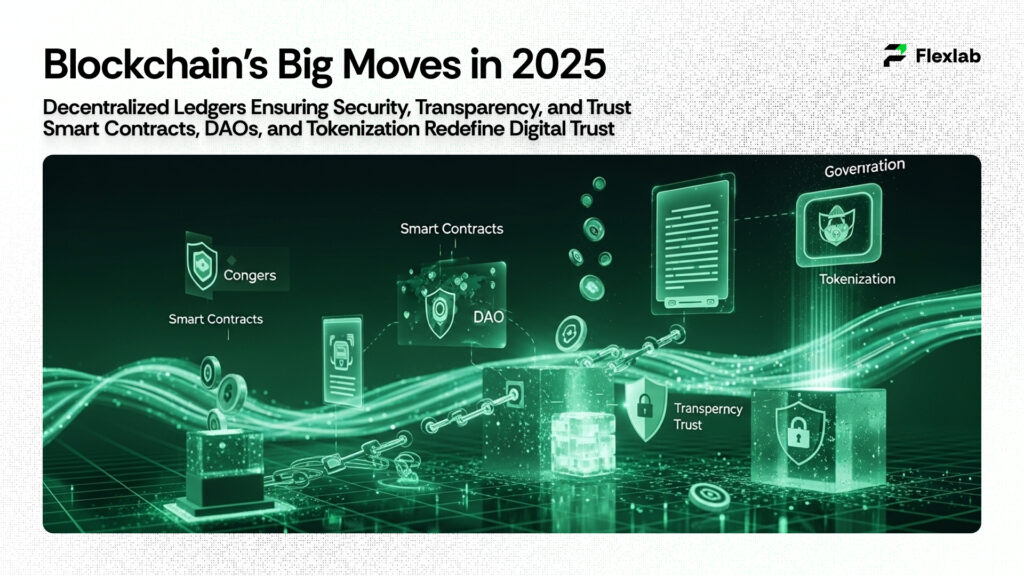
At its core, blockchain technology is a distributed ledger system that does not rely on central authorities. It uses collaborative mechanisms to validate and record transactions across a decentralized network. This structure ensures security and transparency. It is impossible to alter the data once it is written to the blockchain without consensus. Consequently, it’s ideal for fraud prevention and enhancing cybersecurity.
Its adaptability makes blockchain transformative. Through blockchain application development, the technology can be tailored for various industries, including healthcare, finance, logistics, energy, and entertainment. Smart contracts automate agreements, DAOs enable decentralized governance, and tokenization redefines ownership models.
For enterprises, the benefits are hidden in trust. When different parties share the same data source, disputes decrease, audits become easier, and compliance is simplified. For startups, blockchain becomes an outstanding opportunity to innovate without additional access to legacy systems.
Blockchain in 2025: Get Ready for These Surprises
The future of blockchain is closer than we think; it’s unfolding right now. Across industries, organizations are moving from small-scale pilots to enterprise-level integration. At the same time, startups prove that blockchain can solve real-world problems in multiple areas, including identity management, fraud prevention, and payments.
Blockchain Interoperability
One of the clearest signs of transformation is the rise of blockchain interoperability. In earlier times, users were locked into single chains. Today, multichain ecosystems facilitate seamless movement of digital assets, boosting the digital economy. Ultimately, it helps with practical applications of crypto investments, such as supply chain tracking and healthcare data exchange.
Decentralized Internet Platforms
Moreover, another critical transition shaping the digital era is the rise of the decentralized internet through blockchain-powered platforms. These innovative models shift power away from centralized authorities, giving users greater ownership and control over their data and interactions. As privacy concerns continue to intensify, blockchain-based solutions are therefore emerging as a trusted framework for transparency and security. Moreover, the decentralized internet is steadily revolutionizing our online connections by creating a brighter, more secure, and collaborative digital world.
Blockchain: The Secret Weapon for Business Growth in 2025
Enterprise blockchain adoption has moved from idea to reality. In 2025, real-world use cases are everywhere. For example, global banks are streamlining cross-border payments with blockchain, reducing transaction times from days to minutes.
Furthermore, Businesses are also turning to blockchain development services to modernize their operations. From building custom smart contracts to setting up private blockchains, enterprises are working closely with blockchain development companies to design solutions that solve unique challenges.
Reasons for this sudden transformation are trust and transparency. Whether it’s demanding more accountability, customers expecting higher security, or investors expecting efficiency, blockchain provides an answer. Its ability to record data permanently and share it securely across networks makes it a natural fit for modern enterprises.
Tokenization and Digital Assets Growth
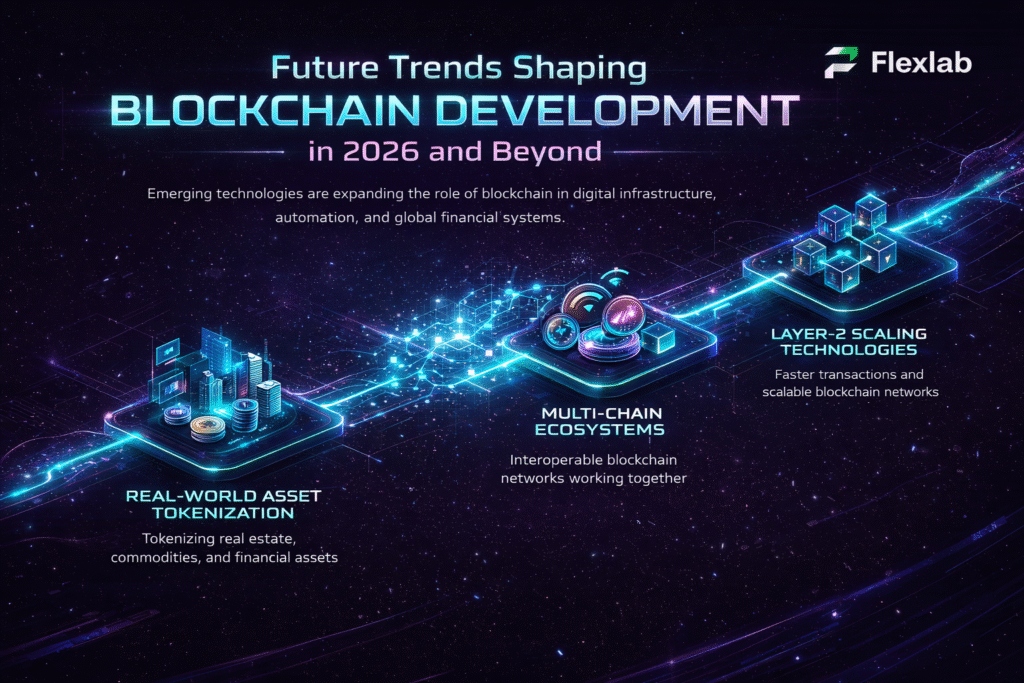
Tokenization is one of the most powerful blockchain applications in 2025. By converting real-world assets such as real estate, art, or intellectual property into digital tokens, businesses are enabling new forms of liquidity.
In addition, Financial institutions are also moving forward with Ethereum ETFs and other blockchain-based investment products. These developments bring legitimacy to the sector while offering traditional investors a bridge into the world of digital assets. It’s about integrating blockchain into the global financial infrastructure.
The Changes in Decentralized Finance (DeFi)
By 2025, decentralized finance (DeFi) is expected to have matured into a more stable and robust sector. The industry is focused on building scalable and long-lasting solutions. A main reason for this maturity is the shift toward proof-of-stake versus proof-of-work agreement models. Proof of stake drastically reduces energy consumption while maintaining network security.
However, DeFi is no longer just about lending, borrowing, or yield farming. Insurance protocols, derivatives platforms, and even fraud prevention systems are increasingly becoming part of the mix. Consequently, for enterprises, this means financial tools are now available outside traditional institutions, thereby giving them greater control and enhanced transparency.
Sustainability and Green Blockchain Initiatives
Sustainability has become a core focus of the blockchain ecosystem. Moreover, beyond proof-of-stake, companies are experimenting with renewable-powered mining facilities and tokenized carbon credits to further incentivize eco-friendly practices. As a result, by embedding sustainability into blockchain application development, developers are aligning technology with broader global goals.
Current Blockchain Market Statistics: A Snapshot of the Blockchain Transformation
Numbers often tell the true story, and blockchain’s growth progression is consistent and undeniable:
- The global blockchain market size is projected to exceed $150 billion by 2030.
- DeFi TVL, as of September 2025, is valued in the hundreds of billions, with Ethereum, Binance, and other protocols leading the charge.
- Over 40% of enterprises worldwide report some form of enterprise blockchain adoption in their operations.
- Demand for blockchain developers is increasing by double digits annually, as companies are ready to invest in specialized skills.
- Regulatory clarity surrounding Ethereum ETFs is attracting institutional investors, strengthening the role of blockchain in mainstream finance.
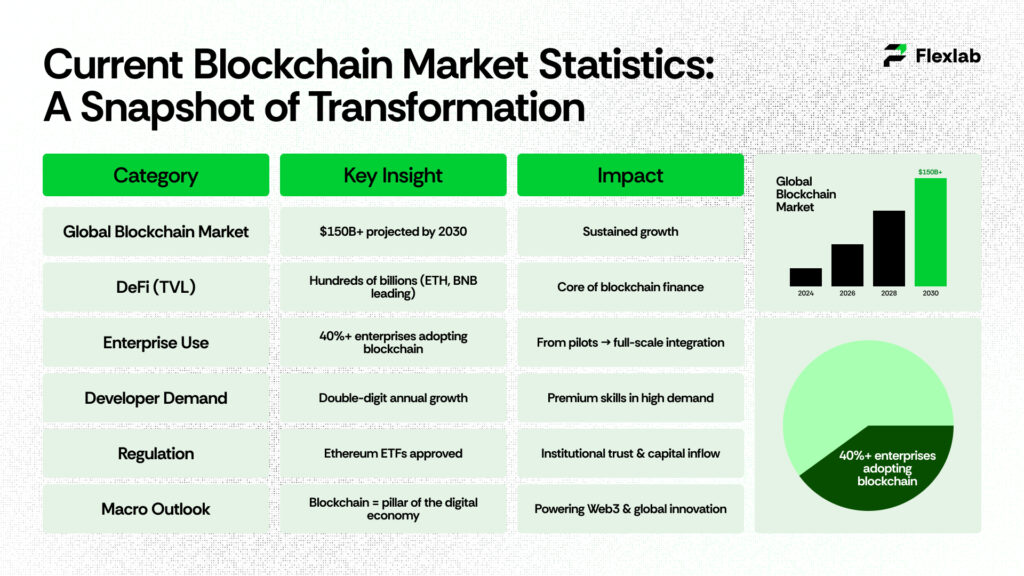
Finally, these statistics highlighted key points: blockchain is not just a trend; it’s a foundational pillar of the digital economy and the broader digital ecosystem.
Latest Emerging Blockchain Technologies
Innovation is a consistent evolution, and blockchain technology in 2025 is proving that once again. Key emerging technologies include zero-knowledge proofs, post-quantum cryptography, AI integration, and scalability solutions. These breakthroughs are shaping privacy, security, and performance in blockchain networks.
Top 10 Blockchain Trends in 2025
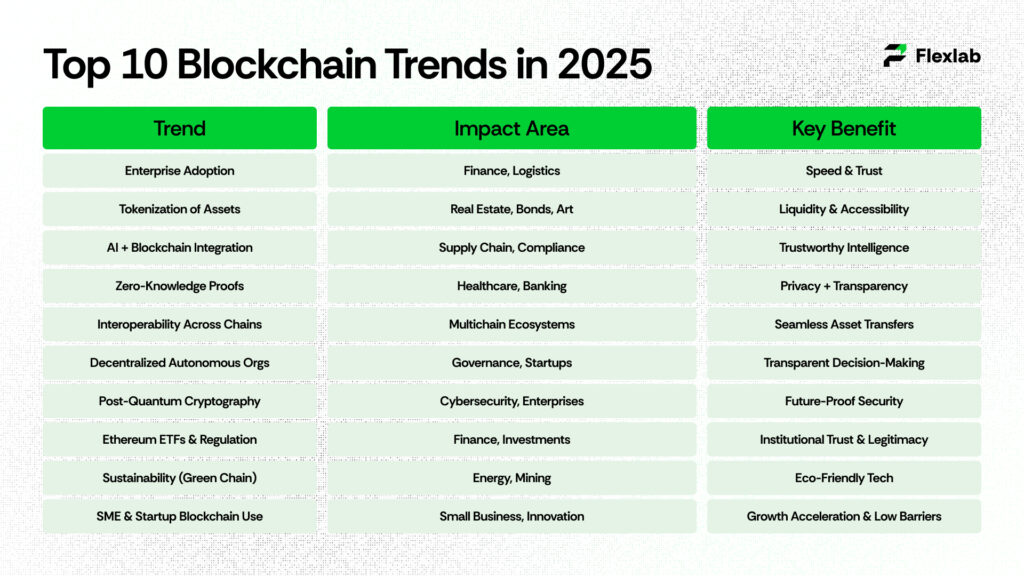
The top 10 Blockchain Trends in 2025 are as follows:
1. Enterprise blockchain adoption goes mainstream
2. Growth of tokenized assets
3. Integration of AI and blockchain
4. Zero-knowledge proofs for privacy
5. Blockchain interoperability across networks
6. Rise of decentralized autonomous organizations (DAOs)
7. Post-quantum cryptography testing
8. Regulatory clarity through Ethereum ETFs
9. Sustainability as a core blockchain value
10. Expansion of blockchain for startups and SMEs
1. Enterprise Blockchain Adoption Goes Mainstream
Corporations are integrating blockchain technology into their supply chains, banking systems, and compliance systems to scale. In 2025, major industries such as logistics, pharmaceuticals, and manufacturing are using blockchain to track goods, verify authenticity, and reduce fraud. Blockchain is no longer an experimental technology but has become a foundational layer for enterprises that want to adopt digital transformation.
2. Growth of Tokenized Assets
Tokenization of real-world assets (RWAs) is rapidly accelerating, thereby transforming markets for real estate, bonds, art, and commodities. In addition, investors can now purchase fractional ownership in physical assets, which not only enhances liquidity but also opens new doors to global participation. Ultimately, this trend is fundamentally reshaping traditional finance by merging physical and digital asset classes.
3. Integration of AI and Blockchain
AI and blockchain together create trustworthy intelligence. AI models can process massive amounts of data, while blockchain ensures tamper-proof transparency and auditability. Use cases include AI-driven supply chain optimization, automated compliance, decentralized insurance payouts, and fraud detection.
4. Zero-Knowledge Proofs for Privacy
Zero-knowledge proofs (ZK-proofs) are becoming a cornerstone of blockchain privacy. They enable transactions to be verified without revealing sensitive details, striking a balance between transparency and confidentiality. Enterprises in healthcare, banking, and identity verification are leading the adoption of ZK-proofs to ensure compliance with privacy regulations while maintaining trust.
5. Blockchain Interoperability Across Networks
Cross-chain solutions are rapidly breaking down the barriers of blockchain ecosystems. In 2025, interoperability protocols will therefore allow assets and data to move seamlessly between Ethereum, Solana, Polkadot, and enterprise blockchains. As a result, this advancement not only reduces fragmentation but also increases liquidity and improves user experience across decentralized finance (DeFi), gaming, as well as enterprise applications.
6. Rise of Decentralized Autonomous Organizations (DAOs)
DAOs are increasingly moving beyond crypto-native projects and into mainstream business models. For example, from venture capital funds to community-driven startups, DAOs are now providing transparent governance and decision-making frameworks. Moreover, enterprises are actively experimenting with hybrid DAO structures to better involve stakeholders and employees in governance, thereby creating more democratic and inclusive business ecosystems.
7. Post-Quantum Cryptography Testing
With quantum computing rapidly advancing, blockchain networks are therefore testing post-quantum cryptographic solutions. In 2025, the focus is increasingly on building resilience against potential quantum attacks that could compromise current encryption standards. Consequently, the early adoption of post-quantum algorithms not only enhances security but also positions blockchain networks as future-proof against emerging technological threats.
8. Regulatory Clarity through Ethereum ETFs
The approval and adoption of Ethereum exchange-traded funds (ETFs) are now giving institutions a safer entry point into the blockchain economy. Furthermore, this regulatory clarity not only signals legitimacy but also clears the way for increased participation from banks, pension funds, and asset managers. As a result, institutional capital is steadily flowing into tokenized markets, thereby increasing credibility and adoption worldwide.
9. Sustainability as a Core Blockchain Value
Environmental concerns are increasingly reshaping blockchain infrastructure. As a result, proof-of-stake (PoS), green mining, and carbon-neutral blockchain initiatives are now setting the standard for sustainable blockchain development. Moreover, enterprises and governments are actively prioritizing sustainability metrics, thereby making eco-friendly blockchain solutions a significant competitive advantage for adoption.
10. Expansion of Blockchain for Startups and SMEs
Blockchain is no longer just for large organizations; instead, it’s becoming a growth accelerator for small and medium enterprises (SMEs). In addition, startups are leveraging blockchain trends for social funding, smart contract-based compliance, and automated supply chain management. Furthermore, with blockchain-as-a-service platforms, SMEs can now adopt the technology more easily and efficiently, without facing large technical overheads.
Impact of Blockchain Trends on Industries and Digital Economy
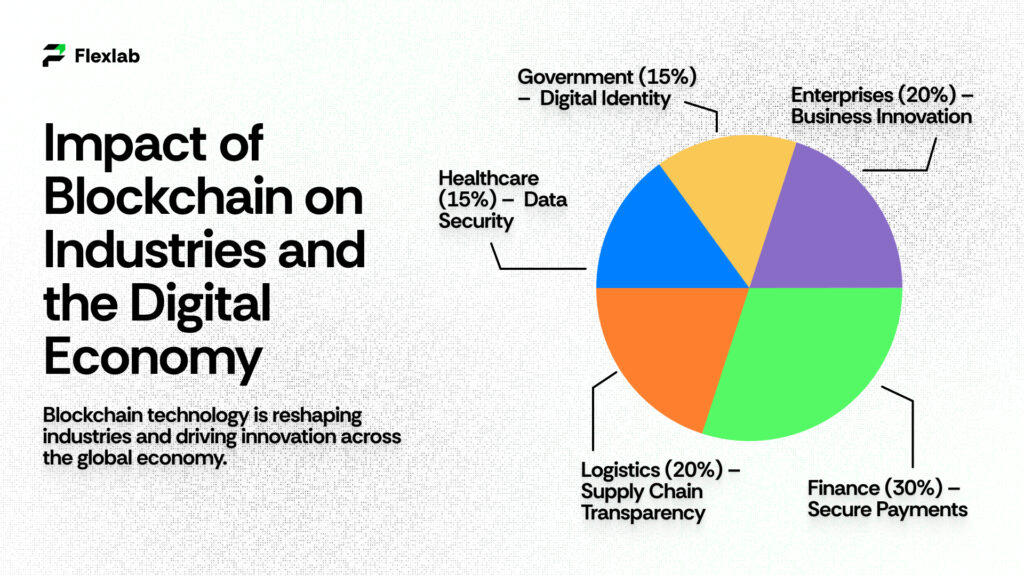
Blockchain technology is transforming various industries, revolutionizing the way businesses operate and interact with one another. For example, in finance, cross-border payments are faster, cheaper, and more secure. Similarly, in logistics, transparent tracking reduces fraud and ensures authenticity. Moreover, healthcare organizations are adopting blockchain to enhance cybersecurity and protect patient data.
Governments are also exploring blockchain technology for digital identity systems and transparent voting. The impact on the digital economy is massive, creating opportunities for businesses of all sizes. For enterprises, it’s a path toward resilience and innovation that was missing before.
Blockchain technology is reshaping industries and driving innovation across the global economy. The following chart highlights how blockchain adoption is distributed across key sectors:
Opportunities in Emerging Blockchain Trends
Blockchain offers a wide range of opportunities for an entrepreneur or innovator:
- Launching a blockchain software development company to serve enterprises.
- Offering specialized blockchain development services in finance, healthcare, or logistics.
- Developing cutting-edge blockchain solutions for startups, with a focus on sustainability and DAOs.
- Creating services to improve fraud prevention and blockchain interoperability.
The most successful ventures will be those that focus on scalable solutions and technologies that can adapt to growing market demands while effectively addressing real-world challenges.
Blockchain Innovations Are Redefining the Digital Economy Landscape in 2025
The digital economy is rapidly evolving, largely driven by the power of blockchain. In particular, decentralization is transforming power from centralized authorities to local communities, thereby empowering them to make decisions that have a greater impact on life experiences.
Tokenization is revolutionizing ownership structures. Meanwhile, AI integration is automating decision-making processes, while sustainable models are fostering responsible blockchain growth. Clearly, this is not just evolution — it’s transformation. For businesses and governments alike, leveraging blockchain represents a key opportunity for both growth and innovation.
Flexlab: The Partner You Need for Safe Blockchain Projects
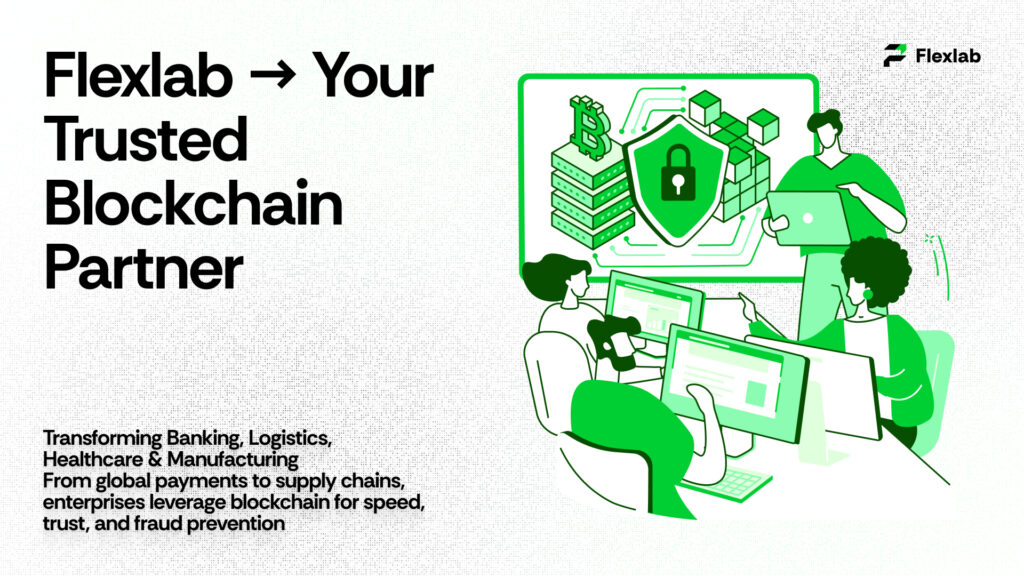
At Flexlab, we don’t just follow blockchain trends; we empower businesses to lead them. We go beyond building technology and create real business impact. Whether you’re a startup exploring blockchain for the first time or an enterprise seeking innovation at scale, Flexlab delivers the expertise and partnership you need to succeed. As a leading blockchain development company, we specialize in:
- Custom blockchain application development for enterprises and startups.
- Full-scale blockchain development services tailored to your industry.
- Digital transformation consulting to align blockchain with your business goals.
- Expertise in scalable solutions designed for global adoption.
Discover how Flexlab can accelerate your blockchain journey by exploring our services page, where we outline tailored solutions designed to fit your business needs. Take a look at our portfolio to see the innovative blockchain projects we’ve delivered for clients across industries. Stay connected with us on LinkedIn for expert insights and the latest trends in blockchain innovation. Are you ready to bring your ideas to life? Contact us and book a call directly with our experts, and we’ll help to turn your vision into impact.
Ready to Launch Your Blockchain Project?
📞 Book a FREE Consultation Call: +1 (416) 477-9616
📧 Email us: info@flexlab.io
With Flexlab, you don’t just get technology — instead, you gain a trusted partner in building your digital ecosystem and shaping the future of blockchain. Moreover, visit our blog page for more insights on the latest trends, use cases, and innovations shaping the digital economy.
You Might Also Be Interested In
- Why Flexlab is Your Best Choice for AI and Blockchain Application Development?
- What Are Smart Contracts? How Do They Work? A Beginner’s Guide
- AI vs Automation: Decoding the Differences for Business Success
Conclusion: What’s Next in Blockchain Trends
In 2025, blockchain is rapidly reshaping the digital economy through DeFi, tokenization, enterprise adoption, and sustainable solutions. Furthermore, with interoperability, AI integration, and zero-knowledge proofs, it’s evolving into a secure and scalable foundation for business and innovation. For instance, for startups, it opens new markets; similarly, for enterprises, it delivers trust and efficiency; and for investors, it signals long-term growth. Therefore, the message is clear: blockchain is no longer optional — it’s the foundation of tomorrow’s digital economy. Consequently, those who act now will lead the transformation ahead. Finally, Flexlab is here to help you unlock that potential through tailored blockchain development services.
FAQs
1. Is blockchain still relevant in 2025?
Absolutely. In 2025, blockchain will have become a core component of digital transformation across industries. It powers DeFi, supply chain tracking, and enterprise adoption. With Ethereum, ETFs, and clear regulations, institutional investors are also entering the space. Far from being a trend, blockchain is shaping the future of finance, business, and technology. Its growing adoption proves that blockchain is no longer optional; it’s essential for staying competitive.
2. How is blockchain helping with fraud prevention?
Blockchain’s transparency and immutability make it a powerful tool against fraud. Each transaction recorded on a blockchain is time-stamped and tamper-resistant, creating a reliable audit trail. Industries such as finance, healthcare, and supply chain are using blockchain to verify data authenticity and detect anomalies in real-time. Smart contracts reduce the risk of manipulation by automating trust between parties. By making fraudulent changes nearly impossible, blockchain significantly strengthens trust and security.
3. What opportunities does blockchain create for startups?
For startups, blockchain offers both technological innovation and a competitive advantage. It opens the door to decentralized applications (dApps), tokenization of assets, and new business models built on transparency and trust. Startups can leverage blockchain for fundraising through token offerings, streamline operations with smart contracts, or enter fast-growing markets like DeFi and Web3. By adopting blockchain early, startups gain agility and a chance to disrupt traditional industries with scalable, future-ready solutions.












3 Responses
Thank you for your sharing. I am worried that I lack creative ideas. It is your article that makes me full of hope. Thank you. But, I have a question, can you help me?