The Role of AI in Transportation for Autonomous Vehicles
Multi-Agent Systems | Web3 Technology | AI Development Company
Transportation underpins modern society, helping with the movement of people and goods across distances. In 2022, the global transportation industry had a market value of $7.31 trillion, underscoring its significant economic impact. Self-driving cars once felt like science fiction. However, today they are quietly navigating test routes, highways, and city streets worldwide. Behind this technological innovation, there is not a single breakthrough, but a collection of intelligent systems working together. At the center of it all is artificial intelligence (AI), processing millions of decisions like human drivers, without thinking. From self-driving cars to smart traffic management systems, AI in transportation is improving mobility while reducing congestion and environmental impact.
AI does not just replace the driver; it replaces perception, judgment, reaction, and learning, all at machine speed. This blog will break it all down in a simple and precise way and explain how AI-powered solutions are the backbone of autonomous driving.
How is AI Transforming Transportation?
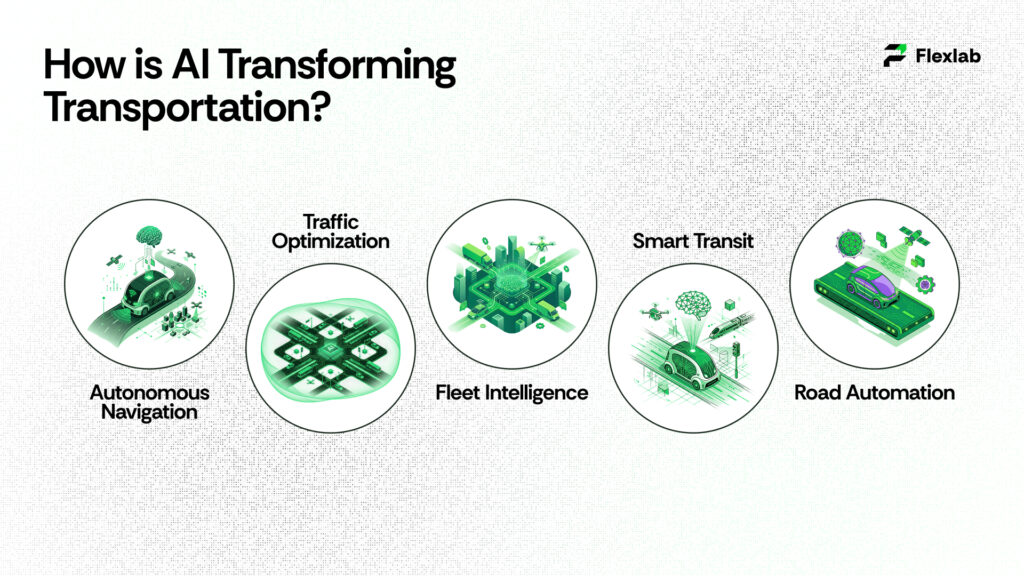
AI is integrated into different operations and aspects of transportation, streamlining operations and enhancing user experiences. Here is how AI is transforming the transportation industry.
- AI in self-driving cars, trucks, and buses helps navigate roads safely with the help of cameras, sensors, and deep learning models.
- With the help of AI algorithms, autonomous technology helps analyze real-time and historical data to optimize traffic signals, improve urban mobility, and significantly reduce congestion.
- In the fleet management system, AI solutions help logistics companies evaluate vehicle performance, optimize routes, and predict maintenance needs.
- AI, with the help of machine learning algorithms, helps improve public transportation by predicting demand, adjusting schedules, and enhancing user or passenger experiences.
- AI-powered road monitoring systems help establish smart city infrastructure by detecting hazards, automating toll collection, and improving the overall quality of transport.
Shortly, autonomous vehicles depend on AI not just to move forward, but to move safely and smoothly in real-world scenarios.
AI in Transportation for Autonomous Vehicles
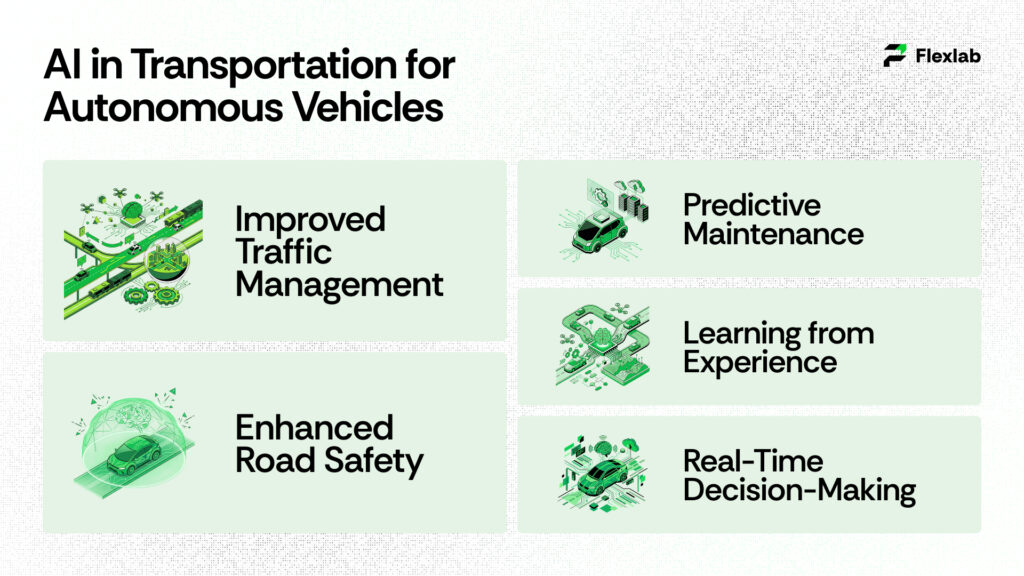
1. Improved Traffic Management System
AI-powered intelligent traffic management systems are redefining how cities deal with congestion. By monitoring and analyzing real-time data from cameras, sensors, and GPS systems, AI helps optimize traffic flow, helping reduce delay and fuel consumption.
For instance, AI-driven traffic lights in Pittsburgh, Pennsylvania, have helped reduce travel time by 25% and vehicle emissions by 20%. Through sensor fusion, these autonomous systems adjust signal timings based on real-time traffic conditions, avoiding unnecessary stops and helping ease congestion.
AI also supports high-definition maps like Google Maps and Waze, providing people with the fastest routes based on live traffic condition updates. Urban mobility will continue to improve, as more cities tend to adopt AI-driven smart traffic solutions.
Artificial intelligence in autonomous vehicles also supports route optimization. It evaluates traffic patterns, weather conditions, and road usage to select routes that reduce congestion and improve efficiency. This is not just about getting from one location to another faster, but about smoother traffic flow for everyone.
2. Teaching Vehicles to See the Road
One of the greatest challenges for autonomous vehicles is perception. Just like human drivers depend on vision and hearing to understand what is happening around them, autonomous vehicles rely on AI. Cameras, radar, and sensors collect raw information from the surroundings. On their own, these inputs or pieces of information are meaningless streams of data. However, AI helps turn them into understanding.
Moreover, AI models identify lanes, traffic lights, pedestrians, cyclists, vehicles, road edges, and obstacles. They make real-time vehicle tracking possible, even when conditions are not ideal. Unforeseen environments like fog, rain, shadows, or poor lighting can confuse traditional systems. However, AI learns from vast and different datasets in different environments, allowing it to recognize subjects even when they are partially hidden or distorted.
This ability to ‘see’ accurately is essential. Without AI-powered perception, autonomous vehicles would not know where the road ends or where danger begins.
3. Enhanced Road Safety
AI is significantly improving road safety by preventing human errors, which account for over 90% of traffic accidents all around the globe. Advanced Driver Assistance Systems (ADAS) driven by artificial intelligence can detect lane violations and issue warnings. It can also evaluate driver behavior to avoid drowsy or distracted driving. Furthermore, on top of it all, it can automatically apply brakes to avoid collisions. AI-powered dashcams and in-cabin monitoring systems are also becoming standard for commercial fleets, helping recognize unsafe driving behaviors and ensuring compliance with safety standards.
Additionally, AI systems do not miss signals, ignore signs, or drive unsafely under emotional stress. AI systems are tested extensively in simulated environments before being implemented or deployed. They are exposed to millions of scenarios, including rare and dangerous ones, to make them even more efficient.
4. Predictive Maintenance
Traditional vehicle maintenance is often reactive, resulting in costly breakdowns and unforeseen repairs. However, AI-enabled predictive maintenance tools tend to analyze sensor data to recognize potential mechanical issues before they become serious problems that need extensive solutions. For example, AI-driven systems in commercial fleets help monitor engine health, tire pressure, and brake performance. If a problem is detected, the system warns the operator to schedule maintenance, avoiding expensive downtime.
In the aviation industry, AI-powered predictive maintenance is helping airlines minimize delays and maintenance costs. Such advanced transportation systems help reduce operational costs and enhance reliability, making transportation more efficient and reliable for both businesses and consumers.
According to a study by UIC, operators who installed predictive maintenance saw a 15% boost in reliability and a 20% reduction in maintenance costs.
5. Learning From Experience
One of the greatest advantages of AI in autonomous vehicles is its ability to learn from experience. Every mile driven generates data. This data feeds into autonomous vehicle software, helping it enhance object-detection, prediction accuracy, and decision-making strategies. When a vehicle comes across a rare event, that experience can be shared across an entire fleet. This translates into the improvement of the whole fleet because of one vehicle’s experience. Human drivers learn individually; however, autonomous vehicle software integrates AI systems to learn collectively.
Over time, this shared learning reduces errors, improves safety, and helps autonomous systems handle edge cases that are difficult to program manually.
6. Decision-Making in Real Time
Once an autonomous vehicle understands its surroundings, it decides on its own about what to do. This is where AI becomes the decision-maker, adjusting its behavior based on the required level of autonomy, whether it is helping a human driver or working fully on its own.
Should the vehicle completely stop or slow down? Is it safe to switch lanes? How close is too close? With AI integration in vehicles, these decisions are made continuously while balancing safety, comfort, and traffic rules.
AI systems balance multiple factors at once. They tend to consider speed limits, road conditions, nearby vehicles, and legal constraints. This kind of visual understanding is often driven by a Convolutional Neural Network (CNN), which helps the vehicle interpret camera images and recognize critical objects on the road. Unlike human drivers, AI does not get distracted or fatigued, and it applies the same rules and decision logic consistently every time.
What makes this strong is adaptability. AI does not rely on a single rigid rule. It evaluates situations dynamically, choosing the safest and most efficient action based on real-time data.
7. Understanding Movement and Behaviour
Seeing and identifying objects is only the first step. Autonomous vehicles must also understand and detect what other vehicles are likely to do next.
AI helps vehicles analyze movement patterns to predict behavior. It also identifies whether a pedestrian is about to cross the road, whether a nearby car is going to change lanes, or whether a cyclist is slowing down. All of this happens in fractions of a second.
With AI implementation in transportation, this is very critical because safe driving depends on the right anticipation. It mimics human drivers who constantly make assumptions based on their experience. Similarly, AI also works like this, but at a much larger scale. It learns from millions of scenarios that allow it to detect even minor signals that indicate risk or change.
With the help of collision avoidance systems, autonomous vehicles predict motion rather than just reacting to it. Consequently, it helps autonomous vehicles drive more smoothly and responsibly, avoiding sudden and unsafe maneuvers.
Real World Examples of AI in Transportation
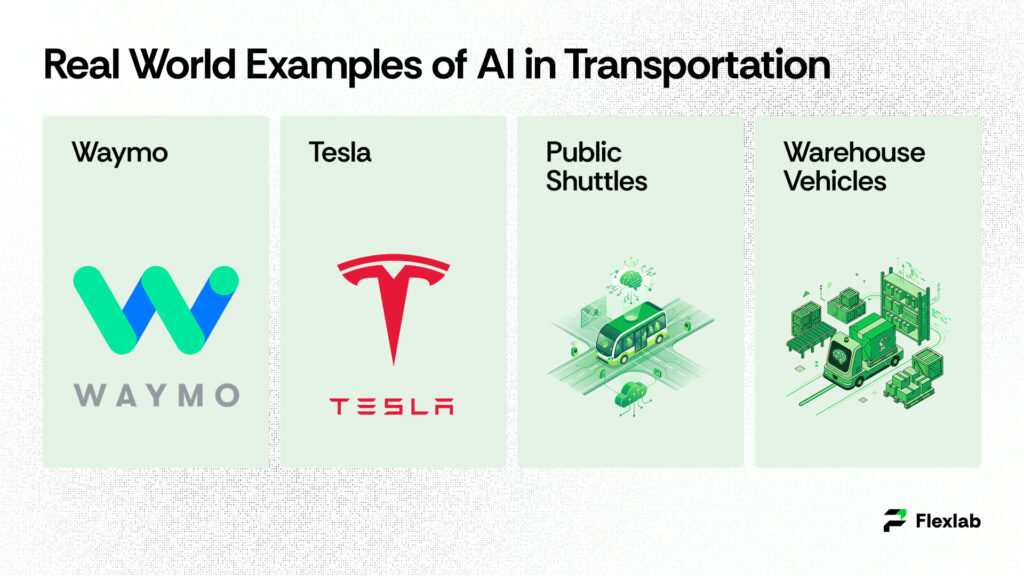
Autonomous vehicles are no longer a science-fiction concept; they are making a real appearance all over the globe now. Here are some of the real-world examples of AI in transportation;
- Waymo uses AI to operate driverless taxis in selected cities. The taxis use AI to handle pedestrians, complex turns, and heavy traffic using real-time learning and decision-making.
- Tesla uses camera-based AI instead of heavy dependence on maps. Their vehicles improve continuously through data collected from different vehicle experiences on the road.
- Public Shuttles: Self-driving public shuttles mostly operate on fixed routes in airports, campuses, and business parks. These vehicles have AI integration to safely navigate pedestrians and short-distance routes.
- Warehouse Vehicles: AI-driven warehouse vehicles are used to transport goods inside the warehouse and ports. These autonomous vehicles help improve efficiency and reduce accidents in controlled environments.
Challenges of Autonomous Vehicles
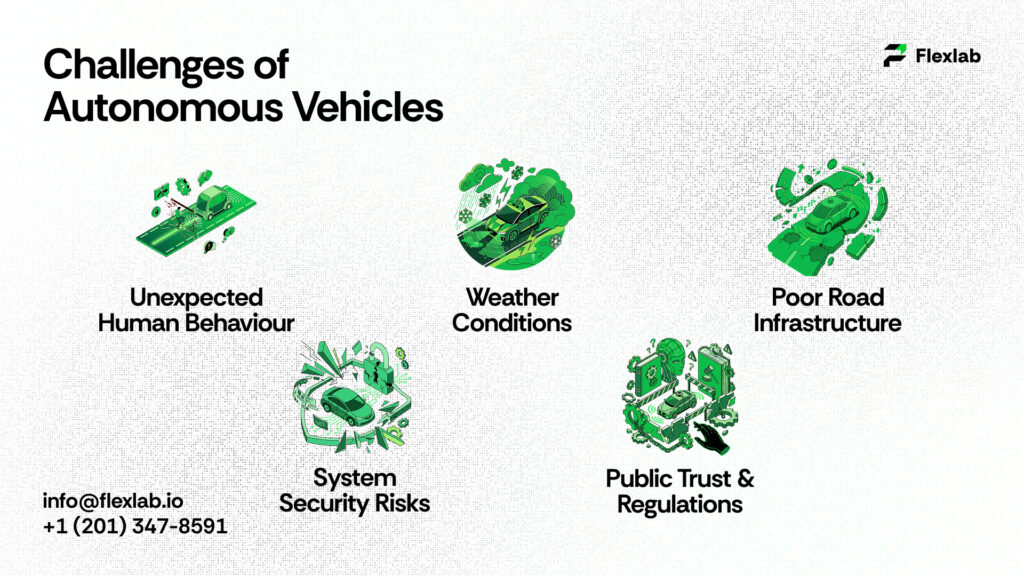
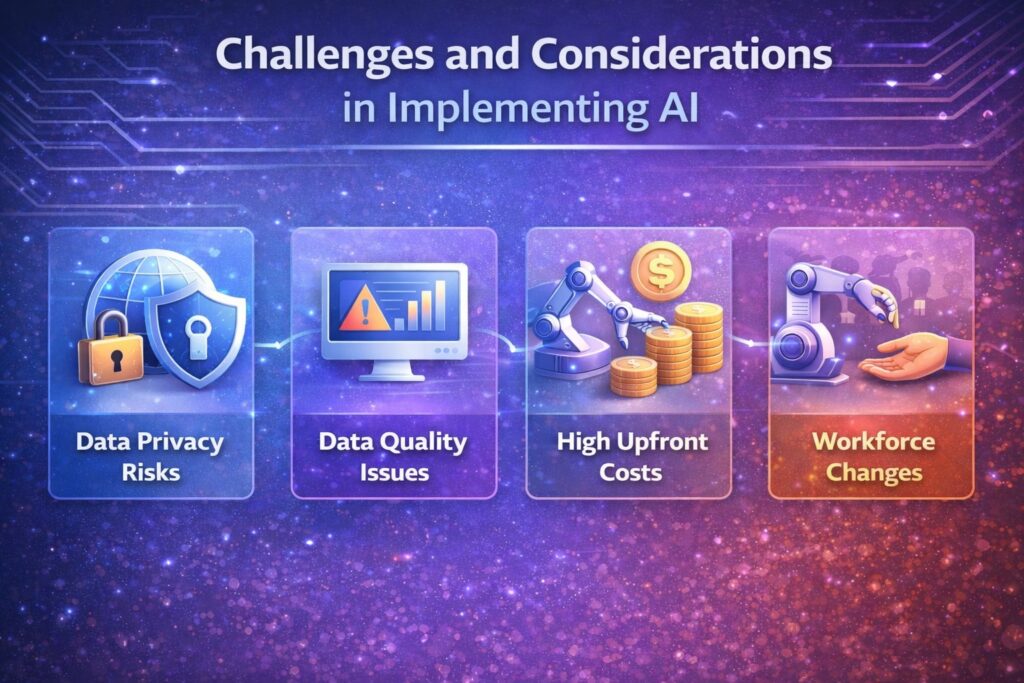
Alongside a huge number of benefits, there are some challenges as well that autonomous vehicles have to come across.
- Human Behaviour: Human behaviour can be unpredictable; drivers may ignore rules, and pedestrians may jaywalk. AI must constantly adjust to human mistakes.
- Weather Conditions: Unforeseen or difficult weather conditions, such as snow, fog, rain, and glare, may interfere with sensors and the AI-driven vision system.
- Poor road infrastructure, such as faded lane markings, broken signals, and unclear signage, tends to confuse AI systems.
- System Security Risks: Autonomous vehicles are prone to security risks. Therefore, they must be protected from system failures and cyber threats.
- Public Trust and Regulations: Many people still doubt the accuracy of AI-driven self-driving cars or autonomous vehicles. Governments must set safety standards and regulations before the mass adoption of AI-integrated autonomous vehicles.
Concluding Remarks About AI in Transportation
Autonomous vehicles are not driven by magic or mystery. They are driven by systems driven by intelligent automation that see, learn, decide, and adapt in real time. From understanding the road to predicting behavior and making split-second decisions, Artificial intelligence supports every important function of autonomous transportation. What makes this technology powerful is not just automation, but intelligence. AI allows vehicles to grow safer with experience, smarter with data, and more responsive to the world around them.
As transportation continues to evolve, AI will remain the engine behind autonomy, secretly transforming how we move through the world. As AI continues to strengthen, autonomous vehicles will become more capable, more reliable, and more integrated into everyday life. They will perform logistics, public transport, personal travel, and emergency services in ways that go beyond driving itself.
Move Ahead with AI Automated Business Operations
The future of transportation is intelligent, connected, and automated with AI, and Flexlab is here to help you bring that change. Whether you run a logistics company, fleet service, mobility startup, or public transport operation, we build AI software that turns your data into real action. From route optimization and vehicle tracking to autonomous system support and safety analytics, Flexlab designs solutions tailored to your unique business goals, not generic templates.
Our team works closely with you to have a clear and detailed understanding of your workflows, challenges, and growth plans, then builds reliable AI tools that improve efficiency, reduce costs, and enhance safety across your operations.
Ready to Grow Your Business
📞 Book a FREE Consultation Call: +1 (416) 477-9616
📧 Email us: info@flexlab.io
Discover real-world success stories in our portfolio, have a look at our solutions, and get your AI development solutions today. Contact us or have a look at our services. See what our clients have to say about us and how you can start your AI-powered transport journey with us.
To have more detailed insights into different topics, explore our blog page for more blogs like public vs private blockchain, benefits of using white label crypto exchanges for startups, and what is multimodal AI?
FAQs
How will AI transportation change the world?
AI transportation will reduce accidents, cut travel time, and make mobility safer by removing human error from the road. It will reshape cities with cleaner traffic flow, lower emissions, and smarter, more accessible transport for everyone. Also, it will ensure reduced labor costs while providing higher profits.
Which car brands are using AI?
Car brands utilizing AI today include Tesla, Mercedes-Benz, BMW, Toyota, and Hyundai, all of which integrate AI for features such as autonomous driving assistance, smart navigation, and in-car intelligence. Other examples include Audi, General Motors (GM), Ford, and Chinese manufacturers such as Baidu’s robotaxi projects and AITO, which utilizes Huawei AI, demonstrating AI applications across driving, safety, and user interface.
What is the future of AI in travel?
AI will make travel smoother by planning trips for you, avoiding delays, and keeping journeys safer and less stressful. It will also create more personalized experiences, so travel feels easier, greener, and built around real people’s needs.