
Empower Your Digital Transformation Strategy with AI and Blockchain Innovation
AI in Digital Marketing | What is Web3 | Benefits of AI Agents
Why does a digital transformation strategy fail? Even high-tech companies with proven track records struggle to find effective ways to upgrade their digital transformation strategies. Don’t worry! We have conducted detailed research and identified the top digital transformation strategies that work wonders for businesses and help them thrive to the next level.
Without wasting your time, let’s dive into these helpful insights and boost your chances to rock your business in the digital landscape.
What is Digital Transformation?
Digital transformation is a business strategy through which organizations incorporate digital technologies into all areas of their business, fundamentally changing how they operate and deliver value to customers. It contains embedding digital solutions across operations, which update technology; additionally, it requires cultural and organizational shifts to meet market demands and customer expectations. This ultimate approach of transformation enables businesses to innovate, increase efficiency, generate new revenue streams, and improve customer experiences in a competitive and rapidly evolving environment.
Here are some key aspects of digital transformation that include:
- Moving beyond digitization, which involves turning ideas into digital form, to rethinking the whole business, such as the models you use, the ways you work, and how you connect with your customers.
- Utilizing technologies including Artificial Intelligence, machine learning, Internet of Things, advanced analytics, and cloud computing.
- Quickly adapting to agility and being responsive where market changes and new opportunities as they appear.
- Getting every leader on the same page, often led by a chief information officer CIO or a dedicated digital transformation office.
- Tracking progress via a key performance indicator (KPI) while ensuring measurable business improvement.
In short, digital transformation is both a technological and cultural evolution that allows organizations to stay competitive, relevant, and innovative in the digital landscape.
What’s Blockchain’s Role in Digital Transformation?
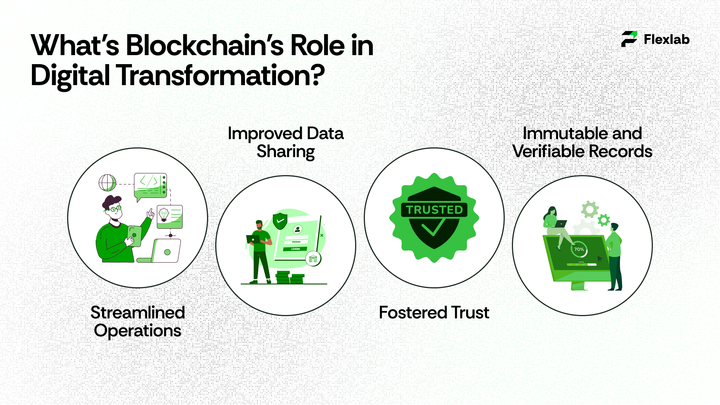
Blockchain is a decentralized ledger technology DLT that plays a significant role in digital transformation strategy by enabling:
- Streamlined operations
- Improved data sharing
- Fostered trust
- Immutable and verifiable records
It enhances security and transparency, which are crucial for achieving digital transformation goals such as agility, improved collaboration, and operational efficiency. Moreover, blockchain enables the automation of transactions through smart contracts, which execute predefined conditions, decreasing reliance on intermediaries and accelerating operations. It boosts data integrity and traceability, which are vital in sectors such as supply chain management, where blockchain can track products from origin to delivery. Hence, this approach ensures authenticity and reduces the risk of fraud.
Related Read: How To Use AI in Fraud Detection in 2025?
The technology supports secure and efficient collaboration across organizational boundaries by allowing trustworthy data sharing without centralized control. Additionally, blockchain assists businesses in tailoring to customer demands for transparency and regulatory compliance by giving a clear audit trail for all transactions. It also integrates innovation through decentralized applications that manage across hybrid cloud environments. Overall, blockchain helps modernize and improve business systems, making them more agile, open, and customer-focused.
What’s AI’s Role in Digital Transformation?
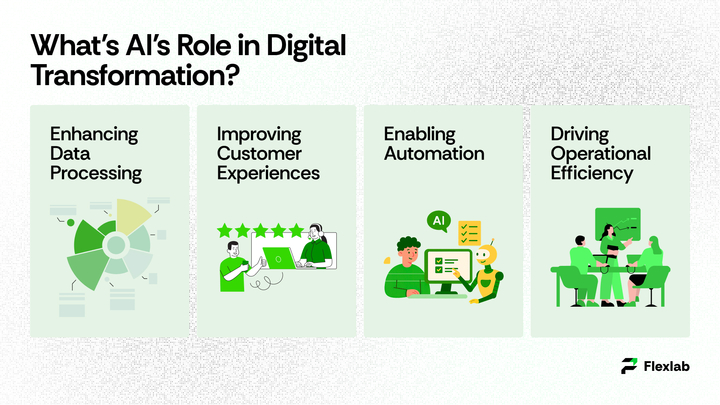
Artificial Intelligence (AI) plays a transformative role in digital transformation by:
- Enhancing data processing
- Improving customer experiences
- Enabling automation
- Driving operational efficiency
AI excels at quickly evaluating and vetting large amounts of data using machine learning and advanced analytics to uncover patterns, trends, and correlations that traditional tools may be unable to do. This capability provides organizations with deep insights into operations, customer behavior, and market trends; therefore, it supports more informed decision-making.
Moreover, AI significantly boosts customer interactions via AI tools, including chatbots and virtual assistants, which use natural language processing to understand and respond to human language; hence, it improves satisfaction with personalized recommendations. An AI-driven system goes beyond simply automating routine tasks. In fact, it learns and adapts over time, thereby making operations more flexible and highly efficient.
It also supports predictive analytics and decision-making by forecasting trends and managing risks, enabling organizations to be proactive and resilient. Furthermore, AI introduces intelligent automation into complex business processes, improving accuracy, reducing errors, and accelerating workflows. Through these capabilities, AI acts as a catalyst that helps businesses innovate, optimize strategies, and achieve successful digital transformation.
Key Components of Digital Transformation in Blockchain and AI
Digital transformation powered by AI and blockchain application development goes beyond technology adoption. It’s about reshaping how organizations operate, make decisions, and build trust.
Below are the core components that drive this transformation:
- Data Integrity & Transparency:
Blockchain makes every transaction and record permanent and easy to track, thereby building trust without the need for middlemen. Furthermore, this transparency is especially important for sectors such as finance, healthcare, and logistics, where data integrity and security are critical. - Intelligent Automation (AI):
AI automates tasks by learning from data, predicting outcomes, and making decisions without human intervention. As a result, it significantly improves efficiency while reducing the likelihood of errors. - Secure & Decentralized Infrastructure:
Combining AI and blockchain creates a safe system where data is processed openly but kept private using techniques like Trusted Execution Environment (TEE) and zero-knowledge proof. - Smart Contracts & Autonomous Agents:
Smart contracts automatically carry out agreements when conditions are met, and AI agents work independently within blockchain ecosystems to manage tasks like payments or supply chains. - Data Privacy & Confidential Computing:
Blockchain confirms data authenticity, while TEEs and encryption keep data secure, allowing AI to work with private data safely. - Interoperability & Integration:
Digital systems connect across different blockchains and platforms with APIs and tools, making sure AI and blockchain work well with existing enterprise systems. - Governance & Compliance:
Blockchain provides a clear, unchangeable record to audit, while AI helps enforce rules automatically, ensuring trust and accountability. - User-Centric Experience:
AI personalizes services for users, and blockchain guarantees secure ownership of digital identities and assets, creating a safe, user-controlled experience.
Why Digital Transformation Is Important in AI and Blockchain?
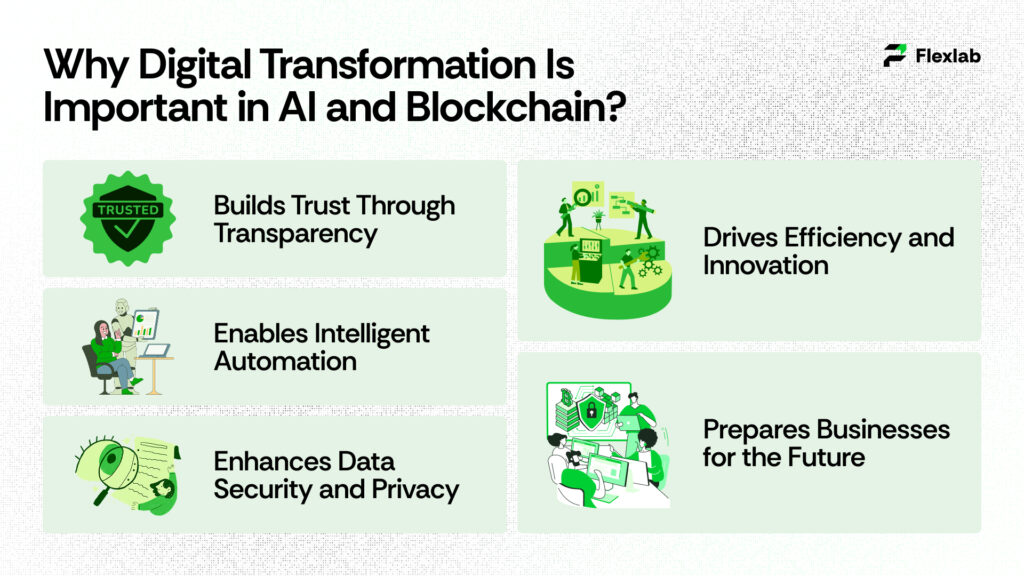
Digital transformation strategy is essential because it helps businesses evolve from manual, disconnected systems to intelligent, secure, and transparent ecosystems powered by AI and blockchain. Together, these technologies redefine how data is processed, shared, and trusted, forming the foundation of the next digital era.
1. Builds Trust Through Transparency
Trust is the foundation of the digital transformation journey. That’s where blockchain comes in. It ensures transactions and data are immutable, verifiable, and tamper-proof. Because of this, it creates a layer of digital trust that helps organizations operate with greater accountability and integrity.
2. Enables Intelligent Automation
AI automates complex decision-making and improves efficiency through data-driven insights. Moreover, a strong digital transformation strategy allows AI to integrate seamlessly into business workflows, thereby turning raw data into smart, actionable outcomes. Consequently, organizations can make faster, more accurate decisions that drive sustainable growth.
3. Enhances Data Security and Privacy
With rising cyber threats, blockchain and AI, combined with secure architectures like Trusted Execution Environments (TEEs) and advanced cybersecurity solutions, protect sensitive data while maintaining performance and scalability. These combined technologies ensure that organizations can pursue digital transformation securely without compromising on trust or compliance.
4. Drives Efficiency and Innovation
Digital transformation not only eliminates outdated, siloed systems but also enables real-time collaboration between AI and blockchain networks. As a result, businesses experience faster operations, lower costs, and smarter, more efficient business models. Moreover, this seamless integration drives innovation and enhances overall productivity.
5. Prepares Businesses for the Future
As industries shift toward decentralization and automation, companies that embrace digital transformation gain a competitive edge in scalability, trust, and intelligence.
How to Upgrade a Digital Transformation Strategy Using AI and Blockchain
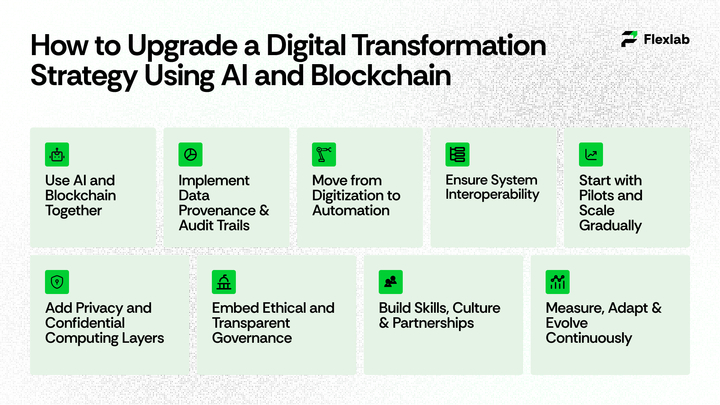
Here are the digital transformation strategies that leverage AI and blockchain technology.
1. Review your Strategy while Keeping both Technologies in Mind
Before integrating AI or blockchain, have a look at the other side of your digital transformation plan. Ask yourself: Which parts of your business are slow, unclear, or don’t have enough trust? Focus on those. The idea is to make AI and blockchain work together. AI helps with smart decisions, and blockchain keeps data safe and trustworthy rather than treating them as separate tools. Research shows that companies that combine both get better results.
2. Introduce Data Provenance and Immutable Audit Trails
One powerful upgrade is to incorporate blockchain-based data provenance into your data pipelines feeding AI models. This ensures that every piece of input data can be traced and verified, helping reduce bias, tampering, and unaccounted changes in model performance. In real deployments, companies use blockchain to lock data logs and version changes, which supports accountability and compliance.
3. Design Confidential Computation & Privacy Layers
AI often works with sensitive or private data. To upgrade your strategy, embed confidential computing techniques (e.g., TEEs, homomorphic encryption, zero-knowledge proofs) into your transformation stack. This enables AI models to compute on encrypted or shielded data while blockchain records attestations without exposing raw inputs. Recent research proposes hybrid AI/blockchain architectures to balance privacy and scalability. Discover our AI and machine learning capabilities designed for seamless integration and intelligent automation.
4. Move from “Digitize” to “Autonomize”
Digital transformation often begins by digitizing analog or manual workflows. The upgrade is to let AI agents + smart contracts assume control of those workflows under predefined rules and constraints. For example, an AI agent could analyze a request and automatically trigger a blockchain transaction when conditions are met, without human intervention. This elevates the transformation from efficiency to autonomy.
5. Ensure Interoperability Across Chains and Systems
Your upgraded strategy must break silos. To achieve this, AI, blockchain, and legacy systems should interoperate seamlessly through APIs, oracles, cross-chain bridges, and middleware. Otherwise, without smooth data flow, the combined power of AI and blockchain remains limited. Therefore, adopting a modular architecture, standardized interfaces, and interoperable protocols is essential to ensure scalability and future expansion.
6. Embed Ethical, Transparent AI Governance
Upgraded strategies must treat ethics, explainability, and bias mitigation as first-class design requirements. Moreover, organizations should use blockchain as an impartial log of AI decision paths and governance rules. As a result, stakeholders gain clear visibility into how models reach conclusions, rather than just viewing the outcomes. In fact, several cross-border AI governance proposals are already leveraging DLT to establish trusted and transparent frameworks.
7. Scale Gradually with Pilot → Expand
Don’t attempt a full-scale overhaul immediately. Start with pilot projects in critical business units to test AI + blockchain modules. Capture lessons, monitor metrics (accuracy, latency, adoption), and then iterate outward. This staged scaling also helps manage costs, risk, and stakeholder buy-in.
8. Build Capability, Skills, Culture & Partnerships
Upgrading your strategy means growing your internal capabilities. Train teams in AI, blockchain protocols, privacy tech, and cross-domain integration. Also, collaborate with specialized partners or vendors (e.g., for cryptography, data pipelines, or secure enclave design). The transformation succeeds only when people and technology evolve together.
9. Measure, Adapt & Evolve
Finally, your strategy must become adaptive. Continuously monitor KPIs (system reliability, trust metrics, ROI, latency, error rates). As new AI techniques or blockchain standards emerge (e.g., quantum-safe crypto, agentic AI), integrate them iteratively. Strategy is not static; it’s an evolving engine for innovation.
Challenges of Digital Transformation
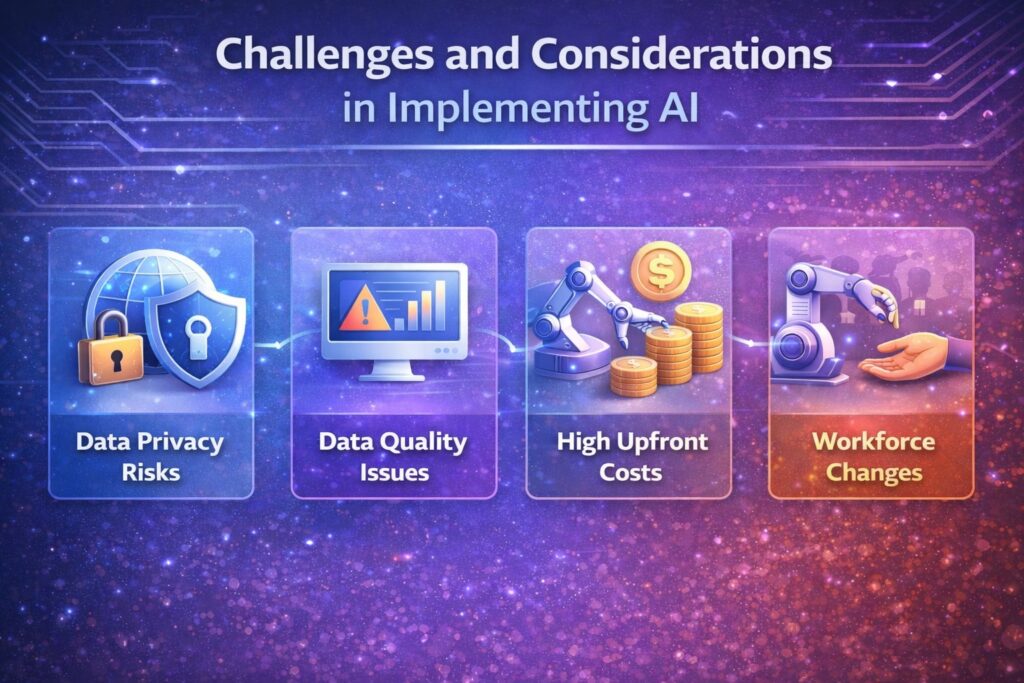
Digital transformation strategy promises agility, innovation, and data-driven decision-making, but executing it successfully remains one of the toughest challenges for modern organizations. According to McKinsey, more than 70% of transformation initiatives fail to achieve their intended goals due to organizational, cultural, and technical barriers. Below are the major digital transformation challenges organizations face when adopting digital transformation, especially when integrating advanced technologies like AI and Blockchain.
- Lack of Clear Vision and Strategy
- Cultural Resistance to Change
- Integration with Legacy Systems
- Data Security and Privacy Risks
- High Implementation Costs
- Lack of Skilled Talent
- Managing Data Quality and Governance
- Measuring ROI and Business Impact
- Compliance and Regulatory Challenges
- Over-Reliance on Technology Without Human Alignment
Digital transformation strategy faces several significant challenges. One major challenge is the lack of a clear vision and strategy, where many organizations adopt AI, blockchain, or AI automation tools without defining specific business problems; hence, it leads to fragmented projects with poor returns. Alongside this, cultural resistance to change presents a barrier, as employees may fear automation and show reluctance towards new processes without a culture that encourages experimentation. Integration with legacy systems also hampers progress due to incompatible old infrastructures, causing data silos and increased costs, necessitating gradual modernization and API-based approaches.
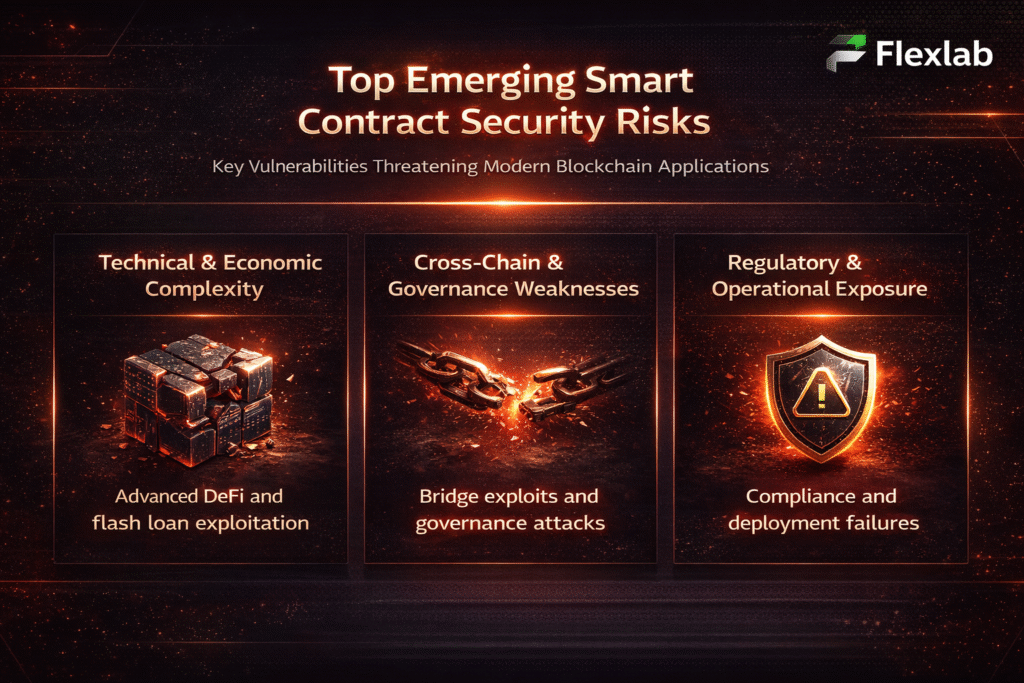
Moreover, data security and privacy risks grow as more information flows digitally, introducing vulnerabilities like smart contract exploits, requiring robust encryption and privacy-preserving methods. High implementation costs further limit transformation, especially for SMEs, although cloud and open-source solutions help lower these barriers. The shortage of skilled talent in AI, blockchain, and cybersecurity fields adds another hurdle, addressed by upskilling and expert partnerships. Managing data quality and governance is essential for accurate AI analytics and compliance, with blockchain aiding traceability. Many organizations struggle to measure ROI and business impact effectively without clear KPIs; combining financial and operational metrics is key.
Additionally, compliance and regulatory challenges also arise from evolving laws like GDPR and AI Act, requiring agility in response. Lastly, over-reliance on technology without human alignment and leadership commitment risks failure, as successful transformation depends on collaboration and engagement across the organization.
How Flexlab Solves these Digital Transformation Challenges
At Flexlab, we help organizations go beyond technology hype and achieve real, measurable transformation using AI, Blockchain, and Confidential Computing. Our digital transformation consulting services guide you through turning ambitious digital visions into secure, intelligent, and scalable ecosystems that drive growth, trust, and long-term resilience.
-
Flexible, Goal-Driven Roadmaps for Business Success
We begin every engagement with a clear digital roadmap that properly aligns AI and blockchain adoption with business goals, not buzzwords. For example, one of our financial services clients wanted to modernize its operations by automating transaction verification and compliance. Flexlab designed a blockchain-based audit trail powered by AI-driven anomaly detection, which reduced manual oversight by 60% and eliminated data discrepancies across departments. This combination of automation and verifiable transparency turned compliance from a bottleneck into a competitive advantage.
-
Empowering Teams Through Skills and Adaptation
We know technology alone doesn’t transform companies; people do. That’s why Flexlab helps teams adapt and upskill through guided onboarding and workflow optimization. In a recent collaboration with a healthcare analytics startup, our team implemented AI models for predictive diagnosis that ran securely within Trusted Execution Environments (TEEs). The project allowed the company to handle patient data responsibly while complying with HIPAA and GDPR, achieving both innovation and data integrity.
-
Modernizing Legacy Systems with Seamless Integration
For enterprises still relying on legacy systems, we offer API-driven modernization that integrates seamlessly with AI and blockchain platforms. For instance, a logistics partner approached us to reduce supply chain delays and fraud risks. Flexlab built a decentralized logistics tracking system that used blockchain for real-time shipment verification and, at the same time, leveraged AI for route optimization. As a result, within just three months, the company achieved a 30% improvement in delivery accuracy and a 40% reduction in operational losses.
-
Advanced Security and Real-Time Performance Tracking
Security and scalability are always central to our solutions. In addition, by combining Zero-Knowledge Proofs, confidential AI computation, and blockchain-based governance, we create systems that protect sensitive information while still maintaining high performance. Furthermore, every deployment includes custom KPIs and analytics dashboards, which in turn help clients track ROI in real time and continuously refine their processes for better results.
-
Ethical AI and Regulatory Compliance Support
Beyond technology, we guide organizations through regulatory compliance and ethical AI governance. Blockchain’s immutable records provide auditability, while AI’s decision transparency supports global frameworks like the EU AI Act. Whether it’s a fintech startup, healthcare provider, or enterprise network, Flexlab ensures that transformation happens responsibly and measurably.
-
Long-Term Partnerships for Continuous Innovation
Our goal is to build a long-term partnership, not just deliver a one-time solution. In fact, we maintain and scale each client’s digital infrastructure as their needs evolve, thereby ensuring continuous innovation and improvement. Moreover, as demonstrated through our collaborations with startups in DeFi, AI analytics, and digital identity systems, Flexlab consistently delivers secure, automated, and transparent ecosystems that, over time, grow smarter with every iteration.
In short, Flexlab bridges the gap between vision and execution. By integrating AI’s intelligence, blockchain’s trust, and confidential computing’s security, we help organizations build future-ready systems that deliver real business impact, not just digital transformation on paper.
Ready to Transform with Flexlab?
If you’re ready to turn a digital transformation framework into real business results, contact us now. We’re happy to help you. Whether you want to integrate AI for intelligent automation, build blockchain-backed systems for trust and transparency, or deploy confidential computing to protect sensitive data, we design secure, scalable, and future-ready solutions tailored to your needs.
Let’s create the next wave of intelligent, decentralized innovation together.
📞 Book a FREE Consultation Call: +1 (416) 477-9616
📧 Email us: info@flexlab.io
Conclusion
To sum up, upgrading your digital transformation strategy with the right blend of AI, Blockchain, and Confidential Computing is crucial for staying competitive in today’s rapidly evolving digital landscape. Many organizations struggle to keep up due to unclear visions, cultural resistance, and technical barriers, but strategic integration of these advanced technologies can drive agility, transparency, automation, and security.
Have you implemented any other strategies to accelerate your business? Let us know in the comments below.
Unlock More Insights:
What are the 4 pillars of digital transformation?
The four pillars of digital transformation are Technology, Data, Processes, and People. They encompass upgrading IT infrastructure, digitizing operations, leveraging analytics, and fostering a digital-ready culture. Each element plays a critical role in enabling organizations to innovate, enhance efficiency, and remain competitive in a rapidly evolving digital landscape.
How does blockchain power digital transformation?
Blockchain enhances transparency, security, and decentralization in digital processes, enabling trustless, tamper-proof transactions and automating operations via smart contracts. It supports supply chain visibility, secure data sharing, and digital identity management, facilitating new business models and operational efficiencies
How to apply generative AI for digital transformation?
Generative AI boosts creativity, automates content creation, personalizes customer experiences, and enhances decision-making with intelligent insights. It integrates into workflows to improve efficiency, innovate products, and enable rapid prototyping, driving competitive advantage in the digital age.











2 Responses
Thank you for your sharing. I am worried that I lack creative ideas. It is your article that makes me full of hope. Thank you. But, I have a question, can you help me? https://accounts.binance.info/ru-UA/register?ref=JVDCDCK4
Your point of view caught my eye and was very interesting. Thanks. I have a question for you.