
Why Flexlab is Your Best Choice for AI and Blockchain Application Development?

Why Choose Flexlab for AI and Blockchain Application Development?

AI Development Company | Multi-Agent Systems | AI vs Automation

Wondering why you need the best blockchain application development company? Here’s a quick answer! In the fast-paced world of technology, where industries are disrupted overnight and market leaders emerge from bold innovation, two forces are reshaping how modern businesses operate: artificial intelligence (AI) and blockchain technology. Individually, each has transformed industries in profound ways. Together, they are reshaping how companies operate, innovate, and compete. AI and blockchain together streamline internal processes and create entirely new business models. This synergy opens doors to possibilities we couldn’t imagine a decade ago.

But the real question for business leaders isn’t whether these technologies have potential — it’s how to make them work for your specific goals. That’s where Flexlab comes in. Headquartered in Canada and trusted globally, Flexlab is a blockchain and AI software development company, offering full-spectrum blockchain application development, AI systems, and software development consulting. Our mission is to turn complex ideas into intuitive, intelligent, and scalable products that deliver measurable business results.

What is Blockchain Application Development?

Blockchain app development means creating decentralized apps (DApps) that use blockchain’s unique strengths—security, transparency, and resistance to censorship. Instead of storing data in one place, these apps save information and process transactions across a distributed network. This design makes them hard to tamper with or control.

Custom blockchain development companies build these apps with platforms like Ethereum, Hyperledger, and Binance Smart Chain. These platforms supply digital assets, security, and tools for making DApps, smart contracts, and other digital solutions that can transform industries.

Blockchain has tons of uses:

  • Finance—It helps make faster, safer cross-border payments.
  • Supply chain—It brings transparency, helps track products, and cuts down fraud and errors.
  • Healthcare—It securely stores patient records and streamlines data sharing.
  • Other areas—Blockchain can improve digital IDs, voting systems, intellectual property rights, and create digital currencies like Bitcoin and Ethereum.

If you’re a blockchain developer or a business aiming to stay ahead, understanding blockchain development is crucial in today’s tech world.

According to Virtue Market Research, the global blockchain technology market was valued at approximately USD 10.02 billion in 2023 and is expected to reach around USD 825.54 billion by 2030, reflecting a compound annual growth rate (CAGR) of 87.7% from 2024 to 2030.

A Partner that Understands the Stakes

The integration of blockchain and AI is not one to be taken lightly. These technologies can be transformative, but without the right execution, they can also be costly distractions. At Flexlab, we understand that businesses aren’t looking for tech experiments. They are looking for reliable, future-ready solutions that integrate seamlessly into their workflows and deliver a clear return on investment.

Our clients come to us for different reasons. For example, some want to automate tedious manual tasks to free up their team’s time. In addition, others aim to improve transparency in their supply chains or secure sensitive transactions with immutable blockchain records. Meanwhile, some are exploring AI-powered personalization to deepen customer relationships. Whatever the goal, they share one thing in common. It is the need for a partner who can translate complex technology into simple, scalable, and effective solutions.

That’s the role Flexlab plays. We are more than a vendor — we are a strategic partner that guides clients through every stage of the software development life cycle SDLC, from idea validation and discovery sessions to deployment and ongoing optimization. Our focus is not simply to “build software” but to engineer solutions that are future-proof, adaptable, and results-driven.

Clients across finance, healthcare, supply chain, retail, and tech innovation turn to us because they want to leverage the latest emerging AI technologies, explore emerging blockchain development trends, and implement secure, scalable platforms without slowing down their operations.

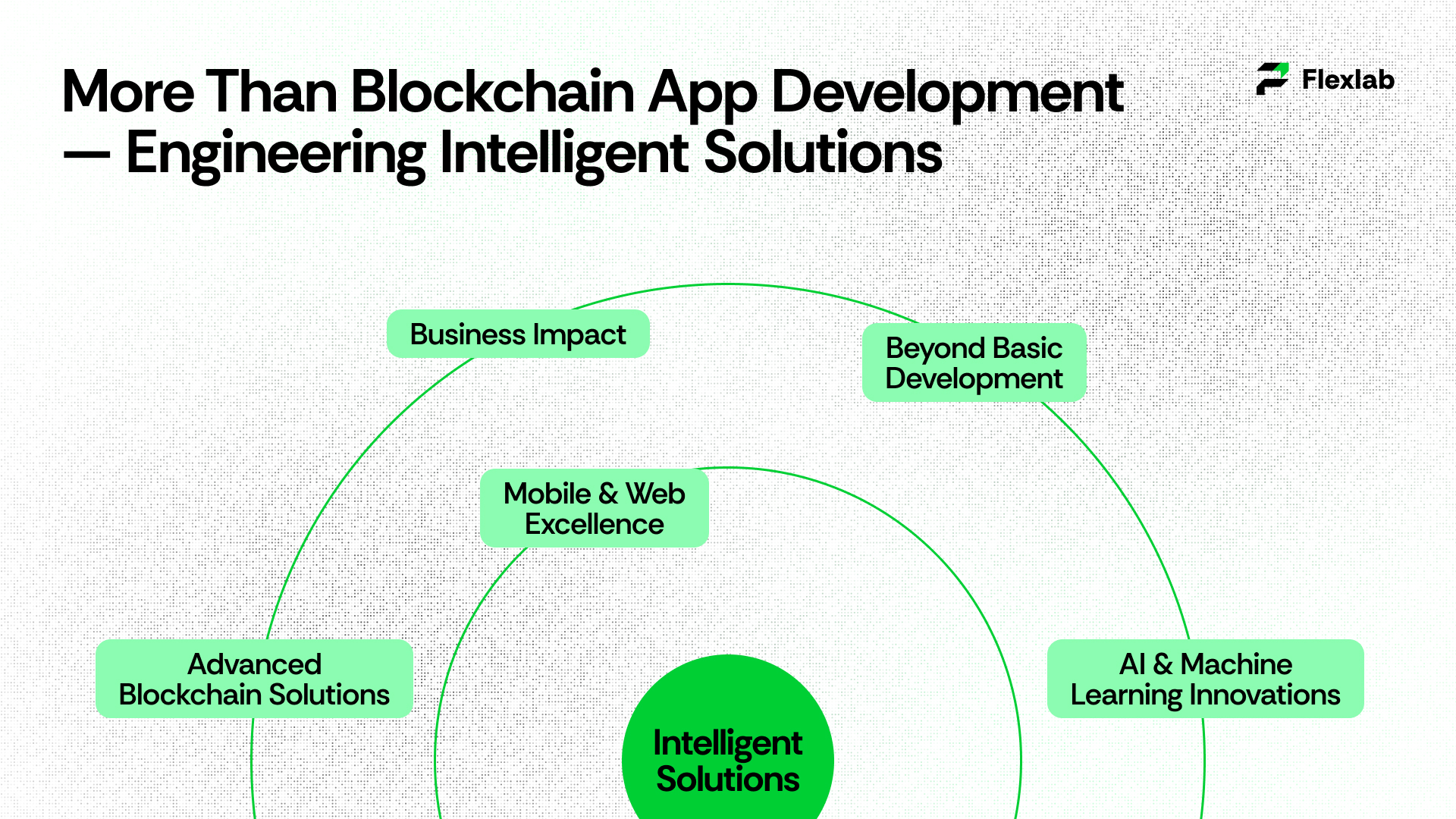
More than Blockchain App Development — Engineering Intelligent Solutions
Engineering Intelligent Solutions

When businesses consider AI and blockchain development, they often envision coding, integrations, and deployment. At Flexlab, we take a much broader view. We view each project as an opportunity to engineer an intelligent ecosystem. It is a system where AI and blockchain not only function but also collaborate to solve real-world problems.

Our mobile and web development services are a perfect example. In today’s digital-first world, your app or platform isn’t just a tool — it’s the front door to your brand. That’s why we design with both aesthetics and performance in mind, creating flawless experiences for users on iOS, Android, and the web. From the architecture to the user interface, every detail is planned to ensure seamless navigation, rapid performance, and long-term scalability. Businesses trust us to build applications that not only function effectively but also work beautifully.

On the blockchain side, our work goes far beyond token creation or smart contracts. We develop entire decentralized ecosystems — from compliance-ready crypto exchanges to blockchain-based tracking systems for logistics networks. Our blockchain engineers are skilled at weaving AI capabilities directly into blockchain workflows, enabling advanced features like predictive analytics, fraud detection, and automated contract execution. The result is a solution that is not only secure and transparent but also smart and adaptive.

Our AI and machine learning solutions range from conversational chatbots and predictive analytics to complex multi-agent systems that can handle entire business processes autonomously. For example, AI agents can manage inventory restocking, monitor cybersecurity threats, or provide real-time financial forecasts — all without constant human intervention. We design these systems to be “human-in-the-loop,” meaning they enhance human decision-making rather than replace it, striking the perfect balance between automation and oversight.

Check out our portfolio and LinkedIn to witness firsthand client satisfaction and success!

Advanced AI & Blockchain Services

Moreover, our more advanced AI in blockchain implementations optimizes decision-making, secures transactions, and personalizes user experiences in real time.

For example, a logistics company might leverage the role of blockchain in supply chain management SCM for decentralized tracking and combine it with predictive AI agents that forecast disruptions before they happen. Or a financial institution might use smart contract development on Ethereum to automate settlement processes while AI systems monitor transaction patterns for fraud prevention.

Additionally,  because technology is never static, our support, maintenance, and upgrades ensure your systems continue to evolve with your business. We provide proactive monitoring, timely updates, and AI-driven optimizations to keep your solutions secure, efficient, and ready for the future.

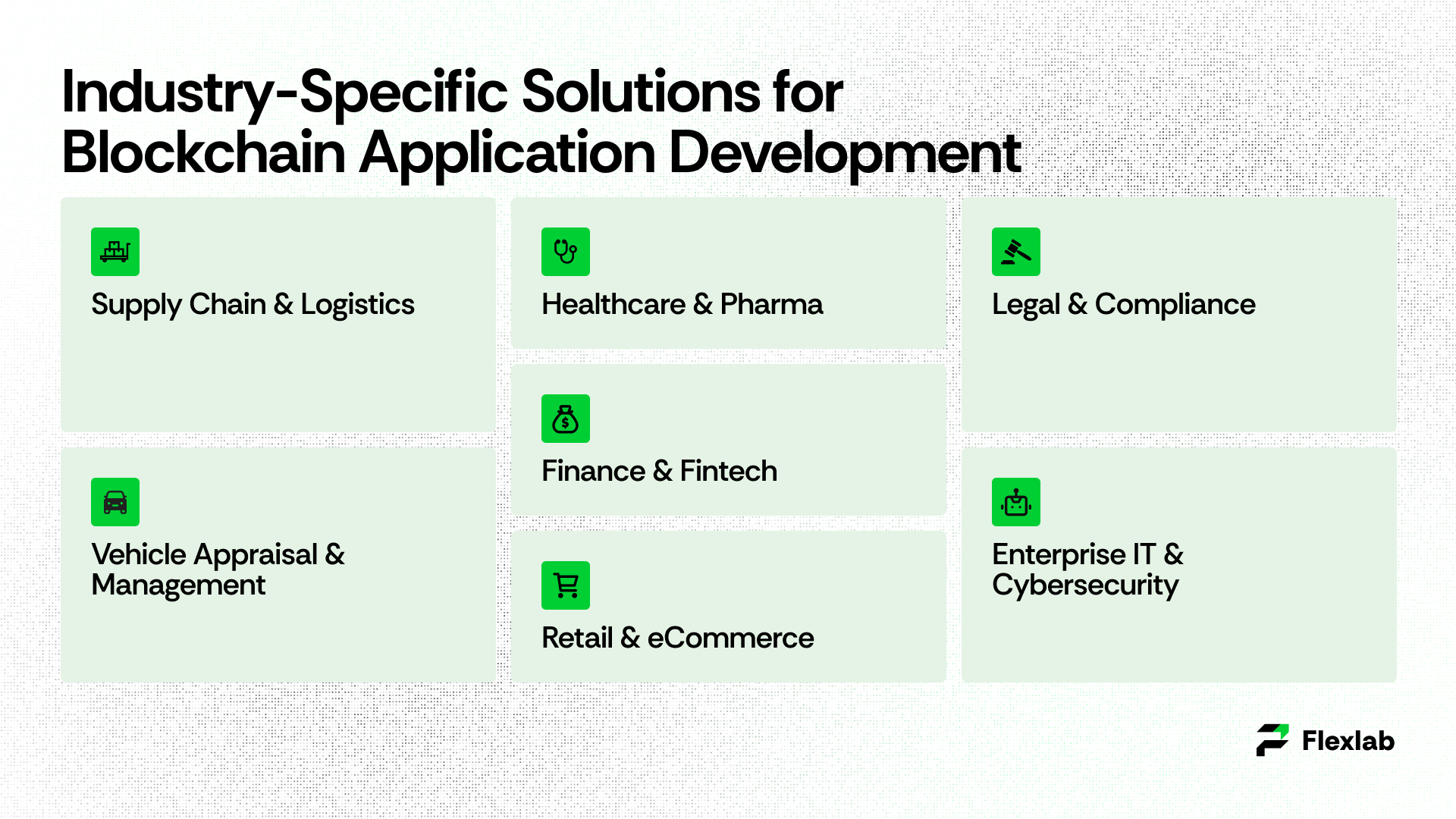
Industry-Specific Solutions for Blockchain Application Development
Industry-Specific Solutions for Blockchain Application Development

One of Flexlab’s greatest advantages is our industry specialization. We know that the challenges facing a fintech startup are very different from those in healthcare, logistics, or retail. That’s why our AI software development company tailors each project to meet sector-specific requirements, regulations, and user expectations.

In healthcare and pharma, our AI-driven diagnostics improve patient care, while blockchain ensures HIPAA and GDPR compliance. Within finance and fintech, we build secure platforms, deliver cryptocurrency development services, and create fraud-resistant transaction systems. Retail and e-commerce also benefit, as our NFT marketplace development platforms enable new digital ownership models, while AI personalization engines drive higher conversions.

Our work in supply chain and logistics often combines Internet of Things IoT with blockchain to provide real-time tracking, while machine learning development services forecast demand and prevent disruptions. These targeted solutions prove that Flexlab isn’t just a technology provider — we’re a partner that understands your business landscape.

Retail and eCommerce clients use our AI personalization engines to boost conversion rates, while blockchain loyalty programs ensure transparency and trust. Legal and compliance teams rely on our smart contracts and immutable ledgers to enforce agreements with zero ambiguity. And in enterprise IT and cybersecurity, our AI threat detection and blockchain identity verification systems protect critical infrastructure against evolving risks.

This breadth of industry experience means that when you work with Flexlab, you’re not just getting generic technology. You’re getting a solution that speaks the language of your industry, understands its regulations, and is optimized for its unique challenges.

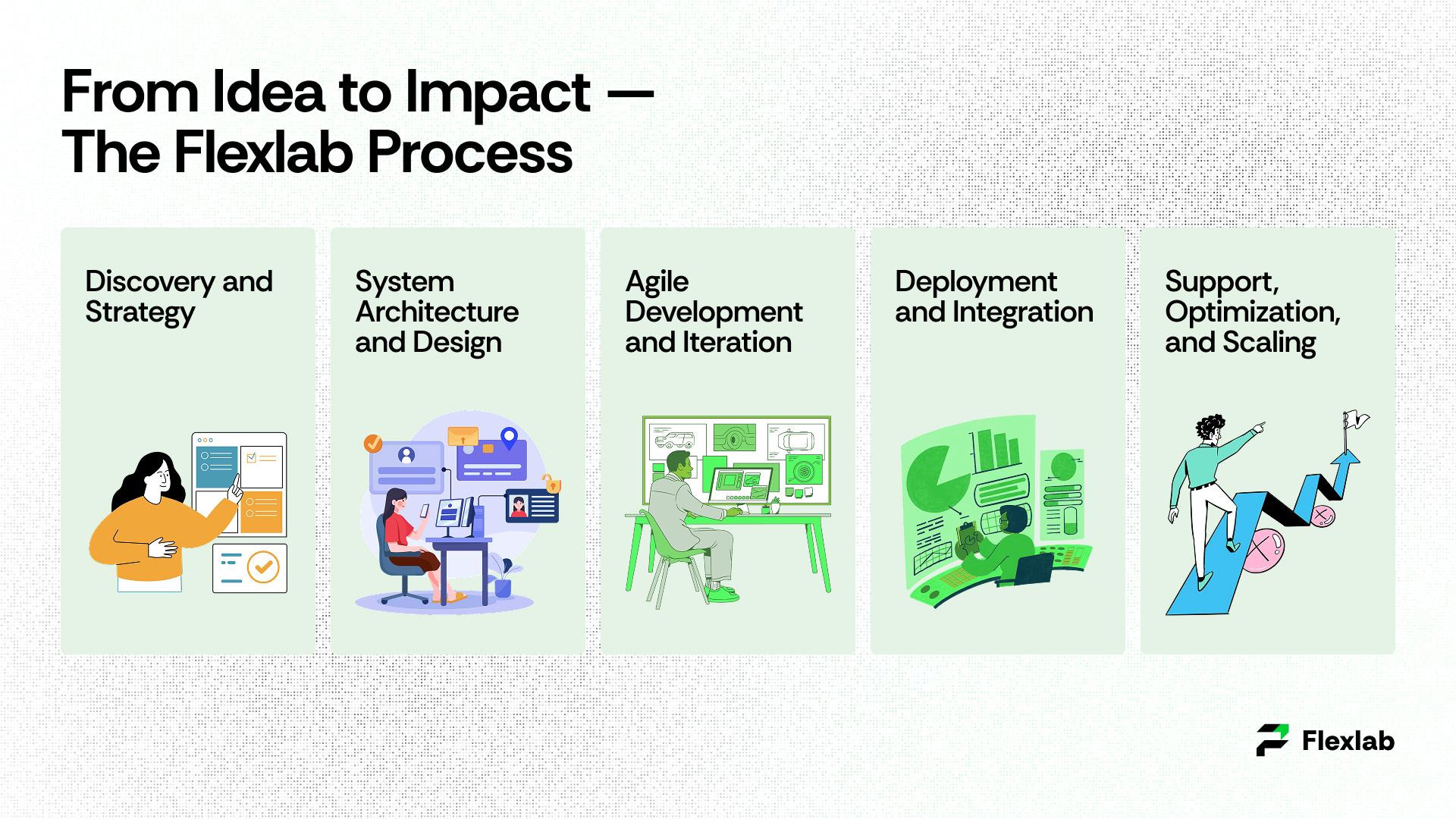
From Idea to Impact — The Flexlab Process
From Idea to Impact — The Flexlab Process

Success in AI and blockchain projects doesn’t happen by chance. It requires a clear roadmap, disciplined execution, and the flexibility to adapt as new insights emerge. At Flexlab, we’ve refined our process into five seamless stages.

We start with Discovery and Strategy, diving deep into your business goals, challenges, and opportunities. This is where we define success metrics and map out how AI and blockchain can help you achieve them. Next comes System Architecture and Design, where we create a blueprint for a scalable, future-proof system tailored to your needs.

In the Agile Development and Iteration phase, we bring the design to life through rapid, iterative builds, keeping you involved at every step. Deployment and Integration follow, ensuring your new solution works flawlessly within your existing environment. Finally, our Support, Optimization, and Scaling stage keeps your systems running smoothly while identifying opportunities for continuous improvement.

As a result, this process ensures that from the first conversation to post-launch optimization, you always know where your project stands, what’s coming next, and how it’s performing.

Real Results — Proven by Case Studies
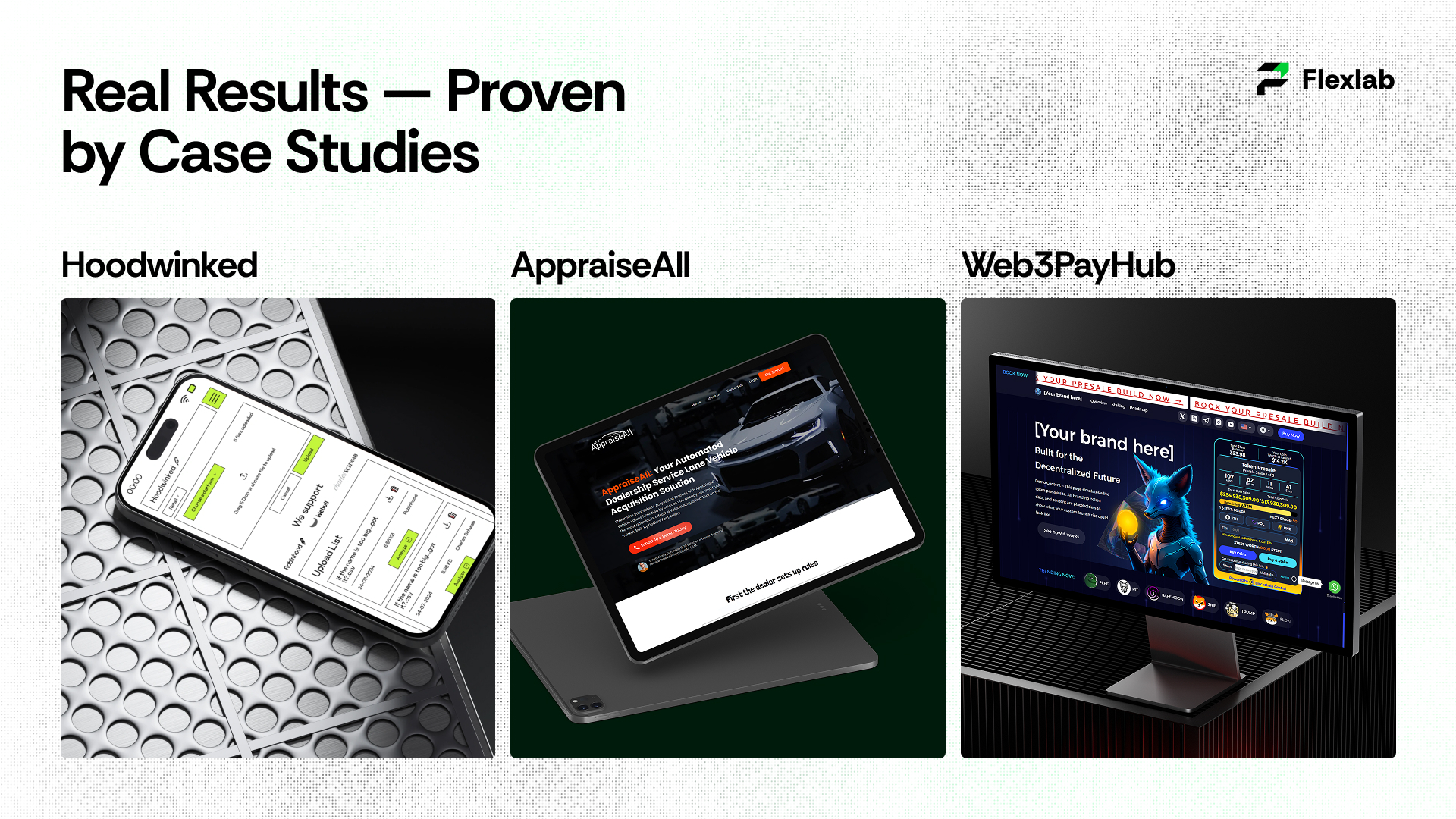
Real Case Studies

Our work with Hoodwinked Trades is a powerful example of what’s possible when AI and blockchain work together. By developing an AI-powered fee detection engine integrated with blockchain transparency, we helped retail traders reduce hidden fees by 65%, saving a collective $1.2 million. Manual fee analysis times dropped by 80%, and the platform now serves over 50,000 active traders with 99.99% uptime.

In another project, we partnered with AppraiseAll to revolutionize vehicle acquisition. Our predictive AI valuation engine increased pricing accuracy to 95%, while blockchain smart contracts reduced paperwork by 80%. Appraisal times fell by 75%, costs dropped by 40%, and more than 500 dealerships were onboarded in just one year — all with zero data breaches and full compliance with GDPR and CCPA regulations.

Most recently, we built Web3PayHub — a secure token presale launchpad enabling founders to raise capital with speed and transparency. By designing a multi-round presale system with automated smart contracts, we eliminated the risk of rug pulls and incomplete deliveries. Projects using Web3PayHub can now launch in under 7 days, with increased investor trust facilitated through real-time reporting and wallet verification. For founders, presale setup times decreased by 70%, and for investors, risk exposure decreased by 90% due to audited contracts and milestone-based distributions. The platform has already supported multiple presales, helping projects collectively raise millions with zero security incidents.

These are not isolated successes. Across industries and geographies, Flexlab’s solutions have consistently delivered measurable improvements in efficiency, security, and profitability.

AI and Blockchain Technology That’s Always Ahead

Staying competitive in AI and blockchain requires constant evolution. Flexlab works with advanced platforms like OpenAI GPT-4/4o, Anthropic Claude, Cursor, and Google Vertex AI to develop everything from chatbots to AI agents that perform multi-step reasoning. Our AI agents guide helps clients understand how to deploy these agents effectively.

In blockchain, we work with Ethereum, Hyperledger, Polygon, The Graph, and Chainlink to deliver everything that transforming industries with custom blockchain development to create an NTF marketplace. Whether you need cryptocurrency development services, a blockchain dApp development guide, or integration with IoT devices, we have the tools and expertise to deliver.

A Team That Acts Like a Partner

Perhaps the most important reason businesses choose Flexlab is that we act like an extension of their team. We’re not just developers delivering a project; we’re partners invested in your long-term success. We measure our performance not just by the code we write but by the growth, efficiency, and competitive edge our solutions bring you.

Clients often tell us that working with Flexlab feels different. They appreciate our transparency, our commitment to deadlines, and our willingness to go the extra mile. Whether it’s adjusting a feature to better fit a workflow, providing extra training for in-house teams, or staying ahead of potential risks, we operate with the mindset that your success is our success.

Why Now Is the Time to Act?

The AI and blockchain revolution is not on the horizon — it’s here. Businesses that embrace these technologies now are positioning themselves to lead their industries in the years ahead. Those who delay risk falling behind competitors who are automating faster, making smarter decisions, and offering more secure, transparent experiences to their customers.

With Flexlab as your partner, you get more than technical expertise. You get a strategic ally who can guide you through the complexities, help you avoid costly mistakes, and deliver solutions that are both innovative and reliable.

Take Your Next Step in Blockchain Development

Take Your Next Step in Blockchain Development

If you’ve been thinking about how AI and blockchain could transform your business, now is the perfect time to take the first step. Flexlab offers a free strategy session where we’ll discuss your goals, explore the possibilities, and outline a clear, actionable roadmap tailored to your needs.

Ready to Grow Your Business?

📞 Book a FREE Consultation Call: +1 (416) 477-9616

📧 Email us: info@flexlab.io

From the first brainstorming session to long-term optimization, we’ll be there to ensure your investment in AI and blockchain delivers maximum value. Whether you’re looking to automate processes, secure transactions, personalize customer experiences, or unlock new revenue streams, we have the expertise, the experience, and the passion to make it happen.

Final Thoughts: Blockchain Application Development

Choosing a technology partner is about more than skills and experience. It’s about trust, alignment, and a shared vision for success. At Flexlab, we’ve built our reputation on delivering intelligent, scalable, and results-driven AI and blockchain application development solutions. We serve businesses across the globe. Our team combines industry expertise with cutting-edge technology, a proven process, and a client-first mindset. This approach ensures that every project we deliver not only meets expectations but also exceeds them.

The future belongs to those who are ready to innovate boldly and execute brilliantly. With Flexlab by your side, you’ll be equipped to do both.

Unlock More Insights:

Why should businesses invest in both AI and blockchain technologies?

AI and blockchain combined offer unique advantages: AI brings smart automation and predictive insights, while blockchain ensures data security, transparency, and decentralization. Together, they create intelligent systems that optimize operations, reduce fraud, and enable trust without intermediaries. This synergy helps businesses innovate and stay competitive in a data-driven world.

What is blockchain application development, and what industries benefit from it?

Blockchain application development involves creating decentralized apps (DApps) that leverage blockchain’s security and transparency. Industries like finance, healthcare, supply chain, retail, and legal use blockchain to enhance data integrity, automate processes, and ensure compliance. This technology ensures secure, tamper-proof data handling while improving operational efficiency.

How does Flexlab’s 2-week Engagement Sprint help companies with AI and blockchain projects?

Flexlab’s sprint delivers a working prototype or proof-of-concept within 14 days, allowing clients to see real progress early. This minimizes risk and builds trust by demonstrating capability before full-scale development. It includes clear milestone planning, tailored development, and a satisfaction-based payment model, ensuring value and transparency from the start.


5 Responses

Leave a Reply

Your email address will not be published. Required fields are marked *

How Custom AI Solutions Can Enhance Your Business Revenue?

Agentic AI vs Generative AI | AI in FinTech | Enterprise AI Solutions

Do you want to retain customers and prioritize data privacy? Don’t worry! Here comes custom AI solutions that provide operational efficiency, seamless integration, and generate revenue, all while keeping your sensitive information under your control.

Custom AI is built around your data, your workflows, and your growth goals, so it does not just automate tasks; it turns insights into smarter decisions, more personalized experiences, and new revenue streams. Whether you want to reduce churn, boost conversions, or strengthen trust through better security and compliance, a tailored AI solution helps you do it all in one unified system.

In this guide, you will discover how custom AI can transform your business from the inside out, making it faster and more profitable without compromising on privacy or control.

What are Custom AI Solutions?

Custom AI solutions are artificial intelligence applications that were created to solve specific business challenges as per your needs. 

Instead of using pre-ready AI models, companies often partner with an AI development company or an AI automation agency to build models that evaluate their unique datasets and customize their workflow automation.

Here are some key examples below:

  • An AI predictive maintenance platform used in manufacturing plants.
  • An AI-powered chatbot trained enough to represent a customer brand tone.
  • A demand forecasting tool for a retail chain.

Hence, each solution is built for purposes that optimize operations and increase return.

Difference Between Custom AI and Off-the-Shelf Solutions

Business owners often confuse investing in which: off-the-shelf solutions or custom AI. Both approaches have benefits; however, it is largely based on specific needs and goals.

Off-the-Shelf AI Solutions

These solutions are ready-to-use and pre-built tools designed to solve common business issues. These AI business solutions are ready to deploy with minimal time and effort. It is attractive for those companies that want to integrate AI quickly without wasting time. These AI systems provide standardized features and functionalities. Therefore, it is suited for those AI development companies that require quick implementation to solve problems right away.

Custom AI Solutions

In contrast, custom AI-powered solutions are niche-specific and developed from the ground up on a powerful base model, using your company’s unique, proprietary data. These solutions are created through AI strategy consulting and AI-powered product development that are basically tailored to fit the specific needs of your business. AI learns the nuances of your customer behavior, your supply chain bottlenecks, and your specialized industry terminology in an AI custom build. 

In short, custom AI is especially useful for industries that need high accuracy, deep personalization, enterprise scalability, integration with the Internet of Things, and advanced automation and predictive insights.

Summarized Comparison Table

Factor Custom AI Solutions Off-the-Shelf Solutions
Cost High upfront ($100K+), lower long-term; owns IP  Low initial/subscription ($2K-5K/mo), rises at scale 
Deployment Months for build/integration  Days/weeks, quick start 
Customization Fully tailored to data/workflows  Limited configs for average cases 
Scalability High, cloud-native growth  Vendor-limited, tier jumps 
Maintenance In-house control  Vendor-handled, potential disruptions 

How Can Custom AI Solutions Drive Measurable Revenue Growth?

Custom AI solutions are no longer a tech experiment; they’re a core revenue engine for modern businesses. When built around your data, workflows, and growth goals, custom AI turns insights into higher conversions, smarter pricing, and new revenue streams that off‑the‑shelf tools simply can’t match.

1. Hyper‑Personalized Experiences That Close More Deals

Generic recommendations can’t work in the evolving digital landscape. Then what to do? Here comes the custom AI software that analyzes a vast amount of your customers’ purchase history, browsing behavior, clicks, and engagement patterns to deliver:

  • Product recommendation
  • Personalized marketing messages
  • Targeted promotions

For instance, e-commerce companies leverage recommendation engines to showcase products that customers are likely to purchase. Hence, this increases average order value, lifts conversion rates, and builds customer loyalty. To sum up,  AI-powered personalization turns generic interaction into revenue-driven moments.

2. Predictive Analytics That Turn Uncertainty Into Upside

Raw data doesn’t increase revenue; insight does. Custom predictive analytics help businesses to forecast demand, churn, seasonal trends, and campaign performance. Instead of reactive decision-making, companies can predict which products sell best, when customers are likely to churn, and how marketing campaigns perform, so they can generate the most revenue. 

It turns insights into revenue-driving action, integrating your predictive models with an Order Management System (OMS). An intuitive OMS leverages real-time demand signals to route orders to the best-available store or warehouse, display endless‑aisle alternatives when items are out of stock, and enable seamless buy online, pick up in store (BOPIS) or ship‑from‑store fulfillment. This reduces stockouts and delivery costs while boosting conversion, average order value, and customer satisfaction across every channel.

3. Automation That Frees Teams to Focus on Revenue‑Generating Work

AI-powered automation is maintaining workflows across departments. It cuts operational costs and improves speed and accuracy. Moreover, the real revenue is generated when employees spend less time on repetitive tasks and are more focused on sales, upselling, innovation, and high-value customer relationships. Custom workflows such as AI-driven lead routing, smart order handling, and intelligent support triage that are designed to feed your deal pipeline.

Furthermore, many companies deploy intelligent agents that can independently handle tasks such as lead qualification, scheduling, and customer interactions without constant human supervision.

4. Smarter Lead Scoring and Sales Forecasting

Sales teams got a lead, but not all leads convert equally. Don’t worry. We have a custom AI lead-scorning model that helps businesses to prioritize the leads more likely to convert based on engagement history, demographic patterns, and past buying behavior. This allows the sales team to focus on the highest-quality opportunities with the best conversion rates and shorten the sales cycle. 

Additionally, AI sales forecasting provides more accurate revenue projections, making it easier to plan campaigns, hiring, and expansion that directly fuel growth.

5. AI‑Driven Marketing That Optimizes for Revenue, Not Just Clicks

Most marketing tools optimize for clicks and impressions; custom AI can optimize for revenue per visitor, per campaign, and per channel. From selecting the highest‑ROI audiences and creatives to adjusting bidding and timing in real time, AI‑driven marketing turns spend into measurable pipeline and sales, not vanity metrics.

6. Risk Management and Fraud Detection That Protect Revenue

AI in fraud detection and risk‑monitoring systems defends revenue streams by spotting anomalies, blocking fraudulent transactions, and minimizing chargebacks. Instead of seeing AI as a compliance tool, leading companies treat it as a revenue‑protecting layer that keeps margins healthy and customer trust intact.

7. AI‑Powered Products and Services That Create New Revenue Streams

AI is not a tool for optimization; it’s a product differentiator. Custom AI-enhanced offerings such as personalized workout plans, smart devices, recommendation-driven subscriptions, and AI-assisted services. For example, e-commerce brands use AI to create personalized product bundles based on a shopper’s browsing history, past purchases, and preferences.

This opens new monetization paths, higher ARPU, and recurring revenue models. When AI is built into the product itself, it gives the business a strong advantage that customers are willing to pay for.

8. Competitive Advantage That Translates Into Market‑Share Growth

Companies that deploy custom AI early move faster, serve customers better, and adapt to changing markets with precision. This translates into higher retention, stronger referrals, and expanded market share, all of which compound revenue over time. Custom AI isn’t just a feature; it’s a long‑term growth engine baked into your business model.

5 Top AI Technologies Powering Businesses Today

5 Top AI Technologies Powering Businesses Today

More and more businesses are using AI to work faster and smarter. Some AI tools are ready to use right away, while others can be built just for your business. These are five of the most useful AI technologies right now.

1. AI-Powered Automation

AI automation helps businesses handle repeated tasks quickly and accurately. It saves time, cuts down on mistakes, and helps teams focus on more important work.

In industries like finance and healthcare, it can speed up many routine processes. That means businesses can run more smoothly and use their resources better.

2. AI-Driven Analytics

AI-driven analytics helps companies make sense of large amounts of data fast. It can spot customer trends, find problems, and help manage risk.

With these insights, businesses can make better decisions and improve results.

3. Generative AI

Generative AI is changing how businesses create content, design products, and build software. It can help write marketing copy, draft documents, and even support coding work.

This makes everyday tasks faster and easier for many teams.

4. Computer Vision

Computer vision helps AI understand images and video. Businesses use it for things like product quality checks, self-driving cars, and visual search.

It can also help monitor production lines and give customers better search experiences with images. Additionally, this technology is widely used in AI in manufacturing and smart factory environments connected through the Internet of Things.

5. AI in Customer Service

AI is also making customer service better. Chatbots and virtual assistants can answer questions quickly and help customers at any time of day.

This leads to faster support, happier customers, and lower support costs for businesses.

Tips for Implementing Custom AI Solutions

Implementing custom AI solutions can be challenging, but with the right approach, businesses can leverage them to double their investment and scale their growth. Here are our tips.

  • Start with One Clear Goal

Pick one problem you want AI to solve first. This could be saving time, improving customer service, increasing sales, or reducing mistakes.

  • Pick a Problem that Matters

Choose a use case that has a real impact on your business. The best artificial intelligence projects solve something important, not just something interesting.

  • Make Sure your Data is Ready

AI works best when your data is clean, organized, and easy to access. If the data is messy, the results may not be accurate.

  • Test the AI on a Small Project First

Start with a small pilot project or MVP development approach before rolling it out everywhere. This helps you see what works and what needs to be improved without taking big risks.

  • Choose the Right AI Development Partner

Choose the right AI development company to reduce technical complexity and accelerate AI implementation. It also helps with infrastructure planning, workflow automation, and long-term optimization.

  • Connect it to your Current Tools and Workflows

The AI should fit naturally into the systems your team already uses. If it saves extra steps instead of adding them, people are more likely to use it.

  • Train your Team

Your team needs to understand how the AI works and how to use it. Simple training can make the difference between a tool people ignore and one they use every day.

  • Track Results

Measure whether the AI is actually helping your business. Consider factors such as sales growth, time saved, improved customer satisfaction, or reduced errors.

  • Improve it Over Time

AI should not stay the same forever. Review the results, collect feedback, and continually improve the system to ensure it remains useful and effective.

Is Investing in a Custom AI Solution Worth It?

Is Investing in a Custom AI Solution Worth It?

Yes, custom AI is worth the investment when your business needs a solution that fits your exact goals, data, and workflows. Unlike off-the-shelf tools, custom AI can help you solve specific problems, improve efficiency, and create new ways to grow revenue.

It is especially valuable if your business handles unique customer data, complex operations, or industry-specific challenges that generic tools cannot solve well. In these cases, custom AI can improve personalization, forecasting, automation, and decision-making in ways that directly support growth.

That said, custom AI makes the most sense when you have a clear goal, clean data, and a real business case. A well-planned AI project should be measured by results such as higher sales, lower costs, faster workflows, or better customer satisfaction.

For many businesses, the smartest approach is to start with one high-impact use case, test it with a small pilot, and then scale once the value is proven. This reduces risk and makes it easier to see whether custom AI is truly paying off.

Real- World Example That Leverages Custom AI

Real- World Example That Leverages Custom AI

Here are the top examples of custom AI solutions.

1. Starbucks

Starbucks uses AI to personalize offers and recommendations for its rewards members. By analyzing purchase history, time of day, and customer preferences, it can suggest drinks and food items that feel more relevant to each person. This helps increase repeat visits, improve customer loyalty, and drive more sales.

2. Amazon

Amazon uses AI to recommend products based on what customers browse and buy. These personalized suggestions help shoppers discover items they may want, which increases cross-selling and upselling. It is one of the clearest examples of how AI can directly support revenue growth.

3. Netflix

Netflix uses AI to recommend shows and movies based on viewing habits. This keeps users engaged for longer and makes the platform more valuable to subscribers. When people stay longer and watch more, it strengthens retention and reduces churn.

4. Sephora

Sephora uses AI to give shoppers personalized product recommendations and virtual try-on experiences. This helps customers choose the right beauty products more easily and makes shopping feel more personal. As a result, the brand improves customer experience and encourages more purchases.

The Best AI Development Tools for Custom AI Solutions

Best AI Development Tools

To build and deploy custom AI at scale, you need the best AI tools for business. These platforms help you create, train, and integrate AI models while maintaining security, compliance, and smooth connectivity with your existing business systems. Let’s read the top AI development tools below.

H2O.ai: Open‑Source Machine Learning

H2O.ai provides enterprise‑ready AI frameworks that make machine learning accessible. Companies use it to build and train predictive models for tasks like customer churn prediction, credit risk assessment, and fraud detection.

Amazon SageMaker: Scalable Cloud‑Based AI

Amazon SageMaker offers an end‑to‑end machine learning environment. It simplifies developing, testing, and deploying custom ML models in the cloud so teams can scale quickly and efficiently.

GitHub Copilot: AI‑Powered Code Assistance

GitHub Copilot acts as an AI assistant for developers. Built on OpenAI’s Codex, it suggests code lines, automates repetitive tasks, and speeds up the development process.

Clarifai: AI for Computer Vision & NLP

Clarifai specializes in analyzing images, videos, and text. Businesses use it to enhance security, personalize e‑commerce experiences, and improve visual search functionality.

MindsDB: Machine Learning Inside Your Database

MindsDB brings machine learning directly into existing database systems. This lets businesses run predictive analytics without moving or copying data, keeping workflows simple and secure.

Turn AI Investment into Measurable Results with Flexlab

Turn AI Investment into Measurable Results with Flexlab

Partner with Flexlab to move beyond generic AI tools and build custom solutions that directly impact your revenue, efficiency, and customer experience. We provide AI development services and ML development services, where we help you define clear goals, design AI‑driven workflows, and track real‑world results, so every dollar you invest in AI delivers measurable growth for your business.

We offer you:

Conclusion: Custom Ai Solutions

Custom AI solutions are no longer a luxury for tech giants; they are a practical way for modern businesses to increase revenue, improve efficiency, and stand out in a crowded market. From personalized customer experiences and smarter pricing to predictive analytics, automation, and AI‑powered products, the right AI implementation strategy can turn data into a real growth engine.

The key is to start with a clear business goal, choose a high‑impact use case, and build a solution that fits your workflows and data, not the other way around. When you do that, AI stops being a cost center and becomes a measurable revenue driver that compounds results over time.

Contact us now for your custom roadmap and check our LinkedIn for real results. You’ll also love our blockchain and AI blog with insights on Multimodal AI, Digital Transformation Strategy with AI and Blockchain, AI-Powered Chatbots in Healthcare Services, and Trusted Execution Environment for AI & Blockchain

Ready to Turn Custom AI Into Real Revenue?

📞 Book a FREE Consultation Call: +1 (416) 477-9616

📧 Email Us: info@flexlab.io

How much does a custom AI solution cost in 2026?

A simple custom AI tool like a basic chatbot usually costs a few thousand to around 25,000 dollars. A mid level tool with more features, such as lead gen or automation, often costs 25,000 to 100,000 dollars. A full custom AI system for a bigger company can cost 100,000 dollars or more. The price depends on how complex it is, how much data you use, and how many custom features you need.

Which custom AI tool is best in 2026 for small businesses?

For small businesses, an AI powered CRM like HubSpot is usually a good fit because it is cheap, easy to use, and helps with sales and marketing. If you want a chatbot trained on your own data, simple no code AI platforms work well without a big technical team. he best tool is the one that matches your main workflow and fits your budget.

What are the biggest challenges in building custom AI solutions?

Building custom AI solutions faces major challenges, mostly around data quality and access, a lack of skilled technical talent, and high running costs. Common issues include getting enough high quality proprietary data, reducing algorithmic bias, protecting security and privacy, connecting with older legacy systems, and making the solution scalable as the business grows.

Key Advantages of Using Artificial Intelligence Development Services in Your Company

Enterprise AI Solutions | AI Automation Services in 2026 | 11 Best AI Tools 

Artificial intelligence development services benefit businesses in several ways. For example, they reduce operational costs, automate repetitive tasks, and improve decision-making. In addition, they deliver personalized customer experiences at scale. As a result, if you’re evaluating whether AI is worth the investment, the data is already clear. According to McKinsey, 88% of companies use AI in at least one business function, making it a baseline capability rather than a future trend.

The gap now isn’t awareness, it’s execution. In fact, Businesses that have already implemented AI are operating faster, leaner, and more efficiently, in fact gaining a strong competitive advantage.

While others are still deciding where to begin, whether you’re running a startup or scaling a mid-sized company, AI development services are now accessible, practical, and capable of delivering measurable ROI. The real question isn’t if AI can benefit your business; it’s where to start and how to implement it correctly.

By the end of this guide, you’ll know exactly how artificial intelligence development services work, where they’ll move the needle most for your business, and how to get started without burning your budget on the wrong things.

Defining AI Development Services in 2026

Defining AI Development Services in 2026

Artificial intelligence development services refer to the end-to-end process of designing, building, and deploying intelligent systems that can think, learn, and make decisions, like a human would, but faster, at scale, and without the coffee breaks. These systems analyze data, recognize patterns, and take actions that would otherwise require a trained person sitting behind a screen.

As reported by Statista, the global AI market is on track to reach US$335.29 billion in 2026 and grow at 25.38% annually, reaching US$1.30 trillion by 2032. The US alone accounts for US$75.14 billion of that in 2026. This is not hype money; this is real investment from real businesses that are already seeing returns. So what does this actually look like in practice? Let’s break it down by its type.

  • Core Components of a Professional AI Build

AI software development services cover everything from initial strategy and data preparation, all the way to building, training, testing, and maintaining intelligent systems inside your business. Think of it less like buying a software tool off the shelf and more likely hiring a team that builds a brain specifically for your operation, one that learns your data, your customers, and your goals.

Additionally, these artificial intelligence development services are not one-size-fits-all. A healthcare company needs AI that handles patient data carefully. A retail brand needs AI that predicts buying behavior. That’s exactly why custom builds exist and why the right partner matters.

5 Essential AI Service Types for Scalable ROI

5 Essential AI Service Types for Scalable ROI

Here’s a quick breakdown of the most common types, so you know exactly what to ask for when you’re ready to move forward with artificial intelligence development services.

Type What It Does Best For
Machine Learning Learns from data to predict outcomes Finance, healthcare, retail
NLP and AI Chatbots Understands and generates human language Customer service, sales
AI Automation Handles repetitive tasks end-to-end Operations, HR, finance
Predictive Analytics Forecasts trends from historical data Marketing, inventory, risk
Computer Vision Interprets visual data in real time Manufacturing, security

1. Machine Learning Development Services: Teaching Your Systems to Think

Machine learning development services are probably the most widely used AI type, and for good reason. Instead of following fixed rules, machine learning models study your historical data and find patterns on their own. The result is a system that gets smarter the longer it runs. Whether you’re predicting customer churn, catching fraudulent transactions, or optimizing your supply chain, machine learning is usually the engine running quietly underneath it all.

2. AI Chatbots: The Customer Service Rep That Never Sleeps

AI chatbots aren’t those clunky pop-up boxes that frustrate customers with scripted responses anymore. Modern AI-powered chatbots understand context, remember previous parts of a conversation, and resolve complex queries without looping in a human agent. Furthermore, they work around the clock, across every time zone, without ever having a bad day. For high-volume businesses, that’s not just convenient, it’s a measurable competitive advantage.

3. Intelligent Automation: Stop Paying People to Do What Machines Do Better

Intelligent automation goes several layers deeper than the basic workflow tools most businesses already use. It handles invoice processing, employee onboarding, compliance checks, and data entry across multiple platforms simultaneously. As a result, your team stops spending Monday mornings on repetitive manual work and starts focusing on decisions that actually move your business forward.

4. AI Predictive Analytics: Know What’s Coming Before It Hits

Imagine knowing which products will spike in demand next quarter, or which customers are three weeks away from canceling. That’s exactly what AI predictive analytics makes possible. By analyzing patterns in historical data, predictive models surface insights that traditional reporting simply can’t catch. Consequently, businesses using predictive analytics don’t just react to what’s happening; they’re already prepared for what’s next.

5. Computer Vision: Give Your Business Eyes That Never Miss a Thing

Artificial intelligence technologies such as computer vision are quietly transforming industries that rely on visual data. In manufacturing, it catches product defects before they reach customers.In retail, it monitors shelf stock in real time, while in security, it flags unusual activity the moment it happens. If your business deals with images, video, or visual processes, computer vision is worth serious attention.

The 7-Step AI Development Lifecycle

The 7-Step AI Development Lifecycle

The AI development lifecycle is the structured roadmap that takes an AI idea from a boardroom conversation to a working system inside your business. Understanding this process matters because skipping steps is exactly why most AI projects fall apart. According to RAND via Pertama Partners, 80.3% of AI projects fail to deliver their intended business value, with 33.8% abandoned before ever reaching production. Done right, however, the process is straightforward.

From Strategy to Launch: The Implementation Roadmap

AI strategy consulting is where every successful AI project begins. Skipping this step is one of the most expensive mistakes a business can make. Here is the full lifecycle broken down simply:

  1. Discovery and Goal Setting: Define the business problem AI needs to solve
  2. Data Assessment:  Audit what data you have, what’s missing, and what needs cleaning
  3. Strategy and Roadmap:  Build a phased plan with clear milestones and measurable outcomes
  4. Model Development: Build and train the AI model on your specific data
  5. Testing and Validation: Run the model against real scenarios before going live
  6. Deployment:  Integrate the system into existing workflows with minimal disruption
  7. Monitoring and Optimization: Track performance and retrain the model as your data evolves

Each step builds on the one before it. Therefore, rushing discovery or skipping data assessment almost always produces a system that works in theory but fails in practice.

How to Build an AI Strategy That Aligns With Your Business Goals

An AI strategy for business works when it starts with a specific problem, not a technology trend. The businesses getting the best results aren’t chasing the latest model releases. They identify exactly where their operations are leaking time or money and build AI around fixing that first.

Additionally, a solid strategy defines success before a single line of code is written. That means setting clear KPIs, deciding who owns the AI initiative internally, and making sure leadership is genuinely bought in. According to McKinsey, AI high performers are more than three times more likely to say their organization intends to use AI to bring about transformative change.

What Does Seamless AI Integration Into Existing Systems Look Like?

AI integration is where a lot of businesses get nervous, and understandably so. Plugging a new intelligent system into your existing CRM, ERP, or support platform sounds complicated. In reality, a good AI development company handles this as part of the build, not as an afterthought.

Seamless integration means your AI works inside the tools your team already uses every day. Your sales team stays in Salesforce. Your support agents stay in their helpdesk. The AI does the heavy lifting underneath. Similarly, proper integration includes team training, so adoption actually happens instead of the tool collecting digital dust after launch.

Direct Business Benefits & Operational Impact

Direct Business Benefits & Operational Impact

Custom AI solutions deliver value across almost every function in a business, from operations and customer service to sales, finance, and security. In fact, according to  Google Cloud’s ROI of AI report, 74% of executives report achieving ROI within the first year of deploying AI agents. Not bad for a technology people spent years calling “experimental.”

Can AI Really Automate Repetitive Tasks and Cut Operational Costs?

Yes, and the savings are significant. Businesses that use AI to automate repetitive tasks report cutting operational costs by 20 to 45% in the functions where AI is deployed. As per Hype Studio, think about every hour your team spends on data entry, invoice processing, report generation, and manual approvals. AI handles all of it, faster and with fewer errors, while your team focuses on higher-value work.

How Does AI Drive Smarter, Faster Business Decisions?

AI systems process data at a scale and speed that no human team can match. They surface trends, flag anomalies, and generate recommendations in real time. As a result, instead of waiting for a weekly report to spot a problem, your team gets an alert the moment something shifts. Businesses using AI-driven decision tools consistently report faster response times and better forecasting accuracy across sales, inventory, and risk management.

How Do AI Assistants Elevate Customer Experience at Scale?

AI assistants resolve queries, personalize recommendations, and handle follow-ups across thousands of customer interactions simultaneously. Moreover, they remember customer preferences, adapt tone based on context, and escalate to a human only when genuinely needed. The result is a customer experience that feels personal even at a massive scale, without the headcount required to deliver it manually.

Why Is AI-Powered Cybersecurity Now a Business Necessity?

AI-powered cybersecurity monitors your systems around the clock and detects threats in milliseconds, far faster than any human security team. According to Mastercard Fullview, AI improved fraud detection by an average of 20%, and up to 300% in specific cases. For businesses handling sensitive customer or financial data, that’s not an optional upgrade. It’s a baseline requirement in today’s threat environment.

Real-World AI Use Cases & Strategic Impacts

Real World AI Use Cases & Strategies

AI for manufacturing, healthcare, finance, and retail isn’t a future concept. It’s happening right now, in businesses of every size, across every geography. According to Deloitte’s State of AI in the Enterprise report, 66% of organizations are already reporting productivity and efficiency gains from AI adoption. Here’s what that looks like across specific industries.

AI in Manufacturing, Healthcare, and Finance, Sector-by-Sector Breakdown

AI product development is reshaping the following  industries faster than any other:

Industry AI Application Business Impact
Manufacturing Predictive maintenance, quality control Fewer defects, less downtime
Healthcare Diagnostics, patient management Faster decisions, better outcomes
Finance Fraud detection, risk assessment Reduced losses, faster processing
Retail Demand forecasting, personalization Higher conversion, lower waste

Edge AI in Manufacturing and Logistics

Edge AI implementations are transforming operations that can’t afford cloud latency. Instead of sending data to a remote server and waiting for a response, edge AI runs directly on local devices, sensors, and machines. In manufacturing, this means quality defects are caught on the assembly line in real time. In logistics, it means route optimization happens on the vehicle itself. The result is faster decisions, lower data costs, and better performance in environments with limited connectivity.

How SMBs Are Using AI to Compete With Enterprise Giants

Small and mid-sized businesses are closing the gap faster than most people realize. Artificial intelligence developers are now building affordable, scalable AI tools specifically designed for smaller operations. An SMB using AI for customer segmentation, automated follow-ups, and inventory forecasting can now compete directly with an enterprise brand that has ten times the headcount. The playing field is leveling out, and AI is the reason why.

Overcoming Key AI Implementation Challenges

Overcoming Key AI Implementation Challenges

AI automation agency partners and in-house teams both face the same core obstacles when bringing AI into a business. Understanding these challenges up front saves time, money, and a lot of frustration down the road.

  • Why AI Projects Fail: Strategy vs. Technology

Most AI projects fail not because the technology is broken, but because the strategy is. According to the MIT Project NANDA (MIT via SR Analytics), the failure is seldom the model. It is data readiness, workflow integration, and the absence of a defined outcome before build starts. In other words, businesses that define success clearly before they start and choose the right implementation partner dramatically improve their odds.

  • Data Quality and Privacy: The Hidden Obstacles Nobody Talks About

Digital transformation strategy starts with data, and that’s exactly where most businesses run into trouble. If your data is incomplete, inconsistent, or siloed across multiple systems, your AI model will produce unreliable outputs. Garbage in, garbage out. Additionally, privacy and compliance requirements add another layer of complexity, particularly for businesses in healthcare, finance, or any industry handling sensitive customer information. Solving this requires a proper data governance framework before any model is built.

  • How to Scale AI Without Breaking Your Budget or Your Team

Scaling AI is where things can get expensive quickly, especially as infrastructure and AI talent costs start to add up. That’s why it’s important to stay focused early on, rather than trying to build everything at once.

At the same time, many businesses are turning to edge AI to reduce cloud costs and improve performance. On top of that, a hybrid approach often works best, keeping a lean in-house team focused on strategy while relying on external experts for development and maintenance, which helps reduce pressure on internal teams and keeps costs under control.

As a result, AI automation ROI shows that companies that scale the right way often see 150–500% returns over 2–5 years, with smaller businesses seeing results even sooner.

The Future of AI: Trends for 2026 and Beyond

The Future of AI

Artificial intelligence developers who are paying attention to where AI is heading are preparing their clients for a business landscape that looks very different from today. The pace of change is accelerating, and businesses that wait to engage are going to find themselves playing an increasingly expensive game of catch-up.

Top AI Trends for Businesses (2026–2030)

The biggest shifts coming are in agentic AI, multimodal models, and deeply embedded AI systems that run autonomously across entire business functions. According to Deloitte, agentic AI usage is poised to rise sharply in the next two years, but only one in five companies currently has a mature governance model for autonomous AI agents. (Deloitte) The businesses building that governance framework now will have a significant head start.

How Generative AI Is Reshaping Business Operations Right Now

Generative AI is no longer a demo. It’s inside live business workflows, writing code, generating reports, personalizing customer communications, and drafting contracts. AI machine learning models are also becoming far more capable at reasoning through complex, multi-step problems autonomously. Consequently, the line between a tool that assists humans and a system that handles work independently is blurring faster than most business owners expected.

Why Businesses That Invest Now Will Lead Tomorrow’s Market

The window to get ahead is still open, but it’s narrowing. AI strategy consulting data consistently shows that early adopters are compounding their advantage over time. Every month of AI use generates more training data, which produces better models, which deliver better results. In contrast, businesses that delay aren’t just missing out on efficiency gains today. They’re falling further behind on the learning curve that will determine market leadership in three to five years.

Drive Real Business Results with Flexlab Artificial Intelligence Development Services

Get the Flexlab Artificial Intelligence Development Services

At Flexlab, we design, engineer, and deploy production-grade artificial intelligence development services built for real-world execution. From custom model development and multi-agent orchestration to enterprise workflow automation, every solution is scalable, reliable, and business-ready from day one.

This is the right moment to act. Explore our portfolio to see documented outcomes, or visit our services page to see exactly how we architect and deploy AI for specific business use cases. Ready to go deeper? Our blog covers real implementation strategies businesses are executing right now. Such as:

When you are ready to build, contact us, and we will map out exactly where AI delivers the highest impact for your operation. Stay connected on LinkedIn for case studies, implementation insights, and emerging AI strategies worth acting on.

The Final Verdict on How to Maximize Artificial Intelligence Development Services for Your Business

Probably, yes. And waiting has a real cost. Throughout this guide, you’ve seen what AI can do across operations, customer experience, security, and decision-making. You’ve also seen why the implementation approach matters just as much as the technology itself.

The businesses winning with AI right now aren’t the ones with the biggest budgets. They’re the ones that started with a clear problem, chose the right partner, and built from there. That’s a formula any business can follow.

The technology is ready. The results are proven. The only question left is whether your business will be in the group that leads, or the one that catches up later.

Ready to move from planning to measurable impact?

📞 Book a FREE Consultation Call: +1 (416) 477-9616
📧 Email Us: info@flexlab.io

How much do custom AI development services actually cost for a mid-sized business?

Pilot projects usually land between $20k and $50k to get a working prototype off the ground. While that range depends on your specific data, the goal is to target one high-impact problem to prove ROI early. Furthermore, starting with a focused sprint prevents you from overspending on features your team won’t actually use. Ultimately, it’s about buying a solution that scales with you, rather than a massive, one-size-fits-all package.

Will implementing AI require me to overhaul my company’s entire existing tech stack?

Actually, you don't need to scrap your current tools because modern AI is built to plug directly into your existing CRM or ERP. By using secure APIs, we can handle the heavy lifting in the background while your team stays in the software they already know. Moreover, this approach keeps your transition smooth and prevents the productivity dip that usually comes with new tech. Consequently, you get a smarter business without the nightmare of a total digital migration.

How do I know if my business data is clean enough to start an AI project?

No one has perfect data, but as long as you have a specific goal, we can usually find enough signal to start. Instead of waiting for a total cleanup, we audit your key systems to ensure the model is learning from your most reliable information. In addition, the development process itself helps organize your data, making it more valuable for the long haul. Therefore, you don't need a pristine database to start seeing a measurable impact on your operations.

How do I start using AI for my business effectively?

To start using AI, first identify one specific problem in your business, such as slow processes or customer response delays. Then, choose a simple AI solution that directly solves that problem instead of trying to automate everything at once. After that, test it on a small scale to measure performance and results. Finally, scale gradually based on ROI and real business impact.

The Role of AI Agents in Asset Tokenization

 AI in FinTechAgentic AI vs Generative AIBest AI Tools 

Asset tokenization is rapidly transforming how assets are owned, traded, and managed in the digital economy. By converting physical and financial assets into secure, tradable digital tokens on a blockchain, businesses and investors can bypass slow paperwork, reduce reliance on intermediaries, and gain access to fractional ownership opportunities. The rise of digital ownership is reshaping investor expectations, making accessibility, liquidity, and efficiency more critical than ever.

As AI and blockchain continue to converge, intelligent systems are becoming essential for managing complex tokenized ecosystems at scale. According to Econ Market Research, the global asset tokenization market reached over $2,496 billion in 2026 and is projected to grow significantly through 2035, reflecting increasing demand for faster settlement, transparent systems, and broader investor access.

In this blog, you will learn what asset tokenization is, how it works, the role of AI agents in modern systems, key real-world use cases, and the challenges and opportunities shaping the future of tokenized markets.

Understanding Asset Tokenization and Its Impact

Understanding Asset Tokenization and Its Impact

Asset tokenization is revolutionizing the way ownership and investment work across industries. Representing physical and financial assets as secure digital units on a blockchain enables faster transactions, greater transparency, and broader market access. This shift is not just a technical upgrade; it’s redefining how real-world asset tokenization is approached and opening opportunities for fractional ownership, democratized investment, and streamlined compliance.

What Is Asset Tokenization 

Asset tokenization converts the rights to an asset, such as a building, a bond, or an artwork, into digital tokens that can be traded or managed on a blockchain. These tokens represent legal claims, cash flows, or voting rights. This approach eliminates cumbersome paperwork, reduces reliance on intermediaries, and ensures ownership can be verified instantly. As a result, tokenization creates efficiency while maintaining security, transparency, and traceability for both individuals and institutions.

Growth of Real World Asset Tokenization

The adoption of asset tokenization has accelerated in recent years, particularly in financial markets, real estate, and collectibles. Institutions are increasingly exploring tokenization to improve liquidity and broaden access for investors. Reports indicate that markets experimenting with tokenized assets are seeing faster settlement times, improved recordkeeping, and lower operational costs. The growth is also driven by regulatory clarity in certain jurisdictions, which makes tokenized assets a viable alternative to traditional ownership models for both retail and institutional investors.

Benefits of Digital Ownership

Digital ownership through asset tokenization provides transparency, security, and flexibility. Owners can track transactions in real time, verify authenticity, and participate in fractional ownership opportunities. This also allows for programmable features, such as automated dividend payments or voting rights, via smart contracts. Investors gain better access to previously illiquid markets, and businesses can optimize capital efficiency. Overall, digital ownership strengthens trust between participants and enables a more inclusive and efficient investment ecosystem.

Core Architecture of Tokenization Blockchain

Blockchain architecture showing digital asset infrastructure

Understanding the core architecture of a tokenization blockchain is crucial to appreciating how asset tokenization works securely and efficiently. This architecture combines distributed ledgers, smart contracts, and consensus mechanisms to ensure ownership is transparent, tamper-proof, and verifiable. It also enables the management of digital tokens across multiple participants while supporting compliance and traceability. A clear grasp of this system is essential for investors, developers, and businesses exploring tokenized assets.

Digital Tokens and Their Role

Digital tokens represent ownership rights or claims over an asset on a blockchain. Each token is a unique record linked to an underlying asset, whether it’s real estate, a bond, or infrastructure assets. Tokens can carry programmable features such as voting rights, dividend distributions, or resale restrictions. By enabling fractional ownership, digital tokens make previously illiquid assets accessible to a wider audience, improve market efficiency, and provide a verifiable, immutable record for all transactions.

Smart Contracts as Rule Enforcers

Smart contracts are self-executing code stored on the blockchain that automates actions based on pre-defined rules. They handle tasks like payments, ownership transfers, and compliance triggers, reducing human error and operational delays. By using smart contracts, tokenized assets maintain security, transparency, and enforceable agreements without intermediaries. This is particularly important in regulated markets, as it ensures that all transactions follow consistent rules while reducing costs and improving trust among participants.

Consensus Mechanisms for Trust and Security

Consensus mechanisms, such as Proof of Stake or Proof of Authority, maintain a consistent and secure ledger across all blockchain participants. They verify transactions, prevent double-spending, and protect against tampering. For real-world asset tokenization, these mechanisms are critical because they ensure that ownership records are accurate and trustworthy, which strengthens investor confidence. Robust consensus protocols also make it possible for digital ownership systems to scale while maintaining security and integrity.

Role of AI Agents in Asset Tokenization

Role of AI Agents in Asset Tokenization

AI agents are becoming essential in modern tokenized ecosystems, bridging the gap between complex blockchain systems and practical asset management. By integrating AI and blockchain, these intelligent software agents automate repetitive workflows, monitor market activity, and support compliance. They help firms scale digital ownership operations efficiently while reducing human error. Understanding the role of AI agents is critical for businesses, investors, and developers exploring real-world asset tokenization opportunities.

AI Workflow Automation for Tokenized Assets

AI agents excel at AI workflow automation, handling repetitive tasks such as verifying investor documents, checking for regulatory compliance, and managing onboarding processes. By automating these workflows, organizations reduce processing time, minimize errors, and allow human teams to focus on higher-level decisions. In tokenized asset systems, this automation ensures transactions are accurate, compliant, and executed quickly. Firms leveraging AI-driven workflows can maintain trust, improve efficiency, and enhance the overall experience for investors in real-world tokenized markets.

Predictive Analytics for Smarter Decisions

AI agents use AI predictive analytics to analyze historical and real-time data, helping identify market trends, pricing shifts, and potential risks. In tokenized assets like securities, real estate, or infrastructure, predictive models provide actionable insights for investors and asset managers. By anticipating market changes, AI agents enable proactive decision-making, reduce exposure to fraud or volatility, and optimize portfolio performance. This integration of AI enhances digital asset management, making tokenized markets more reliable and data-driven.

Agentic AI Architecture for Adaptive Systems

Advanced tokenized platforms often deploy agentic AI architecture, where AI agents operate autonomously, coordinate actions, and adapt to evolving conditions. These architectures combine artificial intelligence technologies such as reasoning, anomaly detection, and memory to handle complex tasks. For asset tokenization, agentic AI ensures that operational processes, compliance checks, and ownership tracking remain efficient and accurate. By leveraging adaptive AI, businesses can scale tokenized systems while maintaining security, transparency, and trust.

Real-World Use Cases of Asset Tokenization

Real-world applications of blockchain in real estate and finance

Asset tokenization is no longer just theoretical; it is transforming how investors and businesses interact with tangible and financial assets. From real estate and private funds to art and infrastructure, tokenization creates tradable digital tokens that improve liquidity, transparency, and access. These real-world tokenization use cases demonstrate how AI agents support monitoring, compliance, and workflow automation, ensuring that operations are efficient, accurate, and trustworthy. Understanding these use cases helps investors and businesses evaluate practical benefits while maintaining regulatory standards.

  • Real Estate & Income-Producing Property

Real estate tokenization allows properties to be divided into tradable digital tokens, enabling fractional ownership and easier transfer of assets. AI agents assist by tracking rent payments, updating ownership records, and sending automated investor notifications. They can also flag irregularities in lease agreements or market data, improving operational accuracy. This combination of tokenization and AI reduces administrative workload while enhancing transparency for all participants. Investors can access smaller entry points into lucrative markets, making real estate investment more inclusive and efficient.

  • Private Funds, Bonds, and Other Securities

Tokenization of private funds and bonds allows fractional investment in previously inaccessible markets. AI agents monitor compliance with investor caps, track distribution deadlines, and ensure reporting obligations are met. By combining the tokenization of assets with predictive monitoring, financial institutions reduce operational risk and improve portfolio transparency. This system also enhances auditability, providing regulators and investors with verifiable records without slowing processes, which is essential in maintaining trust and meeting modern regulatory standards.

  • Art, Intellectual Property, and Infrastructure Projects

Non-fungible tokens (NFTs) are increasingly used to represent ownership of art, music royalties, and other intellectual property rights. In addition, these assets are commonly traded on the best NFT marketplaces, where transparency, liquidity, and authenticity are essential for both investors and creators. 

Infrastructure projects, such as energy or transport assets, are also tokenized to allow broader investor participation. AI agents support these markets by tracking usage rights, revenue splits, and maintenance signals. They help automate reporting, flag anomalies, and keep ownership records up to date. This integration of AI ensures that tokenized creative and infrastructure assets remain secure, transparent, and efficiently managed.

Benefits and Importance of Asset Tokenization

Infographic showing liquidity, compliance, and cost efficiency in digital assets

The growing adoption of asset tokenization highlights its ability to reshape modern financial systems. By combining blockchain infrastructure with advanced tools like digital asset management, businesses can streamline operations, reduce inefficiencies, and unlock new investment opportunities. This approach not only enhances transparency and accessibility but also supports better risk control and governance. As markets evolve, understanding the key benefits of tokenization becomes essential for investors and organizations aiming to stay competitive.

Increased Liquidity and Fractional Ownership

One of the most significant advantages of asset tokenization is improved liquidity. Traditionally, assets like real estate or infrastructure are difficult to sell quickly. Tokenization divides these assets into smaller, tradable units, allowing investors to buy and sell portions easily. This fractional ownership model lowers entry barriers and opens investment opportunities to a broader audience. It also enables faster transactions, making markets more dynamic and efficient compared to traditional systems that rely heavily on intermediaries.

Improved Compliance and Risk Management

Tokenized systems benefit from advanced tools such as compliance automation tools, which help monitor transactions and ensure regulatory requirements are met. These tools reduce manual oversight, minimize errors, and provide real-time alerts for potential risks. AI agents further enhance compliance by analyzing patterns and flagging unusual activities. This combination improves transparency and builds trust among investors, regulators, and institutions, making tokenized markets more secure and reliable in highly regulated environments.

Efficient Operations and Cost Reduction

Asset tokenization significantly reduces operational costs by eliminating intermediaries and automating processes. With the support of regulatory compliance software, businesses can streamline reporting, auditing, and recordkeeping. This automation minimizes delays and ensures accuracy across transactions. Additionally, smart contracts execute predefined rules automatically, reducing administrative overhead. As a result, organizations can operate more efficiently, scale faster, and allocate resources toward growth rather than manual processes, making tokenization a cost-effective solution for modern asset management.

Governance, Risks, and Future Outlook

Governance, Risks, and Future Outlook

As asset tokenization continues to evolve, governance and risk management become critical for long-term success. In addition to technical infrastructure, systems must incorporate clear rules, accountability, and oversight. The concept of decentralized autonomous organization is emerging as a new governance model, enabling transparent and community-driven decision-making. However, alongside innovation, businesses must also address legal uncertainties, data risks, and operational challenges to build sustainable and trustworthy tokenized ecosystems.

Governance Through Decentralized Systems

Governance in tokenized ecosystems is increasingly supported by decentralized autonomous organization models, which allow stakeholders to participate in decision-making through voting mechanisms. Instead of relying solely on centralized authorities, these systems distribute control among participants, improving transparency and accountability. Moreover, AI agents can assist by analyzing proposals, tracking voting outcomes, and ensuring rules are followed. As a result, governance becomes more efficient, inclusive, and aligned with the community interests.

Key Risks and Regulatory Challenges

Despite its advantages, asset tokenization comes with several risks. For instance, regulatory uncertainty across different jurisdictions can create legal complications for investors and businesses. In particular, insights from Katten’s analysis of real-world asset tokenization emphasize how differences in legal frameworks, ownership rights, and enforcement mechanisms can impact tokenized systems. Therefore, businesses must adopt clear legal structures and compliance strategies.

Additionally, data quality issues, smart contract vulnerabilities, and security threats may impact system reliability. Therefore, organizations must implement strict auditing processes, access controls, and testing frameworks. By addressing these risks proactively, businesses can build trust, ensure compliance, and reduce the chances of operational failures in tokenized markets.

Future of AI Agents in Tokenized Markets

Looking ahead, the role of AI agents is expected to expand significantly, especially with the rise of AI agent development services tailored for blockchain ecosystems. These services enable businesses to deploy intelligent systems that automate workflows, enhance compliance, and improve decision-making. Furthermore, advancements in artificial intelligence technologies will allow AI agents to handle more complex tasks with greater accuracy. As adoption grows, AI-powered tokenized systems will become more scalable, efficient, and capable of supporting global digital economies.

Build Smarter Tokenization Systems with Flexlab

Flexlab's AI-powered platform for building automated financial systems

You’ve seen where the market is heading, and more importantly, how fast it’s evolving. The real question is: are you building for what’s next, or staying stuck in outdated systems?

At Flexlab, we design and deploy AI-powered tokenization ecosystems that don’t just function; they scale, adapt, and outperform. Whether you’re exploring real-world asset tokenization, refining your digital asset strategy, or integrating AI agents into blockchain workflows, this is where execution turns into real results. This isn’t a future trend; it’s already happening. The only question is: will you lead, or struggle to catch up?

Ready to Transform Asset Tokenization with AI Agents?

📞 Book a FREE Consultation Call: +1 (416) 477-9616
📧 Email Us: info@flexlab.io

If you want to see how this works in practice, explore our services or review real-world implementations in our portfolio. Or, if you’re ready to take action, contact us and start building a system designed for scale, speed, and long-term advantage. You can also stay connected and follow our latest innovations on LinkedIn

If you’re exploring broader AI applications, you can also dive into topics such as the benefits of AI in supply chains or discover Innovative AI Applications through our blog. And if you’re evaluating the best AI Automation Agency, you’ll find the insights through our blog resources. Then let’s make it happen.

Asset Tokenization with AI Agents Key Takeaways

Asset tokenization is changing how ownership, investment, and value exchange work in today’s digital economy. By turning physical and financial assets into digital tokens, businesses and investors can move faster, reduce friction, and unlock new opportunities that were difficult to access before.

As AI agents become more integrated into these systems, they bring greater efficiency, better decision-making, and improved scalability. At the same time, long-term success depends on getting the fundamentals right, including governance, compliance, and user trust.

Looking ahead, the combination of AI and tokenization will continue to shape how assets are managed and traded across global markets. Consequently, organizations that take a practical, well-structured approach today will be better positioned to stay competitive and create lasting value over time.

What types of assets can be tokenized?

A wide range of assets can be tokenized, including real estate, stocks, bonds, art, commodities, and even intellectual property. In addition, infrastructure assets and private funds are increasingly being converted into digital tokens. This flexibility allows businesses to unlock liquidity from traditionally illiquid assets. As a result, investors gain access to diversified opportunities that were previously limited to large institutions.

How do AI agents improve asset tokenization systems?

AI agents enhance asset tokenization by automating workflows, monitoring transactions, and improving decision-making through data analysis. For example, they can handle compliance checks, detect risks, and optimize asset performance in real time. In addition, AI predictive analytics helps identify trends and prevent fraud. This makes tokenized systems more efficient, secure, and scalable for businesses and investors.

Is asset tokenization safe and legally compliant?

Asset tokenization can be safe and compliant when supported by strong legal frameworks, secure smart contracts, and regulatory compliance tools. However, regulations vary by region, which can create challenges for businesses. Therefore, organizations must implement proper governance, audits, and security measures. When done correctly, tokenization offers a transparent and reliable way to manage digital ownership.

Most Effective AI Frameworks for Automation in 2026

AI in FinTechAI Automation Services in 202611 Best AI Tools  

Why do some AI projects scale into real business systems while others never move beyond testing? In 2026, AI frameworks will play a crucial role in determining whether an idea becomes a production-ready solution or remains stuck in experimentation. AI adoption is widespread; however, turning it into reliable, scalable systems is still a major challenge. As a result, many teams struggle to scale effectively.

According to McKinsey, nearly 88% of organizations now use AI in at least one function, yet many fail to scale it across operations. Moreover, industry research shows that a significant portion of AI initiatives never reach production due to gaps in architecture, workflow design, and execution strategy.

This is where AI automation frameworks become critical, as they define how systems connect, operate, and scale in real environments. Choosing the right AI automation tools directly impacts how effectively teams move from idea to real-world deployment. In this article, we break down the most effective AI frameworks for automation in 2026, how they work in real-world systems, and how to choose the right one for your business.

How AI Frameworks for Automation Work in Real Systems

How AI systems function in 2026

In 2026, building AI systems is about designing structured systems that can handle complexity, adapt to change, and operate reliably over time for real-world AI applications. This shift is exactly why agentic AI frameworks are gaining attention across industries.

Rather than relying on static pipelines, modern systems are designed to operate in steps, respond to inputs, and adjust their behavior in response to changing conditions. As a result, businesses are moving toward more flexible architectures that support real-world operations instead of isolated tasks.

Why Simple Automation Breaks at Scale?

Early automation software worked well for repetitive tasks; however, it struggles when workflows become dynamic. Once processes involve multiple steps, changing inputs, or external dependencies, traditional setups start to fail. That’s the point where AI workflow automation starts moving beyond fixed rules. Instead of following fixed rules, systems now need to handle branching logic, interruptions, and real-time decisions. 

For example, a workflow that processes customer requests may need to pause. In addition, it may require external data before continuing, retrieve external data, and resume based on new information. Without this flexibility, automation becomes fragile. As a result, it struggles to scale in real environments, limiting its ability to rank across real business environments.

What Makes an Autonomous System Reliable?

A reliable system doesn’t just execute tasks; it maintains context, recovers from errors, and continues operating without constant supervision. At this stage, the concept of an autonomous AI agent becomes essential.

These systems are designed to:

  • retain memory across steps
  • retry failed actions
  • make decisions based on context

In many cases, a human in the loop is added to validate outputs and handle critical decisions. At the same time, reliability depends on how well these capabilities are implemented. If memory fails or decisions lack structure, the entire workflow can break. Therefore, strong design becomes more important than just model performance.

The Role of Coordination Across Agents

As systems grow more complex, a single agent is rarely enough. Instead, multiple agents handle specialized tasks. Different tasks often require separate components working together, which introduces the need for coordination.

In more complex systems, multi-agent orchestration plays a critical role. Instead of one system handling everything, multiple agents can specialize in planning, execution, and validation. For instance, one agent may gather data, another may process it, while a third may review the output before completion, especially in AI predictive analytics workflows.

However, coordination introduces its own challenges. If communication between agents is unclear or poorly structured, workflows can become inconsistent. That’s why modern frameworks focus heavily on managing these interactions efficiently.

Architecture Behind Scalable AI Automation Systems

Diagram of a scalable microservices architecture designed for high-load machine learning environments.

Most AI systems don’t fail because of bad models. They fail because the structure behind them can’t support how things actually run in real-world conditions. That’s where architecture makes the difference. As systems grow, they need to handle more data, more decisions, and more moving parts. Without a solid foundation, performance starts to decline, and small issues become bigger failures over time.

How AI Models and Tools Work Together

At the center of every system are AI models, but models alone don’t solve real problems. They need access to tools, data, and clear instructions to produce useful outcomes. Think of it this way: a model can generate answers, but it still needs context to act on them. That’s why modern systems combine models with tools that handle retrieval, execution, and validation.

However, when these components aren’t aligned, results become inconsistent. Therefore, proper system design becomes critical. A strong setup ensures each part works together rather than operating in isolation.

Connecting Systems Through APIs

An AI system cannot work alone. It needs to interact with databases, platforms, and external services, which is where api integration becomes essential. APIs (Application Programming Interfaces) allow different systems to communicate and exchange data without manual effort. For example, an AI workflow can pull customer data from a CRM, process it, and automatically send updates to another system.

In real-world environments, weak integrations quickly turn into delays and errors. If connections are slow or unreliable, the entire workflow is affected. For that reason, scalable systems depend on clean and efficient API connections.

Designing Multi-Agent Workflows

As systems become more advanced, they move beyond single flows and shift toward multi-agent workflows that divide tasks across specialized components. Instead of one system doing everything, responsibilities are split. One part gathers data, another processes it, and another reviews the output. 

This approach improves efficiency and makes systems easier to manage. At the same time, it introduces coordination challenges. That means more components also require better coordination. If communication isn’t clear, workflows can become messy and harder to control. Strong design keeps everything structured without adding unnecessary complexity.

5 Best AI Frameworks for Automation That Work in Real Systems (2026)

Comparison grid featuring logos of top-rated deep learning libraries and development tools in 2026.

There’s no shortage of AI tools in 2026. The real question is which ones can handle real workflows without breaking under pressure. Some frameworks look great in demos; however, they struggle when workflows become unpredictable or prolonged. The ones below stand out because teams are using them in actual systems, not just in experiments.

1. LangGraph for Complex Workflow Control

LangGraph becomes a strong option for AI agent automation. It can easily handle multiple steps, decisions, and delays; in the workflows, simple pipelines fall apart.

Instead of forcing everything into a linear flow, it allows systems to branch, pause, and resume based on conditions. That makes it useful for operations such as document review pipelines or internal approval systems.

One of its biggest strengths is how it handles long-running processes. Workflows don’t lose context, even when they stop and restart. Teams often spend more time designing workflows up front because flexibility introduces complexity. Teams often need solid engineering support to design flows correctly. If the structure isn’t planned well, complexity can grow quickly.

For instance, in insurance claim processing, workflows often pause for document verification, request additional data, and resume later. Systems like this handle those interruptions without losing context.

2. CrewAI for Role-Based Intelligent Systems

Some workflows feel less like automation and more like teamwork. That’s exactly the idea behind CrewAI, where multiple AI assistants take on specific roles within a system.

For example, in a sales workflow, one agent can handle research, another drafts outreach, while a third reviews messaging before it goes out. This division makes processes feel more natural and easier to scale.

The advantage here is speed. Teams can set up role-based systems without building everything from scratch. As workflows expand, maintaining consistency across multiple agents becomes more challenging, especially when roles start overlapping. As the number of agents grows, keeping outputs consistent requires careful coordination.

In sales operations, teams use role-based agents where one researches prospects, another drafts outreach, and a third reviews messaging before sending.

3. AutoGen for Engineering and Dev Workflows

When it comes to development-heavy environments, AutoGen stands out for building systems around LLM agents that can collaborate on tasks.

It’s widely used in scenarios like:

  • code generation
  • debugging workflows
  • automated testing pipelines

Instead of a single system doing everything, multiple agents can write, review, and refine outputs together. The strength here is flexibility, especially for engineering teams. It fits naturally into development workflows and improves productivity.

In practice, performance can drop if agent interactions are not clearly defined, since loops and retries can quickly increase resource usage. Without clear boundaries, agent interactions may create unnecessary loops or delays.

Engineering teams often apply this in pull request workflows, where one agent writes code, another tests it, and a third suggests improvements.

4. Microsoft Ecosystem for Enterprise Systems

For organizations already working within Microsoft environments, the Microsoft agent framework ecosystem offers a structured way to build AI systems.

Tools like Semantic Kernel are designed to integrate directly with enterprise platforms, making it easier to connect AI workflows with existing infrastructure. This works well in regulated environments where control, compliance, and security are critical.

This approach works best inside Microsoft-heavy environments, although it can feel restrictive when teams need cross-platform flexibility. These tools are powerful within their ecosystem, but less adaptable outside of it. Teams using mixed tech stacks may find limitations when trying to expand.

5. LlamaIndex & LangChain for Data + Logic Layers

When data is the hardest part of the problem, frameworks like LlamaIndex and LangChain become essential, especially for systems built on retrieval augmented generation rag.

They focus on connecting AI systems to structured and unstructured data sources, making them ideal for:

  • internal knowledge systems
  • support copilots
  • document-driven workflows

The biggest advantage is how quickly teams can connect data to models and start generating useful outputs. As data volume increases, performance tuning becomes necessary; response quality and speed may decline. Without proper tuning, performance can drop as data complexity increases.

Comparison of the Best AI Frameworks for Automation in 2026

Here’s a quick comparison of the most effective AI frameworks for automation based on real-world performance, strengths, and limitations.

Framework Best Use Case Strength Area Where It Struggles
LangGraph Complex, long workflows State + branching Setup complexity
CrewAI Role-based automation Fast multi-agent setup Consistency at scale
AutoGen Dev + coding workflows Agent collaboration Resource-heavy loops
Microsoft Stack Enterprise systems Security + integration Less flexible outside ecosystem
LlamaIndex + LangChain Data-driven systems Data connectivity Needs optimization

How to Choose the Right AI Framework for Automation

A decision tree infographic helping developers select software tools based on project scalability and speed.

Choosing the right framework is about knowing what actually fits your workflow, your team, and the way your system needs to operate. Many teams make the mistake of chasing features; however, what really matters is how well a framework performs under real conditions. The right choice should simplify your process, not add unnecessary complexity.

Aligning Frameworks with Business Goals

Every system should start with a clear purpose. In real-world AI in business environments, workflows vary widely depending on the industry and use case. For example, a customer support system has very different requirements compared to an internal operations workflow. One may prioritize speed and responsiveness, while the other focuses on accuracy and validation.

Moreover, the first step is simple: define what success looks like. Once that’s clear, it becomes easier to match a framework that supports those goals instead of forcing a mismatch.

Developer vs No-Code Decisions

The ideal technical depth depends on each team’s distinct goals and expertise. Some prefer flexibility, while others need speed and simplicity. This is where AI engineering decisions come into play.

Developer-focused frameworks offer more control and customization. They allow teams to design complex workflows, integrate multiple systems, and fine-tune performance. On the other hand, no-code or low-code tools help teams move faster with less technical overhead. They’re useful for quick deployments; however, they may become limiting as systems grow more complex. The right balance depends on your team’s capabilities and long-term goals.

Managing Tasks Across Agents

As workflows become more advanced, managing coordination becomes just as important as building the system itself. This is where autonomous AI agents’ task management starts to matter. Instead of treating tasks as isolated steps, modern systems break them into smaller responsibilities handled by different agents. This improves efficiency and allows systems to scale more naturally.

However, without proper structure, task management can become disorganized and messy. Clear roles, defined responsibilities, and controlled communication are essential to keep everything running smoothly.

Making AI Automation Systems Reliable, Testable, and Trustworthy

Visual representation of data validation and security protocols in a professional AI deployment.

Building an AI system is only half the job. The real challenge begins once it runs in real environments, where inputs change, edge cases arise, and unexpected behavior emerges.

Furthermore, reliability isn’t just about performance; it’s about consistency over time. Systems need to be tested, monitored, and controlled. In addition, they must adapt to changing inputs. So they don’t break when conditions shift.

Testing and Debugging AI Systems

Unlike traditional software, AI systems don’t always behave the same way twice. That makes testing more complex and far more important. This is the reason AI testing tools come into play. They enable teams to track outputs, evaluate performance, and identify issues that move in the wrong direction.

For example, a system might perform well during initial testing but fail when exposed to real user inputs. Without proper testing, these issues often go unnoticed. As a result, they affect real workflows later. As a result, strong testing practices are essential to maintain stability and avoid unexpected failures.

Understanding Model Behavior

Even when systems work, understanding why they produce certain outputs is just as important. This is where AI interpretability becomes critical. Teams need visibility into how decisions are made, especially in workflows that affect customers or operations. Without that clarity, it becomes difficult to trust or improve the system.

At the same time, complete transparency isn’t always easy to achieve. Many models operate in ways that are not fully explainable. Therefore, improving interpretability becomes essential, creating challenges for debugging and optimization. Improvement in interpretability enables teams to make better decisions and refine system behavior over time.

Governance and Risk Control

As AI systems take on more responsibility, controlling risk becomes a priority. That’s where AI governance tools empower organizations to maintain oversight.

These tools support:

  • audit trails
  • approval workflows
  • access control

They ensure that systems operate within defined rules, especially in environments where compliance matters. However, Governance should not slow down innovation. Instead, it should support safe and scalable growth. The goal is to create guardrails that keep systems reliable while still allowing them to evolve.

Turning AI Frameworks into Real-World Systems with Flexlab

Flexlab_ AI systems made real

Exploring AI frameworks is only the starting point. The real challenge begins when you try to turn them into stable, scalable, production-ready systems that actually work in real business environments. 

At Flexlab, we don’t just experiment with AI. We design, engineer, and deploy production-grade AI automation systems built for real-world execution. From multi-agent orchestration and API integrations to enterprise workflow automation, we focus on building solutions that are reliable, scalable, and business-ready from day one.

If your goal is to move beyond testing and implement AI that delivers measurable business impact, this is the right time to act with Flexlab.

Ready to Build AI Automation That Actually Works?

📞 Book a FREE Consultation Call: +1 (416) 477-9616
📧 Email Us: info@flexlab.io

If you want to see how this works in real scenarios, you can explore our portfolio or read practical insights on our blog. In addition, our services page explains how we design and implement AI systems step by step for real business use cases. If you’re ready to move forward, let’s contact us to get started. You can also stay updated on LinkedIn, where we share real-world AI strategies and implementation insights that businesses are using today.

Keep Exploring:

Final Takeaways on AI Frameworks for Automation in 2026

Choosing the right framework isn’t about chasing trends; instead, it’s about building systems that hold up under real conditions. The difference shows up when workflows run on a daily basis, not just in demos. Therefore, the best approach is to focus on stability, adaptability… In the long run, this ensures sustainable growth and a clear structure from the start.

At this point, teams that succeed treat frameworks as long-term infrastructure, not a short-term tool. For example, selecting a system that fits your workflow today reduces rework later. In addition, strong foundations make it easier to scale without breaking performance.

Ultimately, progress comes from execution. Start with one workflow, measure results, and improve step by step. Over time, that approach turns experiments into reliable systems that actually deliver business value.

What are the best AI frameworks for automation in 2026?

The best AI frameworks in 2026 depend on your use case and workflow complexity. Some are designed for multi-step automation, while others work better for fast deployment. Instead of following trends, most businesses choose frameworks based on how well they fit their systems. This approach helps improve performance and makes scaling easier over time.

Do businesses really need AI frameworks for automation?

AI frameworks become important when automation moves beyond simple tasks. Basic tools can handle repetitive work; however, they often fail in dynamic environments. Frameworks provide structure, allowing systems to adapt, make decisions, and run reliably. For this reason, most growing businesses rely on them for long-term automation.

How do I choose the right AI framework for my business?

Choosing the right AI framework starts with understanding your workflow and goals. If your processes involve multiple steps or integrations, you’ll need a more flexible solution. It also depends on your team’s technical skills and future scaling plans. In most cases, starting small and testing one workflow is the safest way to decide.

Exploring the Future of AI Automation in Canada with Flexlab

AI Automation in 2026AI Automation Agency in TorontoInnovative AI Applications

The future of AI automation is changing how businesses across Canada operate, make decisions, and scale in a practical way. Today, companies are not just testing ideas. Instead, they are integrating smarter systems into everyday workflows. This shift is becoming more outcome-focused.

According to BusinessWire, AI adoption is growing rapidly across Canadian workplaces.  In fact, there is a strong year-over-year increase in employee usage. At the same time, global projections suggest that AI could contribute up to $15.7 trillion to the economy by 2030. Meanwhile, improvements in machine learning methods are making AI more accessible.

Even with this momentum, many organizations still struggle to turn AI into measurable results. In many cases, they invest in tools but fail to connect them to real business goals. As a result, outcomes remain limited, and understanding the future of AI automation in business is essential for companies that want to scale efficiently and stay competitive.

At this point, the real question arises: where is this heading next, and more importantly, which companies are actually leading this shift in a meaningful way?

Understanding the Future of AI Automation in Canada

Understanding the Future of AI Automation in Canada

AI is evolving quickly across Canada, and businesses are moving beyond basic tools toward more intelligent systems. Instead of focusing only on efficiency, companies are now aiming for smarter decision-making and scalable growth. In this shift, artificial intelligence is becoming a core part of how organizations operate, plan, and compete in a fast-changing market.

From Traditional Automation to Intelligent Systems

In the past, automation focused mainly on repetitive, rule-based tasks; however, things are changing rapidly. Today, systems can learn from data, adjust in real time, and improve outcomes with minimal human input. This is where AI and automation become important; AI adds learning and adaptability. As a result, businesses can manage complex workflows more efficiently while improving speed, accuracy, and overall performance. At the same time, organizations are reducing delays and creating more responsive operations.

Canada’s Role in the Global AI Ecosystem

Canada continues to strengthen its position as a global AI hub, attracting both investment and skilled talent. Research institutions and tech companies are actively contributing to innovation, especially in areas driven by deep learning techniques. Hence, businesses operating in Canada have access to advanced tools and expertise, which helps them build smarter solutions and stay competitive in a rapidly evolving digital landscape.

From Experimentation to Real Business Adoption

Many companies have already moved past the testing phase and are now applying AI in real-world scenarios. Instead of isolated pilots, businesses are integrating AI into daily operations, customer interactions, and decision-making processes. With the rise of AI technologies, organizations are improving efficiency, reducing manual work, and scaling faster. However, those who fail to adopt AI strategically may struggle to keep up as competitors continue to evolve.

Why AI Automation Is Accelerating Across Canada?

Why AI Automation Is Accelerating Across Canada

AI adoption is gaining real momentum across Canada, and businesses are moving faster than ever to integrate smarter systems into their operations. As competition intensifies and customer expectations evolve, companies are increasingly focusing on efficiency, speed, and scalability. In this environment, AI trends are not just shaping innovation; they are actively influencing how organizations grow and compete in modern markets.

Rapid Adoption Across Businesses

Businesses across industries are adopting AI to streamline operations and reduce manual effort. Instead of relying on traditional processes, companies are using AI automation tools to handle repetitive tasks and improve productivity. As a result, teams can focus more on strategic work rather than routine activities. This shift is helping organizations operate faster, reduce errors, and scale their processes without significantly increasing costs.

Competitive Pressure Driving Transformation

As markets become more competitive, businesses are under pressure to innovate and adapt quickly. Companies that adopt AI early are gaining an advantage, while others risk falling behind. The impact of AI in the workforce is becoming visible, as employees are using AI to enhance performance and decision-making. Therefore, organizations are rethinking how work gets done and investing more in technologies that improve efficiency and output.

Government Support and Increasing Investments

Government initiatives and private investments are playing a key role in accelerating AI adoption across Canada. With continuous funding and innovation programs, businesses are gaining better access to advanced tools and infrastructure. At the same time, improvements in machine learning methods are making AI more accessible and practical for organizations of all sizes. This combination of support and technology is helping businesses move forward with greater confidence and speed.

Key Trends Shaping the Future of AI Automation

AI trends shaping the future of automation

The future of AI automation is not evolving in one direction; instead, multiple innovations are converging to reshape how businesses operate. As companies adopt more advanced systems, they are focusing on automation that can think, adapt, and improve over time. In this shift, generative AI is playing a leading role, especially in content creation, decision support, and workflow optimization across industries.

AI Agents and Autonomous Workflows

AI agents are changing how work gets done by enabling systems to operate with minimal human input. Instead of relying on step-by-step instructions, these systems can make decisions and execute tasks independently. With the rise of autonomous AI, businesses are automating complex workflows that previously required constant supervision. As a result, organizations are improving efficiency, reducing delays, and creating more responsive operations across different functions.

Hyperautomation and Integrated Systems

Businesses are now combining multiple technologies to create seamless, connected workflows. Rather than automating individual tasks, companies are building systems where tools work together. Through intelligent automation, organizations can integrate data, processes, and applications into one unified system. Because of this, workflows become faster, more accurate, and easier to scale, enabling businesses to handle increasing demands without adding unnecessary complexity.

Predictive and Self-Learning Systems

Modern AI systems are becoming more advanced, capable of learning from data and continuously improving. Instead of reacting to problems, businesses can anticipate outcomes and take proactive steps. By using AI models, organizations can analyze patterns, forecast trends, and make better decisions. This shift toward predictive intelligence is helping companies reduce risks, improve planning, and stay ahead in competitive markets.

Challenges Slowing AI Automation Adoption in Canada

Challenges Slowing AI Automation Adoption in Canada

Even though AI adoption is growing, many businesses still face real barriers to implementation. While the potential is clear, execution often becomes complex due to technical, operational, and regulatory factors. Hence, challenges in AI automation adoption continue to slow down progress, especially for organizations that lack a clear strategy or the right expertise.

Talent and Skill Gaps

One of the biggest challenges businesses face is the shortage of skilled professionals who can build and manage AI systems. While demand is increasing, the supply of experienced talent is still limited. Working with advanced technologies often requires expertise in areas such as big data analytics, which many organizations continuously struggle to access. As a result, companies either delay adoption or rely on external support to move forward effectively.

Integration with Legacy Systems

Many organizations still depend on older systems that were not designed to support modern AI technologies. As a result, integrating new solutions becomes complex and time-consuming. When systems are not properly aligned, even powerful tools like AI in operations fail to deliver expected results. As a result, businesses must invest in upgrading infrastructure or carefully planning integration to ensure smooth implementation and long-term success.

Data Privacy and Compliance Challenges

As AI adoption grows, concerns around data security and compliance are also increasing. Businesses must ensure that their systems follow legal requirements while handling sensitive data responsibly. With the help of AI governance tools, organizations can manage risks, maintain transparency, and ensure compliance. However, without proper frameworks in place, companies may face delays, legal risks, and ultimately reduced customer trust.

Real-World Use Cases of AI Automation in Canada

Real-World Use Cases of AI Automation in Canada

AI is no longer theoretical; businesses across Canada are seeing tangible results by applying intelligent systems in real-world scenarios. These use cases show how AI business solutions are driving efficiency, innovation, and measurable growth across industries. By learning from practical examples, companies can understand how to implement AI successfully in their own operations.

AI in Marketing and Sales

Companies are leveraging AI to optimize campaigns, personalize customer experiences, and boost revenue. With AI in marketing, organizations can analyze customer behavior, predict trends, and tailor messaging for higher engagement. Similarly, AI in sales allows teams to prioritize leads, forecast demand, and close deals faster. This combination of predictive analytics and automation is helping businesses achieve stronger ROI and more consistent growth.

AI in Operations and Fraud Detection

AI is transforming operational workflows, reducing errors, and increasing efficiency. From inventory management to logistics, companies are applying AI in operations to streamline processes and cut costs. In addition, AI in fraud detection is helping financial and e-commerce organizations identify unusual patterns, prevent losses, and protect customers. These applications prove that AI can safeguard both resources and revenue simultaneously.

AI-Powered Customer Experience

Customer service is another area where AI is delivering real impact. Businesses are deploying AI-powered chatbots and virtual assistants to provide 24/7 support, answer queries instantly, and personalize interactions. By automating routine tasks, companies free up human agents to handle complex problems, creating a faster, more satisfying customer experience. These solutions demonstrate that AI can enhance relationships while maintaining operational efficiency.

How Flexlab Is Leading the AI Automation Shift in Canada

How Flexlab Is Leading the Digital Automation Shift in Canada

As AI adoption grows, businesses are looking for partners who can turn ideas into real, scalable solutions. This is where Flexlab stands out by focusing on execution, strategy, and long-term impact. Instead of offering isolated tools, Flexlab operates as an AI automation agency, enabling companies to build systems designed for real business outcomes.

Building AI Ecosystems, Not Just Tools

Many providers focus on individual solutions; however, Flexlab takes a broader approach by building connected systems. By combining AI and automation, the company ensures that workflows, data, and processes work together seamlessly. As a result, businesses can move beyond fragmented tools and operate with fully integrated systems that improve efficiency, visibility, and overall performance across departments.

Advanced AI Capabilities for Modern Businesses

Flexlab leverages cutting-edge technologies to deliver flexible and scalable solutions tailored to each client’s needs. By using open source large language models, the company creates systems that are adaptable, cost-effective, and future-ready. This approach allows businesses to innovate faster, customize their solutions, and stay ahead in a competitive environment where technology is constantly evolving.

Industry-Specific AI Innovation

Different industries require different solutions, and Flexlab understands that deeply. By applying AI across sectors, the company delivers targeted innovation that solves real problems. For instance, in logistics and mobility, AI in transportation is enabling businesses to optimize routes, reduce delays, and improve operational efficiency. This focus on practical, industry-specific outcomes ensures that clients achieve measurable results, not just technical upgrades.

Scale Your Business with Flexlab’s AI Automation Solutions

Scale Your Business with Flexlab’s Intelligent Automation Solutions

If you’re serious about scaling with the future of AI automation, now is the time to act. While many businesses are still testing ideas, Flexlab is already enabling companies to turn AI into real, measurable growth. Instead of getting stuck in experimentation, you can start building systems that actually deliver results, drive efficiency, and create long-term competitive advantage.

   Once you’re ready to move forward, explore how Flexlab approaches AI transformation. Review services to find what fits your business, or check real portfolio examples to see proven results.

If you prefer to start with a conversation, simply contact us and discuss your goals. You can also stay up to date with the latest trends and insights by connecting on LinkedIn. Finally, if you want to keep learning before making a decision, explore our blog,  where you’ll find in-depth guides, strategies, and real-world insights. 

such as:

The opportunity is here, the shift is happening, now it’s your move.

Final Thoughts: AI Automation in Canada 2026

AI is reshaping how businesses across Canada operate, compete, and scale, and this shift is becoming more practical with every passing day. Companies that take action early are already building smarter systems, while others are still working to connect strategy with execution. Therefore, the gap between adoption and real results is becoming more noticeable.

At the same time, success with the future of AI automation is not just about using tools; it is about building systems that align with real business goals. Organizations that focus on scalability, efficiency, and long-term values will stay ahead in a competitive market.

This is where Flexlab creates real impact. By turning complex AI ideas into practical solutions, Flexlab enables businesses to move forward with clarity and confidence. As adoption continues to grow, companies that invest in the right approach today will be better positioned to lead in the long run.

Ready to Turn AI Into Real Business Growth?

📞 Book a FREE Consultation Call: +1 (416) 477-9616
📧 Email Us: info@flexlab.io

What is the difference between AI and traditional automation?

Traditional automation follows fixed rules, so it can only handle repetitive tasks. AI, on the other hand, learns from data and improves over time. AI can handle more complex and dynamic processes. In simple terms, automation does what it’s told, while AI figures out better ways to do it.

Which industries are benefiting the most from AI automation in Canada?

Several industries are seeing strong results, especially finance, healthcare, logistics, and SaaS. For example, financial companies use AI for fraud detection, while logistics firms optimize routes and operations. At the same time, customer-focused businesses use AI to improve engagement and support. As adoption grows, more industries are ready to see real value.

How can a business start implementing AI automation successfully?

The best way to start is by identifying one or two high-impact areas where AI can make a difference. Instead of trying to automate everything at once, businesses should focus on clear goals and measurable outcomes. It also helps to work with experienced partners who understand both strategy and execution. This approach reduces risk and leads to better long-term results.

Understanding AI Automation in 2026 for Businesses

Agentic AI vs Generative AI | AI Automation Agency in Toronto | What Is Marketing Automation

AI automation in 2026 is not just a trend. It’s the engine empowering businesses to cut costs by up to 50%, boost efficiency 24/7, and outpace competitors with intelligent, adaptive workflows. Agentic AI handles complex decisions, while generative tools craft personalized customer experiences.

Do you want to boost productivity and grow your business? This guide covers everything you need: proven benefits, real-world case studies like Amazon’s 20% fulfillment savings, emerging trends, and strategies to measure ROI while overcoming common challenges. 

Understanding AI Automation

AI automation uses advanced technology to handle tasks seamlessly and processes data by programming computer systems to review data, recognize patterns, and make decisions accordingly. It streamlines repetitive or time-consuming tasks that require human effort. From simple data entry and customer invoicing to complex inventory management and dynamic pricing, everything can be managed by AI agents, allowing people to spend more time on valuable work.

What Is Agentic AI and How Does It Differ?

However, computers are not capable of doing abstract reasoning or making moral judgments; here comes Agentic workflows powered by the best autonomous AI agents. It is a technology that can be trained to mimic human decision-making and take autonomous actions. In contrast to traditional automation, which streamlines a fixed set of rules that perform repetitive tasks. But AI agent orchestration enables systems to evolve and improve efficiently. In short, Agentic AI improves over time through reinforcement learning or human-in-the-loop (HITL) retraining. It learns from experience and adjusts its actions to deliver tangible results.

Moreover, AI automation leverages both machine learning and natural language processing (NLP). This is because it enables them to understand and respond to human language. It also evaluates large datasets and makes intelligent decisions. Machine learning (ML) allows AI to analyze datasets and then recognize and predict patterns. This way, it can make decisions based on historical data.

Additionally, the introduction of large language models (LLMs) has greatly enhanced these techniques. Businesses can unlock more opportunities by incorporating generative AI. They use AI systems to create content and engage in natural conversation with humans, rather than only predicting and analyzing data.

AI Agents vs Traditional Chatbots: A Real-World Example

A real‑world example of an AI agent vs chatbot in action is when a customer asks a question of a virtual agent on a company’s website. With a traditional chatbot, the customer would receive a preprogrammed response, but an AI automation model delivers a more comprehensive resolution. Since this model functions as an AI agent trained to analyze language and understand the issue, it can respond with a more relevant and tailored solution.

Benefits of Implementing AI Automation for Businesses

Benefits of Implementing AI Automation for Businesses

Implementing AI automation tools provides significant benefits in businesses. It makes up to 50% faster operational cycle times, saves costs, and enhances decision-making. Hence, businesses that adopt AI-driven workflows get tangible results. Let’s read each benefit in detail.

  • Increased Operational Efficiency
  • Lower Operating and Labor Costs
  • Faster, Better Decision-Making
  • Improved Customer Experience and Engagement
  • Enhanced Accuracy and Reduced Errors
  • Scalability and Agility
  • Competitive Advantage and Innovation

1. Increased Operational Efficiency

AI automation in 2026 streamlines repetitive, rule-based tasks such as data entry, invoice processing, and report generation. As a result, it frees up employees to focus more on strategy and innovation. Additionally, it reduces bottlenecks, cuts cycle times, and enables 24/7 processing without human intervention.

2. Lower Operating and Labor Costs

Organizations cut labor costs via cognitive robotic process automation (RPA), optimizing resource allocation. As a result, it minimizes errors that lead to rework or delays. Research shows AI-driven automation can significantly reduce operational costs, especially in areas such as HR, supply chain, and customer service.

3. Faster, Better Decision‑Making

AI systems examine vast amounts of data in real time, surfacing trends, anomalies, and actionable insights more quickly than manual analysis. As a result, this supports more accurate demand forecasting, inventory management, and risk assessment. It leads to smarter strategic decisions.

4. Improved Customer Experience and Engagement

AI assistants, chatbots, and recommendation engines deliver fast, personalized responses, enhancing customer journey automation across websites and messaging channels. As a result, these tools reduce response times, increase resolution rates, and foster more consistent and satisfying experiences across touchpoints.

5. Enhanced Accuracy and Reduced Errors

AI systems significantly cut human errors in data processing, compliance checks, and quality control via intelligent document processing. Automation improves operational precision and reduces costly errors in roles such as document verification, order processing, and financial reporting.

6. Scalability and Agility

Multi-agent systems handle fluctuating workloads and scale operations without the immediate need for new hires. Whether handling seasonal spikes, expanding into new markets, or experimenting with new campaigns, AI-driven workflows adapt rapidly and maintain consistency.

7. Competitive Advantage and Innovation

Companies that implement AI agent frameworks get advantages in speed, personalization, and service quality. By automating routine work, teams can spend more time on innovation, experimentation, and strategic planning that sets the brand in the market.

Uses of AI Automation to Boost Productivity

AI automation 2026 in businesses boosts productivity by managing repetitive tasks, augmenting employee capabilities, and providing actionable insights through data analysis. Let’s read some of the key use cases of AI:

1. Customer Service and Support

AI-powered chatbots and virtual assistants resolve customer queries 24/7, providing accurate solutions via websites, apps, and messaging platforms. Moreover, they answer FAQs, guide users through processes, and escalate complex issues to human agents. As a result, it cuts response time, improves service availability, and boosts productivity.

2. Sales and Marketing Automation

Businesses leverage AI automation to personalize outreach through AI visibility monitoring, score leads, and recommend products based on behavior and preferences. Additionally, AI tools optimize ad targeting, content generation, and campaign performance. As a result, it helps teams to run seamlessly and build scalable marketing campaigns.

3. Data Processing and Reporting

AI systems extract, clean, and examine data from invoices, forms, emails, and databases. It turns raw data into structured reports. Hence, it speeds up financial close cycles, reduces manual errors, and enables faster decision-making.

4. Supply Chain and Inventory Management

AI in the supply chain forecasts demand, monitors inventory levels, and uses AI in predictive maintenance to anticipate disruptions. It automatically adjusts purchase orders and replenishment schedules. As a consequence, it helps businesses to avoid stockouts and overstock while improving delivery reliability.

5. Human Resources and Onboarding

AI automation helps in recruitment by screening resumes, scheduling interviews, and answering candidate questions. Additionally, it assists in the onboarding workflow while guiding new hires through forms, training, and system setup. Thus, it reduces time-to-productivity.

6. Document and Contract Management

AI tools can read, classify, and extract key information from contracts, emails, and other documents. Then, it highlights deadlines, risks, or non-standard clauses. In this way, it reduces manual review time and improves compliance in legal, procurement, and finance functions.

7. Cybersecurity and Risk Monitoring

AI automation in 2026 analyzes network traffic, user behavior, and system logs to detect anomalies that can signal fraud and security threats. It can trigger alerts or automated responses. Hence, it helps security teams respond so quickly and with fewer false positives.

Real-World Impact of AI Automation in Businesses

Illustration depicting intelligent automation improving business operations with charts, AI agents, and workflow icons.

These case studies showcase how leading companies have harnessed AI automation services to achieve significant efficiency gains, cost savings, and enhanced performance. Let’s have a look at some of the impact.

1. Dentsu: 125,000 Hours Saved

The global marketing and advertising company deployed 60 software robots within 30 days. As a result, it saved over 125,000 hours through automated data extraction and migration tasks.

2. IBM: $3.5 Billion in Productivity Improvements

IBM implemented AI technology across all sectors, including IT and human resource management. As a consequence, they achieved $3.5 billion in productivity improvements.

3. Walgreens: 73% Performance Increase

Walgreens integrated RPA technology to their HR functions and saw a massive increase of around 73% in administrative performance efficiency in its services department.

4. Amazon: 20% Lower Fulfillment Costs

Amazon leverages AI‑driven robots and machine‑learning systems to route inventory, optimize packing, and schedule deliveries in its fulfillment centers. This approach has reduced fulfillment cost by around 20% while increasing order processing.

5. JPMorgan Chase: 360,000 Hours Saved Annually

JPMorgan deployed an AI‑based system called COiN to analyze thousands of legal and financial contracts, extracting key clauses and dates that previously required large teams of lawyers. The automation saves an estimated 360,000 hours of work per year.

Emerging Trends in AI Automation for Business

Emerging Trends in AI Automation for Business

AI automation in 2026 is rapidly evolving from simple rule-based bots into new intelligent, adaptive, and customer-centric systems. These emerging trends are building blocks for how businesses design workflow, customer interaction, and compete in 2026 and beyond.

1. Agentic AI and Autonomous Workflows

Unlike rule‑based automation, which follows a fixed set of instructions, businesses are now using AI agents that can plan, reason, and execute multi‑step tasks on their own. These agents manage and streamline workflows such as order fulfillment and incident resolution while reducing the need for human intervention. For example, C3 AI Agentic Process Automation wraps AI business ideas and processes like order‑to‑cash, customer service, invoice processing, and supplier onboarding into intelligent workflows. This allows complex workflows to run seamlessly with minimal human oversight while maintaining transparency and auditability.

2. Generative AI‑Powered Automation

Generative AI is integrated into automation platforms so systems can create emails, reports, social posts, and code snippets on the fly. This enables companies to automate data handling and generate content, personalize, and communicate with customers at scale.

3. Human‑in‑the‑loop (HITL) and Reinforcement Learning

Many companies are combining automation with human feedback loops, where AI learns from corrections and approvals to improve its outputs over time. Reinforcement learning helps models refine their actions, such as routing customer tickets or suggesting next‑best offers, based on real‑world results.

4. No‑Code / Low‑Code AI Workflows

More business teams are developing AI-driven automation without coding while using visual tools that connect apps, data sources, and AI models with drag-and-drop workflows. This trend makes automation accessible, so marketing, sales, HR, and support teams implement their own AI-powered processes.

5. Hyper‑Personalization at Scale

AI automation allows hyper-personalized experiences across channels by analyzing behavior, preferences, and context in real time. Businesses leverage these systems to tailor product recommendations, pricing, content, and support. Hence, it makes generic mass-marketing feel increasingly outdated.

6. Process‑Mining and Self‑Optimizing Operations

AI tools scan existing business processes (e.g., order‑to‑cash, hire‑to‑retire) to discover inefficiencies and bottlenecks automatically. Then they suggest or even deploy automated fixes, gradually turning historical workflows into self‑optimizing, AI‑driven operations.

Challenges of AI Automation in Business

AI Adoption Challenges

While the benefits of AI automation are clear, many organizations face challenges when getting started. However, with the right strategies, AI challenges can be resolved, resulting in successful outcomes. Here are some of the most common challenges:

1. Data Quality and Integration

AI systems depend on accurate, high-quality, and well-structured data to learn patterns, generate predictions, and automate decision-making. However, many companies have fragmented data sources, inconsistent formats, and missing or outdated records. As a result, AI models will produce misleading and inaccurate outcomes. This reduces the performance and reliability of automated workflows.

2. Integration with Legacy Systems

Many organizations have legacy infrastructure, such as CRM, core operational, and ERP software systems, that were not designed to support modern AI and APIs. Therefore, connecting AI automation to these systems can be complex, time-consuming, and prone to errors or performance bottlenecks.

3. Skills Shortage and Change Management

There is a shortage of skilled professionals who are capable of building and managing AI systems. AI automation projects require expertise in machine learning, data engineering, data science, and software development. Moreover, employees may also resist automation due to fear of job loss or lack of trust in AI‑driven decisions, making adoption and change management a major hurdle.

4. High Initial Cost and ROI Uncertainty

When building, testing, and deploying AI workflows, businesses need upfront investment in tools, licenses, infrastructure, and training. It is difficult to demonstrate clear, measurable ROI in the early stages, especially when the benefits are spread across efficiency, quality, and customer experience

5. Bias, Fairness, and Ethical Concerns

AI models can reflect and amplify biases present in training data. Thus, it leads to unfair or discriminatory outcomes in areas like hiring, pricing, and credit scoring. Moreover, ensuring fairness, transparency, and ethical use of AI automation is now a critical compliance and reputational issue.

How Flexlab Helps You Overcome AI Automation Challenges

Visual showing Flexlab AI solutions helping businesses streamline operations and optimize processes.

AI automation in 2026 may seem complex and intimidating at first, but with the right strategy and approach, it can be handled in a structured, manageable way. As an AI automation agency, Flexlab helps businesses turn these challenges into advantages with a partner‑led, end‑to‑end approach. We specialize in AI in fintech, AI automation in healthcare, and more, while integrating multi-agent systems with legacy ERP systems. 

Is your data fragmented, are your systems legacy‑heavy, or does your team lack AI expertise? Don’t worry. We design, build, and implement AI workflows that are clean, compliant, and built for real‑world ROI.

We simplify data integration, modernize legacy stacks, and embed explainable AI into your workflows so you get reliable automation without sacrificing trust or transparency. Additionally, we guide you through change management, upskilling, and governance to help your organization embrace AI.

If you’re ready to move beyond AI pilot projects and deploy automation that scales, contact us today and visit our GBP profile to transform challenges into measurable business outcomes.

Furthermore, explore our Blockchain and AI blog page and discover the Best AI Automation Agency in Toronto, Role of AI Predictive Analytics, AI in Marketing, Enterprise AI Solutions, and How to Choose the Right AI Automation Agency in Toronto.

Conclusion: AI Automation in 2026 Guide

In 2026, AI automation stands as a transformative force for businesses, driving efficiency, innovation, and competitive edge through agentic AI implementation, generative tools, and scalable workflows. From Dentsu’s 125,000 hours saved to Amazon’s 20% cost reductions, real-world successes prove its impact, while emerging trends like no-code platforms and edge AI promise even greater agility. 

The key? Strategic implementation that overcomes hurdles and unlocks value. At Flexlab, we’re here to guide you every step of the way to seamless integration to ethical, high-ROI automation. 

Ready to Launch Your AI Projects?

 Book a FREE Consultation Call:+1 (416) 477-9616

 Email Us: info@flexlab.io

What is AI business automation?

AI business automation uses machine learning and NLP to perform and optimize business tasks, such as customer service, invoicing, HR, and supply chain workflows, with minimal human effort. It learns from data, handles unstructured inputs, and makes smarter decisions than fixed rule automation. The result is faster operations, fewer errors, and more time for strategic work.

How to make money with AI automation?

You can earn by building and selling custom AI workflows for SMEs, such as email bots, lead qualifier systems, or invoice processing, often as one time or recurring services. Another way is offering AI powered freelance work like content, SEO, or design, typically charging $20–$150+ per hour.

What is the Big 4 AI automation?

Big 4 AI automation refers to how Deloitte, PwC, EY, and KPMG use AI and automation in audit, tax, compliance, and back office workflows. It means chatbots, analytics engines, and agentic systems that cut manual work and improve consistency. This lets consultants focus on advisory instead of routine tasks.

CALL NOW