
Benefits of Choosing a Blockchain Development Agency
Blockchain Development | Blockchain Marketing 101 | Enterprise Blockchain
Hiring a blockchain development agency is becoming essential for businesses looking to innovate with blockchain technology. Blockchain development services are no longer optional for businesses looking to innovate, and in fact, they’re becoming essential. Research shows that over 60% of blockchain projects fail due to overlooked security, compliance, or timeline issues. According to Gartner research, poor planning and lack of expertise are major causes of blockchain project failures. which in turn can cost companies millions in lost revenue and delayed launches.
That’s why working with a specialized blockchain development agency gives you a ready team and proven processes that help reduce these risks. For example, whether you’re building DeFi platforms, tracking supply chains, or launching tokenized assets, an experienced agency ensures faster deployment, fewer surprises, and smooth integration with your existing systems.
By the end of this article, you’ll see exactly why hiring a blockchain development agency is often the smartest move, the benefits you can expect, and how to pick the right partner for your next blockchain project in 2026, so that you can avoid costly mistakes and accelerate results.
What is a Blockchain Development Agency?
A blockchain development agency is a specialized team that helps businesses design, build, and support digital products on blockchain networks. For example, many companies struggle with delays or security issues when developing in-house. Therefore, agencies provide ready-made expertise, tested processes, and guidance so projects launch faster and run smoothly. In fact, studies show that over 70% of blockchain projects experience setbacks without professional support.
Core Services Offered by Blockchain Development Agencies
A professional agency provides end-to-end blockchain development. Key services include:
- Smart contract development: Creating secure, auditable contracts for transactions and permissions.
- Frontend and backend development: Building intuitive dashboards, apps, and connected server systems.
- API and system integration: Connecting blockchain systems with existing applications.
- DevOps and monitoring: Deployment pipelines, continuous integration, and network monitoring.
As a result, businesses can launch faster, reduce errors, and ensure smoother operations.
How Agencies Differ from Freelancers and In-House Teams
Unlike freelancers or in-house teams, a blockchain development agency offers multi-disciplinary expertise under one roof.
- Teams often include an experienced blockchain developer, security specialists, UX/UI designers, and DevOps engineers.
- Also, agencies bring proven templates and frameworks, which reduce time-to-market.
- They provide a single point of accountability, minimizing risk and miscommunication.
Why Businesses Are Turning to Blockchain Agencies in 2026
Businesses across DeFi platforms and enterprise blockchain solutions rely on agencies for several reasons:
- Faster deployment: Experienced teams deliver projects efficiently.
- Security-first approach: Agencies integrate audits and best practices from day one.
- Compliance support: Avoid delays with KYC/AML flows and proper documentation.
Therefore, agencies enable companies to accelerate innovation and achieve better ROI than building in-house or hiring freelancers.
Key Benefits of Hiring a Blockchain Development Agency
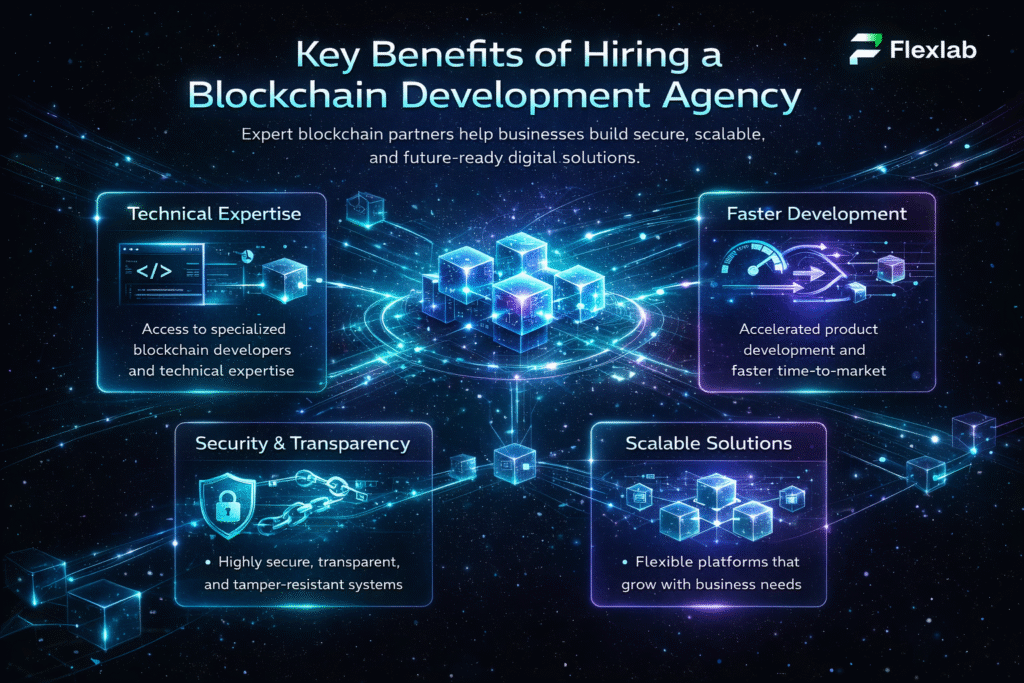
Hiring a blockchain development agency can significantly reduce the complexity of launching and managing Web3 applications and blockchain-based products. However, many businesses still try to build internal teams, which often leads to delays, higher costs, and technical challenges.
According to a Deloitte blockchain survey, nearly 39% of companies struggle to find skilled blockchain professionals, which slows innovation and project delivery. Because of this, organizations increasingly rely on specialized agencies that bring proven experience, secure development practices, and faster deployment cycles. Below are some of the most important benefits businesses gain when working with an experienced blockchain partner.
1. Access to Specialized Expertise
One of the biggest advantages of working with an agency is access to experienced professionals who understand blockchain development from architecture to deployment. Instead of hiring multiple specialists individually, companies gain access to a ready team of engineers, security experts, and solution architects. As a result, projects move faster while maintaining high technical standards.
2. Strong Security and Risk Management
More importantly, security is critical in blockchain systems, especially when smart contracts handle financial transactions or digital assets. Therefore, agencies prioritize blockchain security from the earliest stages of development.
They conduct code reviews, automated testing, vulnerability checks, and a complete blockchain audit before launch. In fact, security audits can reduce contract vulnerabilities by up to 60%, according to multiple blockchain research reports.
3. Faster Project Launch and Validation
Another key benefit is the ability to validate ideas through proof of concept quickly. Instead of spending months building a full system, agencies help businesses test feasibility early. For example, companies can validate user demand, evaluate performance, and refine technical architecture before scaling the solution. Consequently, organizations reduce development risks and save significant time and budget.
4. Seamless Integration With Existing Systems
Meanwhile, modern businesses rarely build blockchain products in isolation. Instead, they often integrate them with payment systems, CRMs, analytics platforms, and internal databases. A professional agency provides flawless blockchain integration services to ensure smooth communication between blockchain networks and traditional infrastructure, enabling businesses to adopt blockchain without disrupting existing operations.
5. Flexible Infrastructure and Cloud Deployment
Many organizations prefer cloud-based solutions because they reduce infrastructure costs and simplify maintenance. Therefore, agencies often implement blockchain-as-a-service, allowing companies to deploy and manage blockchain environments without maintaining complex hardware. This approach provides scalability, faster updates, and simplified network management, making it ideal for growing startups and similar enterprises.
6. Custom Solutions for Business Needs
Every organization has unique goals, whether they involve digital identity, financial transactions, or supply chain transparency. Because of this, agencies design custom blockchain solutions tailored to specific industries and workflows. Ultimately, these tailored systems deliver better efficiency, improved transparency, and a stronger competitive advantage.
Real-World Use Cases Where Blockchain Agencies Deliver Maximum Value
Understanding the benefits is helpful; however, many business leaders still ask a practical question: what are the real use cases of blockchain and where does it create value in the real world?
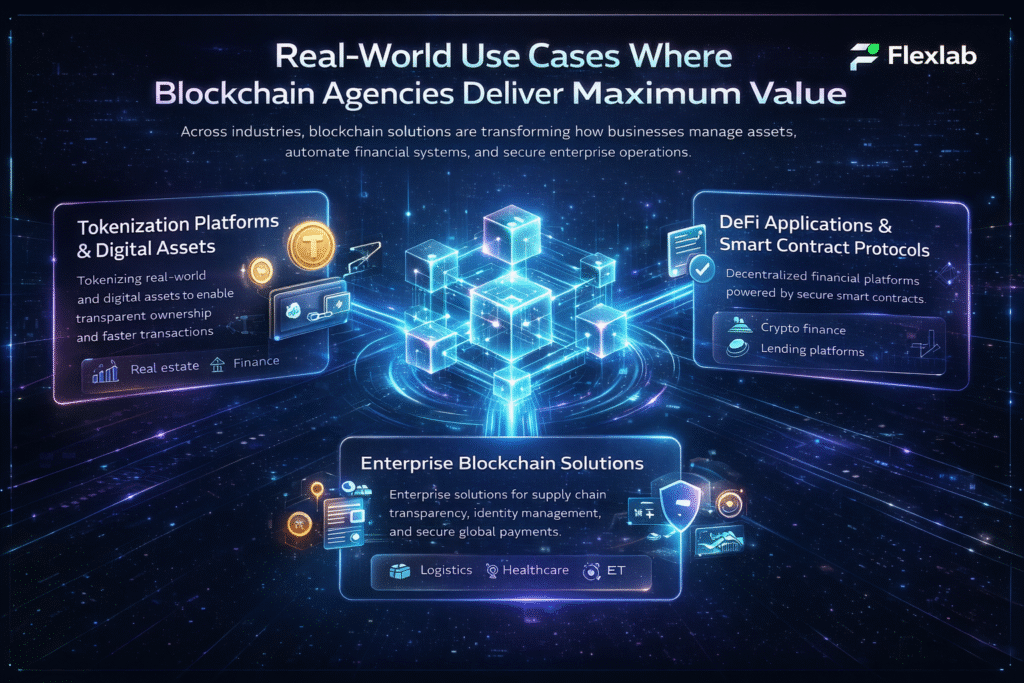
Across industries, organizations are already using blockchain to improve transparency, automate trust, and build entirely new digital ecosystems. Because of this shift, many companies now collaborate with blockchain development agencies to design solutions that solve real operational problems rather than experimental ones. Below are several areas where these agencies consistently deliver measurable impact.
-
Tokenization Platforms and Digital Assets
Tokenization is transforming how businesses represent and transfer value. Instead of relying on traditional ownership systems, companies can convert physical or digital assets into blockchain-based tokens. As a result, transactions become faster, transparent, and easier to verify. For example, real estate firms are exploring tokenized property ownership, while financial institutions are experimenting with tokenized investment products. A blockchain development company helps organizations build the underlying platforms that securely manage these digital assets.
In addition, these platforms often include smart contract automation, wallet integration, and compliance features. Because of this infrastructure, businesses can manage digital assets more efficiently and with greater trust.
-
DeFi Applications and Smart Contract Protocols
Decentralized finance (DeFi) is another area where blockchain for financial services is transforming traditional financial infrastructure. Instead of relying on traditional financial intermediaries, DeFi platforms use smart contracts to automate lending, trading, and asset management.
However, building these systems requires strong technical knowledge and careful security practices. For that reason, companies frequently work with a blockchain application development company when launching DeFi platforms or decentralized protocols.
With the right architecture in place, organizations can create financial ecosystems that operate continuously, process transactions transparently, and reduce operational friction.
-
Enterprise Blockchain Solutions for Supply Chain, Identity, and Payments
Beyond crypto and finance, blockchain is also gaining traction in enterprise sectors such as supply chains, identity systems, and blockchain for healthcare. Many organizations are implementing distributed ledger systems, including private blockchain, to improve supply chain visibility, digital identity verification, and cross-border payment processes.
For instance, supply chain platforms can track products from manufacturing to delivery, ensuring authenticity and reducing fraud. Similarly, blockchain-based identity systems allow individuals and businesses to verify credentials without relying on centralized databases.
To implement these solutions successfully, companies often collaborate with experienced blockchain software development services providers who understand enterprise integration requirements. As a result, businesses can modernize critical systems while maintaining security and scalability.
Blockchain Agency vs In-House Team vs Freelancers
After exploring real-world use cases, many businesses face another important decision: who should actually build the solution? Some organizations hire internal developers, while others rely on freelancers for short-term projects. However, many companies now prefer working with a blockchain development firm because it combines expertise, structured processes, and long-term support. To better understand the differences, let’s compare these three approaches.
Development Speed and Technical Expertise
Building blockchain platforms requires specialized skills, including smart contract development, security auditing, and distributed architecture design. Because of this complexity, development speed often depends on the team’s experience.
However, freelancers can sometimes start quickly, but their expertise can vary by individual developer. Similarly, in-house teams need time to hire, onboard, and train before they can deliver complex blockchain projects. By contrast, a blockchain development firm typically includes multiple specialists working together. As a result, projects move faster while maintaining strong technical quality.
Security and Smart Contract Reliability
More importantly, security is one of the most critical aspects of blockchain systems. A single vulnerability in a smart contract can expose financial assets or sensitive data. Freelancers may not always follow formal auditing practices, especially on smaller projects. Likewise, internal teams might lack deep experience with blockchain security frameworks.
Professional agencies, on the other hand, usually follow structured testing processes. In addition, they perform smart contract audits and security reviews before deployment. As a result, businesses gain greater confidence in the reliability of their blockchain solutions.
Cost Efficiency and Long-Term Scalability
At first glance, freelancers may seem to be the most affordable option. However, projects often require multiple skill sets such as blockchain architecture, backend integration, and security testing. When several freelancers are involved, coordination becomes challenging. Building an internal team can also be expensive due to salaries, training, and infrastructure costs. Furthermore, scaling the team for larger projects may take significant time.
Therefore, working with a specialized agency often provides a more balanced approach. Businesses can access a full team of experts while maintaining predictable project costs. As a result, organizations can scale development more efficiently without managing a large internal department.
Blockchain Development Partner Comparison at a Glance
| Factor | Blockchain Agency | In-House Team | Freelancers |
| Speed to Market | Fast | Slow | Medium |
| Expertise | Multi-specialist team | Limited to hires | Variable |
| Security Practices | Mature processes | Depends on the team | Often inconsistent |
| Cost Structure | Project-based | High fixed cost | Hourly |
| Scalability | Easy to scale | Difficult | Limited |
| Post-Launch Support | Long-term support available | Internal maintenance | Rare |
This comparison shows why many businesses ultimately choose experienced partners when building blockchain platforms. By combining technical expertise, structured processes, and long-term support, agencies often deliver more reliable results than fragmented development approaches.
Future Trends Shaping Blockchain Development in 2026 and Beyond
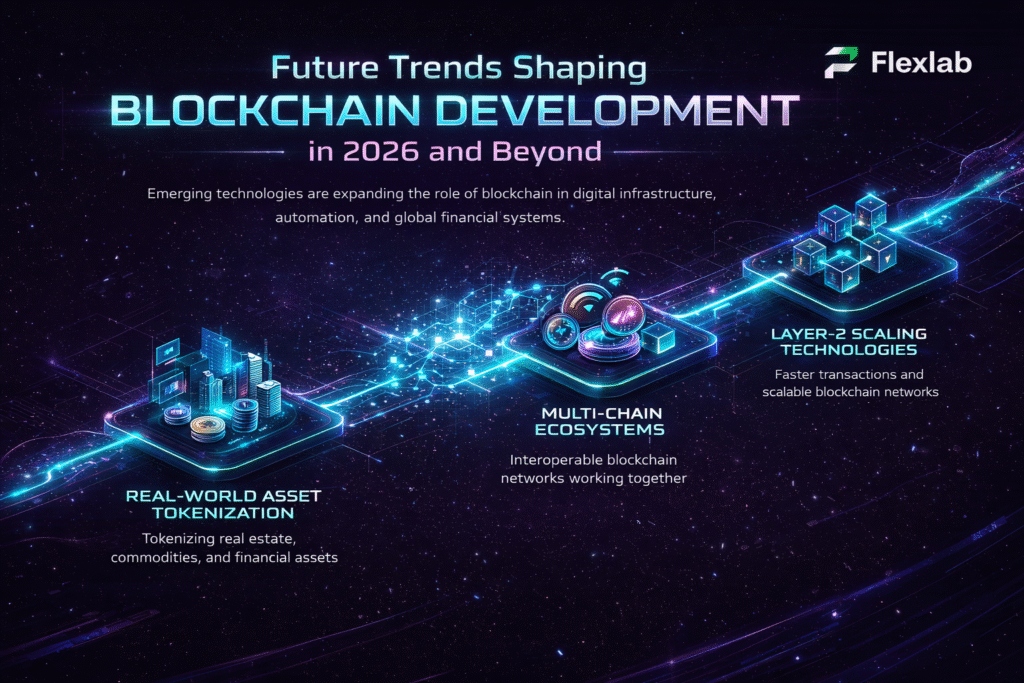
Blockchain technology continues to evolve beyond its early association with cryptocurrencies. Today, many organizations are exploring how distributed systems can support secure digital infrastructure, transparent transactions, and automated processes, highlighting the growing importance of blockchain in modern enterprise technology. Because of this shift, businesses are increasingly working with providers offering blockchain development services to build platforms that can adapt to future technological demands.
One major trend is the growing interest in tokenizing real-world assets, including real estate, financial instruments, and digital collectibles. At the same time, companies are adopting multi-chain ecosystems and Layer-2 scaling solutions to improve scalability and transaction efficiency. In addition, the integration of artificial intelligence with blockchain is opening new possibilities for automated decision-making and smarter data management.
As these innovations continue to mature, blockchain is expected to play a much larger role in enterprise technology. Therefore, organizations that begin exploring these capabilities today will be better positioned to build secure, scalable, and future-ready digital systems.
How to Choose the Right Blockchain Development Agency
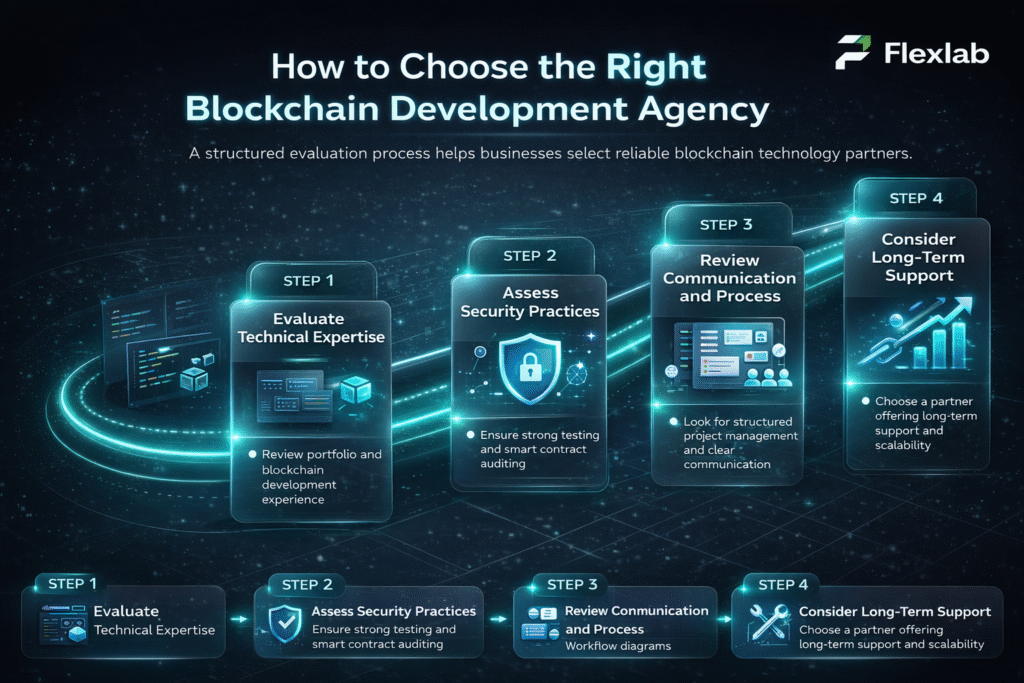
Selecting the right partner for a blockchain project requires careful evaluation. Since blockchain platforms often manage sensitive data and financial transactions, businesses should focus on expertise, security practices, and long-term support before making a decision. The following steps can help organizations choose a reliable development partner.
Step 1: Evaluate Technical Expertise and Experience
First, review the agency’s portfolio and past blockchain projects. An experienced team should demonstrate strong knowledge of smart contracts, decentralized architecture, and enterprise integration. Working with a proven blockchain development solutions provider often ensures that the platform is built using reliable frameworks and best practices.
Step 2: Assess Security and Development Practices
Next, examine the agency’s approach to security. Blockchain systems require careful testing, smart contract auditing, and secure coding standards. Agencies that follow structured development processes and transparent testing procedures can significantly reduce technical risks.
Step 3: Review Communication and Project Management
Clear communication is essential for complex technology projects. Therefore, businesses should ensure the agency provides regular updates, structured development timelines, and collaborative project management tools.
Step 4: Consider Scalability and Long-Term Support
Finally, think beyond the initial launch. Companies continuously evolve blockchain platforms as their needs grow. Choosing a partner that offers ongoing maintenance, updates, and technical support can help ensure the platform remains reliable in the long run.
Launch Powerful Blockchain Development Services with Flexlab
Building a successful blockchain platform requires deep technical expertise, strategic architecture, and flawless execution. At Flexlab, ambitious businesses gain access to powerful blockchain development services engineered for security, scalability, and high-performance digital ecosystems. From advanced smart contract systems to enterprise-grade blockchain platforms, the Flexlab team transforms bold concepts into production-ready decentralized solutions built for long-term growth.
Ready to Hire a Blockchain Development Agency?
📞 Book a FREE Consultation Call: +1 (416) 477-9616
📧 Email Us: info@flexlab.io
Speak directly with blockchain specialists at Flexlab and receive expert insights, technical guidance, and strategic recommendations for your project.
Explore and discover the full range of Services, and read expert insights on the Blog. Many innovators and technology leaders also stay connected with the latest blockchain advancements through LinkedIn.
When you’re ready to move from idea to execution, start the conversation and Contact us to build a secure, scalable, and future-ready blockchain platform with Flexlab.
Read more:
- Why AI and Blockchain are the Pillars of the Next Internet?
- Public vs Private Blockchain: Which is Better for Your Business?
- How Does Blockchain for Startups Improve Transparency and Trust?
Key Insights on Blockchain Development Services
Blockchain is rapidly evolving from an emerging concept into a practical foundation for modern digital systems. As businesses seek stronger security, transparency, and automation, the demand for reliable blockchain development services continues to grow. Throughout this guide, we explored how specialized agencies accelerate development, strengthen security practices, and deliver scalable blockchain solutions across multiple industries.
At the same time, successful adoption requires more than just understanding the technology. Organizations must evaluate expertise, long-term scalability, and strategic implementation before launching blockchain initiatives. Therefore, businesses that invest in the right development approach today are more likely to build secure, efficient, and future-ready digital platforms.
Ultimately, blockchain is reshaping how digital ecosystems operate, and companies that act early gain a meaningful competitive advantage. With the right strategy and experienced development support, organizations can unlock new opportunities, streamline operations, and move confidently toward the next generation of decentralized innovation.
Is hiring a blockchain development agency better than building an in-house team?
For many businesses, hiring a blockchain development agency is often more practical than building an in-house team. Blockchain projects require specialized skills such as smart contract development, security auditing, and decentralized architecture design. Building a full internal team with this expertise can take time and significant investment. Therefore, companies frequently choose agencies to access experienced professionals and accelerate project development.
What is the average cost of blockchain development for businesses?
The cost of blockchain development can vary widely depending on the complexity of the project. A small proof-of-concept may cost a few thousand dollars, while a full enterprise blockchain platform can require a much larger investment. Factors such as network selection, smart contract complexity, security audits, and integrations also influence pricing. Careful planning and a clear project scope help businesses estimate development costs more accurately.
Do businesses need blockchain developers for every blockchain project?
Not every project requires a large blockchain development team, but specialized expertise is usually necessary for building secure and reliable solutions. Blockchain systems involve distributed networks, cryptographic security, and smart contracts, which require technical knowledge beyond traditional software development. Experienced developers ensure that the system functions correctly and remains secure. As a result, businesses often rely on professional developers to implement blockchain platforms effectively.